


TL;DR
Spain does not offer online marriages, but couples in or connected to Spain can marry online through Utah and seek recognition of that U.S. marriage certificate in Spain. Spanish law generally recognizes foreign marriages under the principle of lex loci celebrationis (Article 49, Civil Code). After the ceremony, couples typically need an apostille, a sworn translation, and registration at the Registro Civil or a Spanish consulate. A June 2025 ruling clarified that this registration is declarative, not constitutive, meaning it is not the only way to prove a marriage for immigration purposes.
Couples looking to marry online while living in Spain may be able to use a legally authorized foreign marriage process, such as Utah's remote marriage procedure. However, completing an online ceremony and having that marriage accepted for a specific purpose in Spain are two separate questions.
Spain does not provide a general domestic marriage procedure in which couples simply marry by video call. A Utah marriage may offer an alternative for eligible couples, but its recognition depends on the applicable Spanish legal rules, the circumstances of the marriage, and the requirements of the authority reviewing the documents.
This guide explains how online marriage works for couples connected to Spain, what a Utah marriage certificate and apostille do, how sworn translations and civil registration fit into the process, and what to verify before relying on a foreign marriage for residency, nationality, or other legal purposes.
This glossary covers every term that matters, organized by category, with Spain-specific context for each one.
Can You Get Married Online in Spain?
Spain does not offer a general domestic marriage procedure that allows couples to marry entirely by video call. Eligible couples may be able to marry remotely through Utah County in the United States and then seek to use that marriage in Spain. The process may involve obtaining an official marriage certificate, securing an apostille, arranging a Spanish sworn translation, and applying to the relevant Spanish authority. Recognition is not automatic: requirements can differ depending on the couple's circumstances and whether the marriage is being used for civil registration, immigration, or Spanish nationality.
Get started with an online marriage through Courtly’s guided process, which handles the Utah County marriage license, officiant, and optional witnesses.
How to Get Married Online for Use in Spain: Step-by-Step
Couples considering an online marriage for use in Spain should separate the marriage process from the later document-recognition process. Completing a ceremony does not automatically complete Spanish registration or establish eligibility for immigration benefits.
Step 1: Confirm That an Online Marriage Fits Your Situation
Before applying, identify the purpose of the marriage. You may want to establish marital status, apply for residence as a family member, register a foreign marriage in Spain, or qualify for a nationality-related procedure.
These goals can involve different requirements. If your plans depend on Spanish residency or nationality, ask the relevant Spanish authority or a qualified Spanish lawyer whether a remote Utah marriage will be accepted for your specific purpose.
Step 2: Complete the Utah Marriage Application
If you choose the Utah route, review the current eligibility requirements and application instructions from Utah County. Confirm the identification documents required, the validity period of the marriage license, and the arrangements for the remote ceremony and witnesses.
Do not assume that using an online service removes the need to satisfy the county's legal requirements.
Step 3: Attend the Remote Ceremony

The ceremony takes place by live video with an authorized officiant in Utah. Utah County's remote-appearance rules require the officiant, couple, and witnesses to be able to see and hear one another during the ceremony.
Utah also requires a warning before remote ceremonies explaining that the marriage may be invalid in the country where the parties reside. This warning does not, by itself, determine whether Spain will accept the marriage.
Step 4: Obtain the Official Marriage Certificate
After the ceremony has been completed and recorded, obtain the official marriage certificate issued by the relevant county authority. Check that both names, dates, and other identifying details are accurate before proceeding.
A marriage license authorizes the marriage process; the completed marriage certificate provides evidence that the marriage took place.
Step 5: Confirm the Apostille and Translation Requirements
Ask the Spanish authority that will receive your documents which form of certificate it accepts and whether it requires an apostille and a sworn Spanish translation.
Where required, obtain the apostille through the competent U.S. authority. Arrange a translation that meets the receiving Spanish authority's requirements. Do not assume that a document accepted by one consulate will automatically be accepted by every Spanish civil registry or immigration office.
Step 6: Determine Whether You Need Spanish Civil Registration
Contact the appropriate Registro Civil or Spanish consulate to establish whether you should apply to register the marriage and which documents and forms are required.
If you are applying for immigration benefits, confirm separately whether the authority handling your case can accept the foreign marriage certificate without prior Spanish registration. Do not treat the possibility of using a foreign certificate as a universal exemption from registration.
Step 7: Keep Copies and Follow Up
Retain copies of the marriage certificate, apostille, sworn translation, application forms, and any correspondence with Spanish authorities. Keep proof of submission and respond promptly if the authority requests additional evidence.
If you have a nationality application, residence deadline, or other time-sensitive legal matter, seek advice before relying on estimated processing times or submitting an incomplete application.
Online Marriage Spain: Document Checklist
Before submitting a Utah marriage certificate for use in Spain, check whether you need the following documents:
Official U.S. marriage certificate issued by the competent authority.
Hague Apostille, if required by the receiving Spanish authority.
Spanish sworn translation (traducción jurada), if required.
Valid identification documents for both spouses.
Completed Hoja Declaratoria de Datos or other application form, where applicable.
Proof of residence or domicile, if requested.
Additional civil-status documents or evidence requested by the relevant Registro Civil, consulate, or immigration authority.
Important: This is a preparation checklist, not a universal list of mandatory documents. Requirements depend on the procedure, the applicants' circumstances, and the authority receiving the application. Confirm the current checklist directly with that office before paying for translations or submitting original documents.
What Do You Need the Marriage for in Spain?
The correct process depends on what you want to accomplish. A foreign marriage certificate, Spanish civil registration, and eligibility for an immigration or nationality benefit are separate issues.
Your goal | What to verify | Important consideration |
|---|---|---|
Prove that you are married | Whether the receiving institution accepts your foreign marriage certificate | Apostille and translation requirements may apply |
Register your marriage in Spain | The competent Registro Civil or Spanish consulate and its document checklist | The process may require additional civil-status documents |
Apply for residence as a family member | The evidence accepted by the immigration authority handling your application | Confirm whether prior Spanish registration is required in your circumstances |
Apply for Spanish nationality through marriage | The applicable nationality requirements and marriage-registration rules | Do not assume that a foreign certificate alone qualifies you for a reduced residence period |
Update records with a bank or public authority | The institution's accepted proof of marital status | Requirements can differ between institutions |
Before proceeding: Identify the exact benefit or administrative outcome you need, then confirm its requirements with the relevant authority. Recognition of a marriage does not automatically establish eligibility for a particular residence permit, nationality benefit, or administrative procedure.
Core Legal Terms
Online Marriage
A legally binding marriage ceremony conducted remotely via live video, where neither spouse needs to be physically present at the ceremony location. The United States is currently the only country that has fully legalized this format. While states like Arizona, California, Florida, and Texas allow some form of online officiation, Utah is the only one where both parties can appear entirely remotely from separate locations.
Spain context: Spain has no equivalent process. Couples connected to Spain use the Utah route to obtain a U.S. marriage certificate, then work through the apostille, translation, and registration steps to use it in Spain.
Eligibility is straightforward: both parties must be 18 or older, not currently married, and not divorced in the last 60 days. No U.S. citizenship is required. All you need is a computer, a webcam, and a stable internet connection. For a deeper explanation of what this process involves, see how online marriage works.
Remote Solemnization / Remote Appearance
The legal mechanism Utah uses to make online marriages possible. Utah County permits remote marriage ceremonies when the officiant is physically located in Utah, while the couple and witnesses participate by video from anywhere.
Practical detail most guides skip: The marriage certificates issued by Utah County are identical whether the wedding was performed in person or online. There is no special notation, stamp, or flag distinguishing the two. This matters for couples worried about how a Spanish consulate or Registro Civil will view their certificate. Learn more about what the certificate looks like.
Lex Loci Celebrationis
A Latin legal principle meaning “the law of the place of the ceremony.” It holds that a marriage is valid if it was performed lawfully under the laws of the jurisdiction where it took place.
Why this is the most important term in this entire glossary: Article 49 of the Spanish Civil Code recognizes marriages celebrated abroad, provided they were entered into in accordance with the law of the place of celebration or they comply with the personal law of either spouse. This is the legal backbone for Spain’s recognition of Utah online marriages. Because the marriage was celebrated in the United States (legally, in Utah), and because it complied with Utah law, Spain should recognize it.
The word “should” matters here. A 2025 paper in the European Journal of Law and Technology directly addresses a complication: when a marriage is conducted via videoconference, is the “place of celebration” the state where the officiant sits, or the states from which the parties give consent remotely? This question is unresolved in European legal scholarship, and it explains why some Spanish registrars have pushed back on online marriage certificates. The dominant interpretation in practice, however, treats the officiant’s location (Utah) as the place of celebration.
Article 49, Spanish Civil Code
The specific statutory provision that applies lex loci celebrationis to marriages involving Spanish citizens or residents. It allows Spanish nationals to marry abroad in any form recognized by the law of the place of celebration. Combined with Article 50 (which covers marriages between foreigners with Spanish residency), it forms the legal basis for recognizing a Utah online marriage in Spain.
SB 257: Utah’s 2026 Verbal Warning Requirement
Signed into law on March 18, 2026, and effective May 6, 2026, SB 257 requires Utah officiants to verbally warn couples during remote ceremonies that their online marriage “may be invalid in the country where the parties to the marriage reside.”
This is a disclosure requirement, not a restriction. It does not prohibit online marriages, does not change who is eligible, and does not invalidate any ceremony. It simply acknowledges the international recognition uncertainty that couples face.
Spain context: If you marry online after May 2026, your officiant will read this warning aloud. It’s not a red flag. It’s Utah’s legislature acknowledging what this glossary exists to help you navigate. Practitioners on Reddit’s r/GoingToSpain have discussed this uncertainty for years, long before SB 257 formalized it, with many reporting successful registration of their online marriages despite initial anxiety about the process.
For the broader question of legality, see is online marriage legal.
Document and Certification Terms
U.S. Marriage Certificate
The official document issued by Utah County after the online ceremony. Courtly provides a digital copy within 12 hours of the ceremony and mails a physical copy within the next few business days, including to international addresses.
This is different from a marriage license. The license is the government’s permission to marry. The certificate is proof that the marriage took place. Many people confuse the two, which causes problems when gathering documents for Spanish registration. The license vs. certificate distinction is worth understanding before you start.
Apostille (Hague Apostille)
An international certification, comparable to a notarization, that authenticates a public document for use in another country. Under the Hague Apostille Convention, which Spain has been bound by since September 25, 1978, an apostille issued by the country of origin is sufficient. No further certification by the destination country is needed.
Spain context: Spain commonly requires foreign public documents to be apostilled before they can be used in official procedures. Your Utah marriage certificate will need an apostille from the U.S. state where it was issued.
A nuance that almost nobody covers: The Consulate General of Spain in Miami has stated that American marriage certificates submitted to Spanish consulates in the U.S. require neither apostille nor translation. However, this exception applies specifically to Spanish consulates on U.S. soil. If you are submitting documents to a Registro Civil office inside Spain, you will generally need both the apostille and a sworn translation.
Courtly offers apostille services as an add-on, with processing typically taking 15 to 30 business days after the ceremony. For more complex legalization needs, the document legalization page covers apostille and embassy authentication pathways.
Traductor Jurado (Sworn Translator)
Spain requires all foreign public documents to be submitted in Spanish. You cannot translate the certificate yourself, and a standard translation service won’t work. You must hire a Traductor Jurado, an official sworn translator recognized by the Spanish Ministry of Foreign Affairs. They attach their official stamp and signature to the translation, making it legally binding.
Practical tip: Find your sworn translator before your apostille arrives. The official list is maintained by Spain’s Ministry of Foreign Affairs (Ministerio de Asuntos Exteriores). Sworn translators are available throughout Spain and can often work remotely. Expect to pay between 30 and 80 euros for a single-document translation, depending on length and urgency.
Spanish Registration Terms
Registro Civil (Civil Registry)
The civil registry system where births, marriages, deaths, and other civil status changes are officially recorded in Spain. To have your online marriage formally recognized in Spain’s records, you submit your apostilled and translated marriage certificate to the Registro Civil.
Which office you use depends on where you live:
If one or both spouses reside in Spain, submit to the Registro Civil where the Spanish-resident spouse lives.
If neither spouse resides in Spain, submit through the corresponding Spanish Consulate abroad.
Registro Civil Central (Madrid)
The central civil registry office in Madrid, which handles cases that don’t fit neatly into a local office’s jurisdiction. Processing times here are notoriously long. Community members on Reddit’s r/GoingToSpain frequently report frustration with the timeline, and the numbers bear it out: estimated processing through the Registro Civil Central inside Spain runs 12 to 24 months or longer.
By contrast, processing through a Spanish consulate abroad is estimated at 2 to 6 months. This timeline difference alone may influence where and how you file.
Hoja Declaratoria de Datos
The marriage declaration form that couples fill out when registering a foreign marriage in Spain. You attach your apostilled and translated documents and submit the complete package to the consular civil registry or local Registro Civil. The form itself is straightforward, but make sure every name, date, and detail matches your marriage certificate exactly. Discrepancies between the form and the certificate are one of the most common reasons for delays.
Certificado de Matrimonio
The official Spanish marriage certificate issued by the Registro Civil after your foreign marriage is successfully registered. This document is what Spanish banks, government agencies, and other institutions will accept as proof of marriage. It is functionally the Spanish version of your U.S. marriage certificate.
Audiencia Reservada (Marriage of Convenience Interview)
Because visa fraud is a significant issue in the European Union, Spanish civil registries frequently conduct an Audiencia Reservada (a reserved hearing or private interview) before approving a foreign marriage registration. This is especially common when one spouse is a non-EU national.
What to expect: The registrar may interview each spouse separately, asking questions about the relationship, how you met, daily life details, and plans for the future. This is not adversarial, but it is serious. Couples who are genuinely married and can speak naturally about their relationship have nothing to worry about. Couples who are not prepared, or who give inconsistent answers, may see their registration delayed or denied.
No competitor guide aimed at online marriage Spain couples mentions this step. It is a real friction point, and knowing about it in advance makes a meaningful difference.
Declarative vs. Constitutive Registration (June 2025 DGGM Ruling)
This is the single most important recent development for couples pursuing online marriage for use in Spain.
According to criteria issued by Spain’s Dirección General de Seguridad Jurídica y Fe Pública (DGGM) on June 30, 2025, the registration of a marriage in the Spanish Civil Registry is declarative, not constitutive. In plain terms: registration is one way to prove your marriage exists, but it is not the only way, and it is not mandatory for many official purposes.
What this means practically: For immigration procedures, such as applying for a residence permit as a family member of an EU citizen, a foreign marriage certificate (properly apostilled and translated) may be sufficient proof of the marital bond even without Registro Civil registration. This is a significant change in how the system works on the ground.
The exception: The Sub-Directorate General for Nationality and Civil Status still requires that the marriage be registered in the Spanish Civil Registry to benefit from the reduced one-year residency period when applying for Spanish nationality based on marriage to a Spanish citizen. So if your goal is Spanish citizenship through marriage, you still need the full registration.
For couples focused on immigration and recognition questions, Courtly publishes guidance on online marriage recognition across more than 150 countries.
Marriage Types and Status Terms Relevant to Spain
Civil Marriage (Matrimonio Civil)
The standard secular marriage performed by a judge or authorized official in Spain. This is the most common form of marriage in Spain and the closest domestic equivalent to what an online marriage provides: a legal union without religious ceremony. When your online marriage is registered in the Registro Civil, it is treated functionally the same as a Spanish civil marriage.
Same-Sex Marriage in Spain
Same-sex marriage has been legal in Spain since July 3, 2005, making Spain the third country in the world to recognize it. Spanish law identifies homosexual and heterosexual marriage identically, with no legal distinction.
This means same-sex couples who marry online via Utah face no additional barriers in Spain based on gender. Both Spain and Utah (since 2014) recognize same-sex marriage fully. For same-sex couples exploring this route, Courtly offers a dedicated guide.
Pareja de Hecho (Registered Partnership)
An alternative civil status available in some Spanish autonomous communities, recognized for both same-sex and opposite-sex couples. A Pareja de Hecho is not a marriage. It confers some but not all of the legal rights of marriage, and the specific rights vary by region.
Some couples already in a Pareja de Hecho relationship search for online marriage as a way to upgrade to full marriage status, which carries broader legal recognition both within Spain and internationally.
Immigration and Administrative Terms
Extranjería (Foreigners’ Office)
The immigration office in Spain where non-EU nationals apply for residence permits, work authorizations, and other immigration documents. If you are using your online marriage to apply for residency in Spain as a family member of a Spanish or EU citizen, Extranjería is where your case will be processed.
The June 2025 DGGM ruling is particularly relevant here: you may not need to wait for full Registro Civil registration before submitting your residence application. An apostilled and translated foreign marriage certificate may be accepted as proof of the marital bond, though individual offices may still request additional documentation.
EU Family Reunification Regime
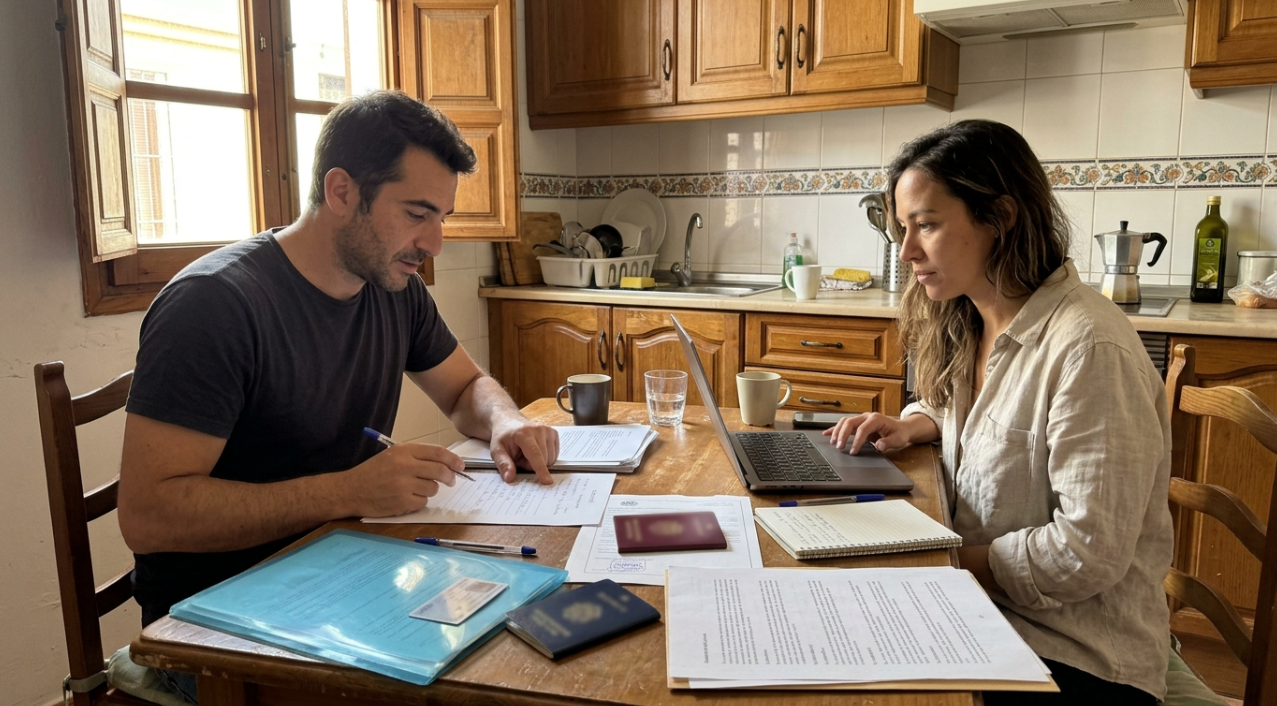
EU law allows the spouse of an EU citizen to apply for a residence card in the EU member state where the citizen resides. For online marriage Spain couples, this means a non-EU spouse can use the U.S. marriage certificate (apostilled and translated) to apply for residency in Spain as a family member.
The process involves submitting the marriage documentation to Extranjería, potentially undergoing an Audiencia Reservada, and receiving a tarjeta de familiar de ciudadano de la UE (EU family member card). Processing times vary significantly by province.
CR-1 / IR-1 Visa (U.S. Spouse Visa)
Some couples connected to Spain also have U.S. immigration goals. The CR-1 (Conditional Resident) and IR-1 (Immediate Relative) are U.S. spouse visas available to the foreign spouse of a U.S. citizen. An online Utah marriage is accepted by USCIS for these petitions.
Important caveat: U.S. immigration authorities generally expect evidence that the couple has met in person, either before or after the online ceremony. This is sometimes referred to as “consummation” in immigration contexts, though the legal meaning is simply that the relationship is genuine and has been physically established.
For couples navigating this intersection of Spanish life and U.S. immigration, Courtly provides resources on online marriage for immigration.
Consummation
In U.S. immigration contexts, this refers to evidence that the couple has met in person after (or before) the online marriage. USCIS and the State Department recognize online Utah marriages, but they may scrutinize whether the relationship has a genuine, in-person component.
Spain does not explicitly require consummation for foreign marriage recognition. However, the Audiencia Reservada process at the Registro Civil may cover similar ground by asking about the couple’s shared life and relationship history.
Online Marriage Spain: Quick-Reference Glossary
Term | Plain-English definition | Why it matters in Spain | What to check |
|---|---|---|---|
Online marriage | Marriage conducted remotely through live video | Spain does not offer a general domestic video-call marriage procedure | Whether the foreign ceremony is legally valid and acceptable for your purpose |
Lex loci celebrationis | Law of the place of celebration | Relevant to the legal form of a foreign marriage | Applicable law and the circumstances of the remote ceremony |
Article 49 | Provision of the Spanish Civil Code concerning marriage abroad by Spanish nationals | Helps explain the legal framework for foreign marriages | Whether the provision applies to your circumstances |
Marriage certificate | Official record that a marriage took place | Evidence of marital status | Required certificate format and issuing authority |
Apostille | Certification authenticating the origin of a public document | May be required to use the certificate in Spain | Whether the receiving authority requires it |
Traductor jurado | Officially recognized sworn translator | Provides an official translation when required | Accepted language and translation format |
Registro Civil | Spanish civil registry | Handles applicable marriage-registration procedures | Competent office, forms, and supporting documents |
Hoja Declaratoria de Datos | Marriage-registration data form | May form part of the registration application | Current form and signature requirements |
Audiencia reservada | Private interview that may be used in a marriage-related administrative review | May arise in certain registration procedures | Whether an interview is required in your case |
Extranjería | Spain's immigration administration | Handles relevant immigration procedures | Which evidence of the marital relationship is accepted |
Certificado de Matrimonio | Spanish marriage certificate or certificate of registration, depending on context | May be issued after Spanish registration | Exact certificate needed for your intended procedure |
Pareja de Hecho | Registered partnership rather than marriage | Rights and rules vary by autonomous community | Whether partnership status meets your legal objective |
Utah SB 257 | Utah legislation associated with the remote-marriage warning requirement | Highlights cross-border recognition uncertainty | Current Utah County ceremony requirements |
Important: The glossary explains common terminology. It does not replace the document checklist or legal requirements of the particular Spanish authority handling your case.
Frequently Asked Questions About Online Marriage in Spain
Can you get married online in Spain?
Spain does not offer a general domestic marriage procedure that allows couples to marry entirely by video call. Eligible couples may be able to use Utah County's remote marriage process in the United States. Whether the resulting marriage can be used for a particular purpose in Spain depends on the applicable legal rules and the requirements of the authority handling the case.
Is an online Utah marriage legally recognized in Spain?
Recognition should not be assumed automatically. The marriage must satisfy the relevant legal requirements, and the Spanish authority reviewing it may consider the circumstances of the ceremony, the applicable law, and the purpose for which the marriage is being used. Seek case-specific advice if recognition is essential to your immigration or nationality plans.
Do I need an apostille for my Utah marriage certificate?
It depends on the procedure and the authority receiving the certificate. Some Spanish consulates publish exceptions for particular U.S. marriage certificates, while other procedures may require an apostille. Check the current instructions of your specific Registro Civil, consulate, or immigration authority before ordering certification.
Do I need a sworn Spanish translation?
A sworn Spanish translation may be required when the certificate is submitted to a Spanish authority. Requirements vary by procedure and office, including whether a particular document in English can be accepted without translation. Confirm the current rules before arranging a translation.
Do I have to register my foreign marriage in the Spanish Civil Registry?
The answer depends on your legal circumstances and what you want to accomplish. Civil registration, proof of an existing foreign marriage, immigration eligibility, and nationality requirements are distinct issues. Confirm whether registration is required for your particular procedure rather than assuming it is always necessary or always optional.
How long does Spanish marriage registration take?
Processing times vary by office, workload, and the complexity of the application. A single estimate cannot reliably predict every case. Consult the relevant civil registry or consulate for current guidance and allow additional time if your marriage documentation is needed for an immigration or nationality application.
Does a Utah marriage certificate reveal that the wedding took place online?
Do not rely on the certificate's appearance alone to establish how a Spanish authority will assess the marriage. Obtain the official certificate and ask the receiving authority what supporting documents it requires. The legal circumstances of a remote ceremony can matter even if a certificate does not prominently describe the ceremony as online.
Can same-sex couples use Utah's online marriage process for Spain?
Same-sex marriage is legal in Spain. Couples considering a remote Utah marriage should verify the general requirements for the ceremony and the specific Spanish procedure they intend to use. Do not assume that the outcome of a cross-border recognition review is guaranteed solely because same-sex marriage is legal in both jurisdictions.
What is an audiencia reservada?
An audiencia reservada is a private interview that may form part of certain marriage-related civil registration procedures. The authority may ask questions to assess the circumstances of the relationship and whether the legal requirements are met. Whether an interview is required depends on the case and the applicable procedure.
Can I use an online marriage for Spanish residency or nationality?
Possibly, but the answer depends on the relevant immigration or nationality rules, the validity and acceptance of the marriage, and the evidence required by the competent authority. A marriage certificate alone does not automatically establish eligibility for a residence permit or Spanish nationality. Obtain advice specific to the application you intend to make.
Ready to start the process? See how Courtly works and explore plans starting at $199 for a fully legal U.S. marriage ceremony you can complete from Spain or anywhere else in the world.
Let us handle the paperwork.
Getting married is complicated. Courtly simplifies the process and provides everything necessary to get married online, including providing a licensed officiant who can perform a remote ceremony.
Get Married

Get married online.
Getting married is complicated. Courtly simplifies the process and provides everything necessary to get married online.

