

Remote marriage and proxy marriage are different things. In a remote marriage, both spouses personally attend the ceremony through live video. In a proxy marriage, a stand-in represents one or both absent spouses. For U.S. immigration, what matters most is whether the couple was physically together during the ceremony. If they were apart, USCIS typically requires proof of post-ceremony consummation before recognizing the marriage.
People use “remote marriage,” “proxy marriage,” “online marriage,” “virtual marriage,” and “Zoom wedding” as if they all mean the same thing. They don’t. The difference between remote marriage and proxy marriage comes down to one question: did the couple personally participate, or did someone else stand in for them?
That distinction shapes everything, from whether the marriage is valid under state law to whether U.S. immigration will recognize it, to whether a foreign government will accept the certificate. Getting the terminology wrong can lead to denied petitions, wasted money, and months of delay.
This guide breaks down each term in plain language, explains how they differ in practice and under the law, and covers what couples need to know about immigration treatment, foreign recognition, and documentation.
Compare Courtly’s packages to see how a remote U.S. wedding works end to end.
Direct Answer: Remote Marriage vs Proxy Marriage
The biggest difference between a remote marriage and a proxy marriage is who personally participates in the ceremony.
- In a remote marriage, both spouses personally attend the ceremony through live video and speak for themselves.
- In a proxy marriage, another person legally stands in for one or both spouses.
- For U.S. immigration, USCIS focuses less on the ceremony label and more on whether the spouses were physically together during the wedding. If they were apart, USCIS generally requires proof that the marriage was consummated after the ceremony before recognizing the marriage under INA §101(a)(35).
If you're trying to decide between the two, the safest question is not "Is this online?" but "Were both spouses physically together during the ceremony?"
Quick Definitions
Remote Marriage
A remote marriage is a wedding ceremony where the couple, officiant, witnesses, or other participants are not all in the same physical room. Instead, they participate through live communication technology, typically video conferencing. The defining feature is that the spouses personally attend and speak for themselves. Nobody substitutes for them.
In Utah County’s remote appearance model, the officiant must be physically located in Utah, while the couple and at least two witnesses join by live video. Everyone must be able to see and hear each other in real time.
Proxy Marriage
A proxy marriage is a ceremony where a third party (the proxy) stands in for one or both absent spouses. The proxy acts with legal authority to represent the absent person during the ceremony. The absent spouse is not personally present, either physically or by video.
Proxy marriage is uncommon in the United States. According to a Super Lawyers state-law overview, most states do not allow it, and only a handful authorize it in limited circumstances. Montana is commonly identified as the only state permitting double proxy marriage, where both spouses are absent, for certain qualifying individuals.
Virtual Marriage / Online Marriage
A virtual marriage or online marriage is a type of remote marriage conducted through electronic media such as Zoom, Google Meet, or another video platform. The spouses may be in the same room, in different cities, or in different countries. What makes it “virtual” is the technology, not whether the couple is together or apart.
For a deeper look at how these terms overlap, see this guide on proxy and virtual weddings.
Utah Remote Appearance Marriage
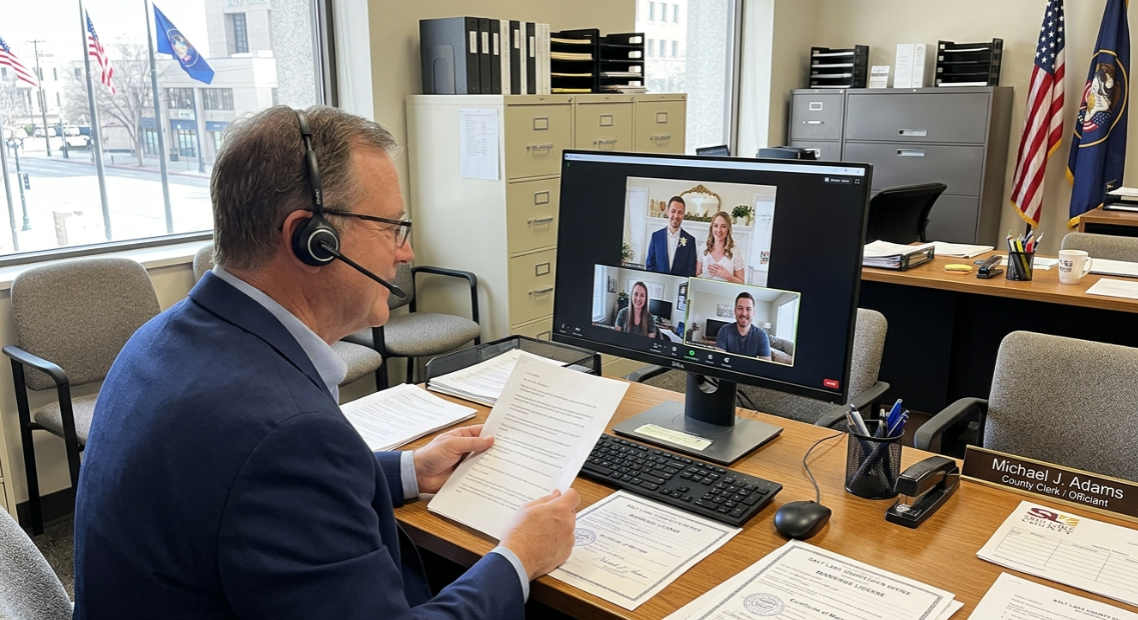
A Utah remote appearance marriage is a legally solemnized Utah wedding where the officiant is physically present in Utah and the couple participates live by video. Utah County treats the officiant’s Utah location as the “host location” for the ceremony. There is no residency or citizenship requirement for Utah marriage licenses, so non-Utah residents and non-U.S. citizens can apply.
Utah marriage licenses have no waiting period, but the ceremony must occur within 32 days after the license is issued. After the officiant finalizes the license, a digital certified copy can be available within minutes.
Remote Marriage vs Proxy Marriage at a Glance
Question | Remote Marriage | Proxy Marriage |
|---|---|---|
Do both spouses participate? | Yes | No |
Is a stand-in used? | No | Yes |
Video required? | Usually | Not necessarily |
Recognized under Utah remote marriage? | Yes | No |
Can USCIS require consummation? | Yes if spouses were apart | Yes |
Common use case | Long-distance couples | Military or limited state exceptions |
Remote Marriage vs. Proxy Marriage: Comparison Table
Remote Marriage | Proxy Marriage | |
|---|---|---|
Who participates? | The couple appears personally by video | A stand-in represents one or both absent spouses |
Stand-in used? | No | Yes, that is the defining feature |
Always online? | Usually, though “remote” can include phone in some jurisdictions | Not necessarily; traditional proxy can be paper-based or in-person with a stand-in |
Utah example | Officiant in Utah, couple and witnesses join by live video | Utah allows virtual weddings, not traditional proxy marriages |
Immigration impact | If spouses were apart, USCIS may require post-ceremony consummation | INA §101(a)(35) requires consummation when spouses were not physically together |
Best shorthand | “We attended our own wedding by video” | “Someone represented an absent spouse” |
Common mistake | Assuming “not proxy” means no immigration complications | Assuming all online weddings are proxy marriages |
Typical use case | Long-distance couples who need a U.S. marriage certificate | Military or exceptional circumstances where a state allows a stand-in |
The bottom line: remote marriage vs. proxy marriage is about personal participation versus substitution. A remote ceremony where both spouses answer for themselves is fundamentally different from a proxy ceremony where someone else speaks on behalf of an absent person.
Is a Utah Online Marriage a Proxy Marriage?
In the ordinary ceremony sense, no. Utah’s remote marriage system is not a traditional proxy marriage because no stand-in represents either spouse. Both people participate personally by live video. The officiant is physically present in Utah, and that Utah location serves as the place of celebration for the marriage.
This matters because some couples (and some immigration officers) assume “online” automatically means “proxy.” It doesn’t. Immigration attorney Heidi Meyers explained on LinkedIn that a Zoom ceremony where both spouses sit together while the officiant is remote is not a proxy marriage. The spouses are personally present, just not in the same room as the officiant.
But here’s the catch. Even though a Utah online marriage is not a proxy marriage by ceremony format, it can still trigger the same immigration requirements as a proxy marriage if the spouses were not physically together during the ceremony.
2026 Utah update: Utah Code §81-2-302, effective May 6, 2026, added a new warning requirement for remote appearance marriages. When the parties are not physically present with the officiant, the county must post a warning that the marriage may be invalid in the country where the parties reside. The officiant must repeat that warning immediately before solemnizing the marriage. This is a significant acknowledgment that foreign recognition is not guaranteed.
Why People Confuse Remote Marriage and Proxy Marriage
Many people assume any online wedding is automatically a proxy marriage. That isn't correct.
The confusion happens because:
both may involve spouses being in different locations
both may be conducted remotely
immigration law treats certain remote marriages similarly to proxy marriages when the spouses were not physically together
many websites incorrectly use "online marriage" and "proxy marriage" interchangeably
Legally, however, the ceremony format is different.
Remote marriage focuses on personal participation through technology.
Proxy marriage focuses on legal substitution.
How USCIS Treats Remote and Proxy Marriages
For immigration purposes, the remote marriage vs. proxy marriage label is less important than one specific question: were the spouses physically together during the ceremony?
Here is the framework that governs how USCIS evaluates these marriages.
The place-of-celebration rule. USCIS generally determines marriage validity under the law of the jurisdiction where the marriage was performed. If the marriage is valid where celebrated, that’s the starting point for recognition.
Exceptions that block recognition. USCIS does not recognize certain relationships as marriages even if they’re valid where celebrated. The list includes polygamous marriages, marriages that violate strong public policy, civil unions not treated as marriages, unconsummated proxy marriages, and marriages entered into to evade immigration law.
The physical-presence rule. This is where remote marriage and proxy marriage converge for immigration. INA §101(a)(35) says that “spouse,” “wife,” and “husband” do not include a person from a ceremony where the contracting parties were not physically present in each other’s presence, unless the marriage has been consummated.
What this means in practice. A Utah online wedding can be non-proxy in the ceremony sense but still require consummation evidence for immigration if the spouses were apart. A LinkedIn post by Gerstein Immigration Law confirms that USCIS will not recognize a marriage under the proxy-style rule unless the couple can prove they met in person after the ceremony and before filing.
For a more detailed look at how immigration authorities evaluate online ceremonies, read about immigration and online marriages.
The safest question to ask is not “Was it called remote or proxy?” The safest question is: “Were both spouses physically together during the ceremony? If not, can they prove a post-ceremony in-person meeting before filing?”
If immigration is part of your plan, consider a spouse visa consultation before filing any petitions.
The Decision Tree for Immigration
Think of it this way:
Spouses physically together during the ceremony, officiant remote: Generally not a proxy issue under INA physical-presence logic, though the marriage must still be valid and bona fide.
Spouses in different locations, officiant remote: Remote/virtual marriage, but immigration may require post-ceremony consummation proof.
Stand-in for an absent spouse: Traditional proxy marriage, and immigration recognition requires post-ceremony consummation.
Timeline: Remote Marriage for Immigration
Stage | Recommended Action |
|---|---|
Obtain marriage license | Apply with the issuing county |
Complete ceremony | Participate according to local law |
Receive certificate | Obtain certified copy |
Meet in person if required | Keep travel evidence |
Gather relationship evidence | Photos, travel, communication |
File I-130 | Only after immigration requirements are satisfied |
Filing I-130: Timing Matters
Couples sometimes rush to file Form I-130 (Petition for Alien Relative) right after a remote wedding. This can backfire. USCIS requires the qualifying relationship to exist when the petition is filed and continue through adjudication. If immigration recognition depends on post-ceremony consummation and the couple hasn’t met in person yet, filing too early risks a Request for Evidence, Notice of Intent to Deny, or outright denial.
Practitioners on Reddit have reported cases where I-130 petitions based on Utah online marriages were denied because the couple could not document post-ceremony physical presence. One 2025 Reddit thread discussed a denial where USCIS questioned whether the marriage was valid because the ceremony happened while both spouses were outside the U.S. Commenters disagreed on whether this reflected an officer error or a broader policy shift, but the practical lesson is clear: don’t treat a remote marriage certificate as automatic for immigration.
Does USCIS Care About the Wedding Format?
Not really.
USCIS is generally less concerned with whether the ceremony was called:
remote marriage
online marriage
virtual marriage
Zoom wedding
Instead, officers usually evaluate:
Was the marriage legally valid where celebrated?
Were both spouses physically together during the ceremony?
If not, has the marriage been consummated afterward?
Is the marriage bona fide?
Is there sufficient evidence supporting the petition?
This framework often matters more than the terminology couples use.
Proof to Keep After a Remote or Proxy Wedding
Whether the ceremony was remote or proxy, couples who were not physically together should collect evidence of a post-ceremony in-person meeting. Immigration practitioners consistently recommend these types of proof:
Passport stamps showing travel to the same location after the ceremony
Airline tickets or boarding passes
Hotel receipts or travel bookings
Photos together after the wedding
Joint lease or evidence of shared residence
Signed witness affidavits from people who saw the couple together
Birth certificate of a child born after the ceremony listing both parents
USCIS does not need intimate details. The practical focus is proving the couple was physically together after the ceremony. As one immigration attorney wrote on Law & Border, the evidence should be straightforward: travel records, photos, and sworn statements.
A common question on Reddit is whether prior visits count. A user planning an I-130 after a Utah online marriage asked whether six earlier in-person meetings were enough, or whether they had to meet again after the ceremony. The answer from experienced commenters: prior visits help prove the relationship is real, but for the physical-presence requirement, plan on evidence from after the ceremony. They are different evidentiary burdens.
Apostille, Authentication, and Foreign Recognition
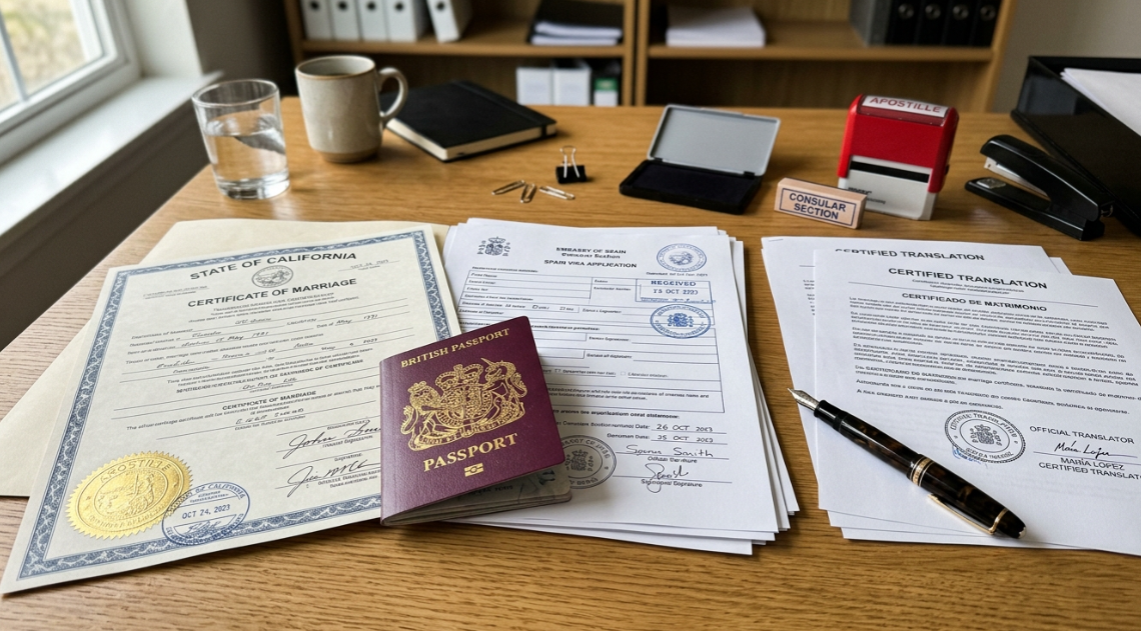
Getting a valid marriage certificate from Utah is one thing. Getting it recognized in another country is a separate challenge entirely.
A remote marriage can be valid in one sense and uncertain in another. There are four distinct layers of recognition to consider:
Valid under the marriage law where performed (state law).
Recognized for U.S. immigration (federal law).
Accepted by the foreign country where the couple lives or plans to register.
Properly authenticated with an apostille or embassy authentication for international use.
Most articles about remote marriage vs. proxy marriage only cover the first two. The third and fourth layers matter just as much for international couples.
An Apostille Is Not Universal Recognition
An apostille authenticates the origin of a public document for countries that participate in the Hague Apostille Convention. Utah’s Lieutenant Governor’s Office is clear that apostilles verify document origin, not the contents of the document. An apostille does not force a foreign government to recognize your marriage. It only confirms that the certificate is a genuine Utah government document.
For countries not part of the Hague Convention, a Certificate of Authentication serves a similar origin-verification function through embassy or consular channels. To understand the difference, see this comparison of apostille vs. authentication.
Foreign Recognition Is Not Guaranteed
Utah County says it cannot provide immigration or international marriage-law advice, and that acceptance by foreign governments is beyond its control. Utah’s 2026 law now requires officiants to warn couples about this very issue before performing a remote ceremony.
Practitioners on Reddit who have tried to register Utah certificates abroad report mixed experiences. Users on a China visa forum described needing an apostilled certificate with certified Chinese translation for a Public Security Bureau process, with questions about whether officials would accept a remote ceremony at all. In another thread, a user trying to register a U.S. marriage for Italian citizenship found that the apostilled certificate lacked details the consulate required (exact city of birth, nationality), and needed a lawyer’s help to complete the registration through additional birth documents.
A Country-Recognition Checklist
Before relying on a remote marriage certificate abroad, check these points:
Does the destination country recognize marriages performed online or remotely?
Does the country accept apostilles, or is embassy authentication required?
Is a certified translation needed?
Is local registration of the foreign marriage required?
Does the foreign authority require information not printed on a standard U.S. marriage certificate?
If you plan to use your certificate internationally, Courtly’s document legalization service can handle apostille and authentication steps. For more background, read the full guide to apostilles.
When Remote Marriage Makes Sense
Remote marriage is a practical tool for couples who face specific barriers to marrying in person. Common situations include:
Long-distance couples who cannot easily travel to the same location for a ceremony. A remote wedding lets them get legally married now and celebrate in person later.
International couples who need a U.S. marriage certificate for immigration, benefits, or legal purposes but cannot travel to the U.S. together.
Military couples separated by deployment or duty assignment. Remote marriage eliminates the need to coordinate leave schedules with courthouse availability.
Same-sex couples in countries where local marriage is unavailable. A U.S. remote marriage can provide a legally valid certificate, though same-sex couples should still verify recognition in both the U.S. immigration system and their home country. USCIS evaluates same-sex marriages under the same place-of-celebration rule as opposite-sex marriages.
Destination wedding couples who want the legal marriage handled first and the celebration handled separately. Some couples legally marry remotely, then hold a ceremony abroad without worrying about foreign marriage paperwork.
Early adopters of Utah’s remote marriage system have described the experience on Reddit. One user in a long-distance relationship detailed applying online, scheduling a video ceremony, having witnesses join, and receiving a digital certified certificate within minutes. Speed, clear instructions, and digital certificate access were the biggest draws.
When In-Person Marriage May Be Simpler
Remote marriage is not always the lowest-risk option. Sometimes marrying in person is faster, cheaper, and less complicated.
Consider an in-person wedding when:
The couple is already physically together in a place where they can legally marry. An in-person ceremony eliminates any ambiguity about physical presence for immigration purposes.
The destination country is known to reject online or remote marriages. Some jurisdictions simply will not register a marriage performed by video, regardless of apostille.
The couple needs immediate local recognition abroad and cannot wait for apostille or authentication processing.
The immigration case has risk factors (prior denials, complicated history, tight timelines) that make additional scrutiny around ceremony format unwise.
On VisaJourney, experienced users sometimes advise couples to marry in person if they can. In one thread involving a non-U.S. citizen in Japan and an active-duty U.S. service member, a commenter recommended that if the couple can physically marry in a country where it’s legal, that may be simpler than navigating a remote route amid evolving immigration policy.
The core principle: use remote marriage when it solves a real problem. Don’t use it just because it exists.
Frequently Asked Questions
Is remote marriage the same as proxy marriage?
No. In a remote marriage, both spouses personally participate by video. In a proxy marriage, a stand-in represents one or both absent spouses. The ceremony mechanics are different, though U.S. immigration may treat them similarly if the spouses were not physically together.
Does USCIS recognize online marriage?
Generally yes, if the marriage is valid where celebrated and does not fall under one of USCIS’s exceptions: polygamy, public policy violations, fraud, or the unconsummated proxy/physical-presence rule. The key issue for couples who were apart during the ceremony is proving post-ceremony consummation.
Do prior visits count as proof for immigration?
Prior visits help prove the relationship is bona fide, but they don’t resolve the physical-presence issue under INA §101(a)(35). For that requirement, USCIS looks for evidence that the spouses met in person after the ceremony. Keep both types of evidence, but understand they serve different purposes.
Can we file I-130 right after a remote wedding?
If both spouses were physically together during the ceremony, the analysis is simpler. If they were apart and recognition depends on post-ceremony consummation, filing before meeting in person creates real risk. The qualifying relationship must exist at filing and continue through adjudication. Consult an immigration attorney for case-specific timing.
Is a Utah online marriage valid abroad?
It depends on the destination country. A Utah marriage certificate can be apostilled or authenticated for international use, but foreign recognition depends on that country’s laws. Utah now requires officiants to warn couples that a remote marriage may not be valid in the country where they reside. Always check the destination country’s requirements in advance.
Is an apostille enough for foreign recognition?
Not always. An apostille confirms that a document is a genuine public record from Utah. It does not guarantee that a foreign government will accept the marriage itself. Some countries also require certified translations, local registration, or additional identity documents not shown on a standard U.S. marriage certificate.
Can a remote marriage affect a K-1 fiancé visa?
If the marriage is recognized for immigration, the person is no longer a fiancé(e). A K-1 visa is for unmarried partners. A consummated remote marriage could make the I-130 spousal petition the correct path instead. This is an area where getting advice before acting prevents costly mistakes.
Is remote marriage valid for same-sex couples?
USCIS evaluates same-sex marriages under the same place-of-celebration rule as opposite-sex marriages. If the marriage is valid where performed, USCIS will generally recognize it regardless of whether the couple’s home state or country would allow it. The physical-presence and consummation rules apply equally.
Ready to start a legally binding remote U.S. wedding? Begin with your online marriage license through Courtly.
Let us handle the paperwork.
Getting married is complicated. Courtly simplifies the process and provides everything necessary to get married online, including providing a licensed officiant who can perform a remote ceremony.
Get Married

Get married online.
Getting married is complicated. Courtly simplifies the process and provides everything necessary to get married online.

