


Long-distance relationships are common now. Work, visas, and global careers mean couples are often building something real while living in different countries.
The challenge is not emotional. It is practical.
You can feel close to someone and still have no clear path to living in the same place. That is where most long-distance relationships break down.
The reality is this: long-distance relationships can lead to marriage, but only when there is a clear plan to close the gap.
At some point, every serious couple reaches the same question:
How do we make this legally and practically permanent?
This guide breaks down what actually works.
Long Distance Marriage Problems No One Prepares You For
The legal commitment of marriage is not a cure for physical separation. Many couples realize, with a sense of sudden clarity, that the formal union does not simplify the logistical reality of living apart.
The Emotional Reality
You are married but still living apart. Time zones make regular communication exhausting. Important moments get missed, and that compounds over time.
The Practical Challenges
Visa delays and immigration processing timelines do not pause for newly married couples. Travel costs accumulate. Work restrictions or relocation limitations create real friction. These are not exceptions. They are standard experiences for internationally separated couples.
The Relationship Risks
Over-reliance on text-based communication leads to miscommunication that escalates faster than it would in person. Couples can feel disconnected despite the formal commitment. Marriage raises the stakes on solving the distance. It does not solve it.
Do Long Distance Relationships Actually Lead to Marriage?
Yes, especially among international couples, people working across countries, military or deployment-based relationships, and students or early-career professionals navigating mobility.
Here’s what makes them work vs break:
Long-distance relationships do not fail because of distance. They fail because the distance becomes permanent with no plan to change that.
When Should You Consider Marriage in a Long-Distance Relationship?
Not every long-distance relationship should move toward marriage. The question worth asking is not whether you love each other enough. The question is whether you have the practical foundation to make it work.
Signs of Readiness:
- You have spent meaningful time together in person.
- You have navigated conflict face-to-face.
- You have had a real conversation about where you will live.
- You understand what each other's daily life actually looks like.
Indicators of Unreadiness:
- You have never met physically.
- There is no concrete plan to close the distance.
- One person is pushing toward marriage more than the other.
A more useful question to sit with: Are we choosing marriage to build a future together, or to escape the uncertainty of the current situation?
Can You Get Married Long Distance?
Yes, you can. But this is where confusion starts, because not all online marriages carry the same legal weight.
What Actually Works
A legally valid long-distance marriage depends on the jurisdiction where the marriage is registered, whether a licensed officiant conducts the ceremony, and whether the resulting certificate is government-issued. These are the factors that determine whether a marriage is legally recognized, not the format of the ceremony itself.
What People Get Wrong
A video ceremony alone does not constitute a legal marriage. Religious ceremonies, while meaningful, may not carry legal recognition in many jurisdictions. Laws vary significantly across countries and even within them.
What Happens in Practice
Some jurisdictions, including Utah County in the United States, allow couples to complete the ceremony remotely, receive a government-issued marriage certificate, and use that certificate for legal and immigration purposes. That distinction matters enormously. It is the difference between something symbolic and something that actually counts legally.
How to Get Legally Married Long Distance: A Step-by-Step Breakdown
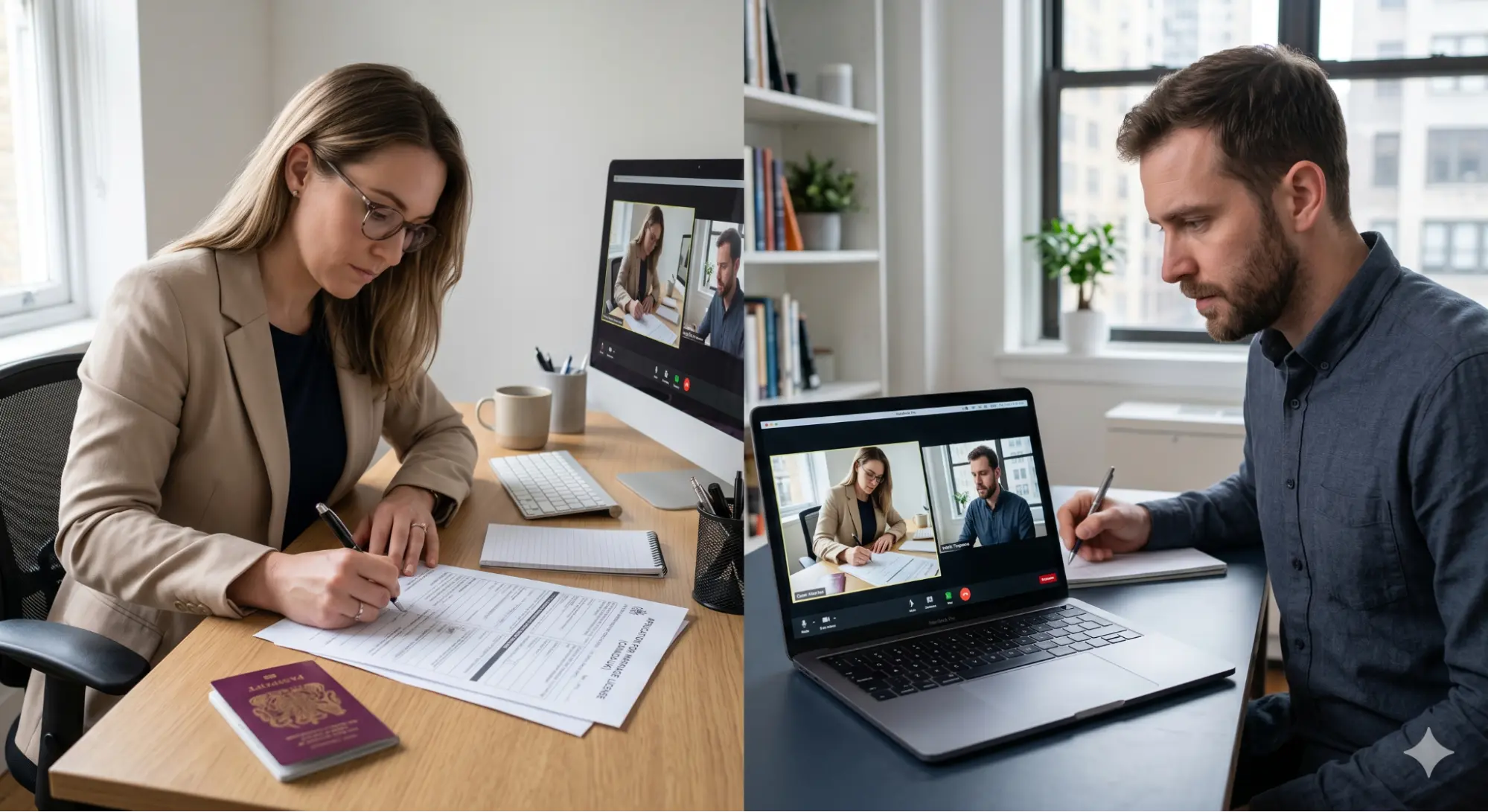
This is the part most couples do not fully understand before starting the process.
Step 1: Choose the Legal Path
There are three main options. You can travel and marry in person, pursue a legally recognized online marriage through a qualifying jurisdiction, or, in limited circumstances, pursue a proxy marriage. Most internationally separated couples who cannot easily travel find the online route through U.S. law to be the most accessible and reliable option.
Step 2: Prepare Your Documentation
- Government-issued identification for both partners
- Completed marriage application
- Witness details, if required by the jurisdiction
Step 3: Complete the Ceremony
The ceremony must be conducted by a U.S.-licensed officiant and meet the legal requirements of the relevant jurisdiction. This is not an informal arrangement. The officiant's credentials and the jurisdiction's legal framework are what give the certificate its validity.
Step 4: Receive Your Marriage Certificate
You will typically receive a digital copy immediately after the ceremony, followed by a physical government-issued certificate by mail. Both serve as legal proof of marriage.
Step 5: Authenticate for International Use
If you need the certificate recognized abroad, for immigration, visa applications, or legal proceedings in another country, you will typically need either an apostille stamp for countries that participate in the Hague Convention or embassy authentication for countries that do not. Skipping this step is one of the most common mistakes couples make.
Making a Long Distance Marriage Actually Work
Once the legal part is handled, the focus shifts to maintaining the relationship across distance.
Build a Communication System with Structure
Frequency matters less than intentionality. Scheduled calls with real conversations, not just logistical updates, keep couples connected across time zones in a way that ad hoc texting rarely does.
Prioritize Physical Time Together
Visits are not optional. They are essential. The relationship needs in-person time to remain grounded in shared reality, not just shared digital space.
Have a Real Plan to Close the Distance
Where will you live? When will that happen? Who is relocating, and what does that mean for their career, family, and daily life? Vague answers to these questions create long-term instability even in marriages that feel emotionally strong.
Be Financially Transparent
Travel costs, legal fees, relocation planning, and potential visa expenses add up. Couples who treat financial planning as a shared project fare significantly better than those who avoid it.
A Practical Option for Long-Distance Couples
Some couples cannot wait for logistics to align. Visa deadlines do not pause. Deployment windows close. Immigration timelines move regardless of whether a couple has had time to plan a traditional ceremony.
At that point, the question changes:
What is the legally valid way to move forward from where you are right now?
Some couples wait. Others use legal pathways that don’t require being in the same place.
When Long Distance Marriage Does Not Work
Distance itself is not the issue. Uncertainty is. These are the patterns that repeat in long-distance marriages that do not survive.
- No agreed timeline to live in the same place
- One partner consistently compromises on location, career, or family proximity without acknowledgment.
- Trust issues that distance amplifies rather than resolves.
- Legal or documentation barriers that were never properly addressed.
Marriage does not eliminate these problems. It makes them more urgent.
The Reality of Long-Distance Relationships and Marriage
Long-distance relationships can lead to strong, lasting marriages. But only when the emotional connection is real, expectations are clear, and the practical steps to make it permanent are actually taken.
Marriage does not eliminate distance. It raises the stakes on solving it.
If you are ready to make your long-distance relationship legally permanent, the first step is understanding your legal options clearly. Courtly handles the ceremony, documentation, and authentication so that the paperwork is as sound as the commitment behind it.
Frequently Asked Questions
Can you get legally married online from different countries?
Yes. Under certain jurisdictions, including Utah County in the United States, couples can complete a legally recognized marriage ceremony online even if they are located in different countries. What determines validity is where the marriage is registered, not the physical location of the partners during the ceremony.
Do both partners need to be physically present for a legal marriage?
Not always. Jurisdictions that permit remote or virtual ceremonies allow both partners to participate from separate locations. Requirements vary, so confirming the rules of the specific legal framework you are using is essential before beginning the process.
Is a long-distance marriage valid for immigration purposes?
It can be, provided the marriage is legally recognized and properly documented. U.S. Citizenship and Immigration Services (USCIS) requires proof of a bona fide relationship alongside a valid, government-issued marriage certificate. The certificate must meet specific documentation standards and may require apostille authentication or embassy certification, depending on the countries involved.
What is the fastest way to get legally married while living apart?
Jurisdictions that permit remote legal marriages offer the fastest route. Through Courtly, the ceremony can be completed within 24 hours of license approval, with a full refund guarantee if that timeline is not met.
Do you need witnesses for a long-distance marriage?
In most cases, yes. Some jurisdictions require witnesses to be present during the ceremony. Services like Courtly can provide witnesses if you do not have people available locally.
What happens if your home country does not recognize the marriage?
You may need additional authentication steps. For countries that participate in the Hague Convention, an apostille stamp on the U.S. marriage certificate is typically sufficient. For countries that do not participate, embassy authentication is required. In some cases, local re-registration of the marriage may also be necessary. Courtly provides recognition guidance for more than 150 countries to help couples navigate this correctly.
Can you change your name after a long-distance marriage?
Yes. Once you have a valid government-issued marriage certificate, you can follow the standard name change process in your country. In the United States, this involves updating records with the Social Security Administration, the DMV, your passport, and financial institutions. Courtly offers a name change kit that includes pre-filled forms and step-by-step instructions covering all major institutions.
Let us handle the paperwork.
Getting married is complicated. Courtly simplifies the process and provides everything necessary to get married online, including providing a licensed officiant who can perform a remote ceremony.
Get Married

Get married online.
Getting married is complicated. Courtly simplifies the process and provides everything necessary to get married online.

