


France historically does not recognize online marriages performed in the United States due to strict physical-presence requirements in the French Civil Code (Article 146-1). A U.S. online marriage is fully legal within the United States, but couples with a French connection should understand the transcription process, apostille requirements, and alternative paths like PACS before making decisions. This glossary covers every key term.
If you’re part of a Franco-American couple, an expat in France, or simply someone with ties to both countries, the phrase “online marriage France” probably brought you here with a specific question: can you get legally married online and have France accept it?
The short answer is that France has historically not accepted online U.S. marriages. The French legal system requires physical presence at a marriage ceremony, and that rule applies whether the wedding happens on French soil or abroad. This is confirmed both by French law and by Courtly’s own published guidance on country-specific recognition.
That said, a U.S. online marriage remains 100% legal in all 50 states and is recognized by many countries worldwide. Depending on your situation, it may still be exactly what you need. The purpose of this glossary is to walk you through every important term so you can make an informed decision.
Can You Get Married Online in France?
France does not offer a general online or video-only procedure for contracting a French civil marriage. A marriage performed remotely in another country, such as a U.S. online marriage, presents a separate question: whether French authorities will recognize it for civil-status, immigration, tax, or other legal purposes. An apostille authenticates the foreign marriage certificate but does not guarantee recognition in France. Couples should confirm the applicable rules with the relevant French consulate or civil-status authority before relying on a remote marriage for French legal purposes.
Explore how online marriage works to understand the U.S. side of the process before reading about France-specific requirements below.
Online Marriage France: Rules at a Glance
Question | Short answer | What to check |
|---|---|---|
Can you contract a French civil marriage entirely online? | France does not provide a general video-only civil marriage procedure. | The applicable mairie and French civil-marriage rules. |
Can you marry online through a U.S. service while living in France? | A qualifying U.S. jurisdiction may permit a remote ceremony. | Eligibility, licensing requirements, and the validity of the resulting marriage. |
Will France recognize a U.S. online marriage? | Do not assume that it will be recognized. | The spouses' nationalities, ceremony circumstances, applicable law, and intended legal use. |
Does an apostille guarantee French recognition? | No. | Document authentication and substantive recognition are separate issues. |
Can you marry in person in France after an online wedding? | A French civil marriage may be an option, subject to the applicable requirements. | Whether the existing marriage affects eligibility to marry again. |
Is PACS an alternative to marriage? | It is a separate French civil partnership, not a marriage. | Eligibility, residence rules, tax treatment, and the rights relevant to your situation. |
Important: This table is a general orientation, not a determination of whether a specific foreign marriage will be recognized under French law.
French Marriage System: Core Terms
Mairie (Town Hall)
The mairie is the only legally valid location for a marriage ceremony in France. Unlike the U.S., where couples can marry in churches, backyards, or over video, France requires that every legal marriage take place at the town hall of the commune where at least one spouse resides. Religious ceremonies carry zero legal weight under French law. They can happen after the civil ceremony but cannot replace it.
Officier de l’État Civil
This is the civil registrar, usually the mayor or a deputy mayor, who performs the marriage ceremony. During the ceremony, the officier reads Articles 212 through 215 of the French Civil Code aloud in French. These articles cover mutual respect, fidelity, shared household responsibility, and joint financial obligations. There is no equivalent of a Utah-licensed officiant performing remotely. The officier must be physically present in the mairie, and so must both spouses.
Acte de Mariage
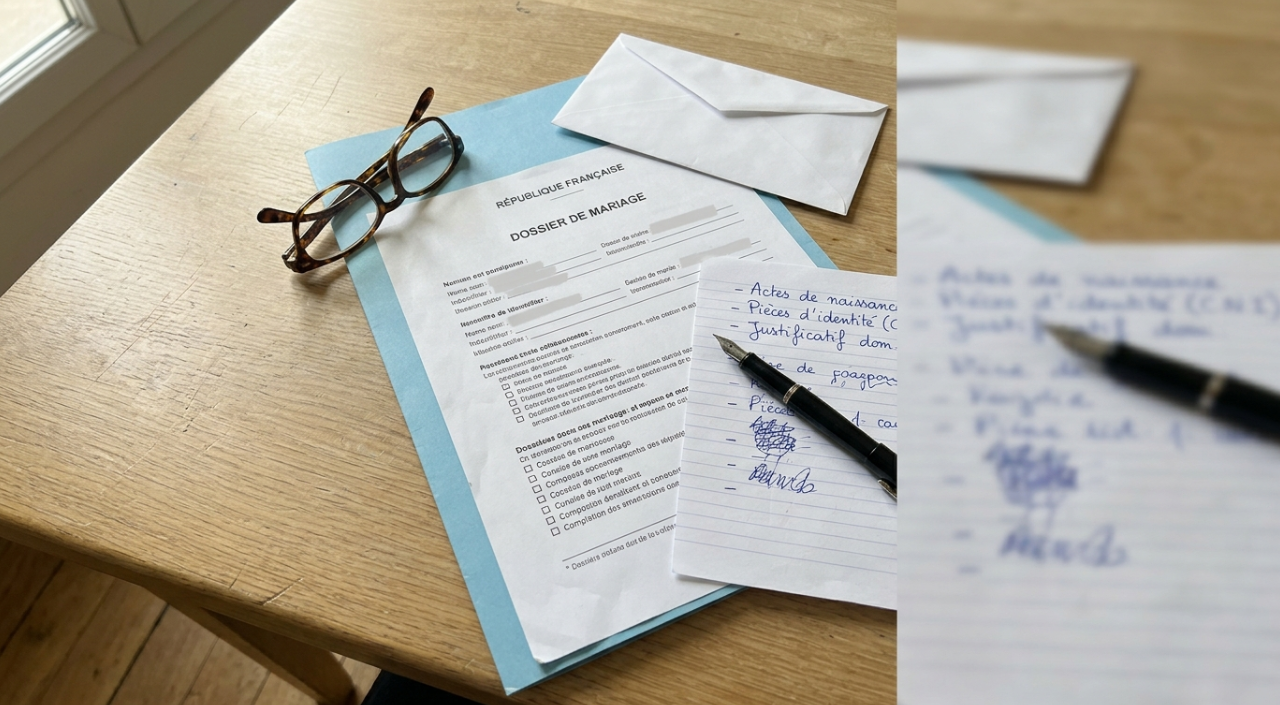
The official French marriage certificate issued by the mairie after the civil ceremony. This is the French equivalent of a U.S. marriage certificate, though the two documents serve different bureaucratic ecosystems. The acte de mariage is recorded directly in the commune’s civil registers.
Publication des Bans (Marriage Banns)
Before any marriage in France, the mairie must publicly post the couple’s intention to marry for at least 10 days. This is a mandatory waiting period with no exceptions. For international couples on a short trip, this requirement alone often makes a legal civil wedding at a French town hall impractical. As multiple wedding planners and legal guides note, most international couples handle the legal step in their home country and come to France for a symbolic ceremony instead.
Certificat de Coutume
A certificate of legal capacity to marry, required from foreign nationals getting married in France. Your embassy or consulate issues this document, which confirms that you are legally free to marry under the laws of your home country. Practitioners on Reddit’s r/SchengenVisa regularly flag this as one of the most confusing requirements for Americans, since the concept doesn’t exist in U.S. domestic marriage law.
Livret de Famille
The “family booklet” issued to every couple after a French civil marriage. It serves as the official record of the family unit, recording marriages, births of children, and divorces. There is no U.S. equivalent. If your marriage took place outside France, you won’t receive a livret de famille unless and until the marriage is transcribed into French civil registers.
Code Civil, Article 143
The foundational statute governing civil marriage in France. It establishes that “marriage is contracted by two persons of different sex or of the same sex,” reflecting the 2013 legalization of same-sex marriage. France was the thirteenth country in the world to allow same-sex couples to marry.
30-Day Residency Requirement
Under French marriage law, at least one partner must live in the commune where the wedding will take place for approximately 30 days before the banns are published. This effectively rules out destination weddings at French town halls for most international visitors.
Online Marriage and Remote Ceremony Terms
Online Marriage
A legally binding marriage ceremony performed entirely via video link, without either spouse needing to travel. In the United States, this is legal through Utah’s remote-appearance framework. The couple connects with a licensed officiant and witnesses over video, and the resulting U.S. marriage certificate is a standard legal document. You don’t need to be a U.S. citizen or resident to get married online through this process.
Proxy Marriage
A marriage where one or both parties are physically absent and represented by a stand-in. This is not the same as an online marriage, where both spouses participate live via video. France does not recognize proxy marriages, and it treats the absence of physical presence as a fundamental defect. The distinction matters because some countries accept proxy marriages but not online ones, or vice versa. For a deeper comparison, see this guide on proxy vs. virtual marriage.
Remote Appearance Marriage
Utah’s specific legal framework that allows couples to appear before an officiant via video for a fully valid marriage ceremony. Utah County pioneered this system, and it remains the primary jurisdiction for remote-appearance weddings in the U.S.
Symbolic Ceremony
A non-legal celebration, sometimes elaborate, held in a location meaningful to the couple. Many international couples who marry legally in the U.S. (or elsewhere) hold a symbolic ceremony in France afterward, often at a chateau or vineyard. This is perfectly common and entirely separate from the legal marriage.
Utah Online Marriage License
The marriage license issued by Utah County that enables a remote-appearance wedding. The license itself is processed digitally, and couples complete the application, ceremony, and certificate delivery without setting foot in Utah. Learn more about the online marriage license process.
Why France Does Not Recognize Online Marriages
Article 146-1 of the French Civil Code
This is the critical statute. Article 146-1 states that “the marriage of a French person, even where contracted in a foreign country, requires his being present.” French courts enforce this strictly. Judges verify the reality of physical presence and reject substitutes like videoconference or proxy representation.
One important nuance that most English-language sources miss: Article 146-1 technically applies only to French nationals. The original French text specifies that it does not govern the marriage of a foreigner celebrated abroad (“Cet article ne régit pas le mariage d’un étranger célébré à l’étranger”). However, France still applies public-policy tests to any foreign marriage presented for recognition, and the expectation of physical presence runs through those tests as well.
Article 146
A separate but related provision requiring that both parties consent to the marriage. Article 146 is about consent; Article 146-1 is about physical presence. Many sources conflate the two, which creates confusion. Both articles can serve as grounds for refusing transcription, but for online marriages, Article 146-1 is the specific barrier.
The Public-Policy Filter (Ordre Public)
Even when Article 146-1 doesn’t technically apply (because neither spouse is French), France can refuse to recognize a foreign marriage that violates French “ordre public,” or public policy. The physical-presence expectation is considered part of that public policy. A competitor legal site puts it bluntly: “the French prosecutor is very likely to refuse transcription because the fundamental condition of physical presence before an officiant was not met.”
This doesn’t mean an online marriage is invalid. It means France specifically chooses not to recognize it within its own legal system.
How to Check Whether France Will Recognize Your U.S. Online Marriage
If you have already married online in the United States, do not assume that the marriage will automatically be recognized in France. The next step depends on your nationality, where the ceremony took place, how it was conducted, and why you need recognition.
Step 1: Identify Your Nationality and Legal Situation
Establish whether either spouse is a French citizen, whether either spouse lives in France, and whether you need recognition for immigration, civil-status registration, taxes, or another purpose. These details can affect which French authority handles your case and which legal rules apply.
Step 2: Confirm the Marriage Was Validly Celebrated
Obtain the official marriage certificate and retain the details of the issuing jurisdiction, officiant, ceremony date, and remote-appearance procedure. Confirm that the marriage complied with the law governing its celebration.
Step 3: Ask the Relevant French Authority About Recognition
If a French spouse is involved, contact the appropriate French consulate or civil-status authority to determine the applicable transcription procedure. For other situations, ask the relevant French authority whether recognition or registration is available and what legal requirements apply.
Do not assume that the same procedure applies to every foreign marriage or every nationality.
Step 4: Check Document Requirements
Ask whether you need an apostille, a sworn French translation, original documents, additional evidence, or specific application forms. Follow the requirements of the authority handling your case rather than relying on a generic document checklist.
Step 5: Confirm the Effect on Your Intended Legal Benefit
Before relying on the marriage for a visa, residence permit, citizenship application, tax treatment, or inheritance matter, obtain confirmation that it qualifies for that specific purpose.
Important: An apostille and a translation address document formalities. Neither one independently establishes that a foreign marriage satisfies French substantive recognition requirements.
Recognition and Legalization Terms
Apostille vs. Sworn Translation vs. Transcription
Requirement | What it does | What it does not do |
|---|---|---|
Apostille | Authenticates the origin of a qualifying public document, including the relevant signature, capacity, and seal or stamp. | Does not guarantee that France recognizes the marriage described in the document. |
Sworn French translation | Translates a foreign-language document for submission where an accepted translation is required. | Does not establish the legal validity or recognition of the marriage. |
Transcription | Records the details of a foreign marriage in the relevant French civil-status registers when the applicable procedure permits it. | Is not guaranteed merely because the documents are complete or authenticated. |
Legal recognition | Determines whether the marriage has the relevant legal effect under French law. | Is not interchangeable with document authentication or translation. |
Key takeaway: A marriage certificate can be authentic and correctly translated without necessarily qualifying for recognition in France.
Transcription (Transcription d’Acte de Mariage)
The process of recording a foreign marriage in French civil status registers. For a foreign marriage to have full legal effect in France, it must be transcribed. Without transcription, the marriage technically exists only between the two spouses and their children, with no effect on third parties.
What does “no effect on third parties” mean in practice? It means the foreign spouse cannot get a residence permit based on the marriage. The couple cannot claim married-couple tax advantages. Insurance, inheritance, and banking benefits tied to marital status won’t apply.
Transcription requires that the marriage was valid in the country where it was performed. A Utah online marriage is valid in the U.S., but France’s physical-presence filter creates the recognition barrier during transcription review.
Practitioners on Reddit’s r/immigration describe the transcription process as “incredibly complicated,” and processing times at France’s central civil-status office routinely run six months to over a year.
SCEC (Service Central d’État Civil)
The central civil-status office located in Nantes, France, that handles transcription requests for French citizens married abroad. All transcription paperwork flows through this office, and delays are the norm rather than the exception.
Apostille
An official certification that authenticates a document for use in countries that are members of the Hague Apostille Convention. France is a member, so U.S. documents (including marriage certificates) need an apostille rather than embassy authentication.
Here’s a distinction that matters enormously for online marriage France situations: an apostille authenticates the document itself. It confirms that the marriage certificate is genuine and was properly issued. It does not guarantee that France will accept the underlying marriage. An apostilled online marriage certificate is authentic, but France can still refuse transcription on physical-presence grounds.
If you need an apostille for your U.S. marriage certificate, Courtly offers this as an add-on. Learn about the marriage certificate apostille process.
Hague Convention
The international treaty that standardized document authentication across member countries. Because both the U.S. and France are signatories, documents pass between the two countries via apostille rather than the longer embassy-authentication route.
Sworn Translation (Traduction Assermentée)
Any non-French document submitted to French authorities must be translated by a certified sworn translator (traducteur assermenté) approved by a French court of appeals. This applies to marriage certificates, birth certificates, and every other piece of supporting paperwork. The translation must be recent, and costs vary by document length and translator.
Marriage Recognition
Whether a foreign government accepts your marriage as legally valid within its own system. Recognition is never automatic for online marriages. Some countries accept them without issue; others historically do not. France falls into the latter category. For comparison, see Courtly’s guides on online marriage in Germany and online marriage in Australia, which face similar recognition challenges.
Document Legalization
The broader process of authenticating documents for foreign use, which may involve apostilles, embassy authentication, or both depending on the destination country. Courtly’s document legalization service covers the options.
Immigration and Status Terms
Conjoint de Français
Literally “spouse of a French citizen,” this is the residence permit category that opens up when you marry a French national. It provides a path to a “vie privée et familiale” residence card. However, accessing this permit requires that the marriage be transcribed in the French civil registers, which brings us back to the recognition problem for online marriages.
Vie Privée et Familiale
The “private and family life” residence card available to spouses or PACS partners of French citizens or residents. This card grants the right to live and work in France and is one of the primary reasons couples care about marriage recognition in the first place.
France Citizenship Through Marriage
France requires 4 years of marriage and 3 continuous years of residence in France for citizenship by marriage. If the couple has not lived in France for 3 uninterrupted years, the requirement extends to a 5-year marriage track. Language and civics tests are also required.
PACS (Pacte Civil de Solidarité)
France’s civil partnership, available to both same-sex and opposite-sex couples since 1999. A PACS sits halfway between cohabitation and marriage. For expats in France, it is often the fastest legal route to a “vie privée et familiale” residence card, joint taxation, and full social security coverage for a non-EU partner.
One critical fact for Franco-American couples: the United States does not recognize a PACS. So while a PACS provides legal standing in France, it offers nothing on the U.S. side. This mirror-image problem (France doesn’t recognize U.S. online marriages; the U.S. doesn’t recognize French PACS agreements) is a recurring frustration for binational couples.
Same-Sex Marriage and Article 202-1
France legalized same-sex marriage in 2013. Article 202-1 of the Code Civil, updated in 2014, establishes a conflict-of-laws rule that allows France to recognize foreign same-sex marriages. This means a same-sex marriage performed abroad can be transcribed in France, but the transcription path still requires meeting the physical-presence standard. The online-marriage barrier applies equally regardless of the couple’s gender composition.
For same-sex couples exploring U.S. online marriage options, Courtly’s same-sex marriage guide covers the process.
Options for Couples With a French Connection
The right approach depends on whether you need a marriage for U.S. legal purposes, French civil-status recognition, or a specific immigration benefit. These objectives are related but not interchangeable.
Option 1: Arrange a French Civil Marriage
If you are eligible to marry under French law, an in-person civil marriage at a mairie is the conventional route to a French marriage record. Ask the mairie about residence conditions, required documents, publication of banns, and any nationality-specific requirements.
If you have already married online abroad, explain this to the mairie before making plans. Do not assume that you can contract another marriage without first establishing your existing legal status.
Option 2: Use a U.S. Online Marriage for a Specific U.S. Purpose
A remote marriage performed under a qualifying U.S. jurisdiction's law may meet certain U.S. legal needs. However, U.S. validity does not establish eligibility for every immigration benefit or guarantee recognition in France or another country.
Before proceeding, confirm that the intended U.S. agency or institution accepts the marriage for the particular purpose.
Option 3: Consider a PACS
For eligible couples in France who need a civil partnership rather than marriage, a PACS may be worth considering. Review its effects on residence, taxation, property, and other rights before choosing it.
A PACS is not equivalent to marriage and may not satisfy requirements that specifically call for a recognized marriage.
Option 4: Obtain Individual Legal Advice Before Relying on Recognition
If the marriage affects a residence application, citizenship, inheritance, or family status, seek guidance before paying for document authentication or submitting a formal application. A French legal professional can assess the relevant facts and advise on available routes.
Practical Realities From Couples Who’ve Been Through It
Community discussions across Reddit paint a consistent picture. On r/expats, users ask whether self-uniting (Quaker) marriages from Pennsylvania will satisfy French immigration, revealing deep confusion about what “officiated” means under French law. On r/immigration, Franco-American couples describe the transcription and consulate path as bewildering. One thread on r/legaladvice features an American-French couple calling the entire process “incredibly complicated.”
The pattern is clear: couples underestimate how rigid France’s physical-presence requirement is, and they overestimate how far an apostille will carry them. An apostille proves your document is real. It doesn’t override a country’s substantive marriage law.
If you’re considering an international online marriage and your situation involves France, talking to a French immigration attorney or your local French consulate before making decisions is not optional. It’s essential.
Getting Married Online Through Courtly
For couples who need a valid U.S. marriage, Courtly handles the entire process from anywhere in the world. The service includes a Utah County marriage license, a licensed officiant, a live video ceremony, and delivery of your U.S. marriage certificate (digital copy after the ceremony, physical copy mailed within days).
Plans start at $199 (Core) and go up to $599 (Fast-Track), which includes two Courtly-provided witnesses and rush processing with a 24-hour scheduling guarantee after license approval. An apostille add-on is available for international use. Couples must be 18 or older, not currently married, and not divorced in the last 60 days.
See full pricing and plan details to find the right option for your situation.
Acceptance by foreign governments, including France, is beyond Courtly’s control. Courtly is not a law firm and does not provide legal advice. For France-specific recognition questions, consult local officials or an immigration attorney.
Frequently Asked Questions About Online Marriage in France
Can foreigners get married online while living in France?
A couple may be able to marry remotely through a foreign jurisdiction that permits online ceremonies. Whether the resulting marriage will be recognized in France is a separate question that depends on the applicable law and circumstances.
Does France recognize a Utah online marriage?
Do not assume that France will recognize a Utah remote-appearance marriage simply because it is valid in Utah. The recognition question should be assessed under the applicable French legal rules, taking into account the spouses' nationalities and the circumstances of the ceremony.
Does an apostille make an online marriage valid in France?
No. An apostille authenticates the origin of a qualifying public document. It does not establish that the underlying marriage satisfies French recognition requirements.
Can I get a French marriage certificate for a marriage performed online abroad?
A French marriage record or transcription is subject to the applicable civil-status procedures and legal requirements. Contact the relevant French authority to determine whether your specific foreign marriage qualifies.
Can I get a French residence permit using a U.S. online marriage?
Do not assume that a foreign online marriage automatically qualifies you for a French residence permit. Eligibility depends on the applicable immigration route and whether the marriage meets the relevant recognition requirements.
Can I marry in France if I am already married online in the United States?
Do not arrange a second marriage ceremony until you have clarified your existing marital status. If the first marriage is legally valid, it may prevent you from marrying again. Ask the relevant French authority or a qualified lawyer to assess your situation.
Is PACS better than marriage for expats in France?
Neither option is universally better. PACS is a civil partnership with its own legal effects, while marriage provides a different set of rights and obligations. The right choice depends on your residence status, family circumstances, nationality, and legal objectives.
Does a same-sex online marriage face the same recognition questions in France?
Same-sex marriage is legal in France. However, the fact that a marriage is between two people of the same sex does not, by itself, resolve whether a particular remote ceremony performed abroad satisfies the applicable recognition requirements.
Let us handle the paperwork.
Getting married is complicated. Courtly simplifies the process and provides everything necessary to get married online, including providing a licensed officiant who can perform a remote ceremony.
Get Married

Get married online.
Getting married is complicated. Courtly simplifies the process and provides everything necessary to get married online.

