


An apostille marriage certificate is an officially certified marriage record that has been authenticated for use in another country. It verifies the authenticity of the issuing official's signature, capacity, and seal, allowing the document to be presented in countries covered by the Hague Apostille Convention.
If you married in the United States and need to use your marriage certificate abroad for immigration, foreign marriage registration, citizenship, or other legal purposes, you may need an apostille. The process typically involves obtaining a certified marriage certificate, submitting it to the appropriate state authentication authority, paying the required fee, and arranging a translation if necessary.
The cost, processing time, and submission requirements vary by state and destination country. This 2026 guide explains how to apostille a U.S. marriage certificate, what documents you need, how much the process costs, and how to avoid common application mistakes.
How Do You Get an Apostille for a Marriage Certificate?
To get an apostille for a U.S. marriage certificate, follow these five steps:
Obtain a certified copy of your marriage certificate from the vital records office or county clerk responsible for the marriage record.
Check the destination country's document requirements to determine whether you need an apostille or authentication.
Submit the certified certificate to the appropriate authentication authority in the state that issued the document.
Pay the applicable state fee and provide any required application forms, return envelope, and shipping information.
Receive the apostilled marriage certificate and arrange a certified translation if the receiving authority requires one.
Important: A marriage certificate apostille authenticates the origin of the document, not the legal validity or international recognition of the marriage itself. Requirements and processing times vary by state and destination country.
What Is an Apostille on a Marriage Certificate?
An apostille is a standardized certificate that a government authority attaches to a public document so it will be recognized as genuine in other countries. When applied to a marriage certificate, the apostille confirms that the document, the signature on it, and the official seal are authentic.
Here’s what trips people up: an apostille does not prove your marriage is valid. It only proves the document itself is real. A foreign government receiving your apostilled marriage certificate can trust that the paperwork came from a legitimate authority, but the apostille says nothing about whether the underlying marriage meets that country’s legal requirements.
The apostille system exists because of the Hague Apostille Convention of 1961, which currently has 130 contracting states. Before this treaty, getting a foreign country to accept your documents required a long chain of certifications from multiple agencies. The apostille replaced all of that with a single, standardized certificate.
If you need to use your marriage certificate in another country, Courtly offers document legalization services that handle the apostille process for you.
Why You Might Need an Apostille Marriage Certificate
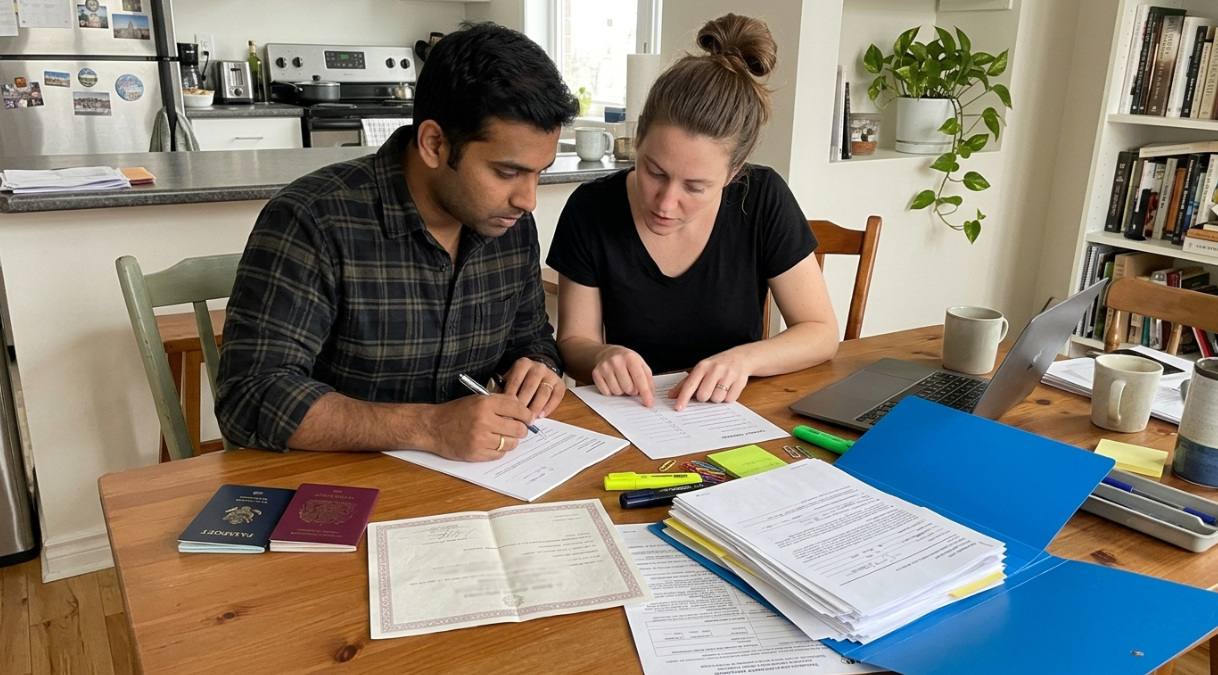
The most common situations where you’ll need an apostilled marriage certificate:
Spouse visa or immigration processing. If you’re sponsoring your spouse for a CR-1 or IR-1 visa, immigration authorities in many countries require an apostilled marriage certificate as proof of the marriage. Practitioners on Reddit who have gone through the USCIS process frequently mention that having documents properly apostilled before filing avoids delays and requests for evidence.
Registering your marriage in a foreign country. Many countries require couples to register a foreign marriage with their local civil registry. The registry won’t accept your U.S. marriage certificate without an apostille.
Buying property abroad. Joint property purchases in another country often require proof of marital status, and that proof needs to be apostilled.
Citizenship by marriage. Some countries offer expedited citizenship or residency for spouses of their citizens, but they want apostilled documentation.
Name changes abroad. If you took your spouse’s name and need to update foreign records, you’ll typically need an apostilled certificate.
Military spouse documentation. Service members stationed overseas frequently need apostilled marriage documents for base housing, benefits, and local registrations. Couples who got married online before deployment often need an apostille to use their certificate at a foreign posting.
For a breakdown of how recognition works in specific countries, check whether your destination is covered on Courtly’s country guides.
Apostille vs. Authentication: Which Do You Need?
This is the single biggest point of confusion in the entire process. The answer depends on one question: is the country where you’ll use the document a member of the Hague Apostille Convention?
If yes (Hague member country): You need an apostille. Once the Secretary of State issues it, you’re done. No further certification is needed.
If no (non-Hague country): You need an authentication certificate instead. This is a more complex process that involves the Secretary of State issuing a certificate of authentication, followed by additional steps through the U.S. Department of State and then the embassy or consulate of the destination country.
Recent additions to the Hague Convention include Saudi Arabia (December 2022), China (November 2023), Canada (January 2024), and the UAE (2025). This means more countries accept apostilles now than even a few years ago, and the list keeps growing. For a deeper comparison of these two processes, Courtly has a dedicated guide on apostille vs. authentication.
The Hague Apostille Convention Explained
The Convention was designed to cut red tape. Before it existed, getting a document accepted in a foreign country meant going through a process called “legalization,” which could involve four or five different agencies, each verifying the previous one’s stamp. The apostille replaced that entire chain with a single certificate.
One important detail: an apostille is not country-specific. If you get an apostille on your marriage certificate for use in Germany, that same apostilled document is valid in Spain, Japan, Brazil, or any other Hague member state. You don’t need a separate apostille for each country.
With 130 member states and counting, most countries where you’d need to present a U.S. marriage certificate are covered by the Convention.
Marriage Certificate Apostille Requirements: What Documents Do You Need?
Before requesting an apostille, prepare the documents and information required by the issuing state's authentication office. Missing paperwork, incorrect certificate formats, or incomplete applications can delay processing or result in rejection.
Most U.S. apostille applications require some or all of the following:
Requirement | What You Need | Important Details |
|---|---|---|
Certified marriage certificate | Official certified copy | Must come from the appropriate vital records authority |
Apostille application form | State-specific request form | Requirements vary by state |
Destination country | Name of the country where the certificate will be used | Helps determine the correct authentication procedure |
Applicant information | Name, address, email, and contact details | Follow the state's application instructions |
Processing fee | Required state payment | Fees vary by state and service type |
Return envelope | Prepaid shipping label or return envelope | Required by some offices |
Translation | Certified translation, if required | Confirm whether translation must be completed before or after authentication |
Does the Marriage Certificate Need to Be Notarized?
Usually, a government-issued certified marriage certificate does not need to be notarized before apostille processing. However, the document must meet the authentication office's specific requirements.
Some states require additional certification from a county clerk, court official, or other authorized official before the Secretary of State can issue an apostille.
Always check the issuing state's instructions before mailing your certificate.
Can You Use a Photocopy of Your Marriage Certificate?
In most cases, a regular photocopy is insufficient. You generally need an official certified copy bearing the issuing authority's recognized signature and seal. A notarized photocopy is not automatically an acceptable substitute.
If you are unsure whether your certificate qualifies, contact the state's authentication office before submitting it.
Where to Get an Apostille for a Marriage Certificate by State
For a U.S. marriage certificate, the apostille is generally issued by the competent authentication authority in the state where the document originated. This is usually the Secretary of State, although some states use a different office.
The correct office depends on where your marriage certificate was issued, not where you currently live.
Here are examples of where to start:
State | Apostille Authority | Important Detail |
|---|---|---|
California | California Secretary of State | Check whether county clerk certification is required for your particular certificate |
Florida | Florida Department of State | Offers mail-in and in-person authentication services |
New York | New York Department of State | Some documents require county clerk authentication first |
Texas | Texas Secretary of State | Verify the signature and issuing authority requirements |
Michigan | Michigan Department of State, Office of the Great Seal | Accepts qualifying certified vital records |
Arizona | Arizona Secretary of State | Check the required document certification and submission procedure |
Colorado | Colorado Secretary of State | Review the applicable document and signature requirements |
Utah | Utah Lieutenant Governor's Office | Handles apostilles for Utah marriage certificates |
How to Find Your State's Apostille Office
Identify the state that issued your certified marriage certificate.
Visit that state's official Secretary of State or authentication website.
Find its apostille or document authentication instructions.
Check whether additional county or local certification is required.
Confirm the current fee, processing time, and accepted payment methods before submitting your document.
Important: Do not assume every state accepts the same type of certified marriage certificate. Some states require an additional verification step before issuing an apostille.
Can You Use One Apostilled Marriage Certificate in Multiple Countries?
An apostille is issued to authenticate a public document for use in a foreign country covered by the Hague Apostille Convention. However, obtaining an apostille does not mean that every foreign institution will accept the document for every purpose.
If you intend to use your marriage certificate in multiple countries, check the requirements of each receiving authority before ordering authentication.
For example, different countries or institutions may have different requirements concerning:
The age of the certified marriage certificate
The language of the document
Certified translation requirements
Physical versus electronic apostilles
Additional civil registration documents
Whether the marriage itself meets local recognition requirements
What If You Need to Submit Your Marriage Certificate to Two Countries?
If you need to use your marriage certificate for immigration in one country and foreign marriage registration in another, contact both receiving institutions.
Ask whether they will accept the same apostilled document or whether separate certified copies and authentication requests are necessary.
This is especially important if one institution requires an original document that the other institution will retain.
The safest approach is to confirm the requirements before submitting your only certified marriage certificate.
Step by Step: How to Apostille a U.S. Marriage Certificate
Getting an apostille for a U.S. marriage certificate involves obtaining the correct certified record, identifying the appropriate authentication authority, and submitting the document according to state requirements.
Follow these seven steps to avoid unnecessary delays.
Step 1: Identify the Destination Country
Before requesting an apostille, confirm which country will receive your marriage certificate.
If the destination country is a party to the Hague Apostille Convention and the Convention is in force between the relevant countries, you will generally need an apostille.
If the destination country is not covered by the Convention, you may need an authentication certificate followed by embassy or consular legalization.
Also ask the receiving authority whether it requires a recently issued marriage certificate, a specific document format, or an official translation.
Step 2: Obtain a Certified Copy of Your Marriage Certificate
Request a certified marriage certificate from the county clerk, state vital records office, or other government authority responsible for maintaining the marriage record.
Make sure the document includes the official signature and seal or other authentication features required by the issuing state.
A regular photocopy or an unofficial digital copy may not qualify.
Step 3: Check Whether Additional Certification Is Required
Some states require an additional verification step before the Secretary of State can issue an apostille.
For example, a county-issued record may need county clerk certification before it can be submitted to the state authentication office.
Requirements depend on the issuing authority and the type of document.
Step 4: Find the Correct State Authentication Office
Submit your marriage certificate to the competent authority in the state where it was issued.
This is usually the Secretary of State, but some states designate another government office.
For example, Utah handles apostille requests through the Office of the Lieutenant Governor.
Step 5: Complete the Apostille Application
Complete the appropriate application or request form.
Depending on the state, you may need to provide:
Your full name and contact information
The destination country
The original certified marriage certificate
The applicable processing fee
A prepaid return envelope or shipping label
Additional supporting documents, if required
Double-check the application before submission.
Step 6: Submit the Documents and Pay the Fee
Follow the state's instructions for mail-in, in-person, or eligible online applications.
Keep copies of your application and payment confirmation. If you are mailing important documents internationally, use a trackable delivery service.
Step 7: Receive the Apostilled Marriage Certificate
Once approved, the authentication office will issue an apostille attached to the qualifying document or provide an eligible electronic apostille.
Keep the certificate and apostille together. Do not remove staples, seals, or other official attachments.
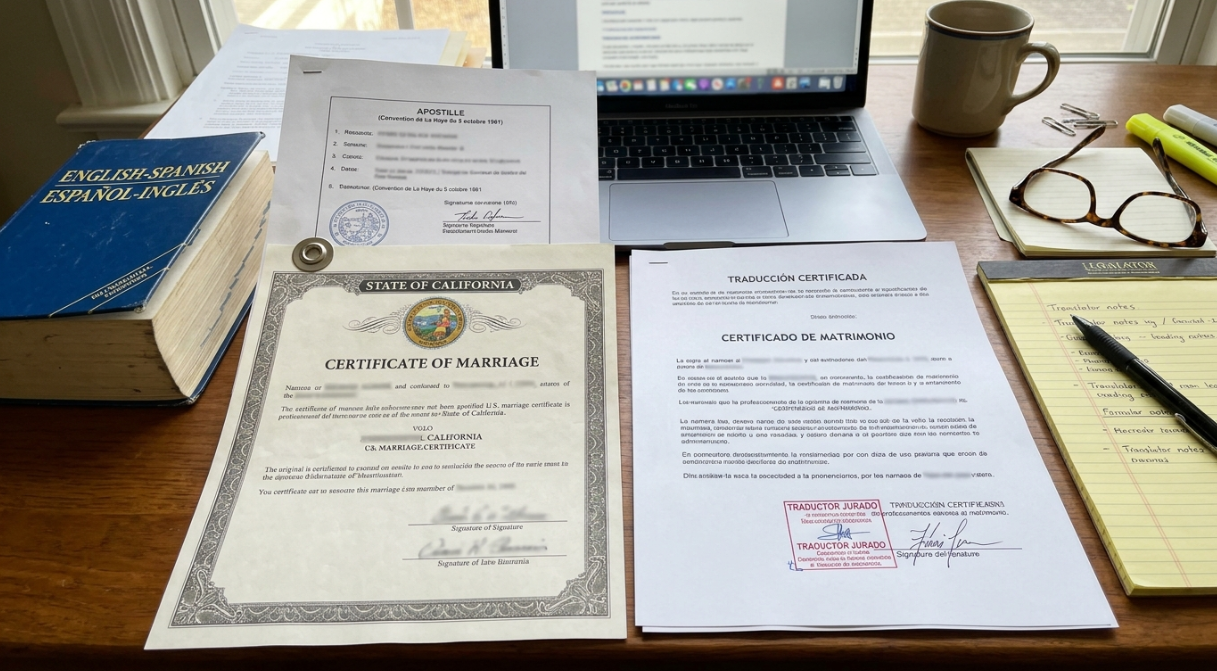
If the destination authority requires a translation, arrange it according to its specific instructions before submitting the completed documents.
How Much Does an Apostille Marriage Certificate Cost in 2026?
The cost of an apostille marriage certificate depends on the state issuing the document, the authentication method, and whether you use a third-party service.
Your total expense may include:
The cost of obtaining a certified marriage certificate
The state apostille or authentication fee
County verification or certification fees, if required
Shipping and return delivery
Certified translation fees
Third-party processing or expedited service fees
Examples of State Apostille Fees
The following examples illustrate how state fees can differ. These are government authentication fees, not necessarily the total cost of obtaining and delivering an apostilled marriage certificate.
State | Published Authentication Fee | Additional Considerations |
|---|---|---|
Michigan | $1 per document | Return postage is separate |
Utah | Varies by submission method | Different fees apply to paper, in-person, and digital requests |
Always confirm the latest fee directly with the relevant state authority before submitting your application.
What Does an Apostille Service Cost?
Using a professional apostille service generally costs more than submitting documents yourself because the provider may handle document collection, government submission, tracking, and delivery.
Your total cost depends on:
Standard or expedited processing
Number of documents
Whether you need a certified copy
Domestic or international shipping
Translation or additional legalization requirements
If you want assistance with the process, compare the total service price with the cost of handling each step independently.
Courtly provides document legalization services for people who need assistance preparing and processing documents for international use. You can also review Courtly's pricing before choosing a service.
How Long Does It Take to Apostille a Marriage Certificate?
The time required to apostille a marriage certificate depends on the issuing state, submission method, document verification requirements, and delivery destination.
There is no single nationwide processing time. Some authentication offices process requests within a few business days after receiving the documents, while mail delivery and additional verification can extend the overall timeline.
Apostille Processing Time by Submission Method
Submission Method | What Affects Processing Time |
|---|---|
In-person application | Appointment availability, document eligibility, and office processing |
Mail-in application | Incoming mail, application review, processing queue, and return shipping |
Online application | Document verification, electronic processing, and eligibility |
Third-party apostille service | Provider handling time, government processing, and delivery |
International delivery | Customs clearance and destination-country postal services |
What Can Delay an Apostille Application?
Several issues can increase the processing time:
Incorrect document: The certificate does not meet the state's authentication requirements.
Missing county certification: An additional verification step is required.
Incomplete application: Required forms, payment, or destination information are missing.
Government processing delays: The authentication office has a high volume of requests.
International shipping: Customs and cross-border delivery add time.
Translation requirements: Additional translation or certification must be completed before submission to the receiving authority.
How Can You Get an Apostille Faster?
If you have a deadline for immigration, foreign marriage registration, or another legal process, consider these steps:
Request a certified marriage certificate before beginning the apostille application.
Check whether the state offers appointments or eligible online processing.
Verify that your certificate does not require additional county certification.
Use a trackable shipping method when mailing documents.
Confirm whether the destination authority requires a translation.
Ask the authentication office about its current processing schedule.
If you use a professional service, ask whether its quoted processing time includes government processing and international delivery or only the provider's handling time.
Does an Apostille Marriage Certificate Expire?
An apostille generally does not have an expiration date. Once issued, the apostille does not automatically become invalid after a certain number of months or years.
However, the government agency, immigration office, court, or civil registry receiving your marriage certificate may require a recently issued certified copy.
This means an apostille can remain valid while the underlying marriage certificate may no longer meet the receiving institution's document-age requirements.
Does an Old Marriage Certificate Need a New Apostille?
Not necessarily. Whether you need a new document or apostille depends on the receiving authority's requirements.
Before ordering another apostille, ask:
Does the receiving authority accept an older certified marriage certificate?
Does it require the certificate to have been issued within the last three or six months?
Must the apostille itself have been issued recently?
Does it require the original physical document or accept an electronic apostille?
If the institution requires a recently issued certificate, obtain a new certified copy and arrange authentication as necessary.
Can You Apostille an Online Marriage Certificate?
Yes. A marriage certificate issued following a legally performed online marriage can generally be submitted for apostille processing if it meets the issuing state's document requirements.
The important distinction is that the apostille process authenticates the official document. It does not determine whether the destination country recognizes the marriage.
How Does an Online Marriage Apostille Work?
Utah is an important example because Utah County permits eligible couples to obtain marriage licenses and participate in remote wedding ceremonies.
After the marriage is legally recorded, the couple can obtain an official certified marriage certificate.
The general process is:
Complete the legally required online marriage process.
Ensure the marriage is officially recorded by Utah County.
Obtain the appropriate certified marriage certificate.
Determine the authentication requirements of the destination country.
Submit the document through the Utah authentication process.
Receive the apostille or applicable authentication certificate.
Does an Apostille Make an Online Marriage Valid Worldwide?
No. An apostille confirms the authenticity of the marriage certificate's official origin. It does not guarantee that every foreign government will recognize the marriage.
The destination country may have separate rules concerning:
Remote or online marriage ceremonies
Whether either spouse must be physically present
The legal capacity of both spouses to marry
Foreign marriage registration
Immigration and spousal visa eligibility
Translation and document submission
Before relying on an online marriage certificate for immigration or civil registration, check the requirements of the receiving authority.
For more information, read Courtly's guides to getting married online, international online marriage, and whether online marriage is legal.
Marriage License vs. Marriage Certificate: A Critical Distinction
Only one of these documents can be apostilled, and it’s not the one most people think of first.
A marriage license is the permission slip. It’s the document that authorizes you to get married. A marriage certificate is the proof. It’s the official record created after the ceremony confirming the marriage took place.
Marriage certificates are vital records and are eligible for apostille certification. Marriage licenses are not. If you send a marriage license to the Secretary of State requesting an apostille, it will be rejected.
Marriage certificates also do not require notarization before apostille. They already carry the registrar’s official signature and seal, which is what the apostille process verifies. For a more detailed comparison, Courtly has a guide on marriage license vs. marriage certificate.
e-Apostille: The Digital Option
An e-Apostille is an apostille issued in electronic form that carries an electronic signature with a digital certificate. It authenticates the origin of a public document for use abroad. Some states now offer this as an option.
However, there are two major caveats.
First, not all Hague Convention member states accept e-Apostilles. Some require the physical apostille and the underlying paper document. You should confirm acceptance with the specific agency or institution that will receive your document before ordering an e-Apostille.
Second, and this is the bigger issue, vital records (including birth, death, marriage, and adoption certificates) are not eligible for e-Apostille services in some states. Connecticut, for example, explicitly excludes vital records from its e-Apostille program. Check your state’s rules before assuming digital is an option for your marriage certificate.
Common Mistakes to Avoid
Sending to the wrong state. The apostille must come from the state that issued your marriage certificate. If you were married in Utah through an online marriage but live in California, you submit to Utah, not California.
Submitting photocopies. Only certified originals get apostilled. A photocopy, even a notarized one, will be rejected.
Confusing the license with the certificate. The license is pre-ceremony permission. The certificate is the post-ceremony record. Only the certificate gets apostilled.
Detaching the apostille. Once the apostille is attached to your certificate, the two documents function as a single unit. Separating them voids the apostille entirely.
Ignoring e-Apostille limitations. Some foreign agencies reject electronic apostilles. Verify before ordering.
Submitting an expired certified copy. Some states place restrictions on how old a certified marriage certificate can be when submitted for apostille. If your copy is several years old, you may need to request a fresh one.
Assuming the apostille validates your marriage. It doesn’t. It validates the document. If a foreign government questions the validity of your marriage itself (for example, because it was performed under laws they don’t recognize), the apostille won’t help with that argument.
FAQ
Does an apostille prove my marriage is valid in another country?
No. An apostille only proves the marriage certificate document is genuine. It verifies the signature and seal of the issuing authority. Whether the foreign country recognizes the marriage itself depends on that country’s laws.
How long is an apostille valid?
Apostilles don’t expire. However, some receiving institutions or foreign governments may require that the underlying marriage certificate be a recently issued certified copy. Check with the destination institution for their requirements.
Can I use the same apostilled marriage certificate in multiple countries?
Yes. An apostille is not country-specific. Once your marriage certificate is apostilled, it’s valid for use in any Hague Convention member state.
What if the country I need isn’t in the Hague Convention?
You’ll need an authentication certificate instead, which involves additional steps through the U.S. Department of State and the embassy or consulate of the destination country. Courtly’s document legalization service can handle both apostilles and embassy authentications.
Can two foreigners apostille a marriage certificate from a U.S. online marriage?
Yes. If two foreign nationals were married online through Utah, the resulting marriage certificate is a standard Utah vital record. It goes through the same apostille process as any other Utah certificate.
Do I need to translate my apostilled marriage certificate?
If the destination country’s official language isn’t English, a certified translation is usually required. Some institutions accept the apostille in its original form but require the certificate itself to be translated. Always confirm with the receiving agency.
How is an apostille physically attached to the certificate?
It varies by state. Some states attach a separate page to the certificate. Others use a stamp or sticker. Regardless of the method, never separate the apostille from the certificate, or it becomes invalid.
Let us handle the paperwork.
Getting married is complicated. Courtly simplifies the process and provides everything necessary to get married online, including providing a licensed officiant who can perform a remote ceremony.
Get Married

Get married online.
Getting married is complicated. Courtly simplifies the process and provides everything necessary to get married online.

