

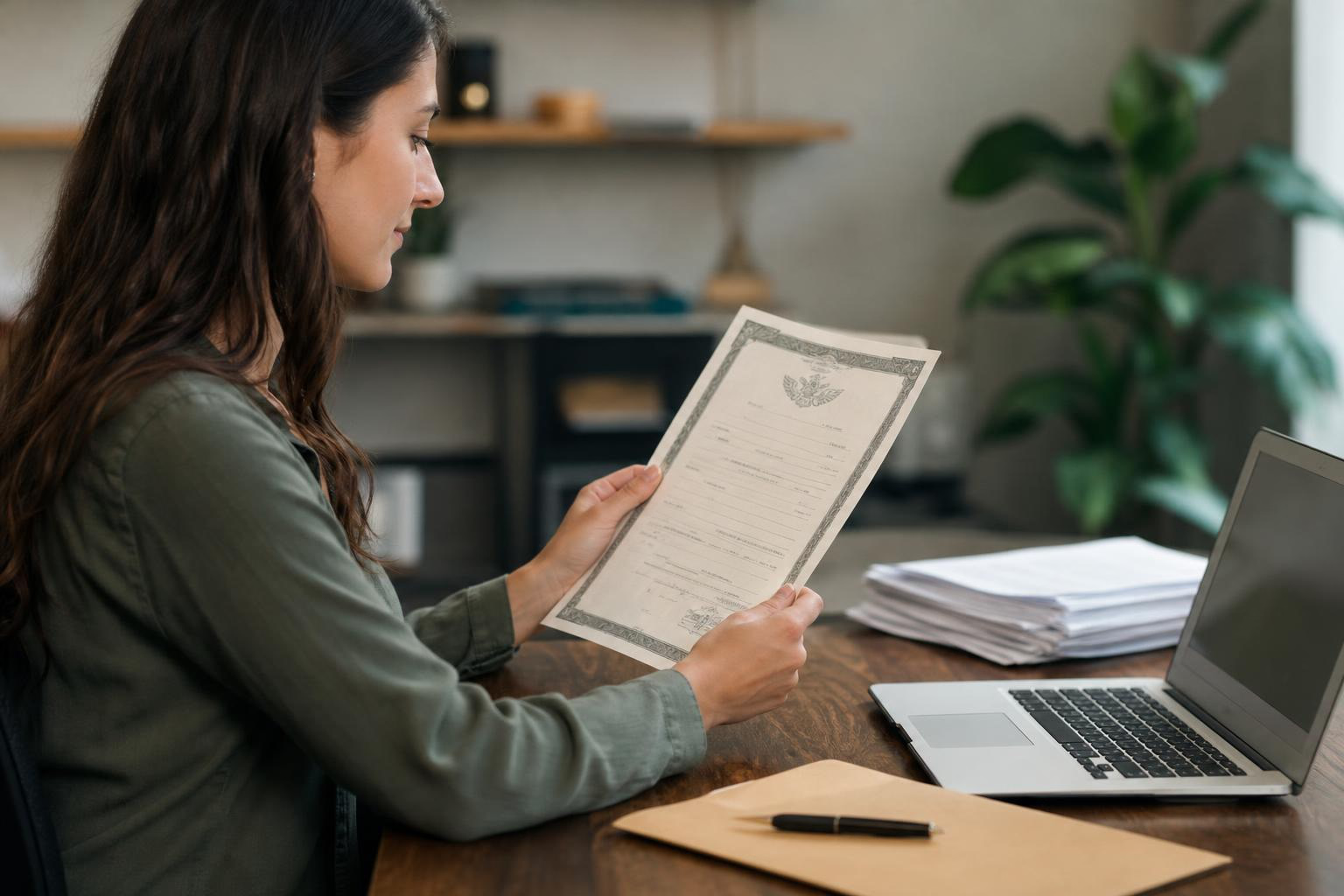
To apostille a US marriage certificate, you need a certified copy from the county clerk or vital records office where you married, then submit it to the Secretary of State (or equivalent office) in that same state. The apostille authenticates your document for use in any of the 130 countries that are part of the Hague Apostille Convention. State fees range from $1 to $40, and processing takes anywhere from a few days to six weeks depending on the state and method. If your destination country is not a Hague member, you need a different process called authentication.
How Do You Apostille a US Marriage Certificate?
To apostille a US marriage certificate, first obtain a certified copy from the county clerk or vital records office that holds your marriage record. Next, confirm that the country where you will use the document accepts apostilles, then submit the certified certificate to the designated apostille authority in the issuing state. The authority verifies the signature and seal and attaches an apostille certificate. If the destination country does not accept the Apostille Convention for that document, you may need state authentication, U.S. Department of State authentication, and embassy legalization instead.
Quick answer: You generally need a certified marriage certificate, the correct state apostille authority, an application form, the applicable fee, and a return shipping method. An apostille authenticates the document's origin; it does not guarantee that another country will recognize your marriage.
What Documents Do You Need to Apostille a US Marriage Certificate?
Before applying for an apostille, prepare the documents and information required by the apostille authority in the state where your marriage certificate was issued.
Most applicants should prepare the following:
Requirement | What You Need |
|---|---|
Certified marriage certificate | An official certified copy issued by the county clerk or state vital records office |
Destination country | The country where you intend to submit the marriage certificate |
Apostille application | The application form required by the issuing state's competent authority |
Processing fee | The applicable state apostille fee and any service charges |
Return shipping | A prepaid return envelope or approved delivery method, if submitting by mail |
Translation | A certified or officially accepted translation if required by the destination country |
Additional certification | Any preliminary county or state certification required by the issuing state |
Do You Need to Notarize a Marriage Certificate Before Apostille?
Usually, no. An official certified marriage certificate is a public record and generally does not need to be notarized before apostille. Notarizing the original vital record can actually make it unsuitable for the standard apostille process.
However, document requirements differ between states. Some jurisdictions require an additional county clerk certification or verification of the registrar's signature before issuing the apostille.
Always check the instructions of the competent authority before submitting your documents.
What Is an Apostille, and Why Does Your Marriage Certificate Need One?
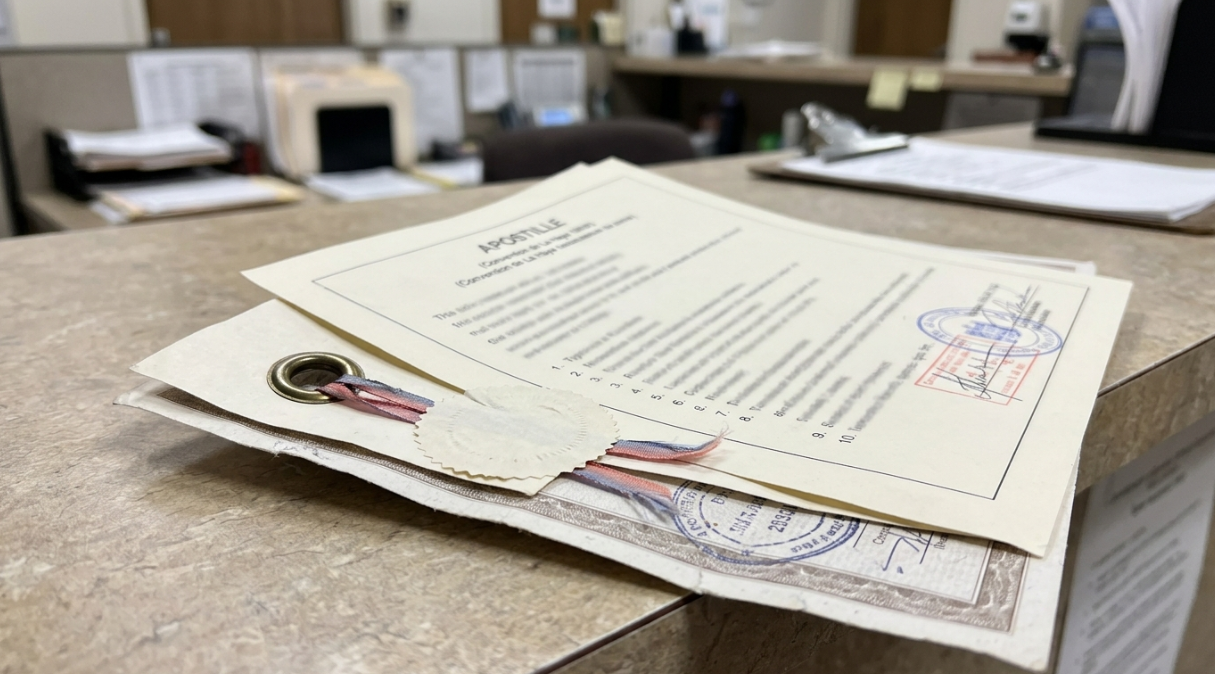
An apostille is a certificate issued under the Hague Convention of 1961 that verifies the signature and seal on a public document so it can be accepted in another member country. Think of it as an international stamp of authenticity. When a foreign government asks you to “apostille your marriage certificate,” they want proof that the document is a genuine public record issued by a U.S. authority.
Here’s a distinction that trips people up: an apostille does not validate your marriage. It doesn’t confirm that your union is legal or recognized. It only confirms that the document itself is real, that the signature on it belongs to an actual government official, and that the seal is legitimate. The receiving country decides whether to recognize the marriage.
As of September 2026, 130 countries are members of the Apostille Convention. Recent additions include Saudi Arabia (2022), China (2024), Canada (2024), UAE (2025), and Algeria (2026). Vietnam’s accession takes effect in September 2026. This means the list of countries requiring the longer, more expensive embassy legalization process keeps shrinking.
If you need an apostille because you got married online through a Utah-based service and plan to use your certificate abroad, the process is straightforward but does require some patience and attention to detail.
Who Needs an Apostille on a Marriage Certificate?
You probably need to apostille your US marriage certificate if you fall into one of these situations:
Immigration and spousal visas. Filing a CR-1 or IR-1 spouse visa with USCIS often requires an apostilled marriage certificate, especially when submitting documents to a foreign consulate. Couples pursuing an online marriage for immigration purposes should plan for this step early.
Registering your marriage abroad. Many countries require foreign marriages to be registered locally before they carry legal weight. The registration office will almost always demand an apostilled certificate.
Name changes in a foreign country. If you’re changing your surname after marriage and live overseas, the local civil authority needs proof of your marriage, authenticated through an apostille.
Dual citizenship applications. Some countries grant citizenship through marriage, but the application requires an apostilled marriage certificate as part of the documentation.
Military spouse benefits. Service members stationed overseas may need apostilled documents for base housing, SOFA agreements, or local legal matters. Practitioners on Reddit confirm that military families frequently use Utah online marriages as a fast path to getting legally married before deployment, then handle the apostille afterward.
Property and inheritance claims. Buying property jointly in another country or establishing inheritance rights as a spouse typically requires authenticated proof of marriage.
Marriage Certificate vs. Marriage License: Which Document Gets Apostilled?
Only the marriage certificate gets apostilled. This is worth stating clearly because the confusion between these two documents causes real delays.
A marriage license is the government permit that authorizes you to marry. You get it before the ceremony. A marriage certificate is the official record proving the marriage happened. You receive it after the ceremony, and it’s issued by the county clerk or vital records office.
In Utah specifically, the license and certificate are often printed on the same document. Since 2020, Utah County documents include both “Marriage License” and “Certificate of Marriage” on the same form. Older Utah documents may be titled simply “Marriage License.” If you were married online through Utah, your document should contain both.
For a deeper breakdown of these two documents, see our guide on marriage license vs. marriage certificate.
The key point: you need the certified copy of your marriage certificate. A decorative certificate, a souvenir copy from the ceremony, or a plain photocopy will be rejected. The certified copy must include a raised seal, registrar’s signature, or official stamp from the issuing government office.
How to Apostille a US Marriage Certificate: Step by Step
Where Can You Get a US Marriage Certificate Apostilled?
You can generally get a US marriage certificate apostilled through the designated competent authority in the state or jurisdiction that issued the marriage record. In most states, this authority is the Secretary of State's office.
The correct office depends on where your marriage certificate was issued, not where you currently live.
For example:
A California marriage certificate generally goes through the California Secretary of State.
A Texas marriage certificate generally goes through the Texas Secretary of State.
A Nevada marriage certificate generally goes through the Nevada Secretary of State.
A Utah marriage certificate goes through the Utah Office of the Lieutenant Governor.
Some states require an additional certification from the county clerk or another government office before the Secretary of State can issue an apostille.
US State Apostille Offices: Where to Submit Your Marriage Certificate
Each state has a designated authority responsible for issuing apostilles on eligible public documents. In most states, this is the Secretary of State's office, although some jurisdictions use a different government department.
Use the directory below to identify the appropriate authority for your marriage certificate. Before submitting an application, check whether your state requires additional certification from the county clerk or vital records office.
Your current residence does not determine which state issues the apostille. The issuing jurisdiction of your marriage record generally determines the correct authority.
Can You Apostille a Marriage Certificate in a Different State?
Generally, you cannot take a state-issued marriage certificate to another state's apostille office simply because you live there.
The apostille authority must be able to authenticate the signature, seal, or official capacity of the person who issued or certified the document.
For example, if you married in Utah but currently live in Florida, you generally need to follow Utah's apostille procedure.
If you are unsure which office handles your document, contact the office that issued your certified marriage certificate and ask which authority can authenticate it for international use.
Step 1: Get a Certified Copy of Your Marriage Certificate
Request a certified marriage certificate from the county clerk or vital records office in the county and state where you married. If you married in Clark County, Nevada, you request it from Clark County. If you married through Utah County’s online process, you request it from Utah County.
Make sure the copy is certified. It should have an official seal (raised or stamped), a registrar’s signature, and certification language stating it’s a true copy of the record on file. Documents without these elements will be rejected.
Pro tip: Order at least three to five certified copies. You may need extras for immigration filings, foreign registration, and your own records. Some countries require multiple apostilled copies for different government offices.
If you used Courtly for your ceremony, your package includes a certified marriage certificate (digital and physical). You can use that physical certificate for the apostille process.
Step 2: Confirm Your Destination Country Is a Hague Convention Member
Before paying any fees, verify that the country where you’ll use the certificate is actually part of the Hague Apostille Convention. If it is, you need an apostille. If it isn’t, you need embassy authentication instead (covered in the next section).
Check the Hague Conference member list directly. With 130 member states as of 2026, most major countries are covered. But Qatar, Kuwait, and several African nations are still not members, meaning you’d need the longer authentication process for those destinations.
Step 3: Submit to the Correct State Authority
This is where many people waste time and money. Your marriage certificate can only be apostilled by the state where the marriage was recorded. A California marriage certificate must go to the California Secretary of State. A New York certificate must go to the New York Secretary of State.
If you married online through Utah, your certificate goes to Utah’s competent authority, regardless of where you physically were during the ceremony.
In most states, the Secretary of State handles apostilles. You can submit by mail or, in some states, walk in for same-day processing. New York has five walk-in locations. Illinois offers same-day service at counters in Chicago and Springfield.
The Utah exception: Utah does not have a Secretary of State. Apostilles are issued by the Office of the Lieutenant Governor in Salt Lake City. This is the office you’ll deal with if you have a Utah marriage certificate, including one from an online ceremony.
You can submit by mail or visit in person. There’s also a digital option through Utah’s ApostilleXpress system, launched in September 2026.
Step 4: Receive the Apostilled Document
Once processed, the Secretary of State (or equivalent) attaches the apostille certificate to your marriage certificate. For Hague Convention countries, this is all you need. No further certification, no embassy visit, no additional stamps. Your document is ready for international use.
The apostille is typically a separate page attached to the original document or, in the case of e-Apostilles, a digital certificate linked to a verification system.
Get your marriage certificate apostilled through Courtly’s document legalization add-on if you’d prefer to skip the paperwork and state office logistics.
How to Apostille a Utah Marriage Certificate
Couples who marry through Utah County, including those who complete a remote online marriage ceremony, must follow Utah's apostille procedure when they need to use their marriage certificate abroad.
Utah is different from most states because apostilles are issued by the Office of the Lieutenant Governor rather than the Secretary of State.
Step 1: Obtain Your Certified Utah Marriage Certificate
Request an official certified copy of your marriage certificate from the Utah County Clerk's Office.
Make sure you have the version accepted by the Utah apostille authority. A ceremonial keepsake or an ordinary digital printout should not be assumed to qualify.
Step 2: Check the Destination Country's Requirements
Confirm that the country where you plan to use your marriage certificate accepts a US apostille.
Also ask the receiving authority whether it requires:
A physical apostille or accepts an e-Apostille
A recently issued certified marriage certificate
A certified translation
Additional documentation for foreign marriage registration or immigration
Step 3: Submit Your Document to Utah's Lieutenant Governor
Submit your certified marriage certificate using an approved application method offered by the Office of the Lieutenant Governor.
Check the current application instructions, accepted payment methods, processing options, and delivery requirements before submitting.
Step 4: Receive and Verify Your Apostille
After the application is approved, the apostille authority issues an apostille linked to the authenticated document.
Check that the certificate and apostille are complete and that the names and other relevant details are accurate before sending them to the receiving institution.
For couples who married online through Utah County, the apostille process is generally the same as for other eligible Utah marriage records. The fact that the ceremony took place remotely does not automatically create a separate apostille procedure.
The office: Utah Office of the Lieutenant Governor, 350 N. State Street, Suite 220, Salt Lake City, UT 84114.
Three submission options in 2026:
Method | Fee | Estimated Time |
|---|---|---|
Mail-in | $5 | 2-4 weeks |
In-person (same day) | $20 | Same day |
Digital (ApostilleXpress) | $74.95 (includes vendor fee) | Varies |
The mail-in fee dropped significantly in July 2026, from $19 down to $5. The digital apostille option carries a steep convenience premium at $74.95, but it’s useful for couples who need speed and don’t live near Salt Lake City.
Important: The apostille process for Utah is not available online through the state itself (outside the ApostilleXpress digital system). Even if you were married virtually, you need a physical certified copy of your marriage certificate to process a paper apostille. The documents must be carried or shipped to the Lieutenant Governor’s office.
Backlog warning: Because Utah County online marriages have become extremely popular, the apostille queue has become backlogged. Practitioners report wait times of four to five weeks for the mail-in process. Plan accordingly, especially if you have immigration deadlines or a visa interview approaching.
Utah’s digital apostille pilot issued over 1,200 digital apostilles with a 100% acceptance rate before the state fully launched the system in September 2026. However, some receiving countries still require a physical apostille. Confirm acceptance with the institution or government office that will ultimately review your document.
How to Use an Apostilled US Marriage Certificate in Another Country
After receiving your apostilled marriage certificate, the next step is preparing it for submission to the government office, immigration authority, court, or other institution requesting proof of your marriage.
The apostille authenticates the origin of the public document. However, the receiving country determines whether the marriage certificate meets its requirements for registration, immigration, or other legal purposes.
1. Check Whether a Translation Is Required
If the receiving country does not accept English-language documents, you may need an officially certified translation of the marriage certificate and apostille.
Ask the receiving authority whether the translation must be completed by a sworn translator, certified translator, or locally authorized translation service.
2. Confirm Whether a Recent Certificate Is Required
An apostille does not automatically expire. However, the receiving institution may require the underlying marriage certificate to have been issued within a specified period.
For example, an immigration office or civil registry may request a newly issued certified copy even if your existing apostille is valid.
3. Check Whether Additional Documents Are Required
Some countries require more than an apostilled marriage certificate. Depending on the purpose, you may also need:
Identification documents
Birth certificates
Proof of previous marriage termination
Passport copies
Local registration forms
Certified translations
Additional evidence requested by the receiving authority
4. Confirm That the Marriage Can Be Recognized
An apostille does not establish that a marriage is legally recognized in every country.
The receiving country applies its own marriage, immigration, family law, and civil registration rules. This is particularly important for couples who married online or whose marriages involve legal circumstances that differ from local requirements.
Before paying for an apostille, confirm both the document authentication requirements and the legal recognition requirements with the institution that will receive your certificate.
Apostille vs. Authentication: When Your Country Isn’t in the Hague Convention
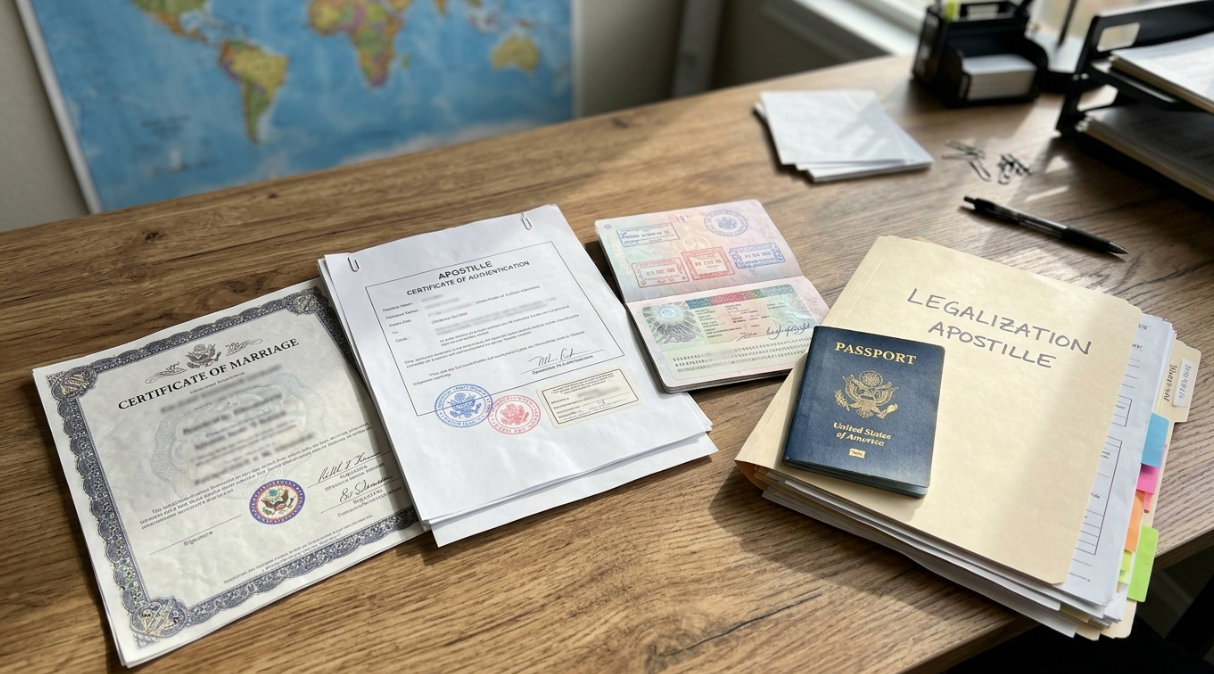
If your destination country is not a Hague Convention member, you cannot use an apostille. Instead, you need a process called authentication (sometimes called embassy legalization). This is a longer, more expensive road.
The authentication chain has three steps:
State certification from the Secretary of State (or equivalent) in the state where the marriage was recorded
Federal authentication from the U.S. Department of State’s Office of Authentications in Washington, D.C.
Embassy legalization at the consulate or embassy of the destination country
The U.S. Department of State currently processes mail-in authentication requests within five weeks from the date received. Walk-in requests are limited to one per day (maximum 15 documents) and take about seven business days. Workforce shortages have pushed mail processing times to eight to ten weeks in some periods.
For a detailed comparison, our guide on apostille vs. authentication breaks down when each process applies and what to expect.
One of the most common mistakes is ordering an apostille when you actually need authentication. If you send your document to the Secretary of State for an apostille but your destination country isn’t a Hague member, you’ve wasted time and will need to start the authentication chain from scratch.
Courtly offers a document legalization service that handles both apostille and embassy authentication pathways, so you don’t have to navigate this yourself.
State Fees and Processing Times: What to Expect in 2026
Fees and timelines vary wildly across states. Here’s a snapshot of current data:
Selected State Apostille Fees
State | Fee per Document |
|---|---|
Michigan | $1 |
Illinois | $2 |
Arizona | $3 |
Colorado | $5 |
Utah (mail-in) | $5 |
Massachusetts | $6 |
Florida | $10 |
New York | $10 |
Kansas | $10 |
Texas | $15 |
California | $20 |
Nevada | $20 |
Utah (in-person) | $20 |
New Jersey | $25 |
Connecticut | $40 |
Fees change frequently. Utah cut its mail-in fee from $19 to $5 in July 2026. Kansas raised its fee to $10 in March 2026. Always verify the current fee on the state’s official website before mailing anything.
Processing Time Estimates (2026)
State | Estimated Mail Processing |
|---|---|
Utah | 2-4 weeks |
California | 3 weeks |
Florida | 3-5 weeks |
Texas | 5-6 weeks |
New York | Varies (walk-in available) |
Florida and Texas have seen significant delays in 2026, with mail processing stretching well beyond a month. If you’re in a rush, check whether your state offers walk-in or expedited processing.
Third-Party Service Costs
If you’d rather not handle the process yourself, third-party apostille services typically charge $70 to $200 on top of the state fee. All-inclusive services (where they obtain the certified copy and handle the submission) often quote $120 to $200 per document. Courtly’s apostille add-on starts at $50 plus shipping for customers who married through the platform, with expedited options available.
The e-Apostille: A Digital Option
Several U.S. states now issue electronic apostilles, known as e-Apostilles. As of 2026, states offering this option include Kentucky, Minnesota, Washington, Connecticut, Montana, Rhode Island, and Utah.
Utah’s e-Apostille system launched fully in September 2026 after a successful pilot. The digital apostille costs $74.95 (including the vendor platform fee), which is substantially more than the $5 mail-in fee. The tradeoff is speed and the elimination of physical mail.
There are caveats. Connecticut, for example, does not allow e-Apostilles for vital records like marriage certificates, meaning those documents still require a paper apostille. And while many Hague Convention members accept e-Apostilles, some countries and specific government offices still demand the physical document. Before opting for a digital apostille, confirm with the end user of your document that they’ll accept it.
For additional background, read our overview of apostilles and how they work in different contexts.
Common Mistakes That Delay or Derail the Apostille Process
After processing thousands of marriage certificates, these are the errors that come up most often:
1. Using the wrong document. The number one cause of rejection. A decorative certificate, a photocopy, or an uncertified printout won’t work. You need an official certified copy with a seal and registrar’s signature from the county clerk or vital records office.
2. Sending to the wrong state. If you married in Utah but live in Texas, your apostille comes from Utah, not Texas. The apostille must come from the state that issued the certificate.
3. Not checking Hague Convention membership first. Ordering an apostille for a non-Hague country means you’ve paid for a service you can’t use. Check the membership list before you start.
4. Submitting an outdated certificate. Some states impose recency requirements. Virginia, for example, requires that marriage certificates be no older than 12 months from the date of issue. If your certificate is too old, you’ll need to request a fresh certified copy.
5. Ignoring spelling errors on the certificate. If there’s a typo in a name or date on the original certificate, fixing it after the apostille is attached means starting the entire process over. Check every detail before submitting.
6. Adding unnecessary notarization. Marriage certificates are vital records. They don’t need to be notarized before apostille. Adding a notary layer can confuse the issuing office and cause delays.
7. Underestimating processing times. Especially in Florida and Texas, where mail-in times have ballooned to over a month in 2026. If you have an immigration interview or foreign filing deadline, build in extra buffer time.
Key Glossary Terms
Term | Definition |
|---|---|
Apostille | A certificate issued under the Hague Convention of 1961 that authenticates the signature and seal on a public document for use in another member country |
Hague Apostille Convention | The 1961 international treaty (130 member states as of 2026) that simplifies document authentication between participating countries |
Certified copy | An official reproduction of a marriage record from the county clerk or vital records office, bearing the registrar’s signature and seal |
Secretary of State | The state office that issues apostilles in most U.S. states (exceptions include Utah, where the Lieutenant Governor’s Office handles it) |
Authentication | A multi-step certification for use in non-Hague countries, requiring state certification, U.S. Department of State verification, and embassy legalization |
Embassy legalization | The final step in the non-Hague authentication chain, where the destination country’s embassy or consulate verifies the document |
e-Apostille | An electronic or digital apostille currently offered by a handful of U.S. states, including Utah, Kentucky, and Connecticut |
Marriage certificate | The certified record proving the marriage occurred, different from the marriage license |
Marriage license | A government-issued permit authorizing a couple to marry, obtained before the ceremony |
Competent authority | The office designated by each state to issue apostilles (Secretary of State in most states, Lieutenant Governor in Utah) |
Frequently Asked Questions
Does an apostille expire?
An apostille itself does not expire. However, some receiving countries or institutions may require that the underlying marriage certificate be recently issued (within 6 or 12 months). Check with the specific foreign office that will review your document.
Can I get an apostille from a different state than where I married?
No. The apostille must come from the state that issued the marriage certificate. If you married in Utah, you go through the Utah Lieutenant Governor’s Office, even if you currently live in another state.
How many certified copies of my marriage certificate should I order?
At least three to five. You may need separate apostilled copies for immigration applications, foreign marriage registration, and your personal records. Some countries require multiple originals for different government departments.
Can I apostille a marriage certificate from an online Utah ceremony?
Yes. A marriage certificate from a Utah online marriage is a standard Utah vital record. It goes through the same apostille process as any other Utah marriage certificate, handled by the Office of the Lieutenant Governor.
Does my marriage certificate need to be translated before getting apostilled?
No. The apostille is applied to the English-language certified copy. However, the receiving country may require a certified translation of both the certificate and the apostille. Translation happens after the apostille is attached, not before.
What if my destination country isn’t in the Hague Convention?
You’ll need the full authentication chain: state certification, then U.S. Department of State authentication, then embassy legalization. This process takes significantly longer (often 8 to 10 weeks or more for the federal step alone). Our document legalization page covers both pathways.
Is the apostille process different for same-sex marriages?
No. The apostille process is identical regardless of the couple’s genders. The apostille authenticates the document, not the marriage itself. However, recognition of same-sex marriages varies by country, so check whether your destination country will accept the marriage even with a valid apostille. Our guide on same-sex online marriage covers recognition issues in detail.
How much does the entire process cost from start to finish?
For a DIY approach, expect to pay roughly $10 to $30 for certified copies plus $1 to $40 for the state apostille fee, plus postage. Total out-of-pocket for a simple mail-in apostille is typically under $75. Third-party services add $70 to $200 for handling. If you need the non-Hague authentication chain, costs increase substantially due to federal fees and embassy charges.
Knowing how to apostille a US marriage certificate saves you from costly mistakes and unnecessary delays. Whether you’re filing for a spousal visa, registering your marriage in your partner’s home country, or establishing legal rights abroad, the apostille is your bridge between a US public record and international acceptance. If you’re still in the planning stages, consider how Courtly’s online marriage process can get you from ceremony to apostilled certificate with minimal friction.
Let us handle the paperwork.
Getting married is complicated. Courtly simplifies the process and provides everything necessary to get married online, including providing a licensed officiant who can perform a remote ceremony.
Get Married

Get married online.
Getting married is complicated. Courtly simplifies the process and provides everything necessary to get married online.

