


If you need to use a U.S. marriage certificate in another country, you’ll go through one of two processes: an apostille (for countries in the Hague Convention) or authentication plus embassy legalization (for countries outside the Convention). The destination country determines which path applies. An apostille is faster and cheaper, typically costing under $40 and taking a few weeks. Authentication and legalization involves multiple agencies, runs $250 to $500+, and can take 6 to 12 weeks.
If you need to use a U.S. marriage certificate in another country, you may need an apostille or authentication followed by embassy legalization. The correct process depends primarily on whether the destination country is a member of the Hague Apostille Convention.
An apostille is generally used for countries that participate in the Convention. Authentication and embassy legalization are typically required for countries outside the Convention. Both processes verify the authenticity of the official signature and seal on your marriage certificate, but they follow different procedures.
Choosing the wrong process can result in rejected documents, additional fees, and processing delays. This guide explains the differences, costs, processing times, requirements, and steps for preparing a U.S. marriage certificate for international use.
Quick Answer: Apostille vs. Authentication for a Marriage Certificate
An apostille is used to authenticate a U.S. marriage certificate for countries that are members of the Hague Apostille Convention. Authentication followed by embassy legalization is generally required for countries that are not members. The apostille is issued by the appropriate state authority, while the non-Hague process involves state authentication, U.S. Department of State authentication, and legalization by the destination country's embassy or consulate. Always check the receiving country's requirements before submitting your document.
If you married online through Utah and need your certificate prepared for international use, Courtly offers apostille and legalization services as part of its post-wedding support.
What Is an Apostille?
An apostille is a certificate issued by a state authority (typically the Secretary of State, or in Utah’s case, the Lieutenant Governor) that verifies the signature and seal on a public document. It was created under the Hague Apostille Convention of 1961 to simplify cross-border document verification.
The key idea: countries that participate in the Convention agreed in advance to accept an apostille as sufficient proof of a document’s authenticity. No further steps are needed beyond the apostille itself.
A few important properties:
Standardized format. Every apostille follows the same layout regardless of which state or country issues it.
Not country-specific. A single apostille on your marriage certificate can be used in any Hague member country, not just one destination.
Does not expire. The apostille itself has no expiration date, though some receiving countries may want a recently issued certified copy of the underlying certificate.
Verifies the signature, not the marriage. The apostille confirms that the official who signed your certificate is authorized to do so. It doesn’t validate whether the marriage itself meets a foreign country’s domestic requirements.
As of mid-2026, approximately 130 countries are contracting parties to the Apostille Convention. Notable recent additions include China, Canada (2024), India (February 2025), Vietnam, and Algeria. If your destination is on this list, the apostille is all you need.
For a deeper look at how apostilles work, see all about apostilles.
What Is Authentication (and Embassy Legalization)?
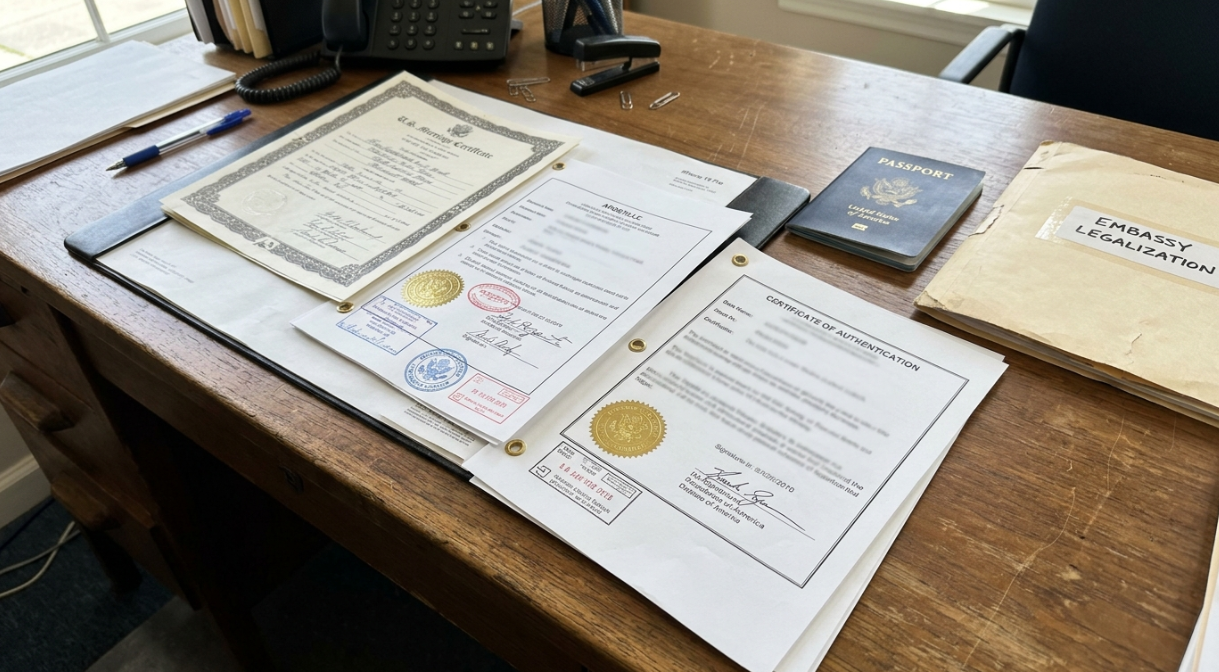
If your destination country is not a member of the Hague Convention, an apostille will not be accepted. Instead, you need a multi-step process called authentication followed by embassy legalization.
Here’s how it differs from an apostille: rather than one certificate from one authority, your marriage certificate passes through a chain of verifications. Each agency in the chain confirms the legitimacy of the previous one’s signature and seal.
The authentication certificate that a Secretary of State issues looks different from an apostille. It has no standardized format because it exists outside the Hague framework. And unlike an apostille, it’s not self-sufficient. It must be followed by federal authentication at the U.S. Department of State, then by legalization at the embassy or consulate of the destination country.
Roughly 70 countries remain outside the Hague Convention and require this full chain.
Apostille vs. Authentication for a Marriage Certificate: Key Differences
The main difference between an apostille and authentication is the destination country's participation in the Hague Apostille Convention. An apostille simplifies international document verification into one standardized certification, while authentication and embassy legalization involve multiple verification stages.
Comparison | Apostille | Authentication + Embassy Legalization |
|---|---|---|
When required | Destination country is a Hague Convention member | Destination country is not a Hague Convention member |
Main purpose | Verifies the origin of a public document | Verifies the origin through a chain of government certifications |
State authority | Secretary of State or designated state authority | Secretary of State or designated state authority |
Federal authentication | Generally not required | Usually required for U.S. documents |
Embassy legalization | Not normally required | Generally required |
Certificate format | Standardized Hague apostille | Varies by issuing authority and embassy |
Processing steps | Usually fewer steps | Multiple verification stages |
Cost | State fees and any service or shipping charges | State, federal, embassy, service, and shipping fees |
Processing time | Depends on state processing and delivery | Depends on state, federal, and embassy processing |
International acceptance | Participating Convention countries | The specific destination country |
Important: Neither certification automatically guarantees that a foreign government will recognize the marriage itself. An apostille or authentication certificate verifies the origin of the official document, not the legal effect of the marriage under foreign law.
This is why understanding the difference between apostille and authentication for your marriage certificate matters before you spend a dime.
How to Know Which Process You Need
The decision tree is straightforward:
Step 1: Identify the country where you’ll use your marriage certificate.
Step 2: Check whether that country is a party to the Hague Apostille Convention.
Step 3:
If yes, you need an apostille.
If no, you need authentication + embassy legalization.
A few countries that recently joined the Convention catch people off guard. Canada joined in 2024, so Canadian immigration and government agencies now accept apostilled U.S. documents. India joined in February 2025. If you’re preparing documents for either country, you no longer need the full legalization chain.
For couples using their marriage certificate for immigration purposes, getting the right type of certification is especially critical. A rejected document can delay visa processing by months.
Wondering whether a specific country will recognize your online marriage? Recognition and document certification are separate questions, but both matter.
Which Countries Accept an Apostille on a U.S. Marriage Certificate?
Countries that are parties to the Hague Apostille Convention generally accept an apostille instead of requiring the traditional embassy legalization process. As of June 30, 2026, the Convention has 130 contracting parties.
Several countries that previously required additional legalization have joined the Convention in recent years. These include:
Country | Apostille Convention effective date |
|---|---|
China | November 7, 2023 |
Canada | January 11, 2024 |
India | July 14, 2025 |
Vietnam | September 11, 2026 |
Algeria | July 9, 2026 |
Important: Membership alone does not tell you every requirement. Check whether the Convention has entered into force between the United States and your destination country, including any applicable objections or territorial extensions.
How to Check Whether Your Country Accepts an Apostille
Visit the official Hague Conference on Private International Law (HCCH) status table.
Find the country where you intend to use your marriage certificate.
Check its Convention effective date and any applicable declarations or objections.
Confirm the document requirements with the receiving government agency or embassy.
Determine whether a translation or recently issued certified copy is also required.
If your destination country is covered by the Convention, you will generally need an apostille rather than the traditional authentication and embassy legalization chain.
If the Convention does not apply, ask the destination country's embassy or consulate which authentication and legalization steps it requires.
Does an Apostille Guarantee That Another Country Will Recognize Your Marriage?
No. An apostille does not guarantee that another country will recognize your marriage. It only verifies the authenticity of the signature, seal, or official capacity associated with the public document.
There are two separate legal questions:
Document authentication: Is the U.S. marriage certificate an authentic government-issued document? An apostille or authentication certificate addresses this question.
Marriage recognition: Does the destination country's law recognize the marriage as legally valid? This depends on that country's marriage, family, immigration, and public policy rules.
For example, a couple may obtain a legally issued Utah marriage certificate and successfully receive an apostille. However, the receiving country may still have additional requirements concerning the validity or recognition of the marriage.
This distinction is especially important for couples who married online, couples of different nationalities, and same-sex couples using their marriage certificates for immigration or civil registration abroad.
Before starting the apostille process, confirm both that the destination country accepts the certification and that its relevant government agency recognizes the underlying marriage.
For more information, read our guide to online marriage recognition by country.
What Type of Marriage Certificate Can Be Apostilled or Authenticated?
Not every marriage-related document qualifies for an apostille or authentication certificate. The document generally needs to be an official public record issued or certified by the appropriate government authority.
Before submitting your marriage certificate, check the following requirements.
Document type | Usually eligible? | Explanation |
|---|---|---|
Government-issued certified marriage certificate | Yes | An official vital record that can be verified by the issuing authority |
Certified marriage record from a county clerk | Yes, subject to state requirements | Must contain the appropriate official signature or certification |
Marriage license | No, generally | It is permission to marry, not proof that the marriage occurred |
Decorative wedding certificate | No | It is not an official government vital record |
Church-issued marriage certificate | Generally no | It is not normally a government-issued public record |
Ordinary photocopy | No, generally | It lacks the required official certification |
Notarized photocopy | Depends | Acceptance depends on the issuing authority and destination requirements |
Marriage License vs. Marriage Certificate
A marriage license is the document issued before the wedding that authorizes a couple to marry. A marriage certificate is the official record created after the marriage takes place.
For international use, you generally need the completed marriage certificate, not the original marriage license.
Where to Obtain a Certified Marriage Certificate
Request a certified copy from the government office that maintains the marriage record. Depending on the state, this may be:
The county clerk's office.
The state vital records office.
Another designated government records authority.
The certificate must meet the authentication requirements of the state where it was issued. Some states also require additional county-level verification before issuing an apostille.
For more information, see our guide to marriage license vs. marriage certificate.
Step-by-Step: How to Get an Apostille for a Marriage Certificate
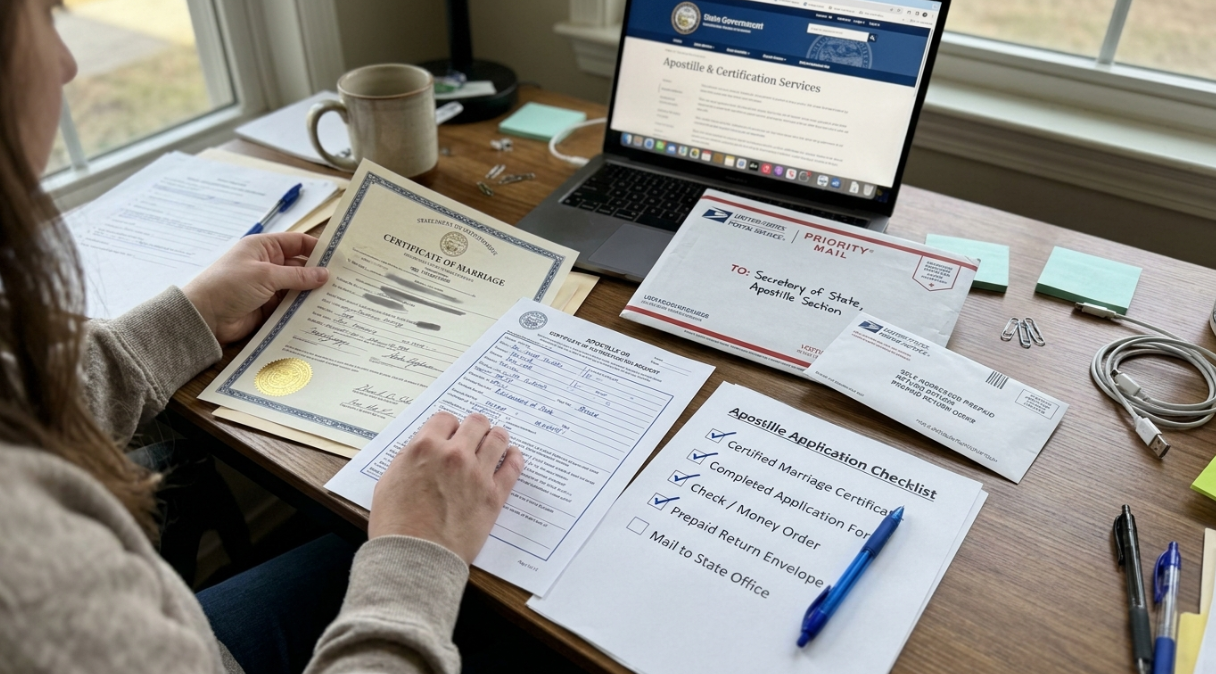
If your marriage certificate will be used in a country covered by the Hague Apostille Convention, follow these steps to obtain an apostille.
Step 1: Request an Official Certified Marriage Certificate
Contact the county clerk or state vital records office that maintains your marriage record.
Request a certified copy suitable for international authentication. Check whether the document needs an original signature, raised seal, official stamp, or additional county certification.
Step 2: Identify the Correct Apostille Authority
Submit your marriage certificate to the designated apostille authority in the state that issued or certified the document.
For most state-issued marriage certificates, this is the Secretary of State. Some states use a different designated authority.
For example, Utah uses the Office of the Lieutenant Governor to issue apostilles and authentication certificates.
Step 3: Submit the Required Application and Fee
Complete the state's apostille application and provide:
Your original or certified marriage certificate.
The destination country.
The required application form.
The applicable processing fee.
A prepaid return envelope or shipping label, if required.
Processing fees and turnaround times vary by state. Check the official authority's current instructions before mailing your documents.
Step 4: Receive Your Apostilled Marriage Certificate
The issuing authority attaches or securely associates the apostille with your marriage certificate, depending on whether it issues paper or electronic certificates.
For paper apostilles, keep the apostille attached to the original certified document. Do not remove staples, seals, or attachments.
Step 5: Arrange Translation if Required
Check whether the receiving country requires a translation of the marriage certificate and apostille.
Some authorities require translations by sworn, certified, or officially recognized translators. Others may accept translations completed under different rules.
Confirm the requirements with the receiving agency before ordering a translation.
If you got married online through Courtly and need your marriage certificate apostilled, the process starts from your Utah-issued certificate.
Step-by-Step: How to Authenticate and Legalize a Marriage Certificate
If your destination country is not covered by the Hague Apostille Convention, you will generally need an authentication certificate followed by embassy or consular legalization.
The process involves multiple government authorities.
Step 1: Obtain a Certified Marriage Certificate
Request an official certified copy from the county clerk or state vital records office that maintains the marriage record.
Make sure the certificate meets the issuing state's authentication requirements.
Step 2: Obtain State-Level Authentication
Submit the certified marriage certificate to the appropriate state authority, usually the Secretary of State or equivalent office.
Instead of an apostille for Hague Convention use, the authority issues an authentication certificate for use in a non-Hague destination.
Step 3: Obtain Federal Authentication
For state-issued U.S. documents that require the federal authentication chain, submit the state-authenticated document to the U.S. Department of State, Office of Authentications.
The federal authority verifies the relevant state official's signature before issuing its authentication certificate.
Check the Department of State's current application, mailing, and fee requirements before submission.
Step 4: Obtain Embassy or Consular Legalization
After federal authentication, submit the document to the destination country's embassy or consulate in the United States, following its specific instructions.
The embassy or consulate may require:
The original authenticated marriage certificate.
A completed legalization application.
Additional identification or supporting documents.
A translation into the destination country's official language.
A separate legalization fee.
An appointment or prepaid return envelope.
Step 5: Submit the Legalized Certificate to the Receiving Authority
Once the legalization process is complete, your marriage certificate is prepared for submission to the relevant foreign government agency.
Keep the authentication and legalization certificates attached to the marriage certificate, and follow the receiving authority's instructions for translations and document submission.
Important: The exact requirements vary by destination country. Some countries may require additional verification or have different submission procedures. Always confirm the complete process with the relevant embassy or consulate before sending your original documents.
Can You Get an Electronic Apostille (e-Apostille) for a Marriage Certificate?
An electronic apostille, commonly called an e-Apostille, is a digitally issued apostille that authenticates the origin of a public document for international use. It performs the same basic authentication function as a traditional paper apostille but uses electronic signatures and digital verification features.
However, not every state offers e-Apostilles for every document type.
For example, Connecticut began issuing e-Apostilles in July 2026, but marriage certificates and other vital records are currently excluded from its electronic apostille service. These documents must receive a traditional paper apostille.
Utah also introduced digital delivery for authentication requests in July 2026. However, digital delivery of a completed authentication document should not automatically be confused with a separate e-Apostille service.
Before requesting an electronic apostille for your marriage certificate, check three things:
Does the issuing state offer e-Apostilles for marriage certificates?
Does the receiving government agency accept the electronic format?
Can the electronic certificate be verified through an official authentication registry?
Under the Hague Apostille Convention framework, an apostille cannot be refused solely because it is issued electronically. Nevertheless, the issuing authority must be able to provide an eligible electronic document, and the receiving authority's specific document requirements should still be confirmed.
For many U.S. marriage certificates, the traditional paper apostille remains the applicable option.
How Much Does It Cost and How Long Does Marriage Certificate Authentication Take?
The cost and processing time for an apostille or authentication depend on the issuing state, the destination country, government processing fees, shipping, and whether you use a document processing service.
An apostille generally involves fewer government processing stages than authentication and embassy legalization.
Apostille vs. Authentication: Estimated Costs and Timelines
Expense or timeline | Apostille | Authentication + Legalization |
|---|---|---|
State certification | State-specific fee | State-specific fee |
Federal authentication | Generally not required | Applicable federal fee |
Embassy legalization | Generally not required | Embassy-specific fee |
Shipping | Depends on delivery method | May involve multiple shipments |
Third-party service | Optional | Optional |
Overall processing | Often days to several weeks | Can take several weeks or longer |
Utah Marriage Certificate Apostille Costs
For couples with Utah-issued marriage certificates, the Utah Lieutenant Governor's Office publishes separate fees for authentication services.
As of the published July 2025 fee schedule:
Standard apostille or authentication: $19.
Next-business-day processing: an additional $34.
Same-day processing: an additional $74.
These are state office fees, not necessarily the total cost of obtaining and delivering your document.
Utah County also offers an apostille request service. Its published ordering page lists a $30 apostille request product and a $15 processing fee, with additional charges for shipping and extra certified copies.
What Affects Processing Time?
Several factors can affect the time required:
Whether the marriage certificate is already available.
Whether the issuing state requires additional certification.
Whether you submit documents by mail or in person.
Whether expedited government processing is available.
Whether federal authentication is necessary.
Embassy appointment availability and processing times.
Domestic and international shipping.
Planning tip: Start the process well before your visa appointment, immigration filing, overseas registration, or other deadline. Do not assume that a government processing estimate includes document retrieval and shipping.
Common Mistakes That Cause Rejection
Based on patterns reported by practitioners and document processing services, these are the errors that trip people up most often:
1. Submitting the wrong certification type. Sending an apostille to a non-Hague country, or sending an authentication certificate to a Hague country, results in rejection. You lose the fees and have to start over.
2. Using the wrong certificate. Souvenir certificates, church certificates, or officiant-signed documents are not public records. No state can verify a signature that doesn’t belong to a public official.
3. Sending to the wrong state. The apostille or authentication must come from the state where the marriage was officially recorded. If you married in Utah but live in Texas, you work with Utah’s office.
4. Detaching the apostille. The apostille must remain physically attached to the marriage certificate. Separating them voids the apostille.
5. Forgetting translation requirements. Many countries accept the apostille but still require the certificate and apostille to be translated into the local language by a sworn translator. Failing to include a translation means your documents won’t be processed.
6. Assuming automatic international validity. A U.S. marriage certificate carries no inherent authority abroad. Without an apostille or authentication, foreign governments have no way to confirm it’s legitimate.
Utah Online Marriage Certificates and International Use
For couples who get married online through a Utah-based service, the marriage certificate is issued by Utah County. This makes the Utah Lieutenant Governor’s Office the relevant authority for both apostilles and authentication certificates.
Utah-issued marriage certificates are fully eligible for apostille or authentication. The process is the same as any other Utah vital record. The certificate doesn’t indicate whether the ceremony was conducted in person or online, which means it receives the same treatment from state authorities and foreign governments.
You can learn more about how the process works from application through certificate delivery.
Do You Need an Apostille for a Marriage Certificate Used for Immigration?
Whether you need an apostille for an immigration application depends on the country processing your application and the specific documents requested by its immigration authority.
Some foreign immigration agencies require an apostille on a U.S. marriage certificate to verify that it is an authentic government-issued record. Others may have different document authentication or legalization requirements.
Before submitting your marriage certificate for immigration purposes, check:
Destination country: Determine whether the country is covered by the Hague Apostille Convention.
Immigration authority: Check the specific marriage certificate requirements published by the agency handling your application.
Document age: Determine whether the agency requires a recently issued certified copy.
Translation: Confirm whether an officially recognized translation is required.
Marriage recognition: Check whether the immigration authority recognizes the type of marriage you entered into.
An apostille verifies the authenticity of the marriage certificate, but it does not guarantee approval of a spouse visa or immigration application.
For couples who married online, this distinction is particularly important. The marriage must meet the relevant legal requirements, and the receiving immigration authority must accept the marriage for the intended immigration purpose.
Read our guide to online marriage for immigration for more information.
FAQ
Does an apostille on a marriage certificate expire?
No. An apostille itself does not have an expiration date. However, some destination countries may require that the underlying certified copy of the marriage certificate be recently issued (within the last 3 to 6 months, for example). Check your destination’s specific requirements.
Can I use one apostille in multiple countries?
Yes. Because an apostille is not country-specific, a single apostilled marriage certificate can be presented in any Hague Convention member country. You don’t need a separate apostille for each destination.
How much does it cost to apostille a marriage certificate?
State fees typically range from $5 to $40 per document. In Utah, the state fee is approximately $19 to $20. If ordering through Utah County’s facilitation service, expect around $29 per document plus a $15 processing fee and shipping. Courtly offers document legalization with apostille add-ons starting at $50 plus shipping.
What if my destination country is not in the Hague Convention?
You’ll need authentication from the state, then federal authentication from the U.S. Department of State, then legalization at the destination country’s embassy. The total process typically takes 6 to 12 weeks and costs $250 to $500+.
Do I need a translation with my apostille?
It depends on the destination country. Countries like Spain, Italy, France, Portugal, Greece, and Cyprus require sworn translations of the apostilled certificate. Always verify with the destination country’s authorities before submitting.
Is a Utah online marriage certificate eligible for apostille?
Yes. A marriage certificate issued by Utah County after an online ceremony is a standard government-issued vital record. It’s processed through the Utah Lieutenant Governor’s Office exactly the same way as any other Utah marriage certificate.
What’s the difference between a marriage license and a marriage certificate for apostille purposes?
Only the marriage certificate, the post-ceremony legal record, can be apostilled or authenticated. The marriage license is the pre-ceremony application and is not eligible for either process.
Can I get an apostille faster if I’m in a rush?
Many states offer expedited processing for an additional fee. Utah’s Lieutenant Governor’s office offers same-day processing at a premium. For couples who married through Courtly, expedited apostille options are available through the document legalization service.
Can I get an apostille for a marriage certificate from a different state?
Generally, a marriage certificate must be authenticated by the competent authority in the state that issued or certified the document. For example, a Utah marriage certificate normally needs to be processed through Utah's designated authentication authority, not another state's Secretary of State.
Does a marriage certificate need to be notarized before getting an apostille?
Not usually. An official government-issued certified marriage certificate generally does not need to be notarized separately. The issuing authority must be able to authenticate the relevant public official's signature or certification. Follow the requirements of the state issuing the apostille.
Is an apostille the same as embassy legalization?
No. An apostille is a standardized certificate used under the Hague Apostille Convention. Embassy legalization is generally part of the document authentication process for countries outside the Convention and involves additional verification by the destination country's diplomatic authority.
Can I apostille a marriage certificate issued after an online wedding?
Yes, if the online marriage resulted in an official government-issued marriage certificate that meets the issuing state's authentication requirements. For example, eligible Utah County marriage certificates can be submitted to the Utah Lieutenant Governor's Office for apostille or authentication.
Does an apostille prove that my marriage is legally recognized abroad?
No. An apostille verifies the origin of the public document, including the official signature and seal. Whether another country recognizes the marriage depends on its own marriage and family laws.
Can I get an apostille without traveling to the United States?
In many cases, yes. State authorities and document processing services may accept applications by mail or through online ordering systems. The available options depend on the state that issued the marriage certificate.
How long is a certified marriage certificate valid for apostille purposes?
An apostille itself generally does not expire. However, the receiving country may require a recently issued certified marriage certificate. Check whether the receiving authority has a document-age requirement before applying.
Need Help Getting Your Marriage Certificate Apostilled?
Preparing a U.S. marriage certificate for international use can involve several steps, especially when you need to meet the requirements of a foreign government.
If you married through Courtly, you can get help preparing your Utah marriage certificate for international document authentication.
Courtly offers apostille and document legalization services to help couples navigate the process and prepare their marriage documents for use abroad.
Before ordering, confirm the destination country's requirements, including whether you need an apostille or authentication certificate, an official translation, or additional legalization.
Let us handle the paperwork.
Getting married is complicated. Courtly simplifies the process and provides everything necessary to get married online, including providing a licensed officiant who can perform a remote ceremony.
Get Married

Get married online.
Getting married is complicated. Courtly simplifies the process and provides everything necessary to get married online.

