


An apostille marriage certificate for India is a marriage certificate authenticated for official use in another country under the 1961 Hague Apostille Convention. Because India and the United States participate in the Convention, a properly apostilled U.S. marriage certificate generally does not need additional Indian embassy legalization. The process depends on where the marriage certificate was issued: U.S. certificates must be apostilled by the competent authority in their issuing state, while Indian certificates must go through India's authorized authentication process before receiving an MEA apostille.
This guide explains both processes, including required documents, government fees, processing times, online marriage certificates, OCI applications, and common reasons for rejection.
Getting an apostille marriage certificate for India is one of those processes that sounds simple until you start Googling. Suddenly you’re buried in acronyms (MEA, SDM, SOS), conflicting advice about whether you need embassy attestation, and forum threads where someone’s OCI application was delayed for months because of a missing stamp.
This glossary cuts through the noise. Whether you hold a U.S. marriage certificate that needs to work in India or an Indian marriage certificate headed abroad, every term below is defined plainly with the practical steps attached.
If you married online and need your certificate apostilled, the Utah-specific process is covered here too.
Which Apostille Process Do You Need?
The apostille process depends on the country that issued your marriage certificate, not simply the country where you currently live.
Your situation | Where to get the apostille | Competent authority |
|---|---|---|
U.S. marriage certificate for use in India | United States | Secretary of State or designated state authority |
Utah marriage certificate for use in India | Utah, USA | Utah Office of the Lieutenant Governor |
Indian marriage certificate for use in the USA | India | Ministry of External Affairs (MEA) |
Indian marriage certificate for use in another Hague Convention country | India | Ministry of External Affairs (MEA) |
U.S. marriage certificate for use in a non-Hague country | United States, followed by the required legalization process | Relevant state and federal authorities, followed by the destination country's embassy or consulate |
Important: An apostille authenticates the origin of a public document. It does not automatically establish that the marriage meets every legal, immigration, or administrative requirement of the receiving country.
How to Get a U.S. Marriage Certificate Apostille for Use in India
If you have a U.S.-issued marriage certificate and need to use it in India, you generally need to obtain an apostille from the competent authority in the state where the certificate was issued.
The apostille verifies the signature, seal, or capacity of the public official who issued or certified the document. Once properly apostilled, the certificate can generally be submitted to Indian authorities without an additional Indian embassy legalization step.
Step 1: Obtain a Certified Copy of Your Marriage Certificate
Request an official certified marriage certificate from the county clerk, state vital records office, or other government authority responsible for marriage records in the state where you married.
Make sure you have the correct document for international use. A marriage license, unofficial photocopy, or commemorative wedding certificate may not qualify.
Step 2: Check Whether Additional Authentication Is Required
Some states require an additional county-level certification or verification before the Secretary of State can issue an apostille.
Requirements differ by state. Check the issuing state's official apostille instructions before mailing or submitting your certificate.
Step 3: Apply for the Apostille
Submit the marriage certificate to the competent authority in the issuing state.
Depending on the state, applications may be accepted by mail, in person, or through an online ordering system. Include the required application form, payment, return shipping information, and any supporting documents.
Step 4: Receive the Apostilled Marriage Certificate
The competent authority attaches or issues the apostille according to its procedures. Keep the apostille and the underlying certificate together.
Step 5: Submit the Certificate to the Indian Authority
Present the apostilled certificate to the Indian government office, immigration authority, court, bank, or other institution requesting proof of marriage.
Ask the receiving authority whether it also requires a translation, a particular certificate format, or additional supporting documents.
Do you need Indian embassy legalization?
Generally, no. Since India and the United States are parties to the Hague Apostille Convention, a properly apostilled U.S. public document should not require additional consular legalization for use in India. However, the receiving institution can still impose requirements relating to the document's contents, purpose, or supporting evidence.
How to Get an Apostille on an Indian Marriage Certificate for Use Abroad
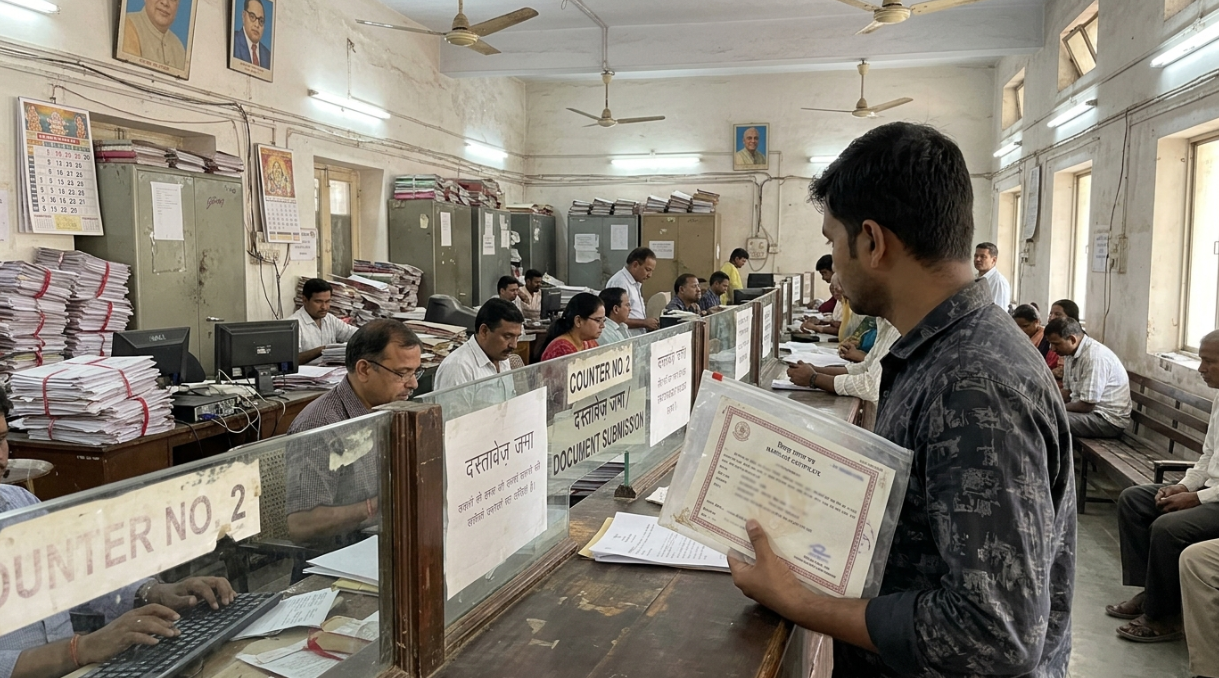
If your marriage certificate was issued in India and you need to use it in the United States or another Hague Convention country, the apostille must be obtained through India's authorized process.
The Ministry of External Affairs (MEA) is India's competent authority for issuing apostilles. Before the document reaches the MEA, it may need verification by the relevant state or union territory authority.
Step 1: Obtain an Official Marriage Certificate
Get the original marriage certificate or an eligible official certified copy from the relevant Indian marriage registrar.
Check that the names, marriage date, registration details, and issuing authority information are correct.
Step 2: Complete the Required Pre-Authentication
Indian documents generally require authentication of the issuing authority's signature through the designated state or union territory verification process.
Depending on the document and location, this may involve the State Home Department, Sub-Divisional Magistrate (SDM), or another designated authority.
Do not assume that notarization is universally required for every Indian marriage certificate. Confirm the applicable document-specific procedure with the relevant state authority or authorized submission agency.
Step 3: Submit the Document Through an Authorized Channel
The MEA uses designated outsourced service providers and authorized submission channels for receiving documents.
Submit the certificate, supporting identification, application details, and required copies according to the current instructions.
Step 4: Obtain the MEA Apostille
After the required verification, the MEA issues the apostille.
The apostille authenticates the official signature and seal associated with the document. It does not independently verify the accuracy of the marriage details.
Step 5: Submit the Apostilled Certificate Abroad
Present the apostilled marriage certificate to the relevant foreign authority.
If the destination country requires a translation, check whether it must be completed by a certified translator or follow another prescribed process.
Important: State-level procedures, submission channels, and document requirements can differ. Confirm the latest requirements before paying an agent or sending your original certificate.
Apostille
An apostille is a certificate of authenticity issued under the Hague Convention of 1961. It verifies that the signatures and seals on a public document are genuine so the document can be used in another member country.
One critical distinction people miss: an apostille does not verify the content of the document itself. It only confirms that the document was properly issued by the authority it claims to come from. The receiving country still decides whether to accept the underlying document for its intended purpose.
An apostille is not country-specific. A single apostille issued in the United States can be used in India, France, Japan, or any other Hague Convention member. You don’t need a separate apostille for each destination.
For a deeper explanation, see this guide on all about apostilles.
Hague Apostille Convention
The Hague Convention Abolishing the Requirement of Legalisation for Foreign Public Documents (its full name) is a treaty among roughly 130 member states. Before this treaty, getting a document recognized abroad required a chain of certifications, often through multiple government offices and embassies. The Convention replaced that chain with a single apostille.
India’s membership status: India became a member on October 26, 2004, and the Convention took effect on July 14, 2005. The United States has been a member since 1981. Because both countries participate, a U.S. apostille on a marriage certificate is recognized in India without further consular legalization, and vice versa.
This matters directly for anyone pursuing an apostille marriage certificate for India. You do not need to visit the Indian embassy or consulate after obtaining a U.S. state-level apostille.
Marriage Certificate vs. Marriage License
These terms are not interchangeable, and confusing them causes real delays.
A marriage license is a government-issued permit that authorizes a couple to marry. It comes before the wedding. A marriage certificate is the official record proving the marriage took place. It comes after the ceremony.
Only a marriage certificate can be apostilled. If you submit a marriage license to a Secretary of State’s office for apostille, it will be rejected. You need the certified copy of the certificate, typically obtained from the county clerk or state vital records office where the marriage was registered.
For more on the distinction, read about the marriage license vs. certificate difference.
MEA (Ministry of External Affairs)
India’s Ministry of External Affairs is the sole competent authority for issuing apostilles on Indian-issued documents. No other Indian government body has this power.
If you hold an Indian marriage certificate and need it apostilled for use in a Hague Convention country (say, the UK, Australia, or Canada), the MEA is where the process ends. But you can’t go directly to the MEA. Indian documents must first pass through a pre-authentication chain (notary attestation, then SDM or State Home Department verification) before the MEA will accept them.
The MEA issues both physical apostille stickers and digital e-Apostilles with QR verification.
Secretary of State / Lieutenant Governor (U.S. Competent Authority)
In the United States, each state designates a “competent authority” to issue apostilles. In most states, this is the Secretary of State’s office.
Utah is the exception. Utah has no Secretary of State. The competent authority is the Utah Office of the Lieutenant Governor. This distinction matters because couples who get married online through a Utah-based service receive a Utah County marriage certificate, and that certificate must go to the Lieutenant Governor’s office for apostille, not to any Secretary of State.
Only the issuing state’s competent authority can apostille a document from that state. A California Secretary of State cannot apostille a Utah marriage certificate, and a Utah marriage certificate cannot be apostilled in India. It must be done in Utah.
Apostille vs. Authentication: What Is the Difference?
An apostille and embassy legalization are two different methods of authenticating documents for international use. The correct method depends on whether the destination country participates in the Hague Apostille Convention.
Comparison | Apostille | Embassy Legalization |
|---|---|---|
When required | Between participating countries | When the Convention does not apply |
Issuing authority | Designated competent authority | Government authentication authorities and, where required, the destination country's embassy or consulate |
Process | Generally one apostille from the competent authority | Usually a multi-step authentication process |
Embassy visit | Generally not required | May be required |
Additional legalization | Generally not required under the Convention | Depends on destination-country requirements |
Processing time | Varies by issuing authority | Varies by authorities and embassy |
Does a U.S. Marriage Certificate Need Embassy Legalization in India?
Generally, no. India and the United States are parties to the Hague Apostille Convention.
A properly apostilled U.S. marriage certificate can generally be used in India without additional Indian embassy legalization.
However, the receiving Indian institution may still require a particular certificate format, translation, or supporting documents.
e-Apostille and e-Sanad
India issues two types of apostilles: the traditional physical sticker and a digital e-Apostille that includes a QR code for verification.
e-Sanad is the Indian government’s online portal for digital document verification. It aims to provide contactless, paperless attestation services for both apostille and standard attestation. Documents processed through e-Sanad receive a digitally signed e-Apostille that can be verified by scanning the QR code.
Most Hague Convention member states accept e-Apostilles, but some still require the physical apostille alongside the original document. Always confirm with the specific receiving authority before choosing the digital-only option.
SDM (Sub-Divisional Magistrate)
In the Indian apostille process, the Sub-Divisional Magistrate plays a specific role in the pre-authentication chain. Before the MEA will apostille an Indian-issued marriage certificate, the document must be verified at the state level. In Delhi, this verification is handled by the SDM; in other states, the State Home Department may perform this function.
The chain for Indian documents looks like this:
Notary attestation
SDM (Delhi) or State Home Department verification
MEA apostille
Skipping step 2 means the MEA will reject your document. Many service agencies in India handle all three steps for ₹1,500 to ₹2,500.
State Home Department Attestation
For Indian marriage certificates issued outside Delhi, the State Home Department serves the same verification role as the SDM. This office confirms that the notary’s attestation is genuine before forwarding the document to the MEA.
Processing times at the state level vary. Some State Home Departments complete verification in one to three working days, while others take longer depending on workload.
Notary Attestation (India vs. U.S. Notarization)
These are not the same thing, and mixing them up is a common mistake.
Indian notary attestation is the first step in the pre-authentication chain for Indian documents. A registered notary verifies the document, and this attestation is a required prerequisite before SDM/State Home Department verification.
U.S. notarization is irrelevant to the apostille process for vital records. A U.S. marriage certificate issued by a county clerk is already a government-issued document. Having it notarized by a U.S. notary public does nothing for the apostille process and can actually confuse the competent authority reviewing it. Don’t do it.
OCI (Overseas Citizenship of India)
OCI, or Overseas Citizenship of India, is a special immigration status for people of Indian origin, their spouses, and certain family members. It grants the holder a lifelong visa to India with certain rights, though it is not full citizenship.
Why apostilles matter here: OCI applications processed through VFS Global (the outsourced visa agency India uses) specifically require apostilled documents. Practitioners on TeamBlind report that VFS requests an apostille of birth and marriage certificates from the relevant state’s Secretary of State (or Lieutenant Governor, in Utah’s case). Multiple users describe delayed applications because they submitted un-apostilled certificates.
One user on TeamBlind noted: “The marriage certificate is recognized in India and the consulate will authenticate it for you in case the certificate doesn’t have an apostille/stamp, and then Indian courts will honor it.” While technically possible, relying on this workaround adds delays and uncertainty. Getting the apostille upfront is far simpler.
If you’re pursuing OCI after an online marriage for immigration purposes, make sure your certificate is apostilled before you submit the application.
Is a U.S. Marriage Legally Recognized in India?
A U.S. marriage certificate can serve as evidence of a marriage performed in the United States. However, obtaining an apostille and establishing legal recognition are two separate matters.
An apostille authenticates the origin of the marriage certificate. It does not independently determine whether the marriage satisfies all applicable Indian legal requirements.
What Does the Foreign Marriage Act, 1969 Say?
India's Foreign Marriage Act, 1969 addresses marriages involving Indian citizens that are solemnized outside India and provides procedures for their registration and legal treatment.
Section 17 specifically provides a mechanism through which certain marriages solemnized in a foreign country can be registered by an Indian Marriage Officer, provided the statutory conditions are satisfied.
The absence of Section 17 registration should not automatically be treated as proof that a foreign marriage is invalid in India.
Do You Need to Register Your U.S. Marriage Again in India?
Not necessarily. Whether additional registration or documentation is required depends on the circumstances of the marriage and the purpose for which the certificate will be used.
An apostilled U.S. marriage certificate may be sufficient documentary evidence for many administrative purposes. However, immigration applications, court proceedings, inheritance matters, and other legal situations can involve additional requirements.
If your marriage was performed online, or if one or both spouses are Indian citizens, consult the relevant Indian authority or a qualified lawyer before relying on the certificate for a specific legal purpose.
Apostille Marriage Certificate India: Fees and Government Costs in 2026
The cost of apostilling a marriage certificate depends on where the certificate was issued, the authentication method, and whether you use a professional document-handling service.
U.S. Apostille Fees
For U.S.-issued marriage certificates, the competent authority in the issuing state determines the government fee.
Utah's current published fee schedule includes the following:
Service | Published fee |
|---|---|
In-person paper authentication | $20 per document |
Mail-in paper authentication | $5 per document |
Electronic document authentication | $5 per document |
Digital delivery service | Additional $69.95 |
Additional documents with the same signer | $5 per additional document, where eligible |
Important: Digital delivery is not available for certain vital records. A Utah marriage certificate must be checked for eligibility before using this option. Additional shipping, third-party, or handling charges may apply.
Indian MEA Apostille Fees
For Indian-issued marriage certificates, the MEA's published government apostille fee is:
Service | Published fee |
|---|---|
MEA apostille government fee | ₹50 per document |
Additional authentication | Depends on the applicable state procedure |
Outsourced submission and handling | Depends on the authorized service provider |
Professional document-handling service | Varies by provider |
What Determines the Total Cost?
Your final cost may include:
Certified marriage certificate fees
State or local authentication charges
MEA apostille charges, for Indian-issued documents
Notary fees, if applicable to the document procedure
Courier and international shipping
Translation fees, if required
Professional handling or expedited processing
Always check the current government fee schedule before submitting your document. Government fees and service charges can change independently.
Processing Timelines
U.S. apostille (Utah): Standard processing takes 3 to 5 business days at the Lieutenant Governor’s office. Same-day and next-day options are available for additional fees.
Indian MEA apostille: The MEA typically processes documents in 1 to 2 working days for physical sticker apostilles and 1 to 3 working days for e-Apostilles. However, the pre-authentication chain (notary, SDM/Home Department) adds time. The full process usually takes 1 to 2 weeks with expedited processing.
Shipping caveat: An apostilled document shipped internationally can take 10 to 20 days to arrive. Exact timelines cannot be guaranteed because the document passes through multiple government offices before it reaches you.
Does an Apostille on a Marriage Certificate Expire?
No. An apostille does not have a formal expiration date under the Hague Apostille Convention.
The apostille authenticates the origin of a public document. It does not establish that the underlying information will remain current indefinitely.
However, the receiving authority may impose its own requirements concerning the age or format of the marriage certificate.
For example, an immigration office, court, bank, or government department may request a recently issued certified copy of a marriage certificate even when the apostille attached to an older copy remains valid.
Before submitting an older apostilled certificate, confirm:
Whether the receiving authority accepts older certified copies.
Whether a newly issued marriage certificate is required.
Whether the original apostille must remain physically attached.
Whether a translation or additional supporting document is necessary.
Remember: The apostille itself does not expire, but the receiving authority can still require a more recently issued underlying document.
Utah Marriage Certificate Apostille for Online Marriages
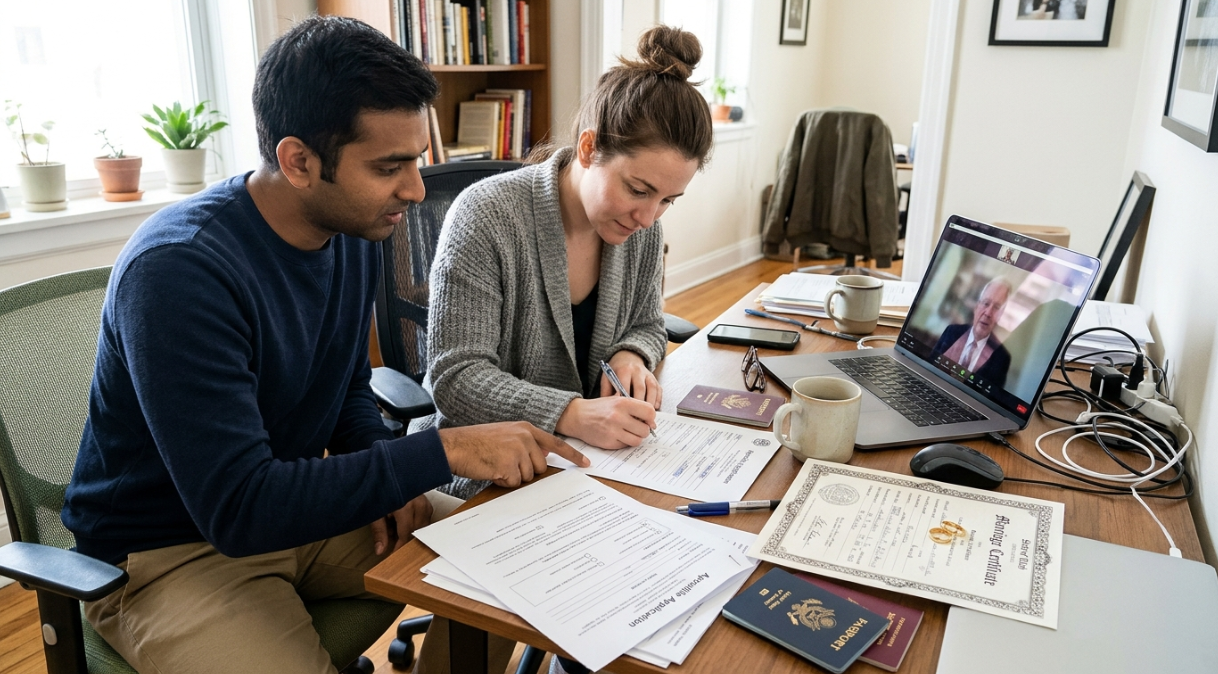
Couples who marry online through a Utah-based marriage service receive a marriage certificate issued through Utah County. If they plan to use that certificate in India, they generally need an apostille from the Utah Office of the Lieutenant Governor.
Utah is different from most U.S. states because its Lieutenant Governor's Office serves as the competent authority for document authentication.
Step 1: Obtain Your Utah Marriage Certificate
After your online marriage ceremony, obtain the official marriage certificate issued by the appropriate Utah County authority.
Make sure you have the government-issued certificate rather than a commemorative wedding document.
Step 2: Prepare Your Apostille Application
Check the current instructions from the Utah Office of the Lieutenant Governor.
Utah introduced online ordering through ApostilleXpress in September 2026. Mail-in and in-person options are also available.
However, digital delivery is not available for certain vital records. Confirm whether your particular marriage certificate qualifies for the requested delivery method before submitting your application.
Step 3: Submit the Certificate for Authentication
Submit the eligible document using the appropriate application method.
Follow the current instructions regarding original documents, supporting information, fees, and return shipping.
Step 4: Receive Your Apostilled Certificate
Once the Utah Office of the Lieutenant Governor completes the authentication, retain the issued certificate and underlying marriage record together.
Step 5: Use the Certificate in India
A properly apostilled Utah marriage certificate can generally be presented to Indian authorities without additional Indian embassy legalization.
The receiving institution may still request additional evidence depending on the purpose of the application.
Can Courtly Help With a Utah Marriage Certificate Apostille?
Courtly offers online marriage services and apostille assistance for couples who need their marriage certificate prepared for international use.
Couples can explore Courtly's online marriage process and review available services on the Courtly pricing page.
Before ordering, confirm the current certificate format, apostille eligibility, delivery method, and total processing cost.
Common Mistakes to Avoid
1. Notarizing a U.S. vital record before apostille. U.S. marriage certificates issued by a county clerk are already official government documents. Adding a notary’s stamp is unnecessary and can cause confusion at the competent authority’s office.
2. Detaching the apostille from the document. Apostilles are physically attached to or bound with the original document. Separating them invalidates the apostille. If you receive an apostilled document, keep everything together.
3. Skipping the state-level step in India. The MEA will not apostille an Indian marriage certificate that hasn’t been verified by the SDM or State Home Department first. You must follow the full chain: notary, state verification, then MEA.
4. Seeking embassy legalization when it’s not needed. Both the U.S. and India are Hague Convention members. An apostille is sufficient. Going to the Indian embassy for legalization on top of an apostille wastes time and money.
5. Assuming any state can apostille any certificate. Only the state that issued the document can apostille it. A Utah certificate must be apostilled in Utah. A New York certificate must be apostilled in New York.
6. Submitting a marriage license instead of a certificate. Licenses authorize the marriage. Certificates prove it happened. Only the certificate can be apostilled.
Frequently Asked Questions
Is an apostille required for a U.S. marriage certificate to be used in India?
Yes. India, as a Hague Convention member since 2005, requires that foreign public documents carry an apostille for official acceptance. For OCI applications, VFS Global specifically requests apostilled documents. Without an apostille, your application will likely be delayed or rejected.
Do I need Indian embassy legalization after getting an apostille?
No. Because both the U.S. and India are Hague Apostille Convention members, no further attestation or legalization is required. The apostille alone is sufficient for Indian legal purposes. This is confirmed by India’s MEA and the terms of the Convention itself.
How long does it take to apostille a marriage certificate for India?
On the U.S. side, standard processing in Utah takes 3 to 5 business days, with expedited options available. On the Indian side, MEA processing takes 1 to 3 working days, but the full pre-authentication chain (notary, SDM, MEA) typically takes 1 to 2 weeks total. Add international shipping time of 10 to 20 days.
Can an online marriage certificate be apostilled for use in India?
Yes. A marriage certificate issued by Utah County after an online ceremony is a standard U.S. government document. It is apostilled through the same process as any other Utah-issued certificate, via the Lieutenant Governor’s office. India recognizes it under the Foreign Marriage Act of 1969, provided it was validly performed in Utah.
Does an apostille on a marriage certificate expire?
The apostille itself has no formal expiration date. However, some Indian agencies and receiving authorities may require a “recent” apostille, typically within 6 to 12 months. Check with the specific office where you plan to submit the document.
What is the cost of apostilling an Indian marriage certificate through MEA?
The government fee is ₹50 per document. If you use an outsourced agency, expect to pay an additional ₹84 plus ₹3 per scanned page. Full-service agencies that handle the entire chain (notary, state verification, MEA) charge ₹1,500 to ₹2,500 per certificate.
Do I need to re-register my U.S. marriage in India?
No. Under the Foreign Marriage Act of 1969, a marriage that was valid where it was performed is recognized in India. Your apostilled U.S. marriage certificate serves as legal proof. Re-registration through an Indian Marriage Officer is optional and rarely necessary.
Next Steps
If you’re planning to use a marriage certificate in India (or send an Indian certificate abroad), the apostille process is straightforward once you understand the terms and the correct sequence of steps. The biggest time savings come from getting it right the first time: know which direction your document is traveling, follow the correct chain, and don’t add unnecessary steps like embassy legalization between Hague members.
For couples considering an online marriage who will need their certificate apostilled for India, Courtly handles the entire process from ceremony through apostille.
Get married online through Courtly and add apostille service to your order, so your certificate arrives ready for legal use in India.
This article is for informational purposes only and does not constitute legal advice. Recognition requirements can change, and acceptance of apostilled documents varies by specific authority and use case. Contact the relevant government officials or a qualified attorney to confirm requirements for your situation.
Let us handle the paperwork.
Getting married is complicated. Courtly simplifies the process and provides everything necessary to get married online, including providing a licensed officiant who can perform a remote ceremony.
Get Married

Get married online.
Getting married is complicated. Courtly simplifies the process and provides everything necessary to get married online.

