

Getting married online through Utah requires a government-issued photo ID, a selfie for biometric verification, a valid email address, and a credit or debit card for the license fee (approximately $71.75). There’s no residency requirement, no waiting period, and no need for in-person signatures. After the ceremony, you’ll receive a U.S. marriage certificate identical to one from an in-person wedding. International couples may also need an apostille or embassy authentication, and those filing for U.S. immigration must meet in person after the virtual ceremony before submitting an I-130 petition.
Online marriage in the United States is legally anchored in Utah, the only state that allows fully remote, legally binding ceremonies through its digital court system. Whether you’re a same-sex couple separated by borders, a military spouse facing deployment, or simply someone who wants a legal marriage without the logistics of a courthouse visit, the process is straightforward. But the paperwork can trip you up if you don’t know exactly what’s required at each stage.
This glossary covers every document in the online marriage process, from initial application through international recognition, and flags the mistakes that cause real delays.
Before you start, it helps to understand how online weddings work from a legal standpoint. And if you want to see what a full-service online marriage package includes, check current plan options.
Quick Answer: Documents Needed for an Online Marriage in 2026
For most couples getting married online through Utah, you'll need:
Required Document | Required for Everyone? | Notes |
|---|---|---|
Government-issued photo ID | ✔ Yes | Passport or driver's license |
Selfie/Biometric verification | ✔ Yes | Completed on your smartphone |
Unique email address | ✔ Yes | Each spouse needs their own |
Credit or debit card | ✔ Yes | Pays the marriage license fee |
Marriage license application | ✔ Yes | Submitted online |
Divorce decree | Only if divorced within 60 days | Certified copy recommended |
Death certificate | Only if widowed | Certified copy required |
Certified English translation | Only for non-English documents | Must be completed by a certified translator |
Apostille or legalization | Only for international use | Depends on destination country |
Proof of consummation | Only for U.S. immigration | Required before filing Form I-130 |
Takeaway: Most applicants only need four things to begin: a valid photo ID, smartphone for identity verification, unique email address, and payment method. Additional documents are only required for special situations like divorce, immigration, or international recognition.
At a Glance: Which Documents Apply to You?
Many couples worry they'll need dozens of documents. In reality, the required paperwork depends on your situation.
Your Situation | Additional Documents Needed |
|---|---|
First marriage | None |
Recently divorced (within 60 days) | Divorce decree |
Widowed | Death certificate |
Foreign-language documents | Certified translation |
Using certificate overseas | Apostille or legalization |
Applying for a U.S. spouse visa | Evidence of meeting after marriage |
Complete Online Marriage Document Checklist
Before Applying
✔ Passport or driver's license
✔ Smartphone
✔ Selfie verification
✔ Email address
✔ Credit or debit card
✔ SSN (if applicable)
✔ Divorce decree (if applicable)
✔ Death certificate (if applicable)
✔ Certified translations (if applicable)
During the Ceremony
✔ Marriage license
✔ Two witnesses
✔ Digital signatures
✔ Video conferencing device
After the Ceremony
✔ Marriage certificate
✔ Certified copies
✔ Apostille (if needed)
✔ Immigration documents (if needed)
This creates a checklist that Google loves.
Documents Needed Before Your Online Marriage (Application Stage)
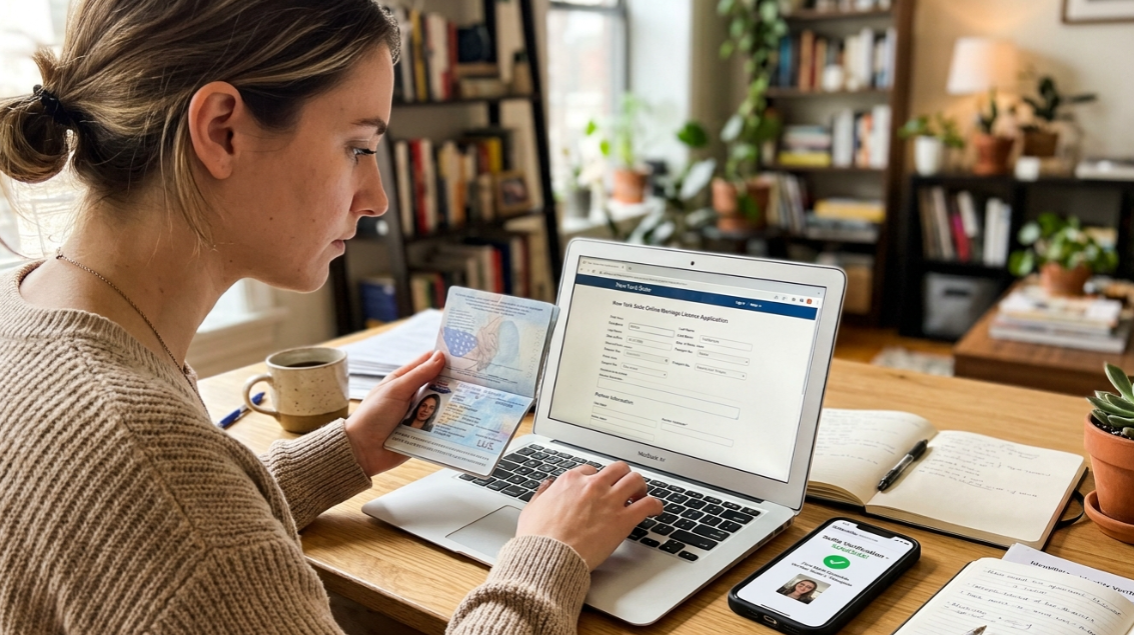
These are the documents and information you’ll need to submit when applying for your marriage license online. Both applicants must provide their own.
Government-Issued Photo ID
This is the foundational requirement. Each applicant needs a valid, government-issued photo ID. The most commonly accepted forms are passports and driver’s licenses. Utah County’s online system can automatically verify most driver’s licenses and passports through its third-party identity verification tool.
Why it matters: Without a verifiable ID, the application cannot proceed. If your ID is expired, damaged, or from a country with limited digital verification infrastructure, expect delays.
Common mistake: Practitioners on Reddit report that photographing your ID with the camera flash on causes glare that triggers verification failures. Turn off the flash and any motion or 3D photo features on your phone. The system highlights security features on the ID under flash, making facial recognition unlikely to succeed.
Social Security Number (SSN)
Per Utah Code 30-1-8, applicants must furnish their names, addresses, Social Security numbers, dates of birth, and the names and places of birth of their parents. International applicants who don’t have an SSN can typically enter zeros or indicate they don’t have one, though the exact process depends on the county system’s current form.
Selfie / Biometric Scan
You’ll need a smartphone to scan each applicant’s ID and face. This is part of the identity verification step built into Utah County’s online application. The system matches your live selfie against the photo on your ID.
Tip: The application works best on a Google Chrome browser. Mac and iPhone users have reported difficulty even with Chrome. If verification fails, try switching to an Android device or a Windows computer.
Valid Email Address
Each applicant needs a separate and unique email address. These emails are used for account creation, application tracking, and receiving your license confirmation. You cannot share an email address between applicants.
Credit or Debit Card
A credit or debit card is required to pay the marriage license fee. Most applicants pay approximately $71.75, which includes the $50 base license fee plus a $20 online processing surcharge and potential minor add-ons.
Divorce Decree (Conditional)
If a divorce has been granted within the last 60 days, that applicant needs to provide their divorce decree. This is specific to the 60-day window. If your divorce was finalized more than 60 days ago, you generally don’t need to provide documentation of it.
Why this catches people off guard: Most guides don’t mention the 60-day rule at all. If you’re recently divorced and rushing to remarry, have your decree ready.
Death Certificate (Conditional)
If a previous spouse is deceased, a death certificate is required to confirm legal eligibility to remarry. This must be an official certified copy, not a photocopy or digital screenshot.
Certified Translation (Conditional)
All documents submitted must be in English or officially translated. If your ID, divorce decree, or death certificate is in another language, you’ll need a certified translation from a professional translator or translation agency. “Certified” means the translator attests in writing that the translation is accurate and complete.
What counts as official: A notarized statement from the translator alongside the translation is the standard. Google Translate output does not qualify.
Parental or Guardian Consent (Conditional)
If either applicant is a minor (which is increasingly rare and subject to strict legal limitations), parental or guardian consent documentation is required. The specifics depend on the applicant’s age and the current Utah statutory framework.
Documents Created During the Online Marriage Ceremony
Once your application is approved and your ceremony is scheduled, a new set of documents enters the picture.
Marriage License
A marriage license is a document obtained from the county recorder before you get married. It authorizes a specific couple to be legally married. In Utah’s online system, the license exists digitally. No one needs to come into an office, and no one needs to put ink to paper. The entire system is electronic.
Critical timing: Utah marriage licenses have no waiting period, but you must have your ceremony within 32 days of the date the license was issued. Utah County recommends getting your license 10 to 14 days before the ceremony to allow time to resolve any problems. If a license isn’t used within 32 days, it expires, and you’ll need to apply and pay for a new one.
For a detailed walkthrough, see the online marriage license process page.
Digital Signature
Both applicants, the officiant, and the witnesses sign the marriage license electronically. Utah’s system accepts digital signatures as legally equivalent to handwritten ones. There is no requirement for wet ink signatures at any point.
Witness Information
Two witnesses are required for the ceremony. Witnesses need to provide their full legal names on the officiant’s submission portal after the ceremony. They do not need to be physically present in Utah (or anywhere specific), they just need to be present during the ceremony via the video platform.
What witnesses should have ready: Their government-issued ID (in case of any verification questions) and their full legal name as it appears on official documents. Misspellings on witness information can cause processing delays.
Ceremony Recording
While not a legal requirement, a recording of the ceremony serves as valuable documentation. It can be used as evidence in immigration proceedings, shared with family who couldn’t attend, or simply kept as a personal record. Some online marriage services include this automatically in higher-tier packages.
Documents You Receive After the Ceremony
Marriage Certificate (Digital Copy)
A marriage certificate is different from a marriage license. The certificate is issued after the ceremony and proves you are legally married. In Utah’s online system, you’ll typically receive a digital copy first.
Here’s the detail that matters most for international couples: the marriage certificate issued by Utah after an online ceremony does not indicate that the marriage was conducted online or remotely. It looks identical to certificates issued after in-person ceremonies. It contains only basic legal information (names, dates, location, officiant, and witnesses) with no mention that the ceremony was virtual.
Marriage Certificate (Physical / Mailed Copy)
A physical certified copy of your marriage certificate is mailed after the ceremony. This is the version you’ll use for most official purposes, including name changes, insurance updates, and international legalization.
Certified Copy
A certified copy is an official reproduction of your marriage certificate issued by the state or county, complete with a registrar’s seal or stamp. You may need multiple certified copies for different agencies (Social Security Administration, DMV, passport office, foreign embassies). Additional certified copies can be ordered from Utah Vital Records.
How Long Should You Keep Each Document?
Document | Keep Forever? |
|---|---|
Marriage Certificate | Yes |
Marriage License | Optional |
Divorce Decree | Yes |
Apostille | Yes |
Certified Translation | Yes |
USCIS Filing Documents | Yes |
Name Change Records | Yes |
Documents for International Recognition
This is where the documents needed for online marriage get more complex. If you plan to use your U.S. marriage certificate outside the United States, additional steps are almost always required.
Apostille
An apostille is a standardized certificate that authenticates the origin of a public document for use in another country. If the country where you’ll use your marriage certificate is a member of the 1961 Hague Convention, an apostille is what you need.
In Utah, the Lt. Governor’s Office handles apostilles for marriage certificates from Vital Records or the County Clerk. One important limitation: documents notarized by a remote notary cannot be authenticated through this office.
For a deeper explanation, read the guide to apostilles.
Freshness requirements: Some countries require that certified copies of marriage certificates be no older than three or six months. Practitioners have reported that their certificates were rejected by the requesting overseas party because of these age limits. Always check with the receiving country’s embassy or consulate before submitting.
Embassy Authentication / Legalization
If the country where you need to use your certificate is not a Hague Convention member, you’ll need embassy authentication (sometimes called legalization) instead of an apostille. This involves submitting your document to the foreign country’s embassy or consulate in the United States for verification.
The process typically adds time and cost compared to an apostille. To understand the differences, see apostille vs. authentication explained.
For couples who need legalization handled professionally, Courtly offers a document legalization service covering both apostilles and embassy authentication.
Countries That May Not Accept Online Marriages
Not every country recognizes marriages performed via remote appearance. Countries that have historically rejected or questioned online U.S. marriages include Germany, Hungary, Australia, Norway, France, Turkmenistan, Sweden, Poland (varies by region), Taiwan, and Finland.
Utah County itself warns: “A marriage solemnized according to the laws of the State of Utah through online remote appearance may be invalid in the country where the parties to the marriage reside.”
This doesn’t mean the marriage is invalid in the United States. It means the foreign government may not register it. Couples in this situation sometimes need to go through a separate registration process in their home country. Check your country’s specific requirements on the countries page.
Typical Timeline for Each Document
Step | Typical Time |
|---|---|
Identity verification | 5–15 minutes |
Marriage license approval | Usually within 24–48 hours |
Online ceremony | 15–30 minutes |
Digital marriage certificate | Often within days |
Certified mailed certificate | Usually 1–3 weeks |
Apostille | Several days to several weeks |
Embassy legalization | Several weeks to several months |
Documents for U.S. Immigration After Online Marriage
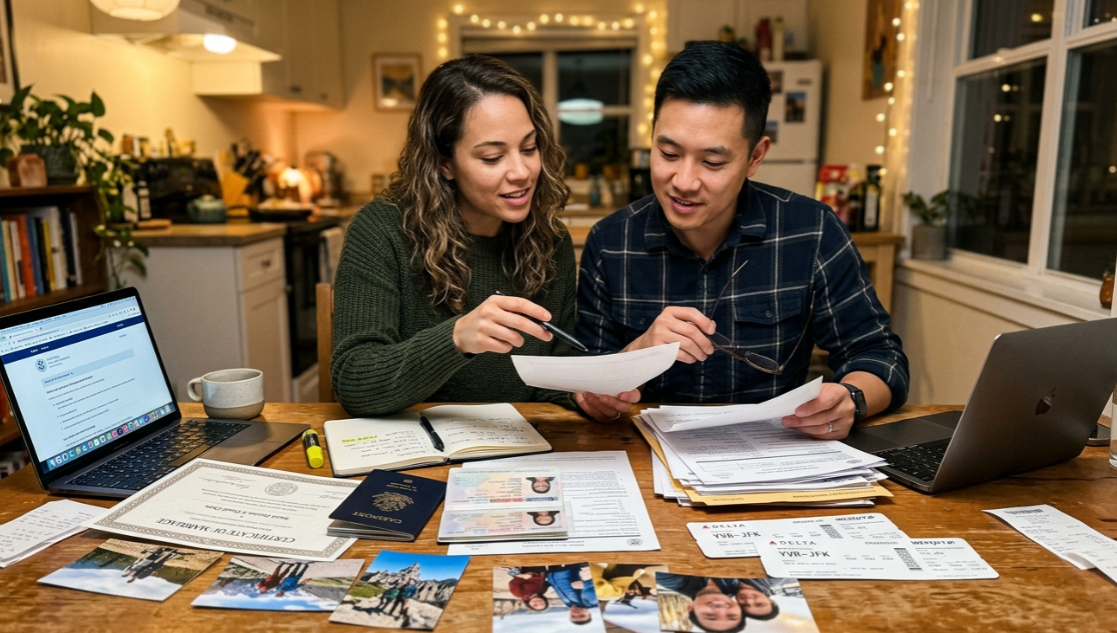
Immigration is one of the most common reasons couples pursue online marriage. The documents needed for online marriage in an immigration context go beyond the certificate itself.
I-130 Petition
The I-130 (Petition for Alien Relative) is the form a U.S. citizen or permanent resident files to establish a relationship with a foreign spouse. The certified marriage certificate is the primary document proving the marriage exists. But for online marriages, USCIS applies additional scrutiny.
Proof of Consummation
The Immigration and Nationality Act states that a marriage will not be recognized for immigration purposes if the parties were not in each other’s physical presence when married, unless the marriage has been consummated. This is the single most important legal nuance for immigration-focused couples.
As of 2024/2025, USCIS requires spouses to meet in person after marrying virtually and before filing the I-130. There is no specified timeline for when the meeting must happen, but it must occur, and you should be prepared to document it.
Practitioners on Reddit’s r/USCIS forum have shared anecdotal I-130 approvals after Utah online marriages, but they consistently emphasize that meeting in person afterward and gathering evidence of that meeting is non-negotiable.
Bona Fide Marriage Evidence
Beyond the certificate, couples should gather evidence showing the relationship is genuine. This includes photos together, travel itineraries showing visits, communication records (messages, call logs), joint financial accounts or leases, and any other documentation of shared life.
For detailed guidance on immigration recognition, read about online marriages and immigration. Couples who need legal guidance can also explore a spouse visa consultation.
Proxy Marriage vs. Virtual Marriage
This distinction matters enormously for immigration. A proxy marriage is one where a stand-in represents one or both parties. A virtual (online) marriage is one where both parties are personally present on camera throughout the ceremony. Utah offers virtual ceremonies, not proxy ones.
USCIS treats these categories differently. Virtual marriages, where both spouses actively participate, have a clearer path to recognition (provided the consummation requirement is met). Proxy marriages face much higher scrutiny. For a full breakdown, see proxy vs. virtual marriage explained.
Documents for Post-Marriage Name Changes (U.S.)
Changing your name after marriage involves updating records across multiple government agencies. Here are the key forms and documents you’ll need.
SSA Form SS-5
This is the application for a new Social Security card reflecting your married name. You’ll need your certified marriage certificate, current Social Security card (or number), and a government-issued ID. Submit to the Social Security Administration in person or by mail.
Passport Update (Forms DS-82 or DS-5504)
If your passport was issued within the last year, you can use Form DS-5504 to update your name for free. Otherwise, Form DS-82 handles standard passport renewals with a name change. You’ll need your current passport, certified marriage certificate, and a new passport photo.
DMV Name Change
Each state has its own process, but you’ll generally need your updated Social Security card, certified marriage certificate, and current driver’s license. Some states require an in-person visit.
If this sounds like a lot of paperwork, Courtly’s name change kit bundles prefilled forms, checklists, and prepaid envelopes to simplify the process across SSA, DMV, passport, and bank updates.
Frequently Confused Terms
Marriage License vs. Marriage Certificate
A marriage license is permission to get married. A marriage certificate is proof that you did. You get the license before the ceremony and the certificate after. They are separate documents with different purposes, and mixing them up when dealing with government agencies or foreign embassies can cause real problems.
Apostille vs. Authentication vs. Legalization
An apostille is a one-step certification for Hague Convention countries. Authentication is a multi-step process for non-Hague countries, usually involving the U.S. State Department and then the foreign embassy. “Legalization” is the embassy’s final stamp in that chain. Many people use these terms interchangeably, but they represent different processes with different costs and timelines.
No Residency or Citizenship Requirements
Utah has no residency or citizenship requirements for marriage licenses. Anyone from anywhere can apply. This is the reason Utah is the hub for online marriages, and it’s a point that confuses people who assume they need to live in (or at least visit) the state.
Troubleshooting: Common Document and Technical Issues
ID verification keeps failing. Turn off your camera flash. Avoid motion or 3D photo modes. Use Google Chrome as your browser, ideally on an Android or Windows device. A stable internet connection matters too. One Trustpilot reviewer noted that an internet connectivity issue caused their ID verification to fail entirely.
Name errors on the application. If your name was entered incorrectly, don’t panic. Complete the application and pay the fee. After the confirmation email arrives with your license number, email marriage@utahcounty.gov with the correction details. The county will fix it.
International address fields. Utah County recently upgraded its marriage license application for international applicants. You no longer need to use a U.S.-based address. All applicants should provide their current mailing address with their correct state/province and country of birth. This is a recent change that eliminates a major friction point for overseas applicants.
License expiring before the ceremony. If life gets in the way and your 32-day window passes, the license expires. You’ll need to apply and pay again. Plan your ceremony date before applying.
FAQ
What documents do I need for an online marriage in Utah?
At minimum, both applicants need a government-issued photo ID, a smartphone for selfie/biometric verification, a valid and unique email address, and a credit or debit card for the license fee. If you were divorced within the last 60 days, bring the divorce decree. If a previous spouse is deceased, bring the death certificate. Foreign-language documents must include certified English translations.
Do I need to be a U.S. resident to get married online?
No. Utah has no residency or citizenship requirements. Couples from any country can apply for and receive a Utah marriage license online.
How much does the online marriage license cost?
Most applicants pay approximately $71.75. This includes the $50 base license fee and a $20 online processing surcharge, plus potential minor additional fees.
Is there a waiting period after getting the license?
No. Utah has no waiting period. You can have your ceremony as soon as the license is issued. However, the license expires after 32 days, so plan accordingly.
Will my online marriage certificate look different from an in-person one?
No. The certificate contains only basic legal information (names, dates, location, officiant, witnesses) and does not indicate that the ceremony was virtual or remote.
Does USCIS accept online marriages for immigration?
USCIS can accept online marriages, but the spouses must meet in person after the ceremony and before filing the I-130 petition. Gathering evidence of the in-person meeting (photos, travel records, communication logs) is essential.
Which countries might not accept my online marriage?
Countries that have historically questioned or rejected online U.S. marriages include Germany, Hungary, Australia, Norway, France, Sweden, Poland, Taiwan, Finland, and Turkmenistan. Always verify with the relevant embassy before relying on your certificate abroad.
Do I need an apostille for my marriage certificate?
Only if you plan to use the certificate in a foreign country that is a member of the Hague Convention. Non-Hague countries require embassy authentication instead. Some countries also impose freshness requirements, meaning your certified copy can’t be more than three to six months old.
Ready to get started? See Courtly’s plans and pricing to find the package that fits your situation, whether you need a straightforward ceremony or full support with witnesses, recording, and document legalization.
Let us handle the paperwork.
Getting married is complicated. Courtly simplifies the process and provides everything necessary to get married online, including providing a licensed officiant who can perform a remote ceremony.
Get Married

Get married online.
Getting married is complicated. Courtly simplifies the process and provides everything necessary to get married online.

