

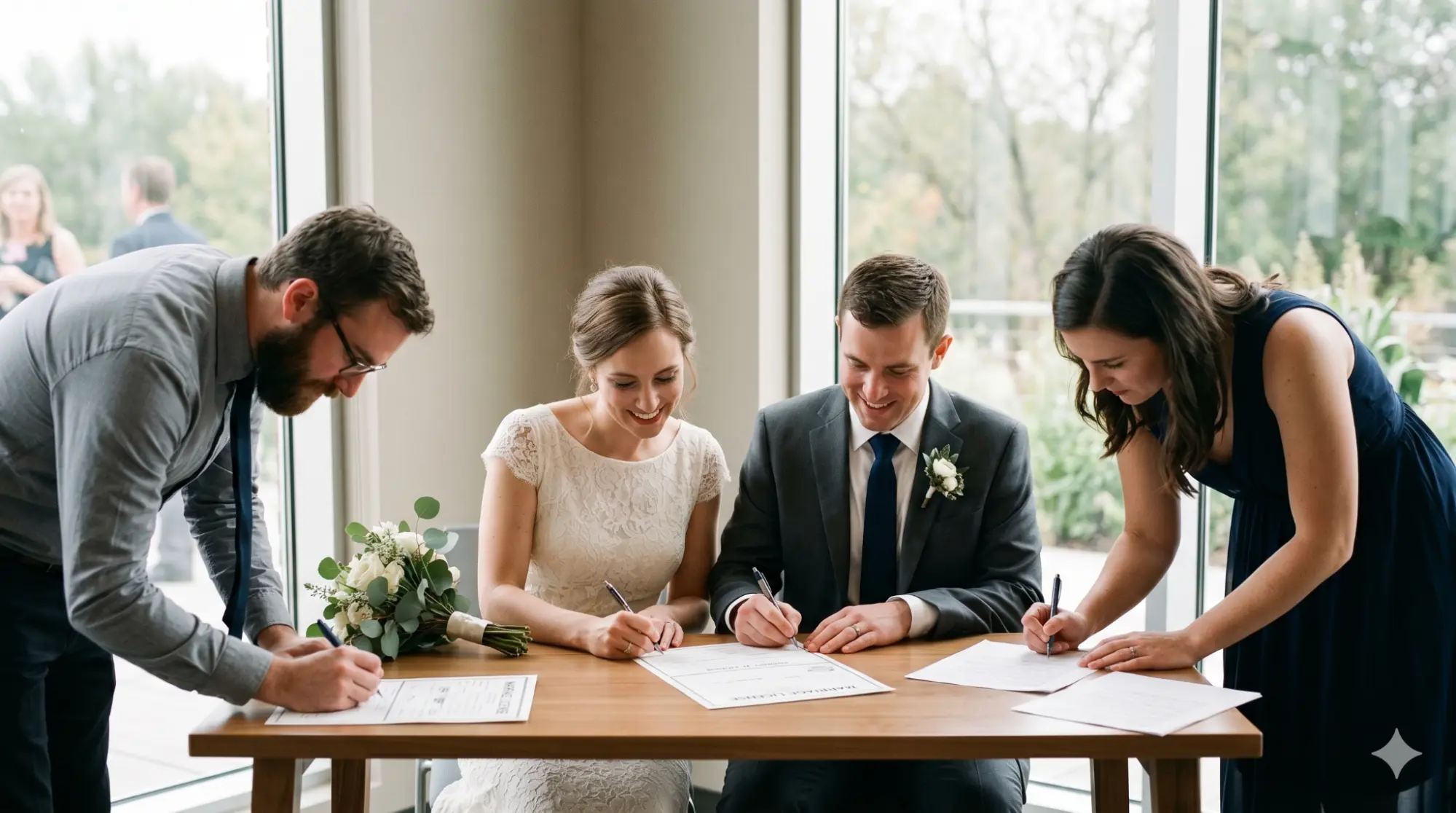
You will find people saying you always need witnesses. Others will tell you witnesses are not required at all. Both are technically correct, depending on where you are getting married.
Legal standards for marriage are far from universal. Requirements for witnesses differ significantly across state lines, depending on your license type and the specifics of your ceremony. Typically, confusion arises from a single, prevalent error: conflating the marriage license application with the actual ceremony.
To help you navigate these requirements, this guide clarifies what matters for your specific situation and leads into the key distinctions between the marriage license and ceremony.
Marriage License vs. Marriage Ceremony: Where Most Confusion Starts
Before going further, let’s understand the distinction.
A marriage license is the legal permission to get married. The government issues it before the ceremony.
A marriage ceremony is the event that legally validates the union, and it is almost always where witnesses come in.
In most cases, witness requirements are tied to the ceremony, not the application process.
Which States Require Witnesses for a Marriage Ceremony?
Rather than listing every state, here is what actually matters. These are the states where witnesses are legally required during the ceremony signing:
Most of these states require one to two witnesses, and the requirement is tied to the ceremony signing process, not the license application.
States That Do Not Require Witnesses
The majority of U.S. states do not require any witnesses at all. That includes Texas, Florida, Georgia, Colorado, Pennsylvania (which offers a self-uniting option), and many others.
If you are getting married in one of these states, you are legally clear to proceed without arranging witnesses.
Do You Need Witnesses for a Court Marriage?
Court marriage typically refers to a civil ceremony performed at a courthouse. What actually happens varies quite a bit:
- Some courts require 1 to 2 witnesses to be physically present.
- Some courts allow courthouse staff to serve as witnesses.
- Some require no witnesses at all.
There is no universal rule, even within the same state. Your best move is to contact the specific courthouse beforehand and confirm their requirements.
Who Can Be a Witness at a Wedding?
The rules around witness eligibility are straightforward in most jurisdictions.
Basic Eligibility Requirements
Most states require that a witness:
- Is 18 years of age or older (some states allow 16 or older)
- Is mentally competent
- Can understand what they are witnessing
- Is capable of signing legal documents
Can a Family Member Be a Witness?
Yes. This is one of the most common options. There are no restrictions on using a family member, including a parent, sibling, or close relative.
Can a Stranger Be a Witness?
Yes. Witnesses do not need to know you personally. Their role is strictly legal: to observe the ceremony and confirm it happened.
Can Witnesses Be Related to Each Other?
Yes. There are no restrictions on witnesses being related to one another or to the couple in most jurisdictions.
Why Are Witnesses Required in the First Place?
Witnesses serve a legal purpose, not a ceremonial one. They:
- Confirm that both parties entered the marriage willingly.
- Help prevent fraud
- Verify that the ceremony actually took place.
That is it. The witness requirement exists to protect the legal integrity of the process, not to add meaning to the ceremony.
When You Do Not Need a Witness
You can legally get married without witnesses in several situations:
- You are in a state that does not require them.
- You are using a confidential marriage license.
This is often the simplest route for couples dealing with distance, visa timelines, or limited access to people who can show up in person.
What If You Do Not Have a Witness Available?
This is where most people get stuck, particularly for couples navigating long-distance logistics or time pressure. Here are your real options:
- Bring a friend or family member who meets eligibility requirements.
- Ask someone at the courthouse, as many staff members are willing to serve in this role.
- Choose a license type that does not require witnesses, such as a confidential license, where available.
- Use a legally compliant marriage platform that includes witnesses as part of the process.
If you are coordinating a ceremony remotely or working under a deadline, platforms like Courtly can legally provide witnesses during your online ceremony so you do not have to manage that logistics problem yourself.
Common Mistakes to Avoid
- Assuming witnesses are always required without checking your state laws.
- Confusing the marriage license application with the ceremony requirements
- Bringing someone who does not meet the age or competency eligibility requirements
- Leaving witness arrangements until the last minute
- Assuming courthouse staff will automatically fill in as witnesses without confirming in advance
Frequently Asked Questions
Do witnesses need to know the couple personally?
No. Witnesses do not need to know you. Their legal role is simply to observe the ceremony and confirm that it happened. They can be strangers, acquaintances, or family members.
Can witnesses be related to each other?
Yes. There is no restriction on witnesses being related to one another or to the couple in most jurisdictions.
Do witnesses have to be present in person?
Yes, in traditional ceremonies. However, some legally recognized online marriage platforms allow virtual witnesses depending on the legal framework of the jurisdiction.
Can the same person serve as a witness more than once?
Yes. There is no restriction on someone acting as a witness for multiple couples across different ceremonies, as long as they meet eligibility requirements each time.
What happens if you do not have a witness in a state that requires one?
You will not be able to complete the legal signing process. You will need to arrange an eligible witness or choose an alternative legal route, such as a jurisdiction or license type that does not require one.
Are witnesses required for marriage registration after the ceremony?
In most cases, witnesses are only required during the ceremony itself, not for the registration process that follows.
Can a witness refuse to sign after the ceremony?
Yes, and this can delay or invalidate the signing process. That is why it is important to confirm your witnesses in advance and choose people who are reliable and understand what they are committing to.
Let us handle the paperwork.
Getting married is complicated. Courtly simplifies the process and provides everything necessary to get married online, including providing a licensed officiant who can perform a remote ceremony.
Get Married

Get married online.
Getting married is complicated. Courtly simplifies the process and provides everything necessary to get married online.

