

“Online marriage Canada” covers three different legal questions with three different answers. Canadian provinces generally require physical presence for a legal ceremony, so you cannot assume a fully virtual wedding under provincial law is valid. Canada usually recognizes foreign marriages performed legally abroad without requiring registration. But IRCC does not accept online, proxy, or internet marriages for spousal sponsorship when one or both spouses were not physically present at the ceremony, with only narrow exceptions.
Can You Get Married Online in Canada?
Online marriage in Canada depends on where the ceremony takes place and what you need the marriage for. Canadian provincial rules generally require the legal participants to be physically present for the ceremony. A marriage performed online in another country may be legally valid and generally recognized in Canada, but Immigration, Refugees and Citizenship Canada (IRCC) does not recognize an internet or proxy marriage for spousal sponsorship when one or both spouses were not physically present, subject to limited exceptions. If your goal is Canadian immigration, check IRCC’s rules before choosing an online ceremony.
Online Marriage in Canada: Rules at a Glance
Situation | General rule | What to check |
|---|---|---|
Getting married through a Canadian province by video call | Do not assume a fully virtual legal ceremony is permitted. Provincial requirements apply. | The province or territory's marriage laws and officiant rules. |
Getting married online through a foreign jurisdiction | The marriage may be recognized in Canada if legally performed abroad, subject to applicable recognition rules. | Whether the marriage is valid under the issuing jurisdiction's law and recognized under Canadian law. |
Using a foreign online marriage for IRCC spousal sponsorship | Generally not accepted if one or both spouses were not physically present at the ceremony. Narrow exceptions apply. | IRCC's current rules and any applicable exception. |
Attending a wedding by livestream | Guests can watch remotely, but livestreaming alone does not determine whether the legal marriage is valid. | Where the legal ceremony takes place and whether its requirements are met. |
Using a foreign marriage certificate in Canada | Registration in Canada is generally not required for a marriage legally performed abroad. | The receiving institution's document, translation, and authentication requirements. |
Key takeaway: A marriage can be valid under the law where it took place and still be ineligible for Canadian spousal sponsorship.
What “Online Marriage Canada” Actually Means
Three distinct questions hide behind this one search term. Mixing them up leads to bad decisions, wasted money, and sometimes immigration applications that get rejected before they are reviewed on their merits.
Meaning 1: Getting legally married through a Canadian province using a video call. This is about Canadian provincial ceremony rules.
Meaning 2: Getting married online through a foreign jurisdiction and using that certificate in Canada. This is about Canada’s general recognition of foreign marriages.
Meaning 3: Using an online marriage for Canadian immigration, specifically IRCC spousal sponsorship. This is about a stricter, immigration-specific rule.
The distinction between a proxy marriage, a virtual wedding, and a remote-appearance ceremony also matters. These terms are not interchangeable, even though people use them that way. Getting the vocabulary wrong can send you down the wrong legal path.
Can You Get Legally Married Online in Canada?
Do not assume you can.
Marriage solemnization in Canada is governed at the provincial and territorial level, not by a single federal law. The clearest evidence from Canada’s largest provinces points against fully virtual legal ceremonies.
Can You Get Married Online in Ontario, Alberta, or British Columbia?
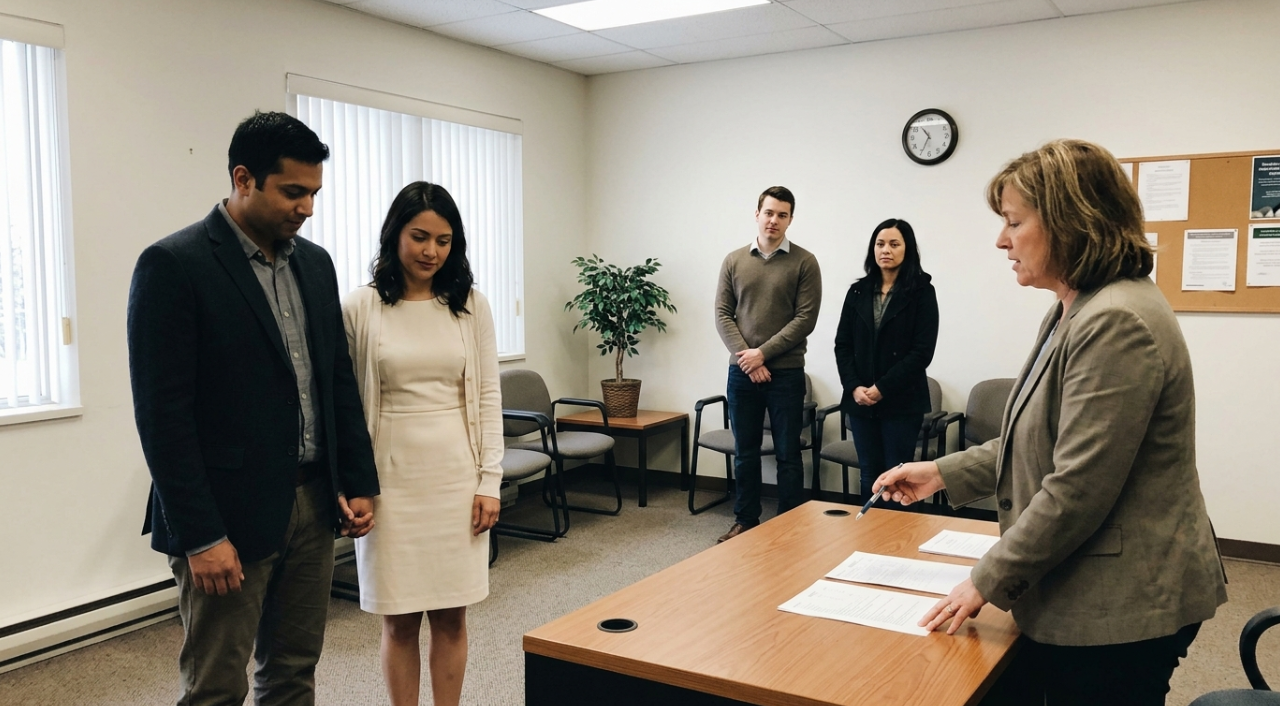
Marriage ceremony rules are set at the provincial and territorial level. The following examples illustrate why couples should verify the requirements in the jurisdiction where they plan to marry.
Province | What the article should explain | Official source to consult |
|---|---|---|
Ontario | The province's guidance states that virtual and proxy marriages are not permitted. The couple, officiant, and required witnesses must be physically present for the legal ceremony. | Ontario's marriage officiant guide |
Alberta | Explain the requirements for a ceremony conducted in Alberta, including the presence of the couple, authorized officiant, and required witnesses. | Government of Alberta marriage ceremony guidance |
British Columbia | Explain the applicable presence and officiant requirements for civil and religious ceremonies. | British Columbia's Marriage Act and official marriage guidance |
Other provinces and territories | Requirements vary by jurisdiction. Do not assume that a rule in Ontario or Alberta applies everywhere. | The relevant provincial or territorial government |
Before booking a ceremony: Confirm the current rules with the relevant government authority or authorized officiant. Online licence applications and certificate orders are administrative services; they do not automatically make a virtual ceremony legally permissible.
Ontario is explicit. The province’s officiant guide states that proxy and virtual marriages are not permitted. The couple, at least two witnesses, and the officiant must be physically present at the ceremony. That is a minimum of five people in the same room. Guests can attend virtually, but every legal participant must be there in person.
Alberta requires the ceremony to take place within the province. The couple and two adult witnesses must be physically in the presence of an officiant authorized by Vital Statistics. Proxy by teleconferencing is not allowed.
British Columbia’s Marriage Act requires both parties to a religious marriage to be present in person. Civil marriages must be contracted before a marriage commissioner and at least two witnesses.
A common source of confusion: some provinces allow online paperwork, like applying for a marriage licence digitally or ordering certificates through a government website. That is administrative convenience, not a fully online legal ceremony.
And a livestreamed wedding is not an online marriage. You can set up cameras and share the moment with family across the world. The legal part still requires physical presence in these provinces.
Will Canada Recognize an Online Marriage Performed Outside Canada?
This is where the picture changes.
The Government of Canada states that marriages legally performed abroad are usually valid in Canada and do not need to be registered. No Canadian consular official needs to attend or approve the foreign ceremony.
If a U.S. online marriage was validly performed under the law of the state that issued it, Canada will generally treat that certificate like any other foreign marriage certificate. This matters for everyday purposes: taxes, benefits, name changes, family law assumptions, and general proof of marital status.
A U.S. marriage certificate issued through a legal remote-appearance process in Utah, for example, would fall into this category. Courtly helps couples complete exactly this kind of ceremony.
Learn how Courtly’s online marriage works
But “usually recognized in Canada” is not the whole story. The reason you need the marriage changes the legal analysis completely, and that brings us to the question most people searching “online marriage Canada” are actually worried about.
Does IRCC Recognize Online Marriage for Spousal Sponsorship?
Usually, no.
IRCC does not recognize proxy, telephone, internet, fax, or similar marriages for immigration purposes when one or both spouses were not physically present at the ceremony.
The legal basis sits in the Immigration and Refugee Protection Regulations. Section 5 of the IRPR excludes a foreign national from being considered a spouse if one or both parties were not physically present. Related sections carry the same exclusion for the Family Class and the Spouse or Common-Law Partner in Canada Class.
The Canada.ca spousal sponsorship guide reinforces this: a marriage performed outside Canada must be legally recognized both where it took place and in Canada, but IRCC will still refuse it for sponsorship if it was conducted by internet, proxy, telephone, or similar means without physical presence.
Does IRCC Accept Online Marriage for Spousal Sponsorship?
Generally, no. Immigration, Refugees and Citizenship Canada (IRCC) does not recognize marriages performed outside Canada by internet, proxy, telephone, fax, or similar means when one or both spouses were not physically present at the ceremony, subject to limited exceptions.
This rule is separate from whether the marriage is legally valid in the jurisdiction where it took place. A foreign jurisdiction may issue a valid marriage certificate after a remote ceremony, but that certificate does not automatically make the marriage eligible for Canadian spousal sponsorship.
Section 5(c) of the Immigration and Refugee Protection Regulations addresses marriages in which one or both spouses were not physically present at the ceremony. IRCC's official guidance also identifies a limited exception for certain Canadian Armed Forces members whose service-related travel restrictions prevented their attendance.
The distinction is important: a foreign online marriage may be legally valid where performed but still fail IRCC's requirements for sponsorship as a spouse.
Before submitting an application, review IRCC's current spousal sponsorship guide and the applicable provisions of the Immigration and Refugee Protection Regulations.
This creates a confusing gap that catches many couples off guard. A marriage can be:
Legal where it was performed
Generally recognized in Canada for civil purposes
Rejected by IRCC for spousal sponsorship
All three statements can be true simultaneously.
Practitioners on Reddit regularly warn about this exact trap. One user in r/ImmigrationCanada specifically advised against using a Utah-style online marriage where not everyone is physically present if the purpose is Canadian immigration.
An RCIC (Registered Canadian Immigration Consultant) noted on LinkedIn that the inconsistency feels strange: IRCC uses online citizenship ceremonies, yet does not accept online virtual marriages for PR family-class sponsorship. The rule may feel illogical, but it is firmly in place.
For broader context on how different countries handle this issue, see Courtly’s guide to online marriage and immigration.
Why IRCC's Online Marriage Rule Predates COVID-19
IRCC's restriction on certain online and proxy marriages for immigration purposes is not a temporary COVID-19 policy.
The relevant amendments to the Immigration and Refugee Protection Regulations came into force on June 10, 2015. The current regulation excludes a person from being considered a spouse for immigration purposes when either or both spouses were not physically present at the marriage ceremony, subject to the applicable exception for certain Canadian Armed Forces members.
This timing matters for couples researching virtual weddings. The rule did not originate as a pandemic-era restriction, so couples should not assume that the end of COVID-era measures makes an online marriage eligible for spousal sponsorship.
For the current legal wording, consult section 5 of the Immigration and Refugee Protection Regulations and IRCC's official guidance on proxy, telephone, internet, and fax marriages.
Exceptions: When Might IRCC Accept a Proxy or Online Marriage?
IRCC lists two narrow exceptions.
Pre-June 10, 2015 applications. If the sponsorship application was received before the amendments took effect, the old rules may apply. This is now a decade-old cutoff and essentially closed.
Canadian Armed Forces cases. The marriage may be recognized if service-related travel restrictions prevented the member from being physically present, the marriage took place outside Canada, and the marriage was registered in a jurisdiction where proxy marriage is legal.
For most couples reading this article, neither exception applies. The Armed Forces exemption requires specific circumstances and documentation.
If IRCC Won’t Accept the Marriage, What Are the Options?
Three pathways come up most often.
Which Canadian Sponsorship Option Might Fit Your Situation?

If an online marriage does not qualify for spousal sponsorship, the next step is to determine whether another relationship category applies or whether an in-person marriage is appropriate.
Option | General eligibility requirement | Important limitation |
|---|---|---|
Spousal sponsorship after an in-person marriage | A legally valid marriage that meets IRCC's requirements, along with the other sponsorship criteria. | If an earlier online marriage exists, determine its legal status before planning another marriage. |
Common-law partner sponsorship | The couple has lived together in a marriage-like relationship for at least 12 consecutive months and meets the other requirements. | An online wedding alone does not establish common-law eligibility. |
Conjugal partner sponsorship | The couple has had a genuine conjugal relationship for at least one year, and marriage or cohabitation has been impossible for qualifying reasons. The sponsored partner must live outside Canada. | This is not a general alternative for couples who simply prefer not to marry in person or live together. |
Case-specific legal advice | A Canadian immigration lawyer or authorized immigration professional reviews the existing marriage, documents, and potential pathway. | The correct approach depends on the couple's legal and immigration circumstances. |
These categories have distinct eligibility requirements. Review IRCC's official sponsorship eligibility guidance before deciding which option to pursue.
What to Do Before Applying for Sponsorship
Identify the ceremony type. Record where the marriage took place, how it was conducted, and whether both spouses were physically present.
Check local legal validity. Confirm that the marriage was legally performed under the law of the jurisdiction that issued the certificate.
Review IRCC's rules. Check whether the physical-presence exclusion applies and whether a specific exception could be relevant.
Gather your relationship evidence. Keep relevant marriage records, cohabitation evidence, joint financial documents, and other genuine relationship records.
Get advice if a prior marriage exists. Before remarrying, applying under another relationship category, or describing your marital status on immigration forms, consult a qualified Canadian professional.
Do not omit a previous marriage or assume that an online marriage can simply be ignored. Answer all immigration questions accurately and disclose the facts required by the application.
Common-Law Partner Sponsorship
IRCC defines a common-law partner as someone who has lived with the sponsor in a marriage-like relationship for at least 12 consecutive months. Evidence can include a shared home address, joint finances, children (where applicable), and publicly presenting as a couple.
Practitioners on Reddit point out that if a couple already lived together for two continuous years before the online ceremony, common-law evidence might be a stronger route than trying to force a Zoom marriage into the spousal sponsorship category.
Conjugal Partner Sponsorship
A conjugal partner is someone outside Canada, in a genuine conjugal relationship with the sponsor for at least one year, where marriage or cohabitation has been impossible for reasons beyond their control. This is not a casual workaround. It is an evidence-heavy category designed for couples facing genuine barriers like immigration restrictions, persecution, or legal prohibitions.
In-Person Marriage
Some couples consider traveling to meet and marry in person. This can work if it happens before a spousal sponsorship application. But if an online marriage already exists, the situation gets complicated fast.
Already Married Online? Don’t Assume the Fix Is Simple
The top-ranking Reddit thread for “online marriage Canada” captures this problem clearly. A user describes getting married via Zoom, learning the marriage may be valid generally in Canada but not accepted by IRCC, and then asking whether they can remarry, divorce, or switch to common-law or conjugal partner sponsorship.
Commenters repeatedly suggest “just get married in person.” But the original poster raises a legitimate concern: if the online marriage is legally valid where it was performed and generally recognized in Canada, they may not be “single” for legal purposes. Attempting a second marriage without addressing the first creates its own risks.
The trap looks like this. A person can be:
Legally married for Canadian civil law purposes
Unable to use that marriage for IRCC sponsorship
Unable to simply remarry without first determining whether divorce or annulment is needed
If you already married online and plan to file for Canadian spousal sponsorship, talk to a Canadian immigration lawyer before doing anything else. Do not file as single. Do not attempt a second ceremony without advice. Do not assume common-law status automatically replaces spousal status.
Questions to Ask a Canadian Immigration Lawyer
If you already have an online marriage certificate and intend to apply for Canadian sponsorship, consider asking a Canadian immigration lawyer:
Is my existing marriage legally valid under the law of the jurisdiction where it took place?
How might the marriage be treated under Canadian civil and family law?
Does IRCC's physical-presence exclusion apply to my ceremony?
Could a specific exception apply to my circumstances?
Would a new in-person marriage be legally possible, or must the existing marriage be resolved first?
Do I meet the requirements for common-law or conjugal partner sponsorship independently of the online ceremony?
How should I accurately disclose my marital status and previous marriage in my application?
Bring your marriage certificate, ceremony details, relevant travel records, and any prior immigration filings to the consultation. The answers depend on your specific facts, so do not rely on a generic online checklist to determine your legal marital status.
Do You Need an Apostille or to Register the Marriage in Canada?
Short answers: probably not for Canadian use, and not automatically.
Registration. Canada says foreign marriages legally performed abroad are usually valid in Canada and do not need to be registered. There is no federal requirement to file your foreign marriage certificate with a Canadian authority.
Apostille and authentication. Global Affairs Canada states that foreign public documents do not have to be authenticated under Canadian law before being used in Canada. However, specific institutions (a bank, benefits office, court, or employer) may still request authentication or a certified translation.
Users on r/legaladvicecanada illustrate the confusion well. One poster asked whether an apostille was required for a foreign marriage certificate simply because Canada joined the Apostille Convention. The answer depends entirely on who is asking for the document. If it’s for general Canadian use, Canadian law doesn’t require it. If you’re using the document in another country, that country’s rules apply.
Do You Need to Register, Authenticate, or Translate a Foreign Marriage Certificate?
Requirement | What it means | What to do |
|---|---|---|
Registration in Canada | Foreign marriages generally do not need to be registered with a Canadian authority merely because the couple lives in Canada. | Check the relevant provincial or territorial guidance if you have a specific legal or administrative concern. |
Apostille or authentication | A document may need additional authentication for use in another jurisdiction or to satisfy a receiving institution's requirements. | Ask the organization receiving the certificate whether it requires an apostille or authentication. |
Certified translation | A certificate in a language the receiving authority does not accept may require translation. | Follow the institution's current translation and certification requirements. |
Immigration documents | IRCC has its own evidence and document requirements. | Follow the instructions for the specific immigration application rather than assuming general document rules apply. |
Before paying for document services, ask the receiving authority exactly what it requires. A certificate's general acceptance in Canada does not guarantee that every institution will accept the same format or supporting documents.
Before spending money on document legalization, ask yourself:
Who is requesting the document?
Is it a Canadian institution or a foreign one?
Does the requesting party specifically require an apostille, authentication, or certified translation?
Is the certificate in English or French?
For a clearer understanding of these processes, Courtly’s explanation of apostille vs. authentication breaks down the differences.
If a receiving authority does require legalization, Courtly offers document legalization services as an add-on for U.S. marriage certificates.
Online Nikah, Religious Weddings, and Civil Marriage
An online Nikah can be religiously meaningful, but IRCC does not evaluate marriages based on religious validity. The questions IRCC asks are straightforward:
Was there a legally valid civil marriage?
Where was the marriage legally performed?
Were both spouses physically present at the ceremony?
Does the marriage fall into an excluded relationship category?
If the Nikah was conducted online without a parallel civil marriage performed in a jurisdiction where both parties were physically present, IRCC may refuse it for spousal sponsorship. The label on the ceremony does not change the physical-presence analysis.
Couples who want an online Nikah alongside a civil process should understand that the religious ceremony and the civil legal marriage serve different purposes. Both may matter to the couple personally. Only the civil marriage matters to IRCC.
Same-Sex Online Marriage and Canada
Same-sex marriage is legal in Canada, and Canadian sponsorship terms apply to couples of any gender. The Government of Canada notes that many countries do not recognize same-sex marriages, which is one reason some couples seek a U.S. online marriage as a legal option when local laws block them.
A U.S. online marriage may be valuable for general proof of marriage in Canada and in other countries that recognize same-sex unions. But for Canadian spousal sponsorship, the same IRCC physical-presence rule applies regardless of sexual orientation.
For same-sex couples who cannot legally marry or cohabit in their home country, conjugal partner sponsorship may be relevant. It requires substantial evidence that genuine barriers, not personal preference, prevent marriage or cohabitation.
More information about same-sex online marriage options and cross-border recognition is available for couples navigating these questions.
Quick Decision Framework
Step 1: What do you need the marriage for?
If your goal is Canadian spousal sponsorship, do not rely on an online or proxy marriage unless a Canadian immigration lawyer confirms an exception applies. If your goal is general proof of marriage in Canada (taxes, benefits, family law), a foreign online marriage that is valid where performed is usually recognized without registration.
Step 2: Have you already married online?
If yes, do not assume you can simply remarry in person or file as single. Get legal advice first. If no, decide the purpose before choosing the ceremony type.
Step 3: Are you marrying under Canadian provincial law?
Check the specific province’s requirements. Ontario, Alberta, and B.C. all require physical presence for legal participants.
Step 4: Does a specific institution need your marriage documents?
Ask the institution before paying for an apostille, authentication, or certified translation.
How Courtly Fits
Courtly is an online U.S. marriage service that helps couples complete a fully remote, legally binding wedding through Utah. The process includes handling the online marriage license application, providing a certified officiant, offering optional witnesses, hosting the ceremony, recording it, and delivering both digital and mailed U.S. marriage certificates.
For many Canadian couples, a Courtly marriage can serve non-immigration purposes well. Canada generally recognizes foreign marriages performed legally abroad, and a U.S. marriage certificate is treated like any other international marriage certificate for everyday civil use.
Courtly is not a law firm and does not provide Canadian legal or immigration advice. If your goal is Canadian spousal sponsorship, check IRCC’s online/proxy marriage rule first and speak with a Canadian immigration professional before relying on any online marriage certificate for that purpose.
Get married online through Courtly
Key Terms You Should Know
Online marriage. A marriage ceremony completed using internet or video technology, often with participants in different physical locations. For Canadian immigration, the critical question is whether one or both spouses were not physically present.
Virtual wedding. Can mean either a legally binding online ceremony or a livestreamed celebration. In Ontario, virtual guests can attend, but the legal ceremony requires physical presence of the couple, witnesses, and officiant.
Proxy marriage. A marriage where someone stands in for one of the spouses. IRCC groups proxy marriages with telephone, fax, and internet marriages for immigration exclusion.
Remote-appearance marriage. A marriage where the couple appears by video before an authorized officiant. May be valid in the issuing jurisdiction, but IRCC may still refuse recognition for spousal sponsorship.
Common-law partner. For IRCC purposes, someone who has lived with the sponsor in a marriage-like relationship for at least 12 consecutive months, with evidence of shared life and finances.
Conjugal partner. A partner outside Canada in a genuine conjugal relationship for at least one year, where marriage or cohabitation has not been possible for reasons beyond their control. Not a general workaround for couples who chose an online wedding.
Spousal sponsorship. A Canadian immigration pathway where a citizen, permanent resident, or registered person sponsors a spouse, common-law partner, or conjugal partner for permanent residence.
Apostille. A certificate attached to a public document for use in another Apostille Convention country. Not automatically required for Canadian use of foreign documents, though some institutions may request it.
Frequently Asked Questions
Is online marriage legal in Canada?
For ceremonies performed under Canadian provincial law, do not assume a fully virtual wedding is legal. Ontario states that virtual and proxy marriages are not permitted. Alberta requires the couple and witnesses to be physically in the presence of the officiant. B.C. requires both parties to be present in person. Online paperwork (licence applications, certificate orders) is different from a fully online legal ceremony.
Will Canada recognize my U.S. online marriage?
Canada usually recognizes marriages legally performed in a foreign country, and you do not need to register them in Canada. But recognition for Canadian immigration is a separate question controlled by IRCC’s physical-presence rule.
Does IRCC accept online marriage for spousal sponsorship?
Usually no. IRCC does not recognize proxy, telephone, internet, fax, or similar marriages if one or both spouses were not physically present at the ceremony. Narrow exceptions exist for pre-June 2015 applications and certain Canadian Armed Forces cases.
Can I sponsor my spouse after a Zoom wedding?
Not as a spouse if the ceremony falls under IRCC’s excluded online/proxy category and no exception applies. Common-law or conjugal partner sponsorship may be alternatives worth exploring with a qualified immigration professional.
Do I need to register a foreign marriage in Canada?
Usually no. The Government of Canada says marriages legally performed abroad are usually valid in Canada and do not need to be registered.
Do I need an apostille for a foreign marriage certificate in Canada?
Not automatically. Global Affairs Canada states that foreign public documents do not need to be authenticated under Canadian law before use in Canada. Some institutions may still request authentication or translation, so ask the receiving party before spending money on legalization.
What should I do if I already got married online and want Canadian sponsorship?
Do not file as single or attempt a second ceremony without legal advice. Determine whether the first marriage is valid where performed, whether Canada generally recognizes it, and what IRCC-compliant pathways exist. A Canadian immigration lawyer is the right next step.
Is a livestreamed wedding the same as an online marriage in Canada?
No. A livestream lets guests watch remotely while the legal participants are physically present. Ontario, for example, allows virtual guests but requires the couple, witnesses, and officiant to be in the same room for the legal ceremony itself.
This article is general information about online marriage and Canada, not legal advice. Immigration and family law matters should be discussed with a qualified Canadian professional. Information is current as of publication but IRCC rules and provincial marriage laws can change.
Let us handle the paperwork.
Getting married is complicated. Courtly simplifies the process and provides everything necessary to get married online, including providing a licensed officiant who can perform a remote ceremony.
Get Married

Get married online.
Getting married is complicated. Courtly simplifies the process and provides everything necessary to get married online.

