

“Online marriage” means two very different things depending on whether you’re inside Saudi Arabia or using a U.S. service. Saudi Arabia’s Najiz platform digitizes marriage paperwork but still requires an in-person Islamic ceremony. A U.S.-based online marriage through Utah allows couples anywhere in the world to marry remotely and receive a legal U.S. marriage certificate. Since Saudi Arabia joined the Hague Apostille Convention in December 2022, getting a U.S. marriage certificate recognized there is more straightforward than ever, though important restrictions apply based on religion, gender, and nationality.
Can You Get Married Online in Saudi Arabia?
Saudi Arabia's online marriage system, Najiz, allows eligible couples to complete parts of the marriage application and registration process electronically, but it should not be confused with a fully remote wedding ceremony. Couples who need a marriage ceremony conducted entirely online may be able to use Utah's remote-appearance marriage process in the United States. However, obtaining a valid U.S. marriage certificate does not automatically guarantee recognition in Saudi Arabia or acceptance for immigration purposes. The appropriate route depends on the couple's religion, nationality, circumstances, and intended use of the marriage certificate.
Saudi Online Marriage vs. Utah Online Marriage
Feature | Saudi Arabia's Najiz Process | Utah Remote-Appearance Marriage |
|---|---|---|
Main purpose | Digital marriage application and registration services | A marriage license and ceremony conducted remotely under Utah law |
Fully remote ceremony | Do not assume the entire process can be completed remotely; confirm current official requirements | Remote appearance is available subject to Utah's current requirements |
Religious requirements | Governed by Saudi marriage law and applicable Islamic requirements | A civil marriage process; a separate religious ceremony may be needed |
Citizenship or residency | Eligibility depends on the applicable Saudi procedure | U.S. citizenship is not generally required |
Marriage certificate | Issued or registered through the applicable Saudi process | Issued under Utah law |
Recognition in Saudi Arabia | Subject to applicable Saudi eligibility and registration rules | Not automatic; depends on Saudi law, documentation, and the circumstances |
U.S. immigration use | Depends on the validity and evidence of the particular marriage | Subject to applicable USCIS marriage-recognition and immigration requirements |
Important: These are different legal pathways. Before choosing one, confirm the current requirements with the relevant government authority.
Why “Online Marriage Saudi Arabia” Covers More Than One Topic
Search for “online marriage Saudi Arabia” and you’ll find a confusing mix of results. Some pages explain Saudi Arabia’s own digital marriage registration system. Others describe how couples connected to Saudi Arabia can use a U.S. online marriage service to get legally married without travel. Still others focus on immigration, same-sex rights, or apostille requirements.
The confusion exists because these are genuinely different legal pathways, each governed by different rules. This guide breaks down every relevant term, process, and pathway so you can figure out which one applies to your situation.
If you’re considering a fully remote U.S. marriage, you can get married online through a Utah-based service regardless of where you live.
Saudi Arabian Marriage Law: The Foundation
Sharia Law and Marriage
All marriage regulations in Saudi Arabia are grounded in Islamic Sharia law. This means the legal framework governs who can marry whom, what ceremony requirements exist, and how marriages are registered. Understanding this is essential because it determines whether certain couples can marry inside the kingdom at all.
Personal Status Law (PSL) of 2022
Saudi Arabia’s first codified personal status legislation was issued on March 8, 2022, and took effect on June 18 of that year. Part of the kingdom’s Vision 2030 reforms, the Personal Status Law sets the legal marriage age at 18, reinforces a woman’s right to financial support from her husband, and grants her the ability to request marriage annulment under specific circumstances.
Before the PSL, Saudi marriage law existed largely as uncodified judicial interpretation. The codification brought more predictability, though Sharia principles still underpin every provision.
Key Terms in Saudi Marriage Law
Nikah is the Arabic term for the Islamic marriage contract. In Saudi Arabia, a Nikah must be performed according to Sharia law and officially registered to be recognized by authorities. The ceremony typically requires a guardian (wali), two witnesses, and a certified officiant (ma’zoun). Couples seeking an online Nikah alongside a civil U.S. marriage can combine both religious and legal processes.
Ma’zoun refers to a licensed marriage official authorized by the Saudi Ministry of Justice to solemnize and register marriage contracts. Think of a ma’zoun as roughly equivalent to a certified officiant in the U.S. system.
Wali is the male guardian required for the bride in Saudi marriages. The PSL maintained this requirement, though it clarified some of the guardian’s obligations and the bride’s rights within the process.
Misyar is sometimes called a “visitor’s marriage,” an arrangement where couples live separately but can meet when they choose. It’s legally recognized under Saudi law but carries different social connotations and practical implications, particularly around housing and financial support obligations.
Iqama is the Saudi residence permit. After marriage, it becomes relevant for dependent spouse transfer and sponsorship, a practical concern for expat couples.
Saudi Arabia’s Own “Online Marriage”: The Najiz Platform
Here’s where the biggest misconception lives. When Saudi government sources talk about “online marriage,” they mean the Najiz electronic portal, not a fully remote ceremony.
What Does Najiz Do for Marriage Applications?
Najiz is Saudi Arabia's Ministry of Justice digital services platform. It provides electronic access to eligible legal and judicial services, including marriage-related procedures.
The exact steps depend on the service being requested and the applicants' circumstances. A digital application or registration service should not automatically be interpreted as permission to complete every part of a marriage ceremony remotely.
Before starting, check the current Ministry of Justice instructions for the relevant marriage service. Confirm who must participate, which identity-verification steps apply, whether a licensed marriage official is required, and which documents must be supplied.
Important: Verify the requirements for the specific service rather than assuming that all marriage applications follow an identical process.
Who Can Use Najiz
Only Muslim couples can use Saudi Arabia’s official marriage platforms, since the entire process adheres to Islamic law. Non-Muslims face a dead end here because civil marriages are not recognized under Saudi law.
Absher Verification
The Najiz system requires an Absher account for electronic verification of marriage contracts. Absher is Saudi Arabia’s broader e-government platform used for identity verification across many government services.
The U.S. Online Marriage Alternative: Utah Remote-Appearance Marriage
For couples who can’t or don’t want to marry through Saudi Arabia’s domestic system, Utah offers a completely different kind of online marriage.
How Utah Remote Marriage Works
In 2019, Utah County pioneered an entirely digital marriage license application process that eliminated the need for couples to physically visit any office. Utah law allows remote-appearance solemnization, meaning both the license application and the wedding ceremony can happen online.
The key facts: any consenting adult worldwide who is 18 or older, not currently married, and not divorced in the last 60 days can use this service. U.S. citizenship is not required. Most couples aren’t even in the same room during the ceremony. One partner might be in Riyadh and the other in New York.
To understand the full process step by step, the sequence typically involves submitting an application, getting a Utah County marriage license, attending a live ceremony with a certified officiant over video, and receiving your marriage certificate.
How to Get Married Online From Saudi Arabia
If you are considering a Utah remote-appearance marriage while living in Saudi Arabia, use the following steps as a general planning checklist. Confirm current eligibility and procedures with Utah County before applying.
Step 1: Confirm that the marriage is appropriate for your needs.
Determine whether you need a U.S. marriage for personal, family, or immigration purposes. If you intend to use the certificate in Saudi Arabia, confirm the applicable Saudi recognition and registration requirements first.
Step 2: Check eligibility and prepare your documents.
Review the current Utah County marriage-license requirements. Prepare the identification and personal information requested during the application, and confirm any rules that apply to a previous marriage or divorce.
Step 3: Apply for the Utah marriage license.
Complete the application through the authorized county process. Follow the county's instructions for identity verification, fees, scheduling, and license validity.
Step 4: Attend the remote ceremony.
If eligible, participate in the live remote ceremony according to Utah's current requirements. Confirm how the officiant verifies identity, records attendance, and completes the marriage documentation.
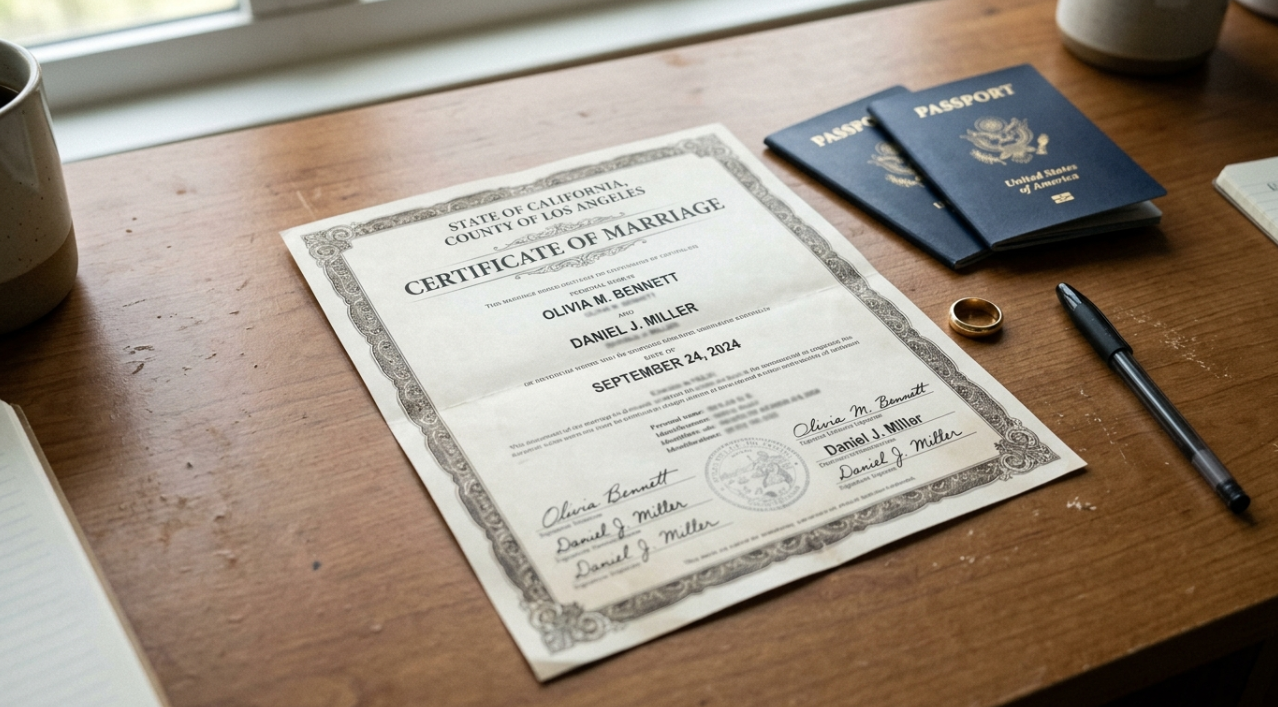
Step 5: Obtain the official marriage certificate.
Follow the county's instructions for receiving the completed record. Check that the names and other identifying details are correct before using the certificate for additional legal procedures.
Step 6: Arrange document authentication and translation if needed.
If the certificate will be presented in Saudi Arabia or another country, confirm the required authentication, apostille, translation, and registration steps with the receiving authority.
Step 7: Confirm the certificate's intended use.
A marriage certificate may be used for different purposes, including immigration petitions, family registration, and residency applications. Confirm each authority's requirements separately before submitting your documents.
Important: Processing times, fees, eligibility conditions, and document requirements can change. Check the current official Utah County instructions rather than relying solely on a service provider's advertised timeline.
Certificate Delivery Timeline
Couples receive a digital copy of a U.S. marriage certificate within 12 hours of the online ceremony. A physical copy is mailed within the next few business days. The total process typically takes less than 72 hours.
Why This Matters for Saudi-Connected Couples
This pathway exists for several groups: non-Muslim expats in Saudi Arabia who cannot marry under Saudi law, cross-border couples where one partner is in Saudi Arabia and the other elsewhere, same-sex couples connected to the kingdom, and immigration-focused couples who need a U.S. marriage certificate for visa processing.
Practitioners on Reddit’s r/immigration confirm that Utah online marriages are widely used by couples with Saudi connections for USCIS purposes. The discussion threads consistently show this is a well-traveled path, not an experimental one.
Document Legalization: The Apostille Connection
This section matters most for couples who need their U.S. marriage recognized in Saudi Arabia. The apostille is the bridge between the two legal systems.
The Hague Apostille Convention and Saudi Arabia
Saudi Arabia officially joined the Hague Apostille Convention on April 8, 2022, with the convention entering into force on December 7, 2022. Since both the U.S. and Saudi Arabia are now members, U.S. documents with a proper apostille are accepted without additional embassy legalization.
This was a major shift. Before December 2022, getting a U.S. marriage certificate recognized in Saudi Arabia required embassy attestation, a slower and more expensive process. Now, an apostille from the relevant U.S. state authority is sufficient.
What an Apostille Does—and Does Not—Prove
An apostille authenticates the origin of a qualifying public document, such as the signature, official capacity, or seal associated with that document. Saudi Arabia's participation in the Hague Apostille Convention, which took effect on December 7, 2022, simplifies the authentication process for eligible documents exchanged between participating countries.
However, an apostille does not independently establish that a marriage is valid under Saudi law, guarantee that a foreign marriage will be registered, or establish eligibility for an iqama or dependent sponsorship.
Before submitting a U.S. marriage certificate to Saudi authorities, confirm the current requirements with the relevant Saudi government department. Ask whether the document needs an apostille, a certified Arabic translation, additional supporting documents, or a specific registration procedure. Requirements may differ according to the purpose for which the certificate will be used.
Practical takeaway: Treat an apostille as document authentication, not as a guarantee of marriage recognition or immigration eligibility.
Courtly offers document legalization services including apostille processing as an add-on to their marriage packages or as a standalone service.
MOFA Attestation (Pre-2022 Process)
Before Saudi Arabia joined the Hague Convention, couples needed Ministry of Foreign Affairs (MOFA) attestation for foreign documents. Some older guides still reference this requirement. For U.S. marriage certificates issued after December 2022, the apostille alone is enough. However, you may still need a certified Arabic translation of your certificate for Saudi government processing.
Documents to Check Before Using a Foreign Marriage Certificate in Saudi Arabia
The documents required for a foreign marriage can vary according to the couple's nationality, religion, residency status, and intended application. Use this checklist to identify what to verify before submitting an application.
Document or requirement | What to confirm |
|---|---|
Official marriage certificate | Whether the receiving authority requires an original, certified copy, or a particular record format |
Apostille or authentication | Whether an apostille is applicable and sufficient for the intended submission |
Certified Arabic translation | Whether a translation is required and which translators or certification methods are accepted |
Passports and identification | Which identity documents are required for each spouse |
Residency documentation | Whether an iqama or other residence record is needed |
Previous marriage or divorce records | Whether evidence of the termination of a previous marriage is required |
Additional marriage documents | Whether a specific declaration, medical record, consent, or approval applies |
Sponsorship documentation | Which additional records are needed for dependent residency or family sponsorship |
Before submitting: Ask the relevant Saudi authority or your employer's government relations officer to confirm the current requirements for your exact application. This table is a planning aid, not an exhaustive or official list of required documents.
Will Saudi Arabia Recognize a U.S. Online Marriage?
A U.S. online marriage certificate is not automatically recognized for every purpose in Saudi Arabia. The outcome depends on the marriage's validity, the applicable Saudi legal requirements, the couple's circumstances, and the purpose for which the certificate will be used.
Three separate questions need to be considered:
Was the marriage validly performed? Check the law governing the ceremony and the requirements applicable to both spouses.
Can the document be authenticated? Determine whether an apostille and a certified Arabic translation are required for the intended use.
Will the relevant Saudi authority accept or register the marriage? Confirm the applicable rules for marriage registration, family status, residency, or dependent sponsorship.
These questions are related, but they are not interchangeable. A document can be properly authenticated without automatically establishing eligibility for every legal or administrative benefit.
Before relying on a foreign marriage certificate in Saudi Arabia, obtain confirmation from the authority responsible for your intended application. Couples with unusual circumstances, including different religions or nationalities, should seek qualified legal advice before paying for a ceremony or document service.
The General Principle
Saudi Arabia recognizes foreign marriages that were legally performed in their jurisdiction of origin, provided they don’t violate Saudi public policy (meaning Sharia law). A U.S. marriage certificate with a proper apostille meets the documentation requirements. But the content of the marriage, who married whom, must also be compatible with Saudi law.
Restrictions That Apply
Saudi law does not recognize marriages between Muslim women and non-Muslim men. It also does not recognize same-sex marriages under any circumstances. Even with a perfectly apostilled U.S. certificate, these marriages will not be registered in Saudi Arabia.
For heterosexual couples where the marriage is compatible with Sharia principles, a U.S. online marriage certificate with an apostille can be registered. Additional steps may include Saudi Arabian sponsor consent (if one spouse is a Saudi national), a Saudi culture course and interview for foreign spouses, and a certified Arabic translation of the certificate.
For a deeper look at how recognition works across countries, see this guide to online marriage recognition.
Non-Muslim Expat Marriages
Most non-Muslim expat couples in Saudi Arabia cannot marry under Saudi law and must complete their marriage at their embassy or consulate following their home country’s rules. A U.S. online marriage provides an alternative: get legally married through Utah, apostille the certificate, and then use it for residency or sponsorship purposes in Saudi Arabia through MOFA registration.
Same-Sex Marriage and Saudi Arabia
Same-sex marriage is banned in Saudi Arabia. The country criminalizes same-sex sexual activity between both men and women, with sentences including a maximum penalty of death. There is documented evidence of enforcement in recent years, and LGBT individuals face systematic discrimination.
Why Some LGBTQ+ Couples Pursue a U.S. Online Marriage
A Utah online marriage will not be recognized inside Saudi Arabia for same-sex couples. That’s a hard legal reality. However, a U.S. marriage certificate creates legal recognition in the United States and in other countries that accept U.S. marriages. This can be critical for immigration benefits, inheritance rights, medical decision-making authority, and legal protections in countries that do recognize same-sex unions.
For LGBTQ+ couples connected to Saudi Arabia, whether through work, family, or residency, a U.S. online marriage may serve purposes outside the kingdom even if it carries no legal weight within it. Courtly’s same-sex marriage page provides more detail on this pathway.
The safety dimension matters too. Couples should carefully consider the risks of having documentation of a same-sex marriage while residing in or traveling through Saudi Arabia.
Immigration and Visa Considerations
For couples where one partner is a U.S. citizen or permanent resident and the other is a Saudi national (or vice versa), the immigration angle is often the primary motivation for an online marriage.
USCIS Recognition of Utah Virtual Marriages
The legal principle USCIS uses is straightforward: if the marriage is legally recognized in the jurisdiction where it took place, USCIS accepts it. Utah virtual marriages are legally valid in Utah, therefore USCIS recognizes them.
Community evidence supports this. Users on VisaJourney forums confirm that Utah virtual marriages are “valid and many have done it,” with multiple approved I-130 petitions based on these marriages.
The Critical Distinction: Virtual Marriage vs. Proxy Marriage
This is the single most misunderstood concept in online marriage immigration law. In a Utah virtual marriage, both partners are present during the ceremony via video. No stand-in or substitute appears on anyone’s behalf. In a proxy marriage, a third party stands in for one or both partners.
USCIS treats these very differently. Proxy marriages that have not been consummated are generally not recognized for immigration purposes. Virtual marriages, where both parties appeared live, are treated as regular marriages.
For a detailed breakdown, see proxy marriage vs. virtual marriage differences.
USCIS Recognition and the Physical-Presence Rule
A Utah remote-appearance marriage may be legally valid under Utah law, but couples seeking U.S. immigration benefits must also satisfy the applicable federal immigration requirements.
U.S. immigration law addresses marriages in which one or both parties were not physically present together at the ceremony. Under the relevant rule, a marriage involving this type of absence generally does not qualify as a marriage for immigration purposes unless it has been consummated afterward.
Do not assume that a marriage certificate alone resolves this issue. The precise ceremony arrangements, the parties' physical presence, and the applicable USCIS guidance should be reviewed before filing a spousal petition.
If you plan to use a Utah online marriage for a CR-1 or IR-1 visa or another immigration benefit, consult a qualified U.S. immigration attorney about your specific circumstances. Ask what evidence is required and whether an in-person meeting and subsequent consummation are necessary for your case.
CR-1 and IR-1 Spouse Visas
After an online marriage, a U.S. citizen can file an I-130 petition to sponsor their foreign spouse for a CR-1 (conditional resident) or IR-1 (immediate relative) visa. The online marriage certificate, properly apostilled, serves as the primary evidence of the marital relationship. Additional evidence of a bona fide marriage (communication records, financial comingling, photos together) strengthens the case.
Requirements for Foreigners Marrying in Saudi Arabia
If you’re going the domestic Saudi route rather than a U.S. online marriage, here’s what foreign nationals face.
For Muslim Expats
Muslim expats can legally marry in Saudi Arabia at the Sharia Court. Both the bride and groom must attend the ceremony along with two witnesses. An authorized ma’zoun must conduct the Nikah. Foreigners typically need approval from their embassies before proceeding.
For Non-Muslim Expats
Non-Muslim expats cannot marry under Saudi law. They must complete their marriage at their embassy or consulate following their country’s rules. If they want that marriage recognized locally for residency or sponsorship, they’ll need to have the embassy-issued certificate attested by MOFA and translated into Arabic.
Pre-Marital Medical Examination
Saudi Arabia requires a pre-marital medical examination for couples marrying within the kingdom. This screens for genetic diseases and communicable conditions. The results must be submitted as part of the marriage application through the Najiz platform.
Certificate of No Impediment
Many embassies require their nationals to obtain a Certificate of No Impediment (sometimes called a single status certificate) before marrying abroad. This document confirms you’re not already married in your home country. Check with your embassy for specific requirements.
Age and Nationality Restrictions
The PSL sets the minimum marriage age at 18. Nationality restrictions also apply: Saudi women generally cannot marry non-Muslim men, and marriages between Saudi nationals and foreigners of certain nationalities may require additional Ministry of Interior approval.
Which Online Marriage Route Is Right for You?
The best route depends on where you need the marriage to be legally effective and what you intend to do with the marriage certificate.
Situation | Route to investigate | Important consideration |
|---|---|---|
Muslim expats living in Saudi Arabia | Applicable Saudi marriage procedures through Najiz and authorized officials | Confirm eligibility, documentation, and current ceremony requirements |
Non-Muslim expats living in Saudi Arabia | Applicable embassy or consular procedures, or a foreign marriage option | Confirm whether the marriage can be used for your intended Saudi residency or administrative purpose |
Couple living in different countries | Utah remote-appearance marriage, if eligible | Check both the ceremony requirements and the destination country's recognition rules |
Couple seeking U.S. immigration benefits | Legally valid marriage plus applicable USCIS requirements | Review physical-presence, consummation, and bona fide marriage evidence requirements where applicable |
Same-sex couple connected to Saudi Arabia | Foreign marriage for jurisdictions where it is legally recognized | Do not assume Saudi recognition; carefully assess documentation and personal safety risks |
Saudi national marrying a foreign national | Applicable Saudi approval and marriage procedures, or another legally available route | Confirm nationality-specific requirements and any required government approval |
Couple needing a marriage certificate for an iqama or dependent sponsorship | The route accepted by the relevant Saudi authority | Confirm registration, translation, authentication, and sponsorship requirements before proceeding |
Before choosing a route: Identify the legal outcome you need first, then confirm the process with the government authority responsible for that outcome.
Historical Precedent: The 2014 Skype Marriage
Online marriage connected to Saudi Arabia isn’t entirely new. In 2014, Gulf News documented an actual Saudi couple married via Skype: a Saudi man in the U.S. and a Saudi woman in the kingdom used the video chat application to exchange vows that made them husband and wife. The officiating ma’zoun confirmed that all Sharia conditions were met during the ceremony. This case demonstrated that even within Islamic jurisprudence, remote presence can satisfy the legal requirements under certain interpretations.
Frequently Asked Questions
Will Saudi Arabia recognize my Utah online marriage?
It depends on whether the marriage is compatible with Saudi law. A heterosexual marriage between parties who meet Sharia eligibility requirements can be registered in Saudi Arabia with a properly apostilled U.S. marriage certificate, a certified Arabic translation, and completion of any required Saudi registration steps (like sponsor consent for Saudi nationals). Same-sex marriages and marriages between Muslim women and non-Muslim men will not be recognized regardless of documentation.
Do I need an apostille for my U.S. marriage certificate in Saudi Arabia?
Yes. Since Saudi Arabia joined the Hague Apostille Convention in December 2022, an apostille from the relevant U.S. state is required and sufficient for document recognition. Embassy legalization is no longer necessary. Courtly offers apostille services as an add-on or standalone option.
Is a Utah virtual marriage considered a proxy marriage?
No, and this distinction is legally significant. In a Utah virtual marriage, both partners appear live via video during the ceremony. In a proxy marriage, a third party stands in for one or both partners. USCIS and other authorities treat these differently. Virtual marriages are recognized the same as in-person marriages. Proxy marriages face additional scrutiny, particularly the consummation requirement.
Can a same-sex couple use an online marriage for Saudi immigration?
No. Saudi Arabia does not recognize same-sex marriages under any circumstances, and same-sex relationships are criminalized. A U.S. online marriage certificate for a same-sex couple carries no legal weight in Saudi Arabia and could potentially create serious legal risks if presented to Saudi authorities.
How long does the entire online marriage process take?
The typical timeline through a U.S.-based service is under 72 hours from start to certificate delivery. Couples receive a digital copy within 12 hours of the ceremony, with a physical copy mailed shortly after. Adding an apostille extends the timeline depending on processing speed, but expedited options exist.
Can two foreigners (neither a U.S. citizen) get married through Utah?
Yes. Utah’s remote-appearance marriage has no citizenship or residency requirement. Any two consenting adults who are 18 or older, not currently married, and not divorced in the last 60 days can marry through this process from anywhere in the world.
What if I need my online marriage recognized for an iqama (residence permit)?
After obtaining your apostilled U.S. marriage certificate and certified Arabic translation, you’ll need to register the marriage through Saudi channels. For dependent sponsorship and iqama transfer, consult with your employer’s government relations officer (PRO) about the specific documentation Saudi immigration authorities require.
Does Courtly offer an Islamic ceremony option?
Yes. Courtly provides an online Nikah option alongside the civil, U.S.-legal process, allowing Muslim couples to fulfill both religious and legal requirements in one streamlined experience.
Ready to start the process? See how online marriage works and determine which pathway fits your situation.
Let us handle the paperwork.
Getting married is complicated. Courtly simplifies the process and provides everything necessary to get married online, including providing a licensed officiant who can perform a remote ceremony.
Get Married

Get married online.
Getting married is complicated. Courtly simplifies the process and provides everything necessary to get married online.

