

Online marriage in the UAE can happen two ways: through the UAE’s own digital systems (Abu Dhabi’s TAMM app, Dubai Courts, or eZawaj for Islamic marriages) or through a foreign jurisdiction like Utah, USA, with the certificate later authenticated for UAE use. The UAE is not a member of the Hague Apostille Convention, so foreign marriage certificates require embassy authentication rather than a simple apostille. Costs range from AED 482 ($131) through Dubai Courts to AED 800 ($217) through TAMM, while a U.S. online marriage starts around $199.
Getting married online in the UAE is no longer a workaround or a pandemic-era experiment. It’s a functioning, government-backed system that processed over 43,000 civil marriage contracts since 2021 and continues to grow. But “online marriage UAE” means different things depending on who you are and what you need. A Dubai-based expat couple, a same-sex couple where one partner lives in Abu Dhabi, and a long-distance pair trying to reunite through a spouse visa are all searching for the same phrase with very different problems.
Can You Get Married Online in the UAE?
Yes, online marriage may be possible in the UAE, but the right process depends on your nationality, religion, residency status, and where you need the marriage certificate to be recognized.
Couples can explore UAE civil or Islamic marriage procedures, including eligible digital services, or marry online through a foreign jurisdiction such as Utah in the United States. These options have different eligibility rules, fees, and documentation requirements.
A UAE-issued marriage certificate is generally the more direct option for domestic use. A foreign online marriage certificate may require additional authentication, attestation, and translation before it can be used for specific administrative purposes in the UAE. Acceptance depends on the applicable legal requirements and the authority handling your application.
Before choosing a service, confirm three things: whether both partners are eligible, whether the ceremony can be completed remotely, and whether the resulting certificate will meet the requirements of the authority where you intend to use it.
This glossary covers every term, system, and process you’ll encounter when researching online marriage options connected to the UAE. It’s organized to help you understand both UAE-issued marriage systems and the foreign alternative (a U.S.-legal online marriage) that many UAE residents and expats use when domestic options don’t fit.
If you’re considering a U.S.-legal online marriage as your path, Courtly handles the entire process remotely, from license to ceremony to certificate delivery.
Online Marriage Options in the UAE Compared
There is no single online marriage route that works for every couple. The main options differ in eligibility, ceremony requirements, cost, and the steps needed to use the marriage certificate.
Marriage option | Best suited for | Remote ceremony | Main consideration |
|---|---|---|---|
Abu Dhabi civil marriage | Eligible couples seeking a civil marriage under Abu Dhabi's legal framework | Remote ceremonies are subject to current eligibility requirements | Confirm the applicable service, residency rules, and fees with the Abu Dhabi Judicial Department |
Dubai civil marriage | Eligible non-Muslim couples who meet Dubai's requirements | Depends on the service currently available | Check residency, age, documentation, and attendance requirements |
UAE Islamic marriage | Muslim couples seeking a marriage contract under applicable Islamic and UAE legal requirements | Remote participation depends on the authorized procedure and applicable rules | Confirm requirements for the guardian, witnesses, medical screening, and registration |
Utah online marriage | Couples who meet Utah's legal requirements and need a marriage performed under U.S. law | Yes, subject to the issuing authority's requirements | Foreign-certificate authentication and acceptance in the UAE must be checked separately |
Important: A remote ceremony, an electronically submitted application, and a marriage certificate that can be used in another country are three different things. Confirm the rules for the exact service and intended use before paying any fees.
Abu Dhabi Civil Family Court
The judicial body within Abu Dhabi’s Department of Judiciary (ADJD) that handles non-Muslim civil marriages. This court has become the busiest civil marriage processor in the Gulf region. Between January and September 2025, it received nearly 15,000 civil marriage applications, averaging about 77 per day. Since the introduction of the Civil Marriage Law in 2021, the court has served clients from over 120 nationalities, including tourists who fly in specifically to get married. It’s the court behind the TAMM virtual marriage service.
Abu Dhabi Civil Marriage Law (Law No. 14 of 2021)
The legal foundation that made civil (non-religious) marriage possible in Abu Dhabi. Articles 4 and 5 establish the framework for secular unions, applicable exclusively to non-Muslims and non-UAE nationals. Before this law, expats in the UAE had to marry under Sharia law or travel abroad for a civil ceremony. The UAE remains the only Gulf nation permitting non-religious civil marriages, and this law is the reason. The numbers tell the story of demand: registered civil marriages grew from approximately 5,400 in 2022 to over 16,000 in 2024.
Apostille
An international certification under the Hague Convention that simplifies document authentication between member countries. Here is the critical fact that trips up most couples: the UAE is not a Hague Convention member. This means an apostille alone will not make a foreign marriage certificate valid for use in the UAE. You need full embassy authentication instead.
This distinction matters enormously for anyone who gets married online through a U.S. jurisdiction and then wants to use the certificate in the UAE for visa sponsorship, property purchases, or family registration. If you’re unclear on the difference, Courtly’s guide on apostille vs. authentication breaks it down.
Attestation (Marriage Certificate)
The multi-step process of legalizing a foreign-issued marriage certificate so it’s accepted within the UAE. For a U.S. marriage certificate, the typical chain looks like this:
Notarization in the issuing state
Secretary of State certification in the issuing state
U.S. Department of State authentication
UAE Embassy/Consulate authentication in the United States
MOFA attestation inside the UAE (final step)
Common reasons you’ll need attestation include adding a spouse’s name to a passport, sponsoring a spouse for a UAE residence visa, applying for a child’s passport, and purchasing property jointly. Practitioners on Reddit’s r/dubai frequently ask whether the UAE recognizes foreign online marriages, and the answer is: yes, it can, but only after proper attestation. Skipping any step in the chain creates problems.
Courtly offers document legalization services to help couples navigate this process for their U.S. marriage certificates.
Certificate of No Impediment (CNI)
A document proving that a person is legally free to marry, meaning they are not currently married, not in a registered partnership, and have no other legal barriers to marriage. Most UAE marriage processes require a CNI, and it must be attested by your country’s embassy or consulate in the UAE. Getting a CNI can take anywhere from a few days to several weeks depending on your nationality, so plan ahead. Not all countries issue them under the same name. Some call it a “single status certificate” or “certificate of freedom to marry.”
Civil Marriage (UAE)
A secular, non-religious marriage ceremony available in the UAE. Abu Dhabi offers civil marriage to any foreigner (minimum age 18), while Dubai restricts its civil marriage service to non-Muslim residents (minimum age 21). Civil marriage is distinct from Sharia marriage in several ways: no guardian (wali) is required, no Islamic contract terms apply, and the legal framework is based on civil law rather than religious law. For many expats, civil marriage is the simpler and faster route, especially when both partners come from different religious or cultural backgrounds.
Dubai Civil Marriage: Eligibility and Application Process
Dubai provides a civil marriage route for eligible non-Muslim couples under the emirate's legal framework. Applicants should verify the current age, residency, marital-status, documentation, attendance, and fee requirements before submitting an application.
Dubai Courts has also announced digital marriage services intended to streamline the process. Because service availability and application procedures can change, use the current Dubai Courts or DubaiNow service instructions to determine whether the application and ceremony can be completed remotely.
Before proceeding, confirm whether the resulting certificate is suitable for your intended use and whether any additional document processing is required.
Embassy Authentication
The legalization process required when documents need to be accepted in a non-Hague country like the UAE. Instead of a single apostille stamp, embassy authentication involves the UAE embassy or consulate in the issuing country reviewing and stamping the document after it has been certified by the relevant state and federal authorities.
For a U.S. marriage certificate headed to the UAE, this means going through the Secretary of State, the U.S. Department of State, and then the UAE Embassy in Washington, D.C. (or a UAE consulate). The process typically takes longer and costs more than a standard apostille, but it’s the only path the UAE accepts.
eZawaj System
The UAE Ministry of Justice’s digital platform for Islamic (Sharia) marriage applications. It operates across all federal Sharia courts and covers the full process: submitting the marriage application, booking an appointment, selecting an authorized marriage official, and paying fees electronically. The system works on computers, tablets, and smartphones.
A valid online nikah through eZawaj must satisfy both Islamic law and UAE civil requirements simultaneously. Neither set of rules is optional. Skipping either one creates a marriage that is either religiously void or legally unenforceable. This dual compliance requirement is something many couples underestimate. For more on this topic, see the section on Online Nikah below.
Federal Decree Law No. 41 of 2022
The UAE personal status law for non-Muslim foreigners. It governs marriage, divorce, wills, and inheritance, providing a modern legal framework that operates separately from Sharia-based personal status law. This decree expanded on the foundations laid by Abu Dhabi’s 2021 civil marriage law and gave non-Muslim expats across the UAE clearer legal standing in family matters. If you’re a non-Muslim foreigner dealing with any family law issue in the UAE, this decree is the governing framework.
MOFA Attestation
The final step of document legalization inside the UAE. After a foreign marriage certificate has been authenticated by the UAE embassy in the issuing country, it must then be stamped by the UAE Ministry of Foreign Affairs and International Cooperation (MOFA). Only after this step is the document considered fully valid for domestic use. MOFA attestation applies to all foreign documents, not just marriage certificates, but it comes up most often in the context of spouse sponsorship and visa applications. Through the TAMM system, couples who marry in Abu Dhabi can add MOFA attestation for an additional AED 300 ($81), giving them an attested digital certificate valid outside the UAE.
Online Marriage
A legally binding marriage conducted via video conference where both parties participate remotely. In the UAE context, online marriage takes two forms:
UAE-issued: Abu Dhabi’s TAMM app offers full virtual ceremonies over a secure WebEx link, with the officiant, witnesses, and guests all joining remotely. Dubai Courts offers its own civil marriage service, though in-person visits are still required.
Foreign-issued: Jurisdictions like Utah, USA allow couples to complete a legally valid marriage entirely online. One commenter on coverage of the TAMM launch noted: “Online marriage for anyone anywhere in the world has been available from Utah, USA since 2021. Much cheaper too and no lawyers or representatives needed, just presence on a Zoom call.” This captures the growing awareness of U.S. online marriage as a viable alternative.
A foreign online marriage certificate can be used in the UAE, but it must go through the full attestation chain described above. To understand how recognition works globally, Courtly publishes detailed guidance on online marriage recognition.
Online Nikah
An Islamic marriage ceremony conducted remotely, typically over video call. In the UAE, an online nikah through the eZawaj system must include:
Consent from both parties
A wali (male guardian) for the bride
Two Muslim male witnesses
A licensed marriage official
Compliance with UAE civil registration requirements
The dual requirement, satisfying both religious and civil law, makes online nikah more complex than a standard civil ceremony. Couples must ensure the officiant is authorized under UAE law, not just recognized by their home country or community. Courtly offers an online Nikah option alongside its civil U.S. marriage process for Muslim couples seeking both religious and legal recognition.
Premarital Screening Certificate
A medical fitness certificate required for marriage registration in the UAE, primarily for Islamic marriages processed through Sharia courts. The screening typically includes tests for communicable diseases and genetic conditions. Requirements vary by emirate and by whether the marriage is civil or religious. Abu Dhabi’s civil marriage pathway treats premarital screening as case-dependent rather than mandatory, while Sharia courts generally require it. A U.S. online marriage through Utah does not require any medical screening.
Remote Appearance Marriage (Utah)
A U.S.-legal marriage where both parties appear via video conference rather than in person. Utah pioneered this process, and it results in a valid U.S. marriage certificate issued by Utah County. The entire process, from application to ceremony to certificate delivery, can be completed online from anywhere in the world.
For UAE-connected couples, this path is particularly relevant in several scenarios: when one partner is in the UAE and the other is abroad, when same-sex couples need a legal marriage (civil marriage in the UAE is limited to opposite-sex couples), or when couples face tight timelines for visa or immigration purposes.
Courtly has married couples where one partner is in Dubai and the other in another country entirely, demonstrating direct UAE-connection use cases.
See how Courtly works for a step-by-step walkthrough of the process.
The key tradeoff: a Utah marriage certificate requires embassy authentication (not just an apostille) before the UAE will recognize it. This adds time and cost but is a well-established pathway that thousands of international couples have used.
TAMM App
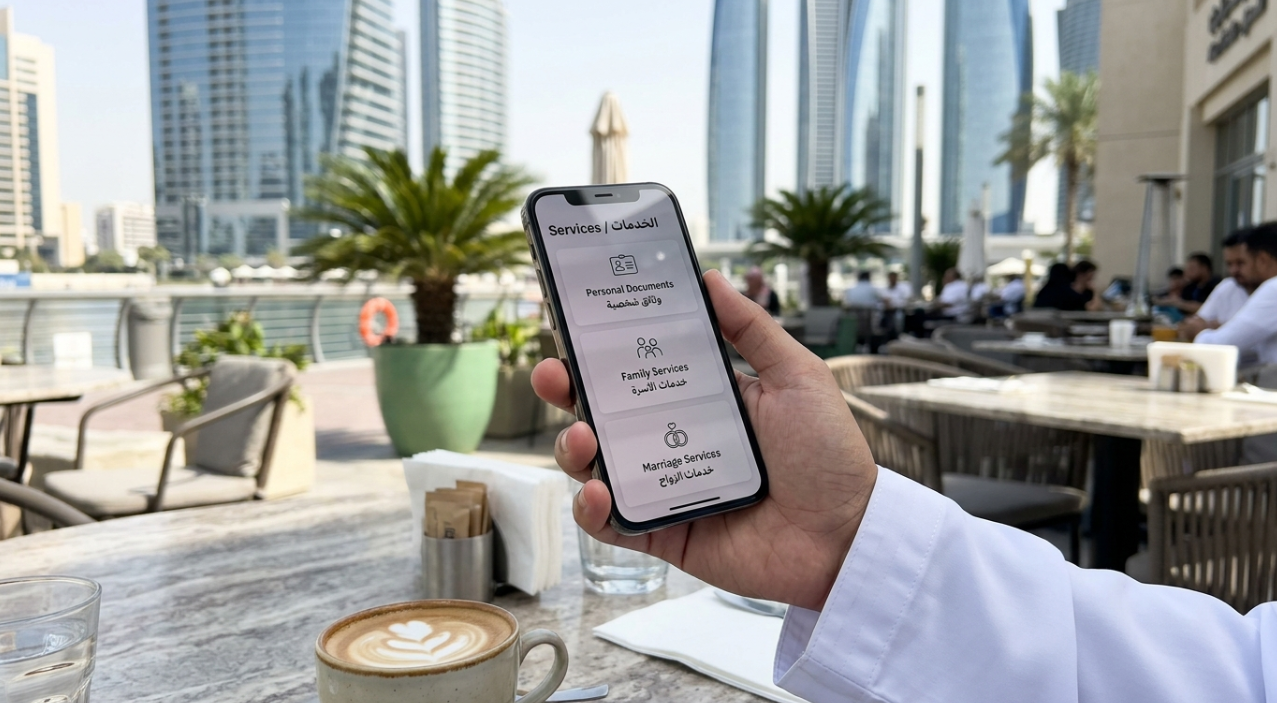
Abu Dhabi’s government super-app offering over 1,100 services, including virtual marriage. Through TAMM, couples can fill out forms, upload documents, schedule an officiant, and host a virtual ceremony, all from a smartphone, and the process can be completed in a single day for AED 800 (approximately $217).
Key details about the TAMM marriage service:
Who can use it: UAE citizens, residents, visitors, and non-residents (non-residents need a local legal representative)
How the ceremony works: Via a secure WebEx link with the officiant, two witnesses, and optional guests all joining remotely
Attestation add-on: AED 300 ($81) for an attested digital certificate valid outside the UAE through MOFA
Authentication: Requires UAE PASS for identity verification
The TAMM virtual marriage service launched in late 2025 and drew significant international media coverage. It represents the most fully digital marriage experience available within the UAE itself.
UAE PASS
The national digital identity system used to access government services in the UAE, including marriage applications on TAMM and eZawaj. Think of it as the UAE’s equivalent of a government login. UAE PASS verifies your identity through facial recognition and Emirates ID data. Residents set it up through the UAE PASS app; non-residents may face additional steps for identity verification. Without UAE PASS, you cannot access most digital government marriage services in the UAE.
Wali (Guardian)
The bride’s male guardian, required under Sharia law for Islamic marriages in the UAE. The wali must be present (in person or via video) and must give consent for the marriage to be valid. Typically the bride’s father, the role can also be filled by a brother, uncle, or another close male relative. In the UAE’s eZawaj system, the wali’s participation is mandatory. Civil marriages in Abu Dhabi and Dubai do not require a wali.
How to Get Married Online in the UAE: Step by Step
The process depends on the marriage service you choose. Before starting an application, identify your eligibility and confirm how the certificate will be used.
Step 1: Check your eligibility
Confirm both partners' ages, nationalities, religions, residency status, and current marital status. Some services have restrictions based on religion or residence, while foreign marriage services follow the laws of their issuing jurisdiction.
Step 2: Choose a UAE-issued or foreign marriage certificate
A UAE-issued marriage certificate may simplify domestic administrative procedures. A foreign online marriage may suit couples who meet the issuing jurisdiction's requirements but should be evaluated against the UAE's document-recognition and authentication rules.
Step 3: Prepare the required documents
Depending on the route, you may need passports, Emirates IDs or residency documents, proof of marital status, divorce decrees or death certificates from previous marriages, and certified translations or attestations.
Do not assume that every service requires a Certificate of No Impediment or that every document must follow the same authentication process. Confirm the current checklist with the relevant authority.
Step 4: Submit the application and pay the applicable fees
Use the official government portal or an authorized provider. Review the total cost, processing time, refund policy, identity-verification requirements, and any optional services before making payment.
Step 5: Complete the ceremony and obtain the marriage certificate
Follow the issuing authority's instructions for identity checks, witnesses, the officiant, and attendance. Confirm how the certificate will be issued and whether you will receive a digital document, a paper original, or both.
Step 6: Check whether further authentication is required
If you intend to use a foreign marriage certificate in the UAE, ask the relevant authority which authentication, attestation, translation, and registration steps apply to your nationality and intended purpose.
Step 7: Confirm acceptance before relying on the certificate
If the certificate is needed for spouse sponsorship, residency, family registration, or another legal process, verify its requirements with the responsible authority before relying on it. Completing a marriage ceremony does not guarantee approval of a separate visa or administrative application.
Cost Comparison: UAE vs. U.S. Online Marriage
Understanding the real costs helps with decision-making. Here’s how the main options compare:
Abu Dhabi (TAMM) | Dubai Courts | U.S. Online (Courtly) | |
|---|---|---|---|
Base fee | AED 800 (~$217) | AED 482 (~$131) | Starting at $199 |
Attestation/authentication | +AED 300 (~$81) for MOFA | Included for UAE use | Embassy authentication needed (~$275 avg.) |
Government processing fee | Included | Included | ~$70 (Utah County) |
Witnesses | Required (you provide) | Not required | Optional add-on ($50) or included in Fast-Track |
Remote ceremony | Yes (WebEx) | In-person visit required | Yes (video call) |
Minimum age | 18 | 21 | 18 |
Residency requirement | Non-residents need local rep | One party must be Dubai resident | None |
Religious restriction | Non-Muslims only (civil) | Non-Muslims only | None |
For current Courtly pricing and plan details, each tier includes different levels of support, recording, and recognition guidance.
When an Online Marriage Certificate May Be Rejected in the UAE
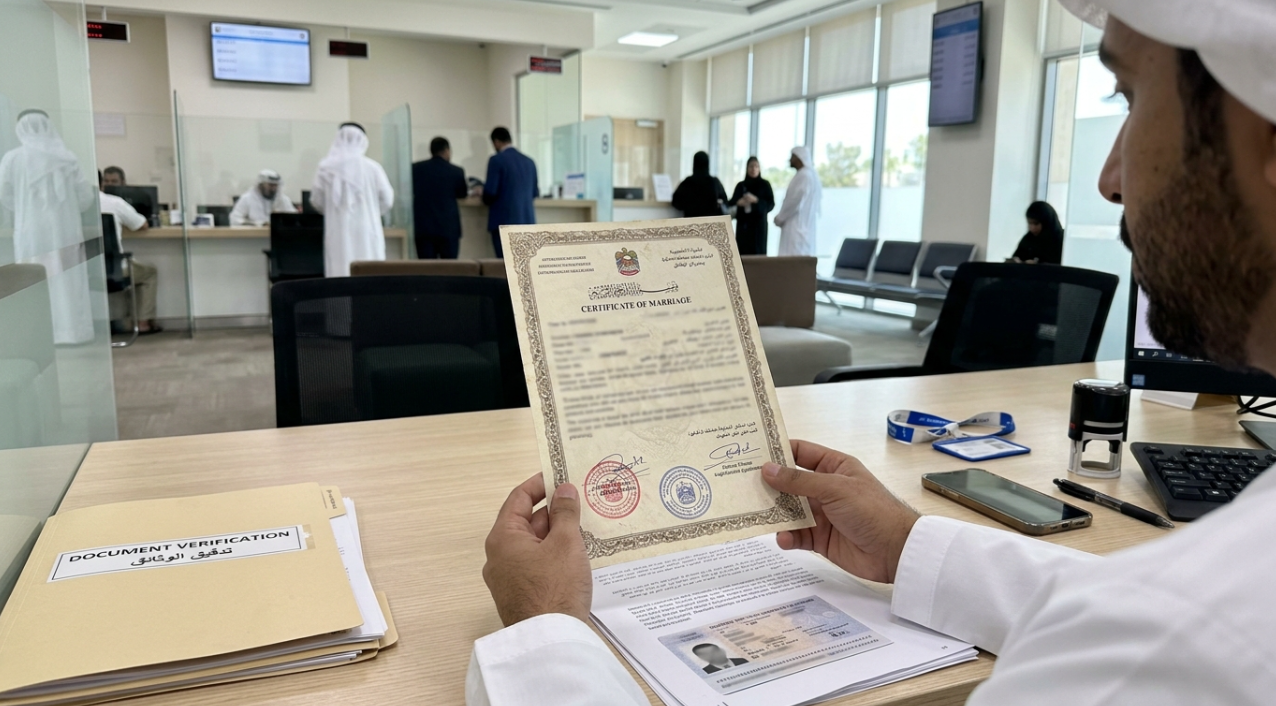
Not every online marriage certificate will be accepted. Common reasons for rejection include:
The officiant was not legally authorized in the issuing jurisdiction
Required documents are incomplete or contain inconsistencies
The attestation chain was not followed correctly (missing a step)
The certificate comes from a jurisdiction the UAE does not recognize
The couple skipped required legal steps in the issuing country
Most UAE residents must complete the full legalization process before using a foreign online marriage certificate for residency applications, spouse sponsorship, or family registration. Acceptance by UAE authorities is ultimately at their discretion, and couples should consult with an immigration or family law attorney before relying on any foreign certificate for critical administrative purposes.
Frequently Asked Questions
Does the UAE recognize online marriages performed in other countries?
The UAE can recognize foreign marriages, including those performed online, but only if the certificate was issued by a recognized authority, is legally valid in the issuing country, and has been properly attested through the full embassy authentication and MOFA process. A U.S. marriage certificate from Utah, for example, is legally valid, but it requires authentication by the Secretary of State, U.S. Department of State, and UAE Embassy before MOFA will stamp it for domestic use. For couples navigating this process, Courtly’s international online marriage page covers how cross-border couples approach these steps.
Can I use an apostille instead of embassy authentication in the UAE?
No. The UAE is not a member of the Hague Apostille Convention. An apostille alone will not be accepted. You need full consular authentication through the UAE embassy or consulate in the country where the document was issued. This is one of the most common and costly mistakes couples make.
What’s the difference between TAMM virtual marriage and a U.S. online marriage?
TAMM issues a UAE marriage certificate directly, meaning no foreign attestation is needed for use within the UAE. A U.S. online marriage issues a U.S. certificate that must then be authenticated for UAE use. TAMM is limited to non-Muslim, non-UAE national couples and requires UAE PASS. A U.S. online marriage through Utah has no citizenship, residency, or religious restrictions but adds the authentication step and cost.
Can same-sex couples get married online for use in the UAE?
The UAE does not recognize same-sex marriages. However, same-sex couples with ties to the UAE sometimes obtain a U.S. legal marriage for use in jurisdictions that do recognize it, or for U.S. immigration purposes such as spouse visa applications. The certificate itself is valid as a U.S. legal document regardless of where the couple lives.
How long does the TAMM virtual marriage process take?
Abu Dhabi’s TAMM platform can process a virtual marriage within 24 hours, from document upload to ceremony. However, this assumes all required documents (passport, Emirates ID or entry permit, CNI, etc.) are already prepared and attested. Document preparation is often the bottleneck, not the ceremony itself.
Do I need to be physically present in the UAE to get married through TAMM?
No. Non-residents can use the TAMM virtual marriage service, but they must have a local legal representative in the UAE. The ceremony takes place over a secure WebEx link, so both parties, the officiant, and witnesses can join from anywhere.
Is an online marriage certificate from Utah different from a regular marriage certificate?
No. Utah County issues the same marriage certificate for remote appearance marriages as it does for in-person ceremonies. The document does not indicate that the marriage was performed online. For more detail on this topic, see Courtly’s explanation of whether online marriage is legal.
How much does it cost total to get a U.S. online marriage recognized in the UAE?
The total depends on your plan and authentication needs. A basic Courtly plan starts at $199 plus the ~$70 Utah County government fee. Embassy authentication for UAE use adds approximately $275 on average. So a realistic total ranges from roughly $470 to $700 or more depending on plan tier, add-ons, and processing speed. Compare this to TAMM’s AED 1,100 (~$298) total with attestation included.
Online marriage in the UAE, whether through a domestic system or a foreign certificate, is a real and growing pathway that tens of thousands of couples have used. The key is understanding which route fits your situation and what documentation steps follow the ceremony.
Ready to explore a U.S.-legal online marriage? Get started with Courtly to see your options, timeline, and pricing.
Let us handle the paperwork.
Getting married is complicated. Courtly simplifies the process and provides everything necessary to get married online, including providing a licensed officiant who can perform a remote ceremony.
Get Married

Get married online.
Getting married is complicated. Courtly simplifies the process and provides everything necessary to get married online.

