

An online marriage embassy interview is the U.S. embassy or consulate interview where a consular officer evaluates your spouse visa application when your marriage was performed virtually. Online marriages (like those conducted through Utah) are valid for immigration, but they face extra scrutiny. You’ll need to prove the marriage was legally performed, that it’s a genuine relationship, and, critically, that you consummated the marriage after the ceremony. This guide covers everything: the legal framework, what happens at the interview, required documents, and how to avoid common pitfalls.
Quick Answer: What Happens at an Online Marriage Embassy Interview?
An online marriage does not automatically disqualify a CR-1 or IR-1 spouse visa applicant. The U.S. government will examine whether the marriage is legally valid where it was performed, whether it qualifies as a marriage under U.S. immigration law, and whether the relationship is genuine. If the spouses were not physically present together during the ceremony, the post-ceremony consummation requirement under INA §101(a)(35) can become critical.
For an online marriage embassy interview, be prepared to show:
* Your original or certified marriage certificate
* Evidence that the marriage was legally performed
* Evidence of your bona fide relationship
* Evidence of any required post-ceremony in-person meeting
* Your DS-260 confirmation page and other required civil documents
* Medical examination results and other documents required by the specific U.S. embassy or consulate
* A clear explanation of when, where, and how your online wedding took place
The most important point is that a marriage certificate alone does not answer every immigration question. The exact way the ceremony was conducted, where each spouse was physically located, and whether the marriage meets the federal definition of a qualifying spousal relationship can affect the case.
Online Marriage and U.S. Immigration: What Changed in 2025?
The most important recent development for couples using an online marriage for U.S. immigration is USCIS Policy Alert PA-2025-23, issued October 17, 2025. The update revised USCIS guidance on qualifying spousal relationships and specifically addressed virtual marriages, proxy marriages, bona fide marriage evidence, and the place-of-celebration rule.
The update did not create a blanket rule that every online marriage is automatically accepted. Instead, USCIS evaluates whether the marriage is legally valid under the law of the jurisdiction where it was performed and whether it qualifies as a spousal relationship under U.S. immigration law.
For couples who married remotely, the details of the ceremony matter.
The 4 questions that matter most
Question | Why it matters |
|---|---|
Where was the marriage legally performed? | USCIS generally applies the place-of-celebration rule when determining marriage validity. |
Was the marriage legally valid under that jurisdiction's law? | A marriage certificate must represent a legally valid marriage. |
Where was each spouse physically located during the ceremony? | Physical presence can affect whether INA §101(a)(35)'s consummation rule applies. |
Did the couple meet in person after the ceremony when required? | A marriage covered by the statutory physical-presence rule may need to be consummated after the ceremony. |
This is why couples should not simply describe their marriage as an "online wedding." They should be able to explain exactly how the ceremony occurred, where the officiant was located, where each spouse was located, and what happened afterward.
What Is an Online Marriage Embassy Interview?
An online marriage embassy interview is the U.S. embassy or consulate interview that takes place as part of the CR-1 or IR-1 spouse visa process when the underlying marriage was conducted online or virtually. It’s the moment where a consular officer reviews your case, examines your documents, and determines whether your marriage is both legally valid and genuinely intended.
This interview is sometimes called a “consular interview” (when held at a U.S. embassy abroad) or a “USCIS interview” (when the foreign spouse is adjusting status inside the United States). The distinction matters: at an embassy abroad, only the foreign spouse attends. At a USCIS field office, both spouses must be present.
For couples who got married online, the interview carries specific implications. The consular officer will want to know why you chose a virtual ceremony, whether the marriage is legally valid under the place-of-celebration rule, and whether you’ve met the consummation requirement. These are questions that couples who married in person rarely face.
Why Online Marriages Face Extra Scrutiny at the Embassy Interview
Does USCIS Recognize Online Marriages?
Potentially, yes. USCIS does not categorically exclude virtual marriages from family-based immigration. However, an online marriage must satisfy the applicable legal requirements. USCIS applies the place-of-celebration rule when evaluating whether a marriage is legally valid, while federal immigration law can impose additional requirements when the spouses were not physically present together during the ceremony.
USCIS issued Policy Alert PA-2025-23 on October 17, 2025, specifically addressing virtual and proxy marriages in its guidance on spousal petitions.
For that reason, the safest way to evaluate an online marriage is not simply to ask, "Does USCIS accept online marriages?" Instead, ask:
Was the marriage legally performed in the jurisdiction that issued the marriage certificate?
What type of remote ceremony was performed?
Where was each spouse physically located during the ceremony?
Does INA §101(a)(35) apply to the ceremony?
If it applies, was the marriage subsequently consummated?
Can the couple establish that the relationship is bona fide?
A Utah remote-appearance marriage can be legally valid under Utah law when the statutory requirements are satisfied. Utah County states that for a remote ceremony, the officiant must be physically present in Utah and the couple and two witnesses must be able to see and hear one another during the ceremony. Utah County also warns that a remote marriage may not be recognized in the country where the spouses reside.
Therefore, legal validity under Utah law and immigration eligibility are related but separate questions.
Does an Online Marriage Need to Be Consummated for Immigration?
It depends on how the marriage ceremony was conducted.
INA §101(a)(35) provides that a person is not considered a spouse for immigration purposes based on a marriage ceremony in which the contracting parties were not physically present together, unless the marriage was subsequently consummated.
This distinction is especially important for remote and proxy marriages.
When the consummation rule matters
If the spouses were not physically present together during the ceremony, the couple should treat the post-ceremony in-person meeting and consummation requirement as a critical immigration issue.
Evidence may include:
Airline tickets or boarding records
Passport entry and exit records
Hotel reservations
Photographs showing the spouses together after the ceremony
Evidence of a shared residence, where applicable
Other credible records documenting the post-ceremony in-person relationship
The evidence should establish the relevant timeline without attempting to provide unnecessary intimate details.
Why the timing matters
Do not assume that simply having met before the online wedding satisfies the rule. The statutory language concerns what happened after a qualifying ceremony in which the spouses were not physically present together.
Because the distinction between a virtual ceremony and a proxy-style ceremony can affect the immigration analysis, couples with uncertainty about their physical locations during the ceremony should obtain individualized immigration advice before filing.
Important: A legally valid marriage certificate does not by itself eliminate every federal immigration requirement.
Misinformation Is a Real Problem
One of the reasons this topic generates so much anxiety: bad information circulates freely. On legal Q&A platforms like Justia, at least one lawyer incorrectly stated that “online virtual marriage is not recognized as a legal form of marriage in the United States” and that both parties must physically be present. This is flatly wrong since Utah changed its law in 2020. If you’re researching your case, be cautious about outdated advice, even from professionals who should know better.
Explore how Courtly’s process works to see how a legally valid online marriage is structured from the start.
Online Marriage vs. Proxy Marriage: What's the Difference?
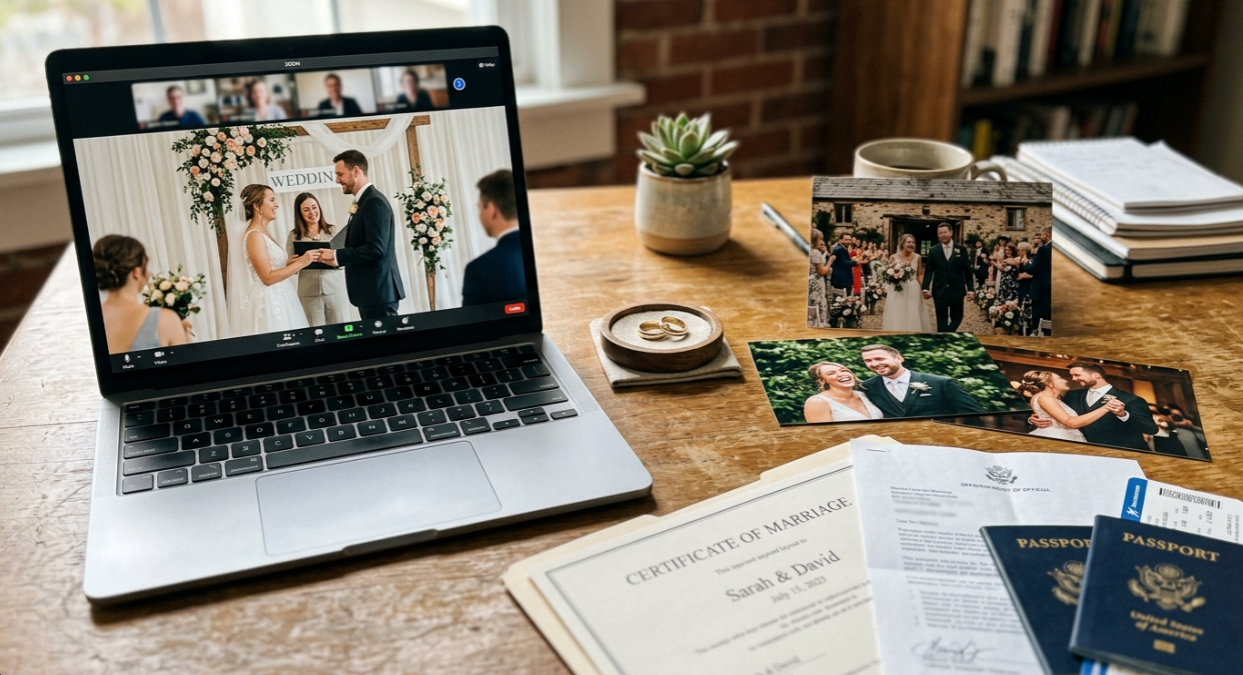
The terms "virtual marriage" and "proxy marriage" are often used interchangeably online, but they can describe different situations.
Feature | Virtual/Remote Ceremony | Proxy Marriage |
|---|---|---|
Ceremony conducted by video | Usually yes | May be, depending on jurisdiction |
Both spouses participate live | Yes | One spouse may be represented by another person |
Spouses physically together during ceremony | Depends on the facts | Generally no |
USCIS physical-presence issue | Depends on how the ceremony was conducted | Yes, potentially |
Post-ceremony consummation issue | Depends on the physical-presence facts | Critical when INA §101(a)(35) applies |
Main evidence to preserve | Certificate, ceremony details, relationship evidence | Certificate, ceremony details, post-ceremony meeting and consummation evidence |
Legal validity | Depends on the law of the place of celebration | Depends on the law of the place of celebration and federal immigration requirements |
Why the distinction matters
Do not determine your immigration strategy based solely on whether the ceremony was called "virtual," "online," or "proxy." The physical locations of the spouses during the ceremony and the law governing the marriage are important facts.
If your ceremony took place remotely through Utah County, document the officiant's Utah location, the participants' locations, the witnesses, the ceremony date, and the official marriage record.
How the Embassy Interview Works for Online Marriage Couples
Who Attends
If the foreign spouse is abroad, the interview happens at a U.S. embassy or consulate, and only the foreign spouse attends. If both spouses are in the United States and the foreign spouse is adjusting status, the interview takes place at a local USCIS field office, and both spouses must be present.
What the Officer Looks For
The consular officer’s job is to determine two things: (1) that the marriage is legally valid, and (2) that it’s a bona fide marriage, meaning a genuine relationship entered into with the real intent to build a life together, not solely to obtain an immigration benefit.
For online marriage embassy interview cases specifically, officers tend to ask:
When and where was your wedding?
Do you have photos or a recording of the ceremony?
Who attended?
How long were you in a relationship before getting married?
Have you met in person? When and where?
What are your plans for living together?
The “when and where” question is where online marriage cases diverge from traditional ones. Saying “We married over video in Utah” will trigger follow-up questions about why you chose that route, whether you’ve met in person since, and what evidence you have of an ongoing relationship. The adjudicator will look to get an impression of your relationship from the details you provide about the wedding and your history as a couple.
Duration and Possible Outcomes
The spousal visa interview typically lasts about 10 to 15 minutes. Three outcomes are possible:
Approval. Your visa is granted.
Request for additional evidence. The officer keeps your passport and asks you to submit more documentation. This is common and not a denial.
Refusal. The officer provides a specific reason. Common grounds include insufficient evidence of a bona fide marriage, incomplete financial support documentation (Form I-864), or medical/criminal inadmissibility.
Practitioners on VisaJourney forums and legal Q&A sites report that requests for additional evidence are especially frequent in online marriage cases. One user described their wife’s CR-1 interview at the U.S. Embassy in London, where the officer asked for additional photos together, chat history, financial documents, and travel records. An immigration lawyer confirmed this is standard practice for verifying authenticity.
What Documents to Bring: Online Marriage Embassy Interview Checklist
Online marriage embassy interviews are more document-heavy than traditional ones. You need everything a regular spouse visa applicant brings, plus evidence specific to the virtual nature of your ceremony and the consummation requirement.
Standard Documents
Valid passport (valid for at least six months beyond your intended entry date)
DS-260 confirmation page
Original marriage certificate
Form I-864, Affidavit of Support (with tax returns, W-2s, or pay stubs)
Birth certificates for both spouses
Police clearance certificates
Medical examination results (from a panel physician)
Two passport-style photographs
Online Marriage-Specific Documents
Ceremony video recording. This is a unique advantage of online marriages. Unlike traditional weddings, a virtual ceremony can be recorded start to finish, providing direct evidence for your file.
Marriage certificate with apostille or embassy authentication. This is not optional for most international couples. We’ll cover the difference below.
Communication history. Emails, WhatsApp chats, call logs, video call screenshots. The more consistent and long-running, the better.
Evidence of post-ceremony meeting and consummation. Airline tickets, hotel bookings, photos together taken after the wedding date, a shared lease or address.
Financial evidence of the relationship. Joint bank account statements, money transfer records, shared bills, property documents.
One important note: in 2026, USCIS has increased its focus on detailed bona fide evidence, making organization more important than ever. Practitioners advise expecting closer review for cross-border or long-distance relationships.
For a full evidence checklist, see the proof of marriage guide.
Apostille vs. Embassy Authentication: Getting Your Certificate Ready
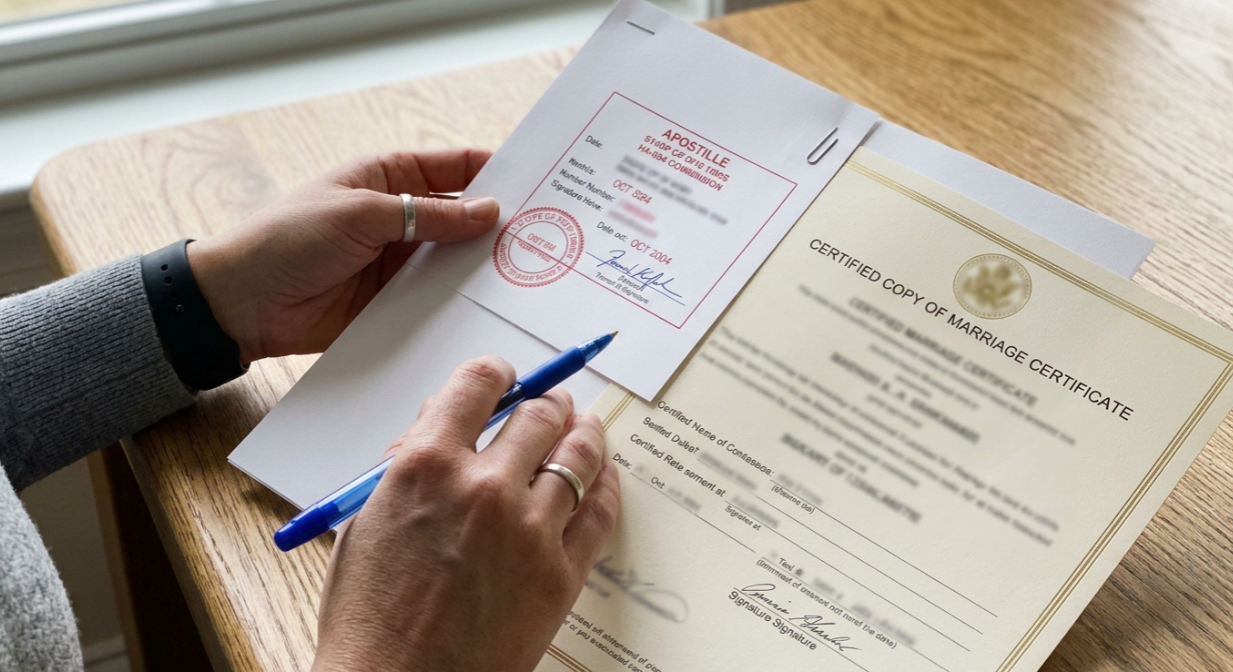
Your U.S. marriage certificate needs to be legalized before a foreign government (or a U.S. embassy abroad) will accept it. There are two paths, and choosing the wrong one can waste months.
Apostille (Hague Convention Countries)
If the country where the embassy interview takes place is a member of the Hague Apostille Convention, you need an apostille. This is a standardized certificate attached to your marriage document that verifies its authenticity. Processing averages 10 to 15 business days.
Embassy Authentication (Non-Hague Countries)
If the country is not a Hague Convention member, you need full authentication, which involves additional steps: state-level certification, U.S. Department of State approval, and legalization by the foreign embassy or consulate in the U.S. This process averages 6 to 12 weeks due to variable embassy processing times.
The difference in timeline is significant. If your embassy interview is approaching and you haven’t started the legalization process, you could face delays. For a detailed comparison, read about apostille vs. authentication.
Courtly offers document legalization services, including both apostille and embassy authentication options.
The Stokes Interview: When Extra Scrutiny Goes Further
If the consular officer suspects the marriage may be fraudulent during the online marriage embassy interview, the case may be escalated to a Stokes interview. This is a secondary interview where the couple is interviewed separately and asked the same questions. The officer then compares answers for inconsistencies.
A Stokes interview is not a death sentence for your case. It’s framed as a second chance to prove the marriage is legitimate. But it requires thorough preparation. Couples should be able to independently answer questions about their daily routine, how they met, each other’s families, their home layout, and future plans, with matching details.
For more on what triggers elevated scrutiny, see the guide on immigration red flags USCIS looks for.
Timeline: How Long Does the Process Take?
The online marriage embassy interview is just one step in a longer process. Here’s a realistic timeline for 2026:
Online marriage ceremony: Can be completed in as little as a few days
Apostille processing: 10 to 15 business days
Embassy authentication (if applicable): 6 to 12 weeks
I-130 petition processing by USCIS: Varies widely
National Visa Center processing: Several months
Embassy interview scheduling and completion: Varies by location
Total from start to finish: Most marriage-based green card applications take between 10 and 24 months, with many cases stretching to 18 to 26 months
The marriage is the beginning of the journey, not the end. Planning each step with realistic timelines prevents surprises.
Common Mistakes to Avoid
Failing to consummate after the ceremony. This is the most preventable reason for a denial. If you married online and haven’t met in person afterward, your marriage will not be recognized by USCIS for immigration purposes.
Not recording the ceremony. A video recording of the virtual wedding is powerful evidence. Don’t skip it.
Using the wrong legalization path. An apostille sent to a non-Hague country, or vice versa, means starting over and losing weeks.
Underestimating the evidence burden. Online marriage embassy interview cases require more documentation than traditional marriage interviews. Bring everything, organized chronologically, with clear labels.
Relying on outdated legal advice. The October 2025 USCIS policy update changed how virtual marriages are evaluated. Advice written before that date may be inaccurate.
For a broader list of common pitfalls, check out the online marriage mistakes guide.
FAQ
Can I use a Utah online marriage for a CR-1 spouse visa?
Yes. Utah is the only U.S. state that allows fully virtual weddings, and USCIS recognizes these marriages under the place-of-celebration rule. However, you must consummate the marriage after the ceremony if both parties were not physically together during it.
Will the consular officer ask how I got married?
Almost certainly. Officers routinely ask when and where the wedding took place, who attended, and why you chose that method. For online marriage embassy interview cases, be prepared to explain the virtual ceremony clearly and have your recording and certificate ready.
What if my home country doesn’t recognize online marriages?
USCIS follows the place-of-celebration rule, meaning your home country’s refusal to recognize the marriage does not affect its validity for U.S. immigration. What matters is that the marriage was lawfully performed in the jurisdiction that issued the certificate. However, you may face separate issues with your home country’s authorities for other legal matters.
Does my U.S. citizen spouse need to attend the embassy interview?
No. When the interview is at a U.S. embassy or consulate abroad, only the foreign spouse attends. If the couple is adjusting status within the United States at a USCIS field office, both spouses must attend together.
How long does the embassy interview last?
Typically about 10 to 15 minutes. But if the officer has concerns, it can extend or result in a request for additional evidence, which means a follow-up submission rather than a longer interview on the same day.
What happens if my visa is denied at the embassy interview?
The officer must provide a specific reason for the refusal. Common reasons include insufficient bona fide marriage evidence, incomplete Form I-864 financial documentation, or medical/criminal grounds. In many cases, you can address the issue and reapply.
What is a Stokes interview, and should I be worried?
A Stokes interview is a secondary interview where both spouses are questioned separately. It’s triggered when an officer suspects the marriage may not be genuine. It’s not common for most cases, but online marriage embassy interview applicants should prepare for the possibility by ensuring both partners can independently describe their relationship in consistent detail.
How do I know if I need an apostille or embassy authentication?
If the country where your embassy interview takes place is a member of the Hague Apostille Convention, you need an apostille. If it’s not, you need embassy authentication, which takes significantly longer. Courtly’s document legalization page can help you determine the right path.
If you’re considering an online marriage with immigration in mind, getting the legal foundation right from the start makes everything that follows easier.
See Courtly’s pricing and plans to understand what’s included, or explore the spouse visa consultation for guidance on the immigration side.
Let us handle the paperwork.
Getting married is complicated. Courtly simplifies the process and provides everything necessary to get married online, including providing a licensed officiant who can perform a remote ceremony.
Get Married

Get married online.
Getting married is complicated. Courtly simplifies the process and provides everything necessary to get married online.

