

Proof of marriage for immigration is not a single document. It includes a civil marriage certificate to show the marriage is legally valid and bona fide evidence to show the relationship is genuine. USCIS and other immigration authorities generally expect both layers of proof, and a certificate alone rarely satisfies the full requirement. If you married online or remotely, proxy marriage rules and consummation requirements may also apply.
When couples begin a spouse visa or marriage-based green card case, one of the first questions is simple: what counts as proof of marriage for immigration? The answer is less straightforward than most people expect.
Immigration authorities are not just asking whether two people signed a marriage license. They want to know two things. First, is the marriage legally valid? Second, is it a real relationship?
Understanding this distinction early can save weeks of back-and-forth with USCIS and reduce the chances of a Request for Evidence slowing down the case.
If you need a legal U.S. marriage certificate before filing, Courtly helps couples get married online through a legally binding Utah ceremony.
Quick Answer: What Counts as Proof of Marriage for Immigration?
Proof of marriage for immigration generally has two parts: legal proof that the marriage exists and evidence that the marriage is genuine. A government-issued marriage certificate establishes the legal marriage, while documents such as joint finances, shared housing, insurance, tax records, travel records, photos, and affidavits can help demonstrate a bona fide relationship. Couples who live apart or married online may need different evidence based on their circumstances. No single document proves a marriage is genuine; the strongest evidence creates a consistent picture of the couple's shared life over time.
What Counts as Proof of Marriage for Immigration?
Proof of marriage for immigration is not one document. For a U.S. marriage-based immigration case, couples generally need evidence showing both that the marriage is legally valid and that the relationship is bona fide.
1. Legal proof of marriage
Legal proof establishes that the marriage legally exists. The primary document is usually a government-issued marriage certificate or marriage record.
Depending on the case, couples may also need:
Certified marriage records
Divorce decrees from previous marriages
Annulment records
Death certificates for deceased former spouses
Court orders documenting legal name changes
Certified English translations of foreign-language documents
2. Bona fide marriage evidence
Bona fide evidence helps demonstrate that the couple entered the marriage in good faith and not primarily to obtain an immigration benefit.
Examples include:
Joint bank accounts
Joint leases or mortgages
Joint tax records
Insurance policies
Beneficiary designations
Shared debts or financial obligations
Evidence of children together
Travel records
Photos over time
Communication records for couples who live apart
Affidavits from people who know the relationship
The two categories serve different purposes. The marriage certificate establishes the legal marriage; bona fide evidence helps establish the reality of the marital relationship.
Evidence | Main purpose | Examples |
|---|---|---|
Marriage certificate | Proves legal marriage | Government-issued marriage record |
Divorce/annulment records | Proves prior marriages ended | Divorce decree, annulment |
Joint residence | Shows shared household | Lease, mortgage, utility records |
Joint finances | Shows financial interdependence | Bank accounts, taxes, loans |
Insurance/beneficiaries | Shows shared obligations | Health, life, auto insurance |
Family evidence | Shows relationship integration | Children's records, family events |
Travel evidence | Shows time spent together | Boarding passes, hotel records |
Photos | Shows relationship history | Dated, captioned photos |
Communications | Shows ongoing relationship | Calls, chats, emails |
Affidavits | Provides third-party evidence | Statements from relatives/friends |
Important: Don't describe these as an official USCIS strength ranking. Your existing article correctly says there is no official ranking system. Keep that distinction.
Proof of Marriage for Immigration: Evidence Checklist
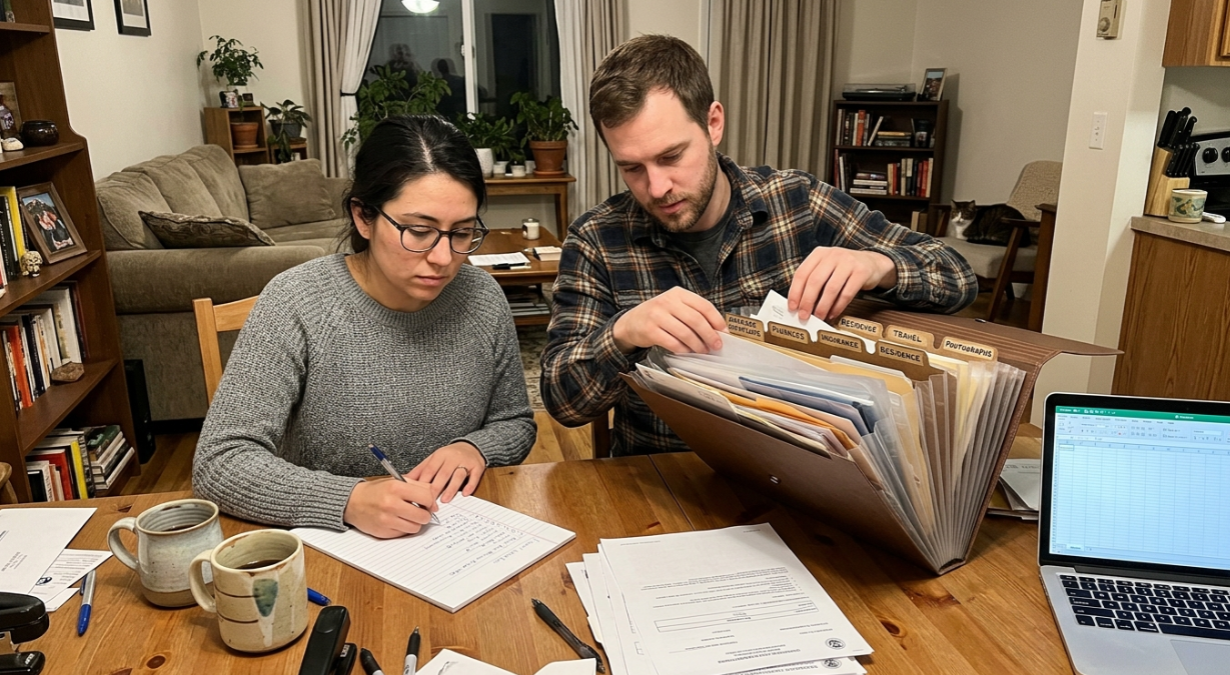
Use this checklist to identify the documents that may apply to your marriage-based immigration case.
Legal marriage documents
Government-issued marriage certificate
Certified marriage record, if required or available
Divorce decrees for previous marriages
Annulment records for previous marriages
Death certificates for deceased former spouses
Legal name-change documents, if applicable
Certified English translations for documents not in English
Should You Send Original Marriage Documents to USCIS?
For most filings, applicants should follow the specific form instructions and USCIS document requirements rather than automatically mailing original civil documents. Clear copies are generally used unless USCIS specifically requests an original or certified document.
Keep your original marriage certificate and other civil records in a secure location. If USCIS schedules an interview, follow the interview notice regarding which originals to bring.
For documents issued outside the United States, check whether a certified copy, translation, authentication, or other form of document preparation is required for the particular filing.
Shared residence
Joint lease
Mortgage or property deed
Utility bills showing the same address
Official correspondence showing a shared address
Property ownership records
Shared finances
Joint bank account statements
Joint credit cards
Joint loans or debts
Joint tax returns or tax transcripts
Shared household expenses
Other evidence of combined financial resources
Insurance and beneficiaries
Health insurance
Auto insurance
Homeowners or renters insurance
Life insurance
Retirement account beneficiary designation
Other beneficiary records
Relationship history
Dated and captioned photos
Photos with family and friends
Travel itineraries
Boarding passes
Hotel bookings
Passport stamps
Event invitations or cards
Shared memberships or subscriptions
For couples who live apart
Call logs
Representative chat or email records
Travel records showing visits
Money-transfer records, when relevant
Affidavits from people who know the relationship
Relationship timeline
Evidence of plans to establish a shared residence
For online or remote marriages
Marriage certificate
Ceremony records
Ceremony recording, if available
Evidence of post-ceremony in-person meetings, when relevant
Travel records
Photos from in-person visits
Other documentation relevant to the specific immigration rules
You do not need every item on this list. The goal is to provide credible evidence appropriate to your circumstances and to explain why certain evidence is unavailable.
Is a Marriage Certificate Enough?
Almost never. A marriage certificate proves the legal act occurred. It does not prove the couple intended to build a shared life.
Immigration attorney Michael Ashoori has noted on LinkedIn that marriage to a U.S. citizen does not guarantee a green card. The applicant still must prove eligibility and, when required, the bona fides of the marriage through shared-life evidence.
Think of it this way: a marriage certificate opens the door. Your shared-life evidence keeps the case moving forward. This distinction trips up many couples, especially those who married recently or live in different countries. Practitioners on Reddit report that newly married and long-distance couples frequently worry about whether their evidence file is “strong enough” because they lack the joint lease or joint bank account that more established couples take for granted.
Documents That Prove a Legal Marriage
These documents establish that the marriage exists and that both parties were free to marry:
Civil marriage certificate from the government office that registered the marriage
Certified copy of the marriage record, if available
Divorce decrees, annulment records, or death certificates ending any prior marriages (for both spouses)
Court-ordered name change records, if names differ across documents
Certified English translations for any non-English documents
Federal regulation requires every foreign-language document submitted to USCIS to include a full English translation, certified as complete and accurate by a competent translator. This applies to marriage certificates, chat excerpts, civil records, and anything else not in English.
USCIS guidance says applicants should submit clear, legible copies unless originals are specifically requested. If you send originals when they are not required, USCIS may retain them as part of the record. Bring originals to your interview if asked, but default to copies for the initial filing. For consular processing through the National Visa Center, the State Department similarly advises scanning documents rather than mailing originals.
If your certificate was issued in the U.S. and needs to be used abroad, you may need an apostille or embassy authentication. Courtly offers document legalization services to prepare certificates for foreign use.
Documents That Prove a Bona Fide Marriage
This is where most of the work happens. Immigration officers are looking for ordinary signs of a shared life, not grand romantic gestures.
Strong Evidence
Financial, legal, and residential records carry the most weight because they show real obligations and consequences:
Joint lease or mortgage showing both names
Joint bank account statements with regular activity by both spouses (rent, bills, groceries, transfers)
Joint credit cards, car loans, or other shared debts
Joint tax returns or tax transcripts filed as “married filing jointly” or “married filing separately”
Insurance policies (health, auto, home, renters, life) listing a spouse as insured or beneficiary
Retirement account, 401(k), or life insurance beneficiary designations naming the spouse
Utility bills or official mail at the same address for both spouses
Deed or title showing joint property ownership
Children’s birth certificates listing both spouses as parents
Immigration attorney Tsui H. Yee has emphasized on LinkedIn that tax returns should be consistent with being married. Filing as “single” or “head of household” without a valid explanation can raise red flags with USCIS officers reviewing marriage proof for immigration cases.
Helpful Supporting Evidence
These documents strengthen the picture of a shared relationship, especially when paired with stronger financial or residential proof:
Dated photos across different stages of the relationship, not just from the wedding day
Photos with both families and friends
Travel itineraries, boarding passes, hotel bookings, and passport stamps
Call logs, chat messages, emails, and letters
Event invitations, holiday cards, and shared memberships or subscriptions
Emergency contact forms listing the spouse
Medical, school, military, or employment records naming the spouse
Twenty captioned photos spanning several years carry more weight than a hundred uncategorized wedding selfies. Practitioners on Reddit consistently note that timeline quality matters more than photo quantity.
Affidavits
USCIS’s I-130 instructions specifically list third-party affidavits as an evidence category. An affidavit is a sworn statement from someone who knows the couple personally, describing the relationship based on firsthand knowledge.
Good affidavits include specific details: how the person knows the couple, occasions they witnessed, observations about the relationship, and dates. Generic statements like “they seem happy” add little value.
Community discussions on Reddit and immigration forums generally treat affidavits as useful supporting evidence, not a replacement for financial, residential, or legal documents. They are most valuable when other evidence categories are thin.
What If You Don't Have a Joint Bank Account or Lease?
Not every genuine married couple has a joint bank account, joint lease, or mortgage. Newly married couples, international couples, military families, students, and spouses living in different countries may have limited joint documentation.
The absence of one particular document does not automatically mean that a marriage is not bona fide. Instead, provide other evidence that fits your circumstances and explain significant gaps when appropriate.
For example:
Situation | Alternative evidence |
|---|---|
Spouse lives abroad | Travel records, photos, calls, messages, visits |
Recently married | Wedding records, beneficiary changes, insurance, photos, travel |
No joint bank account | Tax records, insurance, shared expenses, beneficiary records |
No shared residence | Lease history, travel records, future housing plans |
One spouse lacks an SSN | Insurance, travel, communication, affidavits, other applicable records |
Military deployment | Orders, visits, correspondence, beneficiary records |
Financial separation | Other evidence showing relationship and shared obligations |
The goal is not to manufacture documents simply because they appear on a checklist. The goal is to provide credible evidence that accurately reflects how the marriage operates.
How Strong Is Your Evidence?
There is no official USCIS ranking system for immigration proof of marriage, but practical strength follows a clear pattern. Documents that create legal, financial, or residential ties between spouses are stronger than social proof or personal statements.
Document Type | What It Helps Prove | Practical Strength |
|---|---|---|
Civil marriage certificate | Legal marriage exists | Required |
Joint lease or mortgage | Shared residence | Strong |
Joint bank statements with activity | Combined finances | Strong |
Joint tax return | Married financial unit | Strong |
Insurance or beneficiary records | Shared obligations, future planning | Strong |
Travel records and passport stamps | Time spent together | Medium to strong |
Dated, captioned photos | Relationship history | Medium |
Communication logs | Ongoing contact | Medium/supporting |
Affidavits | Third-party knowledge | Supporting |
Social media posts, cards, gifts | Relationship context | Supporting |
A few quality rules make the difference between a file that moves smoothly and one that triggers an RFE.
Show time. A handful of documents spread across months or years is stronger than many documents from the same week. Evidence should tell the story of a relationship, not document a single moment.
Show mutual use. A joint bank account with no activity is less persuasive than one used for real shared expenses. Practitioners on Reddit frequently warn that opening a joint account just to have one, without using it, does not add much credibility.
Show ordinary life. Immigration evidence is often mundane: rent, taxes, insurance, utility bills, emergency contacts. Immigration attorney Jim Hacking has described bringing stacks of shared-life evidence to marriage-based interviews, highlighting recurring bills with both names, lease agreements, and captioned photos. The “mechanics” of daily life together matter more than staged romance.
Be consistent. Addresses, names, dates, and tax filing statuses should match across all documents. Inconsistencies invite questions.
Explain what is missing. If you cannot open a joint bank account because one spouse lacks a Social Security number or lives abroad, include a short, factual explanation and substitute other categories. Do not leave gaps unexplained.
How Much Evidence Do You Need for a Marriage-Based Immigration Case?
There is no universal number of documents, photos, bank statements, or pages that guarantees approval. The appropriate amount depends on the couple's circumstances, the immigration form being filed, how long the couple has been married, and the evidence available.
Focus on coverage and consistency rather than volume.
A useful evidence file should show:
The marriage is legally valid.
The relationship developed over time.
The spouses have integrated their lives where practical.
The couple has spent time together.
Financial or household responsibilities are shared where appropriate.
Family and friends recognize the relationship.
Any unusual circumstances or evidence gaps have a reasonable explanation.
Ten well-selected documents from different periods may be more useful than hundreds of repetitive pages.
Avoid submitting large amounts of duplicate evidence simply to make the packet appear stronger. Organize representative records that collectively tell a consistent story.
What If You Live Apart or Are Long-Distance?
Living apart is common for couples in the immigration process. One spouse may be waiting for a visa in another country. Military deployment, work assignments, or school can also separate married couples.
The key is to explain why and to compensate with evidence that fits the situation. Long-distance couples on Reddit and VisaJourney forums regularly report filing I-130 petitions without joint leases, shared utilities, or co-signed loans. Instead, they use:
Passport stamps and boarding passes showing visits
Hotel bookings and travel itineraries
Photos from visits with each other’s families
Call logs and messaging app records (with timestamps)
Money transfer records (remittances via Zelle, Wise, or Western Union)
Affidavits from relatives who attended the wedding or witnessed the relationship
Proof of planning a shared residence after visa approval
A written relationship timeline with key dates
One USCIS community member shared that they submitted a detailed timeline from first meeting through marriage, combined with photos from six visits over three years, call logs, and affidavits from both families. The case was approved without an RFE.
The point is not perfection. It is showing a credible, consistent story of a real relationship across distance. If the evidence gaps in your case worry you, a spouse-visa consultation with an immigration attorney can help identify what to strengthen.
Should You Include a Relationship Timeline?
A relationship timeline can help organize evidence, particularly for couples who lived apart, married recently, or have an unusual relationship history.
Keep it factual and concise. Include important milestones such as:
When and where you first met
When you began dating
Significant visits
Meeting each other's families
Engagement
Marriage
Major trips or events
Periods of living apart and why
Birth of children, if applicable
Major changes in residence or employment
Plans to establish a household together
A timeline should explain the evidence rather than replace it. Whenever possible, connect important dates in the timeline to supporting documents such as travel records, photographs, messages, reservations, or civil records.
What If You Married Online or Remotely?
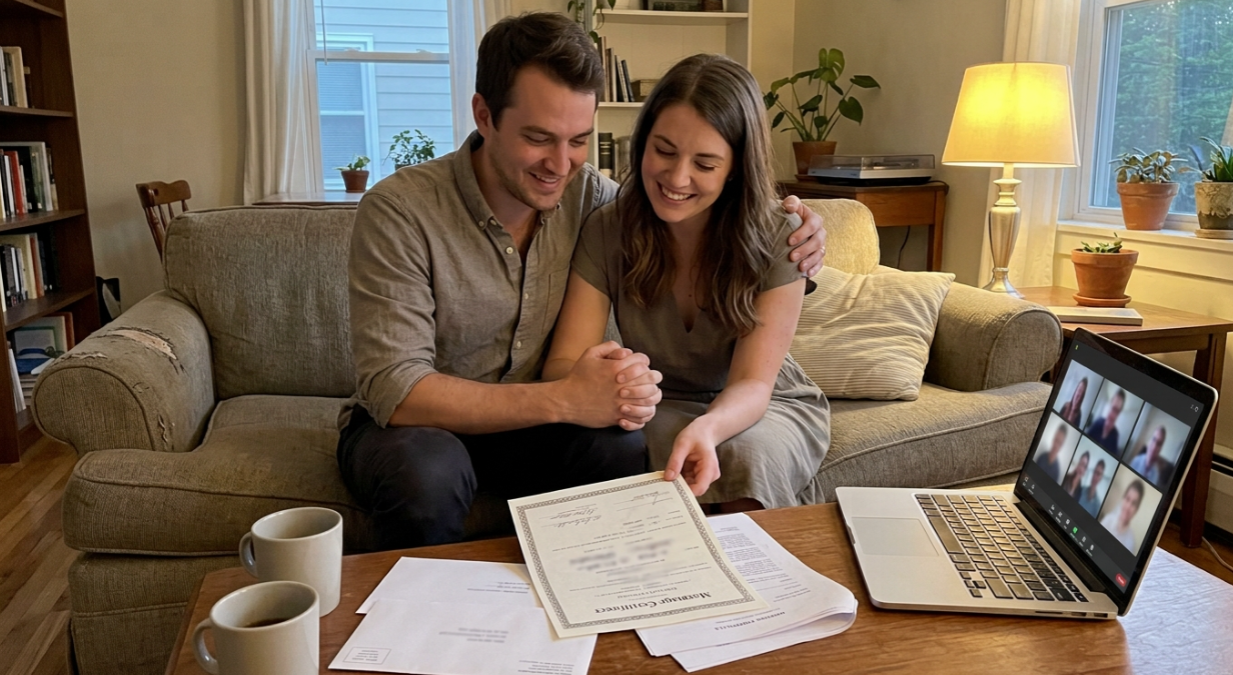
This is one of the most misunderstood areas of proof of marriage for immigration purposes.
A marriage performed online or remotely may be legally valid where it was celebrated. Utah, for example, allows fully remote marriage ceremonies. But immigration recognition is a separate question.
For U.S. immigration, the critical issue is whether the marriage is classified as a proxy marriage. USCIS’s Policy Manual states that a proxy marriage is one where one or both parties were not physically present at the ceremony. If a marriage is treated as a proxy marriage, USCIS generally requires it to be consummated after the ceremony before it creates spousal status for immigration purposes.
The State Department’s Foreign Affairs Manual echoes this: an unconsummated proxy marriage does not create or confer “spouse” status for visa adjudication.
Understanding the differences between proxy and virtual weddings matters here. In a proxy marriage, a stand-in represents one or both parties. In a virtual or online ceremony, both parties are personally present via video. The legal treatment can differ, but immigration authorities may still apply proxy-marriage analysis depending on the facts.
Practical steps for couples who married online or remotely:
Keep your civil marriage certificate and ceremony records
Save any ceremony recording
Document your post-ceremony in-person meeting with travel records, passport stamps, hotel bookings, and photos
Do not submit explicit or graphic material; use practical proof of having met in person
Nolo’s guidance on proxy and virtual marriages confirms that immigration authorities are not looking for graphic proof and that couples should think in terms of practical evidence that the spouses met after the ceremony.
For more detail on how online marriages interact with U.S. immigration filings, see this guide on online marriage and the CR-1 visa.
U.S. vs Canada: Online Marriage Recognition Differs
A marriage that is legally valid in one country may not be recognized for immigration purposes in another. This catches many couples off guard.
United States: USCIS applies the place-of-celebration rule but adds a consummation requirement for proxy marriages. If the couple can show they met in person after the ceremony, the marriage generally qualifies for spousal immigration benefits.
Canada: Immigration, Refugees and Citizenship Canada (IRCC) takes a stricter position. IRCC generally does not recognize marriages performed by proxy, telephone, internet, or fax where one or both parties were not physically present, with narrow exceptions for applications received before June 10, 2015 or certain Canadian Armed Forces cases.
This means a couple who marries online through a U.S. jurisdiction may hold a legally valid marriage under U.S. law but face non-recognition if they file for Canadian spousal sponsorship. Always check the immigration rules of the destination country, not just the marriage-issuing jurisdiction. Learn more about how immigration authorities treat online marriages.
What Should You Avoid Submitting as Online Marriage Evidence?
Evidence should be relevant, lawful, and appropriate for an immigration filing. Couples should not submit intimate or explicit material to demonstrate that they consummated a marriage.
Instead, focus on ordinary documentation that establishes an in-person meeting and the couple's relationship, such as:
Airline tickets
Boarding passes
Passport entry or exit stamps
Hotel reservations
Dated photographs
Receipts from shared activities
Travel itineraries
Other credible records showing when and where the spouses were together
If a specific immigration rule creates a legal requirement concerning consummation, obtain professional legal advice about how that requirement applies to your circumstances rather than attempting to prove it with graphic material.
The Evidence Does Not End at Filing
Many couples treat proof of marriage for immigration as a one-time requirement. It is not.
If the immigrant spouse receives conditional permanent residence (because the marriage was less than two years old at the time of approval), the couple will need to file Form I-751 to remove conditions. This filing requires fresh evidence that the marriage was not entered to evade immigration laws.
Keep collecting evidence after your initial filing:
Save joint bank statements periodically
Update insurance and beneficiary designations
Keep leases, utility bills, and mortgage records
Save tax transcripts
Continue taking photos at family events, holidays, and trips
Maintain a running relationship timeline
Reddit users who have gone through I-751 consistently advise keeping a folder of evidence throughout the conditional residence period rather than scrambling to assemble documents near the deadline. At the interview stage, bring updated evidence since filing: recent bank statements, utilities, photos, insurance documents, IDs, and original civil documents.
How to Organize Your Proof of Marriage
Immigration officers review many cases. A well-organized evidence packet makes their job easier and your case stronger.
Attorney Soulmaz Taghavi has noted on LinkedIn that RFEs are often a paperwork problem, not a relationship problem. A file that looks thin, confusing, inconsistent, or poorly organized invites extra scrutiny.
A practical organization structure:
Cover sheet or table of contents listing each evidence section
Legal marriage documents (certificate, prior marriage termination, translations)
Shared residence (lease, mortgage, utility bills, mail)
Shared finances (bank statements, joint debts, tax returns)
Insurance and beneficiaries (health, auto, life, retirement)
Family and social proof (children’s records, captioned photos, event records)
Travel and communication (boarding passes, passport stamps, call logs, chat samples)
Affidavits (sworn statements with details and signatures)
Use representative samples rather than dumping every page. Six months of joint bank statements with both names and regular activity tells the story. Three hundred pages of identical monthly statements does not add new information.
Caption photos with dates, locations, and the names of people pictured. Translate non-English chat excerpts. Keep everything legible and clearly labeled.
Common Mistakes to Avoid
Assuming a marriage certificate is enough. It proves the legal marriage. It does not prove the relationship.
Sending only wedding photos. Officers want to see the relationship over time, not just one event.
Submitting an empty joint account. Opening one and never using it adds little credibility.
Skipping translations. Every non-English document needs a certified English translation for USCIS.
Sending originals unnecessarily. Send copies unless the instructions specifically require originals.
Ignoring inconsistencies. Mismatched addresses, names, or tax filing statuses across forms and records draw questions.
Not explaining missing evidence. If you lack a common document, explain why briefly and substitute other proof.
Fabricating or staging evidence. Marriage fraud is a serious federal offense carrying up to five years in prison and fines up to $250,000. In February 2026, eleven people were indicted in Florida in an alleged marriage fraud conspiracy involving staged evidence. If evidence is genuinely missing, honesty and substitution are always the right approach.
Forgetting that proof continues. I-751 and interview stages may require updated or additional evidence months or years after the original filing.
What to Do in the First 90 Days After Marriage
For couples planning to file immigration paperwork, the weeks right after the wedding are a window to start building your evidence file:
Order certified copies of your marriage certificate
Update beneficiary designations on insurance, retirement, and bank accounts
Add your spouse to your lease if possible
Add your spouse to health, auto, or renters insurance if practical
Open a joint bank account and use it for real shared expenses
If your certificate needs foreign use, begin the apostille process early
Save travel records, visit documentation, and receipts
Caption and date photos from visits, family gatherings, and everyday life
This is general information, not legal advice. Immigration rules depend on your country, visa type, and personal circumstances. Consult a qualified immigration attorney for guidance specific to your case.
Planning to marry before starting your spouse visa or green card case? Compare Courtly’s plans for a legally binding online U.S. wedding through Utah, with options for witnesses, ceremony recording, and document legalization.
Frequently Asked Questions
What is the best proof of marriage for immigration?
The strongest proof of marriage for immigration combines a civil marriage certificate with evidence of shared finances, shared residence, insurance or beneficiary designations, and relationship history over time. USCIS lists multiple bona fide marriage evidence categories rather than requiring any single document. No one piece of evidence is universally “best,” but joint financial and residential records tend to carry the most practical weight.
Can photos alone prove a marriage is real?
Photos help, but they are usually not enough on their own. Immigration officers give more weight to financial, residential, and legal records that show real shared obligations. Photos are strongest when dated, captioned, and spread across different periods of the relationship, including time with both families.
Do we need a joint bank account for proof of marriage in immigration?
No. Combined financial resources are one USCIS evidence category, but no single type of evidence is mandatory. If a joint account is not practical (because one spouse lacks an SSN, lives abroad, or recently married), explain why and use other evidence: insurance, beneficiary designations, travel records, communication logs, and affidavits.
What if my spouse lives in another country?
Long-distance couples commonly use passport stamps, boarding passes, hotel bookings, photos from visits, call logs, chat messages, money transfers, affidavits, and a relationship timeline. Joint leases and shared utilities are not expected when one spouse lives abroad. Explain the living situation and show consistent contact and visits over time.
Does an online marriage count as proof of marriage for immigration?
It depends on the facts. If the marriage is treated as a proxy marriage (because both spouses were not physically present together at the ceremony), USCIS generally requires the marriage to be consummated afterward. Couples should document their post-ceremony in-person meeting through travel records, photos, and other non-graphic evidence. An online marriage that is legally valid under state law is a starting point, but immigration-specific rules apply on top.
Does Canada accept online marriages for immigration?
Generally, no. IRCC does not recognize marriages performed by proxy, telephone, internet, or fax where one or both parties were not physically present, except in narrow cases. This differs significantly from the U.S. approach and matters for couples planning Canadian spousal sponsorship.
Should I send original documents to USCIS?
Usually not. USCIS guidance recommends submitting clear, legible copies unless originals are specifically requested. Bring originals to your interview if asked. The National Visa Center similarly advises scanning documents rather than mailing originals.
When does proof of marriage for immigration end?
It does not end at filing. If you receive conditional permanent residence (because the marriage was less than two years old at approval), you will need to file Form I-751 with fresh evidence that the marriage is genuine. Keep collecting joint documents, photos, and records throughout the conditional residence period. Updated evidence may also be requested at your green card interview.
Let us handle the paperwork.
Getting married is complicated. Courtly simplifies the process and provides everything necessary to get married online, including providing a licensed officiant who can perform a remote ceremony.
Get Married

Get married online.
Getting married is complicated. Courtly simplifies the process and provides everything necessary to get married online.

