

Online marriages performed through Utah’s remote-appearance process are legally valid, but couples regularly make preventable mistakes that cause delays, extra fees, or outright rejection of their marriage for immigration or foreign recognition purposes. The most common online marriage mistakes include application typos, letting the license expire, skipping apostille requirements, and filing immigration petitions before meeting the consummation requirement. This guide covers every major pitfall across the application, ceremony, legalization, and post-wedding stages.
Getting married online removes enormous logistical barriers. Couples on different continents, military spouses facing deployment, and partners blocked by local laws can all obtain a legally binding U.S. marriage certificate without stepping foot in a courthouse. But the convenience creates a false sense of simplicity. The process has specific legal requirements, and the mistakes couples make range from minor annoyances (a misspelled name that costs $10 to fix) to deal-breakers (an immigration petition denied because you filed it too early).
This guide catalogs every significant online marriage mistake, explains the real-world consequences, and gives you a concrete way to prevent each one.
Explore Courtly’s plans and pricing to see how each tier helps you sidestep these pitfalls.
Quick Answer: The Biggest Online Marriage Mistakes
The most common online marriage mistakes involve filing incorrect paperwork, missing legal deadlines, misunderstanding international recognition rules, and submitting immigration applications before meeting USCIS requirements. Most problems are avoidable by verifying identification, using an authorized Utah officiant, obtaining the correct legalization (apostille or embassy authentication), and completing all post-marriage documentation before beginning immigration or foreign registration.
The five highest-risk mistakes are:
Mistake | Potential Consequence |
|---|---|
Filing an immigration petition before consummation | USCIS denial |
Assuming every country recognizes online marriage | Foreign rejection |
Forgetting an apostille | Documents unusable overseas |
Application mistakes | Delays and correction fees |
Allowing the license to expire | Complete reapplication |
Online Marriage Mistakes at a Glance
Stage | Common Mistake | Risk Level |
|---|---|---|
Application | Name typo | Medium |
Application | Wrong jurisdiction | High |
Application | Expired license | High |
Ceremony | Unauthorized officiant | Critical |
Ceremony | Missing witnesses | High |
Immigration | Filing I-130 too early | Critical |
Immigration | No consummation | Critical |
International | Skipping apostille | High |
International | Wrong legalization | High |
After marriage | Too few certified copies | Medium |
Why Couples Make Online Marriage Mistakes
Most online marriage mistakes happen because couples assume the process works like a traditional courthouse wedding. In reality, an online marriage often involves four separate legal systems:
Utah marriage law
Federal immigration law (if applicable)
International document legalization rules
Foreign country recognition laws
Each system has different requirements. Successfully completing the ceremony does not automatically mean the marriage will be accepted for immigration, visa processing, or foreign civil registration.
Procedural and Application Mistakes
These are the errors that happen before the ceremony even takes place. They’re the easiest to prevent and the most frustrating when they slip through.
Application Typos
What it is: Misspelling a name, entering the wrong date of birth, or listing an incorrect address on the marriage license application.
Why it matters: Once a license is finalized by the officiant, any corrections must happen within two months and cost $10 per edit. That sounds minor until the typo cascades into your marriage certificate, your name-change filings, and your immigration paperwork. A single wrong letter in a legal name can delay a spouse visa petition by months.
How to avoid it: Triple-check every field against your government-issued ID before submitting. Have your partner independently verify the information. If you catch a mistake before the ceremony, contact the county clerk immediately, as correction is far simpler at that stage.
Wrong Jurisdiction Filing
What it is: Applying for a marriage license in the wrong county or state.
Online marriages in the U.S. are anchored in Utah because of its remote-appearance marriage laws. If you accidentally apply for a license from your home county in, say, Texas, that license won’t work for a Utah remote-appearance ceremony. You’ll need to start over entirely.
How to avoid it: Confirm that your application is going through Utah County’s system. If you’re using a service, verify that the license is issued by the correct jurisdiction before paying.
Expired License
What it is: Letting the 32-day validity window pass without holding the ceremony.
Utah marriage licenses have no waiting period, but they expire 32 days after issuance. Miss that window and you’ll need to reapply, repay the approximately $71.75 government fee, and wait for processing again.
How to avoid it: The recommended sweet spot is to get your license 10 to 14 days before your planned ceremony. That gives enough buffer to resolve problems without risking expiration.
ID Verification Failure
What it is: Submitting expired, damaged, or unaccepted identification during the application.
Utah County’s online system uses third-party verification software. Certain document types, especially foreign IDs without English text, can trigger rejections. Expired documents are automatically flagged.
How to avoid it: Check the accepted ID list before applying. Use a current passport if possible, as it’s the most universally accepted form of identification. Review our documents needed checklist to prepare everything in advance.
Premature License Completion
What it is: Filling in fields on the digital marriage license before the officiant instructs you to do so.
This is a surprisingly common online marriage mistake. Some couples receive their license via email and start completing it immediately out of excitement. Doing so can void the ceremony and the license itself, forcing you to pay for a new issuance and reschedule.
How to avoid it: Do not touch any fields on the digital license until your officiant explicitly walks you through the process during the ceremony.
Officiant and Witness Mistakes

The people involved in your ceremony matter as much as the paperwork.
Unauthorized Officiant
What it is: Using someone who isn’t legally authorized to solemnize marriages in Utah, or whose authorization has lapsed.
A Zoom wedding with a friend who got ordained online last week sounds appealing. But for a Utah remote-appearance marriage, the officiant must be legally qualified under Utah law and physically present in Utah during the ceremony. An officiant sitting in California, regardless of their credentials, invalidates the process.
Practitioners on Reddit and legal Q&A forums regularly surface confusion here. On JustAnswer, one attorney flatly stated that online marriages are “not valid or legitimate” — which is factually wrong for Utah’s remote-appearance process but illustrates how even professionals spread misinformation. Choosing the right officiant matters.
How to avoid it: Verify that your officiant is authorized in Utah and will be physically located in the state during the ceremony. Services like Courtly provide certified officiants as part of every plan, removing this risk entirely.
Missing or Unqualified Witnesses
What it is: Not having two witnesses available for the ceremony, or having witnesses who don’t meet the requirements.
Some couples assume witnesses are optional. They’re not. Coordinating two people to be available on a video call at a specific time, sometimes across multiple time zones, requires planning. If a witness doesn’t show, the ceremony can’t proceed.
How to avoid it: Confirm your witnesses well in advance and send them calendar invitations with the correct time zone. If coordinating witnesses is difficult, some service plans include provided witnesses as part of the package.
Recognition and Legalization Mistakes
This category contains the highest-risk online marriage mistakes for international couples. Getting the ceremony right means nothing if your destination country won’t accept the certificate.
Assuming Universal Recognition
What it is: Believing every country will automatically accept a Utah online marriage.
This is the mistake that burns the most couples. As of 2026, no EU country recognizes a marriage performed entirely online without any physical presence as legally binding under domestic law. Countries including Germany, France, Australia, Norway, Sweden, Finland, Hungary, and others maintain this position.
On the flip side, Israel’s Supreme Court recognized Utah Zoom marriages as valid after hundreds of Israeli couples used the process, establishing an important precedent.
How to avoid it: Research your specific country’s stance before the ceremony, not after. The recognition question varies dramatically by jurisdiction. Courtly publishes country-specific guides to help, so check your country’s page for known exceptions.
Skipping the Apostille
What it is: Attempting to use a bare marriage certificate for foreign government processes without obtaining an apostille or embassy authentication.
A U.S. marriage certificate by itself is usually insufficient for foreign governments. If your destination country is a member of the Hague Apostille Convention, you need an apostille stamp. If it’s not a Hague member, you need embassy or consular legalization instead.
How to avoid it: Determine whether your destination country is a Hague member, then follow the correct route. Learn more in our guide to apostilles.
Wrong Legalization Route
What it is: Sending documents for an apostille when your destination country requires embassy legalization, or vice versa.
The apostille process and embassy authentication process are completely different tracks. Sending your certificate down the wrong path wastes weeks and money.
How to avoid it: Confirm your destination country’s Hague Convention status first. Our breakdown of apostille vs. authentication explains the distinction in detail.
Notarizing Before Apostille
What it is: Adding a notary stamp to a government-certified marriage certificate before submitting it for apostille.
This is a leading cause of apostille rejections. Government-issued certified documents should not be notarized before apostille submission. The extra notarization layer confuses the process and can result in your documents being sent back.
How to avoid it: Submit only the original certified document (or a government-issued certified copy) for apostille. Skip the notary entirely for this step.
For couples who need document legalization services, having a provider handle the process reduces the chance of these routing errors.
Immigration Mistakes
Immigration-related online marriage mistakes carry the heaviest consequences. A denied petition can set couples back by a year or more.
Ignoring the Consummation Requirement
What it is: Not understanding that USCIS requires post-ceremony consummation for virtual or proxy marriages.
Under Section 101(a)(35) of the Immigration and Nationality Act, the U.S. recognizes marriages where the couple wasn’t in the same place at the time of the ceremony only if the marriage has been consummated afterward. Critically, consummation must happen after the virtual marriage and before filing the I-130 petition. Having children together before the marriage does not count. Consummation before the ceremony does not count either.
Practitioners on r/USCIS discuss this requirement regularly, with some reporting successful I-130 approvals after Utah online marriages, but also cautioning that filing before the in-person meeting is a common and costly mistake.
How to avoid it: Plan your post-ceremony meeting before you even schedule the wedding. Collect evidence of physical togetherness: boarding passes, hotel receipts, photos with metadata, and similar documentation. For a deeper look, read about how online marriage affects immigration.
Filing I-130 Before Meeting in Person
What it is: Submitting the I-130 spousal petition to USCIS before the couple has met in person after the marriage.
This is the single most damaging immigration mistake in the online marriage context. USCIS can deny the petition outright, and you’ll need to refile after meeting, which adds months or longer to the timeline.
How to avoid it: Do not file the I-130 until you have documented evidence of your post-ceremony meeting. Consider consulting an immigration attorney, particularly one experienced with virtual marriage cases. Courtly offers a low-cost spouse visa consultation with partner attorneys who understand these requirements.
Confusing K-1 and CR-1/IR-1 Pathways
What it is: Not understanding that marrying online means you’re pursuing a spouse visa (CR-1 or IR-1), not a fiancé visa (K-1).
The K-1 visa is for unmarried fiancés. Once you’re married, even via an online ceremony, the K-1 path is closed. Couples who don’t realize this waste time and application fees pursuing the wrong visa category.
How to avoid it: If you’re already married online, your path is the CR-1 (conditional resident, if married under two years) or IR-1 (immediate relative, if married over two years). Don’t apply for K-1.
Insufficient Bona Fide Relationship Evidence
What it is: Failing to document the authenticity of the relationship for USCIS review.
USCIS evaluates whether a marriage is genuine or entered solely for immigration benefits. Couples who can’t produce joint financial accounts, communication records, photos together, travel history, or statements from family and friends who know the relationship face extra scrutiny or denial.
How to avoid it: Start building your evidence portfolio from day one of the relationship. Save screenshots of video calls, collect joint bills or financial records, and take photos during visits. The more documentation, the stronger the case.
Immigration Mistakes Ranked by Severity
Mistake | Risk |
|---|---|
Filing before consummation | Critical |
Wrong visa type | High |
Weak relationship evidence | High |
Missing travel documentation | High |
Missing certified marriage certificate | Medium |
Which Mistakes Cause the Biggest Delays?
Not every mistake has the same consequences.
Mistake | Typical Impact |
|---|---|
Minor spelling error | Days |
Wrong county application | Weeks |
License expiration | Several weeks |
Missing apostille | Several weeks |
Wrong legalization process | 1–3 months |
USCIS filing before consummation | Several months or more |
Foreign recognition misunderstanding | Case dependent |
Technical and Ceremony Mistakes
These are the day-of errors that can turn a meaningful moment into a stressful one.
Untested Technology
What it is: Not doing a tech rehearsal before the ceremony.
Internet drops, camera failures, and audio issues during a live legal proceeding create real problems. If the connection fails at a critical moment, the officiant may need to reschedule, adding days to the timeline.
How to avoid it: Do a full trial run. Test your internet connection, camera angles, audio levels with any music you plan to use, and screen sharing. Run the test at the same time of day as your scheduled ceremony, since internet speeds fluctuate.
Time Zone Miscalculation
What it is: Scheduling the ceremony without confirming local times for all participants.
When the couple is in different countries, the officiant is in Utah, and witnesses are scattered globally, a one-hour time zone error can mean someone misses the event entirely.
How to avoid it: Use a shared time zone converter and send calendar invitations with the correct local time for each participant. Double-check daylight saving time transitions if the ceremony is near a clock change.
No Ceremony Recording
What it is: Failing to record the ceremony.
Beyond sentimental value, a ceremony recording serves as evidence for immigration cases and disputes about whether the marriage took place. Some couples skip recording and later wish they hadn’t, especially when USCIS requests additional proof.
How to avoid it: Record the ceremony. Some online marriage service plans include ceremony recording and cloud storage. If yours doesn’t, assign someone to record on their end as a backup.
Post-Ceremony Mistakes
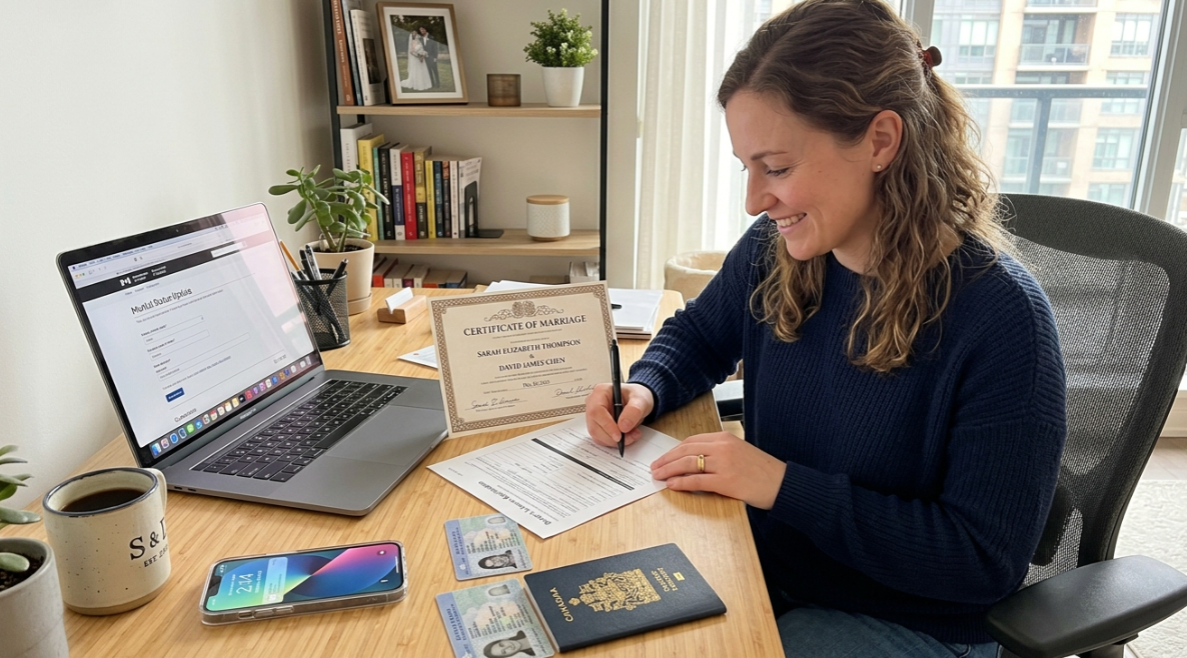
The ceremony is over, but the process isn’t. These are the follow-through errors that catch couples off guard.
Delayed Name Change
What it is: Not initiating name-change paperwork promptly after receiving the marriage certificate.
Changing your name involves separate filings with the Social Security Administration, DMV, passport office, banks, and employers. Each agency has its own forms and requirements. Waiting too long means living with mismatched documents across accounts and IDs, which creates confusion at border crossings, banking, and employment verification.
How to avoid it: Start the process as soon as your certificate arrives. Courtly’s name-change kit provides prefilled forms and checklists that simplify the multi-agency process.
Not Ordering Enough Certified Copies
What it is: Ordering only one certified copy of the marriage certificate, then realizing you need it in multiple places simultaneously.
Immigration filings, bank account changes, employer HR departments, and foreign government legalization processes can all require a certified copy at the same time. Waiting for one copy to come back before sending it to the next agency adds weeks of unnecessary delay.
How to avoid it: Order at least three to four certified copies from the start. The small additional cost is worth the time you save.
Incomplete Document Follow-Through
What it is: Getting the marriage certificate but failing to complete downstream paperwork, like apostille, insurance updates, or tax filing changes.
A marriage certificate sitting in a drawer doesn’t automatically update your tax status, insurance beneficiaries, or legal standing abroad. Each of these requires proactive steps.
How to avoid it: Create a post-ceremony checklist. Walk through the step-by-step guide for what happens after your online wedding to make sure nothing falls through the cracks.
Online Marriage by the Numbers
While every case is unique, the following trends explain why careful planning matters:
Statistic | Why It Matters |
|---|---|
Utah has issued remote marriage licenses since 2020 | Established legal framework |
Thousands of international couples have used the process | Demonstrates widespread adoption |
Marriage licenses expire after 32 days | Common administrative mistake |
Two witnesses are generally required | Frequent scheduling issue |
USCIS requires post-marriage consummation for qualifying immigration petitions involving remote marriages | Major immigration consideration |
Why These Mistakes Keep Happening
The fundamental problem is that online marriage is a new enough concept that reliable information is scattered. Practitioners on Reddit’s r/ukvisa openly debate whether Zoom weddings are “a scam or legit” for UK spouse visa purposes. Legal Q&A sites feature attorneys giving confidently wrong answers about the validity of remote-appearance marriages. And most government websites haven’t updated their guidance to address virtual ceremonies at all.
Utah has been issuing online marriage licenses since January 2020, and thousands of international couples have used the process. A Utah state senator notably remarked, “I’m fine with Utah being the Las Vegas of virtual weddings,” signaling legislative awareness of the growing demand. The legal foundation is solid. But the information gap between what’s legally true and what couples believe creates the conditions for every mistake on this list.
Warning Signs That Could Delay Your Online Marriage
Watch for these common red flags:
Your passport expires soon.
Your names don't exactly match official IDs.
Your witnesses haven't confirmed attendance.
You're unsure whether your country accepts online marriages.
You haven't researched apostille requirements.
You plan to file immigration paperwork before meeting after the ceremony.
You're relying on unofficial legal advice from social media.
Addressing these issues before the wedding can prevent expensive delays later.
FAQ
Can you legally get married entirely online?
Yes. Utah allows remote-appearance marriages where neither the couple nor the witnesses need to be physically present. The officiant must be in Utah. The resulting marriage certificate is a valid U.S. legal document. Learn more about how online marriage works.
What happens if there’s a typo on my marriage license?
If caught before the ceremony, contact the county clerk for a correction. If caught after finalization, you’ll need to order an error correction within two months, typically for a $10 fee in Utah County. Uncorrected errors will appear on your marriage certificate and can cause problems with immigration filings and name changes.
Will my online marriage be recognized in Europe?
As of 2026, no EU country recognizes a marriage performed entirely online without any physical presence. If you plan to use your marriage certificate in an EU country, consult with a local attorney or government office before the ceremony to understand what additional steps may be required.
Do I need an apostille for my online marriage certificate?
If you plan to use your certificate in a foreign country that’s a member of the Hague Apostille Convention, yes. For non-Hague countries, you’ll need embassy or consular legalization instead. Submitting your certificate through the wrong route is a common and time-consuming mistake.
Can I use an online marriage for a U.S. spouse visa?
Yes, but USCIS requires that the marriage be consummated after the ceremony. The couple must meet in person after the wedding and before filing the I-130 petition. Filing without meeting first is one of the most consequential online marriage mistakes for immigration purposes.
What’s the difference between a proxy marriage and a remote-appearance marriage?
A proxy marriage uses a stand-in for one or both parties. A remote-appearance marriage has both parties personally present and participating via video, just not physically in the same location. Utah’s process is remote-appearance, not proxy, which gives it broader legal recognition. Read our detailed comparison.
How long is a Utah online marriage license valid?
Thirty-two days from issuance. There’s no waiting period, so you can hold the ceremony the same day, but you must complete it before the license expires. Getting the license 10 to 14 days before the ceremony is the recommended approach.
What if my internet connection fails during the ceremony?
Technical failures can interrupt the legal proceeding. Always do a full tech rehearsal beforehand, and have a backup connection available (like a mobile hotspot). If the connection drops during the ceremony, the officiant will typically reschedule rather than continue with gaps in the proceeding.
Let us handle the paperwork.
Getting married is complicated. Courtly simplifies the process and provides everything necessary to get married online, including providing a licensed officiant who can perform a remote ceremony.
Get Married

Get married online.
Getting married is complicated. Courtly simplifies the process and provides everything necessary to get married online.

