

Changing your name after marriage while navigating U.S. immigration is a multi-step process with a specific order that matters. A certified marriage certificate from an online marriage (like one performed in Utah) works identically to an in-person certificate for name changes at the SSA, DMV, and USCIS. The smartest move is bundling your name change with your initial immigration filing to avoid extra fees and months of processing. This guide covers every form, fee, and sequencing detail you need.
Quick Answer: Can You Change Your Name After an Online Marriage for Immigration?
Yes. If your online marriage is legally valid and you have acceptable evidence of the marriage and name change, you can generally use your married name in U.S. immigration paperwork. The key is consistency: use your current legal name on each form, disclose prior names where requested, and keep your marriage certificate available as evidence.
For most immigrant spouses, the simplest strategy is to decide on the name you want to use before filing the main immigration application. If you are filing Form I-485, you can generally request that USCIS use your married name on the application rather than changing the name on an already-issued green card later.
An online marriage does not automatically create a special immigration name-change category. What matters is whether the marriage is legally valid and whether the document you submit meets the receiving agency's requirements.
At a Glance: Online Marriage Name Change Immigration Checklist
What you need | Why you need it | Where it is used |
|---|---|---|
Certified marriage certificate | Proves the marriage and may support a name change | SSA, DMV, passport, USCIS |
Current passport or government ID | Establishes identity | SSA, DMV, passport |
Previous/maiden name | Required when a form asks for prior names | USCIS forms |
New married name | Used when the name has legally changed | USCIS, SSA, DMV, passport |
Proof of immigration status | May be required for Social Security and immigration procedures | SSA, USCIS |
Certified translations, when required | Makes foreign-language documents usable by U.S. agencies | USCIS and other agencies |
Apostille, when required by a foreign country | Authenticates a U.S. public document for use abroad | Foreign government |
USCIS receipt notices | Helps connect a name update to a pending immigration case | USCIS |
Important: A digital marriage certificate, printed copy, certified copy, apostille, and authenticated document are not necessarily interchangeable. Always check the requirements of the agency or country receiving the document.
Does USCIS Recognize an Online Marriage for Immigration?
USCIS does not determine immigration eligibility solely by whether a wedding ceremony occurred online or in person. The important issue is whether the marriage is legally valid for immigration purposes and whether the applicant can establish the required marital relationship with appropriate evidence.
For a Utah remote marriage, Utah County allows couples to complete a marriage ceremony by remote appearance. The county states that the officiant must be physically present in Utah and that the couple and witnesses participate by video.
However, a Utah marriage being valid under Utah law does not automatically mean every foreign country will recognize it. Utah County expressly warns that a remote marriage may be invalid in the country where the spouses reside.
For an immigration case, therefore, separate these two questions:
Is the marriage legally valid under the law governing the marriage?
Does the marriage satisfy the requirements for the particular immigration benefit being requested?
If the case involves unusual facts, such as both spouses remaining outside the United States, a prior marriage, proxy-marriage issues, or questions about recognition in another country, professional immigration advice may be appropriate.
Why Name Changes After an Online Marriage Get Complicated for Immigrants
Most name-change guides assume you were born in the U.S., got married at a local courthouse, and just need to update your driver’s license. That describes almost nobody searching for information about online marriage name change immigration.
The reality is more layered. You might be a foreign-born spouse who married a U.S. citizen through a remote ceremony in Utah. You might be holding a green card with your maiden name and wondering whether updating it is worth the $415 filing fee. Or you might be preparing for naturalization and just learned that a name change during citizenship requires a specific type of oath ceremony.
This guide defines every term, form, and concept involved in changing your name after marriage when immigration is part of the picture. It also covers the exact sequencing that prevents costly mistakes and unnecessary delays.
If you’re still in the planning stages and haven’t married yet, Courtly’s immigration page explains how an online marriage fits into the spouse visa process.
Foundation Documents: What Proves Your Name Change
Does an Online Marriage Certificate Prove a Legal Name Change?
A valid marriage certificate can provide the legal evidence needed to support a name change after marriage. The important distinction is not simply whether the ceremony occurred online or in person. The receiving agency may also care about whether you provide an official or certified copy in the format it accepts.
For Utah County remote marriages, the county states that the marriage license/certificate serves as legal proof of marriage for purposes such as name changes. Utah County also cautions that acceptance of a digital certificate varies by agency and that a printed digital certificate is not considered a certified copy.
For immigration purposes, keep an official marriage certificate or certified copy available and follow the evidence instructions for the specific USCIS form you are filing.
Legal Name (USCIS Definition)
Your legal name is the name currently recognized by law in the place where your name was established or changed. USCIS accepts several forms of proof: birth certificates, passports, marriage certificates, divorce decrees, and court orders.
On every USCIS form, you enter your current legal name in the main name fields. If you’ve already changed your name through marriage, your married name goes in the primary field. If you haven’t changed it yet, your birth name goes there.
Maiden Name vs. Married Name on Immigration Forms
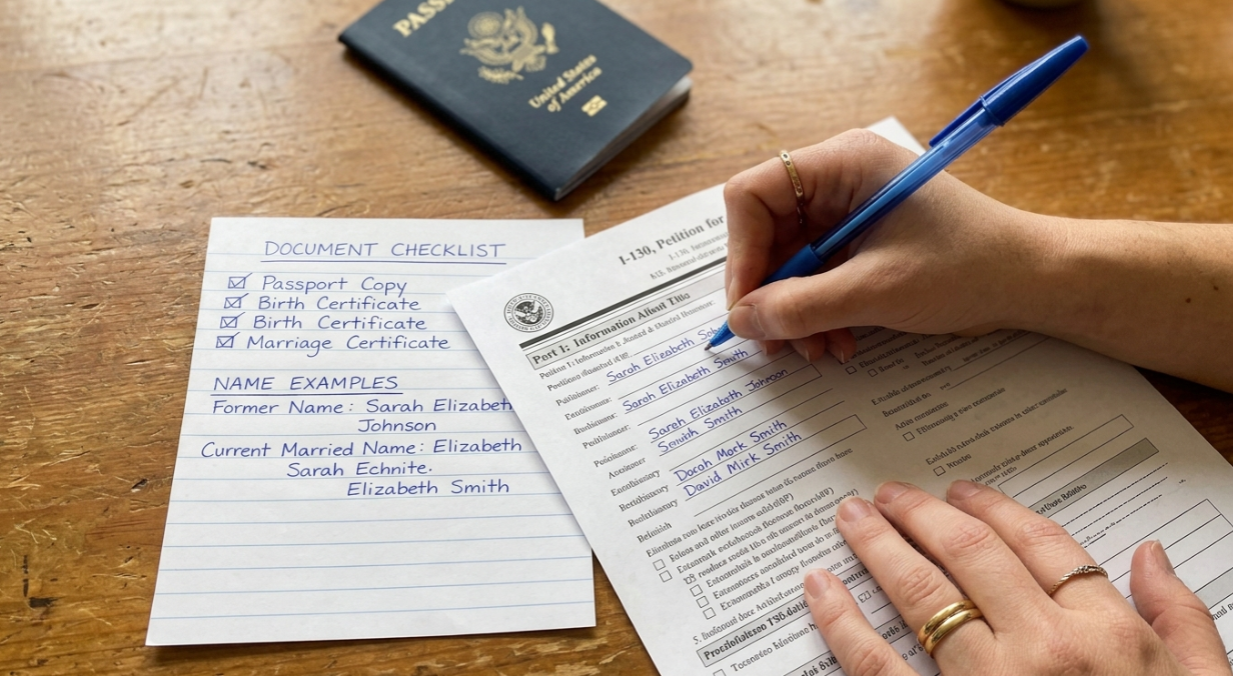
This causes more confusion than almost anything else in the online marriage name change immigration process. The rule is straightforward: enter your married name as your current name if you’ve legally changed it, and list your maiden name (plus any other previously used names) wherever the form asks for prior names.
Keeping your maiden name has zero negative impact on your green card application. As immigration attorneys consistently confirm, USCIS focuses on whether you’re sharing your lives together, not whether you share a last name. One immigration attorney on Avvo noted that in their experience, USCIS has always accepted that a spouse can begin using the other spouse’s last name immediately on immigration forms after marriage.
“Other Names Used” Field
Every USCIS form includes a section for other names you’ve used. This is where your maiden name, nicknames appearing on official documents, and any previous married names go. Skipping this field or filling it out inconsistently across forms creates problems. Use the same list on every form.
Apostille and Document Legalization
When a U.S. marriage certificate needs legal recognition in another country, an apostille or embassy authentication may be required. This applies to couples who married online in Utah and need their certificate accepted by a foreign government for name-change or residency purposes.
Courtly offers document legalization services including apostille and embassy authentication. For a deeper explanation of the difference, the guide on apostille vs. authentication breaks down which one you need based on your destination country.
Three Different Name Changes You Should Not Confuse
An immigrant spouse may be dealing with three separate processes:
1. Name change through marriage
A marriage certificate may provide the evidence used to adopt a spouse's surname under applicable law and agency procedures.
2. Name update on government records
After the legal name changes, you may need to update records with the Social Security Administration, DMV, passport authorities, USCIS, employers, banks, insurance companies, and other organizations.
3. Court-ordered name change
A court petition may be necessary when the desired name change is not one that can be established through the marriage certificate or another accepted legal document.
These processes overlap, but they are not the same thing. A marriage certificate does not automatically update every government database, and changing a name with one agency does not automatically change it everywhere else.
The U.S. Domestic Name-Change Process (Step by Step)
Before touching any immigration form, you need to update your name through the standard U.S. domestic channels. The order matters more than most people realize.
Step 1: Update Your Name With the Social Security Administration
If you legally changed your name through marriage, notify the Social Security Administration so your Social Security record reflects your new legal name.
SSA says applicants may be able to complete the process online depending on their circumstances. If online processing is not available, you may need to complete the process through a Social Security office. SSA requires evidence of your identity, your new legal name, and the event that caused the name change. Noncitizens may also need to provide evidence of current lawful status.
SSA recommends waiting at least 30 days after the marriage before requesting the replacement card with the name change so the state can update its records.
Important: Do not assume every applicant must visit an SSA office. Check SSA's current eligibility screening first.
Step 2: Allow Government Records to Update Before Visiting the DMV
After updating your Social Security record, allow enough time for the DMV to verify the new information.
Many state DMVs use electronic verification with Social Security records, but the timing and procedures vary by state. There is no universal federal "48-hour rule" that applies to every DMV.
Before visiting, check your state's DMV requirements and confirm whether the DMV expects your Social Security record to show the new name first.
Best practice: Do not schedule a DMV visit based solely on an internet claim that records will update in exactly 48 hours. Follow the instructions from your state's DMV.
Step 3: DMV / State ID Update
Once SSOLV has caught up, visit your state’s DMV with your new Social Security card (or the receipt letter), your certified marriage certificate, and your current ID. Fees vary by state, typically around $23 in Utah.
Step 4: U.S. Passport (Forms DS-82 / DS-5504)
If your passport was issued within the last year, you can update it for free using Form DS-5504. If it’s been more than a year, use Form DS-82 and pay the standard renewal fee. Include your certified marriage certificate as proof of the name change.
The Best Name-Change Sequence for Immigrant Spouses
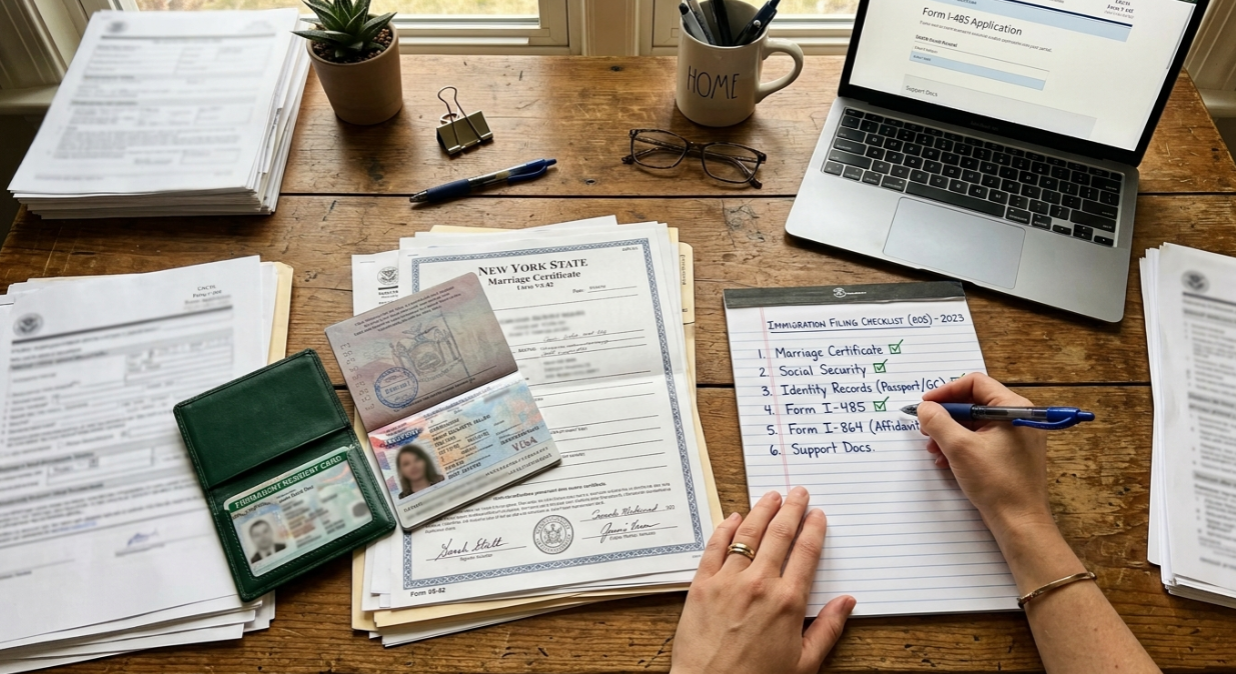
There is no single sequence that works for every immigration case. The best order depends on whether you are preparing to file immigration paperwork, already have a pending case, or already have a green card.
If you have not filed your main immigration application yet
Marriage certificate → Decide on legal name → SSA → Other identity records → USCIS filing using the correct current name
If you are preparing an I-485 filing
Marriage certificate → Decide on the name you want USCIS to use → Prepare I-485 and related forms consistently → Include prior names where requested → Follow USCIS evidence requirements
If you already have a green card
Marriage/name-change document → Update other records as appropriate → File Form I-90 if you want USCIS to issue a replacement green card showing the new name
If you are preparing for naturalization
Decide whether you are keeping your existing legal name or requesting a name change through naturalization → File Form N-400 correctly → Understand whether your requested name change requires a judicial oath ceremony
The key principle: Keep your current legal name and prior names consistent across every form. Do not change names on individual forms simply because you want the documents to match a future name.
Should You Change Your Name Before Filing for Immigration?
Have you legally changed your name through marriage?
→ No
Use your current legal name on immigration forms and follow the form's instructions for prior names.
→ Yes
Use your current legal name consistently and disclose your former/maiden name wherever the form requests previous names.
Do you already have a green card?
→ No
If you are filing an application such as Form I-485, make sure the name you request is consistent throughout the application package.
→ Yes
If you want a replacement green card showing your new name, review Form I-90 requirements.
Are you becoming a U.S. citizen?
→ Yes
Form N-400 includes an optional name-change request. If you request a legal name change through naturalization, the change is not final until the qualifying court ceremony.
Are you using the marriage certificate outside the United States?
→ Yes
Check the destination country's recognition and authentication requirements separately. An apostille authenticates a document; it does not automatically guarantee that the foreign country will recognize the marriage itself.
What Name Should You Put on Each Immigration Form?
Immigration document | Name to use | What else to disclose |
|---|---|---|
Form I-130 | Use the beneficiary's current legal name as required by the form | Former/maiden names where requested |
Form I-485 | Use the applicant's current legal name | Prior names and other requested identity information |
Form I-751 | Use the current legal name | Explain or document a name change when relevant |
Form I-90 | Enter the new legal name if requesting a replacement card after a legal name change | Existing green-card information and the legal name-change event |
Form N-400 | Use the applicant's current legal name | Former names and any requested name change |
Form N-565 | Use the name supported by the legal name-change evidence | Include the required supporting documentation |
Rule of thumb: Do not choose a name simply because it appears on your passport or because you expect to use it in the future. Follow the specific form instructions and accurately report your current legal name and prior names.
USCIS Immigration Forms: Where Name Changes Happen
This section covers every relevant USCIS form in the order most immigrant spouses encounter them. Understanding where and when to update your name is central to the online marriage name change immigration process.
Form I-130 (Petition for Alien Relative)
The I-130 is typically the first immigration form filed in a marriage-based case. The petitioning spouse (U.S. citizen or green card holder) files it to establish the family relationship.
The beneficiary (foreign spouse) should use their legal name on the I-130. If your marriage certificate changed your name and you’ve already updated it with the SSA, use your married name. If you haven’t formally changed it yet, use your current legal name and list your married name under other names used.
For couples who haven’t married yet and are weighing their options, understanding the CR-1 visa process helps clarify how online marriage fits into the I-130 timeline.
Form I-485: Adjustment of Status
Form I-485 is an important point to decide which legal name you want USCIS to use on the resulting permanent resident documentation.
If your name has already legally changed through marriage, complete the form using the appropriate current legal name and disclose prior names as requested. If your marriage certificate is the document supporting the name change, include it according to the current I-485 evidence instructions.
The practical advantage of addressing the name consistently during the initial adjustment process is that you can avoid creating a separate green-card replacement issue later solely because you want the card to show a different legally established name.
However, do not treat an I-485 filing as a substitute for a legal name change. USCIS paperwork records the name you are legally entitled to use; it does not automatically create every type of name change.
Explore how online marriage connects to the spouse visa process if you’re still early in your immigration journey.
Form I-751 (Remove Conditions on Residence)
If you received a conditional green card (valid for two years), you’ll file Form I-751 to remove conditions. This is another opportunity to update your name.
Use your current legal name on the I-751, even if your green card still shows your maiden name. Include your marriage certificate or other name-change document as supporting evidence. USCIS will issue your 10-year permanent green card in your updated legal name.
Form I-90: Changing the Name on an Existing Green Card
If you already have a permanent resident card and your legal name has changed, Form I-90 may be the appropriate application to request a replacement card showing the new information.
The important distinction is that the I-90 is generally a replacement-card process, not the process that creates the underlying legal name change. Your marriage certificate, court order, or other qualifying legal document establishes the name change; Form I-90 is used to request a new green card reflecting that information.
Because USCIS filing fees can change, verify the current I-90 fee directly with USCIS immediately before filing rather than relying on an older fee quoted in an article. USCIS maintains a fee calculator for current filing-fee information.
Form N-400: Changing Your Name During Naturalization
Form N-400 includes an optional request for a legal name change.
If you have already legally changed your name through marriage, divorce, or a court order, you do not need to request another name change simply because you are becoming a citizen.
If you want to request a new legal name as part of naturalization, USCIS states that the requested change is not final until you are naturalized by the court. Applicants requesting a legal name change through naturalization may therefore need a judicial oath ceremony rather than an ordinary administrative ceremony.
When does a naturalization name change make sense?
It may be useful when you want to change your first, middle, or last name and have not already completed that change through another legal process.
If speed is important, understand the ceremony implications before requesting a name change on the N-400.
Judicial vs. Administrative Oath Ceremony
This distinction matters for anyone planning a name change through naturalization. Administrative ceremonies are conducted by USCIS officers and are faster to schedule. Judicial ceremonies are conducted by a federal or state judge and are required if you want to change your name during the citizenship process.
If you request a name change on your N-400, USCIS will schedule you for a judicial ceremony. These may take longer to arrange, potentially adding weeks or months to your timeline.
Form N-565 (Replace Naturalization Certificate)
If you change your name after becoming a citizen (rather than during the naturalization process), file Form N-565 to get an updated Certificate of Naturalization. Include your legal name-change document as evidence. The fee is approximately $555 in 2026.
What If You Change Your Name After Filing Your Immigration Case?
Changing your name after filing an immigration application does not necessarily mean you need to start the immigration process again.
The correct action depends on the status of your case and which document has changed.
If your USCIS case is pending
Keep evidence of the legal name change, such as your marriage certificate, and follow USCIS procedures for updating information on the pending case. If you are unsure whether a specific form, online account update, service request, or written notification is required, check the current USCIS instructions for your case type.
If you receive a USCIS notice in your former name
Do not ignore the notice simply because your name has changed. Your receipt number, A-Number, date of birth, and other identifiers may still connect the notice to your case.
If you already received a green card
A legal name change after the card was issued may require a replacement-card application if you want the new name printed on the card.
Keep both names connected in your records: your former/maiden name should remain documented as a previous legal name when required, while your new legal name should be used consistently after the change.
What If My Passport and Green Card Have Different Names?
A passport and green card can temporarily show different names during a name-change process. A mismatch does not automatically mean that your immigration case is invalid.
The important issue is being able to document the connection between the names.
Keep copies of:
Your previous passport
Your current passport, if updated
Your certified marriage certificate
Your green card
Any USCIS notices
Your Social Security documentation
Any court order or other legal name-change document
If you are preparing international travel while your documents show different names, check the requirements for your airline, destination country, immigration status, and travel documents before departing.
For U.S. passport holders, the State Department has different procedures depending on when the passport was issued and when the legal name change occurred. For example, DS-5504 may be available when both the passport issuance and legal name change fall within the applicable one-year window.
Bona Fide Marriage: Why a Name Change Is Not Required
Some immigrant spouses worry that keeping their maiden name signals something negative to USCIS. This concern is unfounded. USCIS evaluates whether a marriage is genuine based on shared finances, cohabitation, communication records, and other evidence of a life built together. A name change is not a legal requirement for marriage in the U.S., and it is not a factor in immigration adjudication.
While some reviewing officers might view a shared last name as a minor positive signal, it is not a legal consideration. USCIS focuses on the bona fide nature of the relationship, not the name on your ID.
For more on what USCIS actually looks for, the proof of marriage evidence checklist covers the documents that carry real weight.
When Should You Change Your Name? A Decision Framework
The timing of your name change depends on where you are in the immigration process. Here’s a clear framework:
Before filing any immigration paperwork: Change your name with the SSA first, then proceed through the domestic sequence. Use your married name on all immigration forms from the start.
During adjustment of status (I-485): This is the ideal time. Put your married name on the I-485. It’s free and gets processed as part of your case.
After receiving a green card: You’ll need to file Form I-90 ($415 to $465) and wait 6 to 13 months. Worth it if you want your green card to match your other documents, but not cheap or fast.
During naturalization (N-400): Free, but requires a judicial oath ceremony that may delay your timeline.
After naturalization: Requires Form N-565 at approximately $555, plus you’ll still need to update SSA, DMV, and passport separately.
The pattern is clear: the earlier you change your name, the less it costs and the fewer forms you file.
2026 Name Change Cost Reference Table
Agency/Form | Fee | Notes |
|---|---|---|
SSA (Form SS-5) | $0 | Free; allow 2 weeks for new card |
DMV / State ID | ~$23 (varies by state) | Bring marriage certificate + new SS card |
U.S. Passport (DS-82) | Per State Dept. schedule | Free via DS-5504 if passport is less than 1 year old |
USCIS Form I-90 | $415 online / $465 mail | Biometrics included; 6 to 13 months processing |
N-400 name change | Included | Requires judicial oath ceremony |
USCIS Form N-565 | ~$555 | For post-naturalization name changes |
Court petition | Varies by state | Only needed if not using marriage certificate |
Courtly’s Name Change Kit bundles prefilled forms, checklists, and instructions for SSA, DMV, passport, and bank updates, which takes much of the guesswork out of the domestic side of the process.
Common Mistakes in the Online Marriage Name Change Immigration Process
Filing with mismatched names across forms. If your I-130 says one name and your I-485 says another (without listing the other as a previous name), expect a Request for Evidence at minimum.
Skipping the SSA step before visiting the DMV. The SSOLV system will reject you. Always start with Social Security.
Assuming an online marriage certificate is somehow different. It’s not. A certified Utah marriage certificate from an online ceremony is a standard U.S. marriage certificate. USCIS accepts any registered marriage certificate per its policy manual.
Waiting until after a green card is issued to change your name. This triggers an I-90 filing that costs $415+ and takes up to 13 months. Bundling the change with your I-485 is free.
Requesting a name change on the N-400 without knowing about the judicial oath requirement. Administrative ceremonies cannot process name changes. If you need your citizenship quickly, be aware of this potential delay.
FAQ
Does my online marriage certificate work for a name change?
Yes. A certified marriage certificate from an online Utah marriage is legally identical to one from an in-person ceremony. The SSA, DMV, passport office, and USCIS all accept it as proof of a legal name change. No additional court order is needed when changing your last name through marriage.
Do I have to change my name to get a green card?
No. There is no requirement to take your spouse’s last name, and whether you do has no impact on the adjudication of your marriage-based petition. USCIS evaluates the genuineness of your relationship based on shared evidence of a life together, not whether your names match.
When is the best time to change my name during immigration?
At the time you file your initial adjustment of status (Form I-485). This is the cheapest and simplest approach because the name change gets processed as part of your case. Changing your name afterward via Form I-90 costs $415 to $465 and takes 6 to 13 months.
What if my passport still shows my maiden name when I file with USCIS?
Use your current legal name on the USCIS forms and list your maiden name under “other names used.” Include your marriage certificate as evidence of the name change. Your passport does not need to match your married name at the time of filing, though updating it eventually is recommended to avoid confusion at interviews and travel.
How much does it cost to change my name on a green card?
Filing Form I-90 costs $415 online or $465 by mail in 2026, with biometrics included. Processing time runs approximately 6 to 13 months. This is why immigration attorneys recommend changing your name during your initial filing rather than after.
Can I change my first name during naturalization?
Yes. Form N-400 allows you to request changes to your first, middle, or last name. However, any name change through naturalization requires a judicial oath ceremony, which a judge must preside over. This can add time to the process compared to an administrative ceremony.
What documents do I need to change my name at the SSA after an online marriage?
You need your certified marriage certificate (the original, not a copy) and a valid form of identification such as a passport or current government-issued ID. The SSA advises waiting at least 30 days after marriage before initiating the change.
Do I need an apostille on my online marriage certificate for immigration?
For U.S. immigration purposes (USCIS filings), an apostille is generally not required because you’re using a U.S. document within the U.S. However, if you need your Utah marriage certificate recognized by a foreign government for name changes or residency abroad, an apostille or embassy authentication may be necessary. Courtly offers legalization services, and you can learn more about apostilles on their resource page.
Navigating the online marriage name change immigration process doesn’t have to mean filing the wrong form at the wrong time or paying hundreds of dollars in avoidable fees. Start with the SSA, follow the sequence, and bundle your name change with your earliest immigration filing. If you’re ready to begin with an online marriage, see how Courtly works and what’s included at each plan level.
Let us handle the paperwork.
Getting married is complicated. Courtly simplifies the process and provides everything necessary to get married online, including providing a licensed officiant who can perform a remote ceremony.
Get Married

Get married online.
Getting married is complicated. Courtly simplifies the process and provides everything necessary to get married online.

