

Yes, you can marry online before filing for a spouse visa. USCIS recognizes virtual marriages for CR-1/IR-1 spouse visa petitions as long as the marriage is legally valid where it was performed and later consummated in person. This path often beats the K-1 fiancé visa on total time to a green card. Below, every term you need to understand this strategy is defined and explained.
Getting married online before applying for a spouse visa is one of the smartest moves international couples can make in 2025 and 2026, yet the process is wrapped in legal terminology that trips people up. Words like “consummation,” “place-of-celebration rule,” and “INA 101(a)(35)” aren’t exactly dinner table conversation. But understanding them is the difference between a smooth immigration filing and a rejected petition.
This glossary covers the essential terms for couples considering an online marriage before a spouse visa application. Each definition is written for real people making real decisions, not for immigration attorneys who already know the law.
Explore spouse visa consultations to get personalized guidance for your situation.
Can You Marry Online Before Applying for a CR-1 or IR-1 Spouse Visa?
Yes, an online marriage can potentially be used as the basis for a CR-1 or IR-1 spouse visa if the marriage is legally valid where it was celebrated and meets U.S. immigration requirements. USCIS specifically addresses virtual marriages in its October 17, 2025 policy guidance. When the spouses were not physically present together during the ceremony, INA §101(a)(35) creates an additional consummation issue that must be resolved before the marriage can qualify for immigration purposes.
The practical sequence is:
Online marriage → verify legal validity → file Form I-130 when eligible → meet in person and satisfy any applicable consummation requirement → complete NVC processing → attend the immigrant visa interview → enter the United States as a CR-1 or IR-1 permanent resident.
The exact result depends on how and where the ceremony was performed, whether the spouses were physically together during the ceremony, and the laws governing the marriage.
Online Marriage Before a Spouse Visa: 2026 Rules at a Glance
Question | Short answer |
|---|---|
Can an online marriage be used for a spouse visa? | Potentially yes, if it is legally valid and satisfies U.S. immigration requirements. |
Does USCIS address virtual marriages? | Yes. USCIS added specific virtual-marriage guidance in Policy Alert PA-2025-23 on October 17, 2025. |
Does the place-of-celebration rule apply? | Yes. USCIS states that virtual marriages are subject to the same place-of-celebration requirements as other spousal cases. |
Does consummation matter? | It can. INA §101(a)(35) excludes certain marriages where the parties were not physically present together unless the marriage is later consummated. |
Can you file Form I-130 before consummation? | Do not present this as a universal rule. The filing strategy depends on how the ceremony was conducted and whether the marriage qualifies as a spouse relationship under INA §101(a)(35). |
What is the CR-1? | An immigrant visa for a spouse who has been married for less than two years when admitted to the United States. |
What is the IR-1? | An immigrant visa for a spouse who has been married for at least two years when admitted to the United States. |
Does the spouse become a permanent resident after CR-1/IR-1 admission? | Yes. An immigrant spouse admitted on a CR-1 or IR-1 becomes a lawful permanent resident, subject to the applicable conditions. |
Is an apostille automatically required for USCIS? | No. Whether additional authentication is required depends on the document and the authority requesting it. |
Is online marriage always better than K-1? | No. The better option depends on timing, eligibility, ability to meet in person, evidence, and individual circumstances. |
How Online Marriage Before a Spouse Visa Actually Works
The basic strategy is to legally marry through a jurisdiction that permits the type of remote ceremony you are using, then use the resulting marriage as the foundation for an immigrant spouse petition. However, an online marriage should not be treated as automatically equivalent to an ordinary in-person marriage for U.S. immigration purposes.
The critical questions are:
Was the marriage legally valid where it was celebrated?
Were both spouses physically present together during the ceremony, or were they participating from different locations?
Does INA §101(a)(35) apply to the ceremony?
If it applies, has the marriage subsequently been consummated?
Can the couple demonstrate that the marriage is bona fide?
Can the couple provide the civil documents required for the immigrant visa process?
USCIS's October 2025 guidance specifically states that virtual marriages are subject to the same requirements, including the place-of-celebration rule, as other spousal cases. USCIS also emphasizes that petitioners must establish that the marriage is bona fide before petition approval.
That means an online marriage should be viewed as the beginning of an immigration strategy, not as a shortcut that eliminates the normal spouse-visa requirements.
Online Marriage (Virtual Marriage)
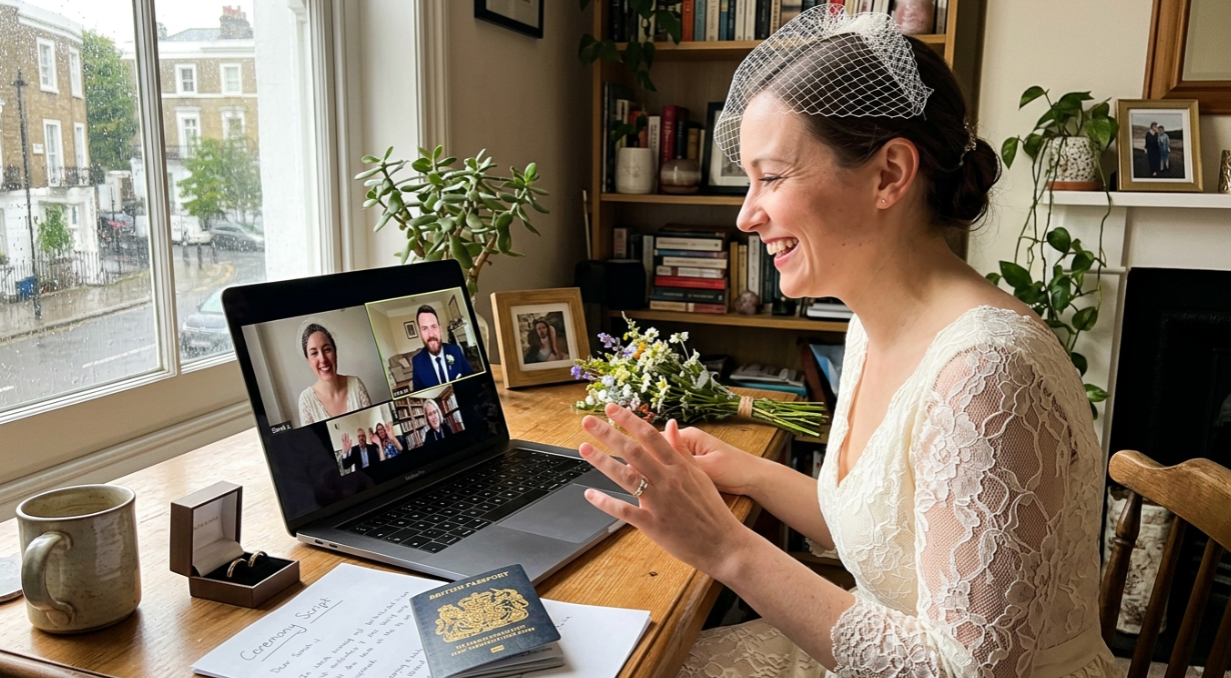
An online marriage is a legally binding wedding ceremony conducted via videoconference where both parties participate remotely. You and your partner appear on screen, exchange vows before a licensed officiant, and the jurisdiction issues a marriage certificate.
This is not the same as a proxy marriage (more on that below). In an online marriage, both people are present and participating. They just aren’t in the same physical room.
Utah is the primary U.S. jurisdiction that allows fully remote marriage ceremonies. Since the Utah County Clerk’s Office began offering online marriage licenses and ceremonies in January 2020, thousands of couples from around the world have used the service. That includes hundreds of Israeli couples and roughly 200 Chinese and Hong Kong couples who married via virtual weddings hosted in Utah since 2021.
For immigration purposes, USCIS issued policy alert PA-2025-23 in October 2025 explicitly acknowledging virtual marriages. The agency stated that virtual or online marriage ceremonies, such as those conducted via videoconference, must meet the same legal standards as in-person marriages. This was the first time USCIS formally addressed online marriages in its policy manual, and it gave couples pursuing this path a much clearer legal foundation.
What Matters for Immigration
An online marriage does not automatically qualify simply because a government-issued marriage certificate exists. USCIS evaluates whether the marriage is legally valid under the applicable law and whether it satisfies the federal definition of a qualifying spouse relationship.
The distinction between an ordinary virtual ceremony and a ceremony where the spouses were not physically present together can also matter because INA §101(a)(35) contains a specific rule for marriages in which the contracting parties were not physically present together.
For that reason, couples should document:
Where the marriage was celebrated
Which authority issued the marriage certificate
How the ceremony was conducted
Where each spouse was physically located during the ceremony
Whether the couple subsequently met in person
Evidence supporting the bona fide nature of the relationship
Learn more about how online marriages work from application to ceremony.
Proxy Marriage
A proxy marriage is a ceremony where one or both parties are represented by a stand-in rather than attending themselves. Think of it as someone else saying “I do” on your behalf. Montana, Texas, California (for military members), and Colorado allow various forms of proxy marriage.
The critical distinction: in a proxy marriage, at least one party is absent. In an online marriage, both parties are present via video. The legal effect is the same for immigration, though, because USCIS treats both under the same statute (INA 101(a)(35), covered below). Both require consummation before USCIS will recognize the marriage for visa purposes.
One immigration attorney’s analysis from Chodorow Law Offices argues that “any virtual marriage is a proxy marriage under INA § 101(a)(35) because that definition excludes (unless consummated) ‘any marriage ceremony where the contracting parties thereto are not physically present.’” This is a conservative reading, but it’s the safest assumption to plan around. For a deeper comparison, see this guide on proxy vs. virtual marriage for immigration.
Place-of-Celebration Rule
This is the foundational test USCIS uses to determine whether your marriage is valid for immigration purposes. The rule is simple: if your marriage was valid under the law of the jurisdiction where it was performed, USCIS generally considers it valid.
So if you marry online through a Utah-based service, what matters is whether Utah law recognizes the marriage. It does. Utah has explicitly allowed remote-appearance marriages since 2020. It doesn’t matter that your home state or your partner’s country might not offer online marriages. The place-of-celebration rule looks only at where the ceremony happened.
The October 2025 USCIS policy update (PA-2025-23) reinforced this point: “If a state does not recognize virtual marriages, this does not affect validity as long as the marriage was lawfully celebrated in a jurisdiction that does.”
This rule is why couples from countries with restrictive marriage laws can marry online in Utah and use that marriage for U.S. immigration filings.
INA 101(a)(35): Why Physical Presence and Consummation Matter
This is the single most important statute for anyone planning to marry online before a spouse visa application. Section 101(a)(35) of the Immigration and Nationality Act states:
“The term ‘spouse,’ ‘wife,’ or ‘husband’ do not include a spouse, wife, or husband by reason of any marriage ceremony where the contracting parties thereto are not physically present in the presence of each other, unless the marriage shall have been consummated.”
In plain English: if you weren’t in the same room when you got married, USCIS won’t recognize you as spouses until you’ve met in person afterward and consummated the marriage. This applies equally to online marriages and proxy marriages.
Ceremony situation | Immigration question |
|---|---|
Both spouses were physically together during the ceremony | Analyze the marriage under the ordinary marriage-validity rules. |
Spouses participated remotely from different locations | INA §101(a)(35) may become relevant because the parties were not physically present together. |
Marriage was performed by proxy | INA §101(a)(35) is directly relevant. |
Remote/proxy marriage is followed by an in-person meeting | Document the meeting and determine whether the statutory consummation requirement has been satisfied. |
Couple never meets after the ceremony | The marriage may not qualify as a spouse relationship for immigration purposes. |
The statute creates what some practitioners call a “catch-22.” If you have to meet in person anyway, why not just marry in person? But the strategic logic holds up well. Getting married online starts the I-130 clock immediately. The CR-1 process takes 12 to 24 months. During that processing window, the couple has plenty of time to meet and consummate the marriage. You don’t need to have consummated the marriage at the time you file. You need to have done so before the visa is issued.
Consummation in the Immigration Context
For certain marriages where the spouses were not physically present together during the ceremony, INA §101(a)(35) requires the marriage to have been consummated before the marriage can qualify as a spouse relationship for immigration purposes.
Couples should understand two separate issues:
Physical meeting: You should maintain evidence showing that the spouses met in person after the ceremony.
Consummation: The statutory requirement is more specific than simply proving that the couple traveled to the same location. Because this involves a legal standard rather than a simple document checklist, couples with an online or proxy marriage should consider obtaining individualized immigration advice about how their circumstances satisfy INA §101(a)(35).
USCIS does not require couples to submit intimate photographs or other unnecessarily invasive material as routine marriage evidence. Instead, preserve ordinary evidence of the post-ceremony meeting, such as travel records, passport stamps, photographs, hotel records, and other documentation showing that the spouses were physically together.
What USCIS Accepts as Proof
The consummation must occur after the online or proxy marriage is performed. Evidence commonly accepted includes:
Sworn affidavits from both spouses confirming they met in person post-ceremony
Plane tickets and passport stamps proving post-ceremony travel
Hotel receipts showing shared accommodation
Photos of the couple together dated after the ceremony
Birth certificate of a child conceived after the ceremony
Immigration practitioners consistently note that definitive proof of consummation is not strictly required. Evidence of the two parties physically being together after the marriage, coupled with an affirmation of consummation, is generally deemed sufficient.
Same-Sex Couple Considerations
The traditional legal definition of consummation is heteronormative, which understandably concerns LGBTQ+ couples. In practice, USCIS applies the same standard regardless of the couple’s gender: physical presence together after the ceremony plus a sworn affidavit. This is particularly important for same-sex couples who may be marrying online specifically because their home countries don’t allow same-sex marriage.
The 2025 Tightening
Four months into 2025, U.S. immigration agencies made a series of quiet but significant updates affecting marriage-based green card applications. Virtual ceremonies remain valid if recognized in the jurisdiction and followed by an in-person meeting, but evidence matters more than ever. Submit proof of a genuine, ongoing marriage from the outset.
CR-1 Visa (Conditional Resident Visa)
The CR-1 is the spouse visa issued to couples who have been married for less than two years at the time the foreign spouse is admitted to the United States. “Conditional” means the green card is valid for two years. Before it expires, the couple files Form I-751 to remove conditions and obtain a permanent green card.
The CR-1 is the visa most couples will get when they marry online before a spouse visa application, since the I-130 processing time (12 to 24 months) often falls within the two-year window.
The biggest advantage of the CR-1 over the K-1 fiancé visa: when a CR-1 visa is approved, your spouse enters the U.S. immediately as a lawful permanent resident. No additional adjustment of status filing. No months of waiting after arrival.
The CR-1 process starts with the U.S. citizen sponsor filing Form I-130 (Petition for Alien Relative).
IR-1 Visa (Immediate Relative Visa)
The IR-1 is the spouse visa for couples who have been married for two or more years at the time of admission. The key difference from the CR-1 is that the IR-1 grants a permanent green card immediately, with no conditions to remove later.
If your online marriage was performed early enough and processing takes long enough, you might cross the two-year mark before your spouse enters the U.S. In that case, the visa classification automatically shifts from CR-1 to IR-1. Some couples who marry online before their spouse visa filing end up with an IR-1 simply because of processing timelines.
K-1 Fiancé Visa
The K-1 is the alternative path. It’s designed for unmarried couples: the U.S. citizen petitions for a foreign fiancé(e) to enter the country, and the couple must marry within 90 days of arrival. K-1 applicants must be unmarried when filing, while CR-1 applicants must provide proof of legal marriage.
The K-1 is filed using Form I-129F and has a total timeline from filing to U.S. arrival of approximately 12 to 18 months. But that number is misleading. After arrival, the foreign spouse must file for adjustment of status, which adds another 8 to 14 months before a green card is actually issued. So a typical K-1 couple reaches lawful permanent residence roughly 22 to 30 months after the initial filing.
Compare that to the CR-1, where the spouse receives a green card on arrival. The total processing time is 12 to 24 months, and there’s no post-arrival adjustment needed.
This math is why practitioners on Reddit’s r/immigration forum frequently advise couples to marry online before filing for a spouse visa rather than pursuing the K-1. Multiple threads show users pivoting from K-1 to CR-1 after learning about the immediate green card benefit. On VisaJourney forums, users have reported filing I-130 petitions using Utah online marriages and receiving standard processing without unusual requests for evidence.
Compare plans and pricing for an online marriage through Courtly.
Form I-130 (Petition for Alien Relative)
This is the first form filed in the CR-1 spouse visa process. The U.S. citizen spouse submits Form I-130 to USCIS to establish the family relationship. For 2026, the filing fee is $625 for online applications and $675 for paper filings.
After USCIS approves the I-130, the case transfers to the National Visa Center (NVC), which charges a $345 immigrant visa fee. Total government costs for consular processing typically range from $1,540 to $3,000 or more depending on the specific circumstances.
One thing to know: you can file the I-130 immediately after your online marriage, even before consummation. USCIS doesn’t require consummation at the time of filing. It needs to happen before the visa interview at the consulate.
Online Marriage to CR-1/IR-1: Step-by-Step Process
Step 1: Confirm the marriage jurisdiction
Before paying for an online ceremony, verify that the jurisdiction legally permits the specific remote marriage procedure you intend to use.
Do not rely solely on the statement that a commercial online marriage service is “USCIS accepted.”
Step 2: Complete the marriage ceremony
Follow the jurisdiction's requirements for the license, officiant, witnesses, identification, ceremony, and issuance of the marriage certificate.
Keep copies of all marriage records.
Step 3: Determine whether INA §101(a)(35) applies
Identify where each spouse was physically located during the ceremony.
This matters because a ceremony conducted with the spouses in different physical locations can raise the statutory issue addressed by INA §101(a)(35).
Step 4: Meet in person when required
If the statutory consummation requirement applies, arrange an in-person meeting after the ceremony and preserve ordinary evidence of the trip.
Examples include:
Flight records
Passport entry and exit stamps
Hotel reservations
Photographs together
Receipts from activities undertaken together
Other records showing the spouses were physically together
Step 5: Build the bona fide marriage file
Begin collecting relationship evidence immediately rather than waiting for the NVC stage.
USCIS's October 2025 guidance emphasizes that petitioners must establish that the marriage is bona fide before petition approval.
Step 6: File Form I-130 when eligible
The U.S. citizen or other qualifying petitioner files Form I-130 with USCIS.
The Department of State identifies Form I-130 as the first step toward an immigrant visa for a foreign spouse.
Step 7: Wait for USCIS adjudication
USCIS reviews the petition and supporting evidence. Additional evidence or an interview may be requested depending on the case.
Step 8: Complete National Visa Center processing
After petition approval and transfer to the NVC, the case proceeds through immigrant visa processing, including the required fees, Affidavit of Support, DS-260, civil documents, and other requirements.
Step 9: Complete the medical examination
The foreign spouse must complete the required immigrant visa medical examination with an authorized panel physician before visa issuance.
Step 10: Attend the immigrant visa interview
The applicant attends the interview at the appropriate U.S. embassy or consulate and provides the required original or certified civil documents and other evidence.
Step 11: Enter the United States
If the immigrant visa is issued and the applicant is admitted to the United States, the spouse becomes a lawful permanent resident.
The final classification is generally CR-1 or IR-1 depending on how long the couple has been married at the time of admission.
Bona Fide Marriage

USCIS requires proof that your marriage is genuine and not entered into solely for immigration benefits. This applies to every marriage-based visa petition, whether the couple married in person or online.
Evidence categories include:
Joint bank accounts or financial records
Shared lease or mortgage documents
Photos of the wedding and life together
Communication records (call logs, chat histories, travel itineraries)
Affidavits from friends and family attesting to the relationship
Evidence of meeting each other’s families
For couples who marry online before their spouse visa process, building a strong bona fide evidence file from the beginning is especially important. The 2025 policy environment emphasizes stronger documentation. Start gathering evidence the day you marry. For a comprehensive overview, see the online marriage and immigration guide.
Apostille
An apostille is a form of document legalization that allows a public document (like a marriage certificate) to be recognized in countries that are members of the Hague Apostille Convention. If your foreign spouse’s country requires an apostilled marriage certificate for local registration or administrative purposes, you’ll need one.
For a Utah marriage certificate, the apostille is obtained through the Utah Secretary of State or a service that handles the process on your behalf. Many countries require this step before they’ll register a foreign marriage in their own civil records.
Courtly offers document legalization services including apostille and embassy authentication for countries that require additional steps beyond the apostille. Some countries that aren’t Hague Convention members need embassy authentication instead, which is a different process. Learn about the differences in this apostille vs. authentication guide.
Marriage Certificate (Digital vs. Physical)
After an online marriage ceremony, you receive both a digital marriage certificate (typically available within days) and a physical copy mailed to you. Both are legally valid.
For immigration purposes, you’ll need the physical certificate when filing Form I-130. USCIS requires an official copy. If filing for a visa at a U.S. consulate abroad, the consular officer will want to see the original or a certified copy.
The digital certificate is useful for immediate proof, starting paperwork, or sharing with attorneys. But don’t skip getting the physical version.
Unconsummated Marriage: The Fallback Path
Here’s something almost no immigration content mentions: if the marriage remains unconsummated, the couple isn’t stuck. Under USCIS policy, a party to an unconsummated proxy or online marriage may be processed as a nonimmigrant fiancé(e) through the K-1 visa path.
This is a genuine safety net. If circumstances prevent the couple from meeting in person after the ceremony (travel bans, financial hardship, medical issues), they can fall back to the K-1 process instead of abandoning the immigration effort entirely.
CR-1 vs IR-1: What's the Difference?
Feature | CR-1 | IR-1 |
|---|---|---|
Meaning | Conditional Resident | Immediate Relative |
Marriage length at U.S. admission | Less than 2 years | At least 2 years |
Status after admission | Conditional permanent resident | Permanent resident without the marriage-based two-year condition |
Green card conditions | Must later be removed | No marriage-based conditions to remove |
Form I-130 | Required | Required |
Consular immigrant visa process | Required | Required |
Does the online nature of the ceremony determine CR-1 vs IR-1? | No | No |
What determines the classification? | Length of marriage at admission | Length of marriage at admission |
The key date is not simply the date the I-130 is filed. The Department of State explains that if the spouse has been married for less than two years when entering the United States on the immigrant visa, the status is conditional.
Online Marriage + CR-1 vs. K-1: Quick Comparison
Factor | Online Marriage + CR-1 | K-1 Fiancé Visa |
|---|---|---|
Must be married to file? | Yes | No (must be unmarried) |
Form filed | I-130 ($625 online) | I-129F |
Processing time to U.S. entry | 12-24 months | 12-18 months |
Total time to green card | 12-24 months (green card on arrival) | 22-30 months (entry + AOS) |
Status on arrival | Lawful permanent resident | Nonimmigrant (must adjust status) |
Work authorization on arrival | Yes (as LPR) | Must wait for EAD after AOS filing |
Consummation required? | Yes (for online marriages) | N/A |
Can travel internationally after arrival? | Yes (as LPR with green card) | Restricted until AOS approved |
The total-time-to-green-card comparison is what makes the online marriage before spouse visa strategy so compelling. The CR-1 looks slower on paper for initial entry, but the K-1’s hidden tail of adjustment processing means the CR-1 often wins by 6 to 12 months on the metric that actually matters: when your spouse gets a green card.
Should You Choose Online Marriage + CR-1/IR-1 or K-1?
Situation | Usually worth evaluating |
|---|---|
You are already legally married | CR-1/IR-1 |
You want the spouse to enter as a permanent resident | CR-1/IR-1 |
You want to avoid adjustment of status after arrival | CR-1/IR-1 |
You are not ready to marry | K-1 |
You want the fiancé(e) to enter before marriage | K-1 |
You cannot satisfy an applicable post-ceremony consummation requirement | Reassess the spouse-visa strategy before filing |
Your online marriage has unusual legal circumstances | Speak with an immigration attorney before filing |
Your main priority is the fastest possible entry | Compare current case-specific processing times rather than relying on generic averages |
When Does the Online Marriage + CR-1 Path Make the Most Sense?
This strategy works best when:
The couple can meet in person within the next 12 months (for consummation), even if they can’t be together right now
The foreign spouse wants to work immediately on arrival, since CR-1 entry as a lawful permanent resident includes work authorization
The couple wants to avoid the post-arrival adjustment of status process, which adds cost, stress, and months of uncertainty
Travel restrictions or distance make an in-person wedding impractical right now
It may not be the best fit when:
The couple has no realistic way to meet in person before the visa interview
The foreign spouse needs to enter the U.S. as quickly as possible (the K-1 can sometimes be slightly faster to initial entry)
The couple’s online marriage jurisdiction isn’t recognized in the foreign spouse’s home country for local purposes (though this doesn’t affect U.S. immigration validity)
Frequently Asked Questions
Can You File Form I-130 Before Meeting Your Spouse After an Online Marriage?
This is one of the most important questions for couples considering an online marriage.
The answer depends on the specific circumstances of the ceremony and whether the marriage qualifies as a “spouse” relationship under INA §101(a)(35). USCIS's I-130 instructions specifically address marriages where the spouses were not both physically present at the ceremony and state that such a spouse relationship is not recognized unless the marriage was consummated.
Therefore, couples should not rely on the assumption that an online marriage certificate alone makes the I-130 immediately approvable.
Before filing, determine:
Whether the spouses were physically present together during the ceremony
Whether the ceremony qualifies as a virtual or proxy marriage under the applicable rules
Whether INA §101(a)(35) applies
Whether the marriage has already been consummated if required
Whether sufficient evidence exists to establish the bona fide relationship
If there is uncertainty about whether the marriage qualifies as a spouse relationship at the time of filing, obtaining case-specific immigration advice before submitting Form I-130 can prevent an avoidable filing problem.
Which states allow online marriages that USCIS will recognize?
Utah is the primary state allowing fully remote marriage ceremonies. Under the place-of-celebration rule, USCIS recognizes marriages that are valid where they were performed. Since Utah law explicitly permits remote-appearance ceremonies, a Utah online marriage is valid for immigration purposes.
What happens if we can’t consummate the marriage before the visa interview?
If the marriage remains unconsummated, USCIS policy allows the foreign spouse to be processed as a K-1 fiancé(e) instead. The couple essentially reverts to the fiancé visa pathway. It’s not ideal, but it’s a real fallback option that prevents the process from being a dead end.
Is an online marriage valid for same-sex couples filing for a spouse visa?
Yes. USCIS recognizes same-sex marriages for all immigration purposes, including CR-1 and IR-1 spouse visas. For consummation, USCIS applies the same standard to all couples: evidence of being physically together after the ceremony plus a sworn affidavit. This is especially important for couples from countries where same-sex marriage is illegal.
How much does the entire process cost, from online marriage through CR-1 visa issuance?
The online marriage itself costs roughly $70 for the Utah County government fee plus the cost of the ceremony service. Government immigration costs include $625 for the I-130 filing (online), $345 for the NVC immigrant visa fee, plus medical exams and other consular fees. Total government costs for consular processing typically range from $1,540 to $3,000 or more.
Do I need an apostille on my marriage certificate for immigration?
For the U.S. immigration filing itself, no. USCIS accepts a certified Utah marriage certificate without an apostille. However, your spouse’s home country may require an apostilled certificate for local registration, administrative purposes, or exit procedures. Check your specific country’s requirements.
Has anyone actually gotten a CR-1 visa approved using a Utah online marriage?
Yes. Practitioners on Reddit’s r/USCIS forum and VisaJourney have reported I-130 approvals using Utah online marriages with standard processing and no unusual requests for additional evidence. The October 2025 USCIS policy update (PA-2025-23) further validated this pathway by explicitly addressing virtual marriages in the policy manual for the first time.
What’s the difference between a CR-1 and IR-1 spouse visa?
The CR-1 is issued when the couple has been married for less than two years at the time of the foreign spouse’s admission. It grants a conditional (two-year) green card. The IR-1 is issued when the couple has been married for two or more years, and it grants a permanent green card with no conditions. The classification depends on timing, not on the type of ceremony.
This content is for informational purposes only and does not constitute legal advice. Immigration law changes frequently. Consult a qualified immigration attorney for advice specific to your situation.
Get started with a spouse visa consultation or view Courtly’s pricing to explore your options.
Let us handle the paperwork.
Getting married is complicated. Courtly simplifies the process and provides everything necessary to get married online, including providing a licensed officiant who can perform a remote ceremony.
Get Married

Get married online.
Getting married is complicated. Courtly simplifies the process and provides everything necessary to get married online.

