

Singapore does not recognize same-sex marriage under its current domestic law. Section 12(1) of the Women’s Charter states that a marriage solemnised in Singapore or elsewhere between persons who are not respectively male and female is void under Singapore law.
A Singapore-based same-sex couple may nevertheless be able to obtain a marriage through a jurisdiction that permits remote ceremonies. Utah County, Utah, allows marriages to be solemnised through online remote appearance, including ceremonies where the couple participates by video from outside Utah. Utah County also warns that a marriage performed remotely under Utah law may be invalid in the country where the couple resides.
The key distinction is where the marriage is legally valid versus where it is recognized. A Utah marriage certificate can establish a marriage under Utah law, but it does not override Singapore's Women’s Charter. An apostille authenticates the origin of a public document; it does not require another country to recognize the underlying marriage.
Thailand is another regional option: its marriage-equality law took effect on January 23, 2025, allowing same-sex couples to marry under Thai law. However, a Thai same-sex marriage does not override Singapore's separate rules on recognition.
This guide explains Singapore's current legal position, online Utah marriage requirements, apostilles, immigration and housing implications, and the difference between having a foreign marriage certificate and having a marriage recognized in Singapore.
Can Singaporean Same-Sex Couples Get Married Online?
Yes, a Singapore-based same-sex couple may be able to obtain a legally valid foreign marriage through an online ceremony, such as a remote-appearance ceremony permitted under Utah law. Utah County provides a digital marriage-license system and remote ceremonies conducted by video conference.
However, this does not mean the marriage will be legally recognized in Singapore. Section 12(1) of Singapore's Women’s Charter states that a marriage solemnised in Singapore or elsewhere between persons who are not respectively male and female is void.
In practical terms:
Question | Current position |
|---|---|
Can a same-sex couple marry through Singapore's Registry of Marriages? | No |
Can a Singapore-based couple potentially marry remotely under Utah law? | Yes |
Does a Utah marriage automatically become recognized in Singapore? | No |
Does an apostille make Singapore recognize the marriage? | No |
Can a foreign marriage potentially be useful in another country? | Potentially, depending on that country's recognition rules |
Does Thailand permit same-sex marriage? | Yes, since January 23, 2025 |
The important distinction is between obtaining a foreign marriage, authenticating the marriage document, and having the marriage recognized by the government of a particular country.
Why Singaporean LGBTQ+ Couples Are Searching for Same-Sex Online Marriage
Singapore occupies a contradictory space. In November 2022, the government repealed Section 377A, decriminalizing male homosexuality. Just weeks later, Parliament passed a constitutional amendment that hardened the legal definition of marriage as between a man and a woman. The amendment took effect on January 3, 2023.
The result: being gay is no longer a crime, but marrying your same-sex partner remains impossible within Singapore’s borders. This is why thousands of Singaporean LGBTQ+ couples are exploring same-sex online marriage in Singapore’s search results, looking for workarounds that give them at least some legal standing somewhere in the world.
The most accessible path is a U.S. marriage conducted entirely online through Utah’s remote appearance system. Couples never leave home, and they receive a U.S. marriage certificate that carries legal weight in every American state and in dozens of countries that recognize same-sex marriage.
Explore Courtly’s LGBTQ+ marriage options
The honest reality, though, is that Singapore will treat that certificate as void under domestic law. What follows is a glossary of every legal term you need to understand before making decisions, along with a clear picture of what a U.S. marriage certificate actually gets you.
Singapore Legal Terms Every LGBTQ+ Couple Should Know
Women’s Charter, Section 12
This is the statute that blocks same-sex marriage in Singapore. Section 12(1) of the Women’s Charter states: “A marriage solemnised in Singapore or elsewhere between persons who, at the date of the marriage, are not respectively male and female shall be void.”
Two critical words: “or elsewhere.” The law doesn’t just prohibit same-sex marriages performed in Singapore. It voids same-sex marriages performed anywhere in the world, as far as Singaporean law is concerned. A marriage certificate from the U.S., Thailand, Canada, or any other country will not change this.
Does Singapore Recognize an Overseas Same-Sex Marriage?
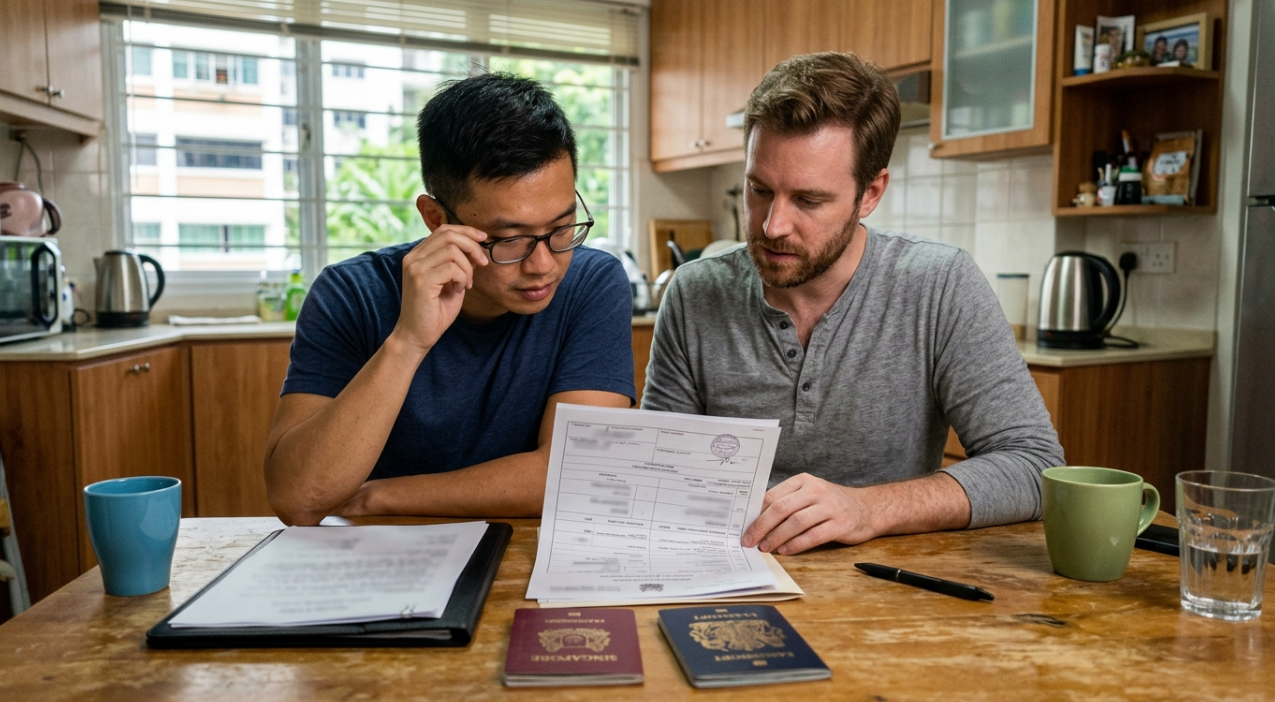
No. Section 12(1) of Singapore's Women’s Charter expressly applies to marriages solemnised “in Singapore or elsewhere” between persons who are not respectively male and female. The statute states that such a marriage is void under Singapore law.
That means obtaining a marriage certificate from another jurisdiction does not, by itself, change the couple's legal status under Singapore law.
The distinction is important:
Situation | What it means |
|---|---|
Marriage valid under the law where it was performed | The issuing jurisdiction treats the couple as married |
Foreign marriage certificate | Evidence that the marriage was registered or certified |
Apostille | Authentication of the document's origin |
Recognition by Singapore | Whether Singapore law gives the foreign marriage legal effect |
Recognition by another country | Determined under that country's own laws |
For a Singapore-based same-sex couple, the first three can potentially exist without producing the fourth. A foreign marriage certificate therefore should not be described as creating marital rights in Singapore.
Constitutional Amendment (2022)
Before this amendment, there was at least a theoretical path: a court challenge could have argued that Singapore’s constitution permitted same-sex marriage. The 2022 constitutional amendment closed that door by embedding the definition of marriage (one man, one woman) into the constitution itself.
The amendment does leave room for a future parliament to expand the definition of marriage. But as of 2025, no legislative movement in that direction has occurred. Practitioners on Reddit’s r/singapore forum frequently discuss whether this “future parliament” clause is meaningful or purely symbolic. The consensus leans toward the latter, at least for the near term.
Registry of Marriages (ROM)
Singapore’s ROM is the official body that solemnizes and registers marriages. It only processes marriages between one man and one woman. Same-sex couples cannot file any paperwork with ROM, period. There is no civil union, domestic partnership, or alternative registration available.
Section 377A Repeal
The repeal of Section 377A decriminalized sex between men. It did not legalize same-sex marriage, civil unions, or any form of partnership recognition. Many Singaporeans initially confused the repeal with broader LGBTQ+ rights, but the simultaneous constitutional amendment made the distinction painfully clear.
Void Marriage
In Singapore’s legal system, a “void marriage” is treated as though it never happened. It doesn’t need to be annulled because it has no legal existence in the first place. Every same-sex marriage, regardless of where it was performed, falls into this category under Section 12.
This classification has cascading effects across housing, taxes, immigration, and inheritance.
HDB (Housing Development Board)
Over 80% of Singaporeans live in HDB public housing. Married couples receive priority access and subsidies. Same-sex couples, because their marriages are void under Singapore law, cannot access the HDB married couple scheme. They can purchase as singles (subject to age and income requirements), but they cannot buy together as a married unit.
On forums like the Singapore Expats Forum, users frequently note that this housing barrier is one of the most tangible daily consequences of non-recognition. Many same-sex couples rent private housing at significantly higher cost.
LTVP and Dependent Pass
The Long-Term Visit Pass (LTVP) and Dependent Pass (DP) are visa categories that allow spouses of Singapore citizens, permanent residents, or Employment Pass holders to live in Singapore. Same-sex spouses are not eligible for either. A same-sex partner must qualify for a residence permit on their own merits, through employment or other independent grounds.
One real-world case illustrates the consequences: an Indonesia-born woman who had lived in Singapore for decades as a permanent resident married a Singaporean citizen abroad and gave birth to their first child in Singapore. Her daughter was denied permanent residency at 18 months. The mother believes the non-recognition of her same-sex marriage contributed to the denial, as she had to apply as a single mother.
CPF (Central Provident Fund)
CPF is Singapore’s mandatory savings and pension system. Married couples can nominate spouses for CPF payouts, access spousal housing grants, and receive tax relief for CPF contributions. None of these spousal benefits are available to same-sex partners, regardless of whether they hold a foreign marriage certificate.
Online Marriage and U.S. Legal Terms
Remote Appearance Marriage
A remote appearance marriage is a ceremony where the couple, the officiant, and the witnesses participate via video call. Utah law explicitly permits this. The couple does not need to be physically present in Utah, or even in the United States, at any point during the process.
This is different from simply streaming a wedding for guests. In a remote appearance marriage, the legal solemnization itself happens online. The resulting marriage certificate is identical to one issued after an in-person ceremony. It will not say “online” anywhere on the document, because U.S. law does not distinguish between remote and in-person marriages.
Utah County Marriage License
Utah County pioneered its fully digital marriage license system in 2019, and by January 2020, couples could apply for a license, attend the ceremony, and receive their certificate without any physical visit. This system is what makes same-sex online marriage possible for Singapore-based couples.
The online marriage license process is open to anyone regardless of residency. There is no requirement to be a U.S. citizen, hold a visa, or have ever visited the country.
Marriage Certificate vs. Marriage License
People often confuse these. The marriage license is the government’s permission to get married. It’s issued before the ceremony. The marriage certificate is the proof that the marriage took place. It’s issued after the ceremony is complete and recorded.
For international recognition purposes, the certificate is what matters. It’s the document you’ll apostille, present to embassies, and use for legal proceedings abroad.
Apostille
An apostille is a certificate used to authenticate the origin of a public document for use in another country that participates in the Hague Apostille Convention. Singapore's accession to the Convention entered into force on September 16, 2021.
For a foreign marriage certificate, an apostille can help establish that the document was issued by the relevant public authority. It does not, however, decide whether the destination country recognizes the underlying marriage.
This distinction matters for same-sex couples. An apostilled marriage certificate can be an authenticated document while the marriage itself remains unrecognized under Singapore's domestic law.
Before ordering an apostille, check the current requirements of the country and authority where the marriage certificate will be submitted. Some authorities may require additional certification, translation, or a particular version of the document.
Embassy Authentication vs. Apostille
For countries that are not part of the Hague Convention, documents need embassy authentication (also called legalization) instead of an apostille. This involves a longer chain of verification, typically through the U.S. Secretary of State’s office and then the destination country’s embassy. It takes more time and costs more, but serves the same fundamental purpose. Courtly’s apostille vs. authentication guide breaks down the differences.
Proxy Marriage vs. Online Marriage
These are not the same thing, and confusing them can create real legal problems. In a proxy marriage, someone else stands in for one or both parties at the ceremony. In an online marriage (remote appearance), both parties are present and actively participating, just via video rather than in the same room.
This distinction matters for immigration. U.S. immigration authorities, for example, treat proxy marriages where one party was absent with significantly more scrutiny than remote appearance marriages where both parties participated. For a detailed comparison, see Courtly’s breakdown of proxy, online, and virtual weddings.
Recognition and Immigration Terms
Marriage Recognition
Marriage recognition refers to whether a government treats a foreign marriage as legally valid within its jurisdiction. For same-sex online marriage, Singapore’s answer is unambiguous: no recognition, regardless of where the marriage was performed or how the documents are authenticated.
However, a U.S. marriage certificate is valid in the United States and in every country that legally recognizes same-sex marriage. As of early 2025, that list includes Argentina, Australia, Austria, Belgium, Brazil, Canada, Chile, Colombia, Costa Rica, Cuba, Denmark, Ecuador, Finland, France, Germany, Greece, Iceland, Ireland, Luxembourg, Malta, Mexico, the Netherlands, New Zealand, Norway, Portugal, South Africa, Spain, Sweden, Switzerland, Taiwan, Thailand, the United Kingdom, the United States, and Uruguay.
If you or your partner may relocate to any of these countries in the future, having a valid marriage certificate matters.
The Israel Precedent
In 2023, Israel’s Supreme Court ruled that thousands of marriages performed virtually in Utah County would be recognized by the state. Israel does not perform civil marriages domestically, so this ruling was significant: it confirmed that a remote appearance marriage through Utah can carry legal weight far from American soil.
Singapore has not followed Israel’s path, and nothing suggests it will soon. But the precedent demonstrates that online U.S. marriages are gaining acceptance in unexpected jurisdictions.
Bona Fide Marriage
A marriage entered into in good faith, not for the purpose of evading immigration laws. This term comes up constantly in U.S. immigration contexts. If one partner is a U.S. citizen or permanent resident and files a spouse visa petition, immigration authorities will evaluate whether the marriage is bona fide.
Online marriages are not inherently suspect. Practitioners on Reddit’s r/USCIS report successful I-130 petition approvals based on Utah online marriages, though they emphasize the importance of gathering strong supporting evidence (photos together, communication records, shared finances).
I-130, CR-1, and IR-1 Visas
These are U.S. immigration pathways relevant to married couples. The I-130 is the initial petition a U.S. citizen or permanent resident files on behalf of their spouse. If approved, the foreign spouse applies for either a CR-1 visa (conditional resident, if married less than two years) or IR-1 visa (immediate relative, if married two or more years).
For same-sex couples where one partner is American, these pathways are fully available. A Courtly marriage certificate works for these petitions. For couples weighing their options, Courtly’s spouse visa consultation connects you with partner attorneys.
Consummation
A concept that causes confusion in the online marriage context. U.S. immigration authorities consider whether a couple has met in person and consummated their marriage when evaluating spouse visa petitions. An online ceremony doesn’t eliminate this requirement. Couples typically need to demonstrate they’ve met in person at some point, ideally after the marriage, before or during the visa process.
This is separate from the marriage’s legal validity. The marriage is legally valid the moment the ceremony concludes. Consummation is an immigration evidence consideration, not a marriage law requirement.
Thailand: The New Regional Option (2025)
Thailand’s Marriage Equality Act took effect on January 23, 2025, making it the first country in Southeast Asia to legalize same-sex marriage. Foreign couples, regardless of nationality, can register their marriage in Thailand.
For Singaporean LGBTQ+ couples, Thailand’s proximity makes it appealing. A weekend trip to Bangkok is cheaper and faster than any alternative. But the fundamental problem remains: Section 12 of the Women’s Charter voids same-sex marriages “solemnised in Singapore or elsewhere.” A Thai marriage certificate carries the same legal weight in Singapore as a U.S. one, which is none.
A Singaporean national quoted in NPR coverage captured the reasoning well: “This is more about building a life together and having the legal rights to protect what we build together.”
The practical comparison between Thailand and a U.S. online marriage comes down to this: Thailand requires travel. A U.S. online marriage through Utah requires only a device with a camera and an internet connection. Both produce legally valid certificates that Singapore will not recognize. Both certificates are recognized in other countries that permit same-sex marriage.
Check Courtly’s pricing and plan details
What a U.S. Marriage Certificate Actually Gets You (and Doesn’t)
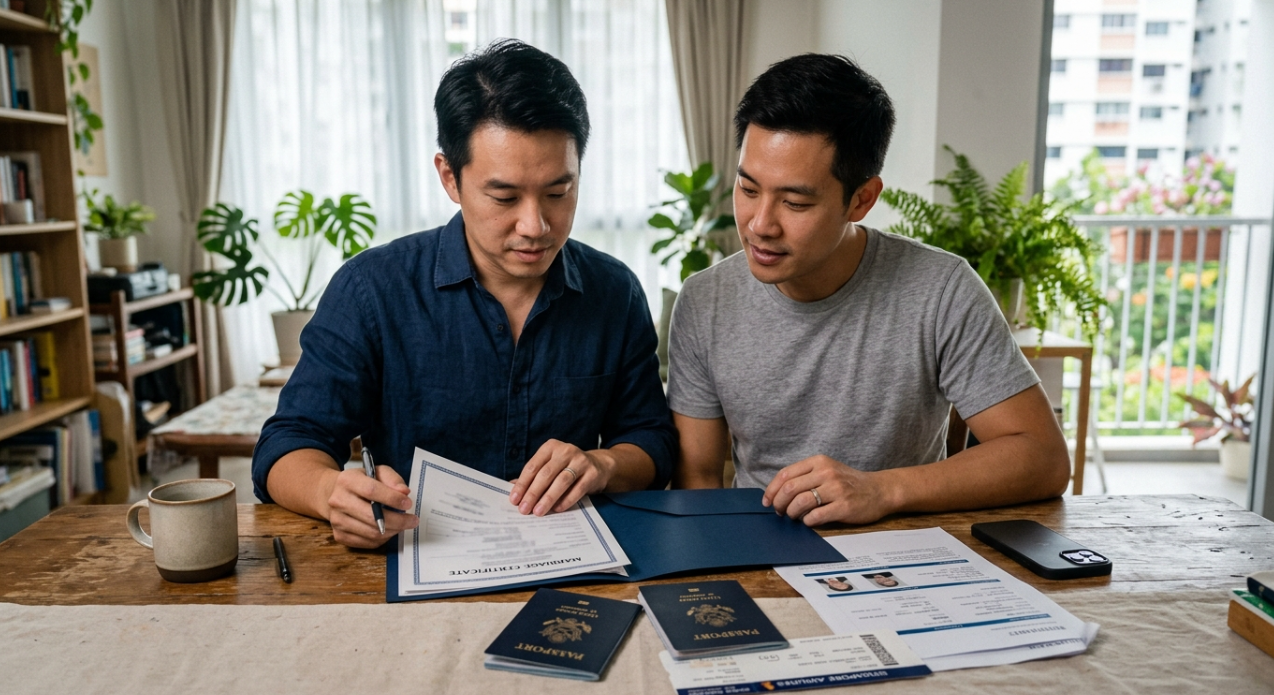
This is the section most articles get wrong. They either stop at “Singapore won’t recognize it” or oversell the certificate. The truth sits in between.
What you get:
A legally valid U.S. marriage. You are married under American law, full stop.
Recognition in 30+ countries where same-sex marriage is legal.
A foundation for U.S. immigration petitions if one partner is American.
A document that can be apostilled for use in Hague Convention countries.
Symbolic and personal significance. For many couples, this is not trivial.
Potential future recognition. If Singapore’s laws change, you already have a valid marriage.
What you don’t get in Singapore:
HDB married couple housing access.
Spousal Dependent Pass or LTVP.
CPF spousal benefits or tax relief.
Hospital visitation rights as a spouse.
Inheritance protections under matrimonial law.
Any official government recognition of the relationship.
A same-sex couple featured in a Courtly testimonial from Singapore put it this way: “Despite the fact that we reside in a nation that does not respect our rights, we are now lawfully wed.” They described the process as smooth and the support as genuinely inclusive.
Shifting Attitudes in Singapore
Public opinion is moving faster than legislation. According to an Institute of Policy Studies survey, about 42% of Singaporeans aged 18 to 25 accepted same-sex marriage in 2018, up from just 17% five years earlier. That trajectory suggests generational change is underway, even if the constitutional amendment has temporarily frozen the legal framework.
Discussions on r/singapore reflect this tension. Younger users often express frustration that the 377A repeal was packaged with a constitutional lock on the marriage definition, viewing it as one step forward and one step back.
For couples making decisions today, the question isn’t whether Singapore will eventually change. It’s what steps make sense right now, given the current legal reality.
How Same-Sex Online Marriage Works for Singapore Couples
The practical process through Courtly is straightforward:
Both partners need to be over 18 and of sound mind.
Each person needs a device with a camera and internet connection.
Neither can be currently married or divorced within the last 60 days.
You apply for a Utah County marriage license online.
A certified officiant conducts the ceremony via video call.
Two witnesses attend (provided by Courtly in the Fast-Track plan, or you bring your own).
The marriage is recorded with Utah County.
You receive digital and physical copies of your U.S. marriage certificate.
The document legalization service handles apostille or embassy authentication if you need the certificate recognized outside the U.S.
One important caveat directly from Courtly: “While remote appearance ceremonies hosted by a Courtly officiant are legal under US law, their acceptance by foreign governments or immigration officials is beyond our control.” Courtly does not provide legal advice on international marriage law or immigration. For Singapore-specific legal questions, consult a Singapore-qualified attorney.
Frequently Asked Questions
Can same-sex couples get legally married in Singapore?
No. Section 12 of the Women’s Charter and the 2022 constitutional amendment define marriage as between a man and a woman. The Registry of Marriages does not process same-sex marriages, and no civil union or domestic partnership alternative exists.
If I marry online through the U.S., is my marriage legally valid?
Yes, in the United States and in every country that recognizes same-sex marriage. The U.S. government does not distinguish between marriages performed in person and those performed via remote appearance. Your certificate will look identical to any other Utah marriage certificate.
Will Singapore recognize my U.S. same-sex online marriage?
No. Under the Women’s Charter, a same-sex marriage performed anywhere in the world is void in Singapore. This applies equally to marriages from the U.S., Thailand, Canada, or any other country.
Do I need an apostille for my U.S. marriage certificate?
If you plan to use the certificate outside the United States, generally yes. Both Singapore and the U.S. are Hague Apostille Convention members. The apostille authenticates the document’s origin but does not compel Singapore to recognize the marriage. It is useful, however, if you present the certificate in other countries that do recognize same-sex marriage.
Can I get a Dependent Pass or LTVP for my same-sex spouse in Singapore?
No. These visa categories require a marriage recognized under Singapore law. Since same-sex marriages are void, a same-sex partner must qualify for residence in Singapore independently, through employment or other eligible categories.
What about getting married in Thailand now that it’s legal there?
Thailand’s Marriage Equality Act (effective January 23, 2025) allows foreign same-sex couples to marry in Thailand. However, the marriage will still be void under Singapore law. The certificate carries legal weight in Thailand and other countries recognizing same-sex marriage, but not in Singapore.
Is it legal to hold a private same-sex wedding celebration in Singapore?
Yes. There is no law against holding a private celebration, commitment ceremony, or symbolic wedding in Singapore. It simply carries no legal recognition. Many couples choose to hold a celebration locally while obtaining their legal marriage certificate through a U.S. online ceremony.
How much does an online marriage through Courtly cost?
Plans start at $199 for the Core package and go up to $599 for the Fast-Track plan, which includes rush processing with a 24-hour scheduling guarantee after license approval, two Courtly-provided witnesses, and ceremony recording with cloud storage. The government processing fee (approximately $70 for the Utah County license) is additional. Add-ons like apostille, live translation, and international shipping are available separately.
Let us handle the paperwork.
Getting married is complicated. Courtly simplifies the process and provides everything necessary to get married online, including providing a licensed officiant who can perform a remote ceremony.
Get Married

Get married online.
Getting married is complicated. Courtly simplifies the process and provides everything necessary to get married online.

