

After an online wedding, your officiant files the signed marriage license with the county clerk, who then issues your official marriage certificate. From there, you need to handle document delivery, potential apostille or authentication for international use, name changes, tax filing updates, health insurance enrollment, and (for many couples) immigration paperwork. This guide defines every key term and walks through the full post-ceremony process in order.
You said your vows over video, the officiant pronounced you married, and now the screen has gone dark. The ceremony is done, but the paperwork is just beginning. Online weddings are fully legal, but the steps that follow them look different from what happens after a traditional courthouse visit. Cross-border couples, immigration petitioners, and anyone who needs their certificate recognized abroad will face terminology and processes that most wedding guides never mention.
This glossary covers every term and milestone you’ll encounter after your online ceremony, organized in the order you’ll actually need them.
See what’s included in each Courtly plan
Direct Answer: What Happens After an Online Wedding?
After an online wedding, your officiant files your signed marriage license with the issuing county. Once the county records the marriage, you'll receive your official marriage certificate. From there, most couples complete five major tasks:
Step | What Happens | Typical Time |
|---|---|---|
1 | Marriage license filed | Same day to several days |
2 | Digital certificate issued | Often within 24 hours |
3 | Certified paper certificate arrives | About 1–3 weeks |
4 | Update legal records | 1–8 weeks |
5 | International or immigration paperwork (if needed) | Several weeks to several months |
If you plan to change your name, apply for immigration benefits, or use your marriage certificate outside the United States, additional legal steps may be required.
Timeline: What Happens After an Online Wedding?
Time | What Usually Happens |
|---|---|
Ceremony Ends | Officiant signs marriage license |
Within 24 Hours | Digital marriage certificate may become available |
1–3 Weeks | Certified marriage certificate arrives |
First Month | Name change, insurance, tax updates |
First 3 Months | Passport, DMV, banks, benefits |
As Needed | Apostille or legalization |
Immigration | USCIS filings begin |
Before You Leave the Ceremony: Save These Three Things
Before closing your laptop after the ceremony, make sure you have:
Confirmation email
Ceremony recording
Receipt or booking confirmation
Officiant information
Expected certificate delivery timeline
These records can help if paperwork is delayed or if you later need proof of your ceremony for immigration or international recognition.
Your Marriage Documents
Marriage License vs. Marriage Certificate
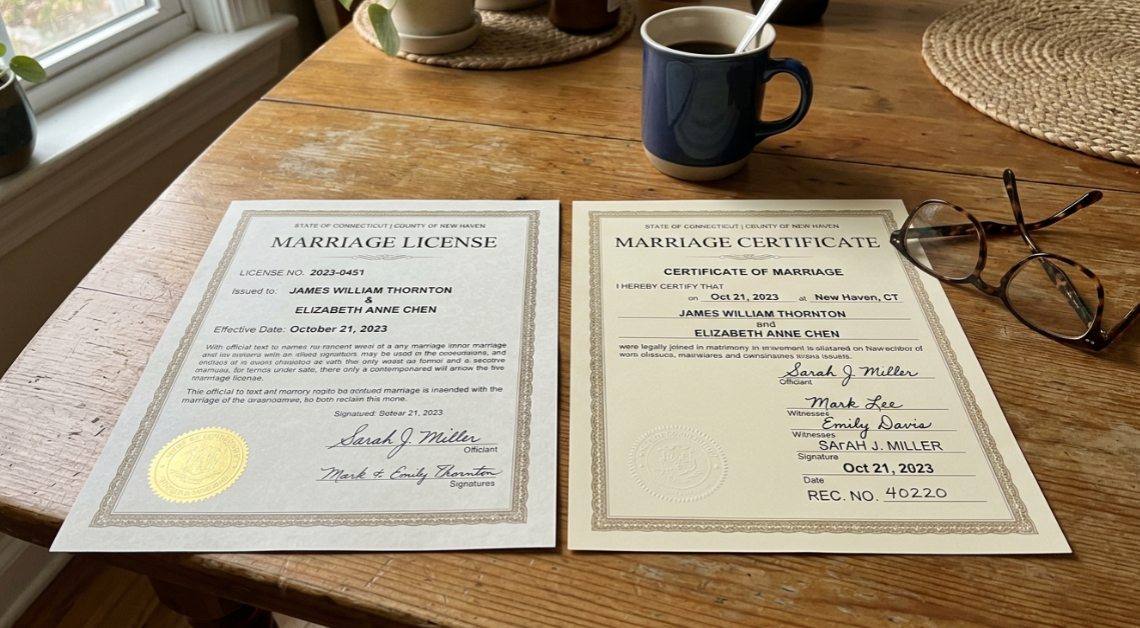
These are two different documents, and confusing them causes real problems. The marriage license is permission to get married. The marriage certificate is proof that you did.
After your online ceremony, the officiant signs the license and files it with the county clerk’s office. The clerk processes the filing, enters your information into the vital records system, and generates the official marriage certificate. With Courtly, your online marriage license is handled through Utah County, and your certificate (digital and physical) follows after.
The digital certificate arrives shortly after the ceremony, which is useful for starting administrative tasks right away. The physical copy is mailed. Practitioners on Reddit who have gone through the process report receiving their digital certificate within 24 hours and the physical copy in roughly 10 days.
Who Files the Marriage License After an Online Wedding?
Many couples wonder whether they need to file anything themselves.
In most online weddings, the officiant submits the signed marriage license directly to the issuing county after the ceremony. Once the county records the marriage, it creates the official marriage certificate.
However, requirements vary by jurisdiction. Always verify whether:
the officiant files the paperwork,
the couple must return documents,
witnesses must sign additional forms,
additional identity verification is required.
Knowing who is responsible helps prevent delays.
Certified Copy of Marriage Certificate
A certified copy is an official duplicate of your marriage certificate, issued by the county clerk with a raised seal or stamp. Government agencies and financial institutions require originals or certified copies, not photocopies.
Order multiple certified copies. Five is a good starting number. You’ll need them for the Social Security Administration, the DMV, the passport office, banks, and possibly immigration filings. Each institution tends to hold onto your document during processing, so having extras prevents bottlenecks.
Digital Marriage Certificate
This is the electronic version of your official marriage certificate, typically delivered as a PDF shortly after the ceremony. It’s not a replacement for the physical certified copy in all situations, but it lets you begin early administrative steps (like researching insurance options or filling out forms) while waiting for paper documents to arrive in the mail.
Online Wedding vs Traditional Wedding: What Happens Next?
Step | Online Wedding | Traditional Wedding |
|---|---|---|
Marriage license signed | Online | In person |
Filing | Usually by officiant | Usually by officiant |
Certificate issued | County clerk | County clerk |
Name change | Same process | Same process |
Taxes | Same rules | Same rules |
Immigration | Same USCIS rules | Same USCIS rules |
Apostille | Same process | Same process |
Making Your Certificate Valid Internationally
Apostille
An apostille is a certificate attached to your document that confirms it’s authentic and legally valid in countries that participate in the Hague Apostille Convention. Think of it as an international stamp of approval. Once your marriage certificate has an apostille, it doesn’t need further certification for use in any member country.
One important detail: a marriage certificate apostille can only be processed through the state where the marriage was issued. For couples married through Utah, that means the Utah apostille. You can learn more about how apostilles work and what they cost.
State-level apostille fees typically start around $10 per document, though expedited processing adds to the total.
Do You Need an Apostille?
Situation | Apostille Needed? |
|---|---|
Name change in the U.S. | No |
IRS filing | No |
Social Security | No |
DMV | No |
U.S. passport | No |
Foreign residency | Usually Yes |
Foreign immigration | Usually Yes |
Registering marriage overseas | Often Yes |
Embassy Authentication and Legalization
For countries that are not members of the Hague Apostille Convention (Thailand, the UAE, Vietnam, and others), an apostille won’t be enough. You need a longer process called authentication and legalization.
After getting state-level authentication, you send the document to the U.S. Department of State Office of Authentications for federal authentication. Then you present it to the embassy or consulate of the destination country for legalization. It’s more steps, more time, and more cost than an apostille. Courtly offers both apostille and authentication packages to handle this process.
Understanding the difference between apostille and authentication matters because choosing the wrong path wastes weeks.
Hague Apostille Convention
This is the 1961 international treaty that created the apostille system. Over 120 countries participate. If the country where you need your certificate recognized is a member, you only need an apostille. If it isn’t a member, you need the full embassy authentication process described above.
International Marriage Recognition
Not every country automatically recognizes an online marriage performed in the United States. Most do, but known exceptions include Germany, Hungary, Australia, Norway, France, Turkmenistan, Sweden, Poland (which varies by situation), Taiwan, and Finland.
Couples should always check with local authorities or a legal professional in their destination country before assuming recognition. Courtly publishes a list of countries and their recognition status to help set realistic expectations.
Changing Your Name
Name Change After Marriage
If you’re taking your spouse’s surname (or hyphenating), the legal process follows a specific sequence. Getting it wrong creates identity mismatches that can take months to untangle.
The correct order is: Social Security Administration first, then DMV, then passport office, then banks and everything else. A Social Security name change is the foundation because completing it before updating your driver’s license, passport, or tax records prevents mismatches across government databases.
You can submit your application by mail or in person at a local SSA office. Online submission is available in some states for U.S. citizens over 18 with a valid state ID. The service is free, and your new card arrives in 10 to 14 business days. However, the SSA advises waiting at least 30 days after your marriage date before requesting the change, giving your state time to update its records.
Worth noting: only 21 states participate in the SSA’s online marriage-data exchange system, which means processing may take longer in other states.
Courtly offers a name change kit with prefilled forms and checklists to simplify updates across SSA, DMV, passport, and banks.
Form SS-5
This is the standard application form for a new or replacement Social Security card. To change your name, complete Form SS-5 and submit it with one original or certified document proving your name change (your marriage certificate) and one unexpired photo ID. That’s the entire requirement. No appointment needed if filing by mail, though in-person visits are available.
Health Insurance and Taxes
Qualifying Life Event
Marriage is a qualifying life event (QLE), which means you don’t have to wait for open enrollment to make changes to employer-sponsored health insurance. Both spouses can make mid-year changes, including joining the other’s plan, switching coverage tiers, or adding dependents.
Compare your insurance benefits with your spouse’s and decide which plan makes more sense. Most employers give you 30 to 60 days from the date of marriage to make changes, so don’t sit on this.
Tax Filing Status
When you get married, your IRS filing status changes. For the tax year in which you’re married as of December 31, you can file as “Married Filing Jointly” or “Married Filing Separately.” This means even a December 31 online wedding changes your entire year’s filing status.
Filing jointly is usually more advantageous, offering wider tax brackets and a higher standard deduction. But couples with significant income disparities, student loan repayment plans, or specific deduction situations should run the numbers both ways.
W-4 Withholding Adjustment
After marriage, review your tax withholding. If both partners are employed, you may need to adjust your W-4 forms to reflect your new combined income. This helps avoid underpayment penalties or an unexpected tax bill at the end of the year. It takes five minutes and saves real money.
Immigration After an Online Marriage: Quick Overview
If one spouse is not a U.S. citizen, the marriage certificate is usually the starting point—not the final step.
The general process is:
Receive certified marriage certificate
Gather relationship evidence
File Form I-130
Complete National Visa Center processing
Attend consular interview (if applicable)
Receive immigrant visa or adjustment of status
Immigration After an Online Wedding
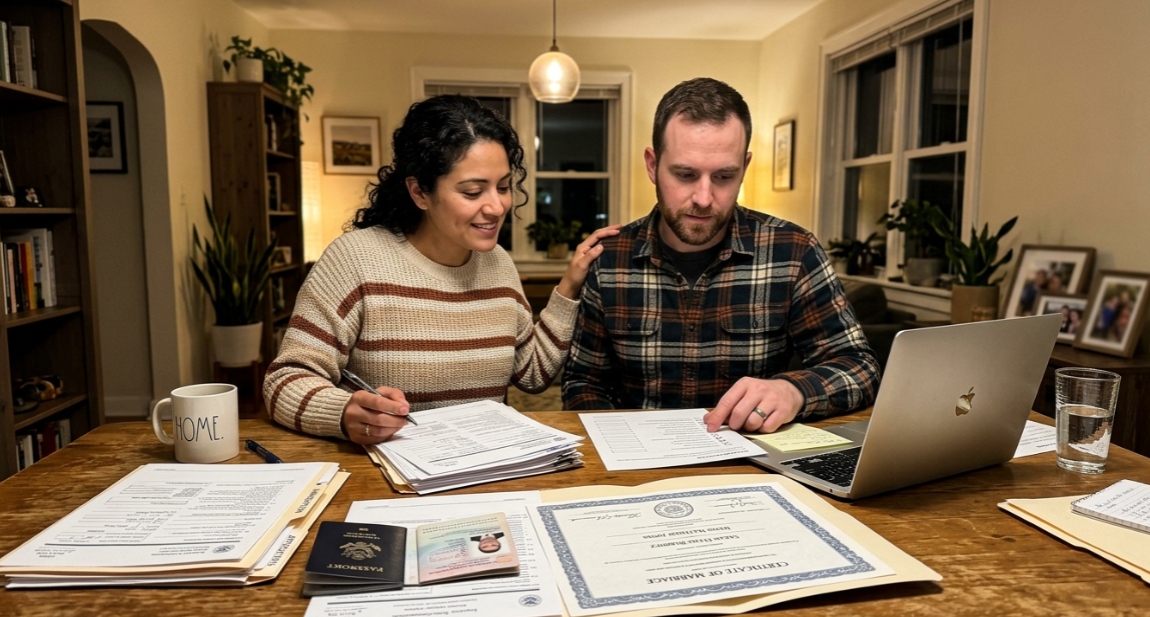
For many couples, the question of what happens after an online wedding is really about immigration. The certificate is a means to an end: sponsoring a spouse for a U.S. visa.
Form I-130 (Petition for Alien Relative)
The first step for a U.S. citizen or permanent resident sponsoring a foreign spouse is filing Form I-130 with USCIS. This petition establishes the qualifying relationship. Current processing time for spousal I-130 petitions runs 8 to 15 months depending on the service center.
Courtly offers a spouse visa consultation with partner attorneys for couples navigating this process.
CR-1 Visa vs. IR-1 Visa
Both are immigrant visas for spouses of U.S. citizens, but they differ based on how long you’ve been married when the visa is approved. Less than two years of marriage means CR-1 (conditional resident). Two years or more means IR-1 (immediate permanent resident).
The CR-1 visa grants conditional permanent resident status valid for two years. The IR-1 grants permanent resident status valid for 10 years without conditions. Current average wait time for either visa is about 14.5 months when the petitioner is a U.S. citizen, and approximately 35 months when the petitioner is a lawful permanent resident.
The practical implication: if your I-130 takes over two years to process, you may end up qualifying for the IR-1 even though you started the process recently married.
Conditional vs. Permanent Residency
If you’ve been married for less than two years when your foreign-citizen spouse enters the United States on an immigrant visa, their permanent resident status is considered “conditional.” Before the two-year mark, you’ll need to jointly file Form I-751 to remove conditions and convert to full permanent residency.
Bona Fide Marriage Evidence
USCIS requires proof that your marriage is genuine and not entered solely for immigration benefits. Evidence includes joint bank accounts, shared leases or mortgages, photos of your life together, birth certificates of any children, and communication records.
For online wedding couples specifically, ceremony video recordings serve as valuable evidence. One user on Reddit’s r/USCIS shared their experience using a Utah online marriage for an I-130 filing, noting that the ceremony recording helped establish legitimacy. Courtly’s Popular and Fast-Track plans include ceremony video recording with cloud storage, which serves both as a keepsake and as documentation.
More detail on whether online marriages are recognized for immigration purposes is available on Courtly’s resource page.
Consummation
Consummation refers to the physical completion of a marriage through sexual intercourse. While it may sound archaic, it comes up in both immigration and foreign government contexts. Some USCIS officers have asked about post-marriage meetings and physical consummation during interviews. Canada’s IRCC generally does not accept online marriages except in narrow circumstances.
For couples who married online and live in different countries, plan to document your in-person meetings after the ceremony. Travel records, boarding passes, and photos together all help.
Ceremony Recording
The video documentation of your online wedding ceremony serves a dual purpose. It’s a personal keepsake you can share with family, and it’s a legal record useful for immigration filings, foreign recognition processes, and general proof of ceremony. If your plan includes recording with cloud storage, download a backup copy for your own records.
Updating Your Life
Beneficiary Updates
Marriage changes who should receive your insurance payouts, retirement account balances, and estate assets. Review and update beneficiaries on life insurance policies, 401(k) or IRA accounts, bank accounts, and any trusts. This is easy to forget and critically important. Beneficiary designations override wills in most cases, so an outdated form means your assets may not go where you intend.
Consider working with an estate planning attorney to draft or update a will, power of attorney, and any trusts. This doesn’t have to be expensive, and it prevents enormous headaches later.
Emergency Contact Updates
Update your emergency contact information with your employer, medical providers, gym, and any other institution that has it on file. It takes 10 minutes and matters when it matters.
Post-Online Wedding Checklist Timeline
Here’s a practical sequence for everything above.
Week 1
Receive your digital marriage certificate
Begin comparing health insurance plans with your spouse
Download and save your ceremony recording
Month 1
Receive your physical marriage certificate in the mail
Order additional certified copies (aim for five)
Enroll in or switch health insurance (qualifying life event window is typically 30 to 60 days)
File Form SS-5 for Social Security name change (wait at least 30 days from marriage date)
Update W-4 withholding at work
If pursuing immigration, begin preparing Form I-130
Months 2 to 3
Receive new Social Security card (10 to 14 business days after filing)
Update driver’s license at the DMV
Apply for passport update if needed
Request apostille or authentication if you need international recognition
Update bank accounts, credit cards, and utilities
Update beneficiaries on insurance and retirement accounts
6+ Months
File taxes with new filing status (Married Filing Jointly or Separately)
Continue monitoring I-130 processing if applicable (8 to 15 months typical)
Remove conditions on residency if applicable (Form I-751, filed before the two-year anniversary)
Review estate planning documents
Get started with your online wedding
Frequently Asked Questions
How long does it take to get a marriage certificate after an online wedding?
The digital certificate typically arrives within 24 hours of the ceremony. The physical certified copy is mailed and usually arrives within about 10 days. Apostille processing, if needed, adds roughly another one to two weeks.
Is an online wedding legally recognized for immigration purposes?
Yes, in most cases. USCIS has accepted marriages performed via Utah’s remote solemnization process. However, you still need to prove the marriage is bona fide with evidence like joint finances, communication records, and in-person meeting documentation. Consult an immigration attorney for your specific situation.
Do I need an apostille for my online marriage certificate?
Only if you need your certificate recognized in another country. If that country is a member of the Hague Apostille Convention, an apostille is sufficient. If not, you’ll need embassy authentication and legalization, which involves additional steps through the U.S. Department of State and the foreign embassy.
When should I change my name after an online wedding?
Wait at least 30 days after your marriage date before applying for a Social Security name change. This gives your state time to update vital records. After that, follow the sequence: SSA, then DMV, then passport, then banks and everything else.
Does getting married online in December affect my taxes for the whole year?
Yes. The IRS determines your filing status based on your marital status on December 31. Even a December 31 online wedding means you file as married for the entire tax year.
What is the difference between a CR-1 and IR-1 visa?
Both are immigrant visas for spouses. The CR-1 applies when you’ve been married less than two years at the time of visa approval, granting conditional residency for two years. The IR-1 applies when you’ve been married two or more years, granting full permanent residency for 10 years. Current average processing time is about 14.5 months for spouses of U.S. citizens.
Which countries don’t recognize online marriages?
Known exceptions include Germany, Hungary, Australia, Norway, France, Turkmenistan, Sweden, Finland, Taiwan, and Poland (which varies). This list can change, so always verify with the relevant country’s authorities before relying on recognition. Check Courtly’s country recognition page for current guidance.
Can I use my online marriage certificate for health insurance changes?
Yes. Marriage is a qualifying life event that lets both spouses make mid-year changes to employer-sponsored health plans without waiting for open enrollment. Most employers require you to act within 30 to 60 days of the marriage date.
Let us handle the paperwork.
Getting married is complicated. Courtly simplifies the process and provides everything necessary to get married online, including providing a licensed officiant who can perform a remote ceremony.
Get Married

Get married online.
Getting married is complicated. Courtly simplifies the process and provides everything necessary to get married online.

