

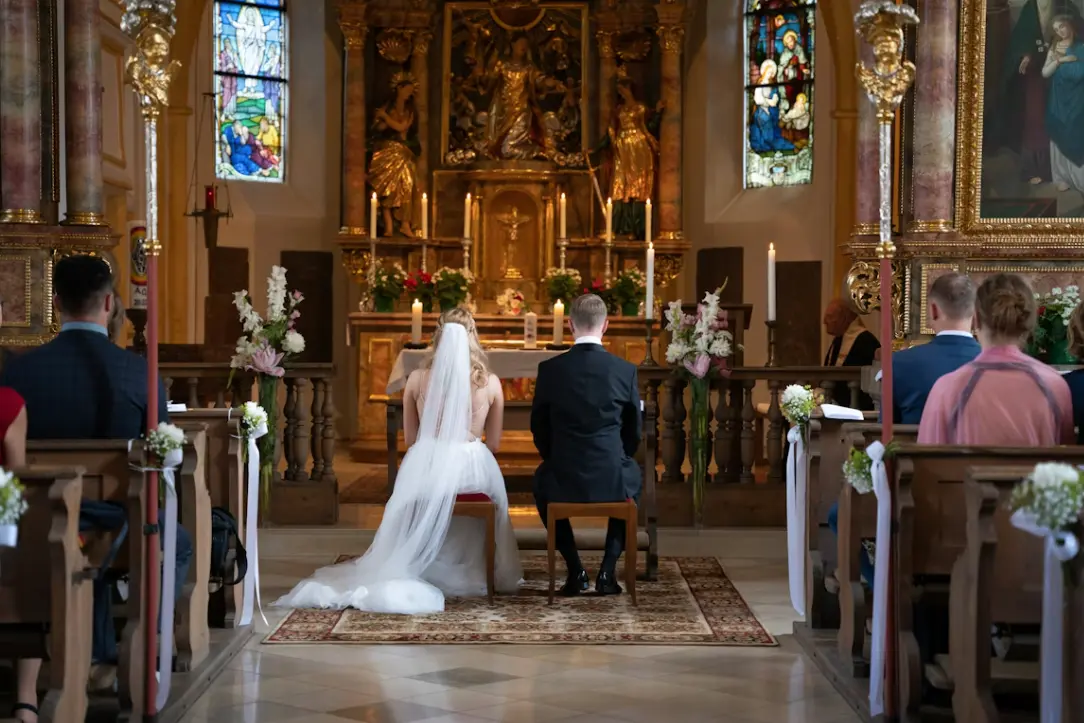
Walk into a Catholic wedding in Manila and you'll see a white cord draped in a figure-eight around the couple. Attend one in County Cork and you might see hands bound together with ribbon.
Both are Catholic weddings. Both follow the sacrament of marriage. But the cultural expressions look completely different.
The Catholic Church provides the sacramental structure: the readings, the vows, the Mass.
But cultural traditions shape everything around it like the Irish handfasting, Hispanic arras, Filipino cord ceremonies, and Italian confetti.
These aren't Church doctrine. They're heritage.
Whether you're planning your own ceremony or attending one as a guest, here's what the Church requires versus what actually happens when local heritage takes center stage.
What Makes a Catholic Wedding Catholic (The Universal Elements)
Before diving into regional flair, you have to understand the non-negotiables.
Catholic weddings are sacraments, not just ceremonies. This means there is a legal framework involved that doesn't exist in secular weddings.
The Sacramental Foundation
The venue: With rare exceptions, the ceremony must happen inside a Catholic church.
The partners: At least one partner must be a baptized Catholic.
The status: Both must be "free to marry," meaning no prior valid marriages unless they have been annulled.
The prep: You'll need to complete "Pre-Cana" marriage preparation and provide baptismal certificates.
Core Elements in Every Ceremony
Every valid Catholic wedding requires an authorized officiant (priest or deacon), consent freely given before witnesses, the exchange of vows using an approved formula, and the exchange of blessed rings. You also need at least two witnesses for the church records.
Everything else, like the lasso, coins, or specific prayers, is culture, not doctrine.
In other words, the church provides the sacrament; culture provides the celebration.
Roman Catholic Wedding Traditions (The Foundation)
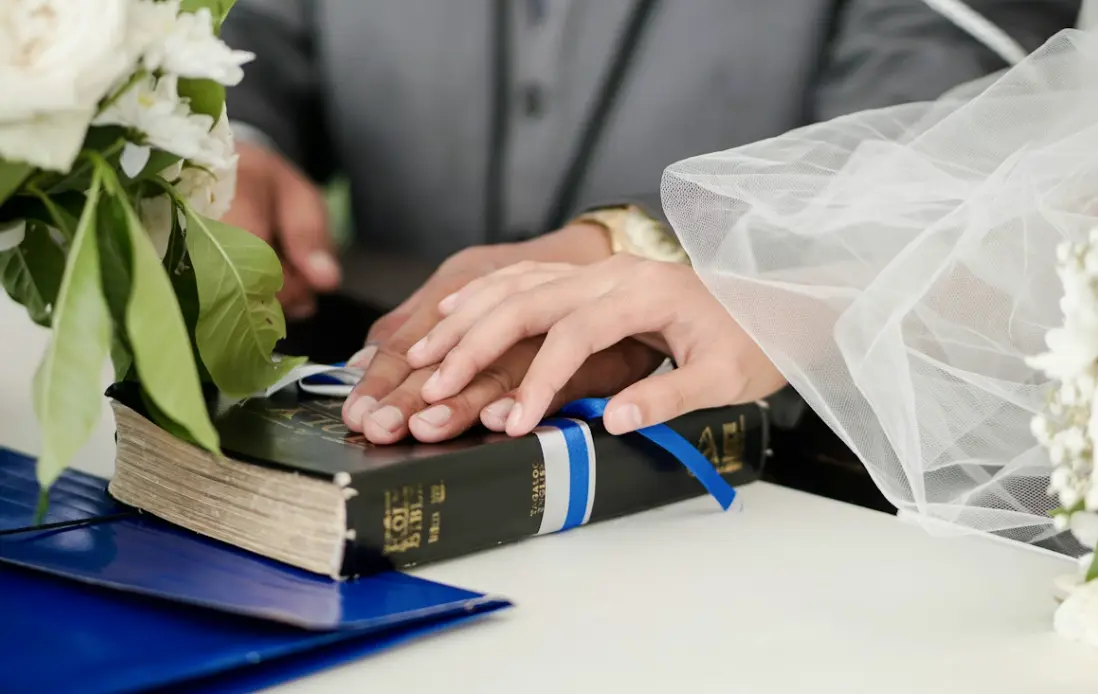
Most Catholic weddings worldwide follow the Roman Rite. While traditionally conducted in Latin, these are now typically held in the local language, but the order of the Mass remains standard.
What's Actually Universal
The Roman Rite includes specific elements that appear in Catholic weddings everywhere:
Required Scripture readings: Three readings from the Bible (Old Testament, New Testament epistle, Gospel) plus a Responsorial Psalm.
Couples choose from approved options, but the readings themselves are mandatory.
Approved vow formulas: The Church provides specific language for vows. You can choose between variations, but you can't write completely original vows for the sacramental moment.
Nuptial blessing: A special prayer for the couple that's part of the official liturgy.
Sign of peace: The couple and congregation exchange a greeting.
If full Mass: Eucharistic prayer and Communion. Catholics receive; non-Catholics may receive a blessing.
Common Western Additions (Not Official Liturgy)
Unity Candle: Often, mothers light two separate candles at the start, and the couple lights a single unity candle after their vows.
This isn't actually in the official liturgy. It's a cultural addition that became widespread in the U.S. and Canada in the 20th century.
Flowers to Mary: The bride may place a bouquet at a statue of the Virgin Mary, usually during a quiet moment after the ceremony. This is a devotional practice, not a required ritual.
White wedding dress: This is Western fashion tradition, not a Church requirement. The Church has no dress code beyond modesty.
Gifts and Receptions
Historically, Catholic communities viewed gifts as a private family matter, so you won't always see a public registry.
Instead, cash gifts in envelopes are the standard and are often presented at the reception.
Catholic receptions tend to be family-heavy, often featuring a formal first dance and a blessing before the meal.
Irish Catholic Wedding Traditions
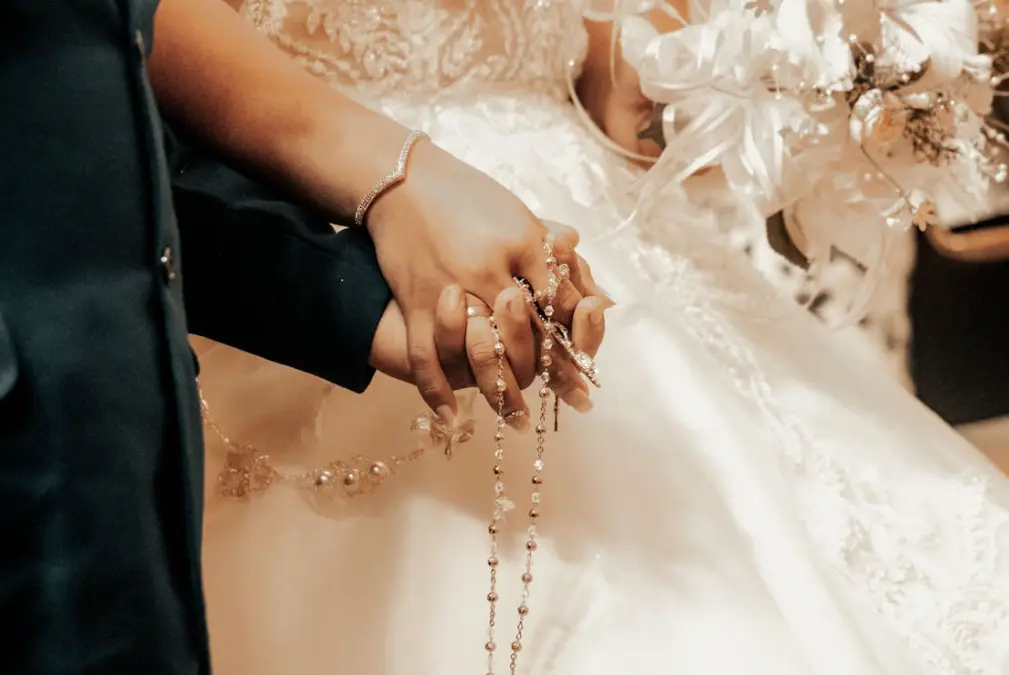
Irish traditions are some of the most distinct, often blending ancient Celtic customs with the Catholic Rite.
Irish Catholic wedding traditions intertwine Celtic symbolism with Catholic sacraments.
Handfasting (Tying the Knot)
This is where the phrase "tying the knot" originates.
During the vows, the couple's hands are bound together with a cord or ribbon, symbolizing the binding of two families, not just two people.
The practice comes from ancient Celtic handfasting ceremonies that predated Christianity. When Ireland converted to Catholicism, the tradition was incorporated rather than discarded.
The Claddagh Ring
This traditional Irish ring features hands holding a crowned heart. If used as a wedding band, it's worn with the heart facing inward toward the wearer's body to show they are "taken."
Luck and Celebration
Irish weddings are heavy on folklore. You might see a horseshoe displayed for luck or hear bells rung to ward off "evil spirits."
Receptions are often "wake-style," meaning lots of storytelling, music, and dancing that lasts until the sun comes up.
Italian Catholic Wedding Traditions
Italian Catholics blend Mediterranean hospitality with the Roman Catholic sacrament, creating ceremonies that honor both Church requirements and cultural heritage.
Integration Into Catholic Mass
Italian Catholic weddings follow the standard Roman Rite Mass structure, with cultural elements appearing primarily at the reception rather than during the ceremony itself.
The ceremony focuses on the sacrament—readings, vows, Eucharist—while Italian cultural traditions shine at the celebration and party afterward.
During Ceremony:
- Standard Catholic Mass structure (Liturgy of the Word, Rite of Marriage, Eucharist)
- May include Italian hymns or prayers if priest approves
- Flowers to Mary (bride may place bouquet at statue of Virgin Mary after ceremony)
At Reception:
- Tarantella dancing (high-energy group dance)
- Bomboniere (five sugared almonds symbolizing health, wealth, happiness, fertility, longevity)
- Multi-course feast lasting several hours
- Money dance with guests pinning cash to couple
- Cookie tables in certain regions (Pennsylvania, Ohio)
Gift Traditions
Cash in plain white envelopes presented at reception, not church.
Typical amounts: $150-$300+ for close family, $100-$150+ for friends and extended family, $50-$100+ for acquaintances.
The envelope tradition reflects the Italian Catholic view of gifts as private family support rather than public registry items.
Hispanic Catholic Wedding Traditions
Hispanic Catholic weddings span Mexican, Colombian, Puerto Rican, Dominican, Cuban, and Spanish traditions.
Though the common thread emphasizes symbolic objects and community sponsorship integrated directly into the Catholic Mass.
Las Arras (Wedding Coins): During Mass
The groom gives the bride 13 gold coins during the Rite of Marriage, after the exchange of rings.
How it works in Catholic Mass:
- Priest blesses the coins during the ceremony
- Groom places them in bride's hands
- Bride accepts them as shared promise of mutual financial responsibility
- Coins remain with the couple through the rest of Mass
The number thirteen represents the twelve months of the year plus one extra, symbolizing sharing blessings with those in need.
El Lazo (The Lasso): During Mass
A large rosary, rope, or floral cord is placed in a figure-eight around the couple's shoulders by their padrinos (godparents), typically after the exchange of rings and arras, before the nuptial blessing.
How it works in Catholic Mass:
- Priest blesses the lazo
- Padrinos (married couple chosen as role models) place it around both the bride and groom
- Lazo stays on the couple throughout remainder of Mass
- Removed before Communion or at the end of ceremony
The figure-eight represents infinity; an eternal, unbroken bond.
The physical connection symbolizes two people becoming one unit while maintaining individual identities.
Padrinos y Madrinas (Godparents): Throughout the Ceremony
Hispanic Catholic weddings designate multiple sponsors for different ceremony elements:
- Padrinos de arras (sponsor the coins)
- Padrinos de lazo (sponsor and place the lasso)
- Padrinos de velación (primary ceremony sponsors)
- Padrinos de ramo (sponsor the bouquet)
Each sponsorship represents a lifetime commitment to support the couple spiritually, emotionally, and sometimes financially.
These aren't honorary titles; padrinos take active roles during Mass and throughout the couple's marriage.
Timing Within Mass
Most Hispanic Catholic priests are flexible about exactly when lazo and arras occur, as long as they don't interrupt key liturgical moments (readings, Eucharistic prayer).
Common placement: during or immediately after the Rite of Marriage, before the nuptial blessing.
Mexican Catholic Wedding Traditions
Mexican Catholic weddings incorporate standard Hispanic Catholic elements (lazo, arras, padrinos) with Mexico-specific cultural expressions.
Extensive Padrino System
Mexican Catholic weddings often have the most elaborate padrino structure of any Hispanic culture, with sponsors for:
- Bible (used during readings)
- Arras (13 coins)
- Lazo (cord or rosary)
- Bouquet
- Rosary
- Pillows (for couple to kneel on during Mass)
Each padrino presents their sponsored element during the appropriate moment in Mass, with the priest blessing each item.
Mariachi During Ceremony
Unlike most Catholic weddings, where music is restricted to approved liturgical hymns, many Mexican Catholic priests allow mariachi music during specific non-liturgical moments:
- Processional (bride's entrance)
- During signing of marriage certificate after ceremony
- Recessional (couple's exit)
The mariachi tradition connects the Catholic sacrament to Mexican cultural pride while respecting the sacred nature of the Mass.
Reception Elements
Mexican Catholic wedding receptions include traditional dances, elaborate meals, and money dance (el baile del billete), but these happen outside the church and sacramental ceremony.
Filipino Catholic Wedding Traditions
Filipino Catholic Wedding Traditions
Filipino Catholic weddings blend Spanish colonial Catholic influence with indigenous Filipino customs, creating highly symbolic ceremonies integrated directly into the Mass structure.
The Cord (Yugal): During Mass
A white silk cord or oversized rosary is draped over the couple in a figure-eight by cord sponsors (typically a married couple chosen as role models).
How it works in Catholic Mass:
- Happens after exchange of rings, during Rite of Marriage
- Cord sponsors (padrinos de yugal) place the cord over the bride's shoulders and groom's shoulders
- Priest may bless the cord before or after placement
- Cord stays on couple through remainder of Mass
- Removed before or during recessional
Similar to Hispanic lazo but specific to Filipino Catholic tradition.
The Veil: During Mass
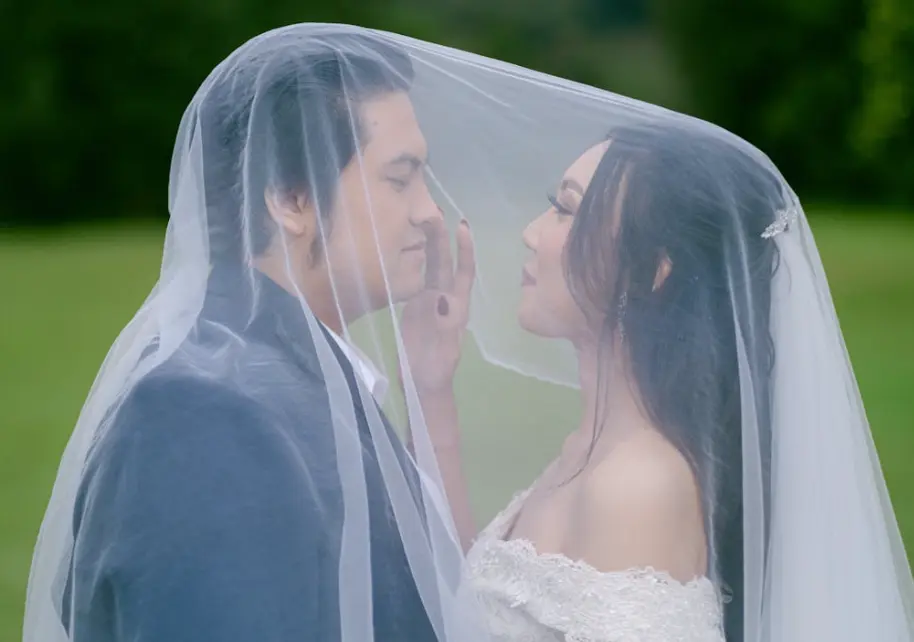
Immediately after or before the cord ceremony, veil sponsors (padrinos de velo) place a large white veil over the bride's head and groom's shoulders simultaneously.
Symbolism: The couple is now "clothed as one" and united under God's protection. The veil covering both represents their shared spiritual journey and commitment to protect each other.
The Coin Ceremony (Arrhae): During Mass
Thirteen coins (similar to Hispanic arras) are blessed by the priest, then passed hand-to-hand between bride and groom three times.
How it works:
- Coin sponsors present coins to priest for blessing
- Priest blesses the coins during Rite of Marriage
- Groom passes coins to bride (first exchange)
- Bride passes coins back to groom (second exchange)
- Groom passes coins to bride again (third exchange)
- Bride keeps coins
The three exchanges symbolize the Trinity (Father, Son, Holy Spirit) and the promise that neither will ever be without resources.
Timing Within Mass
Filipino Catholic priests typically sequence these traditions as: ring exchange → coin ceremony → cord ceremony → veil ceremony → nuptial blessing.
All happen during the Rite of Marriage, before the Liturgy of the Eucharist.
Reception Elements
Large-scale celebrations (200+ guests), money dance where guests pin cash to couple's clothing, and elaborate feasts happen at the reception outside of church.
Vietnamese Catholic Wedding Traditions
Vietnamese Catholic weddings combine Confucian respect for elders with Catholic sacramental structure, resulting in ceremonies that honor both traditions separately.
The Tea Ceremony: Before or After Mass
The tea ceremony is not part of the Catholic Mass.
It's a separate Confucian tradition conducted before the church ceremony or after at the reception.
How it works:
- Couple serves tea to elders in order of seniority (grandparents, parents, aunts, uncles)
- Each elder accepts tea, offers blessings, and typically presents red envelope with money
- Tea ceremony honors family hierarchy and formally welcomes couple into married status
Many Vietnamese Catholic families conduct the tea ceremony at home or a restaurant before traveling to church. Others hold it at the reception venue after the church ceremony ends.
The Ao Dai
Vietnamese brides often wear a red or pink ao dai (traditional dress) for the tea ceremony, symbolizing luck and prosperity in Vietnamese culture.
They change into a white Western wedding gown for the Catholic Mass ceremony, honoring both Catholic tradition (Western dress) and Vietnamese heritage (ao dai for tea ceremony).
Catholic Mass Structure
The Catholic ceremony itself follows standard Roman Rite structure with no Vietnamese-specific additions during Mass. Cultural expression happens through:
- Vietnamese language readings and homily (if priest speaks Vietnamese)
- Vietnamese hymns during appropriate moments
- Multi-generational attendance emphasizing family importance
Gift Traditions
Red envelopes (li xi) with cash, presented during the tea ceremony or at reception.
Amounts should be even numbers for luck, never four (associated with death in Vietnamese culture). Typical amounts: $88, $100, $188, $200.
The separation between tea ceremony (Confucian tradition) and Catholic Mass (Church sacrament) allows Vietnamese Catholics to honor both cultural heritage and religious faith without blending them inappropriately.
Polish Catholic Wedding Traditions
Polish Catholic weddings blend traditional Slavic customs with the Roman Catholic sacrament, creating ceremonies known for symbolic rituals and extended celebrations.
Bread, Salt, and Wine
At the reception, parents present the couple with bread (for prosperity), salt (for overcoming difficulties together), and wine (for joy and health).
This blessing from parents represents their support and wisdom being passed to the new marriage.
The Unveiling (Oczepiny)
Around midnight at the reception, the bride's veil is ceremonially removed and replaced with a married woman's cap or scarf.
This marks her transition from maiden to wife. The veil is sometimes tossed to single women (like a bouquet toss).
Reception Traditions
Polish weddings feature traditional foods like pierogi, kielbasa, and mazurka cake. Polka music and folk dances are central to the celebration.
The money dance (where guests pin cash to dance with the bride or groom) helps the couple financially.
Catholic Wedding Traditions Around the World: Key Differences
To see how different Catholic wedding traditions express the same sacrament, here's how culture, symbolism, and gifts show up across regions:
What Happens During a Catholic Wedding Mass: Step-by-Step
If you've never been to a Catholic wedding, here is the pragmatic reality of the timeline.
Total Time: 20–30 minutes (ceremony without Mass) or 45–60 minutes (full Nuptial Mass)
The Start
Prelude: Music plays as guests are seated
Processional: The priest and altar servers enter, followed by the groom, the wedding party, and finally the bride
The Liturgy of the Word (10-20 minutes into ceremony)
Three readings: Old Testament, New Testament epistle, and Gospel
Responsorial Psalm: Sung or recited between readings
Homily: The priest gives a short talk about marriage
The Rite of Marriage (20-35 minutes into ceremony)
Questions: The priest asks if you come freely, if you will honor each other, and if you will accept children
Consent: This is the exchange of vows; the actual moment the marriage happens
Blessing of Rings: The priest blesses the rings before you exchange them
Cultural elements: Lasso, coins, cord, veil, or unity candle happen here.
This is where many couples integrate their specific Catholic wedding traditions.
Liturgy of the Eucharist (35-50 minutes, if full Mass)
Offertory: Bread and wine brought to the altar
Eucharistic Prayer: The priest consecrates the bread and wine
Communion: Catholics receive communion; others may receive a blessing
Nuptial Blessing: A special prayer for the couple
The Finish
Sign of Peace: The couple and congregation exchange a greeting
Recessional: The couple exits first, followed by the party
A ceremony without Mass takes 20–30 minutes. A full Nuptial Mass takes 45–60 minutes.
The Legal vs. Sacramental Timeline
Here's the thing: the Catholic Church handles the sacrament, but the government handles the legal contract.
In many international cases, these two things don't happen at the same time.
Why couples split legal and sacramental:
If one partner's visa is expiring, or you need to file spousal immigration paperwork before a deadline, waiting for parish availability or family travel schedules may not be possible.
Getting legally married first handles the documentation requirement.
When families are in different countries or continents, coordinating travel for a Catholic ceremony can take months.
Legal marriage can happen immediately while planning the sacramental celebration for when everyone can gather.
Popular churches book 6-12 months in advance. If you need to be married sooner for legal reasons, splitting legal and sacramental allows you to secure your legal status while planning the ceremony you actually want.
Courtly provides government-issued U.S. marriage certificates through online ceremonies legally recognized in 150+ countries.
You can handle civil marriage requirements immediately (within 24-48 hours) while planning your Catholic wedding ceremony for when your parish can accommodate you, families can travel, and you've completed Pre-Cana preparation.
The civil marriage satisfies legal requirements; the Catholic ceremony fulfills the sacrament.
FAQs: Catholic Wedding Traditions
What are traditional Catholic wedding traditions?
Traditional Catholic wedding traditions center on universal sacramental elements:
- Authorized priest or deacon
- Freely given consent before witnesses
- Exchange of vows using approved formulas
- Blessed ring exchange inside a Catholic church
Cultural additions vary by heritage: Irish handfasting, Italian bomboniere (five sugared almonds), Hispanic lazo (figure-eight cord), Filipino cord and veil ceremonies, Polish bread/salt/wine, and Vietnamese tea ceremonies.
These cultural practices occur during the Rite of Marriage and are permitted as long as they don't disrupt core liturgical moments.
What is the lasso tradition in Catholic weddings?
The lasso (or lazo) is a large rosary or cord placed in a figure-eight around the couple to symbolize an eternal bond. It is common in Hispanic and Filipino Catholic wedding traditions.
In Hispanic weddings, padrinos place it around the couple's shoulders after the priest blesses it. In Filipino weddings, it's called the yugal and is often paired with a veil ceremony.
The lasso stays on the couple through most of the Mass and is removed before Communion.
What are appropriate gifts for a Catholic wedding?
Cash in an envelope is the most traditional gift across Catholic wedding traditions. Western Catholic cultures (Irish, Italian, North American) typically give $50-$300 in plain white envelopes, depending on relationship closeness; roughly covering the "cost per plate" ($75-$150 per guest).
Asian Catholic traditions (Filipino, Vietnamese) use red envelopes with even-numbered amounts ($88, $100, $188) for luck, avoiding 4.
Never bring boxed gifts to the church; mail them to the couple's home or bring them to the reception.
Do you need a full Mass for a Catholic wedding?
No. You can choose a shorter ceremony (20–30 minutes) without the Eucharist, which is often preferred if many guests aren't Catholic or when one partner isn't Catholic.
Both formats are fully sacramental as long as core elements (church venue, authorized officiant, proper vows, witnesses) are met. The choice is made during Pre-Cana preparation.
What happens during a Catholic wedding Mass?
A full Mass includes:
- Liturgy of the Word (Bible readings, psalm, homily)
- Rite of Marriage (questions on freedom and fidelity, vow exchange, ring blessing, cultural elements like lasso or coins)
- Liturgy of the Eucharist (consecration, Communion for Catholics, nuptial blessing)
- Sign of Peace, and recessional
Full Mass lasts 45–60 minutes. Ceremony without Communion lasts 20–30 minutes.
Are Catholic priests flexible with cultural traditions?
Most are. As long as the tradition (like the arras, lasso, cord, veil, or yugal) doesn't conflict with the core liturgy, priests usually accommodate them during the ceremony.
These are treated as devotional customs enhancing the sacrament. Priests review them during Pre-Cana preparation to ensure smooth integration.
Flexibility varies by diocese and priest, but the universal sacramental structure remains non-negotiable.
Can you have a Catholic wedding if one person isn't Catholic?
Yes, with a "dispensation" (official diocesan permission).
Both partners attend Pre-Cana, though the non-Catholic partner doesn't need to convert or promise to raise children Catholic (only the Catholic partner makes that promise).
Most couples choose a shorter ceremony without full Mass so the non-Catholic partner and their family don't feel excluded during Communion.
How long is a Catholic wedding ceremony?
A ceremony without Mass takes 20-30 minutes (processional, readings, vows, rings, cultural traditions, nuptial blessing, recessional).
A full Nuptial Mass with Eucharist takes 45-60 minutes. The length depends on whether you include full Mass, how many cultural elements you incorporate, and music selections.
What are Polish Catholic wedding traditions?
Polish Catholic weddings include bread, salt, and wine ceremony at reception (parents offer bread for prosperity, salt for overcoming difficulties, wine for joy), unveiling ceremony (oczepiny) where bride's veil is removed and replaced with married woman's cap, money dance, traditional foods like pierogi and kielbasa, and polka music.
Gifts are typically cash or savings bonds.
What are Mexican Catholic wedding traditions?
Mexican Catholic weddings incorporate lazo (figure-eight cord), las arras (13 gold coins), extensive padrino system (sponsors for different ceremony elements), and mariachi music.
The lasso symbolizes unity; coins represent shared prosperity. Padrinos provide financial and spiritual support.
Receptions include traditional dances, elaborate meals, and money dance. Cash gifts in envelopes are standard.
How do you blend Catholic wedding traditions from different cultures?
Couples incorporate signature elements from each tradition (Irish handfasting + Filipino cord ceremony), split cultural elements between ceremony and reception (one culture's traditions during Mass, the other's at reception), or choose the most meaningful traditions from each background.
Discuss with your priest during Pre-Cana to sequence multiple cultural elements appropriately. Most priests accommodate multiple traditions as long as they don't interrupt key liturgical moments.
Let us handle the paperwork.
Getting married is complicated. Courtly simplifies the process and provides everything necessary to get married online, including providing a licensed officiant who can perform a remote ceremony.
Get Married

Get married online.
Getting married is complicated. Courtly simplifies the process and provides everything necessary to get married online.

