

Online marriage works by completing the entire legal wedding process remotely, from license application to video ceremony to certificate delivery, under a jurisdiction that authorizes it. Utah is the primary U.S. state where couples anywhere in the world can marry online without residency or citizenship requirements. The marriage can be legally binding, but recognition depends on what you plan to use it for: domestic legal status, international registration, or U.S. immigration benefits each have different rules. An apostille authenticates your document for foreign use but does not guarantee every country will accept a remote marriage.
Explore the online marriage process to see how the license step works in practice.
Quick Answer: How Does Online Marriage Work?
Online marriage works by completing a government-approved marriage process remotely under a jurisdiction that permits virtual ceremonies. In Utah, couples apply online for a marriage license, attend a live video ceremony with an officiant physically located in Utah and two adult witnesses, then receive a certified marriage certificate after the officiant files the marriage record. Couples who plan to use the certificate internationally or for immigration may need additional documentation such as an apostille or proof of post-marriage in-person meeting.
What Is Online Marriage?
Online marriage is a legally recognized marriage completed through a remote process, typically by video conference, when the jurisdiction issuing the marriage license allows the couple, officiant, and witnesses to participate without being in the same physical location.
In Utah’s model (which is the main pathway for most online marriages in the U.S.), the officiant’s physical presence in Utah establishes the legal host location. The couple and witnesses join by live video from wherever they happen to be. Utah County describes this as a “remote appearance” where all participants must be able to see and hear each other in real time.
This is worth repeating: online marriage is not merely a livestreamed wedding for guests to watch. A livestream has no legal effect unless the jurisdiction’s license, officiant, witness, and filing requirements are all met. The legal process matters far more than the video platform.
A few terms get confused regularly:
Term | What it means | Legal effect |
|---|---|---|
Online marriage | Full legal marriage process completed remotely under an authorized jurisdiction | Can be legally binding |
Virtual wedding | Ceremony streamed online for guests | Not necessarily legal |
Online marriage license | Application or license handled online | Does not always mean the ceremony can be remote |
Remote appearance ceremony | Couple, witnesses, and officiant appear by live video | Legal if the jurisdiction permits it |
Proxy marriage | One party is represented by a stand-in or absent | Special immigration rules apply |
For a deeper comparison, read about proxy weddings vs online marriage.
Online Marriage Process at a Glance
Step | What Happens | Typical Time |
|---|---|---|
Apply for License | Submit ID and application online | 15–30 minutes |
License Approval | Utah County reviews application | Usually same day |
Schedule Ceremony | Choose officiant and ceremony time | Same day–few days |
Video Ceremony | Couple, officiant and witnesses meet live | 10–20 minutes |
Marriage Filed | Officiant files electronically | Minutes |
Digital Certificate | Certified copy becomes available | Usually within minutes |
Paper Certificate | Mailed to couple | Several business days |
Apostille (Optional) | For foreign use | Days to weeks |
How Online Marriage Works Step by Step
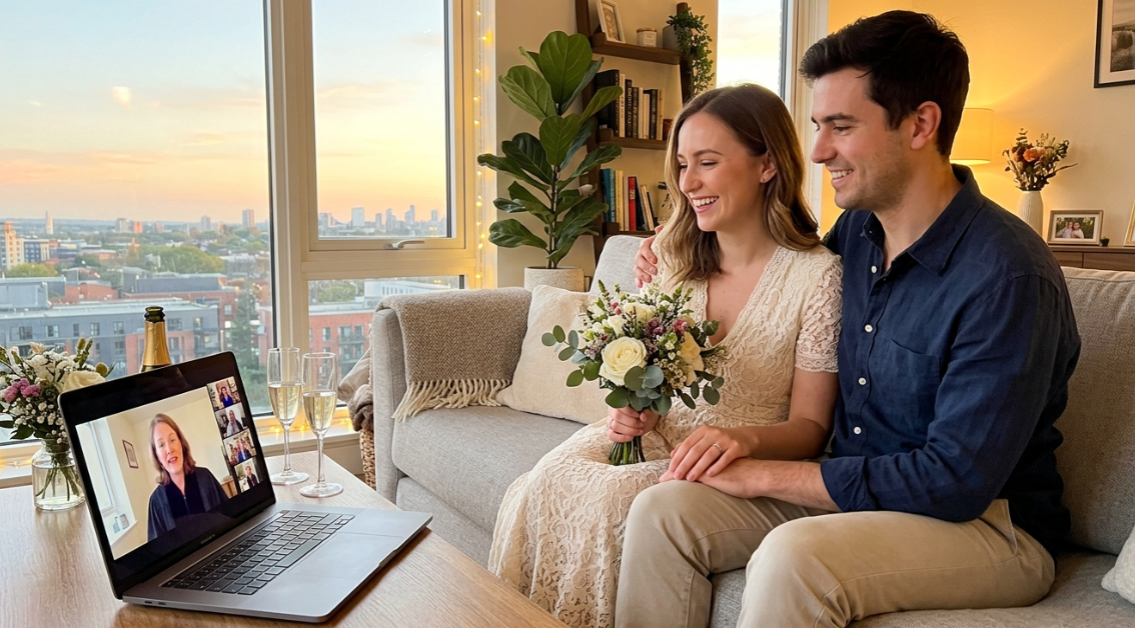
Here is how the process works when using Utah’s remote-appearance framework, which is the most widely used path for online marriages in the United States.
Step 1: Confirm Your Goal and Check Eligibility
Before anything else, know why you need the marriage and where you need it recognized. A Utah online marriage may be valid under U.S. law but require extra documentation or review if used in another country or for immigration. Utah County itself recommends contacting officials or an attorney for jurisdiction-specific recognition questions.
Utah has no residency or citizenship requirements. Anyone from anywhere can apply. That is the legal hook that makes online marriage accessible to international couples, but it also means the couple is responsible for checking whether their home country will accept a remotely performed U.S. marriage.
Step 2: Apply for the Marriage License Online
Utah County’s online application requires each applicant to provide a valid email address, a government-issued photo ID, a smartphone to scan the ID and face, and a debit or credit card for fees. Most applicants pay $71.75, the license expires after 32 days, and there is no waiting period.
Step 3: Send the Digital License to the Officiant
After the license is issued, the couple sends a digital license link or QR code to their officiant through the Utah County system. The officiant later uses that same link to submit the ceremony information and finalize the record.
Step 4: Attend the Live Video Ceremony
For a remote Utah ceremony, the officiant must be physically in Utah. The couple and two witnesses join by video. Utah law requires each party to willingly declare intent, the officiant to pronounce the marriage, and at least two witnesses age 18 or older to be present.
Step 5: Officiant Files the Marriage Record
The officiant finalizes the marriage license through an online submission and affidavit. No ink signatures are required. This digital filing satisfies Utah’s legal requirements.
Step 6: Receive the Marriage Certificate
Utah County says the couple receives a digital certified copy within minutes after the officiant submits the record. A paper certified copy is mailed within the next few business days.
Step 7: Add Apostille or Authentication if Needed
If the marriage certificate will be used outside the United States, the couple may need an apostille or embassy authentication. More on this below.
How Long Does an Online Marriage Take?
The complete process can take anywhere from a few hours to several days depending on appointment availability and whether additional document authentication is required.
Typical timeline:
Online application: 15–30 minutes
License approval: Often same day
Ceremony scheduling: Same day to several days
Ceremony: About 10–20 minutes
Digital certificate: Usually within minutes
Paper certificate: Several business days
Apostille: Several business days to several weeks
If immigration, foreign registration, or embassy authentication is involved, the overall process can take considerably longer.
Is Online Marriage Legal?
Yes. An online marriage can be legally binding when performed under a jurisdiction that authorizes remote marriage. In Utah, the legal foundation is that the license is considered “used in Utah” when the officiant is physically present in Utah at solemnization.
But there is an important distinction that most guides blur. “Legal marriage” and “accepted for your purpose” are not always the same question. Think of it as four separate layers:
Ceremony validity. Was the marriage performed correctly under the authorizing jurisdiction’s law?
Document proof. Did the officiant file correctly, and did you receive a certified certificate?
Foreign or institutional recognition. Will the destination country, employer, bank, or insurer accept it?
Immigration recognition. Will USCIS or the State Department accept it for a visa or green card petition?
A marriage can pass layer one and two while still facing problems at layer three or four. Utah’s 2026 code amendment now requires officiants to warn couples that a remote Utah marriage may be invalid in the country where the parties reside.
For a fuller treatment, see are online weddings legal.
This is not fringe. Online marriage demand is substantial. Utah County issued 7,087 marriage licenses in 2019 and 15,685 in 2022, with up to one-third of applicants presenting IDs issued outside the U.S. According to GovTech, 60 to 70 percent of license processes in 2020 and 2021 were completely remote.
Is Online Marriage Legal in Every Country?
No.
Although a Utah online marriage can be legally valid under U.S. law, each country decides independently whether it recognizes foreign remote marriages.
Some countries:
Fully recognize them
Require local registration
Require apostille
Require embassy authentication
Require certified translation
Do not recognize remote marriages at all
Recognition depends on the country's own family law rather than where the marriage certificate was issued.
Always verify recognition requirements before getting married online.
What Documents Do You Get After an Online Marriage?
Understanding the documents you receive (and what each one actually does) prevents a lot of confusion downstream.
Document | What it is | When you use it |
|---|---|---|
Marriage license | Permission that allows the marriage to be solemnized | Before the ceremony |
Marriage certificate | Proof the marriage was completed and filed | After officiant filing |
Certified copy | Official copy of the completed marriage record | Name change, benefits, legal proof |
Apostille or authentication | Government certificate verifying the document’s origin for foreign use | International registration, foreign institutions |
Letter of validity | Utah County letter explaining remote-appearance ceremonies and their basis under Utah law | Sometimes requested by foreign authorities |
Utah County sends a letter of validity to every couple whose officiant indicates the marriage was held by remote appearance. This letter explains how remote-appearance ceremonies work and their legal basis under Utah marriage law.
What Is an Apostille, and Do You Need One?
This is where many couples get confused, and where many online guides get it wrong.
An apostille is not a second marriage certificate. It is not proof that a foreign country accepts your marriage. It is a government authentication of the document’s origin. Utah’s Authentications Office says apostilles verify the origin of public documents but do not validate the document contents.
You may need an apostille if you plan to register the marriage in another country, apply for a visa abroad, add a spouse to foreign benefits or residency, or present a U.S. certificate to a non-U.S. authority. Documents used only inside the U.S. do not require apostille or authentication.
An important warning: some vendor pages imply that an apostille makes a marriage “recognized worldwide.” That is incorrect. The apostille authenticates where the document came from. Whether the destination country accepts a remotely performed marriage is a separate question governed by that country’s own family law.
Practitioners on Reddit illustrate this well. One user in a 2026 legal-advice thread described a France-recognition problem after a Utah online ceremony, finding that French authorities would not register the marriage despite having an apostilled certificate. Utah County’s own warning about foreign invalidity exists precisely because cases like this happen.
For couples who need help with this step, Courtly offers document legalization services including apostille and embassy authentication.
To understand the difference between these two types of document verification, read apostille vs authentication.
Do Online Marriages Work for Immigration?
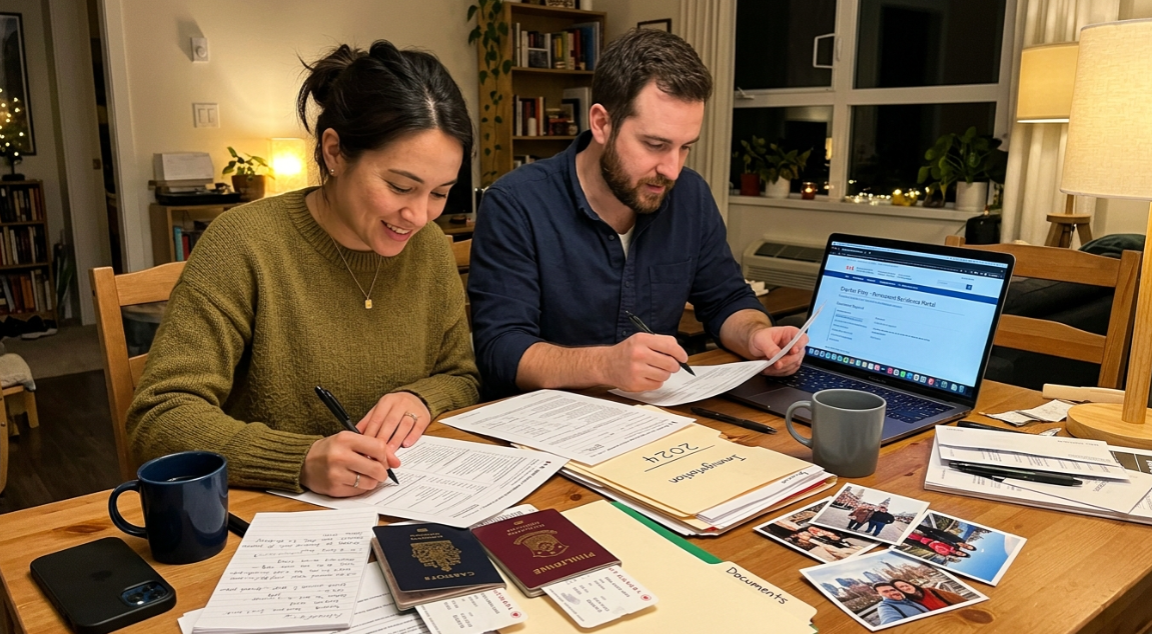
This is the highest-stakes question for many couples researching how online marriage works, and the answer requires care.
Online marriage can be accepted for U.S. immigration, but the marriage must meet immigration-specific rules that go beyond just having a valid certificate. USCIS generally applies the “place-of-celebration” rule: the marriage must be valid where it was celebrated. For a Utah online marriage, that means it needs to be valid under Utah law.
But there is a critical wrinkle. The State Department’s Foreign Affairs Manual says a proxy marriage that has not been subsequently consummated does not confer spouse status for visa purposes. While Utah’s remote-appearance marriage is technically not a traditional proxy marriage (both spouses attend by video, no stand-ins), immigration agencies may still analyze it under rules addressing whether the spouses were physically present together.
USCIS made this more explicit in October 2025 with Policy Alert PA-2025-23, which states that virtual marriage is subject to the same requirements as all spousal cases, including the place-of-celebration rule.
Immigration attorneys on LinkedIn consistently stress this point. One firm’s analysis noted that USCIS recognition of remote marriages requires proving the couple met in person after the marriage before filing. Boundless Immigration similarly distinguishes Utah virtual marriage from proxy marriage but warns that strict USCIS requirements must be met.
On Reddit, immigration-focused users consistently warn that couples should not file an I-130 immediately after a Utah online ceremony if they have not physically met after the wedding. Recent posts discuss I-130 denials and fears following the October 2025 policy update, particularly when both parties were physically outside the United States during the ceremony.
Evidence Checklist for Immigration Cases
If you plan to use an online marriage for U.S. immigration, gather and preserve:
The marriage certificate
Proof all prior marriages ended (if applicable)
Travel records showing a post-ceremony in-person meeting
Passport stamps, boarding passes, flight itineraries
Photos together after the wedding date
Hotel or shared lodging records
Ongoing bona fide marriage evidence: joint finances, insurance, lease, communications, affidavits
Bottom line: If immigration is the reason you are marrying online, consult a qualified immigration attorney before filing. The certificate alone is not enough.
Book a spouse visa consultation if you need guidance on how online marriage fits your immigration situation.
Do Online Marriages Work Internationally?
Not automatically. A country may require apostille, embassy authentication, local registration, certified translation, or may flat-out refuse to recognize a marriage performed remotely. Utah County’s official position is clear: a remote-appearance marriage may be invalid in the country where the parties reside.
Practitioners on Reddit who have gone through this process in countries like the Philippines report that local documentation steps (such as PSA registration or Report of Marriage) can take two to three months, and that apostille alone may not be sufficient without additional local filings. These are anecdotal reports, not legal guarantees, but they highlight a content gap that most guides ignore: country-specific next steps matter enormously.
Before the ceremony, check with the destination country’s embassy or civil registry to confirm whether they accept remote marriages from U.S. jurisdictions. This one step can save months of frustration.
Who Uses Online Marriage?
The people asking how does online marriage work are not a single group. Based on Utah County data and community discussions, the most common use cases include:
International couples who face travel barriers or complex visa situations. Utah County’s own procurement documents show applicants holding IDs from countries including China, the Philippines, Israel, Russia, and Hong Kong.
Long-distance couples who want a legal marriage without one partner having to fly across the world for a courthouse visit.
Same-sex couples, particularly those in countries where local marriage is unavailable or unsafe. Under U.S. immigration rules, a same-sex marriage is valid for visa purposes if it is recognized in the place of celebration, even if the applicant’s home country prohibits it. Learn more about online marriage for LGBTQ couples.
Military couples dealing with deployment timelines, relocation orders, or tight scheduling windows.
Expats who find local bureaucracy slow, expensive, or incompatible with their situation.
Destination wedding couples who want the legal paperwork handled separately so their celebration can happen anywhere, without logistical stress.
Common Mistakes to Avoid
This section is where the article can save you real trouble. These mistakes come directly from government warnings, court filings, practitioner insights, and real user experiences.
Confusing a virtual ceremony with a legal online marriage
Streaming your wedding on Zoom does not create a legal marriage unless the jurisdiction’s license, officiant, witness, and filing requirements are all met. The video platform is irrelevant. The legal framework is everything.
Assuming foreign recognition is automatic
Utah County explicitly warns that remote marriages may be invalid where the parties reside. An apostille does not override this. It authenticates the document’s origin, nothing more.
Filing immigration paperwork too early
Multiple Reddit immigration threads warn against filing a spouse-based petition immediately after a remote wedding if the couple has not met in person afterward. This aligns with USCIS and State Department proxy-marriage rules about consummation and physical presence.
Thinking apostille equals recognition
This is the single most common misunderstanding. An apostille verifies where a document came from. It does not force any foreign government to accept the marriage itself.
Using outdated information
Utah’s marriage law was amended in 2026, and Utah’s authentication process received updates in July 2026. Rules change. Always verify current requirements with official sources before acting.
Ignoring divorce jurisdiction
Utah’s code now requires affidavits consenting to Utah personal jurisdiction for divorce or annulment when one party will not be physically present in Utah at solemnization. This is easy to overlook during the excitement of getting married, but it matters if things go wrong later.
How Courtly Helps
Courtly is an online marriage service that helps couples worldwide complete a fully remote, legally binding U.S. wedding. It manages the Utah County marriage license, certified officiant, optional witnesses, ceremony recording, and U.S. marriage certificate delivery. The company also offers document legalization (apostille or embassy authentication), visa consultation, and a U.S. name-change kit.
Customer support is based in Utah with phone, chat, and email assistance. Packages start at $199 for the Core plan, with the Popular plan at $399 and the Fast-Track plan at $599 (which adds rush processing and two legal witnesses). A government processing fee of approximately $70 is additional. Optional add-ons include two witnesses ($50), live translation ($40), and a U.S. name-change kit ($35).
Courtly does not guarantee recognition in every country or guarantee immigration approval. What it does is handle the operational complexity of the Utah process so you can focus on the parts that matter most to your situation.
Compare online marriage packages to find the right option for your needs.
Frequently Asked Questions
Can you really get married online?
Yes, if the marriage is performed under a jurisdiction that legally authorizes remote marriage. In Utah’s model, the officiant must be physically in Utah while the couple and witnesses join by live video. All of Utah’s standard marriage requirements (valid license, voluntary declarations, officiant pronouncement, two adult witnesses) still apply.
Do both people have to be in the same place?
No. For a Utah remote-appearance ceremony, the couple can be in different locations, even different countries. The officiant must be physically in Utah, but participants join through video-conferencing software.
Do witnesses need to be physically present?
For Utah remote-appearance ceremonies, witnesses can participate by live video. They must be able to see, hear, and be seen and heard during the ceremony. Utah law requires at least two witnesses age 18 or older.
Is an online marriage valid in all 50 U.S. states?
A marriage validly performed in one U.S. state is generally treated as valid in other states. However, blanket guarantees are not possible because edge cases involving age, prohibited relationships, fraud, or specific immigration rules can create exceptions.
Is an online marriage valid outside the U.S.?
Not automatically. A country may require apostille, embassy authentication, local registration, or translation. Some countries do not recognize remote marriages at all. Always check with the destination country’s authorities before the ceremony.
Can you use an online marriage for a U.S. green card?
Possibly, but USCIS has separate rules. The marriage must be valid under the place-of-celebration rule, and remote marriage situations may require proof of post-ceremony consummation. Couples must also prove the marriage is bona fide. Consult an immigration attorney before filing.
How fast do you get the marriage certificate?
Utah County provides a digital certified copy within minutes after the officiant submits the marriage record. A paper certified copy is mailed within the next few business days.
Is online marriage the same as proxy marriage?
Not exactly. In a traditional proxy marriage, a stand-in may represent one absent party. In a Utah online marriage, both partners attend by video. However, U.S. immigration agencies may still analyze remote marriages under rules addressing whether the spouses were physically present together or later consummated the marriage. The distinction matters most for immigration filings.
Let us handle the paperwork.
Getting married is complicated. Courtly simplifies the process and provides everything necessary to get married online, including providing a licensed officiant who can perform a remote ceremony.
Get Married

Get married online.
Getting married is complicated. Courtly simplifies the process and provides everything necessary to get married online.

