

Couples who live in different countries may be able to marry remotely through a jurisdiction that legally permits remote marriage ceremonies. Utah is one of the clearest U.S. examples: Utah County allows couples to apply for a digital marriage license and participate in a remote ceremony while the officiant is physically located in Utah. Neither applicant needs to be a U.S. citizen or Utah resident.
However, three separate questions must be answered before relying on an online marriage: Is the marriage valid under the law where it was performed? Will the couple's home country recognize it? And, if U.S. immigration is involved, will USCIS recognize it for immigration purposes?
A Utah marriage certificate can be used for international purposes with additional document authentication or an apostille where applicable, but an apostille authenticates the document rather than guaranteeing that the destination country will recognize the marriage. The Hague Apostille Convention had 130 contracting parties as of June 30, 2026.
For U.S. immigration, a marriage conducted when the spouses were not physically together can trigger the federal rule concerning proxy marriages. USCIS guidance states that a marriage in which the parties were not physically present together at the ceremony is not treated as a qualifying marriage for immigration purposes unless the marriage is consummated afterward.
Quick Answer: Can Couples in Different Countries Get Married Online?
Yes, in some circumstances. A couple living in different countries can legally marry online if the jurisdiction conducting the marriage allows remote solemnization and the ceremony satisfies that jurisdiction's legal requirements. Utah is a prominent example: Utah County permits remote marriage ceremonies when the officiant is physically located in Utah, while the couple and witnesses participate by video.
But a legally valid Utah marriage is not automatically recognized everywhere. Couples should separately verify:
1. Validity: Was the marriage legally performed under Utah law?
2. Recognition: Will each country where the spouses live recognize the foreign marriage?
3. Documentation: Does the destination country require a certified marriage certificate, apostille, authentication, translation, or registration?
4. Immigration: If the marriage will be used for U.S. immigration, does the federal proxy-marriage rule require the spouses to meet and consummate the marriage before filing?
The safest approach is to confirm recognition with the relevant civil registry, embassy, consulate, or qualified family-law or immigration attorney before relying on the marriage for immigration, residency, benefits, or civil-status purposes.
The Three Legal Questions Every International Couple Must Answer
An online marriage can be legally valid in one jurisdiction while creating recognition or immigration problems somewhere else. Before proceeding, separate these three questions.
1. Is the marriage legally valid where it was performed?
First, determine whether the jurisdiction conducting the ceremony recognizes remote solemnization and whether the couple complied with its requirements.
For a Utah remote marriage, the officiant must be physically present in Utah. The couple and two adult witnesses can participate remotely, and the participants must be able to see and hear one another during the ceremony.
2. Will the couple's home country recognize the marriage?
This is a separate legal question. A foreign government may recognize a marriage performed abroad, require additional documents, require local registration, or refuse recognition because its own marriage laws require physical presence or impose other conditions.
An apostille does not answer this question. It authenticates the origin of a public document; it does not guarantee that the receiving country accepts the underlying marriage.
3. Will U.S. immigration authorities recognize the marriage?
U.S. immigration law adds another layer. USCIS guidance addresses marriages where the spouses were not physically present together at the ceremony and provides that such a marriage must be consummated afterward to qualify for immigration purposes.
Therefore, a couple should never assume that "legally married" automatically means "recognized for every purpose."
How Online Marriage Works for Couples in Different Countries
Utah County's current system allows eligible couples to complete the marriage-license application digitally and participate in a remote ceremony. The applicants do not have to be Utah residents or U.S. citizens.
Step 1: Apply for the digital marriage license
Each applicant completes their portion of the online application, verifies their identity using government-issued identification and a smartphone, signs the required affidavits, and pays the applicable fees. The couple can complete the application from different devices and locations.
Step 2: Provide an authorized officiant
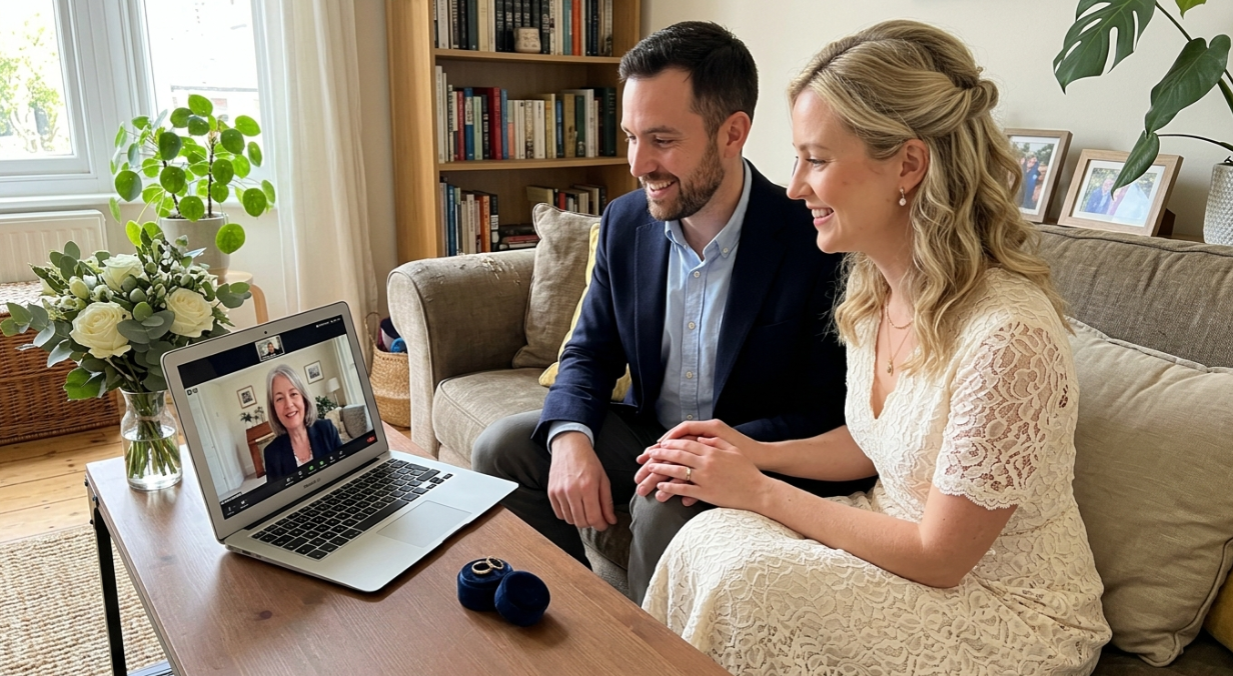
The ceremony must be performed by an authorized officiant who is physically present in Utah. The officiant's physical location establishes the jurisdiction for the remote ceremony.
Step 3: Attend the ceremony by video
The couple and two witnesses participate through video. Utah County requires the officiant, couple, and witnesses to be able to see and hear one another during the ceremony. The witnesses must be at least 18 years old.
Step 4: Complete the marriage record
After the ceremony, the officiant submits the required information electronically. Utah County says couples can receive a digital marriage certificate within minutes after the officiant completes the submission, with physical-document delivery handled separately.
Step 5: Determine whether the certificate can be used abroad
Before using the certificate for immigration, civil registration, name changes, benefits, or other official purposes, determine whether the destination country requires an apostille, authentication, translation, local registration, or additional evidence of validity.
Step 6: Address U.S. immigration requirements if applicable
If the marriage will support a U.S. immigration petition and the spouses were not physically together during the ceremony, additional requirements may apply under the federal rules concerning proxy marriages.
Online Marriage (Virtual Marriage / Zoom Wedding)
Definition: A legally binding civil marriage ceremony conducted via live video, where both partners participate in real time but may be in separate locations.
This is not a symbolic Zoom ceremony where you “pretend” to get married for friends and family. An online marriage carries the same legal weight as an in-person courthouse wedding. Both partners appear on video before a licensed officiant, exchange vows, and the marriage is registered with the county, producing an official marriage certificate.
The United States is currently the only country that has fully legalized online marriages where each spouse can be in a different location during the ceremony. Utah is the dominant jurisdiction for this. While other states like Arizona, California, Florida, Illinois, and Texas allow online officiation, Utah is the only state where both parties can appear fully remotely without either one needing to be physically present in the state.
This distinction matters enormously for couples in different countries, because it means neither partner needs a U.S. visa, a plane ticket, or a passport stamp to get legally married.
Remote Appearance / Remote Solemnization
Definition: “Solemnization” is the formal performance of a marriage ceremony before witnesses. “Remote appearance” means one or both parties participate from a distance, typically via video, rather than being physically present with the officiant.
Under Utah law, a marriage license is considered used within the state as long as the officiant is physically present in Utah at the time of solemnization. The couple can be anywhere in the world.
What Changed for Utah Online Marriages in 2026?
Utah's 2026 legislation changed the disclosure requirements surrounding remote-appearance marriages rather than eliminating Utah's remote marriage system.
Utah County's current guidance states that an officiant conducting a remote-appearance ceremony must give the couple a warning that a marriage solemnized through online remote appearance may be invalid in the country where the parties reside. The same warning is published by the county as part of its remote-marriage guidance.
The practical takeaway is important: Utah still permits remote-appearance marriage ceremonies, but couples are expressly warned that legal validity in Utah does not guarantee recognition in their home country.
Couples should therefore treat foreign recognition as a separate legal research step rather than assuming that an official Utah marriage certificate will automatically be accepted abroad.
For a deeper look at what Utah requires, see this guide to online marriage requirements.
Proxy Marriage
Definition: A marriage where one or both partners are physically absent and represented by a stand-in (a “proxy”) who gives consent on their behalf.
This is fundamentally different from an online marriage. In a proxy marriage, you are not there, not even by video. Someone else literally stands in your place. In an online marriage, both partners are present and participating live, just through a screen instead of in the same room.
The distinction has serious immigration consequences. USCIS does not recognize proxy marriages as valid for immigration purposes unless the marriage has been consummated afterward. Here’s the critical nuance that trips up many couples: when both spouses are in different physical locations during an online ceremony, USCIS treats it similarly to a proxy marriage. The marriage is valid under state law, but for immigration filing purposes, the couple must meet in person and consummate the marriage before it qualifies.
If both partners happen to be in the same physical location during the online ceremony (say, sitting together on the same couch), the marriage is immediately valid for immigration purposes with no consummation requirement.
Practitioners on Reddit and immigration forums regularly flag this distinction as the single most misunderstood aspect of online marriage for international couples. A detailed comparison is available in this resource on proxy marriage vs. virtual marriage.
Transnational / International Marriage
Definition: A marriage between two people from different countries or nationalities.
Transnational marriages are nothing new. What’s new is that cross-border couples can now marry remotely through U.S. law without either partner traveling. This has opened doors for couples separated by visa delays, military deployment, financial constraints, or laws in their home countries that prohibit their union (particularly same-sex couples in countries where such marriages are illegal).
Since 2021, around 200 Chinese and Hong Kong couples have married through virtual weddings hosted in Utah, many of them same-sex couples who cannot legally wed in their home countries.
Marriage License (Online)
Definition: A government-issued document that authorizes a couple to get married. It is obtained before the ceremony and is a prerequisite to a legal marriage.
A legal marriage involves three distinct stages: obtaining a marriage license, participating in a wedding ceremony, and officially registering the marriage with the county. The license is step one.
Utah does not require residency or U.S. citizenship to obtain a marriage license. This is a key reason Utah has become the go-to jurisdiction for online marriage couples in different countries. The government fee for a Utah County marriage license is approximately $70.
After the ceremony, the officiant and witnesses sign the license, and it gets filed with the county. Only then does it become a marriage certificate. For details on how this process works online, see the online marriage license page.
Marriage Certificate
Definition: The official government-issued document proving that a marriage has taken place and been registered.
Don’t confuse the certificate with the license. The license gives you permission to marry. The certificate is proof that you did. After an online ceremony, couples typically receive a digital copy quickly, with the physical copy mailed afterward.
One important detail: the marriage certificate does not indicate that the ceremony was virtual. It looks identical to any other Utah marriage certificate. This matters because some couples worry that a foreign government might reject the document on sight. The certificate itself gives no indication of how the ceremony was conducted.
Apostille
Definition: An official certification that verifies a document’s authenticity for use in countries that are members of the Hague Apostille Convention.
When you need to use your U.S. marriage certificate in another country (to register the marriage locally, change your name, apply for benefits, or file for immigration), that country’s government needs assurance the document is real. An apostille provides that assurance.
The Hague Convention of 1961 established the apostille process, and as of 2025, it has approximately 128 member countries. Notable recent additions include Canada (joined January 11, 2024) and China (joined November 7, 2023).
If your partner’s country is a Hague member, the apostille process is relatively straightforward. You can learn more about apostilles and how they work or explore Courtly’s document legalization options, which include both standard and expedited apostille services.
Authentication / Embassy Legalization
Definition: The alternative document verification process for countries that are not members of the Hague Apostille Convention.
For non-Hague countries, the process is longer and more expensive. It involves three steps:
State authentication: The Secretary of State in the issuing state verifies the document.
Federal authentication: The U.S. Department of State Office of Authentications adds its verification.
Embassy legalization: You present the authenticated document to the embassy or consulate of the destination country, which adds its own stamp of approval.
This can take weeks and cost significantly more than an apostille. Couples planning to use their marriage certificate in a non-Hague country should budget extra time and money. A clear breakdown of the differences is available in this guide on apostille vs. authentication.
Marriage Recognition (International)
Definition: Whether a foreign government accepts a marriage performed in another jurisdiction as legally valid within its own borders.
This is the hardest question for online marriage couples in different countries to answer, and the most honest response is: it depends entirely on the country. A U.S. online marriage can be fully valid under Utah state law and still face problems abroad.
Will Other Countries Recognize a Utah Online Marriage?
Not automatically.
A Utah marriage certificate proves that Utah recorded the marriage, but it does not guarantee that another country will treat the marriage as valid for every legal purpose.
Recognition can depend on:
The law of the country where each spouse lives
Each spouse's nationality
Whether the country's law requires physical presence at the ceremony
Whether the marriage is valid under the law of the place of celebration
Whether the marriage conflicts with local public policy
Whether the couple needs the marriage for immigration, civil registration, benefits, taxes, inheritance, or another purpose
Whether additional authentication, apostille, translation, or registration is required
Why recognition is separate from validity
A marriage can be valid under Utah law while another government questions whether its own laws permit recognition of a remotely performed foreign marriage.
This is why Utah County itself warns couples that a marriage solemnized through online remote appearance may be invalid in the country where the parties reside.
How to check recognition before marrying
Before scheduling the ceremony, contact the relevant government authority in the country where you intend to use the marriage.
Ask specifically:
Does your country recognize marriages legally celebrated in Utah?
Does your country recognize a marriage where both spouses participated remotely?
Does your country require the spouses to have been physically present together?
Is an apostille required?
Is a certified translation required?
Must the foreign marriage be registered locally?
Are there additional requirements based on nationality, sex, residency, or immigration status?
Whenever possible, obtain the answer in writing from the relevant government authority or obtain advice from a qualified local attorney.
The Israel Precedent
On the positive side, an Israeli court ruled that Utah online marriages are valid, a significant milestone. Hundreds of Israeli couples, including same-sex partners who cannot marry under Israel’s religious marriage system, have married over Zoom from Utah and had those marriages recognized at home. This remains arguably the strongest international precedent for recognition of online marriages.
For country-specific guidance, Courtly maintains a country recognition guide covering over 150 countries.
Consummation and U.S. Immigration: What Couples Need to Know

For U.S. immigration purposes, the key issue is whether the spouses were physically present together at the marriage ceremony.
Federal immigration law provides that a spouse relationship does not qualify for immigration purposes when the contracting parties were not physically present together at the ceremony unless the marriage was subsequently consummated. USCIS guidance specifically addresses this rule for proxy marriages.
For couples who married remotely while living in different countries, this means the legal analysis should not stop at obtaining a Utah marriage certificate. Couples pursuing a U.S. spouse-based immigration benefit should determine whether their circumstances satisfy the federal requirements before filing.
Evidence of a subsequent physical meeting may be relevant to demonstrating that the requirement was satisfied. Depending on the circumstances, records may include travel documentation, photographs, accommodation records, or other evidence showing that the spouses were physically together after the ceremony.
Because immigration consequences can be significant, couples with unusual circumstances should obtain individualized advice from a qualified U.S. immigration attorney.
For a thorough walkthrough of what consummation means and how to document it, see the consummation and immigration guide.
CR-1 / IR-1 Visa (Spouse Visa)
Definition: U.S. immigrant visas that allow the spouse of a U.S. citizen to enter the country as a permanent resident.
The CR-1 (Conditional Resident) visa is issued to spouses who have been married for less than two years. Spouses married for longer than two years receive the IR-1 (Immediate Relative) visa, which grants full permanent residency without conditions.
After marrying online and meeting the consummation requirement, a U.S. citizen files Form I-130 (Petition for Alien Relative) to begin the spouse visa process. This is a different path than the K-1 fiancé visa, and the distinction matters.
Couples who need immigration guidance after their online marriage can explore a spouse visa consultation with partner attorneys.
K-1 Fiancé(e) Visa
Definition: A nonimmigrant visa that allows the foreign fiancé(e) of a U.S. citizen to enter the United States for the purpose of getting married within 90 days.
The K-1 is the alternative path for cross-border couples, but here’s the critical fork in the road: if you marry online, you can no longer use the K-1 route. The K-1 is only available to unmarried couples. Once a legally recognized marriage exists, the couple must use the CR-1/IR-1 spouse visa pathway instead.
This isn’t necessarily a disadvantage. Many couples on Reddit and immigration forums report that the CR-1 path, while sometimes taking longer to process, results in the foreign spouse arriving with permanent resident status rather than the conditional status and additional paperwork that follows a K-1 entry. The comparison between these two paths is covered in detail in the K-1 vs. CR-1 guide.
What an Online Marriage Does Not Automatically Mean
Getting married online does not automatically mean:
Your home country will recognize the marriage.
You can use the certificate without an apostille or authentication.
You can skip local marriage registration requirements.
USCIS will automatically accept the marriage for immigration.
You can immediately file a U.S. spouse petition without considering the proxy-marriage rule.
Your country will treat the marriage the same way it treats a marriage performed in person.
An apostille guarantees recognition.
A commercial marriage service can guarantee recognition in every country.
The marriage's legal validity, documentary authentication, foreign recognition, and immigration treatment are separate questions.
How to Check Whether Your Country Recognizes a Utah Online Marriage
Before marrying online, search for the rules that apply to the specific country and purpose.
Use this checklist:
For civil registration
Ask the country's civil registry whether it accepts a foreign marriage certificate from Utah and whether remote solemnization creates an additional recognition issue.
For immigration
Ask the immigration authority whether a Utah remote marriage qualifies as a valid marriage for the specific visa or residence application.
For document legalization
Check whether the country uses the Hague Apostille Convention or requires authentication and embassy/consular legalization instead.
For translation
Confirm whether the marriage certificate must be translated by a certified or authorized translator.
For name changes
Determine whether the marriage certificate can be used directly to change the spouse's surname or whether a separate local procedure is required.
For same-sex couples
Check recognition separately. Marriage recognition rules can differ substantially depending on the destination country's laws and public policy.
Best practice
Do not rely solely on a wedding service provider's statement that a marriage is "recognized worldwide." Ask the government authority that will actually receive the document.
Putting It All Together: The Typical Process for Couples in Different Countries
Understanding these terms in isolation is useful, but here’s how they typically connect in practice:
Two partners in different countries decide to marry online through Utah.
They apply for an online marriage license (no residency or citizenship required).
A licensed officiant in Utah conducts the ceremony via video (remote solemnization).
Both partners participate live, making this an online marriage, not a proxy marriage.
The county issues a marriage certificate.
The couple obtains an apostille (Hague country) or goes through authentication and embassy legalization (non-Hague country) to use the certificate abroad.
They check their home country’s rules on international marriage recognition.
If pursuing U.S. immigration, they meet in person to satisfy the consummation requirement, then file for a CR-1 or IR-1 visa.
Each step involves terms defined above. Knowing them ahead of time prevents costly surprises and delays.
Ready to begin the process? See current plans and pricing to understand what’s included at each tier.
Frequently Asked Questions
Can two foreigners (neither one a U.S. citizen) get married online in the U.S.?
Yes. Utah does not require either partner to be a U.S. citizen or resident. Two foreign nationals living in different countries can marry online through Utah and receive a valid U.S. marriage certificate. Recognition of that certificate in their home countries will depend on each country’s rules.
Do I need a U.S. visa to get married online?
No. Because the ceremony happens via video and neither partner needs to be physically present in the United States, no visa is required. The officiant is in Utah, and both partners can participate from wherever they are.
Will my home country recognize an online marriage from Utah?
It depends on the country. Some countries, like Israel, have court rulings affirming the validity of Utah online marriages. Others, including Germany, France, Australia, and Norway, have historically not accepted them due to physical-presence requirements. Always check with your country’s civil registry or a local attorney before assuming recognition.
What’s the difference between an apostille and authentication?
An apostille is a single certification for countries that are members of the Hague Convention (about 128 countries as of 2025). Authentication is a multi-step process for non-member countries, involving state verification, federal verification, and embassy legalization. Apostilles are faster and cheaper.
Is an online marriage valid for U.S. immigration?
Yes, but with conditions. If both spouses were in different locations during the ceremony, USCIS requires evidence of consummation (a physical meeting after the wedding) before the marriage qualifies for immigration benefits like the CR-1 spouse visa. If both spouses were in the same location during the ceremony, no consummation evidence is needed.
Can same-sex couples use online marriage to marry legally?
Yes. Same-sex marriage has been legal in Utah since 2014, and Utah’s online marriage framework applies equally to all couples regardless of gender. This has made Utah a popular virtual venue for LGBTQ+ couples in countries where same-sex marriage is not recognized, though the marriage may not be accepted by their home country’s government.
What does the 2026 Utah law (SB 257) change?
SB 257, effective May 6, 2026, requires officiants to verbally warn couples that their online marriage may not be valid in the country where they live. It does not restrict who can marry or eliminate remote marriages. It’s a disclosure requirement, not a prohibition.
How long does the entire online marriage process take?
Timelines vary. Some couples complete the process within days, while others take a few weeks depending on license approval speed and whether they need add-ons like apostilles. Rush processing options are available for couples on tight deadlines.
Let us handle the paperwork.
Getting married is complicated. Courtly simplifies the process and provides everything necessary to get married online, including providing a licensed officiant who can perform a remote ceremony.
Get Married

Get married online.
Getting married is complicated. Courtly simplifies the process and provides everything necessary to get married online.

