

TL;DR
A proxy marriage uses a stand-in to replace one or both partners at the ceremony, while a virtual marriage has both partners attending live via video. For U.S. immigration, proxy marriages must be consummated after the ceremony before filing an I-130 petition. Virtual marriages performed in Utah generally avoid this requirement, though USCIS still demands proof of a genuine relationship. Choosing the wrong type, or misunderstanding the consummation rule, can derail your entire visa case.
The terms “proxy marriage” and “virtual marriage” get tossed around interchangeably in immigration forums, blog posts, and even some attorney websites. That’s a problem. Under U.S. immigration law, these are two distinct things, and the difference between them can determine whether USCIS approves or denies your spouse visa petition.
This guide breaks down exactly what each term means, how USCIS treats them, what the October 2025 policy update changed, and which visa path makes sense after each type of ceremony. If you’re considering an online marriage for immigration, the distinctions here matter more than almost anything else in your case.
Quick Answer: Proxy Marriage vs. Virtual Marriage for Immigration
If you're pursuing a U.S. marriage-based green card, a virtual marriage is usually the safer option.
The biggest difference is that a proxy marriage uses a stand-in to represent one or both spouses during the ceremony, while a virtual marriage requires both spouses to participate personally through live video.
For immigration purposes:
- Proxy marriages must be consummated after the ceremony before filing Form I-130.
- Utah virtual marriages are generally recognized without the consummation requirement.
- Couples who marry virtually should still meet in person before filing because USCIS officers may request additional evidence.
Bottom line:
If immigration is your primary goal, meet in person after any remote wedding ceremony and document the visit thoroughly.
What Is a Proxy Marriage?
A proxy marriage is a ceremony where one or both of the parties are not physically present. Instead, a stand-in (the “proxy”) takes their place during the ceremony and acts on their behalf.
When only one partner is absent, it’s called a single proxy marriage. When both are absent and represented by stand-ins, it’s a double proxy marriage.
Who uses proxy marriages?
Primarily military service members deployed overseas, incarcerated individuals, and people who cannot travel due to visa restrictions or health issues. The practice has deep historical roots. It was common during World War II and remains legally valid in several U.S. states.
States that allow proxy marriages
State | Type Allowed | Who Qualifies |
|---|---|---|
Montana | Single and double proxy | Active-duty military or Montana residents |
Colorado | Single proxy only | Active-duty military or government contractors abroad |
Texas | Single proxy only | Active-duty military stationed abroad in combat support |
California | Single proxy only | Narrow military circumstances |
Kansas | Single proxy only | Most flexible (based on AG opinion, not limited to military) |
Montana is the only state that permits double proxy marriage. Costs typically run $500 to $750, and the process takes days to a few weeks depending on the state.
For a deeper comparison of proxy, online, and virtual wedding types, see this guide on proxy weddings and virtual weddings.
What Is a Virtual Marriage?
A virtual marriage (also called an online marriage or Zoom wedding) is a ceremony where both partners personally attend in real time via video. No stand-in is involved. Both people speak their vows, answer the officiant’s questions, and participate directly, just from different physical locations.
As of 2025, Utah is the only U.S. state that allows a fully virtual wedding ceremony where both partners can appear remotely. The officiant must be physically located in Utah at the time of the ceremony, but neither partner needs to be a Utah resident or even present in the United States.
How the Utah process works
A couple applies for a Utah County marriage license online.
A certified officiant conducts the ceremony via video call.
Two witnesses attend (either the couple’s own or provided by the service).
The marriage certificate is issued by Utah County.
The whole process can happen in as little as a few days. You can learn more about the online marriage license process and what’s involved.
The key legal point: because both parties are present (via video) and participate directly, Utah law considers this a standard marriage, not a proxy marriage.
Proxy Marriage vs. Virtual Marriage: Side-by-Side Comparison
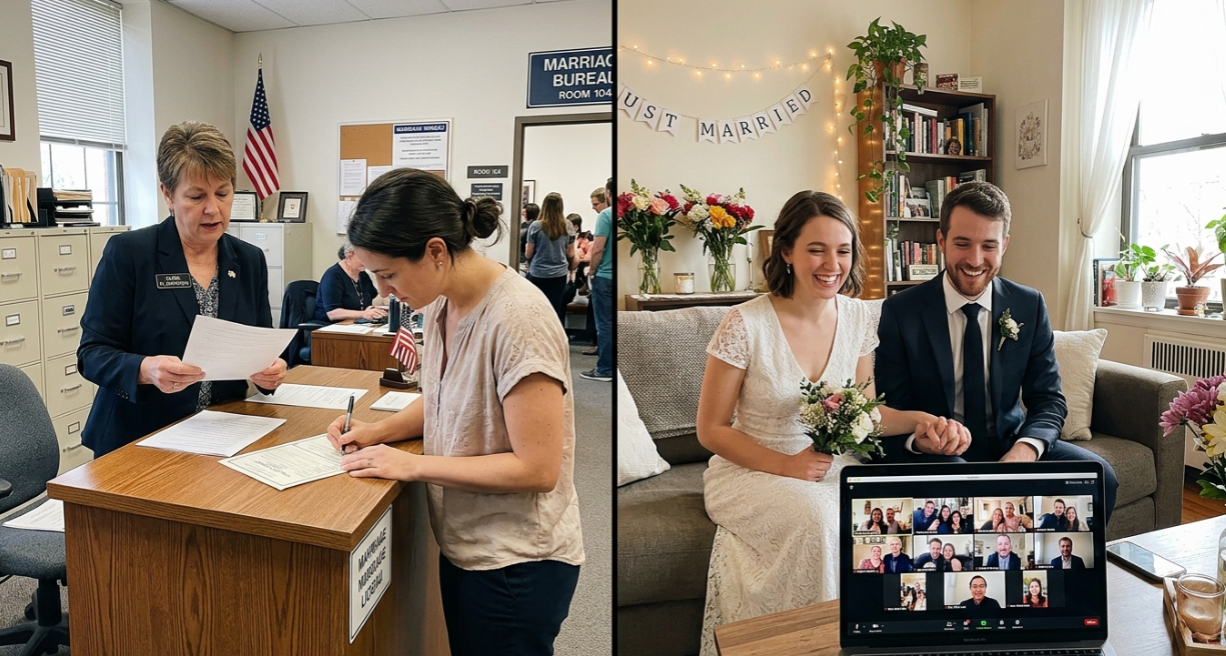
This table captures the differences that matter most for immigration purposes.
Factor | Proxy Marriage | Virtual Marriage (Utah) |
|---|---|---|
Who’s “present” | A stand-in replaces one or both parties | Both parties attend live via video |
States available | MT, CO, TX, CA, KS (with restrictions) | Utah only |
Consummation required for USCIS | Yes, must consummate after ceremony and before filing I-130 | Technically no (not classified as proxy), but strongly recommended |
USCIS scrutiny level | Higher, extra suspicion per USCIS guidance | Moderate, must still prove bona fide relationship |
Can file K-1 if unconsummated | Yes, treated as fiancé(e) | No, you’re legally married so K-1 is unavailable |
Typical cost | $500–$750 | $199–$599+ depending on plan |
Speed | Days to weeks | Same-day to same-week possible |
Common users | Deployed military, incarcerated persons | Cross-border couples, same-sex couples, immigration couples |
The consummation requirement is the single biggest practical difference between proxy marriage vs. virtual marriage immigration outcomes. Everything else flows from it.
Which Marriage Option Is Right for You?
Your situation | Recommended option |
|---|---|
You're deployed in the military | Proxy marriage |
You cannot physically attend the ceremony | Proxy marriage |
You're in different countries | Utah virtual marriage |
You plan to file an I-130 | Utah virtual marriage |
You want to file a K-1 | Unconsummated proxy marriage |
Immigration is your only concern | Virtual marriage followed by an in-person visit |
How USCIS Treats Each Marriage Type
The statute that controls everything: INA § 101(a)(35)
The Immigration and Nationality Act defines “spouse” in a way that creates a specific carve-out for proxy marriages. The statute reads: “The term ‘spouse’, ‘wife’, or ‘husband’ does not include a spouse, wife, or husband by reason of any marriage ceremony where the contracting parties thereto are not physically present in the presence of each other, unless the marriage shall have been consummated.”
In plain English: if you weren’t physically in the same room as your spouse during the ceremony, USCIS won’t consider you legally married for immigration purposes unless you’ve consummated the marriage afterward.
For proxy marriages, this is straightforward. You used a stand-in, you weren’t physically present, so you must consummate before filing.
For virtual marriages, the question is more complex.
The “place of celebration” rule
USCIS follows the place-of-celebration rule: a marriage is valid for immigration purposes if it was legally valid in the jurisdiction where it was performed. Since Utah law recognizes virtual ceremonies as valid marriages (not proxy marriages), USCIS generally accepts them as standard marriages.
This means a Utah virtual marriage should not trigger the consummation requirement under INA § 101(a)(35). The couple was “present,” just via video.
The October 2025 policy update: PA-2025-23
In October 2025, USCIS issued policy alert PA-2025-23, updating guidance on spousal relationships for family-based immigrant visa petitions. The key points:
USCIS now explicitly addresses virtual marriages alongside proxy marriages in its policy manual.
Virtual or proxy marriages must meet the same legal standards as in-person marriages.
The place-of-celebration rule applies equally to virtual and same-sex marriages.
Even if a state doesn’t recognize virtual marriages, that doesn’t affect validity as long as the marriage was lawfully celebrated in a jurisdiction that does (like Utah).
This update matters because it represents USCIS formally acknowledging virtual marriages as a category, rather than leaving immigration officers to figure it out case by case.
The expert dissent: could a virtual marriage still be treated as proxy?
Not everyone agrees that virtual marriages escape the consummation requirement. Immigration attorney Adam Chodorow argues on his legal blog that any virtual marriage is a proxy marriage under INA § 101(a)(35) because the parties are “not physically present in the presence of each other” during the ceremony. Under this reading, even a Utah Zoom wedding would require post-ceremony consummation.
This is a minority legal position, but it’s not frivolous. Some immigration officers may share this interpretation. Couples should prepare for the possibility that their virtual marriage gets treated as a proxy marriage during adjudication.
Understanding whether online marriages are recognized by immigration authorities is essential background reading here.
What Evidence Does USCIS Accept?
For proxy marriages (proving consummation)
Consummation must happen after the ceremony and before you file the I-130. Prior sexual relations don’t count, even if you have children together from before the marriage. This trips people up constantly.
Passport stamps or airline tickets showing both partners were in the same location after the ceremony
A birth certificate of a child born to the couple after the ceremony
Evidence of cohabitation after the ceremony (lease, utility bills, hotel receipts)
A signed affirmation of consummation
Definitive proof isn’t strictly required. Evidence that the couple was physically together after the marriage, combined with an affirmation, is generally considered sufficient.
For virtual marriages (proving bona fide relationship)
If your virtual marriage is accepted as a standard marriage (not proxy), you don’t need to prove consummation specifically. But you absolutely must prove the marriage is genuine. Standard bona fide evidence includes:
Communication records (messages, call logs, video chat history)
Photos together over time
Joint financial accounts or shared expenses
Travel records showing visits
The ceremony recording itself
Affidavits from friends and family who know the relationship
If you need to get your marriage certificate ready for foreign use, consider document legalization options including apostille or embassy authentication.
The universal practical advice
Regardless of whether you had a proxy or virtual marriage, meet in person after the ceremony and document it thoroughly. Practitioners on Reddit and VisaJourney forums consistently recommend this. One VisaJourney user shared their experience of having a Utah Zoom wedding and then waiting to meet their spouse in person before filing the CR-1, specifically to satisfy any potential consummation concerns. On r/immigration, users who filed I-130 petitions after Utah online marriages report positive outcomes but stress the importance of in-person documentation.
An immigration lawyer responding to a question on JustAnswer put it bluntly: “An online marriage will be recognized by USCIS if it is legally recognized in the place where it occurs AND if you have consummated the marriage afterwards. In other words, you would have to meet in person at least once after the wedding before you could apply for a green card based on the marriage.”
Even if the law doesn’t technically require it for virtual marriages, doing it eliminates the risk entirely.
Common USCIS RFEs After Proxy and Virtual Marriages
USCIS may issue a Request for Evidence (RFE) if it needs additional proof that your marriage qualifies for immigration benefits.
Common requests include:
Proxy marriage RFEs
Evidence of post-marriage consummation
Proof that the marriage was legally valid
Documentation showing both spouses met after the ceremony
Virtual marriage RFEs
Evidence that the ceremony complied with Utah law
Proof that both spouses participated in the ceremony
Additional evidence establishing a bona fide relationship
Immigration Evidence Checklist
After a Proxy Marriage
Before filing Form I-130, collect:
Marriage certificate
Passport stamps
Airline tickets
Hotel receipts
Photos together after the ceremony
A signed consummation statement
Shared financial records
After a Virtual Marriage
Collect:
Marriage certificate
Video ceremony recording
Screenshots from the ceremony
Travel records
Photos together
Communication records
Joint financial documents
Affidavits from friends and family
Immigration Timeline After a Remote Marriage
Step | Proxy marriage | Virtual marriage |
|---|---|---|
Wedding ceremony | ✓ | ✓ |
Meet in person | Required | Strongly recommended |
Consummation | Required | Recommended |
File I-130 | After consummation | After gathering evidence |
USCIS review | Higher scrutiny | Standard scrutiny |
Green card process | CR-1/IR-1 | CR-1/IR-1 |
Visa Paths After a Proxy or Virtual Marriage
The type of marriage you have, and whether you’ve consummated it, determines which visa route is available.
CR-1/IR-1 spouse visa (consummated marriage)
If your proxy marriage has been consummated, or if your virtual marriage is accepted as valid, you file Form I-130 to petition for your spouse. This leads to the CR-1 visa (if married less than two years) or IR-1 visa (if married two or more years). The spouse enters the U.S. as a lawful permanent resident.
Recent USCIS data shows the CR-1 visa takes approximately 14.5 months to process. The average denial rate sits around 8–9%, significantly lower than the K-1.
For couples navigating this process, Courtly offers a spouse visa consultation with partner attorneys at a low cost.
K-1 fiancé visa (unconsummated proxy marriage)
Here’s a nuance most people miss. If you have a proxy marriage that hasn’t been consummated, USCIS doesn’t recognize you as “spouses” under INA § 101(a)(35). But you aren’t stuck. You can file for a K-1 fiancé visa instead.
An unconsummated proxy marriage essentially reverts you to fiancé(e) status for immigration purposes. You’d file Form I-129F, your partner enters on the K-1, and you marry again (or consummate and adjust) within 90 days of arrival.
The K-1 currently processes in about 6.4 months, faster than the CR-1. But the denial rate is roughly 25%, nearly three times higher.
Why this matters for virtual marriages
If you had a Utah virtual marriage, you are legally married. Period. You cannot file for a K-1 visa because that’s reserved for unmarried fiancé(e)s. Your only spouse-visa path is the I-130/CR-1 route. This means if USCIS somehow challenges your virtual marriage’s validity, you could find yourself in limbo: married under state law but unable to use the marriage for immigration, and ineligible for the K-1.
This is why the “meet in person and consummate” advice is so important for virtual marriage couples. It’s insurance against the worst-case interpretation.
Common Mistakes and Misconceptions
“Virtual marriage isn’t legal.” Wrong. Utah virtual marriages are legally valid under Utah law and recognized by USCIS under the place-of-celebration rule. Some lawyers have incorrectly stated that online marriages are scams or invalid. That advice is outdated. For more on this, see are online weddings even legal.
“Having children together proves consummation.” Wrong, if those children were born before the marriage. USCIS requires consummation to occur after the ceremony. A child born in 2022 from a marriage performed in 2024 does not satisfy the requirement.
“Any online marriage is automatically recognized.” Wrong. The marriage must be legally valid where it was celebrated. A ceremony performed through a website in a jurisdiction that doesn’t authorize virtual marriages has no legal standing. Utah is currently the only U.S. state that authorizes fully virtual ceremonies.
“You can skip meeting in person after a virtual marriage.” Technically, maybe. Practically, this is risky. Even if USCIS accepts your virtual marriage at face value, you still need to demonstrate a bona fide relationship. Never meeting your spouse in person before filing the I-130 raises red flags that could sink your case. The common advice across online marriage and immigration forums is clear: meet, document it, then file.
“Proxy marriage and virtual marriage mean the same thing for immigration.” This is the core misconception this entire article addresses. They don’t. The presence of a stand-in versus personal video attendance creates a fundamentally different legal classification under INA § 101(a)(35).
A Quick Note on Canada
For couples with ties to Canada, the rules are stricter. Canada’s IRCC explicitly distinguishes proxy marriages from telephone/internet/video marriages. Prior to regulatory changes, Canada accepted online marriages if they were valid where performed. That policy has since been restricted. IRCC generally does not accept online marriages for immigration purposes, with only narrow exemptions. Couples planning to use a U.S. virtual marriage for Canadian immigration should consult a Canadian immigration attorney before proceeding.
Proxy Marriage vs. Virtual Marriage: At a Glance
Question | Answer |
|---|---|
Is a stand-in used? | Only in proxy marriages |
Is live video used? | Only in virtual marriages |
Is consummation required? | Always for proxy marriages |
Can you file a K-1 after the ceremony? | Only after an unconsummated proxy marriage |
Which state allows fully virtual weddings? | Utah |
Which state allows double proxy marriages? | Montana |
U.S. Immigration vs. Canadian Immigration: Important Differences
Immigration system | Proxy marriage | Virtual marriage |
|---|---|---|
USCIS (United States) | Accepted after consummation | Generally accepted |
IRCC (Canada) | Restricted | Generally not accepted |
FAQ
Is a Utah Zoom wedding considered a proxy marriage?
No. Under Utah law, a virtual ceremony where both partners attend via video is a standard marriage, not a proxy marriage. Both parties are legally “present.” However, some immigration attorneys argue that USCIS could interpret it as a proxy marriage under INA § 101(a)(35) because the parties aren’t physically in the same room. This is a minority position but worth preparing for.
Do I need to consummate a virtual marriage for immigration purposes?
Legally, the consummation requirement under INA § 101(a)(35) applies only to marriages where parties were “not physically present in the presence of each other,” which USCIS generally interprets as proxy marriages. Since Utah treats virtual marriages as standard marriages, consummation is not technically required. That said, virtually every immigration practitioner recommends meeting in person and consummating after the ceremony before filing the I-130. It eliminates ambiguity.
Can I file a K-1 fiancé visa after a proxy marriage?
Yes, if the proxy marriage has not been consummated. An unconsummated proxy marriage does not make you a “spouse” under INA § 101(a)(35), so you can be processed as a fiancé(e) through the K-1 route. Once your partner arrives, you’ll need to marry within 90 days.
Does Canada recognize virtual marriages for immigration?
Generally, no. Canada’s IRCC has restricted acceptance of online marriages for spousal sponsorship. While proxy marriages may be accepted in some cases if valid where performed, telephone, internet, and video marriages face significant barriers. Consult a Canadian immigration lawyer for current guidance.
Which states allow proxy marriage?
Montana, Colorado, Texas, California, and Kansas allow some form of proxy marriage. Montana is the only state permitting double proxy. Most states restrict proxy marriages to active-duty military or specific qualifying circumstances, with Kansas being the most flexible.
How long does the CR-1 spouse visa take compared to the K-1?
Based on recent USCIS data, the K-1 fiancé visa takes approximately 6.4 months while the CR-1 spouse visa takes about 14.5 months. However, the CR-1 has a much higher approval rate (roughly 91%) compared to the K-1 (about 75%).
What if USCIS treats my virtual marriage as a proxy marriage?
If an immigration officer classifies your Utah virtual marriage as a proxy, they may request proof of post-ceremony consummation before approving the I-130. This is why meeting in person after the ceremony is so important. Have travel records, photos, hotel receipts, and a signed affirmation ready. If you anticipated this possibility and documented everything, the challenge becomes manageable rather than case-ending.
Choosing between a proxy marriage and a virtual marriage for immigration is not just a logistical decision. It’s a legal one with real consequences for your visa petition. Understand the distinction, prepare your evidence, and meet in person before you file.
If you’re ready to start the process, explore Courtly’s plans to see which option fits your timeline and needs.
Let us handle the paperwork.
Getting married is complicated. Courtly simplifies the process and provides everything necessary to get married online, including providing a licensed officiant who can perform a remote ceremony.
Get Married

Get married online.
Getting married is complicated. Courtly simplifies the process and provides everything necessary to get married online.

