

A same-sex marriage certificate apostille authenticates the origin of a government-issued marriage certificate so it can be presented in another country. There is no separate apostille for same-sex marriages. The same authentication process applies to marriage certificates regardless of the spouses' sex or gender.
An apostille does not prove that the destination country recognizes the marriage. Recognition is a separate legal question that may depend on same-sex marriage laws, recognition of foreign marriages, and whether the ceremony was performed remotely or online.
For a Utah marriage certificate, the document is issued by the relevant Utah authority, while apostilles and authentications are issued by the Utah Office of the Lieutenant Governor. Utah now accepts online authentication requests through ApostilleXpress, but digital delivery has specific eligibility limitations for vital-record documents.
The key rule: an apostille authenticates the document; it does not guarantee recognition of the marriage.
Can You Apostille a Same-Sex Marriage Certificate?
Yes. A same-sex marriage certificate can generally be apostilled when it is an eligible public document issued by the appropriate authority. There is no special apostille for same-sex marriages.
The apostille verifies the authenticity and origin of the public document. It does not determine whether the destination country recognizes same-sex marriage, recognizes the particular foreign marriage, or accepts a remote or online ceremony.
Before ordering an apostille, confirm four things:
1. The certificate is an official certified copy.
2. The destination country accepts an apostille or requires another form of legalization.
3. The destination country recognizes the marriage.
4. The destination country accepts the way the ceremony was performed, including any remote or online ceremony.
What Is a Same-Sex Marriage Certificate Apostille?
A same-sex marriage certificate apostille is an official certificate attached to (or digitally associated with) a same-sex couple’s marriage certificate to verify the document’s authenticity for use in another country. It confirms the signature, seal, and authority of the issuing official. It does not confirm that every country must treat the couple as married.
The Hague Conference on Private International Law (HCCH) is direct about this: an apostille certifies the origin of a public document, but it does not certify the content of that document or add legal weight to it.
Put simply, an apostille says “this marriage certificate is a real government document.” It does not say “every country must treat this couple as married.”
There is no special apostille for same-sex couples. The authentication process is identical regardless of the couple’s sex or gender. The difference shows up later, when the receiving country decides whether to recognize the marriage under its own law.
For same-sex couples considering a U.S.-legal online marriage through Utah, Courtly handles the process from license application through ceremony and certificate delivery.
Explore Courtly’s same-sex marriage options
Question | What the apostille answers | What it does not answer |
|---|---|---|
Is the marriage certificate authentic? | Yes, the authentication process verifies the document's official origin. | It does not independently validate the facts stated in the certificate. |
Is the issuing official's signature or seal authentic? | Yes, this is part of the authentication function. | It does not determine whether the marriage is recognized abroad. |
Is the document prepared for use abroad? | Yes, an apostille facilitates use of eligible public documents in another Hague Convention country. | It does not guarantee acceptance for every purpose. |
Does the destination country recognize same-sex marriage? | No. | This is determined by the destination country's law and applicable rules. |
Does the destination country recognize a remote marriage? | No. | The receiving authority must determine whether the ceremony format is acceptable. |
Is a translation required? | No. | The receiving authority may require a certified or sworn translation. |
What an Apostille Proves, and What It Does Not
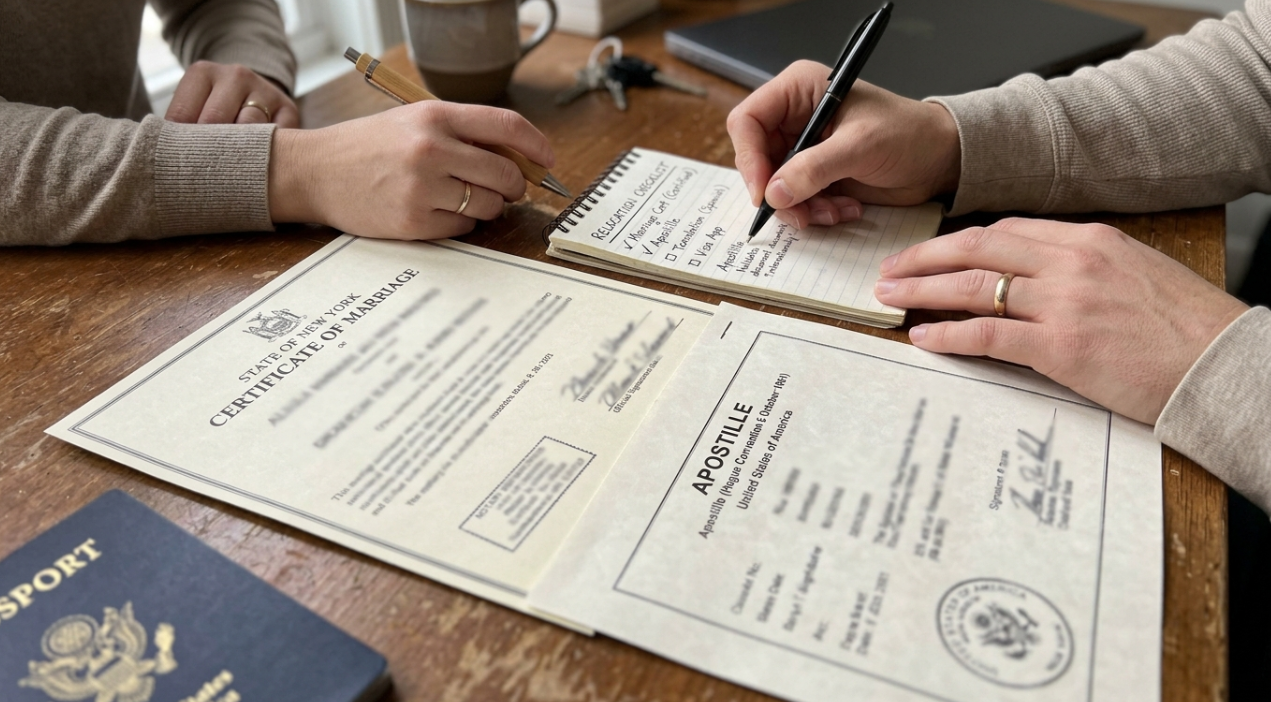
Most guides blur authentication and recognition into a single idea. They are not the same thing, and the difference has real consequences for same-sex couples.
What the apostille proves | What the apostille does not prove |
|---|---|
The certificate came from the issuing authority | That every country recognizes the marriage |
The official’s signature and seal are authentic | That same-sex marriage is legal at the destination |
The document is authenticated for Hague Convention use | That a remote ceremony satisfies every immigration program |
The apostille can be independently verified | That no translation or local registration is needed |
A country might accept an apostilled marriage certificate from an opposite-sex couple and reject the same document from a same-sex couple. The apostille did not fail. The country simply does not recognize same-sex marriages under its own law.
For a broader overview of how apostilles work, see Courtly’s guide to apostilles.
How Much Does a Same-Sex Marriage Certificate Apostille Cost?
The total cost of apostilling a same-sex marriage certificate depends on the issuing jurisdiction, the type of authentication required, delivery method, translation requirements, and whether expedited processing is needed.
For a Utah document, the state publishes separate fees for apostilles, authentications, expedited processing, and related services. Utah's 2026 legislative fee materials list the standard apostille fee at $19, with additional charges applying to expedited processing and other services. Confirm the current fee with the Utah Office of the Lieutenant Governor before submitting a request because fees and service options can change.
Potential cost | What it covers |
|---|---|
Certified marriage certificate | Official copy of the marriage record |
Apostille | Authentication for use in a Hague Convention country |
Certificate of authentication | Alternative authentication route where applicable |
Expedited processing | Faster review where offered |
Translation | Certified or sworn translation if required |
Shipping | Delivery of physical documents |
Embassy or consular legalization | Additional authentication for destinations requiring legalization rather than an apostille |
The apostille fee is only one part of the potential cost. Couples should check the receiving authority's document, translation, registration, and delivery requirements before ordering.
How Long Does It Take to Apostille a Same-Sex Marriage Certificate?
The timeline depends on the issuing authority, whether the document is eligible for an apostille, the processing method, shipping, and whether additional translation or legalization is required.
For a Utah marriage certificate, separate the process into these stages:
Obtain the official marriage certificate.
Confirm that the certificate meets the authentication authority's requirements.
Submit the apostille or authentication request.
Allow the issuing authority to review and issue the authentication.
Arrange physical delivery if required.
Complete any required translation or local registration.
Submit the authenticated document to the receiving authority.
Utah now allows online submission through ApostilleXpress, and digital delivery is available for eligible documents. However, Utah states that digital delivery is not available for vital records, so couples using a marriage certificate should confirm which delivery method applies to their specific document.
Do not treat the apostille processing time as the total international-document timeline. Translation, shipping, embassy legalization, and foreign registration can add additional time.
What Documents Do You Need to Apostille a Same-Sex Marriage Certificate?
The exact requirements depend on the jurisdiction that issued the marriage certificate. In general, couples should be prepared to provide:
An official or certified marriage certificate
The required apostille or authentication request form
Identification or contact information when required
Payment for the authentication service
Shipping information for physical documents
A certified or sworn translation if required by the receiving authority
Additional authentication documents if the destination country does not use the Hague Apostille Convention
Do not assume that a screenshot, unofficial marriage record, ceremony certificate, or ordinary photocopy can be apostilled. Confirm the document requirements with the competent authority that issues apostilles in the jurisdiction where the marriage certificate originates.
When Do Same-Sex Couples Need a Marriage Certificate Apostille?
Common situations where a same-sex marriage certificate apostille is required:
Registering a foreign marriage in the couple’s home country or country of residence
Immigration or residency applications, including spousal visa petitions
Spousal benefits through employers, insurers, or government programs abroad
Name changes in a foreign civil registry
Visa applications requiring proof of marital status
Property, inheritance, or tax filings in another jurisdiction
Even after getting the apostille, many offices require a certified or sworn translation of the certificate. The U.S. Department of State advises couples needing translations to use a professional translator and notarization when the receiving country requires it.
Practitioners on Reddit reinforce how common this is. In a Schengen visa thread, a same-sex Filipino spouse of a Spanish citizen described needing apostilled documents and sworn translations just to begin registering the marriage in Spain. Translation requirements catch people off guard more often than the apostille itself.
Apostille vs Embassy Legalization for a Same-Sex Marriage Certificate
The first routing question is whether the destination country participates in the Hague Apostille Convention.
As of June 2026, the Convention has 130 Contracting Parties. If both the United States and the destination country are members, an apostille is the simplified authentication path. If the destination is not a member, the couple needs embassy or consular legalization instead, which involves a longer chain:
State-level authentication (for Utah certificates, this starts with the Lieutenant Governor’s office)
U.S. Department of State authentication
Destination-country embassy or consulate authentication
Most ranking pages simply say “non-Hague means embassy legalization” without showing the steps. Knowing the full chain helps couples budget both time and money. For a detailed comparison, see apostille vs authentication.
Courtly offers document legalization services covering both apostille and embassy authentication paths, with expedited options for couples on a deadline.
Situation | Typical authentication route |
|---|---|
Destination is a party to the Hague Apostille Convention | Apostille issued by the competent authority in the document's country of origin |
Destination is not covered by the Apostille Convention | Authentication/legalization procedures determined by the destination country |
Destination requires additional local registration | Apostille or authentication may be only the first step |
Destination requires a translation | Certified or sworn translation may be required in addition to authentication |
Same-sex marriage is not recognized | Apostille does not change the destination country's marriage-recognition rules |
Remote marriage is not accepted | Apostille does not change the destination country's rules about ceremony format |
The HCCH says the Apostille Convention currently has 130 Contracting Parties and is designed to replace traditional legalization with a single apostille from the competent authority in the document's place of origin.
How to Apostille a Utah Same-Sex Marriage Certificate
Utah is where most U.S. online marriages happen, including same-sex marriages performed via remote appearance. Here is how to get a same-sex marriage certificate apostille for a Utah-issued certificate.

Step 1: Complete the legal marriage ceremony
The ceremony must meet Utah County’s requirements. For remote-appearance ceremonies, the officiant must be physically located in Utah, and the couple plus two adult witnesses must be able to see and hear each other throughout the ceremony. Utah County details these rules on its officiant responsibilities page.
Step 2: Receive the marriage certificate
Utah County emails a digital certificate after the officiant submits the ceremony details and mails a paper certificate within a few business days. Both versions serve as legal documentation.
Step 3: Request the Utah authentication
Utah marriage certificates can be submitted for authentication through the Utah Office of the Lieutenant Governor, which is the state's designated competent authority for apostilles and authentications. Utah County issues marriage certificates, while the state handles the apostille or authentication.
Utah now provides online submission through ApostilleXpress. The state says ApostilleXpress is used to submit and manage requests, while the Office of the Lieutenant Governor remains the authority that issues the authentication.
Step 4: Check whether digital delivery is available
Utah introduced digital delivery for eligible authentication requests in July 2026 and online ordering through ApostilleXpress in September 2026. However, Utah specifically states that digital delivery is not available for vital records, including documents issued by the Utah Division of Vital Records and Statistics.
Because marriage certificates are vital records, confirm the available delivery method for the exact certificate you are submitting rather than assuming an e-Apostille will be issued.
Step 5: Complete the destination country's requirements
An apostille is not necessarily the final step. Depending on the destination, you may still need:
A certified or sworn translation
Local marriage registration
Additional supporting documents
A recently issued certified copy
Immigration-specific evidence
Confirmation that the foreign authority recognizes the marriage and ceremony format
Check these requirements before sending the document abroad.
DIY or concierge?
Reddit threads about Utah online marriages regularly compare handling the apostille process independently versus using a service. Some couples manage it themselves without issues. Others, especially those facing international shipping, tight deadlines, or unfamiliar country-specific requirements, find that concierge support saves time and prevents mistakes.
The 4-Gate Test for Same-Sex Marriage Recognition Abroad
Before relying on an apostilled same-sex marriage certificate abroad, run it through four gates. This framework prevents the false confidence that comes from treating paperwork completion as the same thing as legal recognition.
Before relying on an apostilled same-sex marriage certificate abroad, check all four gates:
Gate | Question | What you need to confirm |
|---|---|---|
1. Document | Is the marriage certificate official? | Obtain the required certified government copy. |
2. Authentication | Does the destination accept an apostille? | Check whether the destination uses the Hague Apostille Convention or another legalization process. |
3. Marriage recognition | Does the destination recognize the marriage? | Confirm its rules for same-sex and foreign marriages. |
4. Ceremony format | Does it recognize the way the marriage was performed? | Check rules for remote, online, proxy, telephone, or other non-traditional ceremonies. |
Important: Passing the first two gates does not guarantee that the marriage will pass the final two. An authentic, properly apostilled marriage certificate can still be rejected for a particular legal or immigration purpose if the receiving authority does not recognize the marriage or ceremony format.
Gate 1: Is the marriage certificate certified and official?
You need the official certificate issued by Utah County after the ceremony, not an informal copy or ceremony summary.
Gate 2: Does the destination use apostille or embassy legalization?
Check the HCCH status table. Hague member countries accept apostilles. Non-members require the longer embassy chain described above.
Gate 3: Does the destination recognize same-sex marriages or foreign same-sex marriages?
This question has nothing to do with the apostille. ILGA World publishes current recognition maps tracking which countries recognize same-sex marriages, civil unions, or neither. Courtly also maintains a country recognition directory for additional guidance.
Gate 4: Does the destination accept remote or online ceremonies?
A country might recognize same-sex marriage generally but reject a certificate from a remote ceremony. Utah County itself requires officiants to warn couples that a marriage solemnized through online remote appearance may be invalid in the country where the parties reside.
Does an Apostille Guarantee Recognition of a Same-Sex Marriage?
No. An apostille authenticates the origin of a public document. It does not determine whether the receiving country recognizes the marriage described in that document.
For same-sex couples, three separate questions should be kept apart:
Document authenticity: Is the marriage certificate genuine?
Marriage recognition: Does the destination jurisdiction recognize the marriage as legally valid?
Purpose-specific acceptance: Will the particular immigration office, civil registry, court, employer, or other authority accept that marriage for the purpose requested?
A couple can have a genuine government-issued marriage certificate and a valid apostille while still needing additional steps or facing a recognition issue in the destination country.
A couple can pass Gates 1 and 2 (authentic certificate, apostille completed) and still fail Gate 3 or Gate 4. That is why the apostille alone is never the full answer.
Same-Sex Recognition: The Question the Apostille Cannot Answer
Here is the hardest truth about a same-sex marriage certificate apostille. It answers “Is this certificate authentic?” It does not answer “Does this country recognize our marriage?”
Recognition depends entirely on the destination country’s laws. Countries like the Netherlands and Spain will generally recognize a valid foreign same-sex marriage. Others offer civil unions but not full marriage recognition. Many countries recognize no form of same-sex partnership at all.
Israel is an instructive example for a different reason. Israeli couples, including same-sex and mixed-religion couples, have used Utah online marriages to bypass the absence of civil marriage options domestically. The question there is not just same-sex recognition but access to civil marriage of any kind.
Practitioners on Reddit illustrate the recognition gap in other ways. In Philippines-related threads, users point out that an apostilled Utah certificate can serve certain immigration or administrative purposes, but the Philippines does not recognize same-sex marriage domestically. The apostille does not change Philippine law.
For same-sex couples navigating these variations, Courtly publishes guides for international couples that break down the nuances by jurisdiction. Many couples still value a U.S. same-sex marriage certificate as a legal commitment record and as a starting point for recognition in jurisdictions that do accept same-sex unions.
Remote Marriage Recognition Is a Separate Issue
Same-sex recognition and remote-ceremony recognition are two distinct legal questions. A same-sex couple who married online faces both.
Utah’s remote-appearance marriage is valid in Utah and recognized throughout the United States. But the receiving country may independently decide whether it accepts a marriage where the parties were not physically together at the ceremony.
Canada is the clearest cautionary example. IRCC states that it does not recognize marriages conducted by proxy, telephone, internet, or fax where one or both parties were not physically present, with only narrow exceptions. An apostille on the Utah certificate does not override that policy.
In a Reddit thread on r/Chinavisa, a user asked whether a Utah online marriage certificate would be accepted with a physical apostille and certified Chinese translation. Responses underscored a common theme: it depends on the specific receiving office, and checking in advance is the only way to know for sure.
The point is not that online marriages are invalid. They are valid U.S. marriages. The point is that foreign recognition operates under a different set of rules, and a same-sex marriage certificate apostille does not resolve those questions on its own.
Immigration: Two Important Examples
U.S. Immigration
Same-sex spouses are eligible for the same U.S. immigration benefits as opposite-sex spouses, per the U.S. Department of State. USCIS treats all legally married couples equally regardless of sex.
But couples who married remotely face a distinct question. USCIS guidance indicates that a marriage where the parties were not physically present together does not create a spousal relationship for immigration purposes unless consummated afterward. Practitioners on r/USCIS regularly discuss whether meeting in person after a Utah Zoom ceremony satisfies this requirement, with many reporting successful outcomes when they can show the relationship continued in person after the ceremony.
Couples planning a U.S. spouse visa should consult an immigration attorney about timing and evidence requirements. Courtly offers a low-cost spouse visa consultation with partner attorneys for exactly this situation. For more on the consummation question, see this immigration guide.
Canada
Canada recognizes same-sex marriage broadly, which makes it seem like a simple case. It is not. IRCC’s spousal sponsorship program generally rejects internet, proxy, telephone, and fax marriages where one or both parties were not physically present at the ceremony.
A same-sex couple could have a perfectly apostilled Utah marriage certificate and still face rejection for Canadian spousal sponsorship. Not because of the apostille. Not because of their sexual orientation. Because of how the ceremony was conducted. A same-sex marriage certificate apostille does not fix a ceremony-format rule.
Paper Apostille vs e-Apostille
Utah now offers digital apostille delivery through its ApostilleXpress system. The HCCH’s position is that e-Apostilles are official and should not be refused solely because they are electronic.
In practice, acceptance varies. Some foreign offices, particularly in countries with older bureaucratic workflows, still require a physical paper apostille alongside the original paper certificate. Immigration offices, civil registries, and sworn-translation services often expect to handle physical documents.
Before ordering, ask the receiving office these questions:
Do you accept an e-Apostille, or do you require paper?
Do you need the original paper marriage certificate?
Do you require a certified or sworn translation?
Do you recognize foreign same-sex marriages?
Do you accept Utah remote-appearance marriages?
Do you require local registration after apostille?
How recently must the certificate have been issued?
Getting these answers first saves weeks of delays and avoids costly reprocessing.
Frequently Asked Questions
Is there a different apostille for same-sex marriage certificates?
No. The apostille authenticates the marriage certificate as a public document. The process is identical regardless of the couple’s sex or gender. There is no separate form, fee, or procedure.
Does a same-sex marriage certificate apostille make the marriage valid abroad?
No. The apostille verifies that the certificate is an authentic government document. Whether the marriage is recognized depends on the destination country’s rules for same-sex marriage, foreign marriages, and sometimes remote ceremonies.
Can a Utah online same-sex marriage certificate be apostilled?
Yes. Utah County marriage certificates can go through the state’s authentication process. The apostille is issued by the Utah Lieutenant Governor’s Authentications Office, not the county clerk. You can request it during the license application or separately.
Do I need an apostille for U.S. immigration?
Typically not for a U.S.-issued certificate used within the U.S. immigration system. USCIS focuses on the legal validity of the marriage and relationship evidence. Couples who married remotely should get legal advice about post-ceremony meeting and consummation requirements.
What about Canadian spousal sponsorship?
An apostille may authenticate the document, but IRCC’s spousal sponsorship program generally does not recognize internet or proxy marriages where one or both parties were not physically present. The apostille does not fix this issue.
Does the marriage certificate expire?
The certificate itself does not expire. Some receiving offices impose document-age rules, though, requiring recently issued certified copies. Always check what the receiving authority expects.
Can one apostille be used in more than one country?
Apostilles are not country-specific and can potentially be used across multiple Hague Convention member states. That said, each receiving authority sets its own submission rules. Confirm with the office that will process your document.
What if my destination is not in the Hague Convention?
You will need embassy or consular legalization rather than an apostille. This typically involves state-level authentication, U.S. Department of State authentication, and processing by the destination country’s embassy or consulate. It takes longer and costs more.
Next Steps
A same-sex marriage certificate apostille is necessary for many cross-border situations, but only useful when you understand what it does and what falls outside its scope. It proves your certificate is authentic. It does not promise that any particular country will treat you as married.
Start by running the 4-Gate test for your specific destination. Determine whether that country recognizes same-sex marriages and remote ceremonies. Then handle the document authentication, knowing what outcome to expect and what additional steps (translation, registration, legal consultation) might follow.
If you are planning a U.S.-legal online marriage or need your certificate prepared for international use, Courtly can help with the ceremony, certificate, and legalization paperwork.
Let us handle the paperwork.
Getting married is complicated. Courtly simplifies the process and provides everything necessary to get married online, including providing a licensed officiant who can perform a remote ceremony.
Get Married

Get married online.
Getting married is complicated. Courtly simplifies the process and provides everything necessary to get married online.

