

For a same-sex couple who legally marries through a Utah remote ceremony, the key documents are the Utah marriage license, certified marriage certificate, and—when needed for international use—an apostille or authentication certificate. Same-sex couples use the same U.S. marriage and immigration forms as opposite-sex couples.
If you plan to use the marriage for U.S. immigration, the core paperwork may include Form I-130, Form I-130A, Form I-485 or an immigrant spouse visa application, plus evidence that the marriage is genuine. If you plan to use the marriage certificate abroad, you may need an apostille, digital apostille, authentication, legalization, and/or translation, depending on the destination country's rules.
The most important distinction is this: a marriage certificate proves the marriage; an apostille authenticates the public document; neither automatically guarantees that another country will recognize the marriage itself.
See how online marriage works through Courtly’s step-by-step process.
What documents do same-sex couples need after an online marriage?
Same-sex couples who marry through a Utah online ceremony generally need a marriage certificate as proof of the marriage. Depending on what they plan to do next, they may also need an apostille or authentication for international use, immigration forms such as Form I-130 and Form I-130A, and evidence of a bona fide marriage for U.S. immigration.
The exact documents depend on the purpose:
Proof of marriage: Certified Utah marriage certificate
International use: Apostille or authentication, and sometimes legalization or translation
U.S. spouse immigration: Form I-130, Form I-130A, and supporting evidence
Adjustment of status: Form I-485 when eligible
Conditional residence: Form I-751 when applicable
Bona fide marriage evidence: Joint financial, residential, travel, communication, and relationship records
A marriage certificate, apostille, and immigration evidence serve different purposes, so one document does not replace the others.
Document | Purpose | When You Need It |
|---|---|---|
Marriage license | Legal authorization to marry | Before ceremony |
Marriage certificate | Official proof that the marriage occurred | After ceremony |
Certified copy | Official copy used for legal/administrative purposes | When an agency requires one |
Apostille | Authenticates a public document for use in a participating foreign country | International use |
Authentication certificate | Used for certain destinations outside the Apostille Convention | International use |
Translation | Makes the document readable in another language | When required by the receiving authority |
Form I-130 | Establishes the qualifying family relationship for immigration | Spouse immigration |
Form I-130A | Provides information about the spouse beneficiary | Filed with I-130 |
Form I-485 | Application to adjust status inside the U.S., when eligible | Adjustment of status |
Form I-751 | Removes conditions from certain conditional permanent residence | If conditional residence applies |
Bona fide marriage evidence | Demonstrates that the marriage is genuine | Immigration cases |
Marriage License vs. Marriage Certificate vs. Apostille
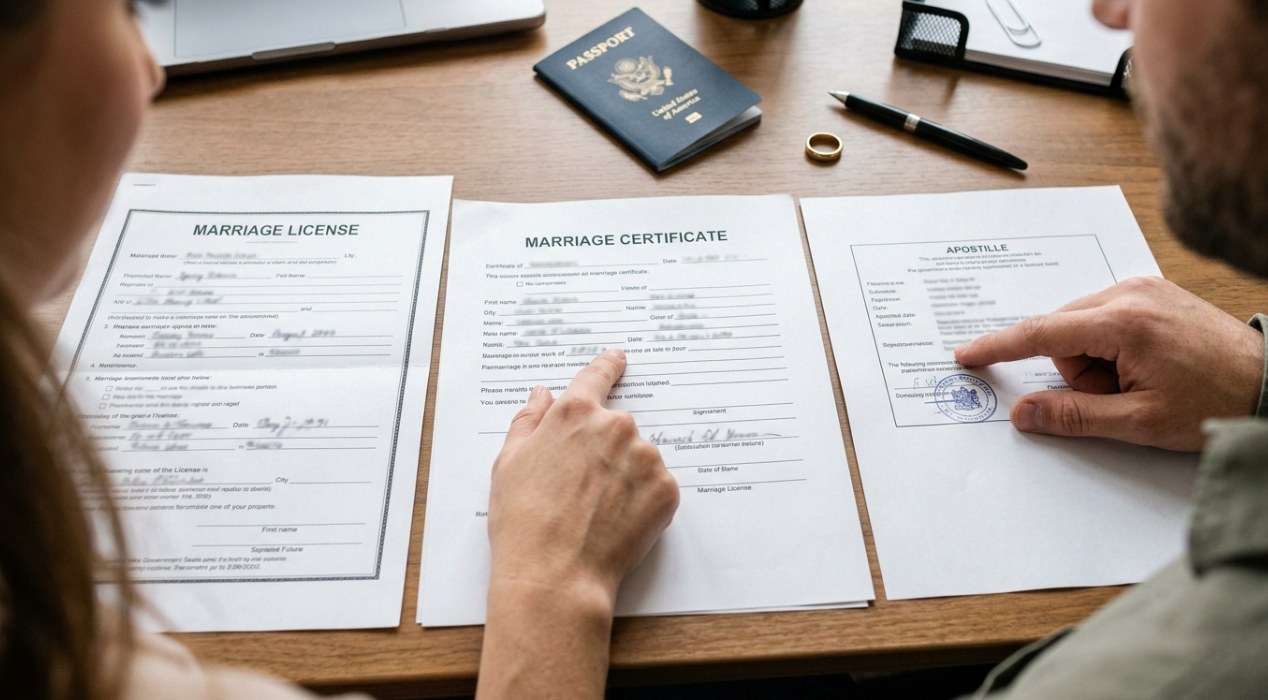
These documents are related, but they do different jobs.
Document | What it proves | When you receive/use it |
|---|---|---|
Marriage license | Authorization to legally marry | Before the ceremony |
Marriage certificate | Official record that the marriage occurred | After the ceremony |
Certified marriage certificate | Official certified copy of the marriage record | When an agency requires an official copy |
Apostille | Authenticates the signature/seal or authority on a public document for use abroad | After obtaining the appropriate public document |
Authentication certificate | Authenticates a public document for certain international uses outside the Apostille process | When required by the destination country |
Translation | Makes the document understandable in the destination country's required language | When required |
The simple rule
The license lets you marry. The certificate proves you married. The apostille authenticates the document for international use.
An apostille does not independently determine whether the destination country recognizes the underlying marriage. That question depends on the destination country's own laws and requirements.
Pre-Ceremony Documents
Marriage License
A marriage license is the legal authorization that permits a marriage to take place. Think of it as the government’s green light. You must obtain it before the ceremony, not after.
For Utah County, the marriage license application is digital. Applicants provide identifying information, verify their identities, and pay the applicable fees online. Utah County currently states that most applicants pay $71.75 including required fees, although qualifying couples may receive a marriage education discount. Additional document, shipping, or optional service fees may apply.
Utah County does not require couples to be U.S. citizens or Utah residents to obtain a marriage license. For remote ceremonies, the officiant must be physically present in Utah, which establishes the jurisdiction for the ceremony.
These requirements apply equally to same-sex and opposite-sex couples. There is no separate application form or different process.
You can learn more about the online license process and what to expect before your ceremony.
Remote Marriage vs. Proxy Marriage
A Utah remote marriage is not the same thing as a proxy marriage.
In a remote marriage, both spouses participate in the ceremony by video, while the officiant is physically present in Utah. Utah County states that the couple, officiant, and two witnesses must be able to see and hear one another during the ceremony.
In a proxy marriage, one spouse is represented by another person who physically stands in for them during the ceremony.
The distinction can matter for U.S. immigration. USCIS has specific rules concerning proxy marriages, including evidence that the spouses were physically present together after the marriage in certain cases. Do not assume that every online marriage is treated as a proxy marriage simply because the ceremony occurred by video.
For immigration cases, review the current USCIS requirements or consult a qualified immigration attorney before filing.
This distinction matters for immigration purposes, as we’ll cover later. If you’re unclear on the differences, the comparison between remote and proxy marriage is worth reading.
Ceremony and Certificate Documents
Marriage Certificate
The marriage certificate is the government-issued record proving that a legal marriage occurred. It contains the names of both spouses, the date and location of the ceremony, and the officiant’s signature. This is the document you’ll use for everything that comes next: name changes, immigration petitions, international recognition, insurance enrollment.
Here’s the single most important fact in this glossary: your marriage certificate will NOT say “online.” The U.S. government does not distinguish between marriages performed in person and those performed virtually. What you receive is a standard Utah County marriage certificate, identical in every legal respect to one issued after a courthouse wedding.
Practitioners on Reddit frequently confirm this point. In threads across r/immigration and r/USCIS, couples report that their Utah online marriage certificates were accepted by USCIS without any issues related to the virtual format. The certificate simply looks like any other marriage certificate.
After the ceremony, couples typically receive a digital copy of their U.S. marriage certificate within 12 hours. A physical copy is mailed within the next few business days.
Certified Copy of a Marriage Certificate
A certified copy is an official copy of the marriage record issued by the government authority that maintains the record. It is different from a screenshot, ordinary photocopy, or informal digital copy.
You may need a certified copy when submitting your marriage record to an immigration authority, government agency, court, financial institution, or foreign authority.
Before ordering copies, check the receiving authority's requirements. Some organizations require a certified copy issued within a particular period, while others may accept a digitally verifiable document.
Marriage Certificate vs. Marriage License
People confuse these constantly. The license comes before the wedding. The certificate comes after. The license is permission; the certificate is proof. You need both at different stages, but the certificate is what you’ll use for years to come.
Ceremony Recording
Some couples keep a video recording of their ceremony as personal memorabilia, but it serves a practical purpose too. A recorded ceremony can function as supporting evidence for immigration applications, proving both spouses were present and participated willingly. Courtly’s Popular and Fast-Track plans include ceremony video recording with cloud storage.
Witness Requirements
Utah requires two witnesses for a marriage ceremony. You can bring your own or, if coordinating witnesses across time zones proves difficult, have them provided as part of your ceremony package.
Public Record Searchability
Once your marriage is completed, it becomes a public record. Anyone can search for it through the Utah County clerk’s marriage license search tool. This is standard for all marriages in Utah and provides an additional layer of verification if anyone questions the legitimacy of your union.
Authentication and Legalization Documents
This is where same-sex online marriage family documents start to get complex, because international recognition requires additional layers of verification.
Apostille
An apostille is a certificate that verifies the legitimacy of a public document and the authority of the official who signed it. It’s required when you need your marriage certificate recognized in a country that belongs to the Hague Apostille Convention, which as of 2026 includes 130 contracting parties worldwide.
The apostille doesn’t verify that the content of your document is true. It simply confirms that the document is a genuine public record issued by a legitimate authority. In Utah, apostilles are issued by the lieutenant governor’s office.
For a deeper breakdown, Courtly’s guide on apostille basics covers the process in detail.
e-Apostille / Digital Apostille
An e-Apostille is an official Apostille issued in electronic form rather than as a paper certificate. The Hague Conference on Private International Law's electronic Apostille Programme (e-APP) supports the electronic issuance and verification of Apostilles.
Utah expanded its authentication system in 2026. The Utah Office of the Lieutenant Governor introduced digital delivery in July 2026 and online ordering through ApostilleXpress in September 2026. Eligible applicants can submit requests online and receive their completed digital certificate electronically when digital delivery is available.
Utah states that its digital certificates can be verified through its official verification system. Before relying on a digital apostille for an immigration, court, marriage-registration, or other legal purpose abroad, confirm that the receiving authority accepts electronic documents and electronic authentication.
Important: An e-Apostille authenticates the public document; it does not by itself determine whether the destination country recognizes the underlying marriage.
Does an Apostille Expire?
An Apostille is generally an authentication of the public document and the signature, seal, or authority identified on that document. The Apostille Convention itself does not establish a universal five-year expiration period for Apostilles.
However, the receiving authority may impose its own requirements about how recent the underlying document must be or whether a previously issued Apostille is acceptable.
If you are submitting a marriage certificate abroad, check the current requirements of the specific government, court, immigration authority, or registry receiving the document.
Certificate of Authentication
What happens if your destination country isn’t in the Hague Convention? Utah now issues the same certificate format for all documents intended for international use. When the destination country participates in the Convention, the certificate functions as an apostille. When it doesn’t, the certificate functions as a Certificate of Authentication.
The practical difference is that a Certificate of Authentication may require an additional step: legalization by the destination country’s embassy or consulate. For a clear comparison, read about the differences between apostilles and authentication.
Embassy Legalization / Consular Authentication
For non-Hague countries, after obtaining a Certificate of Authentication from Utah, you typically need to have the document further legalized by the destination country’s embassy or consulate in the United States. This adds time and cost but is sometimes the only path to recognition.
Embassy authentication packages are available through Courtly at approximately $275 on average, though costs vary by destination country.
Immigration and Family Petition Documents
Same-sex online marriage family documents play a critical role in immigration, where proving a valid marriage is the foundation of every spousal petition.
USCIS and Same-Sex Marriages
Since the Supreme Court struck down Section 3 of the Defense of Marriage Act in 2013, USCIS has treated same-sex marriages identically to opposite-sex marriages. USCIS explicitly states that eligibility to petition for a spouse “will not be denied as a result of the same-sex nature of your marriage.”
There are no special requirements for same-sex couples. You need the same documents as any other married couple to prove an authentic marriage.
That said, practitioners on Reddit and immigration forums report that with heightened USCIS scrutiny in 2025 and 2026, proving a marriage is bona fide has become more critical than ever, regardless of the couple’s sexual orientation. More on that below.

Form I-130 (Petition for Alien Relative)
Form I-130 is the document a U.S. citizen or lawful permanent resident files to establish a qualifying family relationship with their spouse, enabling the spouse to pursue a green card. It’s the starting point for virtually every marriage-based immigration case.
The I-130 filing fee in 2026 is $675 by mail or $625 online (a $50 discount for electronic filing).
For same-sex couples who married online, the I-130 process is no different from any other couple’s. The marriage certificate, combined with bona fide evidence, forms the backbone of the petition.
Form I-130A (Supplemental Information for Spouse Beneficiary)
This supporting form accompanies the I-130 and provides USCIS with detailed biographic information about the foreign spouse. It’s not optional; it’s a required attachment.
Form I-485 (Adjustment of Status)
If the foreign spouse is already physically present in the United States, they can file Form I-485 alongside the I-130 to adjust their status to permanent resident without leaving the country. This concurrent filing can save months compared to consular processing abroad.
Form I-751 (Petition to Remove Conditions)
Here’s a timeline detail many couples miss. If you’ve been married less than two years at the time your green card is approved, the foreign spouse receives a two-year conditional permanent residence card, not a ten-year one. Before that conditional card expires, you must file Form I-751 to remove the conditions and obtain a standard ten-year green card.
If you’ve been married more than two years at approval, the ten-year card is issued directly.
CR-1 and IR-1 Spouse Visas
When the foreign spouse is living abroad, the immigration path runs through consular processing and a spouse visa. CR-1 (Conditional Resident) visas apply to marriages less than two years old at the time of the spouse’s admission to the U.S. IR-1 (Immediate Relative) visas apply to marriages over two years old.
Both visa categories work the same way for same-sex couples. The distinction is purely about marriage duration.
If you’re weighing your options, Courtly offers a low-cost spouse visa consultation with partner immigration attorneys who specialize in online marriage cases.
The In-Person Meeting Requirement
This is a critical caveat that catches people off guard. For immigration purposes, the U.S. government recognizes Utah virtual marriages as long as both spouses attend the video ceremony simultaneously and the marriage complies with Utah law. However, immigration attorneys consistently note that couples must physically meet in person before applying for immigration benefits.
One immigration attorney’s blog (lawandborder.com) specifically addresses this requirement in the context of Utah virtual marriages. You can marry online first, but you need to meet your spouse in person, and be prepared to document that meeting, before filing immigration paperwork.
For a more thorough look at how online marriage and immigration intersect, the USCIS recognition guide is essential reading.
Bona Fide Marriage Evidence
What “Bona Fide” Means
A bona fide marriage is one where two people married with the genuine intention of building a life together. A marriage entered into solely for immigration benefits is not bona fide, and USCIS investigates this aggressively.
Standard Evidence
USCIS expects clear proof that the marriage is real. Common documents include:
Joint bank account statements
Joint insurance policies
Joint tax returns
Shared lease or mortgage documents
Photographs together over time
Travel records showing visits to each other
Communication records (messages, call logs)
Birth certificates of shared children
LGBTQ-Specific Evidence Challenges
This is where same-sex online marriage family documents require special attention. Some LGBTQ individuals keep their sexual orientation or marriage secret from friends, family, or coworkers, particularly when they live in countries where homosexuality is criminalized or heavily stigmatized. As a result, they may struggle to provide the kind of documentation that opposite-sex couples easily accumulate: wedding photos shared on social media, congratulatory cards from family, joint holiday invitations.
USCIS is aware of this gap. The government acknowledges that “some documentary evidence routinely seen in opposite-sex cases may not be available in same-sex marriage cases.” Immigration officers are trained to account for these circumstances.
Still, you should provide whatever evidence you can. Even in cases with limited traditional documentation, creative alternatives can help.
Former Civil Unions and Domestic Partnerships
Many same-sex couples were together for years, sometimes decades, before marriage equality arrived. If you previously registered as domestic partners or obtained a civil union, those records can serve as powerful evidence of a long-standing, genuine relationship. Include them in your bona fide evidence packet.
Affidavits of Support / Relationship
Sworn statements from people who know the couple well carry real weight. Collect affidavits from close friends, family members, and colleagues. Each affidavit should explain how the witness knows the couple, how often they interact, and their observations of the relationship over time.
For same-sex couples with limited family support, affidavits from community members, religious leaders, or therapists who have witnessed the relationship can fill gaps.
International Recognition Terms
Obergefell v. Hodges (2015)
The U.S. Supreme Court decision that legalized same-sex marriage in all 50 states. This ruling underpins every U.S. marriage certificate issued to a same-sex couple, including those from Utah online ceremonies. Without Obergefell, none of this would be possible.
Defense of Marriage Act (DOMA), Section 3
Section 3 of DOMA previously defined marriage as between a man and a woman for all federal purposes, which meant USCIS could deny I-130 petitions from same-sex couples. The Supreme Court struck down Section 3 in 2013 (United States v. Windsor). Previously denied petitions could be reopened and reconsidered without regard to DOMA.
Hague Apostille Convention
The Hague Apostille Convention simplifies international document authentication by replacing complex, multi-step legalization with a single apostille certificate. As of 2026, 130 countries participate. If your destination country is a member, an apostille on your Utah marriage certificate should be sufficient for recognition (subject to that country’s own marriage laws).
International Same-Sex Marriage Recognition (2026)
As of 2026, 38 countries legally recognize same-sex marriage, covering approximately 1.5 billion people, about 20% of the world’s population. Courtly’s Help Center maintains lists of countries with known restrictions, including those that don’t accept online U.S. marriages and those that don’t recognize same-sex unions.
For country-specific guidance, Courtly publishes legal guides for same-sex couples in China, Hong Kong, Japan, and other countries where couples frequently use Utah online marriages.
ECJ Trojan Ruling (November 2025)
A major legal development for same-sex couples in Europe. On November 25, 2025, the European Court of Justice ruled in the Trojan case that EU member states may not refuse to recognize a same-sex marriage lawfully concluded in another member state. The ruling doesn’t force countries to legalize same-sex marriage domestically, but it does require them to recognize marriages performed elsewhere in the EU.
This potentially opens doors for same-sex couples who obtain a U.S. marriage certificate and then seek recognition in EU countries that haven’t legalized same-sex marriage domestically. However, enforcement remains an evolving matter, and couples should consult local legal counsel about practical implementation.
Countries That May Not Accept Online Marriages
Several countries have historically rejected marriages performed via remote ceremony, regardless of sexual orientation. Based on available guidance, this list includes Germany, Hungary, Australia, Norway, France, Turkmenistan, Sweden, Poland (varies), Taiwan, and Finland. Check the international couples guide for the latest updates.
Post-Marriage Family Documents
Name Change Documents
After getting married, many couples want to update their legal name. In the United States, this involves notifying the Social Security Administration, the DMV, the passport office, banks, and other institutions. Each has its own form and process.
Courtly offers a name change kit with prefilled forms, checklists, and prepaid envelopes, available as a print-at-home option ($35) or a shipped Courtly Box ($85).
Joint Financial Documents
Joint bank accounts, shared insurance policies, and joint tax returns serve double duty. They’re standard financial management for married couples, and they’re also some of the strongest pieces of bona fide marriage evidence that USCIS accepts. Start building this paper trail as early as possible after your ceremony.
Common Misconceptions About Same-Sex Online Marriage Family Documents
“My certificate will say ‘online’ or ‘virtual.’”
No. Your marriage records and documents will not say “online.” The U.S. government does not distinguish between in-person and virtual marriages. This is one of the most common fears among couples considering an online ceremony, and it’s completely unfounded.
“Same-sex couples need different immigration forms.”
False. USCIS uses the same forms and applies the same standards regardless of the couple’s gender composition. There are no special forms, separate processing tracks, or additional requirements.
“An apostille proves my marriage is valid.”
Not exactly. An apostille verifies that the document is a genuine public record issued by a legitimate authority. It does not certify the content or validate the marriage itself. A receiving country could theoretically accept the apostille as authentic but still refuse to recognize the underlying marriage based on its own domestic laws.
“We married online, so we don’t need to meet in person before filing for immigration.”
Wrong. Immigration attorneys are consistent on this point: you must physically meet your spouse before applying for immigration benefits, even if you were legally married via video ceremony first.
“Chinese/Hong Kong couples can’t use this system.”
Since 2021, approximately 200 Chinese and Hong Kong couples have married through Utah virtual ceremonies. Utah County reported performing 3,500 virtual weddings for international couples in a recent year. The system is used globally.
Quick-Reference Document Table
Document | What It Is | When You Need It | Where to Get It |
|---|---|---|---|
Marriage License | Pre-ceremony authorization | Before the wedding | Utah County (online) |
Marriage Certificate | Government proof of marriage | After ceremony; for all future legal use | Issued by Utah County |
Apostille | International authentication | Using certificate in a Hague Convention country | Utah Lt. Governor’s office |
e-Apostille | Digital version of apostille | Same as above; available since Sept 2026 | Utah’s digital authentication portal |
Certificate of Authentication | Authentication for non-Hague countries | Using certificate in a non-member country | Utah Lt. Governor’s office |
Form I-130 | Spousal immigration petition | Starting the green card process | USCIS |
Form I-130A | Supplemental spouse information | Filed with I-130 | USCIS |
Form I-485 | Adjustment of status | Spouse is already in the U.S. | USCIS |
Form I-751 | Remove conditional residence | Before 2-year green card expires | USCIS |
Affidavits of Relationship | Sworn statements from witnesses | Supporting bona fide evidence | Prepared by friends/family |
Frequently Asked Questions
Does a Utah online marriage certificate look different from an in-person one?
No. The certificate is a standard Utah County marriage certificate. It contains no indication that the ceremony was conducted remotely. The U.S. government treats in-person and virtual marriages identically.
What documents do same-sex couples need for a spouse visa after marrying online?
The same documents any married couple needs: a valid marriage certificate, proof of the petitioner’s U.S. citizenship or permanent residency, Form I-130, Form I-130A, bona fide marriage evidence, and financial sponsorship documents. There are no additional requirements based on sexual orientation.
Can I get my Utah marriage certificate apostilled digitally?
Yes. As of September 2026, Utah offers a fully digital apostille program, the first of its kind in the United States. The e-Apostille carries the same legal weight as a traditional paper apostille across all 130 Hague Convention member countries.
What if my country doesn’t recognize same-sex marriage?
Your U.S. marriage certificate is still a valid legal document. Many same-sex couples obtain one specifically to establish legal recognition in countries that do accept it, or to support immigration petitions to the United States. The certificate’s utility depends on the specific laws of the country where you plan to use it.
Do I need to meet my spouse in person if we married online?
For the marriage itself, no. Utah allows both parties to appear remotely. For immigration purposes, yes. U.S. immigration authorities require that spouses have physically met before filing petitions like the I-130. Plan a meeting and document it with photos, travel records, and receipts.
How does the 2025 EU Trojan ruling affect same-sex couples?
The ECJ’s November 2025 ruling requires EU member states to recognize same-sex marriages lawfully performed in other member states. While this doesn’t directly cover U.S. marriages, it signals growing acceptance across Europe and may influence how individual countries handle U.S. marriage certificates accompanied by proper authentication.
What if I can’t provide typical bona fide evidence because my relationship is private?
USCIS recognizes that same-sex couples may have limited traditional documentation due to safety concerns or social stigma. Provide whatever evidence you can, including communication records, travel itineraries, affidavits from trusted individuals, and any prior civil unions or domestic partnerships.
How much does the full process cost, from ceremony to apostille?
Costs vary by what you need. The Utah government processing fee is approximately $70 for the marriage license. Ceremony packages, document legalization, and immigration consultations are separate. Check Courtly’s pricing page for current plan details and add-on costs.
Let us handle the paperwork.
Getting married is complicated. Courtly simplifies the process and provides everything necessary to get married online, including providing a licensed officiant who can perform a remote ceremony.
Get Married

Get married online.
Getting married is complicated. Courtly simplifies the process and provides everything necessary to get married online.

