

A same-sex online marriage performed through Utah can be legally valid under U.S. law, but “safe” means different things depending on where you live. Couples must separately evaluate ceremony legality, foreign recognition, immigration acceptance, and personal security before relying on an online marriage abroad. Utah can solve the ceremony problem; it cannot, by itself, solve every country’s recognition, immigration, or personal-safety problem.
A same-sex couple living in a country without marriage equality faces a question that no single Google result fully answers: if we get married online through the United States, is that safe?
The word “safe” is doing a lot of work in that sentence. It could mean legally valid. It could mean recognized by a foreign government. It could mean physically safe to hold, carry, or disclose the marriage certificate. It could mean useful for an immigration petition. For many couples, it means all four at once.
This guide breaks down same-sex online marriage safety abroad into its component parts: the terms you need to understand, the risks that apply at each layer, and the practical checks you should run before committing to any path. It is not legal advice. It is a framework for asking better questions before you spend money, share documents, or file paperwork that touches multiple legal systems.
If you are a same-sex couple considering an online marriage, Courtly’s LGBTQ+ marriage page outlines how the process works and what is included at each plan level.
Is a Same-Sex Online Marriage Safe Abroad?
A same-sex online marriage can be legally valid in the United States, but it is not automatically recognized or safe to rely on in every country. A Utah remote-appearance marriage can satisfy Utah's marriage requirements when the officiant, couple, witnesses, and ceremony meet Utah law, but Utah County warns that an online marriage may be considered invalid in the country where the spouses reside.
Before relying on an online marriage abroad, check four separate issues:
1. Legal validity: Was the marriage properly performed under the law of the jurisdiction where it was celebrated?
2. Foreign recognition: Will the country where you live or plan to use the marriage recognize it?
3. Immigration acceptance: Will the specific immigration authority accept a remote or virtual marriage for your visa or sponsorship?
4. Personal and document safety: Could disclosing, storing, shipping, or presenting the marriage certificate create legal, physical, social, or privacy risks?
An apostille can authenticate the origin of a marriage certificate, but it does not guarantee that another country will recognize the marriage itself.
Bottom line: A Utah online marriage may solve the problem of obtaining a U.S. marriage certificate remotely. It does not automatically solve foreign recognition, immigration eligibility, or personal-safety concerns.
Same-Sex Online Marriage Abroad: Quick Safety Check
Before starting an online marriage application, use this five-question check:
Question | If the answer is "Yes" | If the answer is "No" |
|---|---|---|
Is the marriage legally valid where it is performed? | Continue researching | Do not rely on the marriage |
Does the country where you live recognize foreign same-sex marriages? | Check additional requirements | Do not assume local rights |
Does that country recognize remote/online ceremonies? | Continue | Consider an in-person alternative |
Will your immigration authority accept an online marriage? | Confirm evidence requirements | Consider another immigration pathway |
Is it safe to disclose or store evidence of the marriage? | Create a document plan | Prioritize privacy and personal safety |
A "yes" to all five questions does not guarantee recognition. It means you have cleared the first screening stage and can move on to the specific requirements of the country, agency, and purpose involved.
The most important question to ask
Do not ask only:
"Is our online marriage legal?"
Ask:
"Will the specific government, immigration authority, court, employer, insurer, or other organization that I need to deal with accept this marriage for the purpose I need?"
Recognition can differ depending on whether you need the marriage for immigration, residency, taxes, inheritance, healthcare, name changes, benefits, or divorce.
What Does “Safety” Actually Mean for Same-Sex Online Marriage Abroad?
Safety is not a single yes-or-no question. For same-sex couples abroad, it splits into four distinct dimensions.
Legal safety asks whether the marriage was properly performed. Was the officiant authorized? Were witnesses present? Was the certificate filed correctly? If the ceremony does not meet the requirements of the jurisdiction where it was performed, nothing else matters.
Recognition safety asks whether the country or agency you need will accept the marriage. A marriage can be perfectly valid in Utah and completely unrecognized in the country where you live. Utah County itself warns that a marriage solemnized through remote appearance may be invalid in the country where the parties reside.
Physical and social safety asks whether disclosing the marriage could put you in danger. The Human Dignity Trust currently lists 66 jurisdictions that criminalize private, consensual same-sex sexual activity, with the death penalty imposed or possible in some. The U.S. State Department warns that LGBTQ+ travelers can face unique challenges abroad based on real or perceived sexual orientation.
Document safety asks whether you can receive, store, apostille, and present the marriage certificate without exposing yourself. Can a mailed certificate be intercepted? Could shared cloud storage or social media posts reach the wrong audience?
Each of these dimensions requires its own set of checks. A green light on one does not guarantee safety on the others.
The Four Dimensions of Online Marriage Safety
For an international same-sex couple, "safe" can mean several different things. Separate them before making a decision.
Type of safety | The question to answer | What can go wrong? |
|---|---|---|
Legal safety | Was the marriage validly performed? | Incorrect ceremony, unauthorized officiant, missing witnesses, or filing problems |
Recognition safety | Will another country recognize the marriage? | The marriage may be valid in Utah but not recognized locally |
Immigration safety | Will the relevant immigration authority accept it? | A visa or sponsorship application may treat the ceremony differently from local marriage law |
Personal/document safety | Is it safe to disclose, store, ship, or present the marriage records? | Privacy, discrimination, interception, employment, housing, or personal-security risks |
These categories should be evaluated separately. A marriage can be legally valid where performed but not recognized where the couple lives, and a marriage recognized in one context may still require additional evidence for immigration or another government process.
Essential Glossary Terms
Before evaluating any specific scenario, couples need shared vocabulary. These terms come up repeatedly in immigration forums, legal consultations, and government guidance. Misunderstanding even one of them can lead to costly mistakes.
Same-Sex Online Marriage
A same-sex online marriage is a legal marriage ceremony for two people of the same sex, conducted remotely by video rather than with everyone physically in the same room. “Online” does not mean informal or symbolic. When performed through a jurisdiction like Utah that authorizes remote-appearance ceremonies, the result is a government-issued marriage certificate with the same legal standing as one from an in-person ceremony.
The confusion arises because most countries did not design their marriage laws with video ceremonies in mind. A same-sex online marriage may be valid where performed but face scrutiny, rejection, or legal ambiguity when presented to a foreign government or immigration authority. For a deeper look at what makes these ceremonies legally binding, see this guide on what makes online marriage legal.
Remote-Appearance Marriage
A remote-appearance marriage is a ceremony where one or more participants join by live video instead of attending in person. Utah is the primary U.S. state enabling this. Under Utah County’s rules, the officiant must be physically present in Utah (this establishes jurisdiction), two witnesses aged 18 or older must observe the ceremony, and all participants must be able to see and hear each other in real time during the declaration of intent and pronouncement.
The distinction between “remote appearance” and “proxy” matters enormously for immigration, as we will see below.
Proxy Marriage vs. Remote-Appearance Marriage
A remote-appearance marriage and a traditional proxy marriage are not necessarily the same thing.
In a remote-appearance ceremony, the spouses participate live by video, while the officiant conducts the ceremony from the jurisdiction authorizing the marriage. Utah County, for example, requires the officiant, couple, and two adult witnesses to be able to see and hear one another during the ceremony, with the officiant physically present in Utah.
A proxy marriage generally involves one or both spouses being absent and another person acting in their place. For U.S. immigration purposes, the physical location and presence of the spouses during the ceremony can matter even when the marriage is legally valid where it was performed.
USCIS guidance states that a person generally qualifies as a spouse when both parties were present during the marriage ceremony, or when the parties consummated the marriage after the ceremony if they were not present together. USCIS also specifically addresses virtual marriages and says they must be valid under the law of the jurisdiction where the marriage was celebrated.
Practical rule: Do not assume that calling a ceremony an "online marriage," "remote marriage," or "proxy marriage" determines how an immigration authority will classify it. Describe exactly how the ceremony occurred, where each person was physically located, and what happened afterward.
Place-of-Celebration Rule
The place-of-celebration rule means a marriage is generally evaluated under the law of the jurisdiction where it was performed. If the marriage is valid where celebrated, many agencies (including U.S. immigration) start from that foundation.
USCIS’s October 2025 policy update confirms that virtual marriages are subject to the same requirements, including the place-of-celebration rule, as other spousal cases, regardless of state-specific provisions on virtual marriages. This is good news for Utah ceremonies, but it does not override the consummation question for cases where spouses were not physically together.
Foreign Recognition
Foreign recognition means another country accepts your marriage for local legal purposes: immigration, residency, taxes, inheritance, name changes, medical decisions, benefits, parentage, or divorce.
Here is the part that trips people up: recognition is not one question. It is a stack of questions. A country may recognize same-sex marriage generally but still reject remote ceremonies. It may accept foreign certificates but require apostille, translation, and local registration. It may recognize the marriage for tax purposes but not for immigration.
Equaldex currently lists same-sex marriage as legal in only 39 countries or regions, with 108 regions where it remains illegal. Even among those 39, the rules for recognizing foreign online ceremonies vary. Courtly publishes country-specific guidance to help couples start this research, though verification with local authorities remains essential.
Apostille and Authentication
An apostille is a certificate that verifies the origin of a public document so it can be used in another country that participates in the Hague Apostille Convention. Utah’s Lieutenant Governor’s Office explains that an apostille confirms where a document came from, not the contents or legal effect of that document.
This is one of the most common misunderstandings. An apostille does not force a foreign government to recognize a same-sex marriage or an online ceremony. It only helps prove the document is genuine. For countries not in the Hague Convention, the equivalent process is embassy legalization or authentication, which typically involves additional steps.
For more on the difference, see Courtly’s explanation of apostille vs authentication.
Consummation
In immigration contexts, consummation usually means the spouses met in person and had marital relations after the ceremony. The U.S. Foreign Affairs Manual is explicit: consummation before the ceremony does not count. It must happen after the proxy or remote ceremony to create spouse status for visa purposes.
Practitioners on Reddit report that couples regularly misunderstand this rule, asking whether meeting before the online wedding satisfies the requirement. Community answers consistently warn that evidence of being together after the ceremony may be needed for U.S. immigration filings. An immigration attorney can advise on what evidence is appropriate.
For a more detailed treatment of this topic, read the consummation and immigration guide.
Symbolic Ceremony
A symbolic ceremony is a wedding celebration with no legal effect. IGLTA, the international LGBTQ+ travel association, recommends that many couples separate the legal marriage from the destination celebration to avoid foreign paperwork, waiting periods, and recognition complications. A couple could complete a legal online marriage first, then hold a symbolic celebration in a safe, affirming location.
Legal Limbo
Legal limbo happens when one country considers a couple married while another does not. This can affect divorce, inheritance, taxes, child custody, name changes, and future remarriage. Practitioners on Reddit describe this exact concern: users ask what happens when a Utah online marriage is valid in the U.S. but unrecognized where they live or plan to migrate.
Legal limbo is one of the highest-stakes risks. A same-sex online marriage may solve one problem while creating another if the couple cannot later register, dissolve, or use the marriage in the jurisdiction that matters most.
Is a Utah Online Marriage Legally Valid?
Utah County allows marriage ceremonies to be performed by remote appearance when the requirements of Utah law are met. The officiant must be physically present in Utah, the couple and two adult witnesses must be able to see and hear one another in real time, and the marriage license must be properly completed and submitted.
Utah County's digital system allows couples to apply for a marriage license online and receive a digital marriage certificate after the ceremony. The county also provides remote ceremonies through its Clerk's Office.
However, Utah validity is only the first layer of the analysis. Utah County itself places a legal notice on its remote-ceremony information stating that a marriage solemnized through online remote appearance may be invalid in the country where the parties reside.
That means couples should separate two questions:
Is the marriage valid under Utah law?
Will the country where we live or need to use the marriage recognize it?
The first question is governed by Utah law. The second depends on the law and administrative requirements of the other country.
If you use a marriage service such as Courtly, treat the service as a facilitator of the Utah marriage process rather than as a guarantee of foreign recognition or immigration acceptance.
Explore Courtly’s online marriage service to see plan details and what is included.
But legal in Utah does not automatically mean accepted everywhere else. That gap is where the real risk analysis begins.
What Can Make a Same-Sex Online Marriage Unsafe Abroad?
An online marriage can create risks even when the underlying U.S. marriage is legally valid. The most important risks usually fall into five categories.
1. The marriage is not recognized locally
A foreign government may recognize neither same-sex marriage generally nor remote-appearance ceremonies specifically.
2. The marriage is recognized for one purpose but not another
Recognition can depend on the agency and purpose. Immigration, tax, inheritance, healthcare, family law, and name-change authorities may apply different rules.
3. Immigration rules treat remote marriages differently
An immigration authority may require the spouses to have been physically together during the ceremony or may impose additional requirements when they were not.
4. The marriage certificate creates a privacy or security risk
In countries where LGBTQ+ people face legal or social risks, possession or disclosure of a marriage certificate can reveal sensitive information about the couple.
5. The couple later discovers that divorce or family-law options are unclear
A marriage that is valid in one jurisdiction but unrecognized in another can create complications if the couple later needs a divorce, inheritance decision, custody determination, or other family-law remedy.
The practical lesson is simple: do not evaluate an online marriage only at the moment of the wedding. Evaluate how the marriage will be used five or ten years later.
Will Another Country Recognize a Same-Sex Online Marriage?
This is the question that keeps couples up at night, and it deserves a blunt answer: it depends entirely on the country, and often on the specific purpose.
How to Check Whether a Country Recognizes a Same-Sex Online Marriage
There are four separate questions to answer before assuming a foreign government will recognize a Utah online marriage:
Step 1: Does the country recognize same-sex marriage?
If the country does not recognize same-sex marriage, do not assume that a U.S. marriage certificate creates local marital rights.
Step 2: Does it recognize foreign same-sex marriages?
Some countries recognize same-sex marriages performed elsewhere even if their domestic marriage procedures differ. Others do not.
Step 3: Does it recognize marriages performed remotely?
This is the question couples most often overlook. A country may recognize foreign same-sex marriages but still have rules that exclude marriages where one or both spouses were not physically present.
Step 4: What is the marriage being used for?
Ask the specific authority that will receive the document:
Immigration
Residency
Citizenship
Tax
Inheritance
Healthcare or hospital rights
Property
Name change
Family benefits
Divorce
Parentage or custody
Do not treat "the country recognizes same-sex marriage" as the end of the analysis. The relevant question is whether the specific authority will recognize this type of marriage for this specific purpose.
The recognition checklist
Before relying on a same-sex online marriage abroad, ask these questions of the foreign authority or a qualified attorney:
Does the country recognize same-sex marriage at all?
Does it recognize same-sex marriages performed abroad?
Does it recognize marriages performed by remote appearance or online ceremony?
Does it require apostille, authentication, certified translation, or local registration?
Does recognition differ by use case (immigration, taxes, inheritance, name change, hospital rights, divorce)?
Could presenting the marriage certificate create legal or personal risk?
If the country does not recognize it, could the certificate still be used in a third country or for U.S. purposes?
“Marriage equality country” is not enough. Even countries that recognize same-sex marriage may have separate rules about remote ceremonies, foreign certificates, or registration requirements. A country might accept your marriage for tax purposes but not for immigration. It might require a court order before foreign marriages take local effect.
Country examples that illustrate the range
Israel provides a positive but narrow example. Israeli courts have required the government to recognize online marriages conducted via Utah, with reporting indicating that roughly 1,200 Israeli couples used Utah’s online process since 2020.
Australia recognizes overseas same-sex marriages generally since December 2017. But practitioners on Reddit report uncertainty about whether Australian visa authorities accept remote Utah ceremonies, particularly when neither partner is Australian and the couple wants to use the marriage for migration.
The Philippines does not recognize same-sex marriage. In Reddit threads, commenters correctly separate U.S. recognition from Philippine recognition, warning that the Philippines would not accept a same-sex marriage certificate regardless of its U.S. validity.
Thailand legalized same-sex marriage in January 2025, becoming the first country in Southeast Asia to do so. An in-person marriage there avoids some remote-recognition questions but introduces travel logistics.
The pattern is clear: each country is a separate legal system with its own rules. There is no shortcut around individual verification.
An Apostille Is Not a Recognition Guarantee
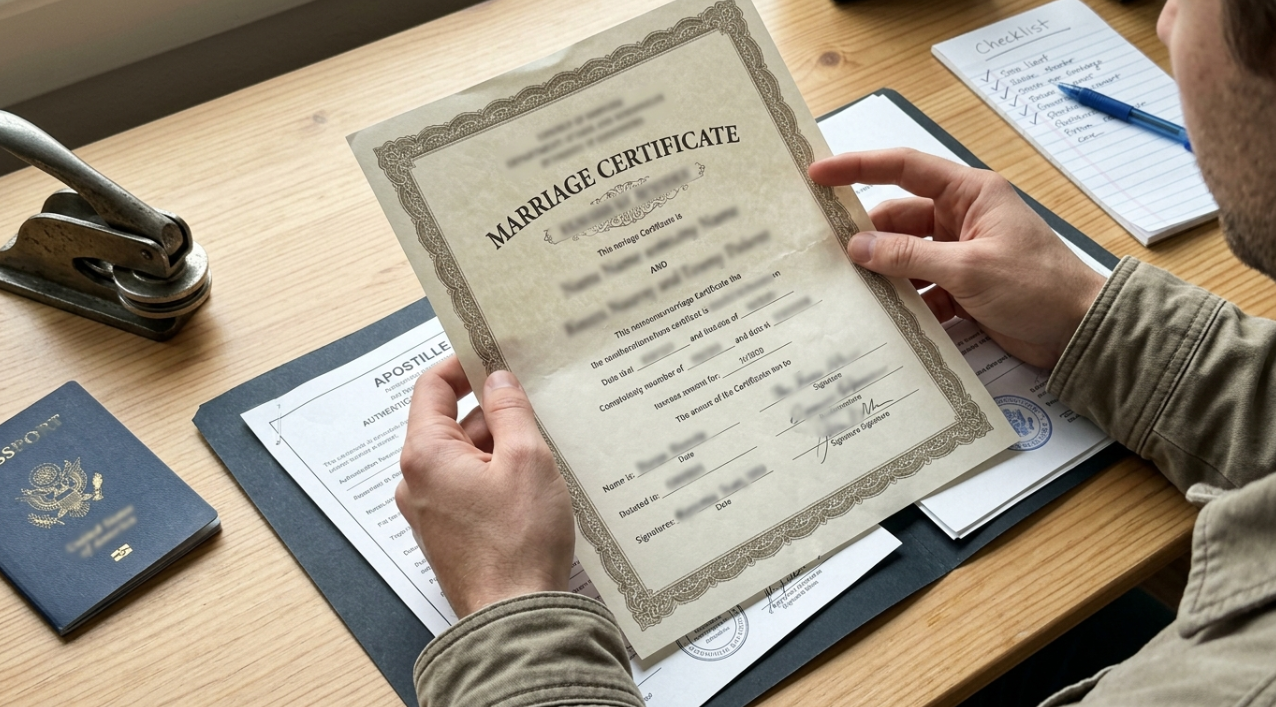
This deserves its own section because the misunderstanding is so widespread. Many couples believe that getting an apostille on their Utah marriage certificate “legalizes” the marriage everywhere. It does not.
An apostille authenticates the origin of the document. It tells a foreign government: “This certificate genuinely came from Utah County.” It says nothing about whether the foreign government will accept the marriage itself. Utah’s own apostille authority makes this clear: apostilles verify origin, not contents or legal effect.
Courtly offers document legalization add-ons including apostille and embassy authentication. These services are genuinely useful for presenting a Utah certificate abroad, but they should be understood as document preparation, not recognition insurance.
Immigration: Where Same-Sex Online Marriage Safety Abroad Gets Complicated
For many international same-sex couples, the real goal behind an online marriage is immigration. A U.S. marriage certificate can potentially support a spouse visa petition, an I-130, or adjustment of status. But immigration agencies apply their own rules on top of the certificate.
U.S. immigration
U.S. visa adjudication recognizes same-sex marriages if valid in the place of celebration, even if the applicant is in a country where same-sex marriage is illegal. This is a significant protection. However, if the spouses were not physically present together during the ceremony, USCIS may apply proxy-marriage rules and require evidence of post-ceremony consummation.
The marriage certificate alone is not enough. Couples still need evidence the marriage is bona fide: shared finances, communication records, photos together, joint plans. Immigration practitioners on LinkedIn emphasize that marriage-based cases are evidence-driven, not just certificate-driven. One immigration law firm posted a same-sex spouse immigrant-visa success story involving a Utah remote-appearance ceremony with the case processed through the U.S. Embassy in Manila, but stressed the importance of careful evidence planning.
If you are considering a U.S. spouse visa after an online marriage, consult with a visa attorney before the ceremony, not after.
Canada
Canada is the clearest warning example. Immigration, Refugees and Citizenship Canada (IRCC) states that it does not recognize marriages conducted by proxy, telephone, internet, or fax if one or both parties were not physically present, except for narrow exemptions such as certain Canadian Armed Forces cases.
A marriage can be perfectly valid in Utah and completely unusable for Canadian spousal sponsorship. Couples targeting Canada should know this before spending money on a ceremony.
Other countries
If the goal is a dependent visa in Australia, the UK, an EU member state, or any other country, the same principle applies. U.S. validity does not equal automatic acceptance by a third-country immigration system. Verify the rules of the specific system before the ceremony.
Immigration practitioners on LinkedIn frame Utah online marriage as “possible but conditional” for immigration purposes. Boundless Immigration posted that proxy or virtual marriage can support a U.S. green card, but only if strict USCIS requirements are met. The consistent message from professionals: plan the evidence strategy before the wedding, not after.
Country-by-Country Recognition Can Differ
The following examples illustrate why couples should verify the rules with the relevant government or immigration authority rather than relying on the fact that a marriage is valid in Utah.
Country/system | Key issue | What couples should verify |
|---|---|---|
United States | U.S. immigration generally applies the place-of-celebration rule to marriage validity, but physical presence can matter for spouse classification | USCIS requirements, ceremony details, and evidence |
Canada | IRCC does not recognize marriages performed by internet, telephone, fax, or proxy when one or both parties were not physically present, subject to narrow exceptions | Whether the couple qualifies under an alternative relationship category or exception |
United Kingdom | Foreign marriages can be recognized when specified legal conditions are satisfied | Whether the foreign marriage meets UK recognition requirements |
Australia | Partner migration has its own relationship and evidence requirements | Whether the specific marriage and ceremony satisfy Australian immigration rules |
Other countries | Rules vary substantially | Recognition of same-sex marriage, remote ceremonies, legalization, translation, and immigration requirements |
Canada is a particularly important example: IRCC expressly states that it does not recognize internet marriages where one or both parties were not physically present, subject to limited exceptions.
The purpose of this table is not to label countries as "safe" or "unsafe." It shows why the specific country + specific agency + specific purpose must be checked before relying on an online marriage.
Personal Safety: What Same-Sex Couples Should Check
Same-sex online marriage safety abroad is not only about paperwork. In many parts of the world, it is about physical survival.
The U.S. State Department advises LGBTQ+ travelers to research destination-specific laws and customs, noting that more than 60 countries criminalize consensual same-sex relations. Canada’s travel guidance tells 2SLGBTQI+ travelers to research laws, safety recommendations, and social customs before departure. The UK Foreign Commonwealth and Development Office warns that public displays of affection may receive unwanted attention in some places.
Here is a practical checklist for couples considering same-sex online marriage safety abroad:
Check LGBTQ+ laws and social attitudes in your country of residence, not just the destination.
Check laws in transit countries if traveling with marriage documents.
Decide whether disclosing the marriage to employers, landlords, family, or authorities is safe.
Use a secure email account for ceremony-related communications.
Avoid shared devices and public Wi-Fi during the ceremony or when handling documents.
Consider shipping the marriage certificate to a trusted address in a safe jurisdiction rather than your home.
Do not post ceremony screenshots or wedding announcements on social media if living in or traveling through a hostile jurisdiction.
Keep apostilled documents separate from casual travel papers.
Enroll in the U.S. State Department’s STEP program (for U.S. citizens) or your country’s equivalent.
Identify LGBTQ±safe legal, medical, and consular contacts before you need them.
A Courtly user on Reddit chose online marriage partly because marrying locally in Morocco required heavy paperwork and intrusive requirements. For some couples, the privacy of a remote ceremony is itself a safety feature. But privacy during the ceremony does not protect against risks after the ceremony if documents are mishandled or disclosed.
When Online Marriage Is Safer Than a Destination Wedding
For some couples, same-sex online marriage safety abroad is better served by staying home and getting married on a screen than by traveling to a marriage-equality country. Here is when that is likely true:
One or both partners cannot safely travel internationally.
Visa restrictions make it impossible to enter a marriage-equality country together.
Local marriage requires invasive or discriminatory procedures.
A public ceremony would endanger the couple or their families.
A military deployment creates a narrow window (one commenter on Reddit noted that online marriage avoided a six-to-eight-month delay while stationed overseas).
The couple wants a legal marriage now and a symbolic celebration later, in a safer time or place.
And here is when a destination wedding might be better:
The destination has clear marriage equality and a straightforward process for foreign couples.
The couple can travel safely and afford the trip.
The destination’s certificate will be easier to use for the couple’s specific immigration or registration needs.
The country where recognition matters does not accept remote ceremonies.
IGLTA notes that separating the legal marriage from the destination celebration is increasingly common among LGBTQ+ couples. The legal piece happens quietly (online or at a courthouse), and the celebration happens wherever feels right. This “legal first, celebrate later” strategy reduces paperwork risk, avoids foreign bureaucracy, and lets couples control what they disclose and when.
When to Get Legal Advice Before Relying on Online Marriage
There are situations where same-sex online marriage safety abroad requires professional guidance before the ceremony. Not after. Before.
Get legal advice first if:
You live in a country that criminalizes same-sex relationships.
You need local recognition for residency, taxes, inheritance, property, or medical decisions.
You are applying for Canadian spousal sponsorship (IRCC’s online-marriage rule is strict).
You need a dependent visa in a third country.
You and your spouse will not meet in person after the ceremony but plan to file for U.S. spouse immigration.
Either partner was previously married and needs proof of a finalized divorce.
You need to change your name in a country that does not recognize the marriage.
You may later need to divorce in a country that does not recognize the marriage (you cannot easily dissolve something a court does not acknowledge).
The strongest position this article can take: before relying on an online marriage for immigration, residency, name change, benefits, or local registration, confirm the rules with the specific agency or a qualified attorney. Courtly can help couples complete the Utah online marriage process and prepare documents such as certificates, apostilles, or authentications, but foreign recognition and immigration acceptance depend on the country, agency, and facts of each couple’s case.
See how the process works and what Courtly can and cannot do for international same-sex couples.
Frequently Asked Questions
Is same-sex online marriage legal?
It can be. If performed through a jurisdiction that authorizes remote ceremonies and all legal requirements are met, the marriage is legally valid where performed. Utah County permits remote-appearance ceremonies with a Utah-based officiant, two adult witnesses, and real-time audio/video participation. Whether it is recognized elsewhere is a separate question.
Will a same-sex online marriage be recognized in my country?
It depends on the country and the purpose. Some countries recognize foreign same-sex marriages. Others do not. Even among those that do, some may not accept remote ceremonies or may require registration, apostille, translation, or a court order. Utah County warns that remote marriages may be invalid where the parties reside.
Does an apostille make my marriage valid abroad?
No. An apostille authenticates the origin of the document. It does not force a foreign government to recognize the marriage. Utah’s apostille authority is clear that the certificate verifies where the document came from, not its legal effect in another country.
Can we use a same-sex online marriage for a U.S. spouse visa?
Potentially. U.S. visa guidance recognizes same-sex marriages if valid in the place of celebration. But if the spouses were not physically present together during the ceremony, proxy-marriage rules may require evidence of post-ceremony consummation. Every case involves additional bona fide marriage evidence. An immigration attorney consultation before filing is strongly recommended.
Does Canada accept online marriage for spousal sponsorship?
Generally no. IRCC does not recognize marriages by proxy, telephone, internet, or fax if one or both spouses were not physically present, except for narrow exemptions. This is one of the most important rules for couples targeting Canada.
Is it safe to announce our online marriage while living abroad?
That depends on where you live. In jurisdictions that criminalize same-sex activity or where social attitudes are hostile, disclosure may create personal, legal, employment, housing, or family risk. Treat marriage documents as sensitive identity information and limit disclosure to trusted parties.
Should we have a legal online marriage and a symbolic destination ceremony?
For many LGBTQ+ couples, yes. Separating the legal marriage from the celebration avoids foreign legal complexity and gives the couple control over what they disclose, where, and when. The legal marriage happens privately online. The celebration happens wherever feels safe and meaningful.
How do we verify our online marriage is real?
Check the issuing county or state’s records where possible. Confirm the officiant filing. Keep both the digital and paper certificate. Order certified copies. Use apostille or authentication when presenting the document abroad. If you used a service like Courtly, retain ceremony records, receipts, and any video recording for your files.
Let us handle the paperwork.
Getting married is complicated. Courtly simplifies the process and provides everything necessary to get married online, including providing a licensed officiant who can perform a remote ceremony.
Get Married

Get married online.
Getting married is complicated. Courtly simplifies the process and provides everything necessary to get married online.

