

Same-sex online wedding ceremony ideas can include personalized vows, gender-neutral or couple-specific ceremony wording, virtual readings, unity rituals, guest participation, digital guestbooks, breakout-room celebrations, and camera-friendly wedding traditions. If the ceremony is legally binding, couples should also confirm the jurisdiction, officiant, witnesses, identification requirements, marriage certificate process, and whether the marriage will be recognized where they live or plan to use it.
For the best experience, keep the legal ceremony short and focused, personalize the language to the couple, assign someone to manage the technology, and move longer speeches, games, toasts, and celebrations into a separate virtual reception.
A same-sex online wedding ceremony can be simple, legal, emotional, and deeply personal. The key is designing for the format: keep the official ceremony focused, use language that reflects your relationship, make guests feel included on camera, and sort out any legal document needs before the wedding day.
“Same-sex” is the phrase most couples search for, but your ceremony language should reflect how you actually describe yourselves: two brides, two grooms, spouses, partners, wives, husbands, or simply your names. This guide uses the search term for clarity while supporting LGBTQ+ couples broadly.
Courtly for LGBTQ+ couples helps same-sex partners complete a fully remote, legally binding U.S. wedding from anywhere in the world.
What Are the Best Same-Sex Online Wedding Ceremony Ideas?
The best same-sex online wedding ceremony ideas combine meaningful personalization with a format that works well on video. Popular options include writing personalized vows, choosing affirming ceremony language, entering the video call together or from separate locations, including chosen family in readings or blessings, using a virtual unity ritual, exchanging rings on camera, inviting guests to participate through the chat, and holding a virtual reception after the ceremony. If the ceremony is intended to be legally binding, confirm the marriage requirements for the jurisdiction before planning the ceremony.
The simplest formula is: legal requirements first, personalized vows and wording second, guest participation third, and the virtual celebration last.
Same-Sex Online Wedding Ceremony Ideas at a Glance
Ceremony element | Simple option | More personalized option |
|---|---|---|
Entrance | Join the video call together | Enter from separate locations with a coordinated music cue |
Vows | Write 1–2 minute personal vows | Use prompts about your relationship, family, and future |
Pronouncement | “I now pronounce you married” | Use your preferred titles, such as spouses, wives, husbands, or partners |
Reading | Short poem or marriage reading | Reading from an LGBTQ+ writer or chosen family member |
Unity ritual | Unity toast | Handfasting, candle lighting, plant watering, or a digital time capsule |
Guest participation | Chat blessing | Guest readings, mailed celebration kits, or virtual witness messages |
Reception | Virtual toast | Breakout rooms, trivia, dancing, cake cutting, and a group photo |
Keepsake | Recording or screenshots | Digital guestbook, video messages, ceremony recording, and printed vows |
25 Same-Sex Online Wedding Ceremony Ideas
Looking for ways to make an online wedding feel personal rather than like a standard video call? Try one or more of these ideas:
Write personalized vows about your relationship, future, and the life you are building together.
Use your preferred pronouns and titles throughout the ceremony.
Enter the video call together if you are in the same location.
Create a two-screen entrance if you are marrying from different locations.
Have a chosen family member introduce you before the ceremony begins.
Play a meaningful song as guests enter the virtual ceremony.
Display a relationship photo slideshow in the virtual waiting room.
Include a short LGBTQ+ reading from an author whose work means something to you.
Ask a friend or family member to give a reading about love, family, or commitment.
Include a bilingual reading when guests speak different languages.
Light candles together or invite guests to light candles from home.
Try a handfasting ritual using matching ribbons or cords.
Create a digital time capsule with photos, letters, or meaningful objects.
Water a plant together as a symbol of growing your life together.
Exchange rings with a camera close-up so guests can see the moment clearly.
Invite guests to type a blessing in the chat after the pronouncement.
Create a digital guestbook for written messages and photos.
Mail celebration kits with candles, confetti, recipes, or other small wedding favors.
Invite two to four guests to give short toasts during the virtual reception.
Use breakout rooms so you can spend a few minutes with smaller groups of guests.
Take a virtual group screenshot immediately after the ceremony.
Host a virtual cake cutting with each partner holding a cake or dessert.
Create a shared playlist for guests to dance along from home.
Play a couples trivia game during the reception.
Record a private message for each other to watch again on your anniversary.
What Is a Same-Sex Online Wedding Ceremony?
It is a wedding between two people of the same sex or gender held over video call. It can be purely symbolic (a livestream for friends and family watching from home) or legally binding, depending on how and where the marriage is performed.
Utah County’s fully digital system allows couples to apply for a marriage license, hold a ceremony by remote appearance, and receive an official marriage license and certificate without visiting the office. The officiant’s physical presence in Utah at the time of the ceremony establishes the jurisdiction. Most applicants pay $71.75 for the Utah County marriage license, including processing fees.
Through Courtly, couples complete a fully remote, legally binding U.S. wedding via Utah. Courtly handles the license application, provides a certified officiant, offers optional witnesses, hosts the ceremony online, records it on select plans, and delivers digital and mailed U.S. marriage certificates.
One important caveat: Utah County itself warns that a marriage solemnized under Utah law through online remote appearance “may be invalid” in the country where the parties reside. Couples who plan to use the certificate abroad should verify local recognition rules and may need an apostille or authentication. More on that later.
Symbolic vs. Legally Binding Online Weddings
Not every online wedding ceremony is legally binding. Before choosing your ceremony format, decide whether you are planning a legal marriage, a symbolic ceremony, or a legal ceremony followed by a separate virtual celebration.
Type | What it means | Best for |
|---|---|---|
Symbolic online ceremony | A celebration that may not create a legal marriage | Couples who are already legally married or want a commitment ceremony |
Legally binding online ceremony | A marriage performed according to the laws of a jurisdiction that permits remote ceremonies | Couples who want the online ceremony itself to create a legal marriage |
Legal ceremony + virtual reception | A short legal ceremony followed by a longer celebration | Couples who want the legal portion to stay focused while still celebrating with guests |
The legal requirements can vary significantly by location. A remote ceremony may be valid where it is performed but not automatically recognized everywhere the couple lives, works, travels, or plans to use the marriage certificate.
If legal recognition matters for immigration, residency, taxes, benefits, insurance, or another official purpose, verify the requirements with the relevant government authority before the ceremony.
The Legal Ceremony Is Short. Design Everything Around It.
This is the single most important thing to understand when collecting same-sex online wedding ceremony ideas. The official legal ceremony is brief. Courtly’s officiant is booked for 40 minutes, but the actual ceremony should take less than 15 minutes. That constraint shapes every decision.
What fits inside the legal ceremony:
Welcome and introduction
Declaration of intent (“I do”)
Vows (1 to 2 minutes each)
Ring exchange
One short reading
One brief unity ritual
Pronouncement
Witness acknowledgment
What belongs before or after:
Long speeches and toasts
Slideshows and photo montages
Breakout-room receiving lines
Games, trivia, or polls
Virtual dance party
Family hangouts and casual conversation
Practitioners on Reddit who have hosted Zoom weddings consistently say the ceremony itself should be tight and focused, with longer celebrations happening separately. One detailed recap recommended assigning a tech-savvy helper to manage mute, unmute, and spotlight controls so the couple could focus on each other rather than screen logistics. Another couple used breakout rooms after their ceremony so they could visit smaller groups of guests, which worked far better than one chaotic group conversation.
Think of the 15-minute ceremony as the legal and emotional anchor. Build the party around it, not inside it.
A Simple 10–15 Minute Online Wedding Ceremony Timeline
A short online ceremony does not have to feel rushed. The key is giving every element a defined place.
Time | Ceremony element |
|---|---|
0:00–1:00 | Welcome and introduction |
1:00–2:00 | Short reading or message |
2:00–4:00 | Declaration of intent |
4:00–7:00 | Personal vows |
7:00–9:00 | Ring exchange |
9:00–11:00 | Unity ritual |
11:00–12:00 | Pronouncement |
12:00–15:00 | Kiss, congratulations, screenshot, and transition |
If your legal ceremony has specific requirements, follow the officiant's instructions rather than treating this timeline as a legal checklist. Save longer readings, speeches, games, and reception activities for after the official ceremony.
Affirming Ceremony Wording Ideas
The wording is where a same-sex online wedding ceremony becomes truly personal. Most default officiant scripts assume a bride and groom. That does not work here, and it does not have to.
Pronouncement Options
The pronouncement is the moment the officiant declares you married. Here are options that fit:
“I now pronounce you married.”
“I now pronounce you spouses for life.”
“I now pronounce you wife and wife.”
“I now pronounce you husband and husband.”
“I now pronounce you partners in marriage.”
“By the authority vested in me, I pronounce you legally married.”
“You may now celebrate your marriage with a kiss, a hug, or whatever feels right.”
The American Marriage Ministries recommends asking the couple directly how they want to be pronounced and notes that gender-neutral wording fits nonbinary, agender, or any couple who prefers it. AMM also makes a useful point: “same-sex” may be a helpful search term, but it may not be how the couple describes themselves. Adjust the script to match the people, not the keyword.
Title and Pronoun Checklist
Before the ceremony, confirm with your officiant:
What names should be used during the ceremony?
What pronouns?
Do you want “wife,” “husband,” “spouse,” “partner,” or something else?
Should the ceremony mention LGBTQ+ identity directly?
Do you want to reference marriage equality or the history behind it?
Are there family dynamics the officiant should avoid mentioning?
Wedding planners on LinkedIn emphasize asking for pronouns and titles before any ceremony. One practitioner urged vendors to replace gendered language like “bridal suite” and “bridal party” with broader terms like “getting ready room” and “wedding party.” The same principle applies to your script, your invitations, and anything your officiant says on camera.
Entrance Ideas for Same-Sex Online Ceremonies
Many LGBTQ+ couples want to reimagine the “groom waits, bride walks in” formula. An online ceremony gives you unusual flexibility because the camera creates its own choreography.
Enter the call together. Both cameras turn on at the same moment. This works best when you are in the same location.
Two-screen entrance. If partners are in different locations, each joins from a separate device and camera. The tech host spotlights both simultaneously.
Chosen-family introduction. A close friend, sibling, or mentor introduces each partner before the ceremony begins.
Walk toward each other on camera. If you are in the same room, start at opposite sides and meet in the center. Practitioners on Reddit’s r/LGBTWeddings have suggested this as a meaningful alternative to a traditional aisle, sometimes decided by a playful round of rock-paper-scissors.
Photo montage waiting room. Play a slideshow while guests join the call. One couple shared on Reddit that they ran a relationship photo slideshow during the Zoom waiting room phase, which gave guests something warm to watch while everyone connected.
Music cue entrance. Play a short song clip before your cameras activate. Keep it simple if you are livestreaming on a platform that might flag copyrighted audio.
Same-Sex Online Wedding Ceremony Script
Use this as a starting point and adapt the wording to your relationship, officiant, jurisdiction, and ceremony requirements.
1. Welcome
“Welcome, everyone. Thank you for joining us from wherever you are in the world to witness and celebrate the marriage of [Name] and [Name]. Although we are gathering through a screen today, the love, support, and community surrounding them are very real.”
2. Introduction
“Today, [Name] and [Name] are choosing to make a lifelong commitment to one another. They have chosen to share this moment with the people who matter most to them.”
3. Reading or Family Message
“Before we hear their vows, [Reader] will share a short reading about love, partnership, family, or commitment.”
4. Declaration of Intent
“[Name], do you take [Name] to be your spouse and promise to share your life with them?”
“I do.”
“[Name], do you take [Name] to be your spouse and promise to share your life with them?”
“I do.”
5. Personal Vows
“[Name], please share your vows.”
[Partner 1 reads their vows.]
“[Name], please share your vows.”
[Partner 2 reads their vows.]
6. Ring Exchange
“Please exchange your rings as a symbol of the promises you have made today.”
“[Name], I give you this ring as a reminder that I choose you, today and every day.”
“[Name], I give you this ring as a reminder that I choose you, today and every day.”
7. Unity Ritual
“[Name] and [Name] will now share a unity ritual representing the life they are building together.”
[Couple completes candle lighting, handfasting, unity toast, plant watering, or another ritual.]
8. Pronouncement
“Having declared your intentions, exchanged your vows and rings, and shared this commitment with those gathered here, I now pronounce you married.”
9. Closing
“May your marriage be filled with love, laughter, patience, friendship, and the courage to continue choosing one another. Congratulations.”
[Couple celebrates, kisses, hugs, or shares another personal gesture.]
Vow Ideas for Same-Sex Online Weddings
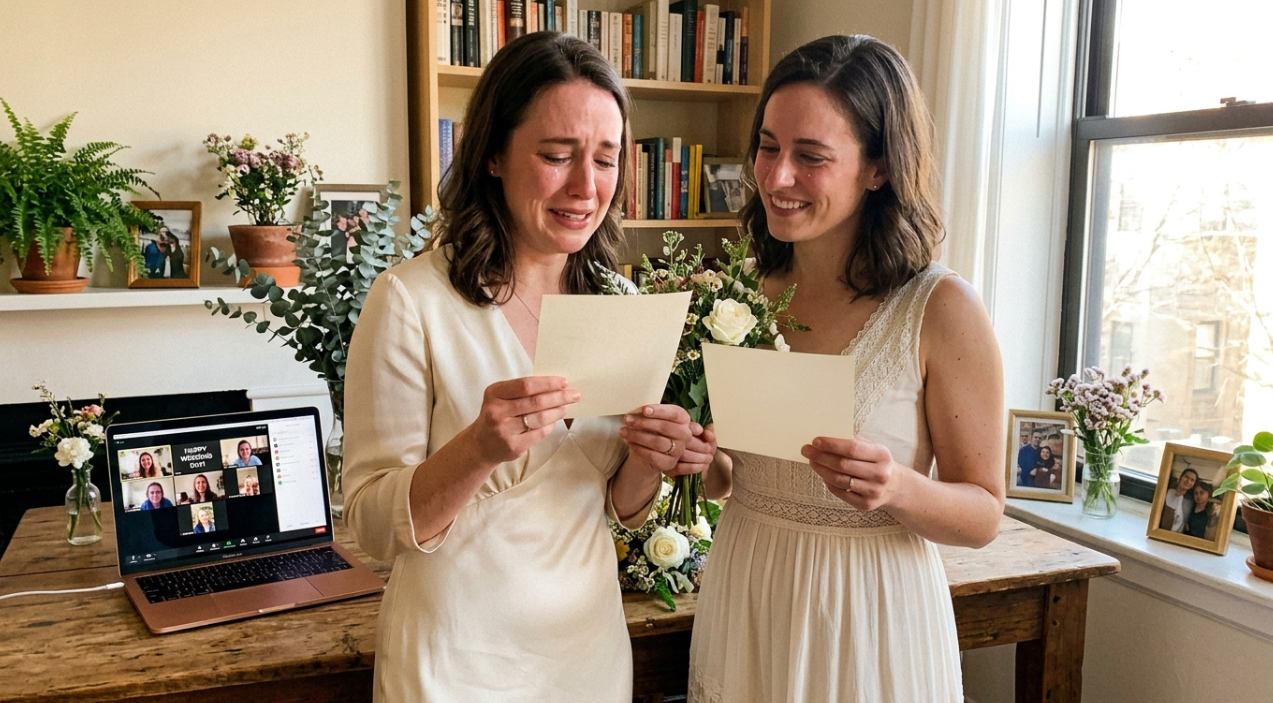
Vows are the emotional center. For a same-sex online wedding, they are also one of the most camera-friendly moments because they are spoken directly to another person.
Vow Prompts
These are starting points, not formulas.
“The first time I felt safe with you was…”
“What marriage means to us, especially as a same-sex couple, is…”
“The family we are building looks like…”
“The promise I make to you in front of our chosen family is…”
“When distance made things hard, we…”
“Today I choose you publicly, legally, and joyfully because…”
“The law may call this a marriage, but to me it means…”
Online-Specific Vow Tips
Keep vows to 1 to 2 minutes each. Short vows carry more weight on video than long ones.
Print them on paper. Do not rely on your phone screen if you are using the phone as your camera. If live speaking feels stressful, record private vows beforehand and say a shorter version during the ceremony. Look at the camera, not the screen, during the final lines.
Need help shaping your words? Try Courtly’s vow builder to structure your thoughts into ceremony-ready vows.
Reading Ideas for LGBTQ+ Online Ceremonies
A single short reading can add depth without stretching the ceremony too long for video. Pick one that fits the couple, not one that fills time.
Marriage-equality reading. An excerpt from the Supreme Court’s Obergefell v. Hodges decision, which held that the Fourteenth Amendment requires states to license same-sex marriages and recognize those performed elsewhere. Reddit users in r/weddingplanning have specifically recommended the closing passage about “equal dignity in the eyes of the law” as a powerful same-sex ceremony reading.
Queer author reading. Poetry or prose by an LGBTQ+ writer. Keep it under 90 seconds when read aloud.
Chosen-family reading. A friend reads a short piece about community, care, and witnessing. This works especially well when biological family is absent or unsupportive.
Bilingual reading. One paragraph in each family’s language. This resonates with international couples whose families speak different languages.
Faith-inclusive reading. For couples who want spiritual language without borrowing from non-affirming traditions.
Not every same-sex couple wants a political or identity-forward reading. Some couples prefer that their orientation not be emphasized at all. That is equally valid. The point is choice, not obligation.
Virtual Unity Ceremony Ideas
Unity rituals create a visible, shared moment on screen. These are some of the strongest same-sex online wedding ceremony ideas because they translate naturally to video without losing meaning.
Candle Lighting Across Households
Ask guests to light candles from wherever they are. The couple lights theirs last. In gallery view, the grid of small flames creates a visual wall of support that photographs beautifully even as a screenshot.
Handfasting
The couple ties ribbons or cords around joined hands while the officiant explains the symbolism. If partners are in different locations, each holds a matching cord. Practitioners on Reddit’s r/LGBTWeddings frequently mention handfasting as a meaningful nontraditional ceremony element that works for couples of any orientation.
Digital Time Capsule
Each partner shows one item on camera: a photo, a ticket stub, a letter, a small object from the relationship. Explain its significance briefly. These objects become part of the ceremony recording, a living archive of what mattered at this moment.
Unity Toast
Everyone raises a glass after the pronouncement. Simple, universally accessible, and effective on camera.
Plant Watering
Each partner waters a plant or seedling, together or simultaneously from different locations. A good choice for couples who want something living and growing rather than symbolic.
Ring Close-Up
The tech host spotlights the couple’s camera during the ring exchange. If the couple is in separate locations, each partner places their own ring on while repeating the ring vow. This small camera direction makes a surprisingly big difference in how the moment feels to guests watching.
Guest Participation Ideas That Work Online
The challenge with virtual weddings is making guests feel like participants rather than passive viewers. These ideas close that gap.
Digital Guestbook
Options include a Google Doc, a shared slideshow, a Kudoboard, a video-message folder, or wedding website comments. Practitioners on Reddit’s r/LGBTWeddings have recommended Google Docs and video guestbooks as low-friction options that even less tech-savvy guests can use.
Chat Blessing
Ask guests to type one word for the couple after the pronouncement: joy, home, adventure, peace, family. Save the chat log afterward. It becomes a keepsake you can print or frame.
Virtual Witness Moment
Witnesses can each say one short sentence on camera: “We see you.” “We support this marriage.” “We are honored to witness your vows.” Courtly can provide optional witnesses, or couples can bring their own.
Mailed Celebration Kits
Send guests a small kit before the wedding: confetti, a mini candle, a tea bag, a cocktail recipe, a printed program, or a sealed “open when we say I do” envelope. One Reddit user in r/LGBTWeddings suggested mailing sealed envelopes as a remote bouquet-toss variation.
Breakout-Room Receiving Line
After the official ceremony, guests move into small Zoom breakout rooms. The couple visits each group for 3 to 5 minutes. Multiple Reddit wedding recaps confirm this works dramatically better than trying to have one giant group conversation where everyone talks over each other.
Spotlighted Toasts
Pick 2 to 4 speakers. Do not open the floor to everyone. Assign a tech host to unmute and spotlight each speaker in order.
For more virtual celebration tactics, read Zoom wedding ideas and tips.
Online Reception Ideas After the Ceremony
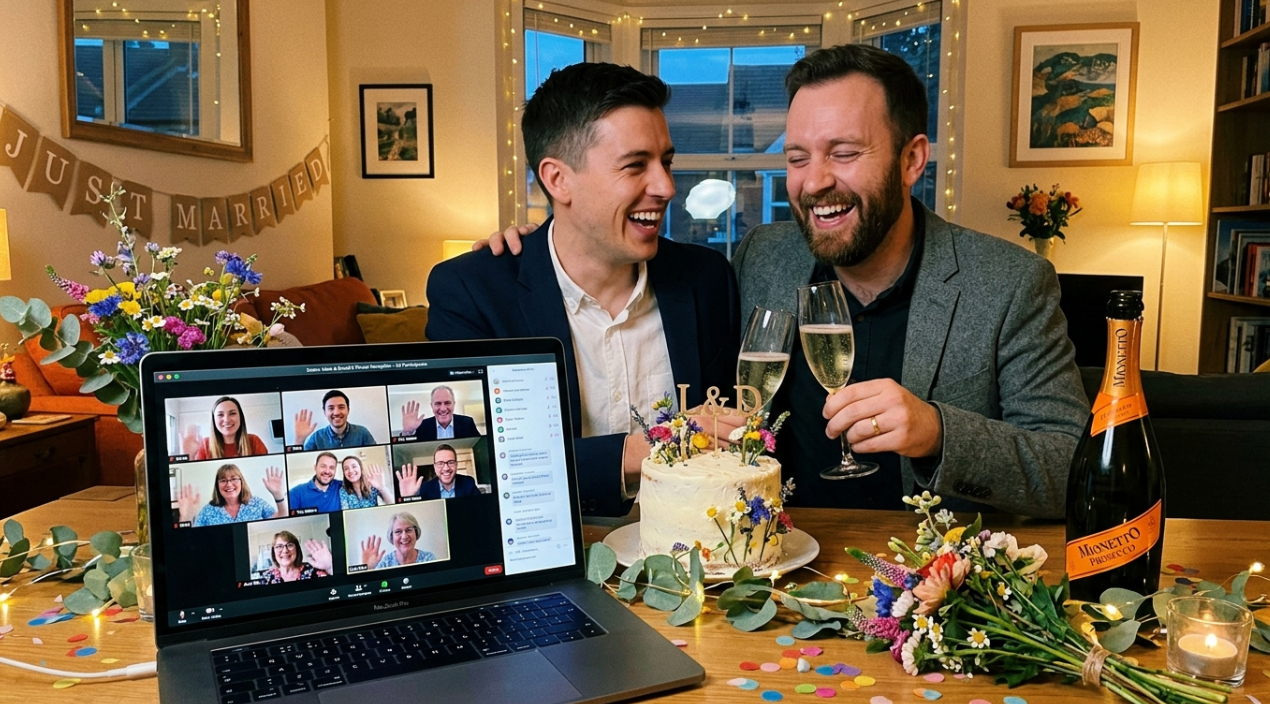
These should be clearly separated from the legal ceremony. The reception is where you have room to be playful, messy, and long.
Virtual cake cutting (each partner cuts their own cake on camera)
First dance on screen
Guests dance from home with a shared Spotify playlist
Trivia about the couple using Zoom polls
Screenshot group photo in gallery view
Breakout-room “family tables”
Live musician surprise performance
A friend delivers a PowerPoint toast (surprisingly popular and consistently funny)
Pride-themed cocktail or mocktail recipe that everyone makes together
Family recipe dinner where all guests cook the same dish
The Williams Institute found that same-sex couples who had weddings reported an average of 44 guests. Online reception formats work well at that scale because breakout rooms and spotlighting keep things manageable. The same study found that 10.7% of same-sex couples who had weddings experienced discrimination while planning, and another 7.2% were unsure. An online ceremony sidesteps many of those interactions entirely.
Backdrop and Camera Setup Ideas
Keep this practical and camera-focused. Nobody needs to rent a virtual studio.
Simple uncluttered background behind the couple
Pride flag visible if meaningful, not mandatory
Flowers or plants at eye level, not below the camera’s frame
Matching or complementary outfits (plan how they look on screen together)
Colored lighting for warmth
A table with rings, certificate folder, candles, and flowers
Cultural items that represent both families
One Reddit user suggested using a green screen with the originally planned ceremony location or a place meaningful to the couple as the virtual background. That idea adds personal significance without requiring travel.
Tech Checklist for a Smooth Online Wedding
The difference between a moving ceremony and an awkward one is preparation. Every practitioner who has shared a virtual wedding recap says the same thing: rehearse the night before.
Before the Ceremony
Test internet speed on every device that matters
Use a laptop if possible (bigger screen, better camera angle)
Set the camera at eye level using a tripod or stack of books
Test microphones and speakers
Check lighting (face a window or use a ring light)
Close all notifications on every device
Assign a tech host to manage mute, spotlight, and recording
Rehearse with the officiant, witnesses, and speakers
Prepare a backup device in case something crashes
Send guests a short “how to join” guide with the link, time, and expectations
During the Ceremony
Keep all guests muted except when they are called to speak
Spotlight the couple and officiant
Use the chat only when prompted
Keep vows printed on paper
Follow a short written run of show
After the Ceremony
Save the recording immediately
Save the chat log
Take screenshots in gallery view
Move guests to breakout rooms or a separate reception call
Back up the video file to a second location
Zoom supports waiting rooms, spotlighting (up to nine participants at once), breakout rooms, and participant management features that make online wedding logistics practical when someone is assigned to run them.
Time-Zone and Multilingual Ceremony Planning
Many same-sex couples planning an online wedding ceremony are international. One partner may be in Southeast Asia, the other in Europe. Family could be scattered across three continents.
Practical ideas:
Choose a ceremony time that is “least bad” for both families. Early morning in one time zone and evening in another tends to work.
Send calendar invites in each guest’s local time zone.
Use a bilingual invitation and ceremony program.
Include vows in two languages.
Ask one family member from each side to give a short blessing in their own language.
Use a live translation add-on if family members do not speak the ceremony language. Courtly offers live ceremony translation in Spanish, Italian, French, Chinese, Portuguese, Filipino, and more.
Record the ceremony so relatives who could not attend live can watch later.
Courtly’s officiants are available 24/7, which means ceremonies can be scheduled across time zones without being locked into business hours.
For couples in different countries, see this guide for international same-sex couples.
Safety and Privacy Tips for LGBTQ+ Online Weddings
This section matters. Same-sex marriage is legal in 37 UN member states and Taiwan, according to ILGA World’s 2025 data. That means in most of the world, it is either not recognized or actively penalized. If either partner or any guests are joining from a country where being visibly LGBTQ+ creates risk, plan for safety.
Use password-protected meeting links.
Do not post the ceremony link publicly or on social media.
Let guests use first names only if privacy matters.
Avoid public livestreaming if either partner lives somewhere unsafe.
Use neutral invitation language if needed for guests in hostile environments.
Decide in advance whether the recording can be shared, and with whom.
Consider whether rainbow decor, public hashtags, or social posts could create unwanted exposure for anyone on the call.
An online ceremony already offers a layer of privacy that in-person weddings do not. Use that advantage intentionally.
Legal Documents After the Ceremony
A beautiful ceremony means more when the paperwork is handled. Here is what to address after your same-sex online wedding.
Save the recording. If your plan includes ceremony video recording and cloud storage, download a backup copy to your own device.
Store your certificate safely. Courtly delivers both digital and mailed U.S. marriage certificates. Keep copies in more than one location.
Check whether apostille or authentication is needed. If you plan to use a U.S. marriage certificate in another country, you may need an apostille (for countries in the Hague Apostille Convention) or embassy authentication (for countries outside it). USAGov explains that the destination country determines which document certification is required.
Courtly offers document legalization add-ons, including apostille and embassy authentication packages. For a detailed walkthrough, see the apostille guide for marriage certificates.
For immigration purposes, proceed carefully. USCIS materials state that marriages where both parties were not physically present together generally require consummation after the ceremony for immigration spouse recognition. Canada’s IRCC generally does not recognize internet marriages for spousal sponsorship, with narrow exceptions. Couples should consult official guidance or an immigration attorney.
Read more about online marriages and immigration.
Key Terms to Know
Online wedding: A wedding ceremony conducted over video conference. Some are symbolic livestreams, while others are legally binding depending on the jurisdiction.
Remote appearance ceremony: A ceremony where one or more participants appear by video. Utah County’s digital system uses this approach to allow marriage from anywhere.
Officiant: The person who solemnizes the marriage. For Utah online marriages, the officiant’s physical location in Utah establishes the legal jurisdiction.
Witnesses: People who observe the ceremony and may be required for legal completion. Courtly’s Fast-Track tier includes two legal witnesses provided by Courtly, or couples can bring their own.
Declaration of intent: The “I do” moment where each person confirms they intend to marry.
Pronouncement: The officiant’s formal statement that the couple is married.
Unity ritual: A symbolic ceremony moment showing two lives joining, such as candle lighting, handfasting, or a shared toast.
Chosen family: Friends, mentors, community members, or affirming relatives who function as family. This concept is central to many LGBTQ+ couples whose biological families may be absent or unsupportive.
Apostille: A certificate verifying the origin of a public document for use in a country that belongs to the Hague Apostille Convention.
The L.O.V.E. Framework for Planning
A simple way to organize your same-sex online wedding ceremony ideas into an actual plan instead of a scattered Pinterest board.
L, Legal first. Confirm the jurisdiction, officiant, witnesses, IDs, ceremony requirements, certificate delivery, and any apostille or authentication needs.
O, Online flow. Plan camera angles, sound, lighting, the tech host role, mute and spotlight settings, guest instructions, recording, and a backup device.
V, Voice and vows. Choose pronouns, titles, the pronouncement wording, readings, vows, and how visible to make LGBTQ+ identity in the ceremony.
E, Everyone included. Design chosen-family roles, bilingual support, a guestbook, breakout rooms, accessibility features, privacy protections, and the post-ceremony reception.
This framework keeps the planning grounded. It prevents the common trap of collecting dozens of inspiration ideas without knowing which ones fit inside a 15-minute legal ceremony and which belong in the reception.
FAQ
Are same-sex online weddings legal?
They can be. In the United States, same-sex marriage has been constitutionally protected since Obergefell v. Hodges in 2015, with additional federal statutory protection from the Respect for Marriage Act signed in December 2022. Utah County allows remote appearance ceremonies through its digital marriage license system, and Courtly facilitates fully remote, legally binding U.S. weddings through Utah. However, recognition abroad varies. Some countries may not accept a marriage performed by remote appearance. Couples should verify local rules before relying on the certificate for foreign registration or immigration.
How long should an online wedding ceremony be?
Courtly’s officiant is booked for 40 minutes, but the actual legal ceremony should take less than 15 minutes. Longer speeches, slideshows, games, and reception activities belong before or after the official ceremony segment.
What should the officiant say instead of “husband and wife”?
Use whatever the couple prefers: “married,” “spouses,” “partners,” “wife and wife,” “husband and husband,” or a custom phrase. The American Marriage Ministries recommends asking the couple directly rather than defaulting to gendered language.
Do we need witnesses for an online wedding?
It depends on the process. Courtly offers optional witnesses as an add-on, and the Fast-Track plan includes two legal witnesses provided by Courtly. Couples can also bring their own witnesses to the video call.
Will an online marriage work for immigration?
It depends on the immigration system. USCIS has specific rules for marriages where both parties were not physically present together. Canada’s IRCC generally does not recognize internet marriages for spousal sponsorship, with narrow exceptions. Couples should consult the relevant immigration authority or an attorney before relying on an online marriage certificate for visa purposes.
Should we get an apostille after our online wedding?
If you plan to use a U.S. marriage certificate in another country, you may need an apostille (for Hague Convention countries) or embassy authentication (for non-Convention countries). The destination country determines which type of certification is required. Courtly offers document legalization add-ons for both.
Can guests attend the legal online ceremony?
Yes. Keep guests muted during the legal portion and use spotlight mode to keep the focus on the couple and officiant. Save longer conversations, toasts, and group activities for a separate reception segment.
This article is general information, not legal advice. Marriage recognition, immigration rules, and document requirements vary by country and agency. If you plan to use your marriage certificate for immigration, residency, benefits, or foreign registration, confirm the rules with the relevant authority or a qualified attorney.
Let us handle the paperwork.
Getting married is complicated. Courtly simplifies the process and provides everything necessary to get married online, including providing a licensed officiant who can perform a remote ceremony.
Get Married

Get married online.
Getting married is complicated. Courtly simplifies the process and provides everything necessary to get married online.

