

A virtual marriage is a legal marriage ceremony conducted through live video where the couple, officiant, and witnesses participate in real time. It becomes legally binding only when performed under a jurisdiction that permits remote participation, with a valid government marriage license, an authorized officiant, and proper recording. Utah is the leading U.S. example. Recognition by other countries or immigration agencies is not automatic and depends on the rules of each reviewing authority.
A virtual marriage is not just a wedding on Zoom. It is a legal process that, when done correctly, produces the same government-issued marriage certificate as an in-person ceremony. But the details matter enormously, and getting them wrong can leave a couple with a meaningful memory but no legal standing.
This guide explains what virtual marriage actually means, when it is legally valid, how it differs from related concepts like virtual weddings and proxy marriages, and what to watch for if you plan to use a virtual marriage certificate for immigration, foreign registration, or other official purposes.
Compare online marriage packages to see what the process involves and costs.
Quick Answer
A virtual marriage is a legally recognized marriage ceremony conducted over live video when performed under the laws of a jurisdiction that allows remote participation. It requires a valid government-issued marriage license, live consent from both spouses, an authorized officiant, required witnesses, and official recording with the issuing government. A virtual marriage is different from a virtual wedding because only the former can create a legally binding marriage.
Key Takeaways
Virtual marriage can be legally valid.
Zoom alone does not create a legal marriage.
Utah is the leading U.S. jurisdiction for remote marriages.
A government marriage license is still required.
Recognition for immigration and foreign countries varies.
Apostilles authenticate documents but do not guarantee recognition.
Always verify whether your destination country accepts remote marriages.
At a Glance
Question | Answer |
|---|---|
Is virtual marriage legal? | Yes, in certain jurisdictions. |
Is a Zoom wedding automatically legal? | No. |
Can foreigners use Utah? | Yes. |
Can spouses be in different countries? | Yes. |
Is it recognized everywhere? | No. |
Is it valid for immigration? | Sometimes, depending on USCIS rules and evidence. |
Do you receive a government certificate? | Yes, if legally performed. |
Virtual Marriage Definition
Virtual marriage is a legally solemnized marriage ceremony conducted through live video, where the couple, an authorized officiant, and any required witnesses participate remotely in real time and the marriage is recorded by the proper government authority.
The word “virtual” describes the ceremony format. The word “marriage” describes the legal status that results. The legal authority does not come from the internet or from video software. It comes from the marriage laws of the jurisdiction that issues and records the license.
A shorter way to put it: virtual marriage means getting legally married through a live online ceremony instead of appearing together in the same physical room, as long as the ceremony follows the marriage laws of the jurisdiction that issues and records the marriage.
Also called: online marriage, remote marriage, video-conference marriage.
Not the same as: a livestreamed wedding celebration, a symbolic online ceremony, a religious-only ceremony with no civil license, or a downloadable “marriage certificate” from a private website.
The Five Requirements That Make a Virtual Marriage Legal
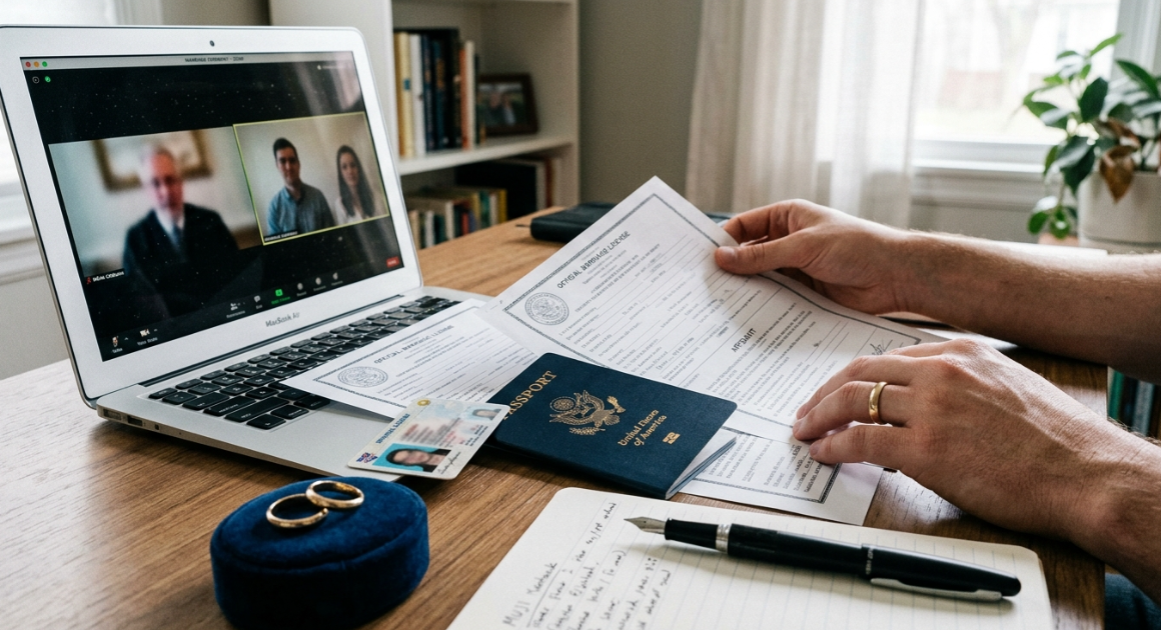
A virtual marriage becomes legally meaningful only when five things are true:
Jurisdiction. The marriage is performed under a jurisdiction that specifically allows remote participation in the ceremony.
License. A government marriage license is issued before the ceremony takes place.
Live consent. Both parties declare their intent to marry in real time, not by filling out a form.
Authorized officiant and witnesses. A qualified officiant solemnizes the marriage, and the required number of witnesses participate.
Recording and certificate. The completed marriage is submitted to and recorded by the issuing government office, producing an official marriage certificate.
This framework matters because it separates ceremony format from legal validity. A beautifully produced Zoom wedding can still have zero legal effect if these five steps are not completed under a permitting jurisdiction.
Under Utah Code § 81-2-302, a marriage is considered solemnized when the parties have a valid license, each party willingly declares intent to marry, required affidavits are filed, an officiant pronounces the parties married, and at least two adults witness the declarations and pronouncement.
Where Is Virtual Marriage Legal?
Many people assume every U.S. state allows online marriage, but that is not the case.
Most states only allow one or two parts of the process online, such as submitting an application. Few jurisdictions currently permit the entire process—from license application through ceremony and certificate—to be completed remotely.
Jurisdiction | Online License | Remote Ceremony | Fully Remote Marriage |
|---|---|---|---|
Utah County | Yes | Yes | Yes |
New York (selected counties) | Online license available | Limited | Partial |
Most U.S. states | Partial | No | No |
Always verify the current requirements before scheduling a ceremony because marriage laws change.
Virtual Marriage vs. Virtual Wedding vs. Proxy Marriage
These terms get confused constantly, and the confusion can cause real problems.
Term | What it means | Always legally binding? |
|---|---|---|
Virtual marriage | A legally solemnized marriage ceremony conducted by live video under a jurisdiction’s marriage laws | Only if legal requirements are met |
Online marriage | Broad consumer term for getting married through an online process (license, ceremony, certificate) | Depends on the jurisdiction and process |
Virtual wedding | A wedding celebration held or livestreamed online | Not necessarily |
Livestream wedding | An in-person ceremony broadcast to remote guests | The livestream itself is not the legal act |
Proxy marriage | One or both parties are represented by someone else or are not physically present | Varies by jurisdiction; immigration agencies may require consummation |
The key distinction: a virtual wedding is about how people attend the celebration. A virtual marriage is about whether the law recognizes the couple as married.
USCIS does not recognize proxy marriages for immigration purposes unless the marriage has been consummated, and immigration agencies may apply similar scrutiny to virtual marriages where both spouses were not physically together during the ceremony.
How a Legally Valid Virtual Marriage Works
The process is more structured than many people expect. It is not “click and married.” Here is the typical sequence, using Utah County as the primary example since it operates one of the most developed fully remote marriage systems in the United States.
Step 1: Check eligibility. Both applicants must meet basic requirements: legal age, not currently married, valid government-issued photo ID.
Step 2: Apply for a marriage license online. In Utah County, applicants need a valid email address, government-issued photo ID, a smartphone to scan their ID and face, and a credit or debit card for fees. Most applicants pay $71.75 with no waiting period, and the license expires in 32 days.
You can start the online marriage license process through a service that handles the application on your behalf.
Step 3: Schedule a live video ceremony. The officiant must be authorized and physically located in the jurisdiction that allows the ceremony. In Utah, the officiant’s physical location in the state becomes the “host location” where all participants gather by video.
Step 4: Attend the ceremony in real time. Both members of the couple and two witnesses must appear by live video. The officiant verifies the identity of both applicants and both witnesses before beginning. The couple and witnesses do not need to be in the same physical location.
Step 5: Officiant files the marriage. Utah County’s system allows the officiant to submit the certificate electronically through an officiant portal. The license exists as a URL and QR code, and witnesses’ names appear on the certificate without needing to sign.
Step 6: Receive the marriage certificate. The couple receives a digital certified copy by email after the ceremony. Paper certified copies are mailed within two to three business days for continental U.S. addresses.
How Long Does a Virtual Marriage Take?
Most couples complete the process within a few days, although timelines vary depending on scheduling and document processing.
Step | Typical Time |
|---|---|
License application | 15–30 minutes |
License approval | Same day to 2 business days |
Ceremony scheduling | Same day to several days |
Ceremony | 10–20 minutes |
Digital certificate | Usually same day |
Paper certificate | 2–7 business days |
Apostille (if needed) | Several days to several weeks |
Is Virtual Marriage Legal?
Yes, but not everywhere. And not automatically.
In the United States, marriage law is primarily state law. Most states have not built a fully remote end-to-end marriage process. According to ITIF’s 2026 report, 32 states offer some form of online marriage license application, but many still require an in-person appearance or paper documents for at least one step. Only New York and Utah had a fully online license process in at least one major jurisdiction.
A virtual marriage is not automatically valid just because it happens online. It is valid only when the issuing jurisdiction allows the process and all legal requirements are completed. This is worth repeating because it is the single most common misunderstanding. For a deeper explanation, read about whether online weddings are legal and what makes the difference.
Utah Remote-Appearance Marriage: The Main Example
Utah is the go-to example for virtual marriage because Utah County has built a system that supports the entire process online. When people ask “what is virtual marriage” and want a concrete answer, Utah is almost always the reference point.
Key facts about Utah’s system:
No residency or citizenship requirement. Anyone who meets the basic eligibility criteria can apply for a Utah marriage license, regardless of where they live.
Officiant must be physically in Utah. That location becomes the host location for the ceremony.
Couple and witnesses join by live video. They do not need to be together or even in the same country.
No waiting period. The license must be used within 32 days.
Fully digital license system. The license exists as a URL and QR code.
The 2026 Law Change
Effective May 6, 2026, Utah law added a significant requirement. For online marriages where the parties are not physically present with the officiant, the county website must post a warning that the marriage may be invalid in the country where the parties reside. The officiant must repeat that warning before solemnizing the marriage.
This change matters because it signals, from Utah itself, that a Utah virtual marriage certificate is not a guarantee of worldwide recognition. The safest way to think about it: legally issued in Utah, but foreign recognition should be verified before relying on the certificate abroad.
Who Uses Virtual Marriage?
Virtual marriage is not a novelty. It serves real needs for specific groups of people.
Long-distance couples who cannot easily travel to the same location for an in-person ceremony. International couples separated by borders and visa restrictions. Same-sex couples who live in countries where local law is unsafe or prohibits their marriage, and who need a legal marriage option from a jurisdiction that recognizes them. Military couples facing deployment timelines that make traditional wedding planning impossible.
Then there are couples with mobility or health limitations who cannot travel, expatriates living abroad without access to a fitting local marriage process, and couples who simply want the legal marriage completed now with a larger celebration planned for later. Immigration-focused couples also make up a significant share, though they need to approach the process with extra caution and documentation.
Recognition in the U.S. and Abroad
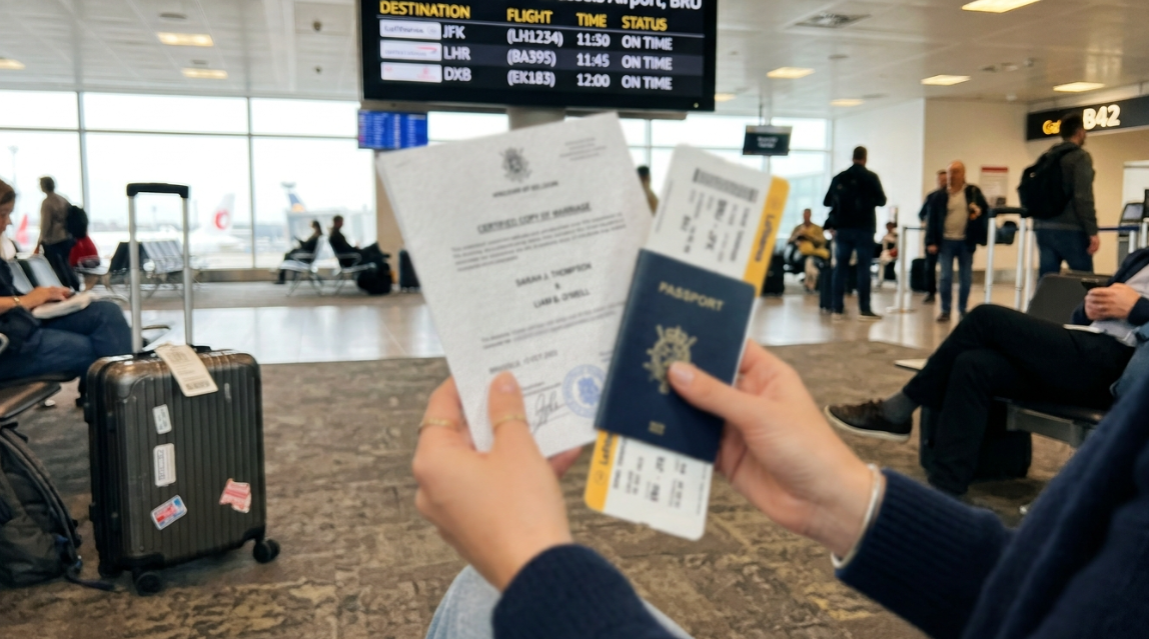
Domestic recognition, immigration recognition, and foreign recognition are three separate questions. Many people treat them as one, which creates problems.
Within the United States, marriages valid in one state are generally recognized by other states under the Full Faith and Credit Clause.
For U.S. immigration, USCIS applies what is called the place-of-celebration rule: the legal validity of a marriage is generally determined by the law of the place where the marriage was celebrated. A marriage certificate is usually prima facie evidence that the marriage was properly performed. But USCIS also says it does not recognize proxy marriages where one party was not present unless the marriage has been consummated.
For foreign recognition, there is no universal rule. Utah County explicitly warns that a marriage solemnized under Utah law through online remote appearance may be invalid in the country where the parties reside.
Apostille and Embassy Authentication
If you need to use a U.S. marriage certificate abroad, you will likely need an apostille or embassy authentication. An apostille is a certificate issued by the state (in Utah’s case, the Lieutenant Governor’s Office) that verifies the origin of a public document for use in countries that are part of the Hague Apostille Convention.
But here is the critical distinction: an apostille verifies that the document is authentic. It does not force a foreign government, court, immigration office, or employer to treat the marriage as valid for every purpose. Learn more about the difference between apostille vs authentication and when each one applies.
If you need help with document legalization for a marriage certificate, that is typically a separate step after the ceremony.
Apostille vs Marriage Recognition
Many couples mistakenly believe an apostille makes a marriage valid worldwide.
These are different concepts.
Apostille | Marriage Recognition |
|---|---|
Verifies document authenticity | Determines legal acceptance |
Issued by government | Decided by receiving authority |
Administrative process | Legal decision |
Does not validate the marriage itself | Determines whether the marriage is recognized |
When Is a Virtual Marriage Usually Accepted?
Acceptance depends on why you need the marriage certificate.
Purpose | Usually Accepted? |
|---|---|
U.S. name change | Usually |
Health insurance | Usually |
Banking | Usually |
Social Security | Usually |
IRS filing | Usually |
USCIS immigration | Depends |
Foreign immigration | Depends |
Foreign marriage registration | Depends |
Immigration Considerations
A large number of people searching “what is virtual marriage” are thinking about immigration. The question behind the question is often: “Can I use this for a spouse visa?”
The short answer is that a virtual marriage may be recognized for U.S. immigration if it is legally valid where celebrated and does not fall into an exception. But immigration recognition is not automatic just because a couple receives a certificate.
A USCIS Policy Alert states that virtual marriages are subject to the same requirements as other spousal cases, including the place-of-celebration rule. Immigration practitioners on LinkedIn have emphasized that USCIS acceptance of proxy-style marriages depends on consummation and proof that the parties met in person after the marriage.
Practitioners on Reddit report that couples need proof they were together in person after the online wedding, such as travel receipts, hotel bills, dated photos, and passport stamps. One VisaJourney user reported submitting a hotel bill and honeymoon pictures as evidence after a Utah virtual marriage.
Another common confusion: what to list as the place of marriage on immigration forms. For virtual marriages, the couple, officiant, and certificate may point to different locations. The typical guidance is to use the location shown on the marriage certificate and seek legal advice if an immigration form or foreign authority asks for more detail.
If immigration is a reason for your virtual marriage, consult an immigration attorney or qualified advisor before filing. Evidence of a valid marriage certificate may not be enough if USCIS asks about physical presence, consummation, or bona fide relationship evidence.
For couples navigating this process, a spouse visa consultation can help clarify what documentation you will need.
How to Tell If a Virtual Marriage Service Is Legitimate
Not all online marriage services are equal. Utah County itself states that online wedding companies vary greatly in quality and price, and the county does not endorse or partner with other companies.
Practitioners on Reddit have described online marriage services as packaging Utah County’s process into a more turnkey experience. Some couples report smooth results, while others have complained that the officiant or translator did not show up. One Reddit user with a Utah marriage license said they struggled to find a Zoom ceremony under $500 and felt that price was excessive for a short ceremony.
Before booking any service, ask these questions:
Who issues the marriage license, and which government office records it?
Who is the officiant, and where are they physically located during the ceremony?
Are witnesses included, or do you need to provide your own?
Is live translation available if needed?
What happens if the officiant misses the appointment?
What fees are refundable?
How quickly will the certificate be submitted and delivered?
Can the service help with apostille or embassy authentication?
Does the service explain its limitations honestly, or does it promise universal recognition?
A legitimate service should make the legal process easier to navigate. It should not replace the law or overpromise what a certificate can do.
Common Myths About Virtual Marriage
Myth: “Any Zoom wedding is legal.”
A video ceremony is legal only if the jurisdiction permits the process and all legal requirements are met. Streaming vows over Zoom does not create a marriage by itself.
Myth: “A virtual wedding and virtual marriage are the same thing.”
A virtual wedding may be a celebration only. A virtual marriage creates legal status after license, ceremony, and recording are completed under a permitting jurisdiction.
Myth: “If it is legal in Utah, every country must accept it.”
Utah itself requires officiants to warn couples that remote-appearance marriages may be invalid in the country where the parties reside.
Myth: “An apostille makes the marriage valid worldwide.”
An apostille verifies document origin for countries in the Hague Apostille Convention. It is not a universal recognition guarantee.
Myth: “Immigration only needs the certificate.”
USCIS applies place-of-celebration and proxy/consummation rules. The applicant bears the burden of establishing a valid marriage with supporting evidence.
The Virtual Marriage Validity Ladder
Not every online ceremony carries the same legal weight. Think of virtual marriage as a spectrum with five levels:
Level 1: Symbolic ceremony. A couple holds a video call and exchanges vows. No legal effect unless separate legal steps are completed.
Level 2: Remote celebration plus separate legal marriage. The couple livestreams a celebration but completes the legal marriage in person at another time. The legal marriage date is tied to the official filing, not the stream.
Level 3: Online license application only. The couple applies for a license online but must still appear in person for the ceremony or recording. This is not a fully virtual marriage.
Level 4: Remote-appearance ceremony. The license, live ceremony, officiant, witnesses, and filing are all completed under a jurisdiction that permits remote appearance. This can be a legally binding marriage in the issuing jurisdiction.
Level 5: Remote marriage plus document legalization plus purpose-specific recognition. The couple obtains certified copies, any needed apostille, and confirms the certificate will be accepted for its intended use (immigration, name change, foreign registration, insurance). This is the strongest practical status, but it still depends on the reviewing authority.
Understanding where your situation falls on this ladder helps you know what steps remain.
Frequently Asked Questions
What is virtual marriage in simple terms?
A virtual marriage is a legal marriage ceremony performed over live video instead of in person. It is legally binding when a government marriage license, authorized officiant, real-time consent, required witnesses, and official recording all happen under a jurisdiction that allows remote participation.
Is virtual marriage legally binding?
It can be. Legal validity depends on the jurisdiction. Utah is the most prominent U.S. example of a state that permits fully remote marriage ceremonies. Most U.S. states have not built a complete remote marriage process.
Do both partners need to be in the same location?
No. In Utah’s remote-appearance system, the couple and witnesses can each be in different locations. They join the ceremony by live video while the officiant is physically located in Utah.
Can non-U.S. citizens get married virtually through Utah?
Yes. Utah has no residency or citizenship requirement for marriage licenses. Anyone who meets the basic eligibility criteria can apply online.
Does USCIS recognize virtual marriage for immigration?
USCIS applies the place-of-celebration rule and treats a valid marriage certificate as prima facie evidence. However, virtual marriages receive the same scrutiny as other spousal cases, and proxy marriages are not recognized unless consummated. Consult an immigration attorney before filing.
What documents do you receive after a virtual marriage?
After a Utah remote-appearance ceremony, couples typically receive a digital certified copy of the marriage certificate by email, with paper copies mailed within a few business days. Additional documentation like an apostille may be obtained separately.
Can my country refuse to recognize a virtual marriage?
Yes. A foreign government is not obligated to accept a remote marriage performed under another country’s laws. Utah’s 2026 law update specifically requires a warning about this possibility before the ceremony.
How do I avoid fake online marriage certificates?
Verify that the service uses an actual government marriage license from a named jurisdiction, employs an authorized officiant, requires live consent and witnesses, files the marriage with the proper government office, and provides a certified marriage certificate. If a service promises instant certificates without these steps, that is a red flag.
This article is general information, not legal advice. Marriage recognition can depend on the jurisdiction, the purpose for which the certificate is used, and the agency reviewing it. If you plan to use a virtual marriage for immigration, foreign registration, or government benefits, consult the relevant authority or a qualified attorney.
Ready to start the process? Explore Courtly’s packages to see how the full online marriage process works, from license through certificate delivery.
Let us handle the paperwork.
Getting married is complicated. Courtly simplifies the process and provides everything necessary to get married online, including providing a licensed officiant who can perform a remote ceremony.
Get Married

Get married online.
Getting married is complicated. Courtly simplifies the process and provides everything necessary to get married online.

