

“Online marriage India” covers at least four different legal situations: a video-conference ceremony under the Special Marriage Act, a Utah remote marriage involving Indian citizens, online registration of an existing marriage, or an online religious ceremony. India has no single, universal fully online marriage system. Indian courts have allowed video-conference procedures in specific cases, and a Utah online marriage can produce a valid U.S. certificate, but whether India recognizes it depends on the purpose, the receiving authority, and the document chain.
Disclaimer: This article provides general information, not legal advice. Marriage recognition depends on citizenship, religion, domicile, gender of the spouses, immigration goals, the receiving authority, and documentation. Consult the relevant Indian authority, consulate, immigration agency, or lawyer before relying on an online marriage for any legal benefit.
The phrase “online marriage India” sounds simple. It is not. The term covers at least four different legal situations, each with different consequences for recognition, immigration, property rights, and family law. Most confusion arises because people treat “legal where performed” and “accepted in India” as the same thing. They are separate questions with separate answers.
The safest framework is to separate three issues. First, was the marriage legally created where it was performed? Second, is the certificate authenticated for use in India (typically through apostille)? Third, will the specific Indian authority you are dealing with accept that marriage for your particular purpose? Each question has a different answer, and getting one right does not guarantee the others.
If you are looking to complete a U.S.-legal online marriage and understand the India recognition limits, you can explore how to get married online through a remote ceremony.
Can You Get Married Online in India?
Not through one universal fully online marriage system. India does not currently have a nationwide process that allows every couple to complete a legally recognized marriage entirely online. However, courts have permitted video-conference procedures in certain cases under Indian marriage law, and Indian citizens can also marry remotely under foreign law, such as Utah’s online marriage system. Whether a foreign online marriage is recognized in India depends on where the marriage was performed, whether the certificate is properly authenticated or apostilled, and what the Indian authority needs the marriage for.
In short: an online marriage can be legally valid somewhere without automatically being recognized for every purpose in India.
Online Marriage in India: Which Situation Applies to You?
Marriage situation | Can it happen remotely? | Is it automatically recognized in India? | Main issue to check |
|---|---|---|---|
Indian marriage registration/application online | Partly | Yes, if the underlying marriage is properly registered | Whether in-person verification or appearance is required |
Video-conference marriage under Indian law | In some circumstances | Potentially, depending on the applicable court/registrar procedure | Local Marriage Officer and applicable court directions |
Utah online marriage | Yes | Not automatically for every Indian purpose | Foreign-marriage recognition and document requirements |
Online Nikah | Religiously dependent | Religious validity does not automatically establish civil recognition | Civil registration and applicable personal law |
Foreign marriage followed by Indian consular registration | Ceremony may occur abroad | Provides an additional Indian registration route where applicable | Indian mission requirements and eligibility |
Key point: “Online marriage” describes how a ceremony or administrative process takes place. It does not, by itself, determine whether the resulting marriage will be recognized for immigration, OCI, property, passport, inheritance, or other purposes.
What Does Online Marriage in India Mean?
The search term “online marriage India” blends at least four distinct scenarios. Conflating them causes real problems for couples who need to make high-stakes legal decisions.
Online Marriage Registration in India
Several Indian states offer online portals for marriage registration. You fill in forms, upload documents, and book a slot. But the actual solemnization and verification often still require in-person appearance before a Marriage Officer. This is not a “fully online marriage” in the way most people imagine it.
Video-conference solemnization under Indian law
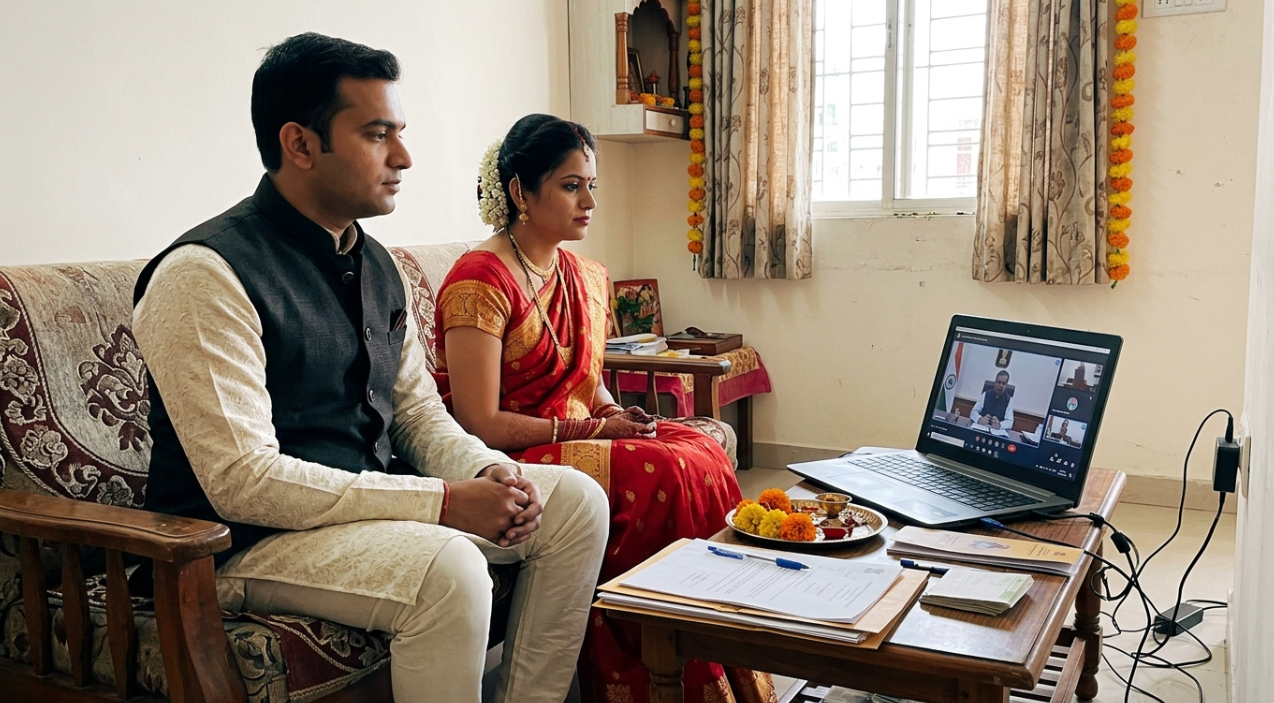
Indian courts have, in specific cases, allowed couples to appear by video conference for solemnization or registration under the Special Marriage Act. The Kerala High Court made earlier directions absolute in 2023, holding that the registering authority under the Special Marriage Act could not refuse online solemnization subject to prescribed conditions. The Delhi High Court has also permitted virtual appearance in specific marriage-registration situations.
These rulings are real but narrow. They do not create a nationwide right to marry online under Indian law. Availability depends on the state, the registrar’s willingness, and often on prior court direction.
Foreign online marriage, especially Utah
This is the most common meaning behind the search. A couple with an India connection wants to know whether they can complete a marriage through Utah’s remote-appearance framework and whether that certificate will work for Indian purposes. Utah allows couples to appear by video conference for the ceremony, with no in-office participation required. The officiant must be physically present in Utah, and two adult witnesses must be able to see and hear the ceremony.
Online religious ceremony
Some Muslim couples seek an online Nikah. Religious validity and civil/legal recognition are separate questions. An online Nikah may fulfill religious requirements in some interpretations, but couples should still confirm civil registration and local legal requirements for the marriage to carry legal weight.
Online Marriage in India vs. Utah Online Marriage
The phrase “online marriage” can describe two very different legal pathways.
An Indian online marriage involves an Indian legal framework, such as marriage registration or a court-approved video-conference procedure. A Utah online marriage is a marriage created under Utah law, even when the couple is physically outside the United States.
The distinction matters because a marriage can be legally valid in the jurisdiction where it was created without automatically producing every legal effect in another country.
Question | Indian online marriage | Utah online marriage |
|---|---|---|
Governing law | Indian law | Utah law |
Where the marriage is legally created | India | Utah, U.S. |
Can both spouses participate remotely? | Depends on the applicable procedure | Yes, subject to Utah requirements |
Foreign document involved? | Usually no | Yes |
Apostille typically relevant? | No | Yes, when the certificate is used internationally |
Does it automatically solve Indian recognition? | No | No |
Best next step | Confirm with the relevant Indian Marriage Officer | Confirm the intended Indian use before the ceremony |
The key distinction is jurisdiction: the place where the marriage is created and the country where you want to use the marriage certificate do not necessarily have the same legal rules.
Is Online Marriage Legal in India?
Is Online Marriage Legal in India?
Sometimes, but there is no nationwide rule making every fully online marriage legal in India.
Indian law does not currently provide one universal process under which every couple can marry entirely by video conference from anywhere in the world. However, Indian courts have considered whether existing marriage laws can accommodate video-conference procedures in specific circumstances.
The most important example involves the Special Marriage Act, 1954. Courts have permitted video-conference participation in certain marriage solemnization or registration proceedings, including proceedings considered by the Kerala High Court.
That does not mean every Marriage Officer in India must conduct every marriage remotely. The procedure available to a couple can depend on the applicable law, jurisdiction, court directions, documentation, and the requirements of the relevant Marriage Officer.
What this means in practice
Before planning an online Indian marriage, confirm:
Which marriage law applies to you.
Which Marriage Officer has jurisdiction.
Whether remote appearance is permitted in your circumstances.
Whether witnesses must appear in person.
Whether any physical verification is required.
What documents will be issued after the marriage.
Whether the resulting certificate will meet the requirements of the authority where you intend to use it.
Do not treat the existence of a court decision allowing video-conference participation in one case as a nationwide guarantee that your local registrar will conduct the marriage entirely online.
Practitioners on Reddit confirm this frustration. One user planning to marry a foreign partner in Bengaluru under the Special Marriage Act reported that the sub-registrar required three witnesses at both the notice stage and the solemnization stage, creating major logistics problems when friends and relatives were far away or elderly. This kind of bureaucratic bottleneck is exactly why people search for online alternatives in the first place.
Can Indians Get Married Online?
Yes, some Indian couples may be able to complete marriage-related procedures remotely, but there is no single online marriage process available to every couple in India.
There are three main possibilities:
Indian marriage with online administrative steps: applications, document submission, appointment booking, and other preliminary steps may be available online.
Video-conference solemnization or registration: courts have permitted remote participation in certain circumstances, but this does not establish a universal nationwide online-marriage procedure.
Marriage under foreign law: an Indian citizen may marry under the law of another country, such as Utah's remote-appearance marriage process. The resulting foreign marriage must then be evaluated separately for use in India.
If your objective is an Indian marriage certificate, start with the relevant Indian Marriage Officer. If your objective is a foreign marriage certificate that you intend to use in India, identify the specific Indian authority that will receive the certificate before choosing the foreign marriage route.
Utah Online Marriage for Indians: Requirements, Process and India Recognition
If you are an Indian citizen considering a Utah online marriage, there are two separate questions: can you legally marry under Utah law, and will the resulting marriage be accepted for the purpose you need in India?
Utah can provide a legally valid U.S. marriage through a remote video ceremony when its requirements are satisfied. That does not automatically determine how Indian authorities will treat the marriage. Couples should therefore evaluate Utah eligibility and Indian recognition as two separate steps.
Eligibility
Non-U.S. residents are not automatically excluded. Utah County’s application guide states that applicants outside the United States can typically use a passport for identity verification, and the system can compare documents against a library of more than 6,000 government-issued IDs. If you do not have a U.S. Social Security number, you can indicate that during the application.
Legal requirements
Utah law requires a valid marriage license, willing declarations of intent by both parties, a pronouncement by an authorized officiant physically present in Utah, and at least two adult witnesses who can see and hear the ceremony. The couple appears by video conference from wherever they are. For more on how these legal requirements work, see this overview of online wedding legality.
How to Get Married Online Through Utah
For couples considering a Utah remote marriage, the process generally follows these stages:
1. Confirm eligibility
Check that both applicants satisfy Utah's requirements and have acceptable identity documents.
2. Apply for the marriage license
Complete the Utah County marriage-license application and provide the required information and identification.
3. Arrange the remote ceremony
The ceremony is conducted by an authorized officiant who must satisfy Utah's requirements, while the couple participates by video.
4. Arrange witnesses
Utah's remote-appearance process requires the applicable witnesses to be able to see and hear the ceremony.
5. Complete the ceremony and recording
Follow the officiant's instructions and retain the ceremony records where available.
6. Obtain certified marriage certificates
Order certified copies of the marriage record for future legal or administrative use.
7. Apostille the certificate when required
If the certificate will be submitted to an authority outside the United States, determine whether an apostille or another authentication process is required.
8. Confirm the receiving authority's requirements
Before using the certificate in India, check whether the specific authority requires an apostille, translation, consular registration, additional registration, or other documentation.
Important: Completing the Utah process establishes the marriage under Utah law. It does not by itself guarantee recognition by an Indian government agency.
The foreign-recognition warning
This point is critical and often glossed over. Utah County itself warns that a Utah remote-appearance marriage “may be invalid” in the country where the parties reside. This is not a defect in the Utah marriage. It is a reminder that foreign governments apply their own laws when deciding what to recognize.
Practitioners on Reddit echo this reality. In one thread on r/SaltLakeCity, an Indian citizen in the UAE and another in India asked whether Utah County online marriage would work for non-U.S. residents. Commenters confirmed passports could be used and that only the officiant needed to be in Utah, but one commenter bluntly stated there was “no way to know” whether the UAE or India would accept the marriage.
Will India Recognize an Online U.S. Marriage Certificate?
Maybe. It depends on the purpose. This is where most online guides fail. They either overstate recognition or dismiss it entirely. Neither approach helps the anxious couple trying to figure out their next step.
The real answer requires a three-part test.
Test 1: Was the marriage valid where performed?
If you followed Utah’s requirements correctly, you have a legally valid U.S. marriage with a real certificate recorded in Utah. That is the foundation everything else builds on.
Test 2: Is the certificate authenticated for India?
India has been a member of the Hague Apostille Convention since 2005. India’s Ministry of External Affairs states that an apostilled document from a member country should not require further attestation or legalization for use in India.
But here is the catch: an apostille proves the document is authentic. It does not force every Indian authority to treat the underlying marriage as valid for every purpose.
Test 3: Will the specific Indian authority accept it?
This is where recognition becomes fact-specific. A Utah certificate with an apostille may sail through one bank and be questioned by a passport office. It may satisfy one consulate but not another. The answer depends on the authority, the purpose, and sometimes the individual officer reviewing your file.
On the Indian lawyer Q&A platform Kaanoon, answers to “Is an online marriage from the U.S. legal in India?” are directly contradictory. Some lawyers say it can be valid under foreign-marriage principles. Another says India does not recognize virtual marriages and recommends registering through an Indian consulate instead. Others advise getting an apostille and pursuing local registration. The article cannot pretend there is a settled answer because there is not one.
One Reddit user on r/NationalVisaCenter shared a telling anecdote. They had a Utah marriage but were told they could not register it locally in India because it was performed outside the country. The local office said they should register at the Indian embassy in the U.S. The apostille was treated as proof the certificate was legitimate, but not as a substitute for consular registration.
Does India Recognize a Utah Online Marriage for Every Purpose?
Not necessarily. Recognition can depend on the authority and the legal purpose for which the marriage certificate is being submitted.
Intended use | What to verify |
|---|---|
OCI application | Current OCI eligibility rules, marriage duration requirement, certificate format and authentication |
Indian passport records | Current passport authority requirements |
Visa or immigration application | Requirements of the relevant immigration authority |
Property transaction | Requirements of the relevant state authority, registrar, bank or institution |
Inheritance | Applicable succession and family law |
Divorce proceedings | Jurisdiction and whether the court recognizes the marriage |
Bank or financial records | Individual institution's documentation requirements |
Indian consular registration | Requirements of the relevant Indian Mission or Post |
Family-law proceedings | Applicable personal law and court jurisdiction |
The same marriage certificate can therefore be sufficient for one administrative purpose but require additional documentation—or raise a recognition issue—for another.
Apostille, Authentication, and Indian Consular Registration
These three terms get confused constantly. They are related but different.
Apostille is a standardized certificate that authenticates the origin of a public document for use in another Hague Convention country. India accepts apostilled documents from member countries without further legalization. For a full explanation, see this guide on apostilles and legalization.
Authentication (or embassy legalization) is the alternative process for countries outside the Hague Convention, or for cases where a specific authority requires steps beyond apostille.
Indian consular registration is entirely separate. It means registering your already-performed marriage with an Indian mission abroad. The Consulate General of India in San Francisco, for example, requires in-person appearance by both spouses and three witnesses, plus an original apostilled marriage certificate, for registration of a U.S. marriage.
The practical takeaway: if you plan to use a Utah marriage certificate in India, get an apostille. But do not assume the apostille alone will satisfy every Indian authority. Some will also require consular registration or additional documentation.
If you need help with document legalization for international use, services exist to handle apostille, embassy authentication, and expedited processing.
The Foreign Marriage Act angle
India’s Foreign Marriage Act of 1969 provides a registration framework for marriages of Indian citizens performed outside India. Section 17 allows registration where a Marriage Officer is satisfied the marriage was duly solemnized according to the foreign country’s law and at least one party was an Indian citizen.
A LinkedIn practitioner article on Indian destination weddings makes an observation that applies equally to online marriage in India contexts: couples focus on the ceremony but overlook whether the marriage will be recognized for downstream purposes like passport changes, property transactions, visa applications, and divorce proceedings. The ceremony is step one. The administrative afterlife matters just as much.
What Does an Apostille Prove?
An apostille generally authenticates the origin of a public document so that it can be presented in another country that participates in the Hague Apostille Convention.
It does not automatically:
validate every underlying legal claim in the document;
create a marriage that was otherwise invalid;
require every Indian authority to grant a particular legal benefit;
replace an Indian registration requirement;
guarantee acceptance for OCI, immigration, property, inheritance, or other purposes.
Think of it this way:
Marriage validity → Certificate → Authentication/Apostille → Acceptance for the specific legal purpose
Each step answers a different legal question.
Online Marriage and OCI
Overseas Citizen of India status is one of the most common downstream use cases for online marriage among India-connected couples. It is also one of the trickiest.
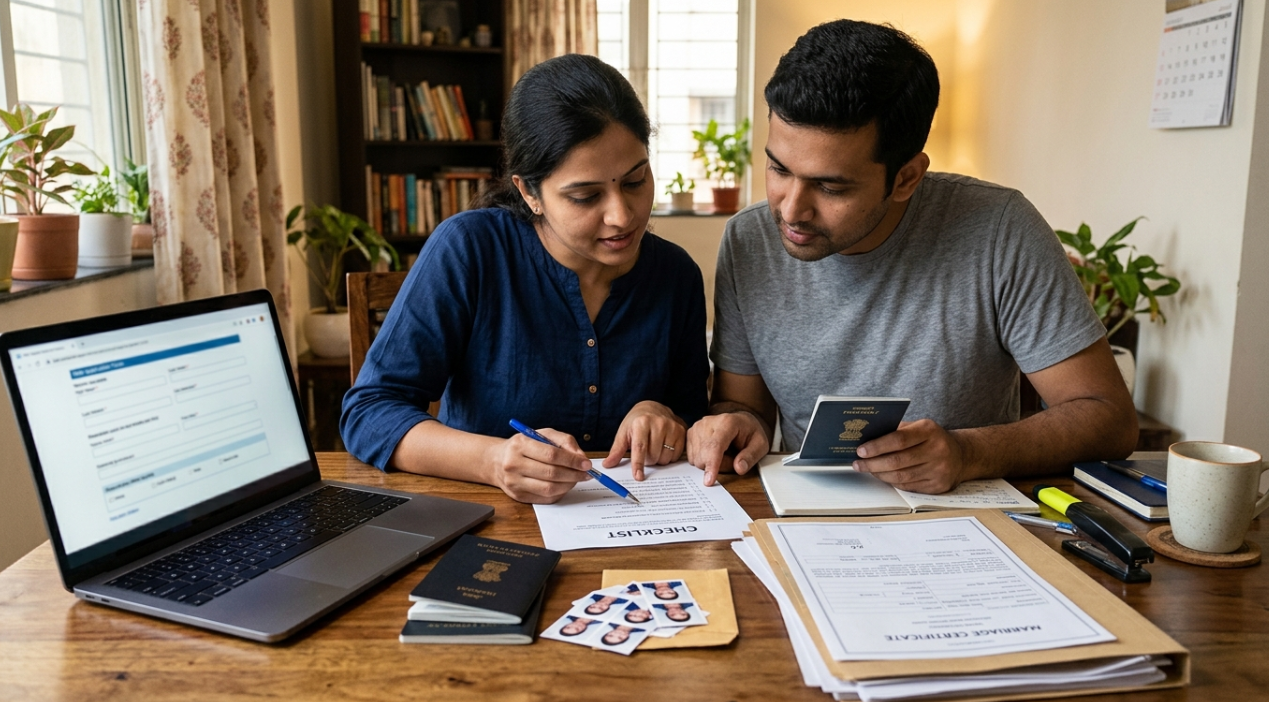
The official OCI FAQ states that a spouse of foreign origin of an Indian citizen or OCI cardholder may apply for OCI only if the marriage has been registered and has subsisted continuously for at least two years immediately before the application. The first OCI issued to a foreign-spouse applicant is valid for five years.
VFS’s U.S. checklist for foreign-spouse OCI applicants requires a registered or apostilled marriage certificate. If the marriage was solemnized in a foreign country, it should be apostilled or certified by the concerned Indian Mission or Post.
One Reddit user on r/nri reported a foreign-spouse OCI application through VFS Washington DC. Their first application was returned because VFS required apostilled birth certificates for the foreign spouse’s parents, a detail most couples do not anticipate. The user later had a WhatsApp video interview and reported “GRANTED” status after roughly six to seven weeks. The takeaway: VFS enforces checklist details strictly, adding friction well beyond the marriage certificate itself.
Bottom line: Do not rely only on a Utah marriage certificate for OCI. Check the current OCI/VFS checklist for your jurisdiction, get the certificate apostilled as required, and confirm whether Indian consular registration is needed. The two-year subsistence requirement also means you cannot apply for spouse-based OCI immediately after marrying.
Online Marriage and U.S. Immigration
Many India-U.S. couples consider online marriage in India-related contexts specifically to start the immigration process. A Utah online marriage can be useful for I-130, CR-1, and IR-1 planning, but immigration rules layer additional requirements on top of the marriage.
The consummation rule
USCIS policy materials state that where the parties were not physically present together during the ceremony, the marriage must be consummated afterward for the spouses to be recognized under immigration law.
This is not optional guidance. Reddit users on r/USCIS repeatedly ask whether Utah Zoom marriages work for I-130 if the spouses meet afterward. Commenters consistently focus on two things: proving the relationship is bona fide and proving an in-person meeting after the online ceremony. For more detail, see this guide on consummation and immigration.
What to keep as evidence
If you use an online marriage for U.S. immigration, plan to meet in person after the ceremony and preserve evidence: travel records and boarding passes, photos and videos from the post-ceremony meeting, the ceremony recording from the online wedding, message histories showing an ongoing relationship, and joint financial documents if any exist.
The marriage certificate proves the marriage exists. The evidence above proves it is real.
For couples who want to discuss immigration planning with an attorney, Courtly offers a low-cost spouse visa consultation through partner attorneys.
Same-Sex Online Marriage and India
A same-sex couple connected to India can create a legal U.S. marriage through Utah if they meet Utah’s requirements. Utah does not restrict marriage by gender.
India is a different story. In the 2023 case Supriyo v. Union of India, the Supreme Court declined to legalize same-sex marriage under existing Indian marriage laws. The Court held there was no fundamental right to marry and did not recognize same-sex couples’ right to marry under the Special Marriage Act.
This means a Utah same-sex marriage can be valid as a U.S. marriage while receiving no marital recognition in India for purposes like OCI spouse status, property rights, inheritance, or family-law proceedings. Couples should not assume otherwise. For a more detailed breakdown, Courtly has published a dedicated guide on same-sex marriage in India covering the current legal landscape.
Common Mistakes to Avoid
These errors come up repeatedly in forums, lawyer Q&A threads, and real-world applications.
Assuming “legal in Utah” means “accepted in India.” Utah legality and Indian recognition are two separate legal questions answered by two different legal systems.
Thinking apostille equals marriage recognition. Apostille authenticates a document. It does not compel an Indian authority to grant any marital benefit based on the marriage.
Ignoring OCI’s two-year requirement. You cannot apply for spouse-based OCI the day after marrying. The marriage must have subsisted continuously for at least two years.
Forgetting the USCIS post-ceremony meeting rule. If you were not physically together during the online ceremony, you need to meet afterward before filing an immigration petition.
Confusing virtual marriage with proxy marriage. In a virtual marriage, both parties are present by video. In a proxy marriage, someone else stands in for an absent party. USCIS treats these very differently, and the distinction matters for any immigration filing.
Assuming same-sex U.S. marriage creates Indian marital rights. It does not, under current Indian law.
Not checking the specific consulate or registrar before the ceremony. Requirements vary by Indian mission, by state, and sometimes by individual officer. Verify before you marry, not after.
Failing to preserve evidence. Ceremony recordings, travel records, and communication histories matter for both immigration and Indian administrative purposes. Keep everything.
Practical Checklist Before Choosing Online Marriage
Use this as a planning framework, not a substitute for legal advice.
Identify the country or state law under which the marriage will be created
Confirm both spouses meet age, single-status, and capacity requirements
Ask the receiving Indian authority what certificate, apostille, translation, or registration it needs
If using Utah, confirm the officiant is physically in Utah and two witnesses can see and hear the ceremony
Order certified copies of the marriage certificate and an apostille
For OCI, check the VFS/OCI checklist for your jurisdiction before filing
For U.S. immigration, plan a post-ceremony physical meeting if you were not together during the ceremony
For same-sex couples, get jurisdiction-specific legal advice before relying on Indian recognition
Keep copies of all emails, certificate orders, apostille receipts, and ceremony recordings
How Courtly Can Help
Courtly helps couples complete a U.S.-legal online marriage through Utah’s remote-appearance framework. The service handles guidance through the Utah County marriage license application, provides a certified officiant, offers optional witnesses, hosts the ceremony online, records it, and delivers both digital and mailed U.S. marriage certificates.
Courtly also offers document legalization add-ons (apostille and embassy authentication), live ceremony translation in multiple languages, and a low-cost U.S. spouse-visa consultation with partner attorneys. For Muslim couples, Courtly provides an online Nikah option alongside the civil U.S.-legal process.
What Courtly cannot do: guarantee foreign recognition or provide legal advice about international marriage or immigration law. If you need a marriage accepted for an India-specific purpose, verify with the receiving authority or consult an Indian family or immigration lawyer.
Plans start at $199 for Core, $399 for Popular (which includes ceremony recording, recognition guidance, and a satisfaction guarantee), and $599 for Fast-Track (which adds two Courtly-provided witnesses and rush processing with a 24-hour scheduling guarantee after license approval). The Utah County government license fee of approximately $70 is separate.
FAQ
Can Indians get married online?
Yes, in some contexts, but not through a single universal Indian online system. Indian courts have allowed video-conference participation under the Special Marriage Act in specific cases. Indian citizens can also marry under foreign law (such as through Utah’s remote-appearance process), though Indian recognition of that marriage depends on the purpose and the authority reviewing it.
Is a Utah online marriage valid in India?
It may be accepted for some purposes if validly performed and the certificate is apostilled, but Indian recognition is not guaranteed for every use case. Utah legality and Indian acceptance are separate legal questions. Always verify with the specific Indian authority reviewing your situation.
Do I need an apostille for a Utah marriage certificate to use in India?
Usually yes. India has been a Hague Apostille Convention member since 2005, and Indian authorities generally expect an apostilled certificate from a member country. The apostille authenticates the document but does not decide whether the Indian authority must accept the marriage for every purpose.
Can a Utah online marriage be used for OCI?
Possibly, but spouse-based OCI has specific requirements. The marriage must be registered and must have subsisted continuously for at least two years before the application. VFS may require an apostilled or Indian Mission-certified marriage certificate, along with additional documentation that varies by jurisdiction.
Can I use an online marriage for a U.S. spouse visa?
Potentially. USCIS recognizes valid virtual marriages, but if the couple was not physically together during the ceremony, immigration rules require post-ceremony consummation or a physical meeting. Plan to meet in person after the ceremony and keep evidence of that meeting before filing a petition.
Is online Nikah legally valid in India?
Religious validity and civil/legal recognition are separate questions. An online Nikah may satisfy religious requirements under some interpretations, but couples should confirm civil registration and local legal requirements for the marriage to carry legal weight in India.
Can same-sex Indian couples marry online through Utah?
They can create a valid U.S. marriage if they meet Utah’s requirements. However, India’s Supreme Court did not legalize same-sex marriage under existing statutes in the 2023 Supriyo ruling. Couples should not assume India will recognize the marriage for Indian spousal benefits, property, or family-law purposes.
What is the difference between virtual marriage and proxy marriage?
In a virtual marriage, both parties are personally present by live video. In a proxy marriage, someone else physically stands in for one absent party. USCIS and other authorities treat these very differently, especially for immigration purposes. Most online marriage services today use the virtual model, not the proxy model.
Let us handle the paperwork.
Getting married is complicated. Courtly simplifies the process and provides everything necessary to get married online, including providing a licensed officiant who can perform a remote ceremony.
Get Married

Get married online.
Getting married is complicated. Courtly simplifies the process and provides everything necessary to get married online.

