

An online wedding conducted under Philippine law is generally not valid because the Family Code requires the contracting parties to personally appear before the solemnizing officer. However, a marriage legally celebrated under the law of a foreign jurisdiction, such as a Utah remote marriage, is a different situation. Article 26 of the Philippine Family Code generally recognizes marriages celebrated abroad when they are valid under the law of the place where they were celebrated, subject to the statutory exceptions.
For Filipino couples considering a Utah online marriage, the process usually involves four separate issues:
Validity under Utah law – the marriage must be validly celebrated under Utah requirements.
Recognition and registration in the Philippines – the marriage can be reported through the appropriate Philippine consular post and transmitted for PSA registration.
Document authentication – the Utah marriage certificate used for Philippine registration must meet the consulate's current document requirements, including apostille requirements.
U.S. immigration – if the marriage will be used for a U.S. spouse visa, additional federal immigration rules may apply, including the rule concerning marriages where the spouses were not physically present together at the ceremony.
Bottom line: A Philippine Zoom wedding and a Utah online marriage are not the same legal event. The first is governed by Philippine marriage requirements; the second is a foreign marriage that must be evaluated under Utah law, Philippine recognition rules, consular registration requirements, and, where relevant, U.S. immigration law.
Online Marriage Philippines: Quick Answers
Question | Short answer |
|---|---|
Can you get married online under Philippine law? | Generally no. The Family Code requires the contracting parties to personally appear before the solemnizing officer. |
Can Filipinos marry online through Utah? | Utah provides a remote marriage process, but Philippine recognition is a separate legal and registration question. |
Do both spouses have to travel to Utah? | Utah County's remote process does not generally require the couple to be physically in Utah. |
Is a Utah online marriage automatically registered in the Philippines? | No. A separate Report of Marriage process is required through the Philippine foreign service post with jurisdiction over the place of marriage. |
Is an apostille required for a Utah online marriage used for Philippine registration? | The Philippine Consulate General in San Francisco currently requires the Utah marriage license/certificate for an online Utah marriage to be apostilled by the Utah Lieutenant Governor. |
Does the PSA automatically receive the marriage record? | No. The foreign marriage must first be reported through the appropriate Philippine Embassy or Consulate. |
Can a Utah online marriage be used for U.S. immigration? | Potentially, but U.S. immigration has separate rules for marriages where the spouses were not physically present together at the ceremony. |
Is a Report of Marriage the same as a marriage certificate? | No. The Report of Marriage is the registration filing; the PSA later issues the Philippine marriage certificate after the record is transmitted and processed. |
If you searched for “online marriage Philippines,” you may be trying to answer one of several different questions: Can Filipinos legally marry through Zoom? Can a Filipino couple marry online through Utah? Will the Philippines recognize a foreign online marriage? How do you register it with the PSA? And can the marriage be used for a U.S. spouse visa?
These questions do not all have the same answer.
A marriage conducted under Philippine law must satisfy the Philippine Family Code, which includes personal appearance before the solemnizing officer. By contrast, a remote marriage conducted under the law of a foreign jurisdiction such as Utah is a foreign marriage and must be evaluated under the law of the place where it was celebrated and Philippine rules governing foreign marriages.
This guide explains the key terms, documents, registration steps, and U.S. immigration concepts that Filipino couples may encounter when researching an online marriage. It also separates marriage validity, Philippine registration, and U.S. immigration eligibility, because those are three different legal questions.
Online Marriage Philippines: The 3 Legal Questions You Need to Separate
When researching an online marriage in the Philippines, it is important to separate three different questions:
1. Is the marriage legally valid where it was celebrated?
This depends on the law governing the ceremony.
A marriage conducted under Philippine law must comply with the Philippine Family Code. A foreign marriage, such as a marriage celebrated under Utah law, is evaluated first under the law governing that foreign marriage.
2. Will the Philippines recognize and register the marriage?
Recognition and registration are related but are not exactly the same thing. Article 26 of the Family Code provides a general rule for marriages solemnized outside the Philippines that are valid under the law of the place where they were solemnized, subject to the exceptions listed in the law.
For a Filipino who marries abroad, the marriage is generally reported through the Philippine Embassy or Consulate with jurisdiction over the place of marriage. The Philippine Consulate General in San Francisco currently lists Utah within its consular jurisdiction and provides specific requirements for Utah online marriages.
3. Can the marriage be used for immigration?
Immigration authorities apply their own rules.
For example, a marriage may be valid under Utah law and eligible for Philippine registration while still requiring additional evidence or meeting additional requirements for a U.S. immigration petition.
The key takeaway: A marriage can pass one of these tests without automatically passing all three. Always evaluate foreign-law validity, Philippine recognition/registration, and immigration eligibility separately.
Is Online Marriage Legal in the Philippines?
The answer depends on where and under whose law the marriage is celebrated.
Marriage conducted under Philippine law
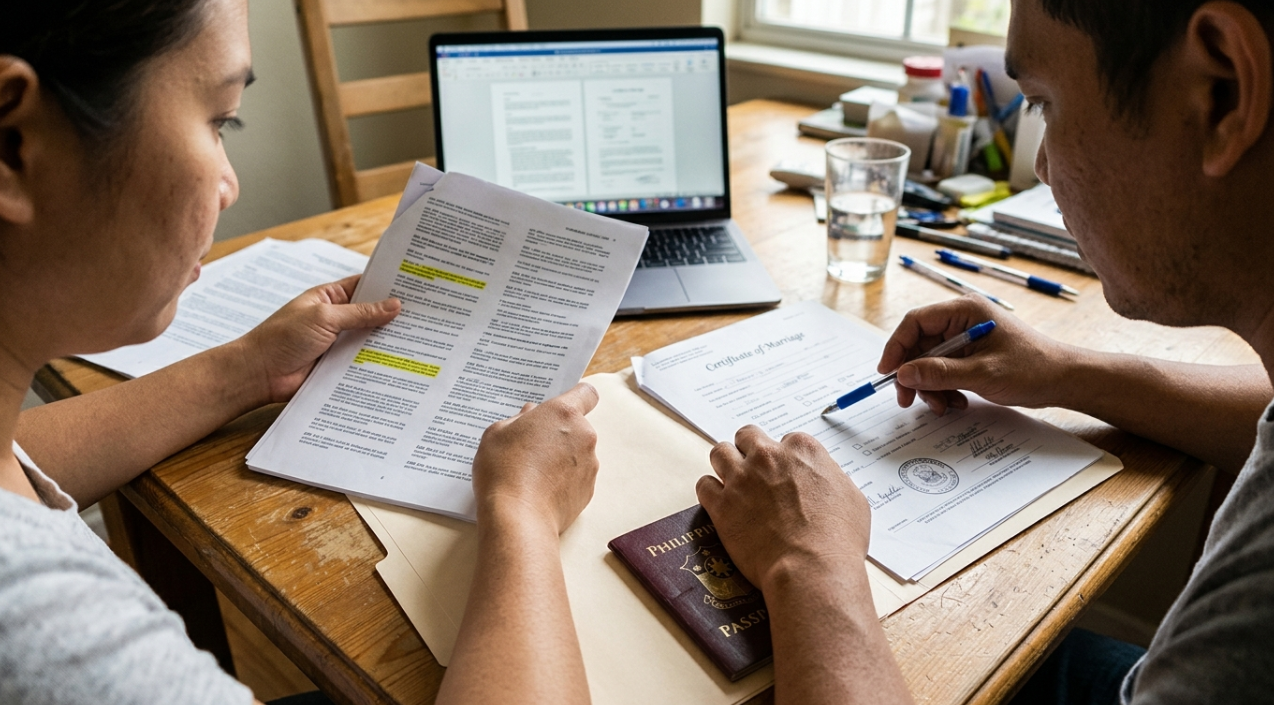
The Philippine Family Code requires the contracting parties to personally appear before the solemnizing officer and declare that they take each other as husband and wife in the presence of at least two witnesses of legal age. Article 3 also identifies the marriage ceremony as one in which the contracting parties appear before the solemnizing officer.
For that reason, a couple should not assume that a ceremony conducted entirely through Zoom, Google Meet, or another video platform creates a valid Philippine marriage.
Marriage conducted under foreign law
A different analysis applies when a couple uses a foreign jurisdiction that legally permits remote marriage.
Article 26 of the Family Code provides that marriages solemnized outside the Philippines in accordance with the laws of the place where they were solemnized and valid there as such shall also be valid in the Philippines, subject to the statutory exceptions listed in Article 26.
This is why a Utah online marriage should not simply be described as a “Philippine online marriage.” It is more accurately described as a foreign marriage celebrated remotely under Utah law.
Why the distinction matters
A couple considering a Utah online marriage should separately confirm:
whether the marriage is valid under Utah law;
whether the Philippine authorities will accept and register the marriage;
which Philippine consular post has jurisdiction;
what documents and authentication are required; and
whether the marriage satisfies the requirements of any immigration process for which it will be used.
Do not treat “online marriage” as a single legal category. The jurisdiction where the marriage is legally celebrated matters.
For a deeper explanation of how online marriage works under U.S. law, including the difference between proxy, virtual, and remote ceremonies, it’s worth understanding the distinctions before moving forward.
Article 26 of the Family Code (Lex Loci Celebrationis)
This is the single most important provision for anyone pursuing an online marriage Philippines recognition path. Article 26, paragraph 1, states:
“All marriages solemnized outside the Philippines, in accordance with the laws in force in the country where they were solemnized, and valid there as such, shall also be valid in this country.”
The legal principle behind it is called lex loci celebrationis, which means the law of the place of celebration governs the marriage’s validity. If Utah says the marriage is valid, the Philippines generally agrees.
Exceptions exist. Article 26 recognition does not extend to marriages that are bigamous or polygamous, involve a party below 18 years of age, or otherwise violate Philippine public policy. Same-sex marriages also fall outside recognition, as discussed later in this glossary.
The practical effect: a Utah online marriage, properly documented and registered, creates a marriage that Philippine authorities will treat as valid. But “properly documented and registered” involves several more terms on this list.
Utah Online Marriage: How Remote Solemnization Works
Utah is one of the jurisdictions that provides a legal framework for remote marriage ceremonies using audio-visual technology.
For couples researching an online marriage from the Philippines, the important point is that the marriage is not being created under Philippine marriage law. The couple is using Utah's marriage system and then dealing separately with Philippine recognition and registration.
Utah County currently offers an online marriage-license application. Its current published fee for most applicants is $71.75, including applicable fees.
The Utah County process generally involves:
Applying for the marriage license online.
Providing the required identification and information.
Obtaining the Utah marriage license.
Participating in the remote ceremony with the authorized Utah officiant.
Completing the required witness and ceremony formalities.
Having the marriage recorded.
Obtaining the certified marriage certificate.
Obtaining an apostille when required for use abroad.
Filing the appropriate Report of Marriage with the Philippine consular post that has jurisdiction over Utah.
Important 2026 warning from Utah County
Utah County currently publishes a legal notice stating that a marriage solemnized under Utah law through online remote appearance may be invalid in the country where the parties reside. This does not by itself determine how Philippine authorities will treat a particular marriage, but it is an important reason to verify the current Philippine registration requirements before proceeding.
Best practice: Check the current Utah County requirements and the current Philippine consular requirements immediately before paying for a ceremony. Rules, fees, document requirements, and consular procedures can change.
Marriage License (Utah County)
Before the ceremony can happen, the couple needs a marriage license issued by a Utah county clerk. Utah County’s system allows the entire application to be completed remotely, including identity verification.
The government processing fee is approximately $70. The license is valid for 30 days after issuance, and there is no waiting period between obtaining the license and holding the ceremony. Utah also has no residency requirement.
Both parties need valid government-issued photo ID. For Filipino applicants, a Philippine passport works. If either party was previously married, proof of dissolution (annulment decree or death certificate of the former spouse) will be required.
You can learn more about the online marriage license process and what documents to prepare.
Online Marriage Philippines: 2026 Step-by-Step Process
If you are considering a Utah online marriage as a Filipino citizen, think of the process as a sequence of separate stages.
Stage | What happens | Main document or authority |
|---|---|---|
1. Check eligibility | Confirm both parties can legally marry and identify any previous marriages | Personal records |
2. Apply for Utah license | Submit the online marriage-license application | Utah County |
3. Hold the ceremony | Complete the remote ceremony under Utah requirements | Utah-licensed officiant |
4. Obtain certificate | Get the certified Utah marriage certificate | Utah vital records/county |
5. Apostille | Authenticate the certificate for foreign use | Utah Lieutenant Governor |
6. Report the marriage | File a Report of Marriage with the Philippine consular post having jurisdiction | Philippine Embassy/Consulate |
7. PSA processing | The reported marriage is transmitted for Philippine civil-registry recording | PSA |
8. Obtain PSA certificate | Request a PSA-certified marriage certificate when the record becomes available | PSA |
9. Immigration process, if applicable | Use the marriage documentation in the appropriate immigration process | USCIS/NVC/consular authorities |
The Philippine Consulate General in San Francisco currently states that Utah is within its jurisdiction and specifically identifies an apostilled Utah marriage license/certificate as a requirement for marriages celebrated online in Utah. It currently estimates approximately six months to one year from filing a Report of Marriage for PSA issuance.
Important distinction
The Utah marriage certificate, Report of Marriage, and PSA marriage certificate are not interchangeable documents.
The Utah certificate proves the foreign marriage. The Report of Marriage is the Philippine registration filing. The PSA marriage certificate is the Philippine civil-registry record issued after the foreign marriage has been reported and processed.
U.S. Marriage Certificate
After the ceremony, the officiant files the signed marriage license with the county clerk, who then issues the official U.S. marriage certificate. This is the foundational document for everything that follows: apostille, Report of Marriage, immigration petitions, and name changes.
Services like Courtly typically provide both a digital copy (available shortly after the ceremony) and a physical copy mailed to the couple. The digital version is useful for starting paperwork immediately, while the physical copy is what you’ll submit for apostille.
To see what’s included at different service levels, check the pricing page for a breakdown of plans.
Apostille
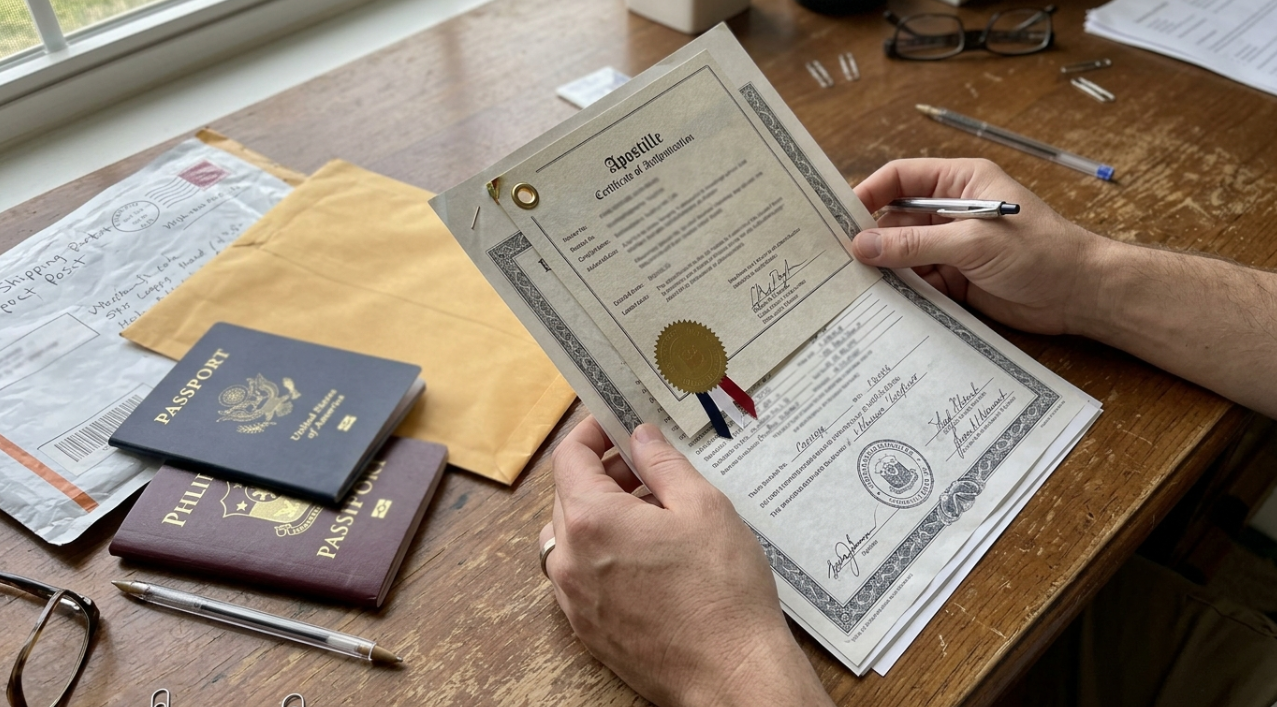
An apostille is a standardized certificate that authenticates the origin of a public document for use in another country. Since both the United States and the Philippines are members of the Hague Apostille Convention, a Utah marriage certificate with an apostille is accepted in the Philippines without further embassy legalization.
For Utah marriages, the apostille is issued by the Utah Lieutenant Governor’s office. The government fee is about $45 plus shipping. Processing time varies, but expedited options exist.
Why it matters for Filipino couples: Without an apostille, the Philippine Consulate will not accept your marriage certificate for Report of Marriage filing. The PSA will not record it. Your marriage will exist under U.S. law but remain invisible to Philippine authorities.
Courtly offers an apostille and legalization service as an add-on, which simplifies the process considerably. For a broader explanation of how apostilles work and when you need one, there’s a complete guide to apostilles worth reading.
CENOMAR (Certificate of No Marriage Record)
CENOMAR stands for Certificate of No Marriage Record, and it’s issued by the Philippine Statistics Authority (PSA). It proves that a person has no existing marriage on record in the Philippines.
Filipino citizens must present a CENOMAR when marrying abroad. It functions as proof of legal capacity to marry, essentially confirming that you’re single and free from any prior undissolved marriage. Some refer to it as a “Certificate of Singleness.”
How to get one: You can request a CENOMAR through PSA Serbilis online, at PSA outlets in the Philippines, or through Philippine consulates abroad. Processing takes anywhere from a few days (walk-in at PSA outlets) to several weeks (consular requests). The document has a limited period of validity for marriage purposes, so timing matters.
If your CENOMAR shows a prior marriage that has since been annulled, you’ll need the court decree and PSA-annotated marriage certificate showing the cancellation. This is one of the more common snags practitioners report encountering.
Report of Marriage (ROM)
The Report of Marriage is a registration process that notifies the Philippine government of a marriage that took place abroad. Filing the ROM is how your Utah online marriage enters the Philippine civil registry system.
Who files it: The Filipino spouse (or both spouses) files the ROM with the Philippine Consulate General that has jurisdiction over the place where the marriage was celebrated. Since Utah online marriages are legally celebrated in Utah, the filing typically goes to the Philippine Consulate General in San Francisco, which lists Utah in its jurisdiction and specifically mentions marriages celebrated online in Utah on its ROM checklist.
A caveat on jurisdiction: Some sources reference the Philippine Consulate General in Los Angeles as having jurisdiction over Utah. This confusion is real and has tripped up multiple couples. Verify directly with the consulate before mailing any documents.
Timeline: The ROM should be filed within one year of the marriage date. Processing takes 6 to 12 months, which includes the consulate’s review period and transmission to the PSA.
Required documents typically include:
Apostilled Utah marriage certificate
CENOMAR of the Filipino spouse
Valid passports of both spouses
Completed ROM application form
Joint affidavit of both spouses
Photos
A detail most guides miss: Practitioners on VisaJourney forums report that some consulates require an “Affidavit of Explanation of Online Marriage” when filing the ROM for a Utah virtual ceremony. This document explains the nature of the online marriage and why both parties were not physically present in Utah. Not every consulate asks for it, but preparing one proactively can prevent delays.
Important warning: Consular acceptance of ROMs for Utah online marriages has been inconsistent. Reports from legal practitioners (including Vowed and Clear, a competing service) indicate that ROM processing for online marriages was suspended and then resumed in 2022, and again faced disruptions in late 2024. Couples should confirm current acceptance status with the relevant consulate before filing.
Philippine Statistics Authority (PSA)
The PSA is the central civil registry of the Philippines. Once the Philippine Consulate processes your ROM, the record is transmitted to the PSA for permanent filing. The PSA then issues a PSA-certified Marriage Certificate, which is the gold standard document for legal transactions in the Philippines.
Why you need it: Without PSA registration, your marriage exists in U.S. records but not in Philippine records. That means you can’t claim spousal benefits under Philippine law, face complications with property transactions, and may encounter difficulties with Philippine immigration authorities.
Processing time: Expect 3 to 6 months from the consulate’s acceptance of the ROM to PSA issuance. The process is fastest when the apostille is an electronic (e-Apostille) and all ROM documents are complete on first submission.
Consummation Requirement (U.S. Immigration)
This term causes more confusion than almost any other, partly because of what the word “consummation” implies. In the immigration context, it does not mean what you think it means.
Under INA § 101(a)(35), USCIS classifies marriages performed via videoconference or proxy as requiring “consummation” before the marriage can be used for immigration benefits. What USCIS actually wants is proof that the couple physically met in person after the ceremony.
What counts as proof: Flight tickets showing travel to the same location, dated photographs together, hotel receipts, restaurant bills, affidavits from friends or family who saw the couple together. USCIS is looking for evidence of a real, in-person meeting. Not intimate evidence.
A tactical recommendation from immigration practitioners: Fickey Martinez Law, an immigration firm that has published extensively on this topic, recommends that both spouses be in the Philippines during the virtual Utah ceremony. This way, the in-person meeting requirement is automatically satisfied on the same day. If that’s not possible, plan a trip to meet as soon as possible after the ceremony and document everything.
Practitioners on Reddit’s r/USCIS confirm that Utah online marriages are “generally accepted by USCIS if the marriage is consummated,” with anecdotal reports of successful I-130 petition approvals. That said, couples should prepare strong documentation. For a detailed look at consummation requirements, read the consummation and immigration guide.
I-130 Petition (Petition for Alien Relative)
The I-130 is the USCIS form that a U.S. citizen or lawful permanent resident files to establish a family relationship with a foreign national spouse. It is the first step in the spouse visa process.
For couples who married online through Utah, the I-130 can be filed once the consummation requirement is met. The petition must include the marriage certificate, evidence of consummation (described above), and evidence that the marriage is bona fide.
Processing times for I-130 petitions vary widely, from several months to over a year depending on the service center and current backlog. Planning ahead matters. If you’re considering the immigration path, Courtly offers a spouse visa consultation with partner attorneys.
CR-1 and IR-1 Spouse Visa
These are the two categories of U.S. spouse visas that follow an approved I-130 petition.
IR-1 (Immediate Relative): For spouses of U.S. citizens who have been married for two or more years at the time of visa issuance. The foreign spouse receives a 10-year green card upon entry.
CR-1 (Conditional Resident): For spouses of U.S. citizens who have been married for less than two years. The foreign spouse receives a 2-year conditional green card and must file Form I-751 to remove conditions before expiration.
Many Filipino-American couples choose the online marriage route specifically to start the CR-1/IR-1 process sooner rather than waiting months or years to meet the requirements for a K-1 fiancé visa. The online marriage approach can sometimes be faster overall because it skips the K-1 stage entirely. For a comparison of these pathways, the K-1 vs. CR-1 guide breaks down timelines and trade-offs.
Bona Fide Marriage
USCIS scrutinizes every marriage-based immigration petition for fraud. A “bona fide marriage” is one entered into in good faith, not for the purpose of evading immigration laws.
Evidence USCIS looks for includes:
Communication records (call logs, chat screenshots, video call history)
Joint financial accounts or shared expenses
Travel receipts from visits to each other
Photos together at different times and locations
Affidavits from friends and family attesting to the relationship
Evidence of meeting each other’s families
Practitioners on Reddit’s r/Philippines_Expats specifically caution that online marriages facilitated through platforms face additional immigration scrutiny, and they recommend preparing strong bona fide evidence from the start. This isn’t unique to any one service provider; it applies to all online marriages used for immigration.
Same-Sex Marriage (Philippine Context)
Utah recognizes same-sex marriage. The Philippines does not. Article 1 of the Family Code defines marriage as a union between a man and a woman, and no legislation currently changes that.
What this means practically: A same-sex couple who marries online through Utah receives a valid U.S. marriage certificate. However, the Philippine Consulate will not accept a Report of Marriage for a same-sex union, and the PSA will not register it. The marriage exists under U.S. law but has no legal standing in the Philippines.
Where the certificate is useful: The U.S. marriage certificate can be used for immigration and spousal visa applications in countries with marriage equality, insurance and pension claims overseas, legal name changes in accepting jurisdictions, and as documentation in any country that recognizes same-sex marriages performed abroad.
For Filipino same-sex couples, the U.S. certificate is a powerful tool, just not one the Philippine government currently accepts. Courtly has a dedicated page for LGBTQ+ couples exploring their options, and there’s also a same-sex online marriage Philippines guide that covers this situation in detail.
Virtual Marriage Act (Philippines)
This refers to proposed Philippine legislation that would authorize online or virtual marriage ceremonies within the Philippines. As of this writing, no such bill has been signed into law.
Various lawmakers have introduced proposals following the COVID-19 pandemic, when couples were unable to marry in person due to lockdowns. The bills generally proposed allowing solemnizing officers to conduct ceremonies via videoconference under specific conditions.
Until such legislation passes, the domestic route remains closed. Filipino couples who want a legally recognized online marriage must use a foreign jurisdiction.
CFO (Commission on Filipinos Overseas) Guidance and Counselling Program
The CFO Guidance and Counselling Program is a pre-departure requirement for Filipino spouses and partners of foreign nationals who are emigrating from the Philippines. If you’re a Filipino citizen who married a foreign national (including through an online Utah marriage) and plan to move abroad on a spouse visa, you must attend a CFO guidance and counselling session before departure.
The program covers cultural adjustment, legal rights, emergency contacts, and resources for Filipinos abroad. You’ll receive a CFO sticker on your passport, which immigration officers check at the airport.
When to do it: After your I-130 is approved and your immigrant visa is issued, but before you travel to the United States. The CFO session can be completed in person at CFO offices in the Philippines or, in some cases, online.
Time-Zone Date Discrepancy
A small but important detail that catches couples off guard: the date on your Utah marriage certificate may not match the date and time of your ceremony as experienced in the Philippines.
Utah operates on Mountain Time (UTC-7 or UTC-6 during daylight saving), while the Philippines is on Philippine Standard Time (UTC+8). A ceremony held at 10:00 AM Philippine time on January 15 is actually 7:00 PM on January 14 in Utah.
The rule: Do not attempt to change the date on any document. The PSA must reproduce the date on the apostilled foreign certificate exactly as it appears. If your certificate says January 14 and you held the ceremony on January 15 Philippine time, the official date of marriage is January 14. Plan accordingly for any anniversary celebrations.
Live Ceremony Translation (Filipino Language Option)
One practical concern for Filipino couples is language. Not every couple is comfortable exchanging vows in English, and family members watching may not follow an English-only ceremony.
Courtly offers a live translation add-on in Filipino (along with Spanish, Chinese, French, Italian, Portuguese, and other languages). This means the officiant’s prompts and the vow exchange can be translated in real time, allowing the couple to participate fully in their own language. Family watching from the Philippines can follow along without confusion.
It’s a small detail that makes a meaningful difference, especially for couples where one or both partners are more comfortable in Filipino or Tagalog.
Comparison Table: Online Marriage Within the Philippines vs. Via Utah
Factor | Within the Philippines | Via Utah (Foreign Marriage) |
|---|---|---|
Legal validity in PH | Void (no law authorizes it) | Valid under Article 26 |
Legal basis | None | Utah Code § 30-1-4.5 + Article 26 |
Physical presence required | Yes (Family Code requirement) | No (remote solemnization) |
Apostille needed | N/A | Yes (Utah Lt. Governor) |
Report of Marriage needed | N/A | Yes (Philippine Consulate) |
PSA registration | N/A | Yes (after ROM processing) |
Immigration use (USCIS) | N/A | Yes (after consummation) |
Frequently Asked Questions
Can I marry online if both of us are in the Philippines?
Yes, but the marriage must be performed under a foreign jurisdiction’s law. Both of you can be sitting in the Philippines during a Utah online ceremony, and the marriage is still legally celebrated in Utah. Immigration attorney Fickey Martinez Law actually recommends this approach because it automatically satisfies the USCIS consummation (in-person meeting) requirement.
How long does the entire process take from ceremony to PSA registration?
The ceremony itself can happen within days of license approval. The apostille takes a few weeks. Filing the ROM and having it processed by the consulate takes 6 to 12 months. PSA issuance after that takes another 3 to 6 months. From start to finish, you’re looking at roughly 9 to 18 months before you have a PSA-certified marriage certificate in hand.
Do I need a CENOMAR even if I’m marrying through Utah?
Yes. Philippine consulates require a CENOMAR from the Filipino spouse as part of the ROM application. It proves you have legal capacity to marry. Order it early, because consular-processed CENOMARs can take several weeks.
Which Philippine consulate do I file the ROM with?
The Philippine Consulate General in San Francisco publishes Utah within its jurisdiction and has specific ROM checklists for Utah online marriages. However, some sources reference the Los Angeles consulate. Contact the consulate directly to confirm before submitting anything.
Does USCIS accept Utah online marriages for immigration?
Generally yes, provided the marriage is consummated (meaning the couple meets in person after the ceremony). Practitioners on Reddit’s r/USCIS report successful I-130 approvals based on Utah online marriages. However, acceptance by immigration officials is not guaranteed and can vary case by case. Couples should consult a qualified immigration attorney for their specific situation.
Can same-sex Filipino couples use an online marriage for Philippine recognition?
No. The Philippines defines marriage as between a man and a woman and will not register a same-sex foreign marriage via the ROM process. The U.S. marriage certificate remains valid under American law and can be used in countries that recognize same-sex marriage, for immigration to those countries, and for overseas benefits claims.
Is there a risk the Philippine consulate will reject my ROM?
There is. Consular acceptance of ROMs for Utah online marriages has been suspended and resumed before, notably in 2022 and late 2024. This is an evolving situation. Always verify with the relevant consulate that they are currently accepting ROM filings for online marriages before you submit your application.
Do I need a lawyer for this process?
It depends on your situation. The marriage ceremony and certificate process is straightforward. The ROM filing is manageable if you follow the consulate’s checklist carefully. But if you’re using the marriage for U.S. immigration, an immigration attorney can help you navigate the I-130 petition, consummation evidence, and visa interview preparation. Courtly is not a law firm and does not provide legal advice, but offers a spouse visa consultation with partner attorneys for couples who need immigration guidance.
Ready to start the process? Courtly handles the Utah marriage license, provides a certified officiant, and can add apostille services and Filipino ceremony translation. See plans and pricing to find the option that fits your situation. For the story of a real U.S.-Philippines couple who went through the process, read about Ross and Jojie’s experience.
Disclaimer: Courtly provides a legal U.S. marriage service. Acceptance of online marriages by foreign governments, consulates, and immigration authorities is beyond Courtly’s control and may change without notice. This article is informational and does not constitute legal advice. Couples should consult qualified attorneys for guidance on their specific legal and immigration circumstances.
Let us handle the paperwork.
Getting married is complicated. Courtly simplifies the process and provides everything necessary to get married online, including providing a licensed officiant who can perform a remote ceremony.
Get Married

Get married online.
Getting married is complicated. Courtly simplifies the process and provides everything necessary to get married online.

