

Same-sex couples who marry online have the same legal right to change their names as any married couple, backed by Obergefell v. Hodges (2015) and the Respect for Marriage Act (2022). The process follows a standard order: Social Security Administration first, then DMV, then passport. However, gendered state laws in 32 states plus D.C. still require men to get a court order for a marriage name change, which hits male same-sex couples especially hard. A Utah online marriage certificate is valid proof for name changes at all federal agencies, even though it doesn’t list your intended new name.
What Is a Same-Sex Online Marriage Name Change?
A same-sex online marriage name change is the legal process of updating your surname or middle name after marrying your same-sex partner through a remote, online ceremony. Typically, this means you married via a Utah-based online marriage service, received a U.S. marriage certificate, and now need to update your identity documents across government agencies, banks, and other institutions.
The good news: your legal standing is identical to that of any opposite-sex couple. The Supreme Court's 2015 decision in Obergefell v. Hodges established the constitutional right of same-sex couples to marry and required states to recognize lawful same-sex marriages performed in other states. The Respect for Marriage Act later added federal statutory protections concerning recognition of valid marriages.
The not-so-good news: the process is legally the same on paper, but same-sex couples face practical complications that generic name-change guides never mention. Gendered state laws, potential clerk resistance, and privacy concerns create real friction that deserves a clear, honest walkthrough.
If you’re still exploring whether an online marriage is right for you, Courtly’s LGBTQ+ marriage page explains how the process works for same-sex couples specifically.
Can You Change Your Name After a Same-Sex Online Marriage?
Yes. A same-sex couple can generally use a valid marriage certificate as evidence for a legal name change, just as an opposite-sex married couple can. For a U.S. name change after marriage, the usual sequence is to update your Social Security record first, then your driver's license or state ID, followed by your passport and other accounts.
The important exception is that the exact name-change procedure depends on the state and the type of name change. Taking a spouse's surname may be possible using a marriage certificate alone in some states, while other states may require a court order for certain spouses or name changes. Hyphenated, blended, entirely new, or first-name changes can also require additional legal steps.
If you married online using a Utah marriage certificate, the certificate can serve as evidence of the marriage, but it does not automatically mean every state agency will process every type of name change the same way. Check your state's current requirements before filing.
Same-Sex Marriage Name Change at a Glance
Question | Short answer |
|---|---|
Can a same-sex spouse change their name after marriage? | Yes, subject to the applicable state name-change rules. |
Does an online marriage change the basic process? | Not necessarily. A valid marriage certificate can be used as evidence of marriage, but state and agency requirements still apply. |
Do both spouses have to change their names? | No. Either spouse can keep their existing name. |
Can both spouses take the same surname? | Often yes, but the procedure depends on state law and the type of name change. |
Is a marriage certificate enough for every name change? | No. Some changes, including certain blended or entirely new names, may require a court order. |
What should you update first? | Social Security, followed by your state ID/driver's license and then your passport and other records. |
Is a Social Security name change free? | Yes. The Social Security Administration does not charge a fee for a replacement card after a name change. |
Can a Utah marriage certificate be used as name-change evidence? | It can serve as evidence of the marriage, but individual agencies and states determine what additional documentation they require. |
Name-Change Options After a Same-Sex Marriage
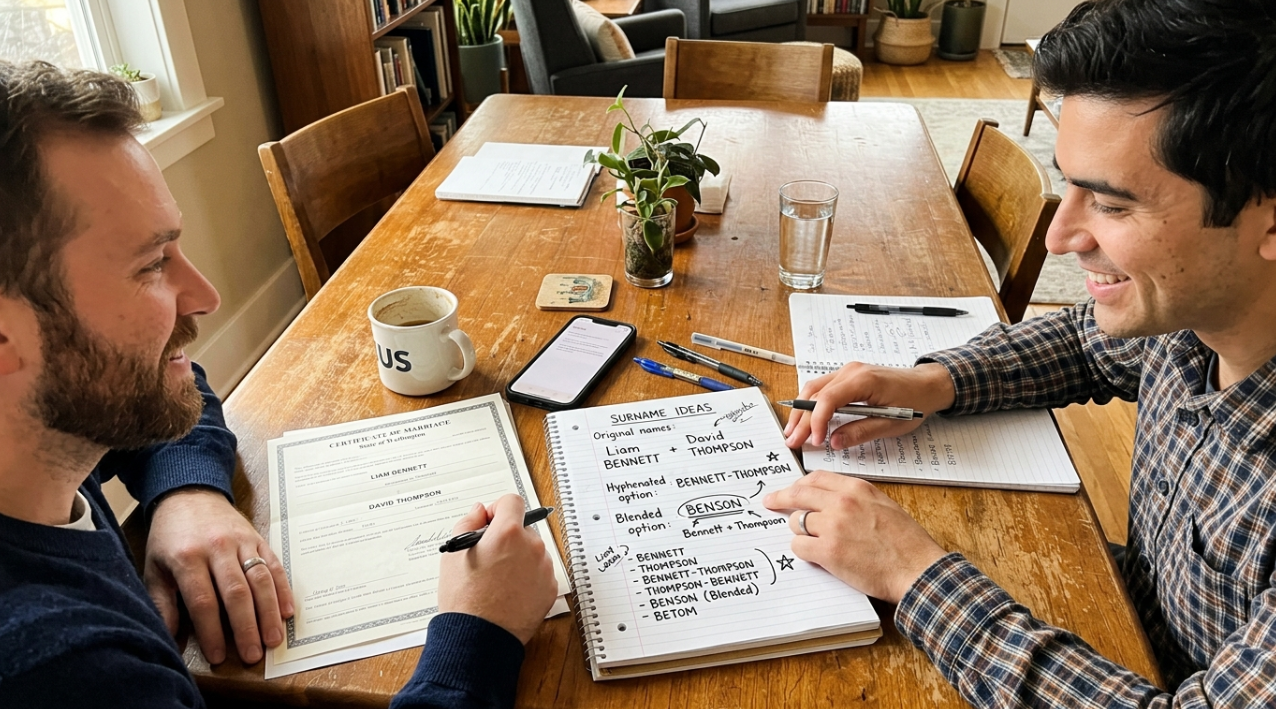
Before you start filling out forms, decide what you actually want your new name to be. Same-sex couples have the same options as any married couple, but the decision often carries different weight. For many LGBTQ+ couples, sharing a surname is a public declaration of a relationship that may have faced years of legal and social barriers.
Here are your options:
Take Your Spouse’s Surname
One partner adopts the other’s last name entirely. Reasons vary: some couples want a shorter or easier-to-pronounce name, some want distance from a family name tied to painful experiences, and some simply like how one name sounds. Practitioners on community forums mention that when children are planned, having one shared family name simplifies school enrollment, medical records, and travel.
A marriage certificate alone supports this change in most circumstances.
Hyphenation
Both partners combine their last names with a hyphen (e.g., Garcia-Thompson). This is popular among couples who want to honor both family names equally. For LGBTQ+ couples specifically, hyphenation requires a legal name change for both spouses, and the process varies by state. In some jurisdictions, one partner can use the marriage certificate while the other needs a court petition.
Name Blending (Portmanteau)
You create an entirely new surname by combining parts of both names. Think “Anderson” plus “West” becoming “Westersen.” This almost always requires a court order since no marriage certificate covers invented names.
Entirely New Surname
Some couples want a fresh start with a name neither partner had before. This requires a court order in every state. The marriage certificate won’t help here.
Middle Name Swap
You move your birth surname to the middle name position and take your spouse’s last name. Many states support this through the marriage certificate alone. It’s a way to preserve your original identity while sharing a family name.
Keeping Your Original Names
No paperwork required. Plenty of couples, same-sex and otherwise, choose this route. It doesn’t make your marriage any less valid.
One important limitation: a marriage certificate can change your last name or middle name, but never your first name. First-name changes always require a separate court petition.
Marriage Certificate vs. Court Order: Two Different Pathways
This distinction matters enormously for same-sex couples, particularly male couples. Understanding it can save you hundreds of dollars and months of frustration.
The Marriage Certificate Pathway
In the simplest version, you walk into the Social Security office with your certified marriage certificate, fill out a form, and your name gets updated. No lawyer, no judge, no court fees. This is how most people imagine the process works.
The Court Order Pathway
A court-ordered name change means filing a petition with your local court, paying a filing fee (typically $100 to $500), sometimes publishing a notice in a local newspaper, attending a hearing, and waiting for a judge’s approval. It takes weeks to months and costs real money.
The Gendered Disparity That Hits Same-Sex Couples Hardest
Here’s what most name-change guides skip entirely: only 18 states allow a man to change his last name using just a marriage certificate. The remaining 32 states plus D.C. require men to get a separate court order, even when changing to a spouse’s surname after marriage.
For opposite-sex couples, this is an inconvenience for the occasional husband who wants his wife’s name. For male same-sex couples, it’s a structural problem. If both spouses are men, both may need court orders. If both spouses are women, only one can use the simplified marriage certificate process while the other faces the petition route.
Legal scholars at the University of Cincinnati Law Review have argued these gendered processes may violate the Fourteenth Amendment’s equal protection guarantees, subjecting men to a more complex and expensive procedure for the exact same outcome.
Name Equality Acts: The Fix That’s Spreading
California led the way in 2007 with its Name Equality Act, which allows one or both marriage applicants to change their middle or last name regardless of gender. Michigan has introduced similar legislation. These gender-neutral laws matter most for same-sex couples because they eliminate the disparity entirely. Check whether your state has adopted or is considering a Name Equality Act before assuming you need a court order.
Using a Utah Online Marriage Certificate for Name Changes
If you married online through Courtly, your marriage certificate comes from Utah. It’s a standard, legally recognized U.S. marriage certificate, but there’s one quirk worth knowing.
Utah Doesn’t List Your Intended New Name
Unlike some states, Utah marriage licenses and certificates do not include the names applicants intend to use after marriage. Your certificate shows your legal name at the time of the ceremony. This confuses some people, but it doesn’t create any actual problem. The certificate proves the marriage happened, and government agencies accept it alongside your request to adopt a spouse’s surname, hyphenate, or move your birth name to the middle position.
Digital vs. Physical Certificate
After your online ceremony, you receive a digital copy of your marriage certificate within 12 hours. A physical certified copy is mailed within the next few business days.
For the name-change process, you need the paper certified copy. Government agencies, particularly the SSA and DMV, generally require physical documentation. Don’t try to use the digital version at a government office window.
If you need your certificate recognized in another country, Courtly offers document legalization services including apostille and embassy authentication.
Step-by-Step Same-Sex Online Marriage Name Change Process
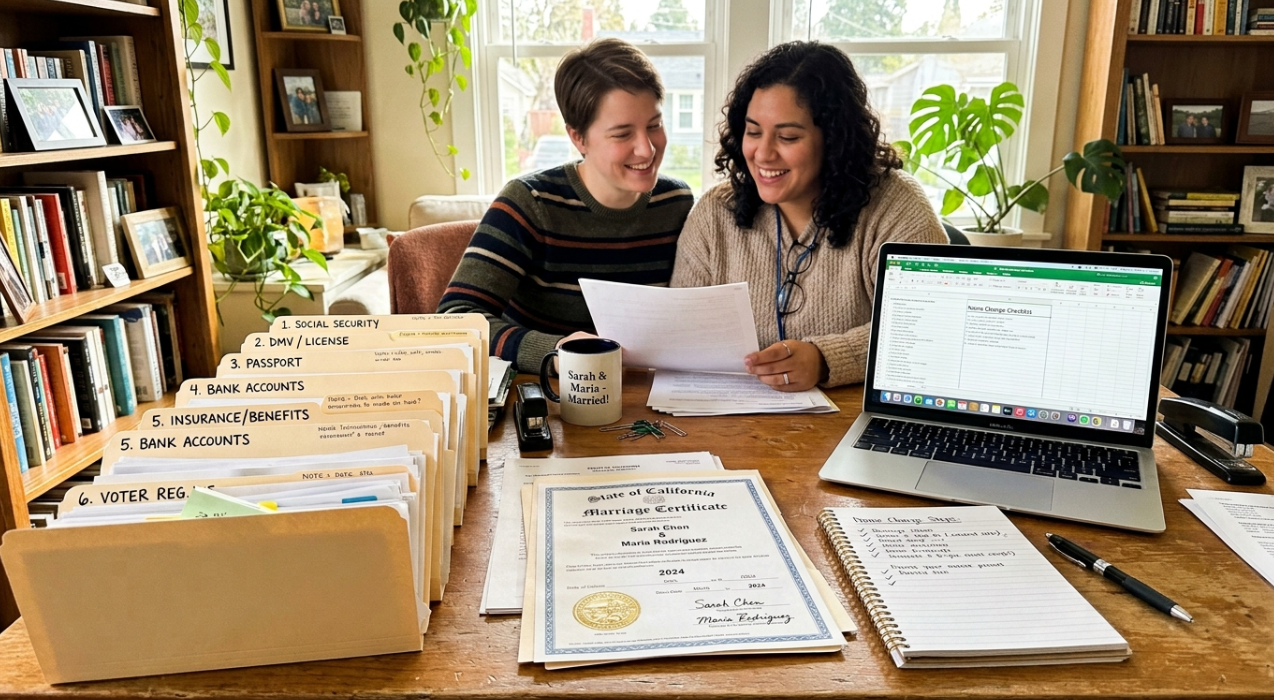
The order matters. Each step builds on the previous one. Skip ahead and you’ll create a mismatch between your records at different agencies.
Documents You May Need for a Same-Sex Marriage Name Change
Before starting the name-change process, gather your documents. Exact requirements vary by agency and state, but you will commonly need:
A certified copy of your marriage certificate
Your current driver's license or state ID
Your Social Security number or Social Security card
Your current passport, if you have one
Proof of identity
Proof of citizenship or immigration status when required
A certified court order if your name change required a court petition
Additional state-specific documentation
Keep several certified copies
If several agencies will need to see your marriage certificate, consider ordering more than one certified copy. Some agencies may retain documents temporarily or require an original or certified copy rather than a photocopy.
Do not assume that a digital PDF, screenshot, or ordinary photocopy will satisfy every agency's requirements. Check the agency's current instructions before submitting documents.
Step 1: Wait 30 Days
The SSA recommends waiting at least 30 days after your marriage date before requesting a name change. This gives the state time to update its records and ensures your marriage certificate is fully processed in the system.
Step 2: Update Your Social Security Card
Step 2: Update Your Name With Social Security
For many people, updating their Social Security record is an important early step because employers, tax records, and other government records may rely on consistent identifying information.
The Social Security Administration says people changing their name after marriage should request a replacement Social Security card. Depending on eligibility and where the marriage was recorded, some applicants may be able to complete the process online or start it online before visiting an office. SSA recommends waiting at least 30 days after the marriage date before requesting the replacement card so that state records have time to update.
Typical requirements include:
Proof of your legal name change, such as a marriage document
Proof of identity
Any additional documentation SSA requests based on your circumstances
Cost: Free.
Processing: SSA currently says replacement cards generally arrive within 5 to 10 business days after the request is completed, although actual timing can vary.
Always check SSA's current instructions before submitting your application.
Online option: If you live in one of 21 participating states, you can complete the process through your my Social Security account online. However, Utah is not currently on the list of participating states for online SSA name changes. If you married online through a Utah service, you’ll likely need to apply in person at your local SSA office or by mail.
Same-sex specific note: The SSA recognizes same-sex marriages for all benefit purposes. Your marriage certificate will be processed the same as any other.
Step 3: Update Your Driver’s License or State ID
Visit your local DMV with:
Your updated Social Security record (some states require the new card itself; others accept a receipt or confirmation letter)
Your certified marriage certificate
Your current driver’s license or state ID
Requirements vary by state. Some states may request additional documentation for middle name changes. Call ahead or check your state DMV’s website before making the trip.
Step 4: Update Your U.S. Passport
Once your other records are updated, review your passport situation.
The U.S. Department of State determines which form you should use based on when your passport was issued, when your legal name changed, and whether you otherwise qualify for renewal by mail.
Situation | Potential form |
|---|---|
Your passport was issued less than 1 year ago and your legal name changed within that period | DS-5504 |
You are eligible to renew by mail | DS-82 |
You are not eligible for DS-82 | DS-11 |
For a marriage-based name change, the State Department accepts an original or certified document showing the name change, such as a marriage certificate, when required.
Important: Passport eligibility rules can change, so verify your situation using the State Department's current passport instructions before mailing anything.
Step 5: Update Everything Else
Once your SSA, DMV, and passport records match, work through the rest:
Banks and credit cards: Usually requires an in-person visit with your marriage certificate.
Employer and payroll: HR will need a copy of your updated Social Security card.
Insurance (health, auto, home): Contact each provider directly.
IRS: Your name should match your SSA record by tax time. No separate form is needed, but if filing jointly for the first time, ensure both names match.
Voter registration: Update through your state’s election office or online portal.
Professional licenses, utilities, subscriptions: Each has its own process. Start with the most time-sensitive ones.
Courtly offers a Name Change Kit that includes prefilled forms, checklists, and prepaid envelopes for SSA, DMV, passport, and bank notifications, available as a $35 print-at-home option or an $85 shipped Courtly Box.
How Long Does a Same-Sex Marriage Name Change Take?
There is no single nationwide timeline. The total time depends on whether you can use your marriage certificate directly, whether your state requires a court order, and how quickly each agency processes your updated documents.
Stage | Typical consideration |
|---|---|
Obtain certified marriage certificate | Depends on the issuing authority |
Wait before SSA request | SSA recommends waiting at least 30 days after marriage |
Social Security update | SSA generally mails replacement cards within 5–10 business days after the request is completed |
DMV/state ID | Varies by state |
Passport | Current State Department routine processing is 4–6 weeks, excluding mailing time |
Banks, employer, insurance and other accounts | Usually varies by institution |
Court-ordered name change | Can add additional weeks or months depending on the state and court |
Best approach: Start with the agencies that establish your official identity record, then work outward to financial, employment, insurance and personal accounts.
How Much Does a Same-Sex Marriage Name Change Cost?
The cost depends on whether your marriage certificate is sufficient or whether you need a separate court petition.
Expense | Possible cost |
|---|---|
Social Security name update | $0 |
Certified marriage certificate | Varies by issuing authority |
Driver's license/state ID update | Varies by state |
Passport name change | May be $0 in certain DS-5504 situations; otherwise normal passport fees may apply |
Court-ordered name change | Varies significantly by state and court |
Certified copies of court order | Varies |
Apostille/authentication | Varies by jurisdiction and document |
Name-change assistance services | Varies by provider |
A marriage-based name change does not automatically mean you will have to pay a court filing fee. If your state permits the desired change through the marriage certificate, you may be able to avoid the court process entirely.
LGBTQ±Specific Challenges and Tips
Clerk Resistance
It’s less common than it was in 2015, but it still happens. Same-sex couples occasionally encounter government clerks who are unfamiliar with, or resistant to, processing their paperwork. A Florida family law attorney and National LGBT Bar Association fellow advises: “Calmly provide your certified marriage certificate and request that they follow the standard married-name update process. If you hit repeated resistance or delays, legal help can resolve it quickly.”
You have the full legal right to change your name after a same-sex marriage in every U.S. state. If a clerk refuses, ask for a supervisor. Document the interaction. Contact your state’s ACLU chapter or the National LGBT Bar Association if the problem persists.
Privacy and Disclosure Considerations
Same-sex couples face a layer of complexity that opposite-sex couples simply don’t. Changing your name to match a same-sex spouse’s name can effectively out you to employers, extended family, or institutions where your relationship status wasn’t previously known.
This is a personal decision with real consequences. Consider:
Are either of you not fully out in certain contexts (work, extended family, certain communities)?
Does your profession or public presence make a name change more visible?
Are there safety concerns, especially for couples with ties to countries where homosexuality is criminalized?
There’s no wrong answer. Some couples find that a shared name is a powerful statement of commitment. Others prioritize privacy and keep their original names. Both choices are valid.
International Same-Sex Couples
If you married online through a U.S. service but live outside the United States, the U.S. name-change process (SSA, DMV, passport) only works for those with U.S. documentation. A foreign-national spouse would need to work through their own country’s name-change process, which may or may not recognize a same-sex marriage certificate.
An apostilled U.S. marriage certificate may be accepted by foreign authorities, depending on local law. Courtly’s apostille guide covers what this involves. For couples navigating immigration alongside a name change, the spouse visa consultation service connects you with partner attorneys.
Practitioners on Reddit’s r/LGBTWeddings have discussed recognition challenges, with some noting that certain countries accept the U.S. certificate for immigration purposes but not for domestic name changes. Research your specific country’s requirements before assuming anything.
For country-specific guidance, Courtly publishes legal guides for same-sex couples in places like Singapore, Japan, India, and Hong Kong, among others.
Key Terms You Should Know
Understanding these terms prevents confusion during the name-change process:
Marriage License vs. Marriage Certificate: A marriage license is the government’s permission to marry. A marriage certificate is the official record proving the marriage took place. You need the certificate (not the license) for name changes.
Certified Copy: A copy of your marriage certificate issued or stamped by the government authority that holds the original record. Agencies require certified copies, not photocopies or digital screenshots.
Apostille: A standardized international certification that authenticates a document for use in another country. If you need your U.S. marriage certificate recognized abroad, you’ll likely need an apostille or embassy authentication.
Name Equality Act: State legislation that allows any marriage applicant to change their name through the marriage certificate, regardless of gender. California’s 2007 law was the first. These laws eliminate the gendered disparity that forces men into court petitions.
Court Petition Name Change: A formal legal process involving filing paperwork with a court, paying fees ($100 to $500), and sometimes attending a hearing. Required for blended names, entirely new names, first-name changes, and, in 32 states plus D.C., for men changing their surnames after marriage.
Frequently Asked Questions
Is the same-sex online marriage name change process different from opposite-sex couples?
Legally, no. The process is identical under federal law. Practically, yes. Gendered state laws can force male same-sex couples into expensive court petitions, and same-sex couples may encounter occasional clerk resistance or face unique privacy considerations. The steps themselves (SSA, DMV, passport) are the same.
Can I use a Utah online marriage certificate to change my name?
Yes. A Utah marriage certificate is a valid, legally recognized U.S. document accepted by the SSA, DMV, State Department, banks, and other institutions. It doesn’t list your intended new name (Utah certificates don’t include that field), but it proves the marriage occurred, which is all agencies need alongside your name-change request.
Do I have to change my name after getting married?
No. Keeping your original name is always an option, and many couples choose it. There’s no legal obligation to change your name after marriage, regardless of sexual orientation.
How long does the entire name-change process take?
Plan for 6 to 10 weeks from start to finish. You’ll wait 30 days before applying to the SSA, then 10 to 14 business days for your new Social Security card. DMV visits vary by state. Passport processing takes 6 to 8 weeks for routine applications. Banks and other institutions each take a few days to a week.
What if a government clerk refuses to process my same-sex name change?
You have the full legal right to change your name after a same-sex marriage. Ask for a supervisor, document the interaction, and consider contacting the National LGBT Bar Association or your state’s ACLU chapter. Legal help typically resolves these situations quickly.
Can my spouse and I both change our names using just the marriage certificate?
It depends on your state’s laws and your genders. In states with gender-neutral name-change laws (like California’s Name Equality Act), both partners can use the marriage certificate. In the 32 states that still have gendered requirements, male partners will need court orders. If both partners are women, typically one can use the marriage certificate while the other needs a court petition.
Does Courtly help with name changes outside the United States?
Courtly currently assists with U.S. name changes only. For international recognition, an apostilled U.S. marriage certificate may help, but foreign-national spouses will need to work through their own country’s processes.
How much does a same-sex online marriage name change cost?
The SSA name change is free. DMV fees vary by state. Passport updates range from free (within one year of issuance) to standard renewal fees. If you need a court petition, expect $100 to $500 in filing fees. Courtly’s Name Change Kit costs $35 for print-at-home or $85 for the shipped Courtly Box, and includes prefilled forms and prepaid envelopes to streamline the entire process.
Let us handle the paperwork.
Getting married is complicated. Courtly simplifies the process and provides everything necessary to get married online, including providing a licensed officiant who can perform a remote ceremony.
Get Married

Get married online.
Getting married is complicated. Courtly simplifies the process and provides everything necessary to get married online.

