


Same-sex marriage is not currently available under Philippine marriage law. Filipino same-sex couples may, however, be able to marry remotely under Utah law and receive a Utah marriage certificate without traveling to the United States. Utah County confirms that its digital marriage system allows non-U.S. citizens and nonresidents to apply remotely, with the officiant physically present in Utah during the ceremony.
A Utah marriage can be relevant to U.S. immigration because USCIS evaluates whether a marriage qualifies under U.S. immigration law, including the law of the place where the marriage was celebrated. However, virtual-marriage cases can involve additional evidentiary and eligibility issues, so couples should not assume that receiving a Utah certificate automatically guarantees an approved immigration petition.
The Philippine legal position is different. Article 1 of the Family Code defines marriage as a union between a man and a woman, while Article 26 generally addresses marriages celebrated outside the Philippines. Whether a particular foreign same-sex marriage produces any legal effect in the Philippines should therefore be treated as a separate Philippine-law question.
Bottom line: A Utah online marriage can create a legally documented marriage under Utah law, but that does not automatically make the couple legally married under Philippine law or guarantee a U.S. immigration outcome.
If you’re ready to explore the process, Courtly’s LGBTQ+ marriage page walks through how it works step by step.
Can Same-Sex Couples From the Philippines Get Married Online?
Yes, a Filipino same-sex couple may be able to obtain a Utah marriage remotely without traveling to the United States. Utah County allows non-U.S. citizens and nonresidents to apply for a marriage license remotely, and remote ceremonies can be performed when the officiant is physically present in Utah. The couple receives a Utah marriage certificate after the ceremony.
However, three separate questions must be answered:
1. Is the marriage valid under Utah law?
Utah law can recognize the remote marriage when its statutory requirements are satisfied.
2. Will the Philippines recognize the marriage?
This is a separate question because Philippine Family Code provisions define marriage as between a man and a woman and foreign-marriage recognition involves additional Philippine-law rules.
3. Will USCIS recognize the marriage for immigration purposes?
A Utah marriage can qualify for U.S. immigration purposes, but virtual marriages require careful analysis of current USCIS rules and the couple's circumstances.
The key distinction is simple: a Utah marriage certificate proves a marriage under Utah law; it does not automatically create a Philippine marriage record or guarantee an immigration benefit.
Three Different Legal Questions You Need to Separate
A same-sex couple with Philippine ties can encounter three different legal systems. Confusing them is one of the biggest sources of misinformation about online marriage.
Question | Governing system | What it determines |
|---|---|---|
Is the online marriage valid? | Utah law | Whether the Utah marriage was legally solemnized |
Is the marriage recognized in the Philippines? | Philippine law | Whether Philippine authorities give the foreign marriage legal effect |
Can the marriage support U.S. immigration? | U.S. immigration law | Whether USCIS and the Department of State recognize the relationship for immigration purposes |
These questions are related, but they are not interchangeable.
A couple can have a valid Utah marriage without automatically obtaining the same marital status in Philippine civil records. Likewise, a marriage certificate does not by itself guarantee approval of an immigration petition.
This distinction should guide every step that follows.
Key Philippine Law Terms
Article 1, Family Code of the Philippines

This is the legal wall. Article 1 defines marriage as “a special contract of permanent union between a man and a woman.” Every other Philippine marriage law flows from this definition. Because the statute explicitly requires one man and one woman, no government office in the Philippines will solemnize, register, or recognize a same-sex marriage performed domestically.
As of August 2025, no Supreme Court ruling has struck down this definition, and no national legislation has created an alternative status like civil unions or domestic partnerships for same-sex couples. Multiple bills have been filed over the years. None have passed.
Why it matters to you: This article is the reason your Utah online marriage won’t be recognized by Philippine authorities. Understanding this helps you set realistic expectations about what your U.S. marriage certificate will and won’t do at home.
Article 26 of the Family Code: Foreign Marriages
Article 26 of the Family Code provides a general rule concerning marriages solemnized outside the Philippines: marriages valid under the law of the place where they were celebrated may also be recognized in the Philippines, subject to the exceptions stated in the law.
This is often described using the legal principle lex loci celebrationis, meaning that the law of the place where a marriage was celebrated is important in determining its formal validity.
For same-sex Filipino couples, however, Article 26 should not be treated as an automatic guarantee of Philippine recognition. Article 1 of the Family Code defines marriage as a union between a man and a woman, creating a significant issue when a foreign same-sex marriage is presented for recognition in the Philippines.
Why this distinction matters
A Utah marriage certificate can establish that a marriage was legally solemnized under Utah law. It does not, by itself, determine how Philippine authorities will treat that marriage under Philippine law.
For that reason, couples should distinguish between:
validity under Utah law
recognition under Philippine law
registration in Philippine civil records
These are separate legal questions.
Same-Sex Marriage (Philippines, Domestic Status)
Same-sex marriage is not legal anywhere in the Philippines at the national level. No court has ordered it. No statute permits it. The constitution does not explicitly prohibit it, but the Family Code’s man-and-woman definition has held firm through every challenge.
That said, the ground is shifting. Several cities have passed local LGBTQ+ ordinances (covered under “Right to Care Card” below). Senator Robin Padilla filed a civil partnership bill in July 2025. The SOGIESC Equality Bill advanced through a House committee in 2026. And the Supreme Court’s February 2026 ruling in Josef v. Ursua marked the first major judicial recognition of same-sex couples’ property rights.
None of these developments create marriage equality. But they represent incremental movement that future couples may benefit from.
Josef v. Ursua: Property Rights for Same-Sex Couples
Josef v. Ursua is a Philippine Supreme Court decision involving property rights between same-sex partners. The decision is dated February 5, 2025, although the Supreme Court's case page was uploaded in February 2026.
In the case, the Supreme Court recognized co-ownership of property acquired during a same-sex relationship where there was evidence of actual contribution. The Court applied Article 148 of the Family Code, which addresses property relations involving couples who live together but cannot legally marry.
The decision does not legalize same-sex marriage and does not create a civil union system. It is narrower: it confirms that a same-sex partner may establish property rights when the legal requirements and evidence of contribution are present.
Why it matters
For Filipino same-sex couples, the decision shows that the absence of marriage recognition does not necessarily mean the absence of every legal protection.
However, do not describe Josef v. Ursua as creating general marital rights. Property ownership, inheritance, taxation, immigration, healthcare decisions, and marriage recognition remain separate legal questions.
Philippine Statistics Authority (PSA)
The PSA is the government body responsible for recording civil status events in the Philippines, including births, deaths, and marriages. When a Filipino marries abroad, the marriage must eventually be transmitted to the PSA for inclusion in the civil registry.
For same-sex marriages performed in Utah or anywhere else, the PSA is the point of rejection. Even if the Philippine consulate accepts your Report of Marriage paperwork (more on that below), the PSA will decline to register a same-sex marriage because it conflicts with Article 1 of the Family Code. Practitioners on Reddit’s r/Philippines_Expats have confirmed this, noting that the consulate may receive the ROM “pro forma” but that PSA will reject it.
Report of Marriage (ROM)
A Report of Marriage is the formal process by which a Filipino citizen reports a foreign marriage to the Philippine government. You file it at the nearest Philippine consulate or embassy, which then transmits it to the PSA for civil registry recording.
For Utah virtual marriages specifically, the ROM is processed by the Philippine Consulate General in San Francisco, California. The registration process typically takes 6 to 12 months and costs approximately $25.
The same-sex reality: A same-sex couple can attempt to file an ROM. The consulate may even accept the documents. But the PSA will not register the marriage. This means the marriage will not appear in your Philippine civil records, and you will not receive a PSA marriage certificate. For immigration purposes, this distinction matters less than you might think, since USCIS relies on the Utah marriage certificate, not a Philippine registration.
SOGIE Equality Bill (SOGIESC Equality Bill)
The Sexual Orientation, Gender Identity, and Gender Expression, and Sex Characteristics (SOGIESC) Equality Bill is anti-discrimination legislation that has been filed repeatedly in the Philippine Congress. In 2026, the Commission on Human Rights welcomed its approval by the House Committee on Women and Gender Equality, consolidating multiple House Bills.
This bill does not create marriage equality. It addresses discrimination in employment, education, and public services based on sexual orientation and gender identity. Its passage would be meaningful, but it would not change your ability to marry in the Philippines or register a foreign same-sex marriage with the PSA.
Right to Care Card and Local LGBTQ+ Ordinances
Several Philippine cities have passed local ordinances granting limited rights to LGBTQ+ residents. Quezon City’s “Right to Care” program allows registered same-sex partners to make healthcare decisions for each other. By mid-2025, over 468 couples had registered. San Juan passed a similar ordinance in June 2025, followed by Iloilo City (March 2026), and Dasmariñas, Mandaluyong, and Parañaque (May 2026).
These ordinances provide real, practical benefits: hospital visitation, emergency decision-making, and a measure of official acknowledgment. They are not marriage. They do not convey inheritance rights, tax benefits, or immigration standing. But if you live in one of these cities, they offer protections worth knowing about.
Utah Online Marriage Terms
Online Marriage (Utah Virtual Marriage)
Since January 2019, Utah has allowed couples to obtain a marriage license and complete a wedding ceremony entirely online. Both spouses appear before a Utah-licensed officiant via live video (typically Zoom). Neither spouse needs to be physically in Utah or even in the United States.
After the U.S. Supreme Court’s Obergefell decision, Utah must issue marriage licenses to same-sex couples. A Filipino same-sex couple married online through Utah receives the exact same marriage certificate as any opposite-sex couple.
The scale of this program is substantial. The Utah County Clerk reported performing approximately 3,500 virtual weddings for international couples in a single year, including couples from Azerbaijan, Estonia, Finland, France, Kenya, and many other countries. Around 200 Chinese and Hong Kong same-sex couples alone married via Utah since 2021.
For a detailed look at how the online marriage process works, Courtly’s step-by-step guide covers the full sequence from application to certificate delivery.
Utah Code §30-1-1 et seq.
This is the Utah statute that makes the whole thing possible. It authorizes county clerks to issue marriage licenses through remote appearance (meaning by video) and allows solemnization to occur with both parties appearing remotely before a Utah-based officiant.
The key legal requirements are straightforward: the officiant must be physically in Utah during the ceremony, the license must be issued by a Utah county, and both parties must appear live via video. There is no requirement that either spouse ever set foot in Utah.
If you’re wondering whether this type of online wedding is legally valid, the short answer is yes under Utah law, U.S. federal law, and for USCIS immigration purposes.
Obergefell v. Hodges (2015)
This U.S. Supreme Court decision, issued on June 26, 2015, held that the fundamental right to marry is guaranteed to same-sex couples under the Fourteenth Amendment. All 50 U.S. states, including Utah, must license and recognize same-sex marriages.
Same-sex marriage had actually been legal in Utah since October 6, 2014, following a federal court ruling. Obergefell made it the nationwide standard and eliminated any risk that a future Utah law could revoke it.
Why it matters to you: Obergefell is the constitutional foundation that guarantees your Utah online same-sex marriage is a fully valid U.S. marriage. Without it, the Utah virtual marriage route wouldn’t exist for same-sex couples.
Proxy Marriage vs. Virtual Marriage
This distinction is critical for immigration. A proxy marriage is one where a stand-in (proxy) appears on behalf of an absent spouse. Montana, for example, allows proxy marriages. USCIS treats proxy marriages differently, requiring consummation after the ceremony before the marriage is recognized for immigration benefits.
A virtual marriage, like Utah’s, is not a proxy marriage. Both spouses appear live via video and personally exchange vows. Utah law considers them legally “present” at the ceremony. This means the USCIS proxy marriage rules, including the consummation requirement, should not apply.
That said, the distinction has become murkier in recent years (see “Consummation Requirement” below). For a deeper comparison, see this guide on proxy vs. virtual marriage and the immigration implications of each.
Apostille
An apostille is a certificate issued by a designated government authority that authenticates a public document for use in another country. When you receive your Utah marriage certificate, you’ll need an apostille to use it internationally.
The Philippines is a member of the Hague Apostille Convention (along with 126 countries as of 2025), so an apostilled Utah marriage certificate is the standard format for any recognition attempt. The apostille doesn’t make the marriage “more valid.” It simply verifies that the document is authentic and issued by a legitimate authority.
For same-sex couples, the apostille is essential if you plan to use your marriage certificate for immigration, legal proceedings abroad, or any official purpose outside the United States. Courtly offers document legalization services including apostille processing.
What a Utah Marriage Certificate Does—and Does Not—Prove
A Utah marriage certificate is important evidence that the marriage was legally solemnized under Utah law. Utah County states that its marriage certificate serves as legal proof of marriage and allows couples to request certified copies and apostille services.
But the certificate does not automatically answer every legal question in another country.
A Utah marriage certificate can establish:
that a marriage was solemnized under Utah law;
the identity of the spouses;
the date and place associated with the marriage record; and
documentary evidence that may be used for other legal purposes.
A Utah marriage certificate does not automatically establish:
that the Philippines will recognize the marriage as a Philippine marriage;
that the marriage will appear as a same-sex marriage in Philippine civil records;
that every Philippine government agency will accept it for every purpose; or
that a U.S. immigration petition will automatically be approved.
This distinction is especially important for couples who intend to use the marriage for immigration, inheritance, property, healthcare, taxation, or other legal purposes.
U.S. Immigration Terms
I-130 Petition (Petition for Alien Relative)
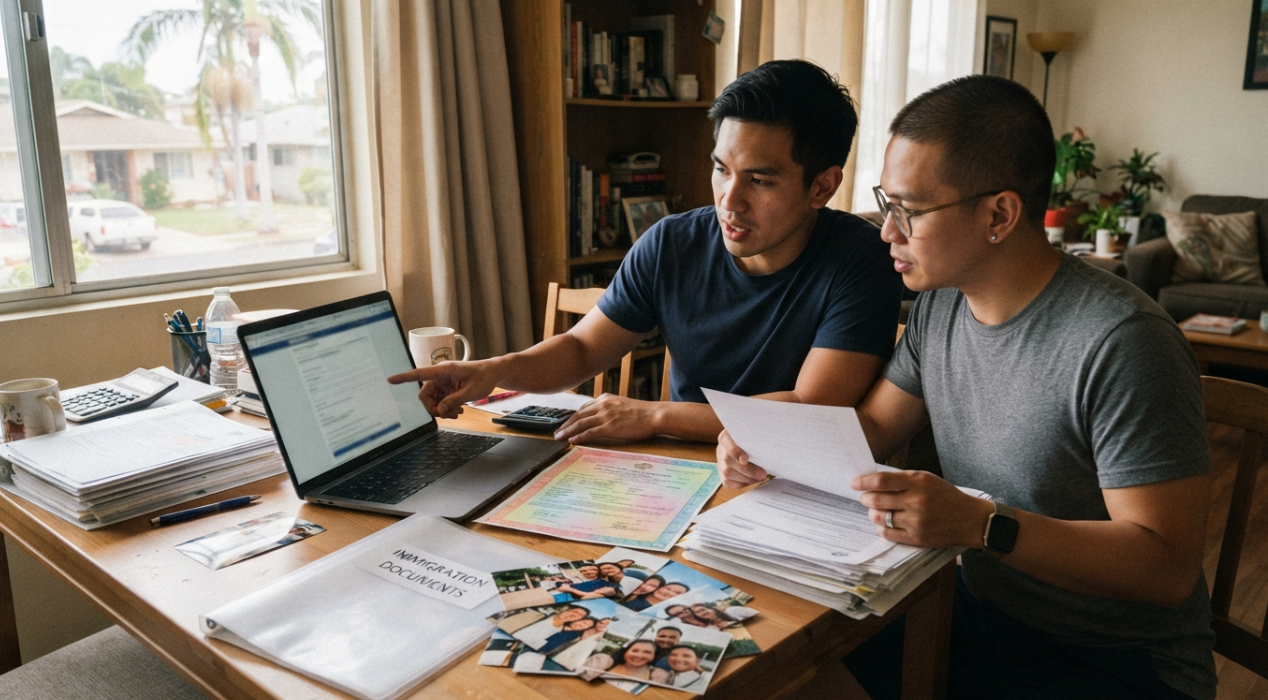
The I-130 is the USCIS form that starts the spousal immigration process. A U.S. citizen or lawful permanent resident files it to establish a qualifying family relationship with a foreign spouse. For same-sex couples who married online through Utah, the I-130 is typically the first immigration step.
USCIS evaluates the marriage under the “place of celebration” rule: if the marriage was valid where it was performed (Utah), it’s valid for immigration purposes. This applies equally to same-sex and opposite-sex marriages after Obergefell.
Important: you do not need to register your marriage with the Philippine government before filing the I-130. USCIS cares about the Utah marriage certificate, not a Philippine ROM. Practitioners on immigration forums like VisaJourney have confirmed that the ROM and the I-130 filing are entirely separate processes.
For guidance on the CR-1 visa process after an online marriage, including evidence requirements and timelines, that guide covers the specifics.
CR-1 / IR-1 Visa (Spouse Visa)
After your I-130 is approved, your Filipino spouse will apply for either a CR-1 (Conditional Resident) or IR-1 (Immediate Relative) visa to immigrate to the United States. The CR-1 applies if you’ve been married less than two years at the time of visa issuance. The IR-1 applies if you’ve been married two years or more.
Both are spouse visas that grant lawful permanent resident status upon arrival in the U.S. For same-sex couples, these visas work identically to those for opposite-sex couples. The key requirement is a valid marriage, which your Utah online ceremony provides.
Consummation Requirement (U.S. Immigration)
This is where things get complicated, and where practitioners disagree.
The traditional USCIS rule is simple: proxy marriages (where one party was absent) must be consummated before they’re recognized for immigration. Since Utah virtual marriages are not proxy marriages (both parties appear live), consummation should not be required.
However, immigration attorney guidance has shifted. Fickey Martinez Law, a firm with extensive Philippines-specific experience, advises that USCIS now requires spouses to meet in person after marrying virtually and before filing the I-130. On October 17, 2025, USCIS issued Policy Alert PA-2025-23, which clarified that virtual marriages are subject to the same requirements as other spousal cases.
There’s also a same-sex-specific wrinkle. Immigration attorney Andy Chodorow has noted that it would be difficult for USCIS to define what “consummation” means for same-sex couples. One immigration attorney called it “folly” to attempt such a definition.
The practical takeaway: Meet your spouse in person after the online ceremony and before filing the I-130. Document the meeting with photos, travel records, and communication logs. This protects you regardless of how USCIS interprets the consummation issue.
For a thorough breakdown of the consummation question for online marriages, that guide covers both the legal arguments and practical evidence strategies.
USCIS Policy Alert PA-2025-23 (October 2025)
Issued on October 17, 2025, this policy alert clarified USCIS’s position on virtual marriages. The key point: virtual marriages are subject to the same requirements as other spousal cases, including the place-of-celebration rule.
This means USCIS still recognizes Utah virtual marriages as valid, but it also means officers may apply increased scrutiny, particularly around whether the couple has met in person and whether the marriage is bona fide (genuine). The alert did not specifically address same-sex couples, but it applies equally to all virtual marriages.
What Can You Actually Do?
Here’s the honest summary. This table reflects the current legal reality for Filipino same-sex couples pursuing a Utah online marriage.
Action | Status | Notes |
|---|---|---|
Get a valid U.S. marriage certificate (Utah) | ✅ Yes | Same certificate as any married couple |
Use it for U.S. immigration (CR-1/IR-1) | ✅ Yes | With caveats about meeting in person first |
Get an apostille for international use | ✅ Yes | Philippines is a Hague Convention member |
Register the marriage with PSA | ❌ No | PSA will reject same-sex ROM filings |
Gain domestic Philippine marital rights | ❌ No | No inheritance, tax, or family law protections |
Claim property co-ownership | ⚠️ Maybe | Possible under Josef v. Ursua if both partners contributed |
Access local protections | ⚠️ Varies | Depends on your city (QC, San Juan, Iloilo, others) |
This table is the clearest picture available. The Utah marriage gives you a legally valid U.S. marriage and a viable immigration pathway. It does not give you a recognized marriage in the Philippines.
Frequently Asked Questions
Can a same-sex Filipino couple legally marry online?
Yes, through Utah’s virtual marriage system. Both partners appear via video before a Utah-based officiant and receive a legally valid U.S. marriage certificate. Neither partner needs to be in the United States. This marriage is fully legal under U.S. federal law following Obergefell v. Hodges (2015).
Will the Philippines recognize a same-sex online marriage from Utah?
No. Article 1 of the Philippine Family Code defines marriage as between a man and a woman. While Article 26 says foreign marriages valid where celebrated should be valid in the Philippines, this collides with Article 1 for same-sex couples. The PSA will reject the registration.
Can I use a Utah online marriage for U.S. immigration?
Yes. USCIS recognizes Utah virtual marriages for spousal visa petitions (I-130, CR-1/IR-1). The marriage must be valid where celebrated, which it is under Utah law. However, practitioners recommend meeting your spouse in person after the ceremony and before filing the I-130, especially after USCIS Policy Alert PA-2025-23.
Do I need to report my Utah marriage to the Philippine consulate before filing an I-130?
No. The I-130 petition relies on your Utah marriage certificate, not a Philippine Report of Marriage. The ROM and immigration filing are separate processes. For same-sex couples, attempting to file an ROM will likely result in PSA rejection anyway.
Is a Utah virtual marriage the same as a proxy marriage?
No. In a proxy marriage, a stand-in appears for an absent spouse. In a Utah virtual marriage, both spouses appear live via video and personally exchange vows. This distinction matters because USCIS applies different rules (including a consummation requirement) to proxy marriages. Utah’s virtual marriage avoids those rules, though recent USCIS guidance has complicated this picture.
What rights do same-sex couples have in the Philippines right now?
No national marriage or civil union rights exist. However, the February 2026 Josef v. Ursua ruling established property co-ownership rights for cohabiting same-sex partners who jointly acquire assets. Several cities (Quezon City, San Juan, Iloilo City, Dasmariñas, Mandaluyong, Parañaque) have passed local ordinances granting healthcare decision-making and other limited protections to registered same-sex partners.
How much does a same-sex online marriage through Utah cost?
Courtly offers plans starting at $199, with the most popular plan at $399 including a ceremony recording, marriage recognition guidance, and a satisfaction guarantee. A government processing fee of approximately $70 for the Utah County marriage license applies separately. Visit the Courtly pricing page for full details on what each plan includes.
Should I consult an immigration attorney before proceeding?
Yes, especially for same-sex couples with Philippine ties. The intersection of Philippine family law, U.S. immigration policy, and virtual marriage recognition creates enough complexity that professional guidance is worth the investment. Courtly offers a low-cost spouse visa consultation with partner attorneys who handle these cases regularly.
The legal situation for same-sex Filipino couples is not where it should be. But options exist. A Utah online marriage gives you a real, legally recognized U.S. marriage certificate, a workable immigration pathway, and the start of a documented legal relationship that may carry increasing weight as Philippine law evolves. The key is understanding exactly what you’re getting and what you’re not.
When you’re ready to take the next step, get married online through Courtly from wherever you are in the world.
Let us handle the paperwork.
Getting married is complicated. Courtly simplifies the process and provides everything necessary to get married online, including providing a licensed officiant who can perform a remote ceremony.
Get Married

Get married online.
Getting married is complicated. Courtly simplifies the process and provides everything necessary to get married online.

