

An online marriage is legally binding when it meets five requirements: a valid state-issued marriage license, a state-licensed officiant physically located in Utah, two adult witnesses, a declaration of intent from both parties, and proper filing with the county clerk. Because of the U.S. Constitution’s Full Faith and Credit Clause, an online marriage performed legally in Utah is recognized across all 50 states. International recognition varies by country and often requires an apostille or embassy authentication.
The technology doesn’t make an online marriage legal. The law does. Couples searching for what makes online marriage legal often assume the video call itself is the key ingredient. It’s not. What matters is whether specific legal requirements are satisfied during the ceremony, regardless of whether the participants are in the same room or on different continents.
This glossary breaks down every legal term and concept you need to understand before getting married online. Each definition explains not just what the term means, but why it matters for your marriage to hold up in court, at the immigration office, and abroad.
If you’re evaluating whether an online wedding is right for you, compare plans and pricing to see what’s included at each tier.
Quick Answer: What Makes an Online Marriage Legal?
An online marriage is legally valid when it satisfies the legal requirements of the state issuing the marriage license rather than the physical location of the couple. In 2026, Utah remains the only U.S. jurisdiction that offers fully remote civil marriages for couples located anywhere in the world.
To be legally binding, every online marriage must include:
Requirement | Required? | Notes |
|---|---|---|
Valid Utah marriage license | ✅ Yes | Must be issued before the ceremony |
Licensed officiant physically located in Utah | ✅ Yes | Establishes legal jurisdiction |
Two adult witnesses | ✅ Yes | May attend remotely |
Verbal declaration of intent ("I do") | ✅ Yes | Required under Utah law |
Marriage filed with county clerk | ✅ Yes | Usually handled electronically |
If all five requirements are met, the marriage is legally recognized throughout the United States under the Full Faith and Credit Clause. Recognition outside the U.S. depends on each country's laws and may require an apostille or embassy legalization.
The Core Legal Building Blocks
These are the elements that, taken together, answer the question of what makes an online marriage legally binding. Miss one, and the marriage may not be valid.
Online Marriage
An online marriage (also called a virtual wedding, Zoom wedding, or remote-appearance marriage) is a legally binding civil marriage ceremony conducted over video conferencing technology. The couple and their witnesses participate remotely while a licensed officiant performs the ceremony from a jurisdiction that authorizes this format.
The critical distinction: an online marriage is not a symbolic gesture or a “pretend” wedding. When performed correctly under Utah law, it produces the same legal outcome as walking into a courthouse. Utah County created the nation’s first fully online marriage system in 2019, and the process gained national attention during the 2020 pandemic.
For a deeper explanation of how the process works from start to finish, see this guide on how online marriage works.
Marriage License
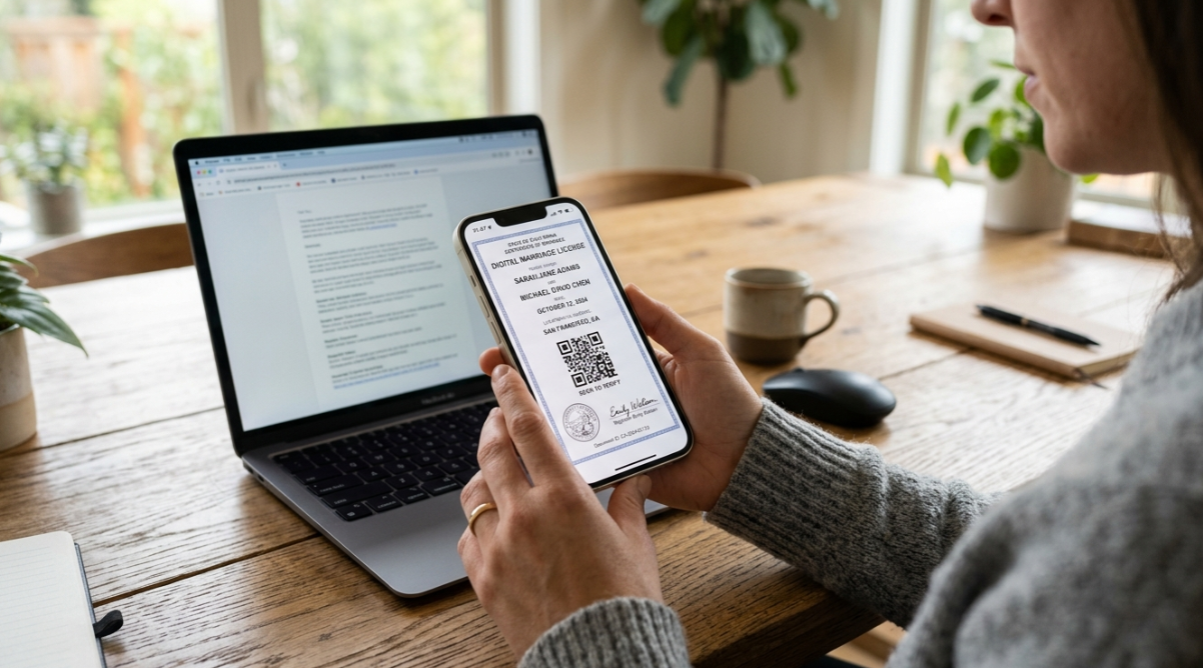
A marriage license is the government-issued document that authorizes a couple to marry. Without it, no ceremony, whether in person or online, produces a legal marriage. Think of it as the permission slip that comes before the wedding, not after.
In Utah, the marriage license process is completely digital. Key details:
Cost: Approximately $71.75, which includes the base $50 fee, a $20 online processing surcharge, and a small system fee
Validity: 32 days from the date of issuance
Waiting period: None
Residency requirement: None. Neither party needs to live in Utah or even be a U.S. citizen
The license exists as a distinct URL and QR code sent to your email once the application is approved. This is different from a marriage certificate, which comes after the ceremony (more on that distinction below).
You can start the application process through Courtly’s online marriage license page.
Typical Online Marriage Timeline
Step | Typical Time |
|---|---|
Submit marriage license application | 15–30 minutes |
License approval | Usually a few business days |
Schedule ceremony | Same day to several days |
Online ceremony | 15–30 minutes |
Officiant files paperwork | Immediately after ceremony |
Digital certificate available | Usually within days |
Physical certificate arrives | Depends on mailing location |
Solemnization
Solemnization is the legal term for the ceremony itself, the act that transforms a marriage license into a marriage. Under Utah’s 2024 recodification (Title 81), a marriage is considered solemnized when all required elements occur: the officiant pronounces the parties as married, the couple declares their intent, and witnesses observe the proceedings.
This is the part most people think of as “the wedding,” but in legal terms, solemnization is a specific, defined event with mandatory components. A ceremony that skips any of them isn’t solemnized in the eyes of the law.
Officiant
An officiant is the person authorized by the state to perform a marriage ceremony. For online marriages conducted under Utah law, the officiant must be physically located in the state of Utah at the time of the ceremony. This is non-negotiable. The officiant’s physical presence in Utah is what establishes the jurisdiction needed to use a Utah County marriage license.
Who qualifies as an officiant in Utah? Religious leaders, judges, county clerks, and individuals ordained or authorized under state law. For remote-appearance marriages, the officiant’s Utah location serves as the “host location” of the videoconference ceremony.
Declaration of Intent
Both parties must explicitly state their willingness and intent to marry during the ceremony. This isn’t just a formality. The declaration of intent is one of the legal conditions for a valid solemnization under Utah law.
In practice, this means each person says something to the effect of “I do” or “I will” when asked whether they freely choose to enter the marriage. The officiant cannot simply declare the couple married without this verbal confirmation from both parties.
Witnesses
At least two individuals who are 18 years old or older must witness the declarations of intent. Here’s where online marriage gets interesting: Utah law explicitly allows the witnesses to be located anywhere in the world and to attend the ceremony remotely using audio-visual technology.
So your witnesses can be a friend in London and a sister in Tokyo. They don’t need to be in Utah or even in the United States. They just need to be adults who can see and hear what’s happening during the ceremony.
Practitioners on Reddit’s r/wedding have confirmed that services like Courtly offer witness provision as an add-on (typically $50), which is useful for couples who can’t coordinate two adults to be online at the same time.
Remote Appearance
“Remote appearance” is Utah’s official legal term for participation in a marriage ceremony via video technology. It’s the phrase used in the state’s statutes and county clerk documents. When you see “remote-appearance marriage,” that’s the formal version of what most people call a Zoom wedding or online marriage.
Important 2026 update: As of May 6, 2026, Utah Code §81-2-302 requires officiants to state a verbal warning during every remote-appearance ceremony: “A marriage solemnized according to the laws of the State of Utah through online remote appearance may be invalid in the country where the parties to the marriage reside.” This same warning must also appear on the website of the county issuing the license.
This new requirement came after a bill by Utah State Senator Todd Weiler initially proposed abolishing remote-appearance marriages entirely. The bill was ultimately revised. The practice remains fully legal, but the disclaimer is now mandatory. Most competing resources haven’t covered this change yet, so be aware of it as you research.
Why It’s Recognized Everywhere in the U.S.
Understanding what makes online marriage legal in one state is only half the question. The other half is why every other state has to accept it.
Full Faith and Credit Clause
The Full Faith and Credit Clause, found in Article IV of the U.S. Constitution, requires every state to recognize legal rulings and public records from other states. This is why a marriage performed legally in Utah is recognized in California, New York, Texas, and everywhere else in the country. There is no asterisk for online marriages. If the marriage was validly performed under Utah law, it’s valid everywhere.
This same principle applies to marriages performed in Las Vegas, courthouse weddings in Alabama, and any other lawful ceremony in any state. The method of solemnization doesn’t matter. What matters is whether the marriage was legal where it happened.
The clause is particularly relevant for same-sex couples who may live in states with complicated histories around marriage recognition. Federal law now reinforces this protection.
Respect for Marriage Act
In November 2022, Congress passed the Respect for Marriage Act with a 61-36 vote, codifying federal protection for same-sex and interracial marriages. This means that even if a future Supreme Court were to revisit prior rulings, federal law now independently requires recognition of these marriages across state lines.
For couples married online, this provides an additional layer of certainty beyond the Full Faith and Credit Clause. The marriage certificate issued by Utah carries the same federal protections as any other U.S. marriage certificate.
Marriage Certificate
A marriage certificate is the official document proving that a marriage took place. It’s the output of the process, issued after the ceremony. Many people confuse it with the marriage license, but they’re different documents serving different purposes:
Marriage license: Permission to marry (issued before the ceremony)
Marriage certificate: Proof of marriage (issued after the ceremony)
For online marriages through Utah, the officiant electronically submits the completed marriage information to the county clerk after the ceremony. The couple then receives both a digital and physical copy of their marriage certificate. This is the document you’ll use for name changes, tax filing, insurance updates, immigration petitions, and everything else that requires proof of marriage.
Immigration and International Recognition
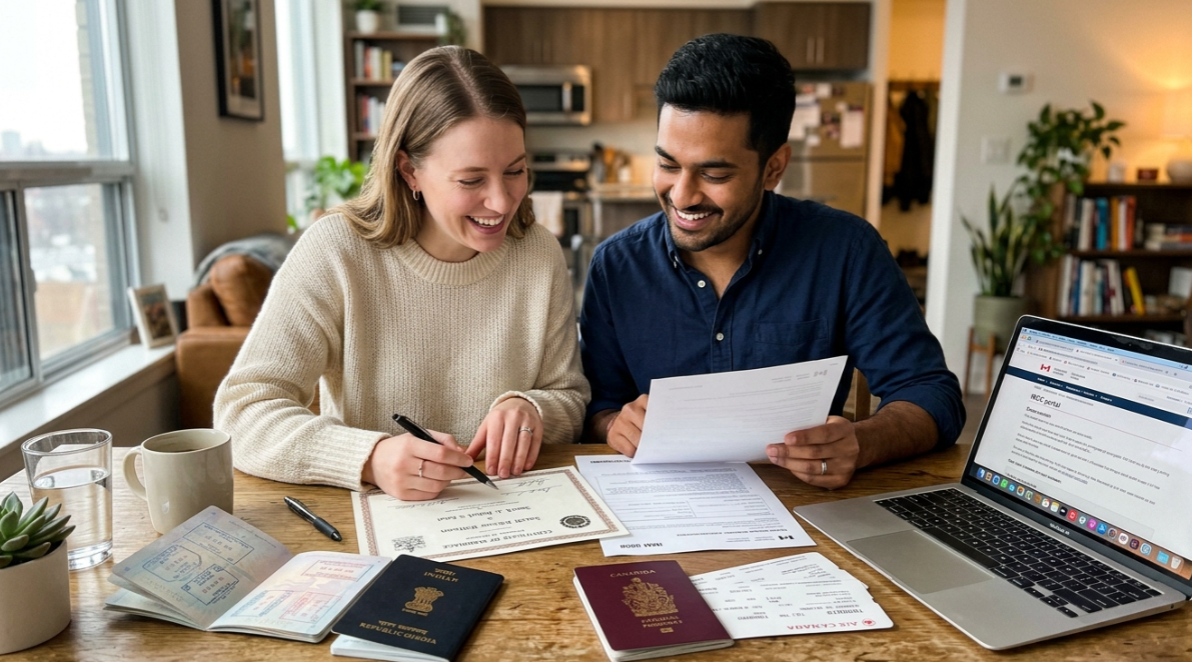
This is where things get more nuanced. Understanding what makes online marriage legal for domestic purposes is straightforward. International recognition introduces variables that depend on where you live and what you plan to do with the certificate.
Place-of-Celebration Rule
The place-of-celebration rule is the standard USCIS uses to determine whether a marriage is valid for immigration purposes. Under this rule, if a marriage is valid in the jurisdiction where it was performed, it’s valid for U.S. immigration. Since online marriages are legal in Utah, they satisfy this requirement.
Immigration attorney Gary Chodorow of LawandBorder.com has confirmed that Utah virtual marriages are valid for U.S. immigration law purposes, noting that Utah law doesn’t limit the location of the parties seeking to marry.
Multiple users on Reddit’s r/USCIS have reported successful I-130 petition approvals after Utah online marriages. However, there’s one critical caveat that comes up at nearly every immigration interview.
If you’re navigating the immigration process after an online ceremony, Courtly offers a spouse visa consultation with partner attorneys.
Consummation
In immigration law, consummation refers to the physical meeting and intimate relationship between spouses after marriage. This term matters specifically for online marriages where the two spouses were in different locations during the ceremony.
Here’s the rule: when parties are physically separate during an online ceremony, USCIS may treat it similarly to a proxy marriage. In that case, the marriage is not considered valid for immigration purposes until it is consummated. If both spouses were physically together (say, sitting on the same couch during the video call), consummation proof is not required.
Practitioners on Reddit’s r/USCIS consistently report that the consummation meeting is the single most asked-about element during immigration interviews. Couples should plan to meet in person after the ceremony and keep evidence of that meeting (travel records, photos, hotel receipts) for their immigration file.
For more on how immigration authorities view online marriages, read this detailed breakdown of immigration recognition.
Apostille
An apostille is a certification that authenticates a document for international use. If you need your U.S. marriage certificate recognized in another country, an apostille is usually the first step.
The apostille process was established by the Hague Convention of 1961. It essentially tells a foreign government, “This document is legitimate and was properly issued by the authorities in its country of origin.”
For online marriages, getting an apostille on your Utah marriage certificate is the standard pathway to international recognition. Courtly offers document legalization services including apostille processing and expedited options.
Hague Apostille Convention
The Hague Apostille Convention is the international treaty that created the apostille system. Over 120 countries have signed this treaty, agreeing to accept apostilled documents from other member nations without further authentication.
If the country where you need your marriage recognized is a Hague Convention member, an apostille on your marriage certificate should be sufficient. If the country is not a member, you’ll need embassy authentication instead.
Embassy Authentication / Legalization
For countries that haven’t signed the Hague Convention, the alternative to an apostille is embassy authentication (also called legalization). This involves having the document certified by the destination country’s embassy or consulate in the United States.
The process is typically longer and more expensive than getting an apostille. It often involves multiple steps: state-level authentication, U.S. Department of State authentication, and then embassy legalization. The difference between these two pathways is explained in detail in this apostille vs. authentication comparison.
Common Confusion Points
Proxy Marriage vs. Online Marriage
This is one of the most misunderstood distinctions in the entire topic, and it has real consequences for immigration and legal recognition.
A proxy marriage is a ceremony where one or both parties are not physically present and are represented by someone else (a proxy) standing in for them. States like Montana, Colorado, Texas, and California allow proxy marriages under specific conditions. Montana even allows double proxy marriages where neither party is present, as long as one is a Montana resident or active-duty military.
An online marriage is different. Both parties personally participate in the ceremony via live video. Nobody stands in for anyone. Both spouses see each other, hear each other, and verbally declare their intent to marry in real time.
Why does this matter? Immigration authorities treat these two categories differently. Online marriages where both spouses actively participated via video are generally viewed more favorably than proxy marriages. However, when the spouses were in different locations during either type of ceremony, the consummation requirement applies to both.
For a thorough side-by-side comparison, see this resource on remote marriage vs. proxy marriage.
Countries That Don’t Recognize Online Marriage
While a Utah online marriage is valid across the entire United States, not every country will recognize it. Countries that historically have not accepted online U.S. marriages include Germany, Hungary, Australia, Norway, France, Sweden, Poland (varies by case), Taiwan, Finland, and Turkmenistan.
Users on Reddit’s r/LGBTWeddings have specifically raised concerns about Australia not recognizing their online Utah marriages, which highlights how important it is to check your specific country’s requirements before proceeding.
On the other side, the Israeli Supreme Court ruled in 2023 that thousands of Israeli marriages performed virtually through Utah County would be recognized by the state. And since 2021, approximately 200 Chinese and Hong Kong LGBTQ+ couples have married via virtual Utah ceremonies, according to reporting from NextShark/AOL News.
You can check whether your country recognizes online marriages on Courtly’s countries page.
“Is It a Real Marriage?”
Yes. There is no legal distinction between a marriage performed in a courthouse and one performed via video conference under Utah law, provided all five legal elements are met. The marriage certificate is the same. The legal rights are the same. The tax implications are the same.
The May 2026 verbal warning requirement (UC §81-2-302) sometimes causes confusion on this point. The warning states that the marriage “may be invalid in the country where the parties reside,” but this refers to potential foreign non-recognition, not to the validity of the marriage itself under U.S. law. Within the United States, the marriage is fully and unambiguously legal.
Quick Reference: The Five Elements That Make It Legal
For anyone still wondering what makes online marriage legal, here’s the checklist:
Valid marriage license issued by Utah County (no residency or citizenship requirement, ~$71.75, valid 32 days)
Licensed officiant physically present in Utah during the ceremony
Two witnesses aged 18 or older (can attend remotely from anywhere)
Declaration of intent from both parties, stated verbally during the ceremony
Proper filing with the county clerk (handled electronically by the officiant)
All five must happen. The couple, witnesses, and officiant connect via video. The officiant performs the ceremony from Utah. Both parties say “I do.” The officiant files the paperwork. A legal marriage exists.
Ready to get started? See Courtly’s plans and pricing to find the option that fits your situation, whether you need witnesses provided, rush scheduling, or document legalization.
Online Marriage vs. Traditional Marriage
Feature | Online Marriage | Traditional Marriage |
|---|---|---|
Marriage License | Required | Required |
Licensed Officiant | Required | Required |
Witnesses | Required | Required |
Ceremony | Video conference | In person |
Marriage Certificate | Same legal document | Same legal document |
Legal Status | Equal | Equal |
State Recognition | All 50 states | All 50 states |
Federal Recognition | Yes | Yes |
Immigration Eligibility | Yes (with USCIS rules) | Yes |
Common Reasons an Online Marriage Could Be Invalid
Although legally recognized, an online marriage can become invalid if one or more required legal elements are missing.
Examples include:
Marriage license expired before the ceremony
Officiant was not legally authorized
Officiant was outside Utah during the ceremony
One or both parties lacked legal capacity to marry
Required witnesses were missing
Marriage was never filed with the county clerk
Fraud or coercion occurred during the ceremony
Fortunately, these situations are uncommon when couples use established online marriage providers that follow Utah law.
Frequently Asked Questions
Can I get legally married online if I don’t live in the United States?
Yes. Utah has no residency or citizenship requirements for obtaining a marriage license. Couples from any country can apply for and receive a Utah marriage license, participate in the ceremony remotely, and receive a legally valid U.S. marriage certificate. However, whether your home country recognizes that certificate is a separate question that depends on local laws.
Is an online marriage valid for U.S. immigration purposes?
Yes, but with a condition. USCIS uses the place-of-celebration rule, so a marriage valid in Utah is valid for immigration. If the spouses were in different locations during the ceremony, USCIS requires proof of consummation before the marriage is considered valid for immigration benefits. Couples who were physically together during the ceremony don’t face this requirement.
Do all 50 U.S. states recognize online marriages from Utah?
Yes. The Full Faith and Credit Clause of the U.S. Constitution requires every state to recognize a marriage that was validly performed in another state. Additionally, the Respect for Marriage Act (passed in 2022) provides further federal protections for all lawful marriages, including same-sex marriages.
What is the new 2026 verbal warning requirement?
As of May 6, 2026, Utah Code §81-2-302 requires officiants to verbally inform couples during remote-appearance ceremonies that their marriage “may be invalid in the country where the parties to the marriage reside.” This warning must also appear on the county clerk’s website. The requirement doesn’t affect the legal validity of the marriage within the United States. It simply ensures couples are aware of potential international recognition issues.
How is an online marriage different from a proxy marriage?
In an online marriage, both spouses personally participate in the ceremony via live video. In a proxy marriage, a stand-in represents one or both spouses during the ceremony. This distinction matters for immigration, as USCIS treats proxy marriages with additional scrutiny. Both types require consummation if the spouses weren’t physically together, but online marriages where both parties actively participated are generally viewed more favorably.
Do I need an apostille to use my marriage certificate in another country?
In most cases, yes. If the country where you need your certificate recognized is one of the 120+ members of the Hague Apostille Convention, an apostille will authenticate your document for international use. For non-member countries, you’ll need embassy authentication instead, which involves additional steps through the U.S. Department of State and the destination country’s embassy.
Can same-sex couples get legally married online?
Absolutely. Online marriages through Utah are available to all couples regardless of gender or sexual orientation. The Respect for Marriage Act provides federal protection, and Utah law does not restrict marriage based on the sex of the parties. Since 2021, hundreds of LGBTQ+ couples from countries where same-sex marriage isn’t legal have used Utah’s online marriage system to obtain a valid U.S. marriage certificate.
How long does the entire online marriage process take?
The timeline varies. After applying for the marriage license, approval can take a few business days. The license is valid for 32 days with no waiting period, so the ceremony can happen as soon as the license is approved. Some services offer rush processing for couples on tight timelines due to deployment, visa deadlines, or travel windows. For a detailed breakdown, check out this step-by-step timeline guide.
Let us handle the paperwork.
Getting married is complicated. Courtly simplifies the process and provides everything necessary to get married online, including providing a licensed officiant who can perform a remote ceremony.
Get Married

Get married online.
Getting married is complicated. Courtly simplifies the process and provides everything necessary to get married online.

