

TL;DR
Saudi Arabia criminalizes same-sex relationships under Sharia law, with penalties up to death. No same-sex marriage, whether performed online or in person, will ever be recognized there. However, same-sex couples connected to Saudi Arabia can get legally married online through Utah’s remote ceremony system. That marriage is valid in the United States and in the 38 countries that recognize same-sex marriage as of 2025, and it can serve as a foundation for U.S. immigration petitions.
If you are researching same-sex online marriage in Saudi Arabia, the most important distinction is between getting legally married and having that marriage recognized in Saudi Arabia.
Saudi Arabia does not recognize same-sex marriage, and the U.S. Department of State states that foreign same-sex marriages are not recognized in Saudi Arabia. Consensual same-sex sexual relations are also illegal under Saudi law, with penalties that can include imprisonment, fines, and death.
That does not necessarily prevent a same-sex couple with ties to Saudi Arabia from marrying under the law of another jurisdiction. Utah County allows couples to apply for a marriage license online and conduct a remote-appearance ceremony, including when the applicants are outside the United States. Utah County specifically states that there is no U.S. citizenship or residency requirement.
The important limitation is recognition. A marriage can be valid under Utah law without being recognized in Saudi Arabia or another country. This guide explains the difference between a Utah online marriage, Saudi Arabian law, apostilles, international recognition, and U.S. immigration rules.
Explore how Courtly works for same-sex couples anywhere in the world.
The terms below are organized to walk you through the legal landscape from Saudi Arabia’s prohibitions to the practical mechanics of getting married online, and the safety considerations that matter most.
Can Same-Sex Couples Get Married Online in Saudi Arabia?
No. Saudi Arabia does not legally recognize same-sex marriage, including same-sex marriages performed online in another jurisdiction. However, eligible couples can potentially obtain a legally valid marriage through Utah County's remote-appearance system while both spouses are outside Utah. Utah County states that its online marriage process is available without a U.S. citizenship or residency requirement, but it also warns that an online marriage may be considered invalid in the country where the spouses reside.
For couples connected to Saudi Arabia, the key distinction is between where the marriage is legally performed and where the marriage is later recognized. A Utah marriage can be legally valid under Utah law while still receiving no recognition under Saudi law. The certificate may be useful for U.S. immigration or other legal purposes, but recognition must be checked separately for each country or jurisdiction where the marriage will be used.
Same-Sex Online Marriage Saudi Arabia: Quick Answer
Question | Answer |
|---|---|
Can same-sex couples marry under Saudi law? | No. |
Does Saudi Arabia recognize foreign same-sex marriages? | No. |
Can same-sex couples potentially marry remotely through Utah? | Yes, subject to Utah's requirements. |
Must the couple be U.S. citizens? | No. Utah County says there is no U.S. citizenship requirement. |
Must the couple live in Utah? | No. Utah County says there is no residency requirement. |
Does a Utah marriage automatically become valid in Saudi Arabia? | No. Utah County specifically warns that remote marriages may be invalid in the country where the spouses reside. |
Does an apostille override Saudi marriage law? | No. An apostille authenticates a public document; it does not change the receiving country's substantive marriage law. |
Can a Utah marriage potentially be relevant to U.S. immigration? | Yes, but immigration eligibility depends on the applicable U.S. rules and the specific facts of the marriage. |
Is Same-Sex Marriage Legal in Saudi Arabia?
No. Same-sex marriage is illegal in Saudi Arabia, and foreign same-sex marriages are not recognized there. The U.S. Department of State's current Saudi Arabia guidance explicitly states that same-sex marriage is illegal and that foreign same-sex marriages are not recognized.
Saudi Arabia's criminal framework is based on Sharia principles, and same-sex sexual activity is criminalized. Human Dignity Trust reports that the maximum penalty under the applicable law is the death penalty and that there is evidence of enforcement against LGBT people.
This means an online ceremony performed through another jurisdiction does not create a Saudi-recognized same-sex marriage. The marriage may be legally valid under the law of the jurisdiction where it was performed, while remaining unrecognized in Saudi Arabia.
Does an Online Marriage Change Saudi Recognition?

No. Performing a marriage ceremony through video conference does not change the receiving country's marriage-recognition rules.
For example, Utah County allows remote-appearance marriage ceremonies, but its own legal notice states that an online marriage performed under Utah law may be invalid in the country where the parties reside.
The key distinction is therefore:
Utah validity ≠ Saudi recognition.
Same-Sex Marriage
Definition: A legally recognized marriage between two people of the same sex or gender.
Same-sex marriage is legal in nearly 40 countries and jurisdictions worldwide, according to Pew Research Center's 2026 analysis. Recent additions include Estonia, Greece and Nepal in 2024 and Liechtenstein and Thailand in 2025.
Saudi Arabia is not among the jurisdictions that recognize same-sex marriage. The U.S. Department of State states that same-sex marriage is illegal in Saudi Arabia and that foreign same-sex marriages are not recognized there.
For this reason, the location of the marriage ceremony and the country where the marriage will later be used must be treated as two separate legal questions.
Sharia Law (Marriage Context)
Definition: Islamic law derived from the Quran and Hadith, which governs all aspects of marriage in Saudi Arabia.
Saudi Arabia’s legal system is built on an uncodified criminal code based on Sharia law. There is no secular alternative for marriage. All marriages must comply with religious prescriptions, which define marriage as a contract between a man and a woman. The ceremony requires the consent of both parties, the presence of witnesses, a male guardian (wali) for the bride, and a dowry (mahr).
Under this framework, same-sex relationships are not just unrecognized. They are criminalized. The maximum penalty for same-sex sexual activity under Saudi Sharia interpretation is death. Other documented penalties include imprisonment of indeterminate length, flogging, fines, and deportation for foreign nationals.
Non-Muslim expatriates living in Saudi Arabia cannot marry under Saudi law at all. They must complete their marriages at their embassy or consulate, following the laws of their home country. Even in those cases, a same-sex marriage would not be recognized by the Saudi government.
LGBTQ+ Safety and Privacy in Saudi Arabia
Legal recognition is only one part of the issue for same-sex couples connected to Saudi Arabia. Personal safety and digital privacy are separate considerations.
The U.S. Department of State currently states that consensual same-sex sexual relations are illegal in Saudi Arabia and that penalties can include fines, imprisonment, and death. Its travel guidance also warns that online dating apps and social media may be monitored and that people may face consequences for discussing or supporting same-sex relationships online.
The same guidance advises travelers to delete sensitive photos, comments, and other content that could be considered controversial or inappropriate before traveling to Saudi Arabia. It also warns that electronic devices may be searched and that authorities may consider past online activity.
Because laws and enforcement can change, anyone with a Saudi residency, citizenship, employment, family, or travel connection should obtain current professional legal or consular advice before deciding how to store, present, or use marriage records in Saudi Arabia.
Important distinction
A Utah marriage certificate may prove that a marriage was legally recorded in Utah. It does not create a right to have that marriage recognized by Saudi authorities.
Online Marriage (Virtual Marriage)
Definition: A legally binding marriage ceremony conducted via video conference, where both partners attend live but may be in different physical locations.
Utah is the state that enables this. Under Utah law, two adults can apply for a marriage license and complete a legal ceremony via video call regardless of their gender, citizenship, or physical location. Neither partner needs a U.S. visa, residency, or any immigration status.
The resulting marriage certificate is a standard U.S. marriage certificate. Nothing on the document indicates it was a virtual ceremony. It carries the same legal weight as a certificate from an in-person wedding.
For same-sex couples connected to Saudi Arabia, this is the primary pathway to a legal marriage. A Utah online marriage won’t be recognized in Saudi Arabia, but it will be recognized in the United States and in the other 37 countries that have legalized same-sex marriage. It can also serve as the basis for U.S. immigration petitions, insurance benefits, hospital visitation rights, and other legal protections.
Courtly handles the entire process: the marriage license application, a certified officiant, optional witnesses, the online ceremony, a video recording, and delivery of both digital and physical marriage certificates.
See Courtly’s plans and pricing to understand what’s included.
For a deeper look at what makes online marriages legally valid, see our guide on what is virtual marriage.
Proxy Marriage
Definition: A marriage where one or both partners are not present at the ceremony, and a third-party stand-in signs documents on their behalf.
This is a critical distinction. Utah does not perform proxy marriages. What Utah offers is a virtual marriage, where both partners attend the ceremony live via video. The difference matters enormously for immigration.
U.S. immigration authorities (both USCIS and the Department of State) treat proxy marriages differently from virtual marriages. A proxy marriage is generally not recognized for immigration purposes unless the marriage has been consummated after the ceremony. A virtual marriage, where both parties attend in real time, is treated more favorably, though couples must still physically meet in person before applying for immigration benefits.
If you’re exploring immigration options, understanding proxy marriage vs. virtual marriage differences is essential.
Utah Online Marriage for Same-Sex Couples
Utah County allows eligible couples to complete a marriage-license application online and participate in a marriage ceremony by remote appearance. Utah County states that applicants do not need to be U.S. citizens or Utah residents.
The remote ceremony still has physical-location requirements. The officiant must be physically present in Utah, and Utah County requires the couple and two adult witnesses to be able to see and hear one another during the ceremony.
Current Utah Online Marriage Requirements
Requirement | Current Utah County information |
|---|---|
U.S. citizenship | Not required |
Utah residency | Not required |
Online application | Available |
Remote ceremony | Available |
Officiant | Must be physically present in Utah |
Witnesses | Two witnesses, age 18 or older |
Couple's physical location | Can be outside Utah |
Current license fee | $71.75 including listed fees |
License validity period | Must be used within 32 days of issuance |
Utah County's current instructions should be checked immediately before applying because fees, procedures and technical requirements can change.
Can a Saudi Resident Get Married Online Through Utah?
Potentially, yes. Utah County states that its marriage-license process does not require applicants to be U.S. citizens or Utah residents, and its system allows couples in different locations to complete their portions of the application remotely.
However, eligibility to obtain a Utah marriage certificate and recognition of that marriage in Saudi Arabia are separate questions.
A couple may be legally married under Utah law without gaining marital status under Saudi law. Utah County itself warns applicants that a remote-appearance marriage may be invalid in the country where the parties reside.
If one or both spouses live in Saudi Arabia, they should therefore evaluate the Saudi-law consequences separately from the Utah marriage process.
Marriage Certificate (Utah)
Definition: The official government document proving that a marriage has been legally performed and registered.
A Utah marriage certificate looks identical to one issued after an in-person ceremony. It lists the names of both spouses, the date of the marriage, the county of issuance, and the officiant’s credentials. There is no indication that the ceremony was conducted remotely.
This matters because the certificate is the document you’ll use for everything that follows: immigration petitions, name changes, insurance enrollment, property rights, and recognition in other countries. It can be apostilled for international use (more on that below).
For details on how the certificate is issued and what it includes, see Courtly’s marriage license page.
Apostille
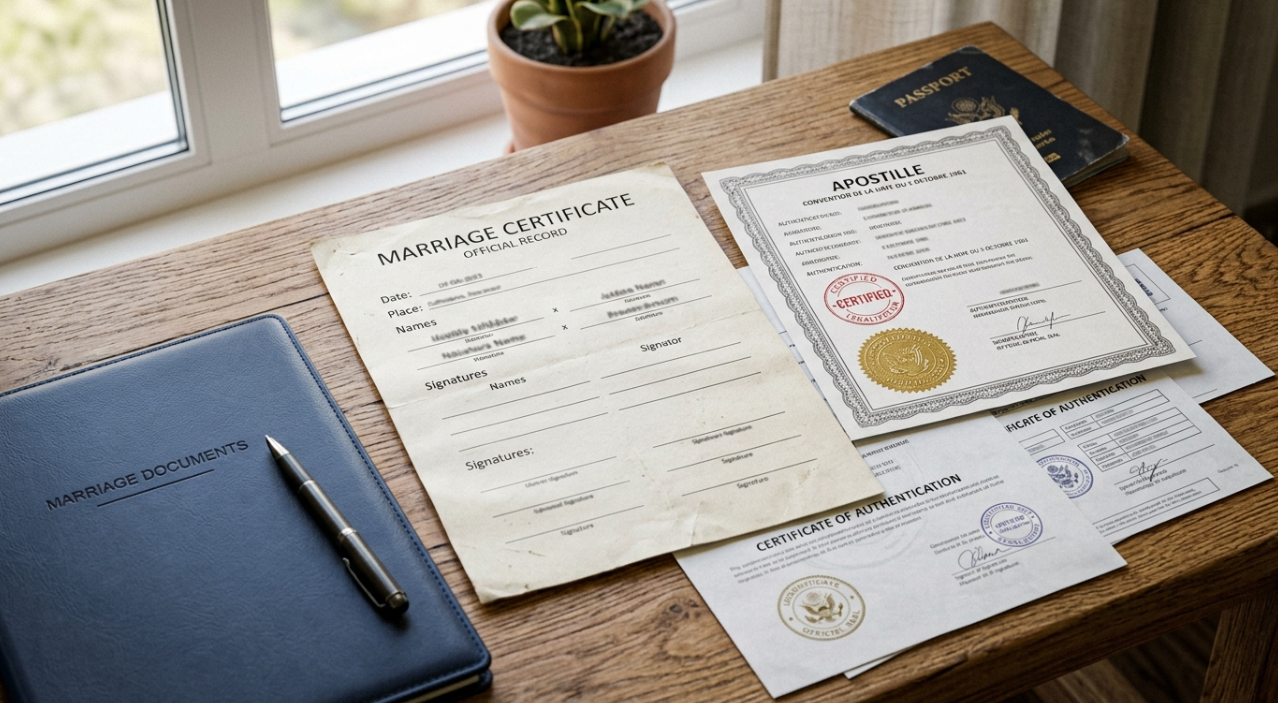
Definition: An international certification that authenticates the origin of a public document, recognized under the Hague Apostille Convention.
Saudi Arabia joined the Hague Apostille Convention in December 2022. This means that official documents carrying an apostille can be procedurally accepted through a simplified legalization process in the Kingdom.
Here is the distinction that no other page on this topic makes clearly enough: an apostille authenticates where a document came from. It does not override the domestic laws of the receiving country.
A same-sex marriage certificate from Utah, even with a valid apostille, carries zero legal standing in Saudi Arabia. The apostille confirms that the document was genuinely issued by Utah County. Saudi Arabia will still refuse to recognize the underlying marriage because same-sex marriage is illegal under Saudi law.
However, apostilles are essential for recognition in countries that do accept the marriage. If you plan to use your marriage certificate in the UK, Canada, Australia, or any of the other 37 countries recognizing same-sex marriage, you will likely need an apostilled certificate. Courtly offers document legalization services including apostille and embassy authentication.
For a full explanation of apostilles, authentication, and when you need each one, read our apostille guide.
Where Is a Utah Online Marriage Recognized?
Recognition should be evaluated jurisdiction by jurisdiction rather than assuming that a Utah marriage certificate is automatically recognized everywhere.
Location | What to check |
|---|---|
United States | Validity under the applicable U.S. law and circumstances of the marriage |
Saudi Arabia | Saudi authorities do not recognize foreign same-sex marriages |
Another country that recognizes same-sex marriage | Check that country's rules for foreign and remote marriages |
Country that does not recognize same-sex marriage | Same-sex marriage recognition may be unavailable |
Country with special rules for foreign marriages | Check whether registration, apostille, translation, or additional authentication is required |
The existence of a valid Utah marriage certificate does not eliminate the need to check the law of the country where the document will be used.
Marriage Recognition
Definition: The process by which a country or jurisdiction decides whether to honor a marriage performed in a different jurisdiction.
Many countries follow a principle called lex loci celebrationis, which means “the law of the place of celebration.” Under this principle, a marriage valid where it was performed is valid everywhere. In practice, though, countries apply significant exceptions, especially for marriages that conflict with their domestic law or public policy.
For same-sex marriages, the pattern is straightforward:
Countries that have legalized same-sex marriage (38 as of 2025) generally recognize same-sex marriages performed abroad, including online marriages from Utah.
Countries that have not legalized same-sex marriage generally do not recognize them, regardless of where or how the ceremony was performed.
Saudi Arabia falls firmly in the second category. There is no pathway, no exception, and no workaround for recognition of a same-sex marriage in Saudi Arabia.
A notable precedent worth mentioning: in July 2022, Israel’s Central District Court ruled that marriages performed via Utah’s online system, including same-sex marriages, are legal in Israel. This ruling expanded the practical reach of Utah online marriages beyond the 38-country list for at least some couples.
For a country-by-country breakdown, see Courtly’s recognition guide.
Consummation Requirement (U.S. Immigration)
Definition: The U.S. immigration rule requiring that a marriage be physically consummated, or that both spouses meet in person, before certain immigration benefits can be pursued.
This requirement originally applied to proxy marriages, where USCIS will not recognize the marriage for an I-130 petition unless consummation has occurred. For virtual marriages performed through Utah, the rule operates slightly differently but with similar practical effect: couples must physically meet in person after the ceremony before applying for immigration benefits such as a CR-1 or IR-1 spouse visa.
Immigration attorneys note that couples from countries where same-sex marriage is illegal (including Saudi Arabia, Iran, and the Philippines) have successfully used Utah online marriages for immigration purposes. The consummation/meeting requirement applies regardless, with no hardship or national interest exception.
If you’re considering a same-sex online marriage connected to Saudi Arabia for immigration purposes, the sequence matters: get married online, meet in person, then file the immigration petition.
For immigration-specific guidance, Courtly offers a low-cost spouse visa consultation with partner attorneys. You can also read our detailed guide on online marriage and immigration.
Saudi Arabia Marriage Laws for Foreigners
Definition: The regulations governing how non-Saudi nationals can marry within Saudi Arabia’s borders.
This term provides important context. Saudi nationals may marry individuals from Arab and Islamic countries with government approval, though stricter regulations apply for marriages to non-Muslims. Non-Muslim expatriates cannot marry under Saudi law at all. They must arrange their marriage through their home country’s embassy or consulate in Saudi Arabia, following their home country’s legal requirements.
Even through this embassy route, a same-sex marriage is not an option. Embassies of countries that do permit same-sex marriage may theoretically perform consular marriages, but doing so within Saudi Arabia would create extreme safety risks for the couple involved. No embassy or legal advisor would recommend it.
The practical reality: if you are a same-sex couple with any connection to Saudi Arabia, whether through citizenship, residency, employment, or family, your safest and most effective option for getting legally married is through an online ceremony conducted entirely outside Saudi Arabia’s jurisdiction.
What This Means for You
The facts are clear and worth restating plainly:
Saudi Arabia will not recognize a same-sex marriage. Not from Utah, not from any country, not with an apostille, not under any circumstance.
A Utah online marriage is legal and valid in the United States and 38 other countries.
The marriage certificate is identical to one from an in-person ceremony and can be used for immigration, insurance, inheritance, and other legal protections in jurisdictions that recognize it.
Safety comes first. Do not carry evidence of a same-sex marriage or relationship when in Saudi Arabia. Do not attempt to register or present such documents to Saudi authorities.
For same-sex couples connected to Saudi Arabia who want legal recognition of their relationship, the path forward runs through Utah’s online marriage system. It won’t change Saudi law, but it gives you legal standing where it counts.
Get started with Courtly to learn how the process works for same-sex couples.
Courtly does not provide legal advice. For questions about recognition in a specific country or immigration case, consult local officials or an attorney in your jurisdiction.
Frequently Asked Questions
Can a same-sex couple get legally married in Saudi Arabia?
No. Saudi Arabia prohibits same-sex marriage under Sharia law. Same-sex sexual activity is criminalized with penalties including imprisonment, flogging, and death. There is no legal pathway to a same-sex marriage within Saudi Arabia.
Will Saudi Arabia recognize a same-sex marriage performed online in Utah?
No. Saudi Arabia does not recognize same-sex marriages from any jurisdiction, regardless of whether the ceremony was online or in person, and regardless of whether the certificate carries an apostille.
Is it safe for LGBTQ+ people to travel to Saudi Arabia with a same-sex marriage on record?
Saudi Arabia actively enforces anti-LGBTQ+ laws, and these laws apply to foreign nationals. The U.S. State Department advises deleting sensitive content from all devices before traveling there. UC Berkeley classifies Saudi Arabia as “extremely dangerous” for LGBTQ+ individuals. Having a same-sex marriage on record is a documented concern among travelers, as reflected in community discussions on forums like Reddit.
Can two people of the same sex get married online through Utah without being U.S. citizens?
Yes. Utah’s remote appearance marriage system has no citizenship or residency requirement. Two adults of any gender, anywhere in the world, can apply for a Utah marriage license and complete a legal ceremony via video conference.
What is the difference between a proxy marriage and a Utah online marriage?
A proxy marriage uses a third-party stand-in who signs documents on behalf of an absent spouse. Utah does not perform proxy marriages. A Utah online marriage requires both partners to attend the ceremony live via video. This distinction affects immigration eligibility, since USCIS treats these two types of marriages differently.
Where will a same-sex online marriage from Utah be recognized?
The marriage will be recognized in the United States and in the 38 countries that have legalized same-sex marriage as of 2025. These include Canada, the UK, Australia, Germany, France, Spain, Brazil, South Africa, and Taiwan, among others. It will not be recognized in countries that have not legalized same-sex marriage, including Saudi Arabia.
Can a same-sex online marriage be used for U.S. immigration purposes?
Yes, but both spouses must meet in person after the ceremony before filing an immigration petition such as an I-130 for a CR-1 or IR-1 spouse visa. There is no exception to this requirement. Immigration attorneys have confirmed that couples from countries where same-sex marriage is illegal have successfully used Utah online marriages for this purpose.
Does an apostille make a same-sex marriage certificate valid in Saudi Arabia?
No. An apostille authenticates the origin of a document, confirming it was genuinely issued by the stated authority. It does not override the domestic laws of the receiving country. Saudi Arabia will not recognize a same-sex marriage certificate regardless of whether it has been apostilled.
Let us handle the paperwork.
Getting married is complicated. Courtly simplifies the process and provides everything necessary to get married online, including providing a licensed officiant who can perform a remote ceremony.
Get Married

Get married online.
Getting married is complicated. Courtly simplifies the process and provides everything necessary to get married online.

