

TL;DR
Yes. LGBTQ couples can legally marry online through Utah County's remote-appearance marriage system. Utah County allows couples to apply for a digital marriage license without Utah residency or U.S. citizenship, and the ceremony can be conducted by video conference when the officiant is physically present in Utah and the required witnesses participate.
For U.S. immigration, a same-sex marriage that is legally valid where it was celebrated can generally qualify for immigration purposes under USCIS's place-of-celebration framework. However, an online marriage should not automatically be assumed to be recognized in the couple's home country. Foreign recognition can depend on both same-sex-marriage law and the destination country's rules for marriages performed remotely.
Can LGBTQ Couples Get Married Online? What This Guide Covers
This guide explains how online marriage works for LGBTQ couples using Utah County's remote marriage system, including:
Whether same-sex couples can obtain a Utah marriage license online
How Utah's remote-appearance ceremony works
Whether U.S. citizenship or Utah residency is required
How same-sex online marriages are treated for U.S. immigration
The difference between a remote marriage and a proxy marriage
When consummation may matter in an immigration case
How foreign countries may recognize or reject a Utah online marriage
When an apostille or document authentication may be needed
What couples should verify before relying on an online marriage certificate
The Short Answer: Yes, and Here’s Why It Matters
LGBTQ couples can get married online. The mechanism is straightforward: Utah allows fully remote marriage ceremonies conducted over video call, and the resulting marriage certificate carries the same legal weight as any in-person marriage performed in the state. There are no gender requirements, no citizenship requirements, and no need to physically travel to the United States.
This matters enormously for same-sex couples in countries where their relationship is criminalized or simply unrecognized. Since 2021, around 200 Chinese and Hong Kong couples alone have married through Utah’s virtual system, according to reporting from Yahoo News. The Utah County Clerk has reported performing 3,500 virtual weddings for international couples from countries including Azerbaijan, Kenya, and Madagascar.
Courtly supports LGBTQ couples through this exact process, handling everything from the license application to the ceremony itself.
What follows is a glossary of every legal term, process, and recognition concept you need to understand before moving forward.
Online Marriage: The Core Concepts
Online Marriage
An online marriage is a legally solemnized marriage in which the couple and officiant participate remotely through video conference when the governing jurisdiction permits remote appearance.
Utah County operates a digital marriage-license system that allows eligible couples to apply online and participate in a remote ceremony. For a Utah remote-appearance ceremony, the officiant must be physically present in Utah, while the couple and two witnesses can participate remotely. Everyone must be able to see and hear one another during the ceremony.
The important distinction is between the legal validity of the marriage in Utah and whether another country will recognize that marriage. Utah County itself warns that an online remote-appearance marriage may be invalid in the country where the spouses reside.
Can Two Foreign Nationals Get Married Online in Utah?
Yes. Utah County states that there is no U.S. citizenship or Utah residency requirement for obtaining a marriage license. Its digital system allows couples outside the United States to apply for a license, participate in a remote ceremony, and receive a Utah marriage certificate without visiting the county office.
For a remote ceremony, however, the couple still needs to satisfy Utah's marriage requirements. The officiant must be physically present in Utah, and the ceremony must include two witnesses who are at least 18 years old and can see and hear the couple and officiant.
Being eligible to marry under Utah law does not automatically mean the marriage will be recognized by the couple's home country. Foreign recognition should be checked separately before the couple relies on the certificate for immigration, residency, family registration, taxes, inheritance, or other legal purposes.
Step | What happens | Key requirement |
|---|---|---|
1. Apply | Both applicants complete the digital Utah County application | Government-issued photo ID and identity verification |
2. Receive license | The digital marriage license is issued | License must be used within 32 days |
3. Arrange ceremony | Couple schedules a remote ceremony | Officiant must be physically in Utah |
4. Attend ceremony | Couple, officiant and witnesses participate by video | Everyone must see and hear one another |
5. Marriage is solemnized | Officiant performs the legal ceremony | Two witnesses age 18+ |
6. Certificate is finalized | Officiant submits the completed information | Digital certificate becomes available after submission |
7. Foreign use, if needed | Couple obtains additional document authentication | Requirements depend on destination country |
Utah County currently states that licenses must be used within 32 days, remote ceremonies require two adult witnesses, and digital certificates can become available within minutes after the officiant finalizes the ceremony.
Online Marriage Recognition Has Three Separate Questions
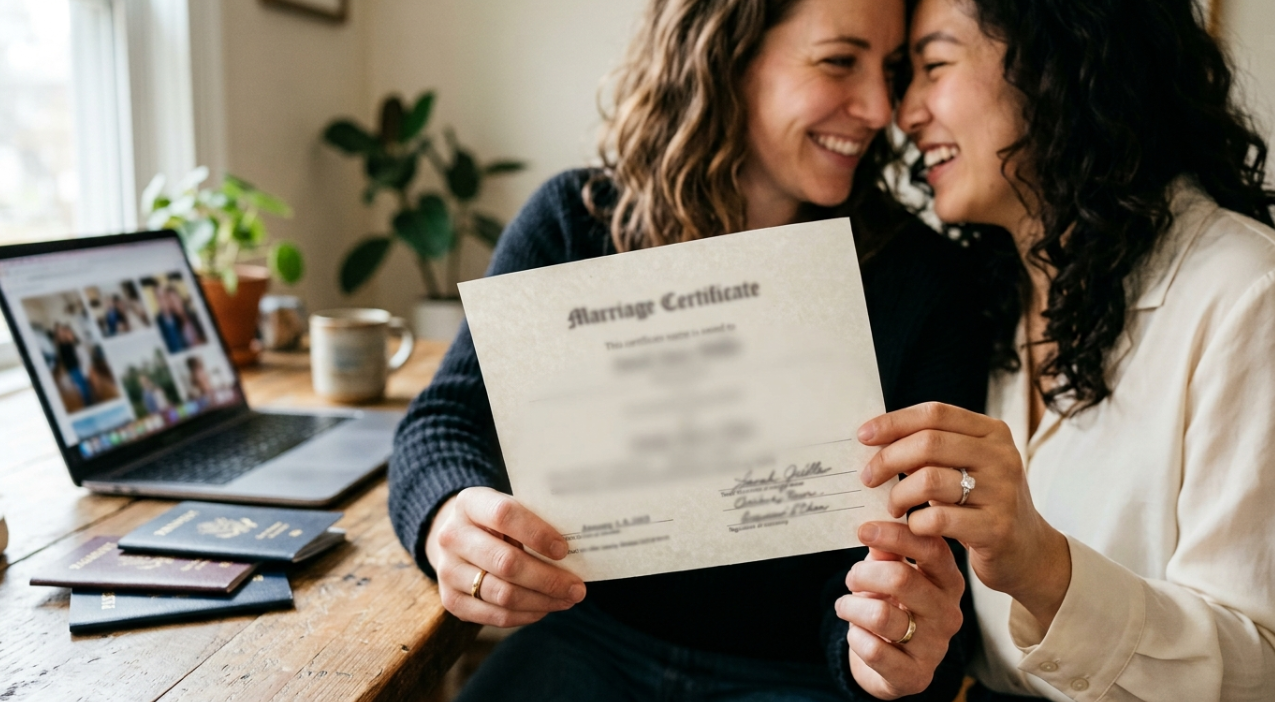
When an LGBTQ couple gets married online, there are three different legal questions to answer. They should not be treated as the same issue.
Question | What it asks | Who determines it? |
|---|---|---|
Is the marriage valid in Utah? | Did the couple satisfy Utah's marriage and remote-ceremony requirements? | Utah law and Utah County |
Can it be used for U.S. immigration? | Does USCIS recognize the marriage for the immigration benefit being requested? | U.S. immigration law and USCIS |
Will another country recognize it? | Will the couple's destination or home country accept the marriage certificate? | That country's laws and authorities |
This distinction matters because a marriage can be legally valid in the jurisdiction where it was celebrated while facing additional recognition requirements elsewhere.
Utah County explicitly warns that a marriage solemnized through online remote appearance may be invalid in the country where the spouses reside.
For immigration, USCIS has historically applied a place-of-celebration framework to legally valid same-sex marriages. USCIS materials state that a same-sex marriage legally valid in the jurisdiction where it was celebrated can be valid for immigration purposes even when the jurisdiction where the couple resides does not recognize same-sex marriage.
These are separate legal questions, so couples should verify each one independently.
Remote Appearance (Remote Solemnization)
The legal mechanism in Utah law that allows couples and an officiant to appear by video rather than in person. This is what makes the entire system work. Unlike a proxy marriage (where someone stands in for an absent spouse), remote solemnization means both partners are present and actively participating, just through a screen instead of in the same room.
This distinction matters for immigration purposes, as USCIS treats remote-appearance ceremonies differently from proxy marriages. For a deeper comparison, see this guide on remote vs. proxy marriage.
Utah County Marriage License
The specific marriage license issued through Utah County’s digital portal. The application is completed online, and the license is granted without any in-person visit, residency requirement, or U.S. citizenship requirement. As long as both parties meet age and identification requirements, they are eligible regardless of where they live in the world.
The government processing fee is approximately $70.
The Legal Foundation for LGBTQ Online Marriage
Same-Sex Marriage
Marriage between two individuals of the same sex or gender identity. It has been legal across all 50 U.S. states since 2015 and specifically in Utah since October 6, 2014. When LGBTQ couples get married online through Utah, they receive the same marriage certificate as any opposite-sex couple. There is no separate process, no different form, and no asterisk.
Obergefell v. Hodges (2015)
The landmark U.S. Supreme Court decision that guaranteed same-sex couples the fundamental right to marry under the 14th Amendment. Before this ruling, marriage recognition was a patchwork across states. Obergefell made it uniform: every state must both perform and recognize same-sex marriages.
This decision is the constitutional backbone of why LGBTQ online marriages through Utah are valid everywhere in the United States.
Respect for Marriage Act (2022)
Federal legislation that requires all U.S. states to recognize marriages lawfully performed in any other state, including same-sex marriages. Think of it as a safety net. If the Supreme Court were ever to reverse Obergefell (a concern raised after the Dobbs decision), the Respect for Marriage Act would still compel federal recognition and interstate recognition of existing same-sex marriages.
For LGBTQ couples weighing whether to get married online now, this law provides an additional layer of legal security.
Marriage Equality
The principle that same-sex couples hold the same marriage rights as opposite-sex couples. In the U.S., this is settled law. In the context of online marriage, it means the Utah County system applies identical rules to every couple regardless of gender composition.
How Online Marriage Is Recognized Across the U.S.
Full Faith and Credit Clause
A provision in the U.S. Constitution (Article IV, Section 1) requiring each state to honor the legal acts of every other state. A marriage license issued in Utah must be recognized in Texas, New York, California, and everywhere else. This is why a couple living in Florida can marry through Utah’s online system and have their marriage treated as fully valid at home.
Place-of-Celebration Rule
The legal principle stating that a marriage’s validity is determined by the laws of the jurisdiction where it was performed, not where the couple lives. This rule is critical for two groups: LGBTQ couples in countries that don’t recognize same-sex marriage, and couples using online marriage for U.S. immigration purposes.
Because the marriage was celebrated in Utah, where same-sex marriage is legal and remote ceremonies are authorized, the marriage is valid. Period. It doesn’t matter if the couple resides in a country or territory that wouldn’t have allowed them to marry locally.
USCIS applies this rule explicitly, which brings us to the next section.
Immigration and LGBTQ Online Marriage
This is where the question “can LGBTQ couples get married online” takes on urgent, practical weight. Many same-sex couples pursue online marriage specifically to start an immigration process.
In October 2025, USCIS published a policy alert confirming that marriages performed through virtual or online ceremonies are evaluated under the same standards as in-person ceremonies. The determining factor is the place-of-celebration rule. The same alert reaffirms that same-sex marriages are treated equally to opposite-sex marriages for all immigration purposes.
For couples navigating this process, Courtly offers a spouse visa consultation at low cost with partner immigration attorneys.
I-130 Petition (Petition for Alien Relative)
USCIS Form I-130 is the first step in sponsoring a spouse for a marriage-based green card. A U.S. citizen or lawful permanent resident files this form to establish a qualifying family relationship. For LGBTQ couples who married online through Utah, the I-130 process is identical to that of any opposite-sex couple. The same evidentiary standards apply.
Practitioners on Reddit’s r/USCIS have reported successful I-130 approvals based on Utah online marriages, though processing times vary by service center.
CR-1 / IR-1 Spouse Visa
These are the immigrant visa categories for spouses of U.S. citizens. CR-1 (Conditional Resident) applies when the marriage is less than two years old at the time of visa issuance. IR-1 (Immediate Relative) applies when the marriage is over two years old. Same-sex couples follow the same visa pathway as opposite-sex couples.
Consummation
A legal concept that surfaces in immigration contexts for online and proxy marriages. Some immigration attorneys note that USCIS may ask whether an online marriage has been consummated, meaning the couple has met in person and lived together as spouses after the ceremony.
Immigration lawyer Adam Chodorow has stated that a Utah Zoom marriage, “once consummated, would be recognized as a valid marriage under the Immigration and Nationality Act.” This doesn’t mean consummation is always required, but it’s a factor that can arise during adjudication. Couples should discuss this with an immigration attorney, especially if they haven’t yet met in person.
For more detail, Courtly has published a dedicated guide on consummation and immigration.
Unique LGBTQ Immigration Challenges
In countries hostile to LGBTQ rights, gathering evidence of a bona fide relationship can be genuinely dangerous. Social stigma, criminalization, and surveillance make it difficult to produce the kind of documentation (joint leases, shared bank accounts, public photos together) that USCIS typically expects.
Foreign spouses from countries where homosexuality is criminalized may also face safety risks during consular processing interviews. Immigration attorneys familiar with LGBTQ cases recommend preparing supplementary evidence carefully and, where possible, conducting interviews at consulates in more tolerant jurisdictions.
One user on the VisaJourney forum described this exact dilemma: “I and my girlfriend are LGBTQ that we couldn’t get marriage certificate from our country government.” This couple was exploring Utah’s online marriage as a path to include a spouse on a diversity visa, a specific use case that most guides overlook entirely.
International Recognition: Where It Works and Where It Doesn’t
As of early 2025, 38 countries recognize same-sex marriage, with most concentrated in Europe and the Americas. Thailand and Liechtenstein joined the list in 2025. The full roster includes Andorra, Argentina, Australia, Austria, Belgium, Brazil, Canada, Chile, Colombia, Costa Rica, Cuba, Denmark, Ecuador, Estonia, Finland, France, Germany, Greece, Iceland, Ireland, Luxembourg, Malta, Mexico, the Netherlands, New Zealand, Norway, Portugal, Slovenia, South Africa, Spain, Sweden, Switzerland, Taiwan, the United Kingdom, the United States, and Uruguay.
Many of these countries also recognize marriages performed abroad, which is what makes online marriage through Utah a viable option for international LGBTQ couples.
The Dual-Recognition Problem
Here is the nuance that almost every competing guide misses. Two separate questions determine whether your online marriage will be recognized abroad:
Does the country recognize same-sex marriage?
Does the country recognize marriages performed via remote ceremony?
A country might answer “yes” to the first question and “no” to the second. Germany, for instance, recognizes same-sex marriage but has historically not accepted marriages conducted through remote-appearance ceremonies. Australia, Norway, France, Sweden, Finland, and Taiwan fall into similar gray areas, where the issue isn’t about same-sex recognition but about the online format.
Courtly’s help center identifies specific countries that have historically not accepted online U.S. marriages: Germany, Hungary, Australia, Norway, France, Turkmenistan, Sweden, Poland (case-by-case), Taiwan, and Finland. For a country-by-country breakdown, Courtly maintains an updated reference.
Practitioners on Reddit’s r/LGBTWeddings have discussed this exact problem, particularly around Australian recognition. Multiple threads show same-sex couples who married online and then discovered that Australia’s objection wasn’t to the same-sex aspect but to the remote-ceremony format.
The ECJ Ruling (November 2025)
In a significant development, the European Court of Justice ruled on November 25, 2025 that EU member states must recognize same-sex marriages lawfully concluded in another member state, even if they haven’t legalized same-sex marriage domestically. This ruling doesn’t force every EU country to perform same-sex marriages, but it does require them to recognize those performed elsewhere for purposes like residency, inheritance, and family reunification.
For LGBTQ couples who married online through Utah and later relocate within the EU, this ruling strengthens their position considerably, especially in countries like Poland or Romania that haven’t legalized same-sex marriage domestically.
Anti-LGBTQ Laws
Laws in certain countries that criminalize homosexuality, prohibit same-sex marriage, or penalize public expressions of LGBTQ identity. These laws are the primary reason many same-sex couples seek online marriage through a U.S. jurisdiction. A Utah marriage certificate won’t override local law in the couple’s home country, but it can serve as the legal foundation for immigration to a country that does recognize same-sex marriage.
The roughly 200 Chinese and Hong Kong couples who married through Utah since 2021 illustrate this pattern clearly. China decriminalized homosexuality in 1997 but does not recognize same-sex marriage. For these couples, the Utah certificate isn’t about gaining local recognition. It’s about creating a legal record of their marriage that can be used internationally.
Documentation for Foreign Use
Apostille
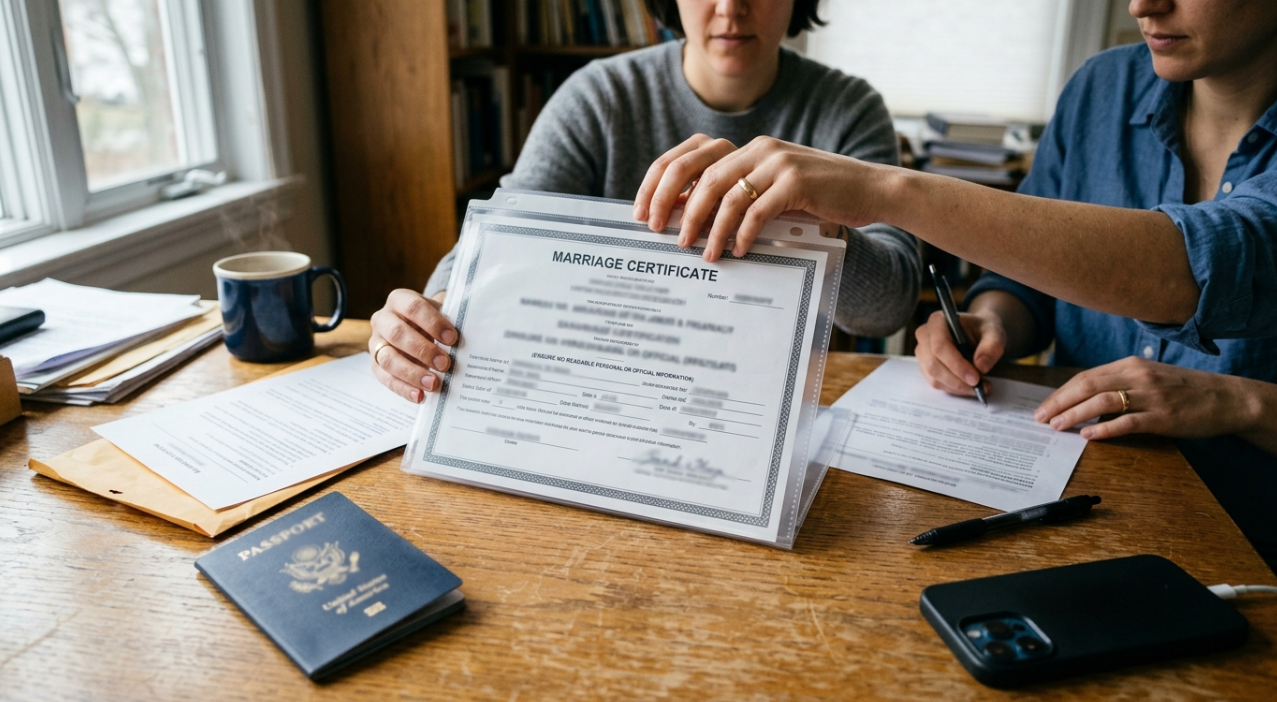
An international certification under the Hague Convention that authenticates a U.S. document (in this case, a marriage certificate) for use in foreign countries. If you plan to use your online marriage certificate outside the United States, you will almost certainly need an apostille. It’s essentially a stamp confirming that the document is genuine and was issued by a legitimate authority.
Courtly offers apostille services as an add-on. For a deeper explanation of what apostilles are and how they work, see Courtly’s apostille guide.
Embassy Authentication (Legalization)
The process for certifying a U.S. marriage certificate for use in countries that are not part of the Hague Apostille Convention. This typically involves getting the document authenticated by the U.S. State Department and then legalized by the embassy or consulate of the destination country. It takes longer and costs more than an apostille, but it’s the only path for certain countries.
Courtly provides document legalization services for both apostille and embassy authentication.
As Courtly notes in its own materials: “While remote appearance ceremonies are legal according to US law, their acceptance by foreign governments or immigration officials is beyond our control.” This is an honest and important disclaimer. An apostille or embassy authentication increases the likelihood of acceptance but doesn’t guarantee it in every jurisdiction.
What LGBTQ Online Marriage Costs
Compared to traveling internationally to marry in person (flights, visas, accommodation, local legal fees, translation services), online marriage is dramatically cheaper.
Here’s the cost breakdown:
Government fee: Approximately $70 for the Utah County marriage license.
Courtly service plans:
Core ($199): Licensed officiant, basic concierge support, digital and physical marriage certificate. You provide your own two witnesses.
Popular ($399): Everything needed for an online wedding including ceremony video recording, cloud storage, marriage recognition advice for 150+ countries, and a full refund if you change your mind before the ceremony.
Fast-Track ($599): Everything in Popular plus two legal witnesses provided by Courtly and rush processing with a 24-hour scheduling guarantee after license approval.
Common add-ons: Two witnesses ($50), live translation ($40), apostille ($50+ on the wedding pricing page), rush processing ($275 if not on Fast-Track).
For specific, current pricing, check Courtly’s pricing page.
For many LGBTQ couples in restrictive countries, the alternative isn’t a local courthouse wedding. It’s either traveling to a third country that allows same-sex marriage or not getting legally married at all. In that context, a few hundred dollars for a legally binding U.S. marriage certificate is remarkably accessible.
Frequently Asked Questions
Is an online marriage a “real” marriage?
Yes. An online marriage performed through Utah’s remote-appearance system produces a legally binding U.S. marriage certificate. It is not a symbolic ceremony or a novelty. Courts, government agencies, and immigration authorities treat it the same as an in-person marriage. For more on this, read Courtly’s explanation of whether online weddings are legal.
Can LGBTQ couples get married online and use it for a green card?
Yes. USCIS applies the place-of-celebration rule, meaning a legally valid Utah marriage is recognized for immigration purposes regardless of the couple’s gender composition or country of residence. The October 2025 USCIS policy update explicitly confirms that both virtual ceremonies and same-sex marriages are treated under the same standards as in-person, opposite-sex marriages.
Will my home country recognize an LGBTQ online marriage?
It depends on two separate factors: whether your country recognizes same-sex marriage and whether it recognizes marriages performed through remote ceremonies. Some countries accept both, some accept one but not the other, and some accept neither. Courtly maintains a list of known exceptions, and an apostille or embassy authentication is typically required for foreign use.
Do I need to consummate the marriage for immigration purposes?
Possibly. Consummation (meeting in person and cohabiting as spouses after the ceremony) can be a factor in immigration adjudication, particularly for online or proxy marriages. Immigration attorney Adam Chodorow has noted that a Utah Zoom marriage is recognized under the INA “once consummated.” This doesn’t mean every case requires it, but couples should consult an immigration lawyer about their specific situation.
What if Obergefell v. Hodges is overturned?
The Respect for Marriage Act (2022) provides a federal backstop. Even if the Supreme Court reversed Obergefell, this law would still require all U.S. states to recognize same-sex marriages lawfully performed in any state, including Utah. For international couples, the impact would be more complex and would depend on how foreign governments interpret the legal shift.
Can two non-U.S. citizens get married online through Utah?
Yes. There are no citizenship or residency requirements. Two foreign nationals living outside the United States can apply for a Utah County marriage license and complete the ceremony over video call. This is one of the main reasons the system has become so popular with international LGBTQ couples.
How long does the entire process take?
Courtly describes the process as typically taking less than 72 hours from start to receiving a legal U.S. marriage certificate. The Fast-Track plan includes a 24-hour scheduling guarantee after license approval, with a money-back promise if they can’t meet that window.
Are there countries where LGBTQ couples specifically should not rely on an online marriage?
Countries that criminalize homosexuality will not recognize a same-sex marriage regardless of how or where it was performed. Additionally, countries like Germany, Australia, Norway, France, Sweden, Finland, and Taiwan have historically raised objections specifically to the remote-ceremony format, even though some of these countries fully recognize same-sex marriage. Always verify both dimensions of recognition before relying on the certificate for legal purposes abroad.
Getting legally married shouldn’t require risking your safety or spending thousands on international travel. For LGBTQ couples facing legal barriers at home, Utah’s online marriage system offers a real, documented, and increasingly well-tested path.
See how Courtly works and decide if it’s right for your situation.
Let us handle the paperwork.
Getting married is complicated. Courtly simplifies the process and provides everything necessary to get married online, including providing a licensed officiant who can perform a remote ceremony.
Get Married

Get married online.
Getting married is complicated. Courtly simplifies the process and provides everything necessary to get married online.

