

TL;DR
Online marriage for immigration is a legal pathway where couples marry remotely through a Utah virtual ceremony, then use that marriage to petition for a U.S. spouse visa (CR-1/IR-1) instead of a fiancé visa (K-1). USCIS recognizes these marriages under the place-of-celebration rule, but couples must understand consummation requirements, the I-130 petition process, and document legalization. This glossary covers every term cross-border couples need before starting.
Quick Answer: Can You Use an Online Marriage for Immigration?
Yes.
A legally performed Utah online marriage can be used for U.S. immigration if it satisfies USCIS requirements.
In most cases, couples must:
- Complete a legally valid online marriage ceremony
- Meet in person after the ceremony
- Consummate the marriage
- Collect evidence showing the relationship is genuine
- File Form I-130
- Complete consular processing
The most important rule is the USCIS place-of-celebration rule. If the marriage was legally valid where it occurred, USCIS generally recognizes it.
However, online marriages involve one additional requirement that many couples overlook: consummation after the ceremony.
Without proof of consummation, an I-130 petition can be denied.
Online Marriage for Immigration: Key Takeaways
Question | Short Answer |
|---|---|
Does USCIS recognize online marriage? | Yes |
Which state allows fully online marriages? | Utah |
Can you skip the K-1 visa? | Yes |
Can you apply for a CR-1 visa after an online marriage? | Yes |
Is consummation required? | Usually yes |
Can same-sex couples use online marriage? | Yes |
Is an apostille always required? | No |
Why This Glossary Exists

Cross-border couples face a wall of legal terminology when planning an online marriage for immigration purposes. Terms like “place-of-celebration rule,” “consummation requirement,” and “bona fide marriage” get thrown around in attorney blog posts and USCIS policy manuals without much context. Misunderstanding even one of these concepts can lead to a denied petition and months of lost time.
This glossary puts every critical term in one place, organized by category, so couples can make informed decisions about their immigration path. It reflects the latest USCIS policy changes as of October 2025.
This is not legal advice. Immigration law changes frequently, and individual cases vary. Consult an immigration attorney for guidance specific to your situation.
Explore Courtly’s immigration page for an overview of how online marriage fits into the U.S. spouse visa process.
Marriage Types
Online Marriage / Virtual Marriage
A virtual marriage is a legally binding ceremony conducted remotely through video technology. Both parties participate in real time, typically over Zoom or a similar platform, but they can be in different physical locations, even different countries.
The important word here is “both.” Unlike a proxy marriage (defined below), neither party is represented by a stand-in. Both spouses are present, participating, and expressing consent directly. For a deeper explanation of the legal mechanics, see this guide on what virtual marriage means.
As of 2025, Utah is the only U.S. state that permits a fully virtual wedding where both partners appear remotely. Neither partner needs to be a Utah resident. The officiant must be physically located in Utah during the ceremony. The resulting marriage certificate is a standard U.S. legal document, identical in form to one issued after an in-person ceremony.
The scale of this practice is significant. Utah County reported performing 3,500 virtual weddings for international couples in a single year, with participants from countries including Azerbaijan, Estonia, Finland, Denmark, and France.
Proxy Marriage
A proxy marriage is one where a stand-in physically represents one or both parties during the ceremony. The actual spouses are not present, even by video. Montana and a handful of other states allow proxy marriages under specific circumstances, often for military personnel.
For immigration purposes, the distinction between proxy and virtual marriage is critical. USCIS treats them differently. A proxy marriage is only valid for immigration if the couple consummates the marriage after the ceremony. A virtual marriage where both parties participated live may face different scrutiny.
Practitioners on Reddit and immigration forums regularly confuse these two categories, and so do some attorney websites. If you want the full breakdown, this comparison of proxy, virtual, and online weddings clarifies the differences.
Utah Remote-Appearance Marriage
This is the specific legal mechanism that makes online marriage for immigration possible. Utah Code allows marriage solemnization through “remote appearance,” meaning the couple can participate electronically while a Utah-based officiant conducts the ceremony.
There was concern in early 2026 that Utah Senate Bill 110 might restrict or eliminate online marriages. However, Sen. Weiler clarified that the bill targets common-law marriage provisions, not remote-appearance ceremonies. The second substitute of SB 110 does not impact remote wedding ceremonies. Utah’s online marriage system remains intact as of mid-2026.
How Online Marriage for Immigration Works
The immigration process typically follows this sequence:
Step | Action |
|---|---|
1 | Complete a Utah online marriage |
2 | Obtain the marriage certificate |
3 | Meet in person after the ceremony |
4 | Consummate the marriage |
5 | Gather relationship evidence |
6 | File Form I-130 |
7 | Submit documents to the National Visa Center |
8 | Attend the consular interview |
9 | Receive a CR-1 or IR-1 visa |
10 | Enter the United States as a permanent resident |
Understanding the sequence is important because filing the I-130 before consummation can create serious immigration problems.
Core Immigration Rules
Place-of-Celebration Rule
This is the single most important legal principle for anyone using an online marriage for immigration. It states that USCIS recognizes a marriage as valid if it was legal under the laws of the jurisdiction where it was performed.
For Utah virtual marriages, this means the marriage is “celebrated” in Utah, under Utah law, regardless of where the couple physically sits during the ceremony. A spouse in London and a spouse in Manila are both legally married in Utah.
USCIS has been explicit about this. The USCIS Policy Manual states that if a state does not recognize virtual marriages, that does not affect validity as long as the marriage was lawfully celebrated in a jurisdiction that does. In other words, it doesn’t matter if the foreign spouse’s home country, or even another U.S. state, wouldn’t allow an online ceremony. What matters is that Utah allowed it.
This principle also protects same-sex couples. A same-sex marriage is recognized for immigration if it was legally valid in the place of celebration, even if the couple lives in a country that criminalizes same-sex relationships. More on this in the LGBTQ+ couples section.
Consummation Requirement (INA §101(a)(35))
Under the Immigration and Nationality Act, a person qualifies as a “spouse” if both parties were physically present at the ceremony, or, if they were not present together, the parties consummated the marriage afterward.
This is where online marriages for immigration hit a technical snag that every couple must plan around.
What consummation means for USCIS: The couple must meet in person after the marriage and have sexual relations after the ceremony. Prior physical intimacy does not count. This is a strict timing rule.
You cannot file Form I-130 until after consummation has taken place. USCIS evaluates eligibility at the time of filing, not afterward.
Acceptable evidence of consummation includes:
Birth certificate of a child born to the couple after the ceremony, listing both parents
Passport stamps or airline tickets showing both spouses were in the same location after the marriage
Evidence of shared residence after the ceremony, such as a joint lease or signed witness affidavits
This requirement catches some couples off guard. Consummation evidence doesn’t need to be graphic or invasive. Travel records and hotel bookings showing a shared stay typically satisfy the requirement. For a deeper look at how this affects your application, read about how online marriage affects immigration success.
Consummation Evidence Checklist
Use this checklist before filing Form I-130.
Passport stamps after the wedding
Airline tickets
Hotel receipts
Boarding passes
Photographs together after the ceremony
Joint travel itineraries
Joint lease agreements
Witness statements
Evidence of shared residence
Remember: evidence must show the couple was physically together after the marriage ceremony.
Bona Fide Marriage
A bona fide marriage is one entered into in good faith, not solely for the purpose of obtaining immigration benefits. USCIS will examine whether the relationship is genuine throughout the immigration process.
Evidence of a bona fide marriage includes commingled finances, shared communication history, photographs together, joint travel, and testimony from friends and family. The standard isn’t that the marriage must be perfect. It’s that the marriage must be real.
This matters for online marriage for immigration because USCIS officers may scrutinize virtual ceremonies more closely. Having a ceremony video recording can serve as supporting evidence that the marriage was a genuine event with real vows and mutual consent.
Evidence USCIS Looks for in an Online Marriage Case
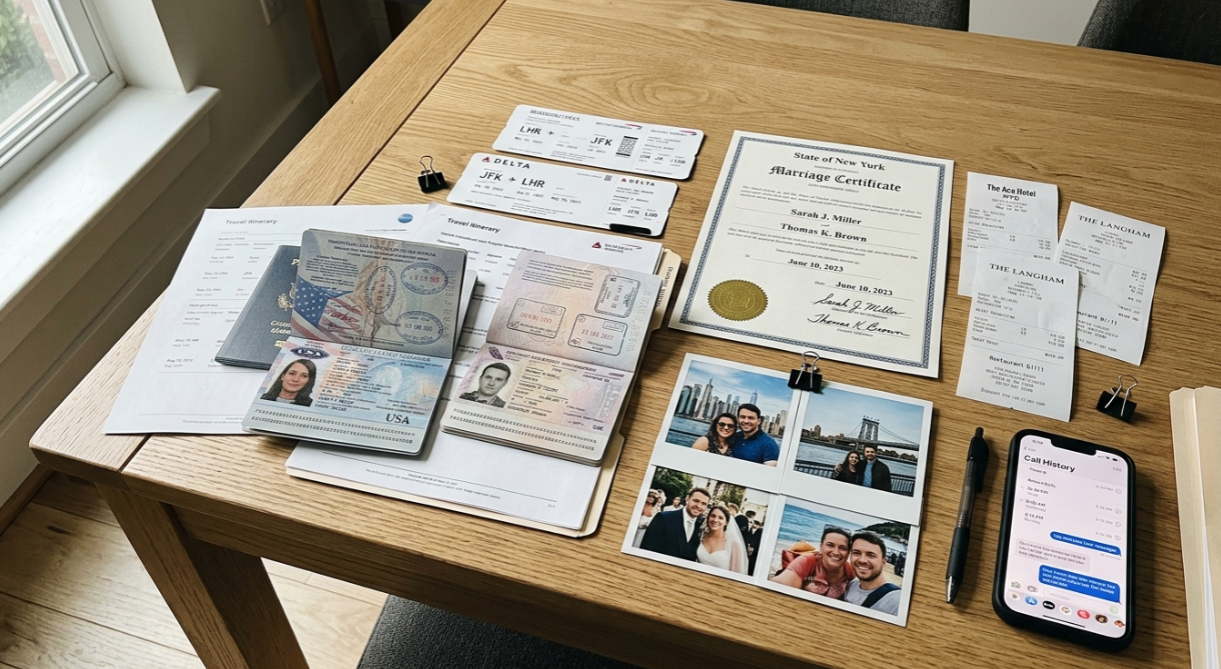
Evidence Category | Examples |
|---|---|
Identity | Passports, birth certificates |
Marriage | Marriage certificate |
Consummation | Travel records, hotel receipts |
Relationship | Photos, messages, call logs |
Finances | Joint bank accounts, insurance |
Residence | Leases, utility bills |
Family | Children's birth certificates |
Third-party evidence | Affidavits from relatives and friends |
Is an Online Marriage the Right Immigration Strategy?
An online marriage may be the best option if:
You and your partner live in different countries.
International travel is difficult.
You want to pursue a CR-1 visa instead of a K-1 visa.
You want permanent residency upon arrival in the United States.
You want to avoid the adjustment-of-status process.
An online marriage may not be the best choice if:
Your home country refuses to recognize virtual marriages.
You cannot meet in person after the ceremony.
Your immigration case involves previous petition denials or allegations of marriage fraud.
Marriage Fraud Bar (INA §204©)
INA §204© imposes a lifetime bar on approving a new immigration petition for any beneficiary previously found to have participated in marriage fraud. This applies even if a subsequent marriage is completely genuine.
The penalty is severe and permanent. If USCIS determines that a prior marriage was fraudulent, no future petitioner can successfully file an I-130 for that person. This is one reason to ensure every aspect of your online marriage and immigration filing is thoroughly documented and legitimate.
Immigration Forms and Visa Pathways
Form I-130 (Petition for Alien Relative)
The I-130 is the foundational document in the spouse-based immigration process. A U.S. citizen or lawful permanent resident files this form to establish a qualifying family relationship with a foreign national spouse.
For couples who married online, the I-130 is where USCIS first evaluates whether the marriage is valid for immigration purposes. The petition must include the marriage certificate, evidence of the petitioner’s U.S. citizenship, and (for online marriages where the parties weren’t physically co-present) evidence of consummation.
Real-world caution: Practitioners on Reddit report that I-130 petitions based on Utah online marriages can be denied at the initial review stage. One widely discussed case in the r/USCIS subreddit involved a user whose I-130 was denied because USCIS deemed the Utah marriage invalid. The user hired an immigration attorney, filed a 290B appeal motion, and ultimately won. The case demonstrates two things: denials happen even with valid marriages, and appeals can succeed with proper legal representation.
If you’re considering the spouse visa path, Courtly offers a U.S. spouse visa consultation with partner attorneys who can evaluate your specific situation.
CR-1 / IR-1 Visa (Spouse Visa)
The CR-1 (Conditional Resident) visa applies to spouses married for less than two years at the time of admission. The IR-1 (Immediate Relative) visa applies to spouses married for two or more years. Both are immigrant visas that grant lawful permanent residency upon entry to the United States.
This is the key advantage of the online marriage for immigration strategy. With a CR-1/IR-1, the foreign spouse receives a green card on arrival and can work immediately. There’s no additional adjustment of status process required after entry.
Processing times for CR-1 visas average 12 to 18 months from I-130 filing to visa issuance.
K-1 Visa (Fiancé Visa)
The K-1 is a nonimmigrant visa that allows a foreign fiancé to enter the United States to marry their U.S. citizen partner. The couple must marry within 90 days of entry, after which the foreign spouse applies for adjustment of status.
K-1 visas take 6 to 15 months to process, and then the adjustment of status adds additional months (sometimes over a year) before the spouse receives a green card and work authorization.
Utah Online Marriage vs. Traditional Marriage vs. K-1 Visa
Factor | Utah Online Marriage | Traditional Marriage | K-1 Visa |
|---|---|---|---|
Requires international travel before marriage | No | Usually | No |
Allows direct CR-1 filing | Yes | Yes | No |
Requires adjustment of status | No | No | Yes |
Requires a second immigration process | No | No | Yes |
Green card upon U.S. entry | Yes | Yes | No |
Work authorization upon arrival | Yes | Yes | No |
Many couples choose a Utah online marriage because it eliminates the need to coordinate international travel before the wedding while preserving access to the CR-1 immigration pathway.
Why Online Marriage Changes the K-1 vs. CR-1 Calculus
This is the comparison that matters most, and it’s where online marriage for immigration has the biggest practical impact.
Factor | K-1 (Fiancé Visa) | CR-1 (Spouse Visa) |
|---|---|---|
Denial rate | ~25% | ~8-9% |
Time to entry | 6-15 months | 12-18 months |
Green card on arrival | No (must adjust status) | Yes |
Can work immediately on arrival | No (must wait for EAD) | Yes |
Total time to permanent residency | Often 18-30+ months | 12-18 months |
The CR-1 has a longer initial wait, but the total timeline to permanent residency is often shorter because there’s no adjustment of status step. The denial rate is roughly one-third that of the K-1. And the foreign spouse can work from day one.
An immigration law firm specializing in Philippine spouse cases explicitly recommended Utah virtual marriages for this reason, noting it allows the U.S. citizen petitioner to “marry almost instantly” even while abroad, eliminating the K-1 wait entirely.
By marrying online, couples can skip the K-1 and file directly for the CR-1, which grants permanent residency on arrival. For many couples, this is the strongest argument for pursuing an online marriage.
Adjustment of Status
Adjustment of status is the process by which a person already in the United States applies to become a lawful permanent resident without leaving the country. K-1 visa holders must go through this process after marrying in the U.S. CR-1 holders do not, because they receive permanent residency upon entry.
Consular Processing
Consular processing is the visa interview and issuance that happens at a U.S. embassy or consulate abroad. For CR-1 spouse visas, this is the standard path. After USCIS approves the I-130, the case transfers to the National Visa Center and then to the appropriate consulate for the interview.
National Visa Center (NVC)
The NVC is the Department of State office that processes approved immigrant visa petitions before forwarding them to the relevant consulate. After the I-130 is approved, the NVC collects fees and supporting documents (Form DS-260, civil documents, financial evidence) and schedules the consular interview.
Document Legalization
Apostille
An apostille is an internationally recognized certification that authenticates the origin of a public document. For couples who married online, an apostilled marriage certificate may be needed to register the marriage in a foreign country, satisfy consular requirements, or complete immigration processes abroad.
The apostille applies only in countries that are members of the 1961 Hague Apostille Convention. Most of Europe, Latin America, and parts of Asia are members.
The process involves submitting the original marriage certificate to the appropriate state authority (in this case, the Utah Secretary of State or a designated agency) for certification. For a complete walkthrough, see this guide to apostilles.
Courtly offers document legalization services including apostille and embassy authentication, with expedited options available.
Embassy Authentication / Legalization
If the destination country is not a member of the Hague Apostille Convention, your marriage certificate will need embassy legalization instead. This is a multi-step process that typically involves authentication by the U.S. State Department followed by certification at the relevant foreign embassy in Washington, D.C.
Embassy legalization is generally more expensive and time-consuming than an apostille. Countries like China, Canada, and several Middle Eastern nations require this route. For a comparison of the two processes, read about apostille vs. authentication.
Hague Apostille Convention
The Hague Convention of October 5, 1961, simplifies the process of authenticating documents for international use among its member states. If both countries (the one that issued the document and the one where it will be used) are members, an apostille is sufficient. No embassy legalization is needed.
Over 120 countries are part of the convention. Checking membership status is an essential step before deciding which legalization path to follow.
Policy and Compliance
USCIS Policy Alert PA-2025-23 (October 2025 Update)
On October 17, 2025, USCIS issued Policy Alert PA-2025-23, updating the Policy Manual to redefine what constitutes a valid spousal relationship for immigration purposes. This is the most significant recent policy change affecting online marriage for immigration.
Key impacts:
Virtual marriages confirmed under place-of-celebration rule. A virtual marriage is subject to the same requirements as all spousal cases, regardless of state-specific provisions on virtual marriages.
Earlier fraud detection. USCIS now plans to identify potential fraud earlier in the process, at the petition stage rather than waiting for the adjustment of status or consular interview. Officers are instructed to scrutinize evidence more carefully upfront.
Same-sex marriages explicitly affirmed. A same-sex marriage will be recognized if legally valid in the place of celebration, regardless of where the couple resides.
This policy update is good news for couples pursuing online marriage for immigration. It formally establishes that USCIS applies the same standards to virtual marriages as to in-person ones. But the heightened fraud-detection emphasis means thorough documentation is more important than ever.
Same-Sex Marriage Recognition for Immigration
USCIS recognizes same-sex marriages for all immigration purposes if the marriage was valid where it was performed. Because Utah allows same-sex marriage, a Utah online marriage between same-sex partners is fully valid for I-130 petitions and spouse visa processing.
This has global implications. Since 2021, around 200 Chinese and Hong Kong couples have married via virtual Utah ceremonies. For couples in countries where same-sex marriage is illegal, a Utah online marriage provides a legal path to U.S. immigration benefits.
International Recognition of Online Marriages
Not every country will recognize an online marriage performed in Utah. While USCIS honors these marriages under the place-of-celebration rule, foreign governments have their own rules.
In a significant 2023 precedent, the Israel Supreme Court ruled that thousands of Israeli marriages performed virtually in Utah County would be recognized by the state. This was a landmark decision supporting international acceptance of virtual ceremonies.
However, some countries are known to reject online marriages. Couples planning to use their marriage certificate abroad should check country-specific recognition before proceeding.
Countries with Known Non-Recognition Issues
Several countries have historically declined to recognize virtual or online marriages. The specifics vary and can change, so couples should verify current policy with local authorities or an attorney. This is particularly important if you need the marriage recognized in your home country for purposes beyond U.S. immigration.
7 Common Mistakes Couples Make When Using an Online Marriage for Immigration
Filing Form I-130 before consummation
USCIS evaluates eligibility at the time of filing.
Assuming all countries recognize online marriages
Recognition varies by country.
Confusing proxy marriages with virtual marriages
These marriages are treated differently under immigration law.
Forgetting to collect evidence
Travel records should be preserved immediately after the ceremony.
Using the wrong document legalization process
Some countries require an apostille, while others require embassy legalization.
Waiting too long to gather relationship evidence
Communication records and travel documents can become difficult to retrieve.
Relying exclusively on online information
Immigration cases can involve facts that require professional legal advice.
Frequently Asked Questions
Does USCIS recognize online marriages for immigration?
Yes. USCIS applies the place-of-celebration rule, meaning a marriage valid under Utah law is recognized for immigration purposes. The October 2025 Policy Alert PA-2025-23 confirmed that virtual marriages are subject to the same requirements as in-person marriages. However, if the parties were not physically together during the ceremony, consummation after the marriage must be documented before filing the I-130.
What is the difference between a proxy marriage and a virtual marriage for immigration?
In a proxy marriage, a stand-in represents one or both parties at the ceremony. In a virtual marriage, both parties are present and participating via video. USCIS treats proxy marriages more strictly, requiring consummation evidence in all cases. Virtual marriages where both parties actively participated may face less scrutiny, though consummation evidence is still required when the couple was in separate locations. For more on the differences between proxy and remote marriage, see our detailed comparison.
Can I skip the K-1 fiancé visa by getting married online?
Yes. By marrying online, you can file directly for a CR-1/IR-1 spouse visa instead of a K-1 fiancé visa. The CR-1 has a lower denial rate (roughly 8-9% compared to about 25% for the K-1) and grants permanent residency upon arrival in the United States, eliminating the need for adjustment of status.
What evidence of consummation does USCIS accept?
USCIS accepts several forms of evidence, including the birth certificate of a child born after the ceremony, travel records showing both spouses were in the same place after the marriage, and evidence of shared residence such as joint leases or witness affidavits. The consummation must occur after the ceremony date. Prior physical contact does not count.
Has anyone had an I-130 denied for a Utah online marriage?
Yes. There are documented cases of initial denials, including a well-known case discussed on Reddit’s r/USCIS where a petitioner’s I-130 was denied because the officer concluded the Utah marriage was invalid. The petitioner hired an immigration attorney, filed a 290B appeal, and the decision was reversed. This illustrates why legal counsel and thorough documentation matter.
Do I need an apostille for my online marriage certificate?
If you plan to use the marriage certificate in a country that is a member of the Hague Apostille Convention, yes, you will likely need an apostille. If the destination country is not a Hague member, you will need embassy legalization instead.
Is Utah going to stop allowing online marriages?
As of mid-2026, no. Despite earlier concerns about Utah Senate Bill 110, the final substitute version of the bill does not affect remote-appearance wedding ceremonies. Utah’s virtual marriage system remains fully operational.
Can same-sex couples use online marriage for immigration to the U.S.?
Absolutely. USCIS recognizes same-sex marriages that were valid in the place of celebration. Since Utah permits same-sex marriage, a virtual ceremony performed through Utah is fully valid for I-130 petitions and spouse visa applications, regardless of whether the couple’s home country recognizes same-sex unions.
Next Steps
Understanding these terms is the first step. Putting them into action requires choosing the right marriage service and, often, the right immigration attorney.
See Courtly’s pricing and plans to learn how an online marriage works from start to finish, including ceremony recording, certificate delivery, and document legalization options.
Let us handle the paperwork.
Getting married is complicated. Courtly simplifies the process and provides everything necessary to get married online, including providing a licensed officiant who can perform a remote ceremony.
Get Married

Get married online.
Getting married is complicated. Courtly simplifies the process and provides everything necessary to get married online.

