

Online marriages performed through Utah are legally valid, not a leftover pandemic experiment. Utah is the only U.S. state that still allows fully remote weddings, and roughly 27,000 marriage licenses were issued there in 2024, with one-third going to international couples from 183 countries. Most myths about online marriages stem from confusion between proxy and online ceremonies, misunderstandings about immigration requirements, and assumptions about international recognition. This guide breaks down every major myth with facts and real-world evidence.
The internet is full of confident-sounding claims about online marriages. Some say they’re not real. Others insist they’re a pandemic relic. A few swear USCIS will reject them outright. Most of these claims are wrong, and believing them can cost couples thousands of dollars or years of wasted time on the wrong visa pathway.
This guide covers the most persistent online marriage myths, organized by how much damage they can actually cause. Each myth gets a clear definition, the factual reality, and an explanation of why it matters for your specific situation.
If you’re considering an online ceremony, explore how it works before reading further, or keep going to separate fact from fiction.
Quick Answer
Online marriages performed under Utah law are legally valid throughout the United States. Both spouses can participate from anywhere in the world while the officiant remains in Utah. However, legal validity does not automatically mean every government agency or foreign country will recognize the marriage for every purpose. Immigration rules, foreign recognition, apostilles, and local marriage laws all affect whether an online marriage can be used in a particular situation.
Most common myths are false:
- Utah online marriages are legally valid.
- Online marriage is different from proxy marriage.
- USCIS generally recognizes legally valid marriages but immigration rules may still apply.
- Some countries recognize Utah online marriages while others do not.
- Apostilles verify documents, not marriage recognition.
Why So Many Online Marriage Myths Exist
Many myths about online marriage originate from outdated COVID-era news articles, confusion between online and proxy marriages, social media posts, and immigration forum discussions that mix different legal situations together.
Online marriage laws have changed significantly since 2020. Utah permanently updated its laws, while many temporary pandemic policies in other states expired.
Whenever researching online marriage, verify whether the information refers to:
Utah online marriage
proxy marriage
state marriage law
immigration law
foreign recognition
Each follows different legal rules.
Legal Validity Myths
Myth 1: “Online Marriages Aren’t Legally Valid”
The Myth: An online wedding is just a symbolic ceremony with no legal standing. You’d still need to visit a courthouse or church to make it “official.”
The Reality: A Utah online marriage is a valid, legal marriage. Utah law requires the officiant to be physically in the state during the ceremony, but the couple getting married has no such requirement. They can be anywhere in the world.
This isn’t a fringe loophole. According to data from the Utah County Passport & Marriage Office, approximately 27,000 marriage licenses were issued in Utah in 2024. Roughly one-third went to Utah residents, another third to Americans from other states, and the final third to couples from 183 countries worldwide.
A former Utah County deputy clerk wrote in the Deseret News about personally performing 468 weddings in 11 months, most of them virtual, with couples joining from the U.S., Israel, China, the Philippines, and beyond. Some logged on in the middle of the night to accommodate time zones.
Why It Matters: If you’re planning your life around the assumption that an online wedding “doesn’t count,” you could be passing up a legitimate legal option, particularly if distance, deployment, or restrictive local laws make an in-person ceremony impossible.
Myth 2: “Online Marriages Were Just a Pandemic Thing”
The Myth: States allowed Zoom weddings as a COVID-era emergency measure. That window has closed.
The Reality: Most states did roll back their temporary remote marriage allowances once the pandemic emergency period ended. But Utah didn’t just keep the option alive; it formalized it. In 2024, Utah legislators worked with the Utah County Clerk’s Office to codify meaningful updates to virtual marriage laws through SB81, which went into effect on May 1, 2024.
State Senator Todd Weiler described virtual marriages as “a resounding success.” As of 2026, Utah remains the only U.S. state allowing fully remote legal weddings, and the volume of ceremonies continues to grow year over year.
Why It Matters: Couples who dismiss online marriage as expired are working with outdated information. The legal framework is stronger now than it was during COVID, with formal legislation backing it rather than temporary executive orders.
Myth 3: “You Need to Be in Utah to Get Married Online”
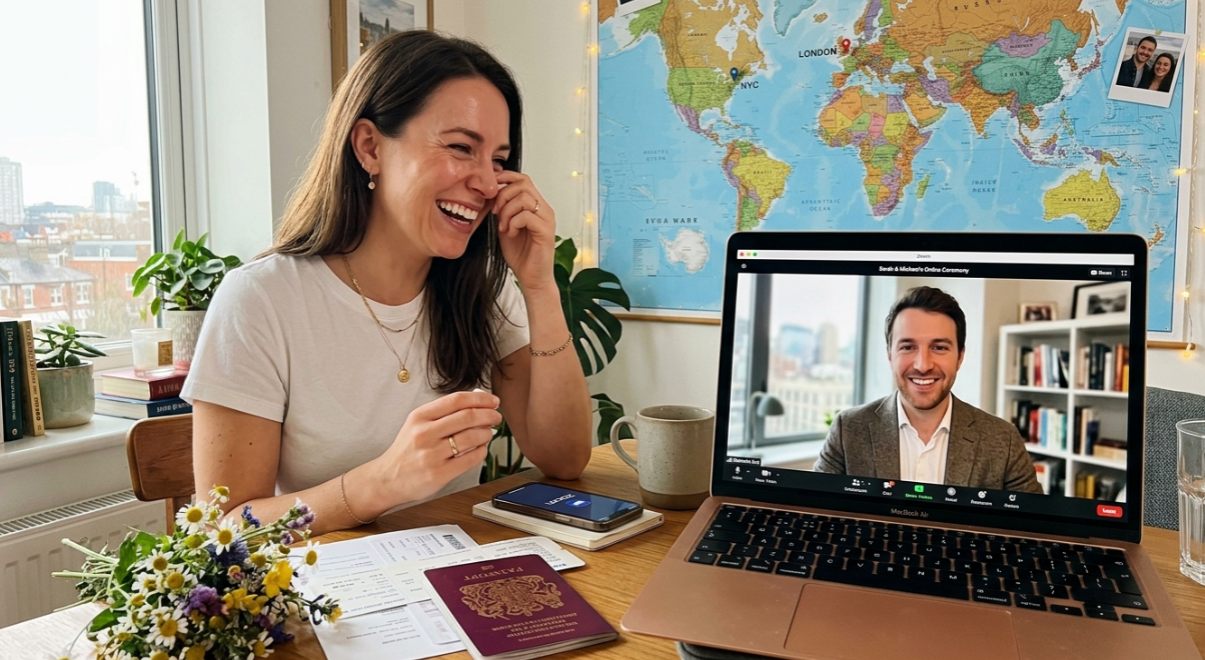
The Myth: Sure, Utah allows it, but you or your partner still has to physically be in the state.
The Reality: Neither partner needs to be in Utah, or even in the United States. The marriage license comes from Utah, and the officiant must be physically located there during the ceremony. But you and your partner can attend from any state or any country.
This is what makes it genuinely “online.” Couples in Singapore, military members deployed overseas, and partners separated by oceans have all completed legal ceremonies this way. The deputy clerk account mentioned above specifically noted marrying couples across vastly different time zones as a routine part of the job.
You can learn more about the Utah online marriage license process and what’s required from your side.
Why It Matters: The assumption that you need to travel to Utah kills the primary benefit of an online marriage: getting legally married when geography makes an in-person ceremony impractical.
Proxy vs. Online Marriage Myths
Myth 1: “Online Marriage and Proxy Marriage Are the Same Thing”
The Myth: Whether you call it online, virtual, proxy, or Zoom, it’s all the same thing.
The Reality: This is the single most dangerous myth on this list, especially for immigration applicants. In an online marriage, both partners are present and participating in the ceremony live via video. They exchange their own vows and respond to the officiant in real time. In a proxy marriage, one or both partners are absent from the ceremony entirely, and a stand-in exchanges vows on their behalf.
The immigration consequences are dramatically different. USCIS does not recognize a proxy marriage as valid for immigration purposes unless the marriage has been consummated afterward. For an online marriage where both parties attend live via video, several immigration attorneys argue that USCIS treats the couple as “present” for each other, potentially avoiding the consummation requirement altogether.
For a deep comparison, see this breakdown of remote marriage vs. proxy marriage.
Why It Matters: Confusing these two terms can lead to filing the wrong paperwork, triggering the consummation requirement unnecessarily, or having a petition denied. Immigration forums are full of people who learned this distinction too late.
Online Marriage vs Proxy Marriage vs Civil Marriage
Feature | Utah Online Marriage | Proxy Marriage | Traditional Civil Marriage |
|---|---|---|---|
Both spouses attend | Yes | No | Yes |
Video participation | Yes | No | Usually No |
Stand-in allowed | No | Yes | No |
Legal under Utah law | Yes | Depends | Yes |
USCIS considerations | May require additional review | Consummation required | Standard |
Travel required | No | No | Usually Yes |
Marriage certificate | Standard Utah certificate | Depends | Standard |
Myth 2: “Someone Else Can Stand in for Me at My Online Wedding”
The Myth: If you can’t make the video call, a friend or family member can do it for you.
The Reality: That would make it a proxy marriage, not an online marriage, and would trigger entirely different legal and immigration rules. In a Utah online ceremony, both partners must personally attend the video call, say their vows, and consent to the marriage. No stand-ins. No surrogates.
Why It Matters: If one partner genuinely cannot attend even a video call, the couple needs a different legal pathway, not an online marriage.
Immigration and Recognition Myths
This section covers the highest-stakes online marriage myths. Getting these wrong can affect visa petitions, green card applications, and years of immigration timelines.
Explore spouse visa consultations if you’re navigating this process.
Myth 1: “USCIS Won’t Recognize an Online Marriage”
The Myth: U.S. immigration authorities don’t accept marriages performed over video.
The Reality: USCIS will generally recognize a marriage performed online, provided it was legally valid in the jurisdiction where it took place. A Utah online marriage meets that standard.
The key nuance involves Section 101(a)(35) of the Immigration and Nationality Act, which states that when “the contracting parties are not physically present in the presence of each other,” the marriage must be consummated before it’s recognized for immigration purposes.
Here’s where it gets interesting. One immigration law firm’s analysis on lawandborder.com argues that since both partners attend the ceremony live via video, Utah law considers them legally “present,” which would mean the consummation requirement (intended for proxy marriages where a party is absent) doesn’t apply.
Practitioners on Reddit’s r/USCIS report anecdotal I-130 approvals using Utah online marriages, with discussion of wait timelines and supporting evidence they submitted.
Why It Matters: Many couples avoid online marriage entirely because they’ve heard USCIS rejects them. The reality is more favorable than the myth, though the proxy vs. online distinction is critical to get right.
Myth 2: “Marriage to a U.S. Citizen Automatically Gets You a Green Card”
The Myth: Once you marry an American citizen, online or otherwise, the green card is guaranteed.
The Reality: Marriage to a U.S. citizen makes you eligible to apply for an immigrant visa or adjustment of status. It does not guarantee approval. USCIS evaluates the legitimacy of the relationship, reviews financial sponsorship requirements, conducts interviews, and can deny petitions if the marriage appears to be entered into primarily for immigration benefits.
Online marriages receive the same scrutiny as in-person ones. Having a ceremony recording, photos, communication records, and evidence of a genuine relationship matters regardless of how you got married.
Why It Matters: Assuming the green card is automatic can lead couples to skip critical evidence-gathering steps. The marriage is step one, not the finish line.
Myth 3: “Online Marriages Are Accepted Everywhere Internationally”
The Myth: A U.S. marriage certificate is a U.S. marriage certificate. Every country will honor it.
The Reality: Recognition varies significantly by country, and some nations explicitly reject marriages where the parties weren’t physically together during the ceremony.
The most notable example: since 2015, Canada’s IRCC has not recognized virtual marriages for family class sponsorship. Their stated rationale is preventing forced marriages facilitated by remote ceremonies. The only exemption applies to members of the Canadian Armed Forces who couldn’t attend due to service-related travel restrictions.
Moving2Canada.com specifically warned that while services facilitating Utah online marriages are legitimate, the resulting marriage “is not a valid [option] for Canadian immigration purposes at this point.”
Countries that historically don’t accept online U.S. marriages also include Germany, Hungary, Australia, Norway, France, Sweden, Poland (varies by case), Taiwan, Finland, and Turkmenistan.
On the other hand, Israel’s Supreme Court ruled in 2023 that Utah virtual marriages would be recognized by the state. In 2024, approximately 5,316 Israelis were married through Utah, placing Israel at the top of the international list.
Check whether your country recognizes online marriages before making plans.
Why It Matters: Assuming universal acceptance and then discovering your country rejects the marriage can derail immigration applications, property rights, and family law protections.
Myth 4: “An Apostille Makes Your Online Marriage Accepted in Every Country”
The Myth: Get an apostille stamp on your certificate and you’re good to go anywhere.
The Reality: Over 120 countries have agreed to the Hague Apostille Convention, which makes it easier to accept official documents from other countries, including marriage certificates. But an apostille only authenticates that the document is genuine. It doesn’t force any country to recognize the underlying marriage itself.
Think of it this way: an apostille confirms the document is real. Whether the marriage it represents is valid in a given country is a separate question governed by that country’s domestic law. Canada, for example, would accept an apostilled Utah marriage certificate as an authentic document but would still refuse to recognize it for immigration sponsorship.
For countries not part of the Hague Convention, embassy authentication (a different process) may be required instead. Understanding the difference between apostille vs. authentication matters before you spend money on the wrong service.
Why It Matters: Couples who stop at the apostille step and assume everything is handled can face rejection at embassies, immigration offices, or foreign courts.
Myth 5: “You Can File I-130 Before Consummating a Proxy or Virtual Marriage”
The Myth: File the immigration petition first, meet up later, and sort out consummation after the paperwork is in.
The Reality: If your marriage falls under the consummation requirement (because USCIS considers the parties to have been “not physically present in the presence of each other”), you cannot file Form I-130 until after consummation. The reason is straightforward: a petitioner must meet all requirements for the benefit at the time of applying.
Filing before consummation would mean filing based on a marriage that USCIS doesn’t yet consider valid. The petition would be denied.
Why It Matters: Timing your filing incorrectly doesn’t just cause delays. It can result in denial and the need to start over, wasting months or years.
Myth 6: “Having Children Before the Marriage Proves Consummation”
The Myth: If you already have kids together, the consummation requirement is clearly met.
The Reality: Under immigration law, consummation must occur after the marriage ceremony, not before. Having children together before the wedding is not considered consummation for immigration purposes. The requirement is specifically about consummating the marriage, meaning sexual intercourse after the ceremony has taken place.
Why It Matters: Couples with children sometimes assume this box is automatically checked. It isn’t. Plan accordingly.
Same-Sex and LGBTQ+ Myths

Myth 1: “Same-Sex Online Marriages Are Recognized Everywhere the U.S. Certificate Is Valid”
The Myth: If a country accepts U.S. marriage certificates, it accepts all of them, including same-sex ones.
The Reality: The U.S. certificate itself is valid. Same-sex marriage has been legal in Utah since 2014, and USCIS reviews immigration petitions for same-sex spouses the same way as opposite-sex spouses. The ceremony format (online vs. in-person) isn’t the issue.
The issue is the receiving country. Nations like China, the Philippines, and many Middle Eastern countries do not recognize same-sex marriages regardless of where or how they were performed. A U.S. marriage certificate doesn’t override another country’s domestic law on this point.
That said, Utah County has become a meaningful option for same-sex couples unable to wed in their home countries. Roughly 200 Chinese and Hong Kong same-sex couples have married via Utah since 2021 according to Yahoo News reporting. For some, the U.S. certificate provides legal standing in third countries or within the U.S. immigration system, even if their home country won’t recognize it.
Practitioners on Reddit’s r/LGBTWeddings have discussed recognition concerns after online marriages, particularly for couples planning to use the certificate in Australia or other countries with acceptance caveats.
Why It Matters: The marriage is real. But expecting it to change another country’s laws about same-sex unions sets couples up for disappointment or legal complications.
Myth 2: “Getting a U.S. Marriage Certificate Forces Your Home Country to Recognize Same-Sex Marriage”
The Myth: A legal U.S. document compels recognition abroad.
The Reality: No. Countries apply their own domestic law to determine whether a foreign marriage is recognized. A U.S. marriage certificate, whether from an online or in-person ceremony, carries no authority to override the legal framework of another sovereign nation.
Why It Matters: Couples from restrictive countries should plan with clear eyes about what the certificate can and cannot do for them domestically versus internationally.
Process and Cost Myths
Myth 1: “Online Weddings Don’t Have Real Officiants or Witnesses”
The Myth: It’s just you and your laptop. No officiant, no witnesses, no legal formalities.
The Reality: Utah requires a certified officiant and two witnesses for a valid marriage. In an online wedding, all of these people participate via video. The officiant is physically in Utah, and witnesses can attend remotely.
If you don’t have two people available to serve as witnesses, services like Courtly can provide them. The ceremony follows the same legal structure as an in-person wedding: officiant asks the questions, partners give their vows, witnesses observe, documents get signed.
Why It Matters: The assumption that online weddings skip legal formalities is factually wrong and might lead people to dismiss them without understanding the actual process.
Myth 2: “Online Marriage Is Only for People Who Can’t Afford a Real Wedding”
The Myth: It’s a budget shortcut for people who can’t do the “real thing.”
The Reality: The reasons couples choose online marriage span far beyond cost. Military members stationed overseas use it to get legally married during deployment. Cross-border couples use it to start immigration processes without waiting months for travel visas. Same-sex couples in restrictive countries use it to access legal protections unavailable at home. Many couples complete the legal marriage online, then have a full celebration with family later.
One Reddit user on r/wedding shared a detailed account of their Courtly experience, breaking down costs and explaining that they chose the online route for convenience and speed, not because of budget constraints. The community response was largely supportive, with several people noting they hadn’t realized online marriage was a legal option.
Why It Matters: Dismissing online marriage as a budget-only option misses the real reason most people choose it: practical necessity.
Myth 3: “The Marriage Certificate from an Online Wedding Looks Different”
The Myth: You get some kind of lesser document, a “virtual certificate” that officials will side-eye.
The Reality: The certificate is a standard Utah County marriage certificate. It looks like any other Utah marriage certificate because it is one. There’s no asterisk, no “online” label, no visual distinction. Government agencies, immigration authorities, and foreign embassies see a Utah marriage certificate, period.
Why It Matters: Worrying about the certificate looking “different” is understandable but unfounded. The document carries the same weight as one issued after an in-person ceremony.
See current plans and pricing to understand what’s included in each online marriage package.
Quick-Reference: Online Marriage Myths vs. Facts
Myth | Fact | Stakes Level |
|---|---|---|
Online marriages aren’t legally valid | Utah online marriages are fully legal under state law | High |
Online and proxy marriages are the same | They’re fundamentally different, with different immigration consequences | High |
USCIS won’t recognize online marriages | USCIS generally recognizes them if valid in the jurisdiction performed | High |
You can file I-130 before consummation | You cannot; requirements must be met at time of filing | High |
Canada accepts online marriages for sponsorship | IRCC has rejected virtual marriages since 2015 | High |
Children before marriage prove consummation | Consummation must occur after the ceremony | High |
Online marriages work everywhere internationally | Recognition varies; many countries explicitly reject them | Medium |
An apostille guarantees foreign recognition | An apostille authenticates the document, not the marriage | Medium |
Same-sex online marriages are recognized everywhere | Recognition depends on the receiving country’s laws | Medium |
You need to be in Utah | Neither partner needs to be in Utah or the U.S. | Medium |
Online marriage was just a pandemic thing | Utah codified virtual marriage in 2024 through SB81 | Medium |
Someone can stand in for you | That would be a proxy marriage, not an online marriage | Medium |
You don’t need witnesses | Utah requires two witnesses; they can attend via video | Low |
The certificate looks different | It’s a standard Utah County marriage certificate | Low |
Online marriage is only for budget couples | Military, immigration, LGBTQ+, and convenience are primary drivers | Low |
A U.S. certificate forces foreign same-sex recognition | Countries apply their own domestic law regardless | Medium |
Typical Online Marriage Timeline
Step | Typical Time |
|---|---|
Submit application | 15–30 minutes |
License approval | Depends on county processing |
Schedule ceremony | Same day to several days |
Online wedding ceremony | 15–30 minutes |
Marriage certificate issued | After recording is completed |
Apostille (if needed) | Varies by state processing |
Common Mistakes Couples Make
Many problems associated with online marriages happen because couples misunderstand legal requirements rather than because online marriage itself is invalid.
The most common mistakes include:
Confusing online marriage with proxy marriage
Assuming every country recognizes Utah marriages
Filing immigration paperwork before meeting applicable requirements
Ordering an apostille before confirming the destination country's requirements
Believing a marriage certificate automatically grants immigration benefits
Relying on outdated pandemic-era information
Avoiding these mistakes can save months of delays and unnecessary legal expenses.
Situations Where Online Marriage May Not Be the Best Option
Although online marriage is a practical solution for many couples, it is not ideal for every situation.
You may want to consider alternatives if:
Your destination country explicitly rejects virtual marriages.
Your immigration attorney recommends an in-person ceremony.
Your home country requires physical presence for recognition.
You cannot both attend the ceremony live.
Local family law creates additional recognition requirements.
Checking recognition rules before marrying can prevent future legal complications.
Frequently Asked Questions
Is an online marriage legal in the United States?
Yes. Utah is the only U.S. state that currently allows fully remote legal weddings. The marriage is performed under Utah law, with a certified officiant physically in the state. The resulting certificate is a standard Utah County marriage certificate recognized throughout the United States under the Full Faith and Credit Clause of the U.S. Constitution.
What’s the difference between an online marriage and a proxy marriage?
In an online marriage, both partners attend the ceremony live via video and exchange their own vows. In a proxy marriage, one or both partners are absent and a stand-in acts on their behalf. For immigration purposes, proxy marriages require consummation before USCIS will recognize them. Online marriages where both parties participate live may not trigger that requirement, though legal interpretations vary.
Does USCIS accept Utah online marriages for immigration?
Generally, yes. USCIS recognizes marriages that are legally valid in the jurisdiction where they were performed. The key question is whether the INA’s consummation requirement applies when both partners participated via live video rather than through a proxy. Some immigration attorneys argue it does not, since both parties were “present” for the ceremony. Consulting an immigration attorney for your specific case is strongly recommended.
Which countries do not recognize online marriages?
Countries that have historically not accepted online U.S. marriages include Canada (for immigration sponsorship), Germany, Hungary, Australia, Norway, France, Sweden, Finland, Poland (case-dependent), Taiwan, and Turkmenistan. This list is not exhaustive and policies can change. Always verify with the relevant government authority in the country where you plan to use the certificate.
Do I need an apostille for my online marriage certificate?
If you plan to use your marriage certificate outside the United States, you almost certainly need an apostille (for countries in the Hague Apostille Convention) or embassy authentication (for countries outside it). The apostille confirms the document is genuine but does not guarantee the receiving country will recognize the marriage itself. Learn more about document legalization options.
Can same-sex couples get married online?
Yes. Same-sex marriage has been legal in Utah since 2014, and online ceremonies are available to all couples regardless of gender. USCIS treats same-sex spouse petitions the same as opposite-sex ones. However, whether your home country recognizes the marriage depends on that country’s laws regarding same-sex unions, not on how the ceremony was conducted.
How fast can I get married online?
Standard processing typically allows scheduling within the same week. Rush options with a 24-hour scheduling guarantee (after license approval) are available. The overall timeline depends on how quickly you complete your application and how fast the county processes the license. Check out a detailed online marriage timeline for a step-by-step breakdown.
Is an online marriage certificate different from a regular one?
No. The certificate issued after an online ceremony is a standard Utah County marriage certificate. It is identical in format, legal weight, and appearance to certificates issued after in-person ceremonies. There is no indication on the document that the ceremony was conducted remotely.
Let us handle the paperwork.
Getting married is complicated. Courtly simplifies the process and provides everything necessary to get married online, including providing a licensed officiant who can perform a remote ceremony.
Get Married

Get married online.
Getting married is complicated. Courtly simplifies the process and provides everything necessary to get married online.

