

Online marriage requirements go beyond having a passport and a video call. Couples need valid government-issued photo ID, a digital marriage license from a jurisdiction that permits remote ceremonies (usually Utah), an authorized officiant physically located in Utah, two adult witnesses on live video, and a verbal declaration of intent. After the ceremony, using the certificate abroad typically requires an apostille. Immigration agencies like USCIS may require post-ceremony consummation if spouses were not physically together during the ceremony, and Canada’s immigration authority generally does not recognize online marriages at all.
This article explains general online marriage requirements using Utah County’s remote appearance system as the primary U.S. example. It is not legal advice. Marriage recognition varies by country, agency, and immigration category. Couples using a marriage certificate abroad or for immigration should confirm requirements with the relevant authority or a qualified attorney.
Getting married online is a real legal option, not a novelty or loophole. But the requirements go well beyond what most people expect. The phrase “online marriage requirements” covers eligibility rules, document submission, ceremony logistics, witness obligations, and the recognition steps that determine whether a marriage actually works for immigration, foreign registration, or government benefits.
Utah is the leading U.S. jurisdiction for fully remote, legally binding marriages. Utah County’s marriage license system is completely digital, requires no residency or citizenship from applicants, and supports remote appearance ceremonies where the couple never sets foot in the state. That accessibility is why couples from over 150 countries use it. But accessibility does not automatically equal universal recognition, and that distinction matters enormously.
See Courtly’s plans and pricing for online marriage.
Quick Answer
Online marriage requirements depend on the jurisdiction where the marriage is performed. For a fully remote Utah marriage in 2026, couples generally need:
Requirement | Needed? |
|---|---|
Government-issued photo ID | ✔ Yes |
Utah County marriage license | ✔ Yes |
Authorized Utah officiant | ✔ Yes |
Officiant physically located in Utah | ✔ Yes |
Two adult witnesses | ✔ Yes |
Live video ceremony | ✔ Yes |
Declaration of intent ("I do") | ✔ Yes |
Marriage certificate after ceremony | ✔ Yes |
Apostille (international use only) | Sometimes |
Post-marriage consummation (US immigration) | Often required if spouses were apart |
Bottom line: Getting legally married online is relatively simple in Utah, but recognition for immigration, foreign governments, and legal benefits depends on additional requirements after the ceremony.
What “Online Marriage Requirements” Actually Means
Most couples start by asking, “What documents do I need?” That is the wrong first question. The better question: what does the issuing jurisdiction require, and what will the receiving government or agency require later?
Online marriage requirements are best understood as a four-layer stack:
Eligibility requirements: Who is legally allowed to marry?
License requirements: What must be submitted to get the marriage license?
Ceremony requirements: Who must appear, where must the officiant be, and what must be said?
Recognition requirements: What extra documents or steps make the marriage usable for immigration, foreign registration, name changes, or benefits?
Most guides online cover layers one and two, skip the details of layer three, and ignore layer four entirely. That gap is where problems start. Couples complete a perfectly valid online ceremony and then hit walls with apostilles, USCIS evidence demands, or outright foreign government rejection. Understanding all four layers before the wedding prevents those problems after it.
Who Can Get Married Online?

Most adults can legally marry online through Utah County if they:
Are at least 18 years old
Are legally free to marry
Can provide government-issued identification
Can participate in a live video ceremony
Can communicate consent
Meet Utah's legal eligibility requirements
People from nearly every country may apply because Utah has no residency or citizenship requirement. However, whether the marriage is recognized in another country depends on that country's laws.
Basic Eligibility Requirements
Before applying for a license or scheduling a ceremony, both parties must be legally eligible to marry. For Utah, the eligibility requirements include:
Age: Both parties must be at least 18. Utah County states that additional processes and documents are required for anyone under 18.
Legal capacity: Each person must be able to consent voluntarily and without duress.
Not currently married: Neither party can already be in an existing legal marriage.
No prohibited relationship: The parties cannot be related in a way that state law prohibits.
Recent divorce documentation: If either party’s divorce was finalized within the last 60 days, Utah County requires the divorce decree to be uploaded with the application.
These eligibility checks are standard across most jurisdictions. What makes Utah distinctive for online marriage is everything that follows.
Online Marriage License Requirements
A marriage license is the pre-ceremony document that authorizes the marriage. It is not the same as a marriage certificate, which comes after the ceremony. Many people confuse the two, so the distinction is worth stating plainly: the license comes first, the certificate comes after.
Utah County’s online license application requires:
A valid email address for each applicant
A valid government-issued photo ID for each applicant (passport or driver’s license)
A smartphone to scan each applicant’s ID and face for identity verification
A credit or debit card to pay fees
Accurate personal information (names, dates of birth, addresses)
A divorce decree if either party’s divorce was granted in the last 60 days
The system also requires each applicant to submit affidavits, including a statement that no lawful reason prevents the marriage. Under Utah Code § 81-2-303, if either party will not be physically present in Utah during the ceremony, they must also sign an affidavit consenting to Utah’s personal jurisdiction for any future divorce or annulment. That second affidavit is something most guides skip, but it matters.
There is no waiting period. However, the license expires after 32 days, so Utah County recommends applying 10 to 14 days before the planned ceremony date. Applying too early is one of the most common mistakes.
For a complete document checklist, see this documents needed for online marriage guide.
Start your online marriage license application with Courtly.
What You Do NOT Need
One reason Utah online marriage has become popular is because many traditional marriage requirements do not apply.
You generally do not need:
To live in Utah
To be a U.S. citizen
To travel to the United States
Blood tests
Waiting periods
A courthouse visit
An in-person ceremony
Both spouses in the same physical location
However, these conveniences do not guarantee the marriage will be recognized everywhere.
Ceremony Requirements for an Online Wedding
This is where online marriage requirements get specific and where the most confusion lives. A “Zoom wedding” is not just a video call with a nice background. It is a legal ceremony that must satisfy precise conditions under Utah law.
For Utah County remote appearance ceremonies, the requirements are:
Valid license. The couple must already have an approved Utah County marriage license before the ceremony can be scheduled.
Authorized officiant. The officiant must be someone legally authorized to solemnize marriages in Utah.
Officiant must be physically in Utah. This is the single most important ceremony requirement. The officiant’s physical presence in Utah is what establishes jurisdiction and anchors the ceremony to Utah law. If the officiant is outside Utah, the marriage is not valid under the remote appearance framework.
Live video participation. The couple, the officiant, and at least two witnesses must all be able to see and hear each other in real time. Pre-recorded or asynchronous video does not count. Utah County’s ceremony guidance states that all participants must appear by live video and be able to see, hear, and be seen and heard during the ceremony.
Two adult witnesses. Utah requires at least two witnesses, each age 18 or older, who observe the declarations and the officiant’s pronouncement. The witnesses do not need to be in the same room as each other or the couple. Their names appear on the certificate, but in Utah’s digital system, witnesses do not need to sign anything.
Declaration of intent. Each party must willingly state their intent to marry, typically by saying “I do” or an equivalent affirmation. Rings and personal vows are optional. The declaration of intent is the legal core.
Officiant pronouncement and finalization. The officiant formally pronounces the couple married, then completes the license through the county’s digital portal.
Practitioners on Reddit frequently mention that finding a Utah-based officiant and two willing witnesses is one of the biggest friction points for couples doing this independently. Users in r/Utah have posted looking for volunteer officiants for simple Zoom ceremonies, while others in r/LongDistance debate whether to go directly through the county or use a managed service. Utah County itself notes that third-party package quality, quantity, and price vary greatly and advises researching services and reviews.
Courtly provides a certified officiant, offers optional witnesses as an add-on, and hosts the ceremony online, removing much of that coordination burden.
Online Marriage vs Traditional Marriage Requirements
Requirement | Online Utah Marriage | Traditional Marriage |
|---|---|---|
In-person license application | No | Usually Yes |
Travel required | No | Usually Yes |
Live ceremony | Yes | Yes |
Government ID | Yes | Yes |
Witnesses | Yes | Usually Yes |
Officiant | Yes | Yes |
Marriage certificate | Yes | Yes |
Legal recognition | Depends on jurisdiction | Depends on jurisdiction |
What Documents Do You Get After an Online Marriage?
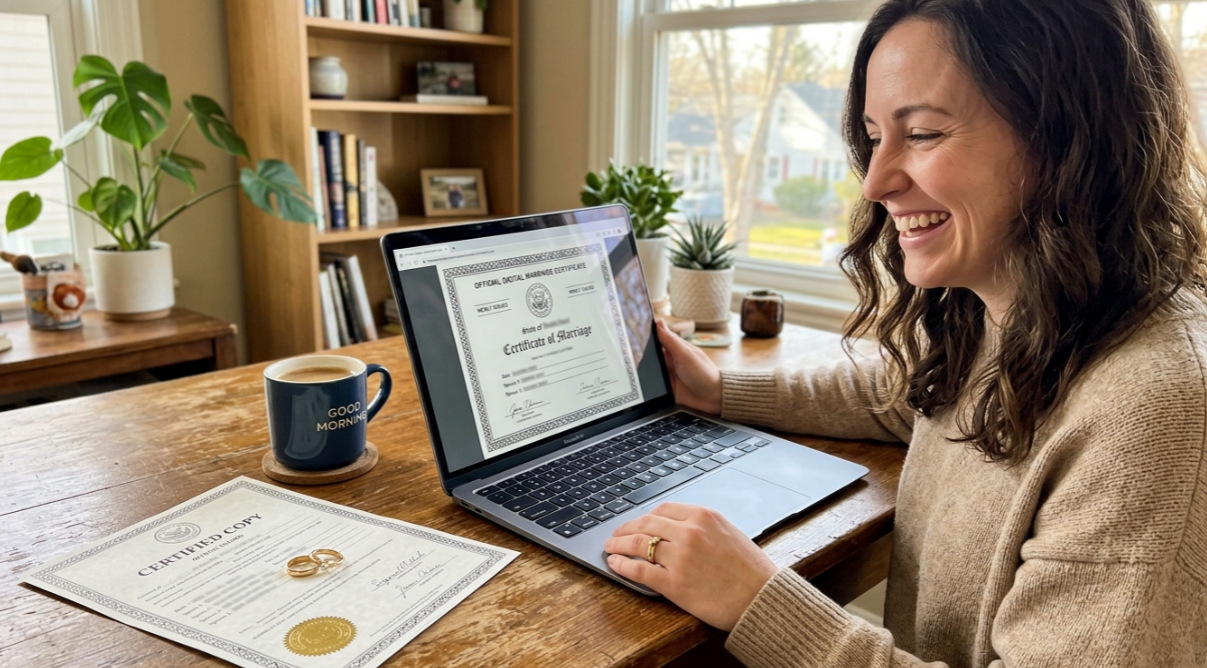
Once the officiant finalizes the license through the portal, things move quickly. Utah County issues a digital certified copy within minutes of finalization. A paper certified copy is mailed within a few business days for continental U.S. addresses.
A few things to know about post-ceremony documents:
The original marriage record stays in the county’s files. What couples receive are certified copies.
Check the spelling of every name immediately. Correcting errors after the fact takes time and hassle.
Some agencies and foreign governments require paper originals, not digital copies.
Additional certified copies can be ordered from the county.
The certificate is the document that proves the marriage happened. The license was just the authorization. Going forward, the certificate is what matters.
For a full walkthrough of next steps, see what happens after your online wedding.
Apostille and Authentication Requirements
An apostille is not a requirement for getting married online. It is often a requirement for using the marriage certificate in another country.
The Hague Apostille Convention created a system where a single certificate, issued by a competent authority in the document’s country of origin, replaces the old multi-step legalization chain. If the destination country is a Hague Convention member, an apostille is usually sufficient. For non-Hague countries, Utah’s Authentications Office issues a universal certificate that functions as a standard certificate of authentication.
Here is the distinction that many people miss: an apostille proves the document is official. It does not force every country to accept the marriage for every legal purpose. Utah County itself warns that foreign government and immigration acceptance is beyond its control. Users on Reddit often treat the apostille as a magic stamp that makes everything work everywhere, but official sources do not support that interpretation.
For a deeper explanation, read all about apostilles and how they differ from other authentication methods.
Need your certificate prepared for international use? See Courtly’s legalization options.
Online Marriage Requirements by Situation
Although the ceremony requirements stay mostly the same, additional documents depend on why you are getting married.
Situation | Extra Requirements |
|---|---|
Name change | Certified marriage certificate |
USCIS immigration | Evidence of bona fide marriage and possible consummation |
Foreign registration | Apostille and certified translation |
Visa application | Country-specific documentation |
Banking or insurance | Certified marriage certificate |
Immigration Requirements After an Online Marriage
Immigration is one of the highest-stakes reasons people research online marriage requirements. The rules here are more nuanced than most service providers acknowledge.
U.S. Immigration (USCIS)
USCIS generally evaluates marriage validity based on the law of the place where the marriage was performed, a principle called the “place of celebration” rule. A marriage valid under Utah law is typically recognized by USCIS. But there is a significant catch.
USCIS does not recognize proxy marriages unless consummated. While a Utah remote appearance ceremony is not technically a proxy marriage (both parties participate via live video), the practical question arises when spouses were not physically together during the ceremony. Immigration attorney analysis from Law and Border summarizes the USCIS position: a virtual marriage is valid for immigration if it is valid where issued, does not violate public policy, and (when the parties were not physically together) has been consummated afterward.
Users on Reddit’s immigration forums report this as a persistent source of anxiety. One notable r/USCIS thread described an I-130 petition denial where the officer questioned a Utah online marriage’s validity, even as community members cited official State Department guidance supporting recognition after consummation. Immigration attorneys have also addressed this in YouTube walkthroughs, confirming it is one of the most frequently asked questions they receive.
Practical advice for U.S. immigration: If the spouses were in different locations during the ceremony, document the post-wedding in-person meeting thoroughly. Save flight records, passport stamps, hotel bookings, photos together, and any other evidence showing the couple met physically after the ceremony.
To understand how remote and proxy ceremonies differ for immigration, see remote marriage vs. proxy marriage.
Canadian Immigration (IRCC)
Canada is the clearest example of why “legal in Utah” does not mean “accepted everywhere.” IRCC states that it does not recognize marriages conducted by proxy, telephone, internet, fax, or similar means if one or both parties were not physically present. The exceptions are narrow: applications received before June 2015, or certain Canadian Armed Forces circumstances.
Reddit threads in Canadian immigration communities show that couples regularly assume a valid foreign online marriage should work for spousal sponsorship, only to discover IRCC’s blanket exclusion. Do not make this assumption. Check IRCC’s current rules directly before planning a marriage intended for Canadian immigration.
When to Consult an Immigration Attorney
If the primary reason for getting married online is to support a spouse visa (CR-1, IR-1, or equivalent), consult an immigration attorney before the ceremony, not after. The requirements for a valid marriage and the requirements for immigration recognition overlap but are not identical.
Explore Courtly’s spouse visa consultation.
International Recognition: What to Expect
Foreign recognition of an online marriage depends on the country and the specific purpose. There is no universal answer, and anyone who tells you otherwise is oversimplifying.
Use case | Likely accepted? | Typical extra requirement |
|---|---|---|
U.S. domestic proof of marriage | Usually yes | Certified copy |
U.S. immigration | Usually yes, with conditions | Post-ceremony consummation evidence |
Canadian immigration | Generally no | Physical presence at ceremony |
Foreign civil registry (Hague country) | Varies | Apostille, sometimes certified translation |
Foreign civil registry (non-Hague country) | Varies | Authentication, embassy legalization |
Positive example: In 2023, an Israeli court ordered the Ministry of Interior to register a marriage officiated in Utah via virtual conferencing, relying on the principle that registration clerks should record a valid foreign certificate unless there is reason to question it.
Cautionary examples: France, Germany, Australia, and several other countries have historically not recognized remote or proxy-style marriages. Utah County displays a legal notice warning that a marriage solemnized through online remote appearance may be invalid in the country where the parties reside. Utah Code even requires the officiant to reiterate that warning before proceeding with the ceremony.
The takeaway: always verify recognition with the destination country’s authorities or a local attorney before relying on an online marriage for foreign purposes. For more on the legality question, see are online weddings even legal.
Common Mistakes With Online Marriage Requirements
Based on official guidance, practitioner analysis, and community reports from Reddit and immigration forums, these are the most frequent errors:
Applying for the license too early. The license expires after 32 days. Apply 10 to 14 days before the ceremony, not months ahead.
Assuming an apostille guarantees recognition. It authenticates the document. It does not override a country’s marriage law.
Forgetting to arrange witnesses. Two adults, age 18 or older, must be on the video call. Guests who happen to be watching are not legal witnesses unless they meet the requirements and are designated as such.
Using an officiant who is not physically in Utah. For a Utah remote ceremony, the officiant’s Utah location is what makes the marriage valid under Utah law.
Not checking name spelling on the certificate. Review every detail immediately after receiving the digital copy.
Skipping post-wedding evidence for U.S. immigration. If spouses were in different locations during the ceremony, USCIS may need proof of consummation and in-person meeting.
Assuming Canada accepts online marriages. IRCC generally does not, with very limited exceptions.
Waiting until after the marriage to check foreign registration rules. Some countries require specific documents, translations, or procedures that are easier to arrange before the ceremony than after.
Confusing an online license application with a fully online marriage. Many U.S. jurisdictions let couples apply for a license online but still require an in-person ceremony. Utah is different because it supports both.
Online Marriage Requirements Checklist
Before Applying
Confirm both parties meet eligibility requirements (age, consent, not currently married)
Check whether the destination country or immigration authority recognizes online marriage
Gather valid government-issued photo ID for each applicant
Locate the divorce decree if either party divorced within the last 60 days
Choose a ceremony date within the 32-day license window
Decide whether you need witnesses, translation, apostille, or legal consultation
During the Application
Use a valid, separate email address for each applicant
Upload government ID via smartphone scan
Complete the identity verification selfie
Review all spelling carefully before submitting
Pay government fees
Save the license link or QR code
Before the Ceremony
Confirm the officiant is authorized and will be physically in Utah
Confirm two witnesses (age 18+) will join by live video
Test video and audio on all devices
Have IDs ready for the officiant’s pre-ceremony verification
Confirm time zones for all participants
After the Ceremony
Download the digital certified copy immediately
Review all certificate details for accuracy
Order additional certified copies if needed
Request an apostille or authentication if using the certificate abroad
Save travel and meeting evidence if relevant for immigration
Register the marriage with the home country’s civil authority if required
Frequently Asked Questions
Can you legally get married online?
Yes, if the marriage is performed under a jurisdiction that allows remote ceremonies and all legal requirements are met. Utah is the most established U.S. jurisdiction for this. The marriage is valid under Utah law, but recognition abroad depends on the destination country and the specific purpose.
Do both people need to be in the same location?
No. For Utah County remote appearance ceremonies, the couple and witnesses can all be in different physical locations. The only location requirement is that the officiant must be physically in Utah during the ceremony.
How many witnesses are required?
Utah requires two witnesses, each at least 18 years old, who observe the ceremony via live video. Their names appear on the certificate. The witnesses do not need to be in the same location as each other or the couple.
Do I need an apostille to get married online?
No. An apostille is not part of the online marriage requirements for the ceremony itself. But if you plan to use the marriage certificate outside the United States, you will likely need one. Utah County notes that couples wanting foreign recognition will probably need an apostille.
Is an online marriage valid for U.S. immigration?
It can be. USCIS generally recognizes a marriage that is valid where performed. However, if spouses were not physically together during the ceremony, USCIS may treat it similarly to a proxy marriage and require evidence of post-ceremony consummation and in-person meeting.
Does Canada accept online marriages for immigration?
Generally no. IRCC does not recognize marriages conducted by internet, proxy, telephone, or fax where one or both parties were not physically present, with very narrow exceptions.
Can non-U.S. citizens get married online through Utah?
Yes. Utah has no residency or citizenship requirement for marriage licenses. Anyone from anywhere can apply. However, foreign recognition of the resulting marriage is not guaranteed.
How quickly do you receive the marriage certificate?
Utah County issues a digital certified copy within minutes of the officiant finalizing the ceremony. A paper certified copy is mailed within a few business days for U.S. addresses.
Let us handle the paperwork.
Getting married is complicated. Courtly simplifies the process and provides everything necessary to get married online, including providing a licensed officiant who can perform a remote ceremony.
Get Married

Get married online.
Getting married is complicated. Courtly simplifies the process and provides everything necessary to get married online.

