

TL;DR
An online marriage performed through Utah’s virtual ceremony process can be used to apply for a U.S. spouse visa (CR-1 or IR-1), but USCIS requires the couple to meet in person and consummate the marriage before filing Form I-130. The filing sequence is: marry online, meet physically, consummate, then file. As of 2026, mandatory in-person interviews apply to all marriage-based green card cases, and some countries (notably Canada) do not recognize online marriages for immigration at all.
Thousands of couples marry online each year with the goal of starting the U.S. immigration process. The Utah County Clerk’s Office alone has performed 3,500 virtual weddings for international couples since launching the service in January 2020. More than 250,000 marriage-based immigrant visas were issued in fiscal year 2024, making the spouse visa one of the most common paths to a green card.
But the intersection of online marriage and spouse visa law is full of terms that confuse even experienced applicants. Words like “proxy,” “consummation,” and “place of celebration” carry specific legal weight that can determine whether a petition gets approved or denied.
This glossary defines every key term couples encounter when pursuing an online marriage spouse visa, explains the legal framework connecting the two, and lays out the practical steps in the right order.
If you’re considering this path, Courtly’s immigration page offers a starting point for understanding how an online marriage connects to the spouse visa process.
Quick Answer: Can an Online Marriage Be Used for a U.S. Spouse Visa?
Yes. USCIS recognizes an online marriage for CR-1 and IR-1 spouse visa petitions if the marriage was legally valid where it was performed and the couple met in person and consummated the marriage after the ceremony.
The correct filing order is:
Step | Requirement |
|---|---|
1 | Get legally married online |
2 | Meet in person |
3 | Consummate the marriage |
4 | Gather evidence |
5 | File Form I-130 |
6 | Complete NVC processing |
7 | Attend the visa interview |
Filing Form I-130 before consummation is one of the most common reasons online marriage petitions are denied.
Marriage Types: The Definitions That Matter Most
Online Marriage (Virtual Marriage)
An online marriage is a ceremony conducted via video conferencing where both parties appear personally on screen but are not in the same physical location. The officiant performs the ceremony remotely, typically over Zoom or a similar platform.
As of 2026, Utah remains the only U.S. state that allows fully virtual weddings. Neither party needs to be a Utah resident, but the officiant must be physically located in Utah. The marriage produces a legally valid U.S. marriage certificate issued by Utah County.
This distinction matters enormously for online marriage spouse visa purposes: both parties are “present” in the legal sense (they appear personally), even though they are physically apart. For a deeper look at how virtual marriages differ from other remote formats, see this guide on remote vs. proxy marriage.
Proxy Marriage
A proxy marriage is a ceremony where one or both parties are not personally present and are instead represented by a stand-in (the “proxy”). Several U.S. states allow proxy marriages, including Montana, Colorado, and Texas under certain conditions.
Why the Distinction Between Virtual and Proxy Marriage Is Critical
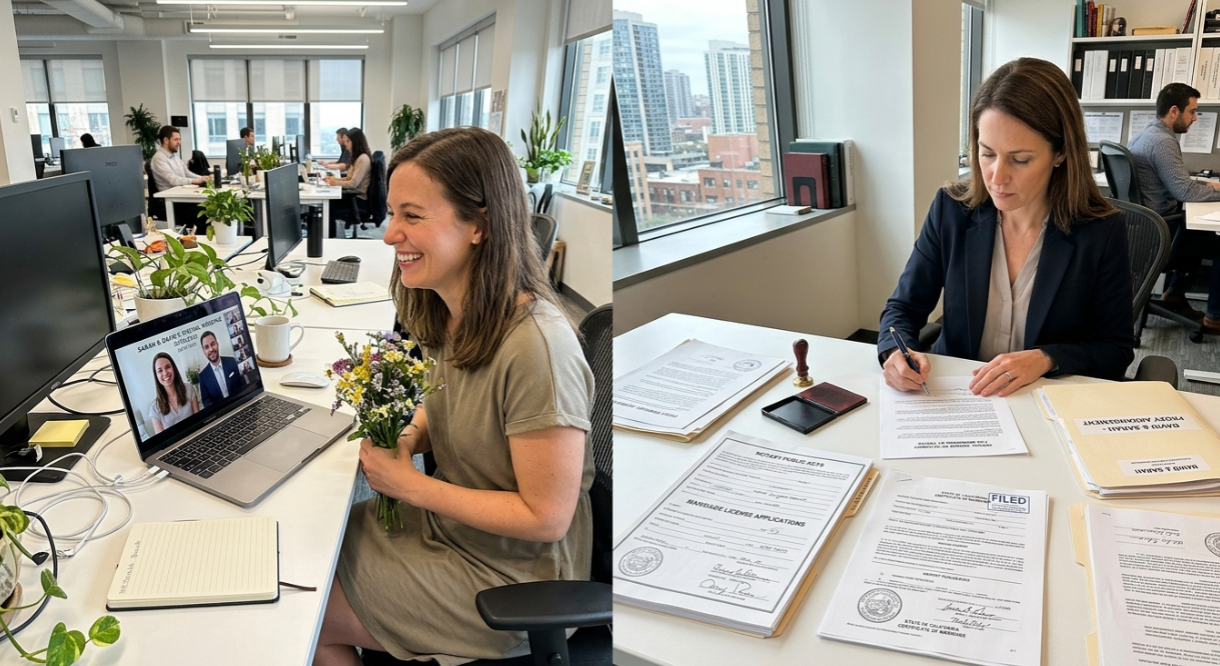
This is the single most important nuance in the entire online marriage spouse visa process, and most articles get it wrong.
A proxy marriage and a virtual marriage are legally different. In a proxy marriage, someone else stands in for you. In a virtual marriage, you appear personally via video. USCIS treats them differently in some respects but similarly in one crucial way: if the parties were not physically together during the ceremony, USCIS applies the consummation requirement regardless of whether the marriage was technically “proxy” or “virtual.”
Immigration attorney Josh Chodorow, whose blog ranks among the top results for this topic, has analyzed this question directly. His conclusion: Utah Zoom marriages are not proxy marriages, because both parties appear personally. But USCIS still wants proof the couple met and consummated the marriage afterward.
Practitioners on Reddit’s r/USCIS forum report inconsistent treatment by individual officers. Some approve Utah virtual marriage petitions quickly with standard documentation. Others issue Requests for Evidence (RFEs) or outright denials that later get overturned on appeal. One widely discussed thread describes a user whose I-130 was denied because USCIS incorrectly classified their Utah marriage as “not valid,” only to be approved after filing a Form I-290B appeal with an attorney.
The takeaway: documentation quality matters more than it should, because officer-level inconsistency is real.
Online Marriage vs. Traditional Marriage for Immigration
Factor | Online Marriage | Traditional Marriage |
|---|---|---|
Ceremony | Virtual | In person |
State availability | Utah only | All states |
Marriage certificate | Yes | Yes |
USCIS recognition | Yes | Yes |
Consummation requirement | Yes | No |
Travel required before filing | Yes | Usually no |
Additional documentation | Yes | Standard |
The biggest difference is that online marriages require additional proof that the couple physically met and consummated the marriage after the ceremony.
Place-of-Celebration Rule
USCIS generally recognizes a marriage as valid if it was valid under the laws of the jurisdiction where it took place. This is called the place-of-celebration rule.
For online marriage spouse visa applicants, this means a Utah virtual marriage is evaluated under Utah law, not under the law of the country where either spouse happened to be sitting during the ceremony. Since Utah explicitly authorizes virtual marriages, the marriage is legally valid at the place of celebration.
This rule is the legal foundation for why online marriages can work for immigration. But it has limits. The marriage must also meet federal requirements under the Immigration and Nationality Act (INA), including the consummation requirement when the parties were not physically together.
U.S. Spouse Visa Terms
Spouse Visa (CR-1 / IR-1)
The CR-1 visa is an immigrant visa for the spouse of a U.S. citizen, issued when the marriage is less than two years old at the time of visa approval. The holder enters the U.S. as a conditional permanent resident. After two years of marriage, the couple files to remove conditions.
The IR-1 visa is identical except it’s issued when the marriage has already lasted two or more years. The holder enters as a full (non-conditional) permanent resident.
Both are filed using Form I-130, Petition for Alien Relative. As of 2026, I-130 processing times for immediate relatives typically range from 8 to 14 months, with National Visa Center processing and consular scheduling adding 3 to 5 months. Total timeline from filing to U.S. entry: roughly 12 to 17 months.
Fiancé Visa (K-1)
The K-1 visa allows the fiancé of a U.S. citizen to enter the United States. The couple must marry within 90 days of entry.
Here is the critical point for anyone considering an online marriage spouse visa: if you are already married, you cannot use the K-1. You are no longer a fiancé. The moment you complete a valid online marriage, the K-1 path closes and the CR-1/IR-1 path opens.
This catches some couples off guard. They marry online thinking they can still choose between the two visa types. They cannot.
K-1 vs. CR-1/IR-1: Which Is Better?
Factor | K-1 (Fiancé) | CR-1/IR-1 (Spouse) |
|---|---|---|
Prerequisite | Not yet married | Already legally married |
Filing form | I-129F | I-130 |
2026 processing estimate | 8 to 13 months to U.S. entry | 12 to 17 months to U.S. entry |
Green card on arrival | No (must file I-485 after entry) | Yes, enters as permanent resident |
Work authorization | Must apply separately | Immediate |
Travel freedom | Restricted until advance parole | Can travel freely |
The K-1 gets you to the U.S. faster, but the CR-1/IR-1 delivers a green card on arrival with immediate work authorization. For couples already married online, the CR-1/IR-1 is almost always the better path. It costs less overall, has a higher approval rate, and avoids the complicated adjustment-of-status process after entry.
If you’re weighing these options and want guidance specific to your situation, Courtly’s spouse visa consultation connects you with partner immigration attorneys.
Form I-130 (Petition for Alien Relative)
This is the form a U.S. citizen or lawful permanent resident files with USCIS to sponsor their spouse for immigration. It’s the first official step in the online marriage spouse visa process after the marriage is consummated.
You cannot file the I-130 until consummation has occurred. USCIS evaluates eligibility at the time of filing, not afterward. Filing too early is a common and costly mistake.
National Visa Center (NVC)
After USCIS approves the I-130, the case transfers to the NVC, a Department of State processing center. The NVC collects additional documents (including the DS-260 immigrant visa application and Affidavit of Support) and schedules the consular interview at a U.S. embassy or consulate abroad.
Adjustment of Status (I-485)
If the foreign spouse is already physically in the United States on a valid visa, they may be able to “adjust status” to permanent resident without leaving the country. This is done by filing Form I-485 instead of going through consular processing.
As of 2026, USCIS has updated its policy manual with heightened discretionary standards for I-485 approvals, so this path requires even more careful documentation than before.
Online Marriage Spouse Visa Requirements Checklist
Before filing a marriage-based immigrant petition, make sure you can answer "yes" to every requirement below.
USCIS Requirement | Required? |
|---|---|
Legally valid marriage | Yes |
Marriage certificate | Yes |
Post-ceremony in-person meeting | Yes |
Consummation | Yes |
Evidence of consummation | Yes |
Evidence of a bona fide marriage | Yes |
Completed Form I-130 | Yes |
Affidavit of Support (I-864) | Yes |
DS-260 | Yes |
Consular interview | Yes |
If any required element is missing, the case may be delayed, denied, or sent back for additional evidence.
Legal Requirements for USCIS Recognition of Online Marriages
Consummation Requirement
This is the term that causes the most confusion and anxiety for online marriage spouse visa applicants.
Under the INA, a person qualifies as a “spouse” for immigration purposes only if both parties were physically present during the marriage ceremony, or the parties consummated the marriage afterward if they were not together. Since online marriages by definition involve parties in different locations, the consummation requirement applies.
Three critical rules about consummation:
It must happen after the ceremony. Consummation before the online marriage does not count, even if the couple has been together for years.
There is no specific legal deadline. Immigration attorney Josh Chodorow notes there’s no timeline specified in the INA for how long after a proxy or virtual marriage consummation must take place. But you cannot file the I-130 until it has happened.
You need evidence. USCIS accepts various forms of proof, including passport stamps or airline records showing travel together after the ceremony, hotel bookings in both names, photographs together post-wedding, joint financial records, and affidavits from both spouses.
The filing sequence that every couple must follow is: marry online, meet in person, consummate, then file I-130. Getting this order wrong results in denials.
Evidence USCIS Accepts After an Online Marriage
Evidence | What It Proves |
|---|---|
Passport stamps | Post-marriage travel |
Boarding passes | Travel together |
Hotel reservations | Shared accommodations |
Photographs | Physical presence |
Joint bank accounts | Financial integration |
Joint leases | Shared residence |
Affidavits | Relationship authenticity |
A child's birth certificate | Consummation |
The strongest petitions combine multiple forms of evidence instead of relying on a single document.
Bona Fide Marriage

A bona fide marriage is a genuine marriage entered into with the intent to build a life together, not primarily to obtain immigration benefits. Every online marriage spouse visa petition requires the couple to demonstrate that their marriage is bona fide.
Evidence includes joint bank accounts, shared lease agreements, photos together over time, communication records, travel together, and statements from friends and family who know the relationship. The more evidence of a genuine, ongoing relationship, the stronger the case.
Marriage Fraud Bar (INA § 204©)
If USCIS has previously found (or finds) that either party entered into a marriage to evade immigration laws, the agency can permanently bar future marriage-based petitions. This is a serious and largely irreversible consequence. It applies even if the current marriage is genuine.
Document and Process Terms
Marriage Certificate
The official government-issued document proving the marriage occurred. For Utah online marriages, this is issued by the Utah County Clerk. Courtly’s online marriage service provides both digital and physical copies of the U.S. marriage certificate as part of its packages.
The certificate is the foundational document for the entire spouse visa process. Without it, nothing else moves forward.
For questions about what this document looks like and how it’s used, the guide on online marriage certificate uses covers the details.
Apostille
An apostille is a form of international authentication that certifies a document (like a marriage certificate) is genuine. Countries that are members of the Hague Apostille Convention accept apostilled documents without further legalization.
For online marriage spouse visa applicants, the Utah marriage certificate often needs an apostille before it can be used in the foreign spouse’s country, whether for local registration, name changes, or supporting the immigration case. Learn more about how apostilles work and when you need one.
Embassy Authentication / Legalization
For countries that are not part of the Hague Convention, the marriage certificate may need embassy authentication instead of (or in addition to) an apostille. This is a multi-step process that typically involves state-level authentication followed by certification at the relevant embassy or consulate.
Courtly offers document legalization services covering both apostille and embassy authentication, with expedited options available.
Affidavit of Support (Form I-864)
The U.S. citizen spouse must file Form I-864 to demonstrate they have sufficient income or assets to support their foreign spouse at 125% of the federal poverty level. This is a legally binding contract with the U.S. government, not just a form. If the immigrant spouse receives certain government benefits, the sponsor can be held financially responsible.
DS-260 (Immigrant Visa Application)
The online application form the foreign spouse completes after the I-130 is approved and the case reaches the NVC. It collects biographical information, travel history, and other details needed for the consular interview.
Country-Specific Recognition: Where Online Marriages Hit a Wall
Canada (IRCC): Explicit Rejection
This is the biggest warning for couples where the sponsoring partner is Canadian rather than American. Immigration, Refugees and Citizenship Canada (IRCC) does not recognize marriages performed by proxy, telephone, fax, internet, or other means where one or both persons were not physically present at the ceremony.
This applies regardless of whether the marriage was legally valid where it took place. Canadian immigration flatly rejects online marriages for sponsorship purposes. Couples planning to use a Utah online marriage for Canadian immigration should consult a Canadian immigration lawyer before proceeding.
Other Countries with Known Non-Acceptance
Several countries have historically rejected online U.S. marriages for official use. Based on published guidance, these include Germany, Hungary, Australia, Norway, France, Turkmenistan, Sweden, Poland (treatment varies), Taiwan, and Finland. For a country-by-country overview, it’s worth checking the latest guidance, as policies change.
The Bottom Line on International Recognition
The place-of-celebration rule is a U.S. immigration concept. Other countries apply their own rules. An online marriage that’s perfectly valid for a U.S. spouse visa may be worthless for immigration to Canada, Australia, or the EU. Always verify with the destination country’s immigration authority before assuming your marriage will be recognized.
2025-2026 Policy Changes That Affect Online Marriage Spouse Visa Cases
USCIS Policy Alert PA-2025-23 (October 2025)
On October 17, 2025, USCIS issued Policy Alert PA-2025-23, updating the Policy Manual on qualifying spousal relationships. The update replaced earlier rules from the Adjudicator’s Field Manual and applies to all new and pending petitions.
Key points from the update: virtual or online marriage ceremonies must meet the same legal standards as in-person marriages, and proxy marriages are recognized only if later consummated and legally valid in the jurisdiction where they took place.
This was not a dramatic change in substance, but it formalized guidance that had previously been inconsistent. For online marriage spouse visa applicants, it means clearer (though stricter) standards.
Mandatory In-Person Interviews (2026)
One of the most significant 2026 changes: USCIS reinstated mandatory in-person interviews for all marriage-based green card applicants without exception. Previously, certain low-risk cases could proceed without an interview under waiver provisions. Those waivers no longer exist.
For online marriage couples, this means every case will face a face-to-face interview where an officer evaluates the bona fide nature of the marriage. Prepare accordingly.
Travel Ban Expansion (Proclamation 10998)
Effective January 1, 2026, Proclamation 10998 expanded the travel ban to cover 39 countries and the Palestinian Authority. Countries under full entry suspension, including Afghanistan, Iran, Syria, Burma, Libya, Somalia, and Yemen, are effectively blocked from both immigrant and nonimmigrant visas absent a specific National Interest Waiver.
For couples where the foreign spouse is from one of these countries, the online marriage spouse visa path faces an additional and potentially insurmountable barrier. Legal counsel is essential.
Utah Legislative Status (SB 110)
In early 2025, Utah Senate Bill 110 raised concerns that it might restrict online marriage ceremonies. Senator Weiler later clarified the bill was not intended to affect remote appearance ceremonies, and the substitute version (2nd Sub SB110) only addresses common-law marriages. Utah’s virtual marriage process remains intact.
This is worth monitoring but is not currently a threat to the online marriage spouse visa pathway.
The Filing Sequence: Getting the Order Right
This is the practical roadmap that ties the entire glossary together. Every term defined above feeds into this sequence:
Get married online. Complete a virtual ceremony through Utah. Both parties appear via video. You receive a valid U.S. marriage certificate.
Get your documents legalized (if needed). Obtain an apostille or embassy authentication for the marriage certificate so it can be used in the foreign spouse’s country.
Meet in person. The couple must physically be together after the ceremony.
Consummate the marriage. Collect evidence: travel records, photos, hotel bookings, affidavits.
File Form I-130. The U.S. citizen spouse submits the petition to USCIS with the marriage certificate, consummation evidence, and bona fide marriage evidence.
NVC processing. After I-130 approval, complete the DS-260 and submit the Affidavit of Support (I-864) and civil documents.
Consular interview. The foreign spouse attends an in-person interview at a U.S. embassy or consulate. As of 2026, this is mandatory for all cases.
Entry to the U.S. The foreign spouse enters as a conditional or full permanent resident, depending on the length of the marriage.
Missing a step or getting the order wrong, especially filing the I-130 before consummation, is one of the most common online marriage visa mistakes couples make.
Online Marriage Spouse Visa Timeline (2026)
Stage | Estimated Time |
|---|---|
Online marriage ceremony | 1 day |
Meeting and consummation | Varies |
I-130 processing | 8-14 months |
NVC processing | 2-3 months |
Embassy scheduling | 1-2 months |
Visa approval | 1-4 weeks |
Total | 12-17 months |
Processing times vary by embassy, country, and USCIS workload.
What Does an Online Marriage Spouse Visa Cost in 2026?
Expense | Estimated Cost |
|---|---|
Online marriage | Varies |
Marriage certificate | Varies |
Apostille | Varies |
Form I-130 | USCIS fee |
DS-260 | Department of State fee |
Medical examination | Country dependent |
Translation services | If required |
Attorney fees | Optional |
Total costs vary significantly depending on the couple's location and whether legal representation is used.
7 Common Online Marriage Spouse Visa Mistakes
Filing Form I-130 Before Consummation
USCIS evaluates eligibility when the petition is filed. Consummation must occur before submission.
Assuming Every Country Recognizes Online Marriages
Many countries do not recognize marriages performed remotely.
Applying for a K-1 Visa After Marriage
A legally married couple cannot use the fiancé visa pathway.
Relying on a Single Piece of Evidence
One hotel receipt or one photograph is rarely sufficient.
Ignoring Country-Specific Rules
Recognition requirements differ by country.
Waiting Too Long to Obtain an Apostille
Document legalization often causes avoidable delays.
Assuming USCIS Officers Interpret Every Case the Same Way
Documentation standards vary among officers.
Frequently Asked Questions
Can I use an online marriage to get a U.S. spouse visa?
Yes. A Utah online marriage is legally valid under the place-of-celebration rule, and USCIS recognizes it for spouse visa (CR-1/IR-1) purposes. However, you must consummate the marriage after the ceremony and provide evidence of consummation when filing Form I-130.
Is an online marriage the same as a proxy marriage for immigration?
No. In a proxy marriage, a stand-in represents one or both parties. In an online marriage, both parties appear personally via video. USCIS treats them differently in classification, but both require consummation if the parties were not physically together during the ceremony.
Can I still apply for a K-1 fiancé visa after getting married online?
No. Once you are legally married, you are no longer eligible for a K-1 visa. Your only immigrant visa option is the CR-1 or IR-1 spouse visa.
What evidence does USCIS accept for consummation?
Acceptable evidence includes passport stamps or airline records showing post-ceremony travel together, hotel bookings in both names, photographs taken together after the wedding, joint financial records, and sworn affidavits from both spouses. The birth certificate of a child born after the ceremony also qualifies.
Does Canada accept online marriages for immigration sponsorship?
No. IRCC explicitly rejects marriages performed via internet, proxy, telephone, or any method where one or both parties were not physically present. This applies even if the marriage is legally valid in the United States.
How long does the online marriage spouse visa process take in 2026?
From I-130 filing to U.S. entry, expect roughly 12 to 17 months. I-130 processing currently averages 8 to 14 months, with NVC and consular scheduling adding 3 to 5 months. This does not include the time needed to meet, consummate, and gather evidence before filing.
What happens if USCIS denies my I-130 based on an online marriage?
You can appeal using Form I-290B. Practitioners on Reddit report cases where Utah online marriages were incorrectly denied and later approved on appeal. Having an immigration attorney handle the appeal significantly improves the chances of success. Submitting thorough documentation upfront reduces the risk of denial in the first place.
Do I need an apostille for my Utah marriage certificate?
It depends on where the foreign spouse’s country requires the certificate to be used. Countries that are part of the Hague Apostille Convention accept an apostille. Others may require embassy authentication. Either way, getting the certificate legalized before you need it avoids delays later in the process.
Navigating the online marriage spouse visa process is complicated, but the vocabulary shouldn’t be the hard part. With the right terms understood and the filing sequence followed correctly, couples can move through the system with confidence.
Ready to start with the marriage itself? See Courtly’s pricing and plans to understand what’s included at each tier, from the ceremony and certificate through document legalization and spouse visa consultation.
Let us handle the paperwork.
Getting married is complicated. Courtly simplifies the process and provides everything necessary to get married online, including providing a licensed officiant who can perform a remote ceremony.
Get Married

Get married online.
Getting married is complicated. Courtly simplifies the process and provides everything necessary to get married online.

