

TL;DR
An online wedding ceremony involves specific legal terms and steps that most couples have never encountered before. This glossary covers 25+ terms you’ll run into, from marriage license and declaration of intent to apostille and Full Faith and Credit Clause. Each definition explains what the term means, when it matters in the process, and what it costs (if anything). Bookmark this as your go-to online wedding ceremony checklist reference.
Getting married online means entering a world of unfamiliar vocabulary. Words like “solemnization,” “host location,” and “remote appearance ceremony” show up in your paperwork, and understanding them isn’t optional. They determine whether your marriage is legally valid.
This glossary serves double duty: it defines every key term you’ll encounter during an online wedding ceremony and organizes them chronologically so you can use it as a practical checklist. Whether you’re a long-distance couple, a military spouse on a deadline, or exploring options for immigration after an online wedding, these are the words you need to know.
See Courtly’s plans and pricing →
Quick Answer
An online wedding ceremony requires five essential legal steps: obtain a valid marriage license, verify your identity, attend a live video ceremony with an authorized Utah officiant and two witnesses, complete the required declaration of intent, and receive your marriage certificate afterward. Couples needing international recognition may also require an apostille or embassy authentication depending on their destination country.
Online Wedding Ceremony Checklist at a Glance
Who Benefits Most From an Online Wedding?
Online weddings are especially useful for:
- International couples
- Military families stationed overseas
- Long-distance relationships
- Couples facing visa deadlines
- Disabled or mobility-limited couples
- Couples wanting a small private ceremony
- Destination wedding couples completing the legal paperwork beforehand
Online Wedding Ceremony Requirements Checklist
Before scheduling your online wedding, confirm you have:
☐ Valid government-issued photo ID
☐ Stable internet connection
☐ Webcam and microphone
☐ Two witnesses (18+)
☐ Utah marriage license
☐ Authorized officiant
☐ Quiet ceremony location
☐ Reliable video conferencing platform
☐ Payment for license fees
☐ Passport (if international recognition will be needed)
Pre-Ceremony Terms
These are the terms that matter before your ceremony date. Getting them right determines whether everything else goes smoothly.
Marriage License
A marriage license is the government’s legal permission for you to marry. It is not the same as a marriage certificate (more on that below). In Utah, you can apply for a marriage license entirely online through the county clerk’s system. There’s no residency or citizenship requirement, meaning anyone from anywhere can apply.
Key details: the Utah County license fee is approximately $71.75 for most applicants, and you can save $20 through the Marriage Education Discount offered by the Utah Marriage Commission (free podcasts, webinars, and courses qualify you). If you want a deeper walkthrough, the online marriage license page covers the full application process.
32-Day License Validity
Once issued, your Utah marriage license is valid for exactly 32 days. There’s no waiting period on the front end, so you could technically get married the same day your license is approved. But if you let 32 days pass without completing the ceremony, the license expires and you’ll need to reapply and pay again.
Practical tip: don’t apply too early. Count backward from your target ceremony date and apply within that 32-day window.
ID Verification / Biometric Scan
During the online license application, both partners use a smartphone to scan their government-issued ID and complete a facial biometric scan. This is how Utah County verifies your identity without an in-person visit. Make sure your ID is current, undamaged, and that you’re in a well-lit room for the face scan.
For the full list of accepted documents, check the documents needed for online marriage checklist.
Marriage Education Discount
Utah offers a $20 discount on the marriage license fee for couples who complete an approved marriage education course. The Utah Marriage Commission provides free options including podcasts, webinars, assessments, and handbooks. It’s a small savings, but it takes minimal effort.
Typical Online Wedding Costs
Officiant / Certified Officiant
The officiant is the person legally authorized to perform your wedding ceremony. For online weddings through Utah, the officiant must be physically located within the state of Utah at the time of the ceremony. This isn’t negotiable. The officiant’s physical presence in Utah is what establishes legal jurisdiction.
Courtly provides a certified officiant as part of every plan, so couples don’t need to find one themselves.
Witnesses (Online Wedding Witnesses)

Utah law requires two witnesses who are at least 18 years old. The good news: witnesses can attend remotely. They don’t need to be in the same room as you or each other. They do need to be able to see and hear everything happening during the ceremony in real time.
If you don’t have two willing witnesses available, Courtly’s Fast-Track plan includes two legal witnesses. Otherwise, witnesses can be added to any plan for +$50.
Power of Attorney Prohibition (May 2024 Update)
As of May 1, 2024, Power of Attorney cannot be used to apply for a remote marriage license in Utah. Both partners must personally complete the application. This is a recent change that many older guides haven’t caught up with, so be cautious about outdated information you find elsewhere.
During-Ceremony Terms
These terms come into play on your actual ceremony day. Understanding them beforehand prevents confusion in the moment.
Remote Appearance Ceremony
This is the official legal term used by Utah County for what most people casually call an “online wedding.” In a remote appearance ceremony, the couple and their witnesses appear via live two-way video rather than being physically present in the same room as the officiant. Utah law explicitly permits this format, making it one of the few states where a fully remote, legally binding marriage ceremony is possible.
If you’re wondering whether this actually holds up legally, the short answer is yes, online weddings are legal under Utah law and recognized across the United States.
Host Location
This term trips people up. The “host location” is not where you are. It’s where the officiant is. Since the officiant must be physically within Utah’s borders, their location is designated as the host location of the videoconference ceremony. This is what establishes the legal jurisdiction for using a Utah County marriage license.
You and your partner can be anywhere in the world. Your location doesn’t need to be in Utah, or even in the United States.
Declaration of Intent
The declaration of intent is your verbal statement that you are knowingly and willingly entering the marriage. Think of it as the spoken equivalent of signing your marriage license. The officiant will ask something like, “Do you take this person to be your lawfully wedded spouse?” and both partners must answer affirmatively.
This became a mandatory ceremony element as of May 1, 2024. Before that date, it was standard practice but not strictly required by law. Now it is. If your ceremony doesn’t include a verbal declaration of intent from both parties, the marriage may not be considered valid.
Don’t confuse this with wedding vows. Wedding vows are personal promises you make to each other. The declaration of intent is a legal requirement. You can write custom vows (Courtly even offers a vow builder tool), but the declaration of intent must happen regardless.
Solemnization
Solemnization is the formal act of performing the marriage ceremony. Utah law requires that all marriages be solemnized, but the nature of the ceremony can vary widely. A solemnization can be religious, secular, simple, or elaborate. What matters legally is that it happens, that an authorized officiant performs it, and that the required elements (declaration of intent, pronouncement, witnesses) are present.
Pronouncement
The pronouncement is the moment the officiant officially declares you married. It usually sounds like, “By the power vested in me by the State of Utah, I now pronounce you married.” Along with the declaration of intent, the pronouncement is a legal requirement during the ceremony, not just a ceremonial flourish.
Foreign Recognition Warning (Utah §81-2-302)
Before the ceremony begins, Utah law requires the officiant to deliver a specific warning: “A marriage solemnized according to the laws of the State of Utah through online remote appearance may be invalid in the country where the parties to the marriage reside.”
This sounds alarming, but it’s a disclosure requirement, not a prediction. Most countries recognize Utah marriages, especially after apostille. However, some countries have historically not accepted marriages performed via remote appearance. The warning ensures couples are informed.
Ceremony Recording / Cloud Storage
Some online wedding services record the ceremony and store the video in the cloud. This recording serves multiple purposes: sharing with family who couldn’t attend, keeping a personal memento, and (importantly for immigration cases) providing evidence that the ceremony took place. Courtly’s Popular and Fast-Track plans include ceremony video recording and cloud storage.
Ceremony Format Types
Not all remote weddings work the same way. These terms describe different formats, and mixing them up can cause real confusion.
Virtual Wedding / Zoom Wedding
A virtual wedding is a ceremony conducted entirely over a video conferencing platform (Zoom, Google Meet, Skype, FaceTime, etc.) where all participants can see and hear each other clearly. The officiant and the couple are in different physical locations. In most Utah online ceremonies, the officiant can share a Zoom link with guests, and up to 100 devices can connect.
For ideas on making the experience feel special, there’s a helpful guide on Zoom wedding tips worth reading.
Hybrid Wedding / Livestream Wedding
A hybrid wedding combines an in-person gathering with a virtual livestream. Maybe you and your partner are in the same room with a few guests, but extended family watches online. This format works well when some guests can’t travel due to distance, health, or visa restrictions. The legal ceremony portion follows the same rules as a fully virtual ceremony.
Proxy Wedding
A proxy wedding is fundamentally different from an online wedding, and confusing the two is common. In a proxy wedding, a third party physically stands in for one or both partners during the ceremony. Montana is the only U.S. state that allows double-proxy marriage (where stand-ins replace both the bride and groom).
Utah’s online marriage model does not use proxies. Both partners must personally appear on camera and speak for themselves. For a more detailed comparison, see the guide on proxy weddings vs. online marriages.
Minimony
A “minimony” is a mini ceremony, typically with just the couple and their closest people, usually no more than ten guests. It can be legal or symbolic. Many couples use a minimony as the legal component and plan a larger celebration for later.
Post-Ceremony and Administrative Terms
The ceremony is the emotional peak, but the administrative work that follows is what makes your marriage functional in the real world. This section of the online wedding ceremony checklist covers what happens after “I do.”
Marriage Certificate
A marriage certificate is the document that proves your marriage took place. It records the date, time, and place of the wedding. This is distinct from the marriage license, which gives you permission to marry. Think of it this way: the license comes before the ceremony, the certificate comes after.
With Courtly, couples receive both a digital certificate (delivered shortly after the ceremony) and a physical certificate mailed to their address.
Apostille
An apostille is a specific form of authentication issued under the Hague Convention of 1961. It certifies that your marriage certificate is a legitimate government document so that foreign countries will recognize it. If your marriage certificate needs to be accepted in another country, and that country is one of the 125+ Hague Convention members, you’ll likely need an apostille.
Practitioners on Reddit’s r/immigration report that the apostille is a step many couples forget about until they need to register the marriage in their home country. One commenter described it as an overlooked cost that adds weeks to the timeline if not planned for in advance.
Courtly offers an apostille and document legalization service so couples can handle this without navigating the Secretary of State’s office themselves.
Embassy Authentication / Legalization
If the country where you need to use your marriage certificate is not a member of the Hague Convention, your document goes through a different process called embassy authentication (sometimes called legalization). This involves getting your certificate authenticated by the U.S. Department of State and then further certified by the embassy or consulate of the destination country.
The distinction matters because the process is longer and more expensive than an apostille. For a side-by-side breakdown, see apostille vs. authentication differences.
Full Faith and Credit Clause
This is the constitutional principle that makes a Utah online marriage valid across all 50 states. The Full Faith and Credit Clause of the U.S. Constitution requires every state to recognize legal acts (including marriages) performed in other states. So a marriage validly performed in Utah, even via video call, must be recognized in California, Texas, New York, or anywhere else in the U.S.
This is why couples from any state can get married through Utah’s online system without worrying about whether their home state will accept it.
Consummation (Immigration Context)
In the context of U.S. immigration, consummation refers to the requirement that couples meet in person after the wedding and can demonstrate that the marriage is genuine, not just a legal formality. Immigration practitioners advise couples to plan a trip to meet after the online ceremony, save receipts, take photos together, and document their time as a couple.
This term is especially relevant for couples pursuing a CR-1 or IR-1 spouse visa. For more on how online marriages intersect with immigration, the immigration and online marriage page covers the key considerations.
Name-Change Kit
After the wedding, many spouses want to update their legal name. In the U.S., this means filing changes with the Social Security Administration, DMV, passport office, banks, and more. A name-change kit bundles the necessary forms, instructions, and checklists into one package.
Courtly offers two versions: a print-at-home option ($35) and a shipped “Courtly Box” ($85) that includes prefilled forms, step-by-step checklists, and prepaid envelopes. Details are on the name-change kit page.
Video Conferencing Platform
The technical backbone of any online wedding. Zoom is the most commonly used platform, but Google Meet, Skype, and FaceTime are also acceptable. The requirement is simple: all participants must be able to see and hear each other clearly in real time. With Zoom, couples can share their ceremony link with guests and connect up to 100 devices.
Make sure to test your connection, camera, and microphone before the ceremony. A dropped call during the pronouncement is a story you’ll tell forever, but probably not one you want to live through.
Commonly Confused Term Pairs
This quick-reference table is one of the most useful parts of your online wedding ceremony checklist. These pairs trip up nearly everyone.
Typical Online Wedding Timeline
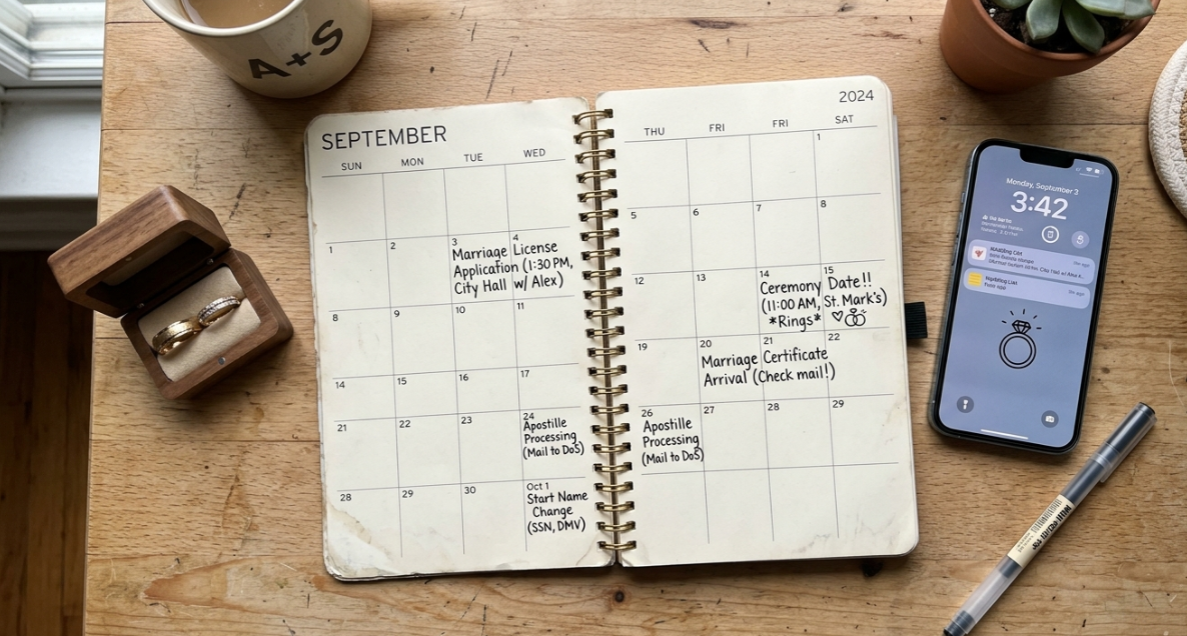
How to Use This Glossary as Your Online Wedding Ceremony Checklist
Reading definitions is useful. Turning them into action steps is better. Here’s how to map these terms to your timeline:
2-4 weeks before the ceremony: Understand marriage license, ID verification, 32-day validity, and the Marriage Education Discount. Apply for your license. Line up your witnesses.
1 week before: Confirm your officiant is arranged, test your video conferencing platform, and make sure your witnesses know when and how to join. Read about the declaration of intent and foreign recognition warning so you’re not surprised.
Day of ceremony: The officiant handles solemnization, the declaration of intent, and the pronouncement. Your witnesses observe via video. The ceremony recording captures everything.
After the ceremony: Your marriage certificate arrives (digital first, physical mailed). If you need your certificate recognized abroad, start the apostille or embassy authentication process immediately. If you’re changing your name, order the name-change kit. If immigration is involved, begin planning your in-person meeting and documentation for consummation.
For a more detailed step-by-step timeline, the online marriage timeline guide walks through each phase.
Now that you know every term on the online wedding ceremony checklist, the next step is straightforward. Start your application, and the vocabulary you just learned will make every step feel familiar instead of foreign.
Start your online marriage with Courtly →
Common Online Wedding Mistakes to Avoid
Many delays happen because couples overlook small legal requirements. The most common mistakes include:
- Applying too early and letting the 32-day marriage license expire
- Using expired identification during verification
- Forgetting to arrange two legal witnesses
- Confusing a marriage license with a marriage certificate
- Assuming every country accepts remote marriages automatically
- Waiting until after the wedding to request an apostille
- Not testing cameras, microphones, or internet before the ceremony
- Relying on outdated information published before the May 2024 Utah law changes
Frequently Asked Questions
What is a remote appearance ceremony?
A remote appearance ceremony is the official legal term for an online wedding performed through Utah’s system. Both partners appear via live two-way video instead of being physically present with the officiant. Utah law explicitly authorizes this format, and the resulting marriage is legally binding.
How long is a Utah marriage license valid?
A Utah marriage license is valid for 32 days from the date of issuance. There’s no waiting period, so you can hold the ceremony as soon as the license is approved. If the 32 days pass without a ceremony, you’ll need to reapply and pay the fee again.
What changed about online weddings on May 1, 2024?
Two significant changes took effect. First, every online ceremony must now include a verbal declaration of intent from both partners. Second, Power of Attorney can no longer be used to apply for a remote marriage license. Both partners must personally complete the application.
Is an online wedding valid in all 50 U.S. states?
Yes. Under the Full Faith and Credit Clause of the U.S. Constitution, every state must recognize a marriage that was validly performed in another state. A Utah online marriage meets Utah’s legal requirements and is therefore recognized nationwide.
Do I need an apostille for my online marriage certificate?
Only if you need your marriage recognized in a foreign country. If that country is a member of the Hague Convention (125+ countries are), an apostille is the standard process. If the country is not a member, you’ll need embassy authentication instead, which involves additional steps and higher costs.
Can my witnesses attend the online wedding remotely?
Yes. Utah requires two witnesses who are at least 18 years old, but they can attend via the same video conferencing platform used for the ceremony. They must be able to see and hear all activity in real time.
How much does an online marriage cost in total?
The Utah County marriage license fee is approximately $71.75 (or ~$51.75 with the Marriage Education Discount). Service provider fees vary by plan. For example, Courtly’s plans range from $199 to $599 depending on inclusions like witnesses, ceremony recording, and rush processing. Add-ons like apostille, translation, and name-change kits are priced separately.
What’s the difference between a virtual wedding and a proxy wedding?
In a virtual wedding, both partners personally appear on camera and speak for themselves. In a proxy wedding, a third party physically stands in for one or both partners. Utah uses the virtual model. Only Montana allows double-proxy marriages where neither partner is present.
Let us handle the paperwork.
Getting married is complicated. Courtly simplifies the process and provides everything necessary to get married online, including providing a licensed officiant who can perform a remote ceremony.
Get Married

Get married online.
Getting married is complicated. Courtly simplifies the process and provides everything necessary to get married online.

