

TL;DR
Same-sex marriage local recognition means whether the government where you live or use your marriage certificate treats a same-sex marriage performed elsewhere as legally valid. In 2026, marriage equality exists in 37 UN member states plus Taiwan, while recognition of foreign same-sex marriages can extend beyond countries that perform same-sex marriages domestically.
For couples married online or remotely, recognition usually involves more than one question: Was the marriage legally valid where it was performed, does the destination jurisdiction recognize foreign marriages, and does it accept the specific ceremony format? An apostille can authenticate a marriage certificate for use abroad, but it does not by itself require a country to recognize the underlying marriage.
Getting married is the straightforward part. Knowing whether that marriage will actually mean something where you live is where things get complicated. For same-sex couples, the question of local recognition is not academic. It determines whether you can sponsor a spouse for immigration, file joint taxes, make medical decisions for each other, or inherit property without a legal fight.
If you’re a same-sex couple considering an online U.S. marriage, this question carries extra weight because you face not one but two recognition tests.
Is a Same-Sex Marriage Recognized Locally?
A same-sex marriage is locally recognized when the government in the jurisdiction where you live or are seeking a legal benefit accepts the marriage as legally valid. A marriage performed abroad can be valid where it was celebrated but still require separate recognition in another country. For an online marriage, couples should verify three separate issues: the legal validity of the marriage where it was performed, recognition of foreign marriages in the destination jurisdiction, and whether the destination accepts the remote or online ceremony format.
An apostille can authenticate the marriage certificate for international use, but an apostille does not create a marriage or force a destination country to recognize a same-sex marriage.
What “Same-Sex Marriage Local Recognition” Actually Means
Same-sex marriage local recognition refers to whether a government, at the city, state, provincial, or national level, accepts a same-sex marriage as legally valid within its jurisdiction. Recognition is what transforms a marriage certificate from a piece of paper into a source of legal rights: spousal benefits, inheritance, tax treatment, hospital visitation, and immigration sponsorship.
The word “local” is doing important work here. A marriage that is perfectly legal in the place it was performed may carry zero legal weight in the place you call home. This gap between where a marriage happens and where a couple lives is the central tension behind same-sex marriage local recognition worldwide.
Recognition vs. Legalization: What Is the Difference?
Legalization and recognition are not the same thing.
Legalization means a jurisdiction permits same-sex couples to marry under its own laws.
Recognition means a jurisdiction accepts a marriage that was legally created somewhere else.
A jurisdiction can therefore fall into different categories:
Situation | Performs same-sex marriages? | Recognizes foreign same-sex marriages? |
|---|---|---|
Full marriage equality | Yes | Yes |
Recognition without domestic marriage | No | Potentially yes |
Limited or conditional recognition | No or limited | Depends on the circumstances |
No recognition | No | No |
The distinction matters for couples who marry abroad or through an online ceremony. A country does not necessarily need to issue same-sex marriage licenses domestically for its authorities to have a legal obligation or mechanism for recognizing a foreign marriage.
The Three-Gate Test for Online Same-Sex Marriage Recognition
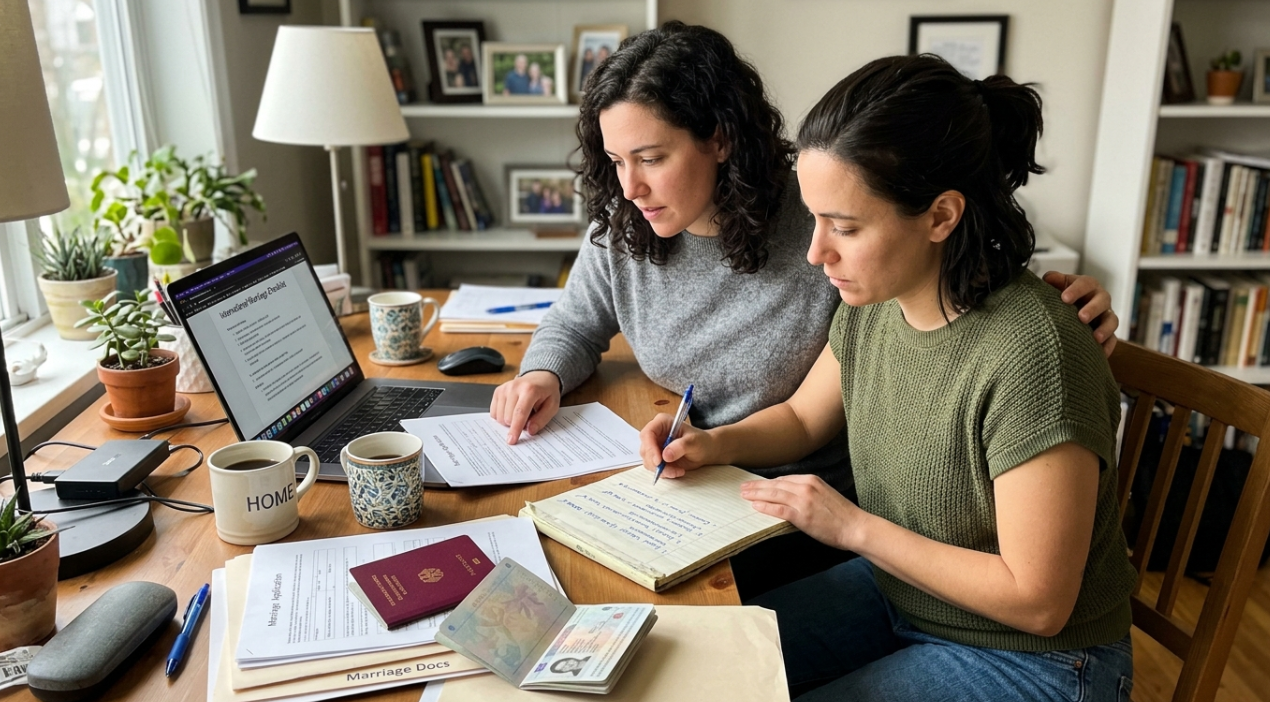
For an online or remote same-sex marriage, checking only whether same-sex marriage is legal in the destination country is not enough. Couples should evaluate three separate legal questions.
Question | What it determines | Why it matters |
|---|---|---|
1. Was the marriage legally valid where performed? | Whether the marriage legally exists in the place of celebration | A certificate is only useful if the underlying marriage was legally created |
2. Does the destination recognize foreign same-sex marriages? | Whether the destination treats the marriage as legally valid | Some jurisdictions may recognize foreign marriages even when they do not perform same-sex marriages domestically |
3. Does the destination accept the ceremony format? | Whether an online, remote, or proxy ceremony satisfies local recognition rules | A jurisdiction may recognize same-sex marriage but apply additional rules to foreign or remote ceremonies |
The key takeaway
A country can recognize same-sex marriage but still create problems for a marriage performed remotely abroad. Conversely, a jurisdiction may not perform same-sex marriages domestically but may have rules requiring recognition of certain foreign marriages.
That is why couples should check the marriage's place of celebration, the destination's foreign-marriage rules, and the ceremony format separately.
What Does Local Recognition Actually Affect?
Whether a destination recognizes your marriage can affect different legal matters separately. Recognition for one purpose does not necessarily guarantee recognition for every other purpose.
Legal issue | Why recognition can matter |
|---|---|
Immigration | May affect eligibility for spouse-based immigration or residence rights |
Taxes | May affect whether spouses can use married filing status or receive marital tax treatment |
Inheritance | May affect succession and inheritance rights |
Healthcare | May affect spousal decision-making or related rights |
Social benefits | May affect eligibility for benefits linked to marital status |
Property | May affect marital property and ownership rights |
Name changes | May affect whether a marriage certificate can support a legal name change |
Family benefits | May affect access to spouse or family-related benefits |
Important: Recognition is often purpose-specific. A government office may accept a foreign marriage certificate for one administrative purpose while applying additional requirements for another.
Same-Sex Marriage: Global Status in 2026
Marriage equality is now legally available in dozens of jurisdictions worldwide. ILGA World’s May 2026 data reports marriage equality in 37 UN member states plus Taiwan. Pew Research Center similarly describes same-sex marriage as legal in nearly 40 places worldwide.
The legal landscape is not uniform, however. A jurisdiction may perform same-sex marriages, recognize marriages performed elsewhere, provide civil unions or partnerships, or impose additional requirements on foreign marriages.
For that reason, the question “Is same-sex marriage legal in this country?” is only the first step. For couples who married elsewhere, the more relevant question is often:
“Does this jurisdiction recognize my particular marriage, performed in this particular place and in this particular way?”
Same-Sex Marriage Status by Region
Region | General pattern |
|---|---|
Europe | Many countries provide marriage equality, while recognition of foreign marriages can also be affected by EU law |
Americas | Marriage equality is established in several countries, including Canada, Argentina, Brazil, Chile, Colombia, Costa Rica, Cuba, Mexico, Uruguay and the United States |
Asia-Pacific | Taiwan, Nepal and Thailand have distinct legal frameworks involving same-sex couples |
Africa | South Africa provides marriage equality; other jurisdictions have different forms of recognition or protection |
Middle East | Legal treatment varies substantially, including jurisdictions that may recognize certain foreign marriages without performing same-sex marriages domestically |
Because marriage and family law can change, use current government or court sources for the specific country rather than relying solely on a global list.
Marriage Equality
Marriage equality means full legal parity between same-sex and opposite-sex married couples. It’s not just about the right to marry. It means the rights that flow from marriage are identical regardless of the spouses’ genders.
In the United States, marriage equality was achieved through the Supreme Court’s 2015 decision in Obergefell v. Hodges, which held that same-sex marriage is a fundamental right under the Constitution. Every state must both perform and recognize same-sex marriages.
The distinction matters because some jurisdictions offer a lesser status, like civil unions, that fall short of full equality. Marriage equality means no asterisks.
Performed vs. Recognized: The Critical Distinction
This is the single most important concept for understanding same-sex marriage local recognition. A jurisdiction can fall into one of three categories:
1. Performs and recognizes same-sex marriages. The government will both issue marriage licenses to same-sex couples and honor same-sex marriages from elsewhere. The United States, Canada, Germany, and all 38 countries on the list above fall here.
2. Does not perform but does recognize same-sex marriages. The government won’t let you get married locally, but it will treat a same-sex marriage obtained elsewhere as legally valid. Israel is the most prominent example. In July 2022, an Israeli court ruled that marriages performed via Utah’s online marriage system, including same-sex marriages, are legal in Israel.
3. Neither performs nor recognizes. The vast majority of countries. Roughly 65 countries still criminalize same-sex activity, and 32 have constitutional amendments explicitly prohibiting same-sex marriage.
For same-sex couples in category-three countries, obtaining a marriage through a U.S.-based online ceremony can serve personal, emotional, or immigration purposes, but it won’t unlock local spousal rights at home. Country-specific guides for places like China, India, or Singapore can help you understand what a U.S. marriage certificate can and cannot do in your specific situation.
Obergefell v. Hodges (2015)
The 2015 Supreme Court decision in Obergefell v. Hodges is the legal foundation for same-sex marriage local recognition throughout the United States. The Court ruled 5-4 that the Fourteenth Amendment requires all states to issue marriage licenses to same-sex couples and to recognize same-sex marriages performed in other states.
Before Obergefell, same-sex marriage local recognition in the U.S. was a patchwork. Some states performed and recognized these marriages, some recognized but didn’t perform them, and many did neither. The ruling eliminated that inconsistency overnight.
It remains the bedrock, but it’s a court decision, not a statute. That vulnerability is exactly why Congress acted in 2022.
Respect for Marriage Act (RFMA)
Signed into law in December 2022, the Respect for Marriage Act serves as a legislative backstop for same-sex marriage recognition in the United States. It officially repealed the Defense of Marriage Act (DOMA), which had defined marriage as between one man and one woman for federal purposes since 1996.
The RFMA does two things:
Requires the federal government to recognize same-sex marriages.
Requires all U.S. states and territories to recognize the validity of same-sex marriages performed in any jurisdiction where such marriages are legal.
There’s an important limitation. If the Supreme Court were ever to overturn Obergefell, the RFMA would not force states to issue new marriage licenses to same-sex couples. It would, however, require states and the federal government to continue recognizing marriages already performed. Think of it as a safety net for existing marriages, not a guarantee of future access.
For same-sex couples using an online U.S. marriage for immigration purposes, both Obergefell and the RFMA ensure that the federal government, including USCIS, treats their marriage as valid. More on the immigration implications of online marriages is available separately.
Civil Unions, Civil Partnerships, and Domestic Partnerships
These terms describe marriage-like legal arrangements that grant some but not all of the rights of marriage. They persist in various forms around the world as alternatives (or, more accurately, lesser substitutes) for full marriage equality.
Civil union: A state-level legal arrangement providing many of the same protections as marriage but without federal recognition. Still available in about four U.S. states and used in over ten countries as a middle-ground approach.
Civil partnership: Functionally similar to civil unions, this term is more common in European and Commonwealth jurisdictions. The UK used civil partnerships before legalizing same-sex marriage in 2014.
Domestic partnership: Typically the most limited of the three, often covering basics like hospital visitation and property rights. Some U.S. cities and states offer domestic partnership registries.
The critical difference: civil unions and partnerships generally do not entitle partners to federal benefits unless the arrangement has been automatically converted to a marriage. They also don’t travel well. A civil union from Vermont may mean nothing in another state or country, whereas a marriage performed in any U.S. state must be recognized nationwide under the RFMA.
For couples weighing options, full marriage is almost always the stronger legal choice, especially for immigration or cross-border purposes.
The Place-of-Celebration Rule
The place-of-celebration rule holds that a marriage is valid if it was legal in the jurisdiction where and when it was performed. This principle is foundational for same-sex marriage local recognition.
In practice, it means that a same-sex marriage performed in Utah (where it is legal) is considered valid by the U.S. federal government and all other U.S. states, regardless of the couple’s home state.
USCIS applies this rule when evaluating marriage-based immigration petitions. If the marriage was legal where it happened, USCIS treats it as valid. This is why online marriages through Utah have become a pathway for same-sex couples worldwide.
The contrast is the domicile rule, used by some countries, which tests a marriage’s validity against the laws of the couple’s home country. Under this approach, a same-sex marriage performed in the U.S. might not be recognized if the couple’s home country bans it. This is one reason same-sex marriage local recognition varies so dramatically across borders.
Apostille: Getting Your Marriage Certificate Recognized Abroad
An apostille is an official certification that authenticates a document, in this case a marriage certificate, for use in another country that is part of the Hague Apostille Convention. Over 120 countries participate.
For same-sex couples seeking local recognition of a U.S. marriage abroad, an apostille is typically the first step. Without it, foreign governments may not accept the certificate as genuine.
For countries that are not part of the Hague Convention, you’ll need embassy or consulate legalization instead, a more involved process that usually requires authentication by the U.S. Department of State followed by the destination country’s embassy.
Courtly offers document legalization services including apostille and embassy authentication options for couples who need their certificate prepared for foreign use.
An apostille proves the document is authentic. It does not force a foreign government to recognize the marriage itself. A country that doesn’t accept same-sex marriages will likely reject the underlying marriage regardless of whether the certificate has a gold seal on it.
Online Same-Sex Marriage and USCIS Immigration
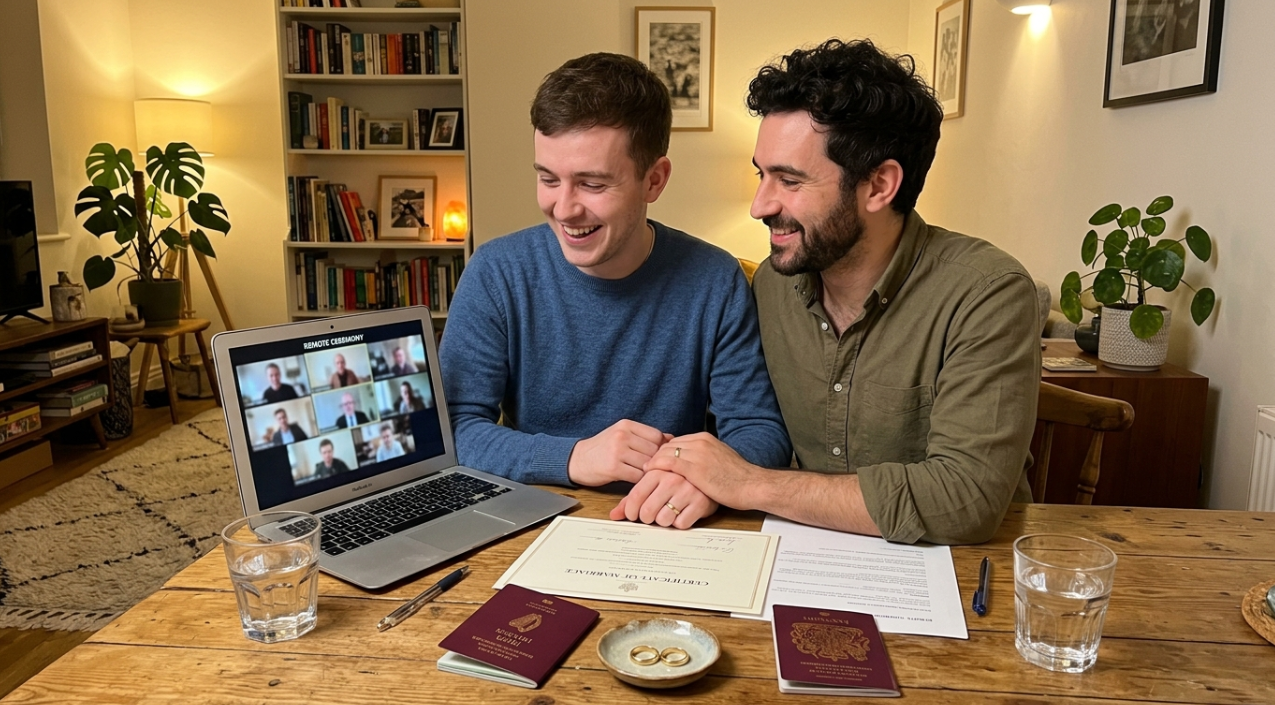
An online or remote marriage can raise a separate immigration issue even when the marriage is legally valid where it was performed.
Under U.S. immigration law, a marriage ceremony in which the parties were not physically present together generally does not establish a qualifying spouse relationship for immigration purposes unless the marriage was subsequently consummated. USCIS materials also state that marriage validity is generally determined by the law of the place where the marriage was celebrated.
For couples considering an online marriage for a U.S. immigration case, this means that three questions should be kept separate:
Was the marriage legally valid where it was celebrated?
Does the marriage qualify as a marriage for the specific immigration benefit being requested?
Have the requirements applicable to a remote or proxy marriage been satisfied?
Because immigration rules and agency interpretations can change, couples should verify the current USCIS Policy Manual and consider qualified immigration counsel before relying on an online marriage for an immigration filing.
Cross-Border Recognition of Same-Sex Marriage
Cross-border recognition asks whether a marriage performed in one country will be honored in another. For same-sex couples, this question defines everything from immigration eligibility to inheritance rights.
The EU’s 2025 Landmark Ruling
On November 25, 2025, the European Court of Justice ruled in the Cupriak-Trojan case that EU member states may not refuse to recognize a same-sex marriage lawfully concluded in another EU member state. This means countries like Poland, Romania, Bulgaria, and Slovakia, which don’t perform same-sex marriages domestically, must still recognize marriages from EU countries that do.
The ruling does not require these countries to change their domestic marriage laws. They don’t have to start issuing marriage licenses to same-sex couples. But they must recognize marriages validly performed elsewhere in the EU.
This is a major shift. Before this decision, couples who married in the Netherlands or Spain could lose their married status simply by moving to another EU country. That’s no longer permissible.
One important caveat: the ruling applies to intra-EU marriages. A U.S. marriage certificate is not automatically covered. However, the decision signals the direction of European jurisprudence and may influence how individual EU countries treat non-EU same-sex marriages over time.
The Utah Online Marriage Pathway
Utah’s pandemic-era allowance for remote marriage ceremonies has become an unexpected lifeline for same-sex couples worldwide. A Reddit thread on r/UpliftingNews highlighted how Chinese same-sex couples were using Utah Zoom ceremonies to obtain legally valid U.S. marriage certificates, even though same-sex marriage is unavailable in China. Israeli courts have similarly ruled that Utah online marriages are valid in Israel, removing the need for couples to leave the country to get married.
Immigration attorneys have framed this as a critical tool. For LGBTQ+ couples in countries where marriage is illegal, a U.S. marriage certificate obtained through Utah’s remote ceremony process can serve as the basis for a spousal immigration petition, provided the couple meets USCIS requirements including the consummation rule.
For same-sex couples exploring this route, Courtly has published country-specific recognition guides covering dozens of destinations.
Countries Known to Reject Online Ceremonies
Even among the 38 countries that recognize same-sex marriage, not all accept online or remote ceremony formats. Countries with strict civil law traditions, including Germany, France, Australia, Norway, Sweden, Finland, and Taiwan, have historically required in-person ceremonies. This is the double-gate problem in action: the country accepts same-sex marriage but rejects the ceremony method.
Couples should always verify with local authorities or a qualified attorney before assuming their online marriage will carry weight abroad.
Frequently Asked Questions
Is my same-sex marriage from the U.S. automatically recognized in every country?
No. Only the 38 countries that have legalized same-sex marriage will recognize it, and even among those, some may not accept marriages performed through online or remote ceremonies. You need both gates, same-sex acceptance and ceremony format acceptance, to be open.
What is the difference between a country “performing” and “recognizing” same-sex marriages?
A country that performs same-sex marriages issues marriage licenses to same-sex couples. A country that only recognizes them (like Israel) won’t let you marry locally but will treat a same-sex marriage from elsewhere as valid. Many countries do neither.
Does the Respect for Marriage Act protect my same-sex marriage if Obergefell is overturned?
Partially. The RFMA requires the federal government and all states to recognize existing same-sex marriages. However, it would not force states to continue issuing new marriage licenses to same-sex couples. It’s a backstop for recognition, not a guarantee of future access to marriage.
Do I need an apostille to use my U.S. marriage certificate abroad?
In most cases, yes. If the destination country is part of the Hague Apostille Convention, an apostille authenticates your certificate for foreign use. Non-Hague countries require embassy or consulate legalization instead. Learn more in Courtly’s apostille guide.
Can USCIS reject my same-sex online marriage for immigration?
USCIS recognizes virtual marriages performed in Utah as valid, but it treats them like proxy marriages, meaning consummation must occur before filing Form I-130. For same-sex couples, USCIS has not defined what consummation means, and no known rejections have been based on this issue alone. The key is meeting in person after the ceremony and before filing.
What did the EU’s 2025 ruling change for same-sex couples?
The ECJ’s Cupriak-Trojan ruling requires all EU member states to recognize same-sex marriages performed in other EU countries. This means a couple married in Spain must be treated as married in Poland. It does not force any country to start performing same-sex marriages domestically, and it applies specifically to intra-EU marriages.
Is a civil union the same as a marriage for recognition purposes?
No. Civil unions are state-level arrangements that don’t automatically confer federal benefits and often aren’t recognized across borders. For immigration, tax filing, and international recognition, a full marriage is almost always the stronger legal instrument.
How do I find out if my specific country recognizes online same-sex marriages?
Start with Courtly’s country-by-country guides, then verify with your local civil registry or a family law attorney in your jurisdiction. Laws change frequently, and local practice sometimes differs from what’s written in the statute books.
Same-sex marriage local recognition is not a single yes-or-no question. It depends on where you married, how you married, and where you live. The global trend is clearly toward broader recognition, from one country in 2001 to 38 in 2025, but the path is uneven. For couples ready to take the first step, Courtly’s online marriage service for LGBTQ+ couples handles the U.S. legal ceremony, and pricing details are available to help you plan.
Let us handle the paperwork.
Getting married is complicated. Courtly simplifies the process and provides everything necessary to get married online, including providing a licensed officiant who can perform a remote ceremony.
Get Married

Get married online.
Getting married is complicated. Courtly simplifies the process and provides everything necessary to get married online.

