

Same-sex couples living in countries without marriage equality may be able to obtain a legally valid U.S. marriage through Utah's remote marriage process without traveling to the United States. However, getting married online and having that marriage recognized in the couple's home country are separate legal questions.
Utah County permits remote marriage ceremonies when the officiant is physically present in Utah and the couple and two witnesses participate by video. Utah County also states that an online marriage may be invalid in the country where the spouses reside.
For international couples, check four issues before relying on the marriage:
Is the marriage valid under Utah law?
Does the destination country recognize foreign marriages?
Does that country recognize same-sex marriages?
Does it recognize marriages performed through remote appearance?
A Utah marriage may be useful for U.S. immigration even when the couple's home country does not recognize same-sex marriage, because USCIS generally applies the law of the place where the marriage was celebrated when determining marriage validity for immigration purposes.
Only 38 countries currently recognize same-sex marriage. That leaves couples in more than 150 nations without a domestic path to legal marriage. In 63 of those countries, homosexuality itself is criminalized, and in 12, it carries the death penalty. For same-sex couples living in these places, the idea of a legal wedding can feel impossible.
It doesn’t have to be. Utah’s remote marriage law has created a narrow but real legal pathway. Thousands of international couples, including same-sex partners from countries that ban their unions, have used online marriage to obtain a valid U.S. marriage certificate without ever setting foot in America. Utah County alone performed 3,500 virtual weddings for international couples in a single recent year.
This glossary explains every legal concept same-sex couples need to understand when considering online marriage from countries without marriage equality. It covers what the terms mean, why they matter, and where the limits are.
Explore how online marriage works for same-sex couples through Courtly’s guided process.
Direct Answer: Can Same-Sex Couples Marry Online From a Country Without Marriage Equality?
Yes, in some circumstances. A same-sex couple living outside the United States may be able to obtain a legally valid Utah marriage through a remote ceremony without traveling to Utah. Utah County allows couples to apply for a digital marriage license and participate in a remote ceremony by video conference. The officiant must be physically present in Utah, and two witnesses who are at least 18 years old must participate.
However, a Utah marriage certificate does not automatically create marriage rights in the couple's home country. Utah County explicitly warns that a marriage performed through online remote appearance may be invalid in the country where the spouses reside.
This creates an important distinction:
Question | What it determines |
|---|---|
Is the marriage valid under Utah law? | Whether a legal Utah marriage was created |
Does the home country recognize foreign marriages? | Whether foreign marriages can be recognized domestically |
Does the home country recognize same-sex marriages? | Whether the couple's marriage qualifies for recognition |
Does the home country accept remote marriages? | Whether the online ceremony itself creates a recognized marriage |
Is an apostille or legalization required? | Whether the certificate can be authenticated for use abroad |
Is the marriage being used for U.S. immigration? | Whether USCIS recognizes the marriage for the relevant immigration benefit |
The key point is that a valid marriage in Utah and recognition in another country are separate legal questions.
How Online Marriage Works for Same-Sex Couples
For couples living outside the United States, Utah County's remote marriage process can generally be understood as a sequence of separate legal and administrative steps.
1. Apply for a Utah marriage license

Utah County allows couples to complete the marriage license application online. Each applicant provides identification and completes their portion of the digital application. Utah County states that there is no U.S. citizenship or Utah residency requirement for obtaining a marriage license.
2. Arrange the remote ceremony
The couple participates in a video ceremony with an authorized officiant. For a Utah remote ceremony, the officiant must be physically present in Utah because the officiant's location establishes the jurisdiction for the ceremony.
3. Include two witnesses
Utah County requires two witnesses who are at least 18 years old. During a remote ceremony, the couple, officiant and witnesses must be able to see and hear one another.
4. Complete the ceremony
The couple makes the required declarations of intent and the officiant solemnizes the marriage.
5. Receive the marriage certificate
After the officiant submits the ceremony information, Utah County says the couple can receive a digital marriage certificate within minutes, with a printed copy sent afterward.
6. Prepare the certificate for international use
If the certificate will be used outside the United States, the couple may need an apostille or another form of authentication, depending on the destination country.
7. Confirm recognition before relying on the marriage
The final step is not administrative. It is legal: determine whether the country where the couple intends to use the marriage certificate recognizes the marriage and the method by which it was performed.
Will a Utah Online Marriage Be Recognized in Your Country?
There is no single worldwide rule for recognizing an online marriage. The answer depends on the laws of the country where the certificate will be used.
Use this five-question framework:
Question 1: Is same-sex marriage legal domestically?
If yes, determine whether the country recognizes foreign same-sex marriages and what documents it requires.
If no, continue to the next question.
Question 2: Does the country recognize foreign same-sex marriages?
Some countries that do not perform same-sex marriages domestically may still recognize marriages performed abroad. Others may refuse recognition based on domestic law or public policy.
Question 3: Does the country recognize marriages performed remotely?
A country may recognize foreign same-sex marriages while applying separate rules to marriages performed through remote appearance.
Question 4: Does the country require an apostille or legalization?
The marriage certificate may need additional authentication before a government agency will accept it.
Question 5: What will you use the marriage for?
Recognition requirements can differ depending on whether the certificate is being used for immigration, residence, inheritance, taxation, family registration, name changes, benefits or another legal purpose.
The practical rule
Do not treat "Utah marriage is legal" and "my country recognizes my Utah marriage" as interchangeable statements. Verify both separately before relying on the certificate.
Marriage Equality and Legal Status Terms
Marriage Equality
The legal recognition of marriages between same-sex couples with the same rights, responsibilities, and benefits granted to opposite-sex marriages. As of 2026, 38 countries have full marriage equality. The most recent additions are Thailand (January 2025) and Nepal (June 2026, via Supreme Court order).
Why it matters: If your country has marriage equality, you can marry domestically. If it doesn’t, you’re in the group this entire glossary was written for. The 38 countries with equality represent roughly 20% of the world’s population, meaning 80% of people live somewhere without it.
Countries with full marriage equality (as of mid-2026): Andorra, Argentina, Australia, Austria, Belgium, Brazil, Canada, Chile, Colombia, Costa Rica, Cuba, Denmark, Ecuador, Estonia, Finland, France, Germany, Greece, Iceland, Ireland, Liechtenstein, Luxembourg, Malta, Mexico, Nepal, the Netherlands, New Zealand, Norway, Portugal, Slovenia, South Africa, Spain, Sweden, Switzerland, Taiwan, Thailand, the United Kingdom, the United States, and Uruguay.
Civil Union / Registered Partnership / Domestic Partnership
A legal status available in some countries that provides certain rights associated with marriage, but typically not all of them. About 11 countries offer civil unions or registered partnerships for same-sex couples without granting full marriage rights.
Why it matters: A civil union is not a marriage. It may grant hospital visitation rights or inheritance protections domestically, but it almost never carries the same weight internationally. For immigration to the United States, USCIS generally requires a marriage, not a civil union, to petition for a spouse visa.
Decriminalization vs. Legalization
Two concepts that are often confused but represent very different realities. Decriminalization means homosexuality is no longer a criminal offense. Legalization of same-sex marriage means the government actively recognizes and performs these unions. A country can decriminalize without legalizing. India, for example, struck down its sodomy law in 2018 but still does not allow same-sex marriage.
Why it matters: Living in a country where homosexuality is decriminalized does not mean you can marry there. It just means you won’t be prosecuted for existing. This distinction affects how safe it is to pursue recognition of a foreign marriage certificate and whether legal counsel is advisable before taking any steps.
Public Policy Exception (Ordre Public)
A legal doctrine that allows a country to refuse recognition of a foreign marriage if that recognition would be “manifestly incompatible” with its own legal principles. This is the mechanism countries without marriage equality most commonly use to reject same-sex marriages performed abroad, including online marriages from Utah.
Why it matters: Even if your marriage is perfectly legal under U.S. law, your home country can invoke its public policy exception to decline recognition. This is one half of what we call the “double barrier” (explained in detail below).
Online Marriage Mechanics
Online Marriage / Remote Appearance Marriage
A marriage ceremony where both parties participate via video conferencing rather than being physically present at the ceremony location. Both spouses appear live, exchange vows, and sign documents remotely. The ceremony is officiated by a licensed officiant in the issuing jurisdiction.
Why it matters: This is the core mechanism that makes marriage accessible to couples in countries without marriage equality. Unlike a symbolic online ceremony, a legally valid remote marriage produces a real U.S. marriage certificate with the same legal standing as any in-person marriage performed in that state.
Utah Remote Solemnization
Utah is the primary U.S. jurisdiction that permits fully remote marriage ceremonies under state law. Two adults, regardless of gender or physical location, can apply for a Utah County marriage license and complete a legally binding ceremony via video call.
Why it matters for couples in countries without equality: Utah’s law doesn’t require either spouse to be a U.S. citizen or resident, and it doesn’t require physical presence in Utah. This combination is what enables same-sex couples anywhere in the world to obtain a U.S. marriage certificate. Around 200 Chinese and Hong Kong same-sex couples have married through Utah’s system since 2021, and roughly 1,200 Israeli couples have used Utah’s online portal since 2020.
Proxy Marriage
A marriage where a stand-in physically appears on behalf of an absent party. This is fundamentally different from an online/remote appearance marriage, where both spouses are present and participating via video.
Why it matters: USCIS treats proxy marriages and online marriages differently. A proxy marriage generally must be consummated before immigration benefits can be claimed. With a remote appearance marriage, both parties are live participants in the ceremony, which strengthens its legal standing. Understanding the differences between proxy and virtual marriage is critical before starting any immigration process.
Marriage License vs. Marriage Certificate
A marriage license is the government’s permission to get married. It’s issued before the ceremony. A marriage certificate is the official record proving a marriage took place. It’s issued after the ceremony.
Why it matters: For international use, you need the marriage certificate, not the license. The certificate is what gets apostilled, authenticated, and presented to foreign governments or immigration authorities.
Officiant
A person legally authorized to perform a marriage ceremony. In Utah online marriages, the officiant is a certified professional who conducts the ceremony via video call and signs the marriage documents.
Why it matters: An uncertified officiant can invalidate the entire marriage. Services that handle Utah online marriages provide licensed officiants to ensure legal compliance.
Witnesses
Most marriage ceremonies require witnesses to observe and attest to the ceremony. Utah requires two witnesses for a valid marriage. In online marriages, witnesses can attend virtually.
Why it matters: Finding two witnesses who can join a video call at a specific time, potentially across time zones, is a logistical hurdle. Some services, including Courtly’s Fast-Track plan, provide witnesses so couples don’t need to coordinate their own.
International Recognition Terms
Lex Loci Celebrationis (Place-of-Celebration Rule)
A Latin legal principle meaning the validity of a marriage is governed by the law of the place where it was celebrated. If the marriage is valid where it happened, other jurisdictions generally recognize it.
Why it matters: This is the legal foundation that makes online marriage from countries without marriage equality work at all. A Utah marriage is valid under Utah law, so countries and agencies that follow the place-of-celebration rule should recognize it. USCIS explicitly applies this rule to same-sex marriages, which is why a Utah online marriage certificate can support a U.S. spouse visa petition regardless of where the couple lives.
The strongest real-world precedent came from Israel. In March 2023, Israel’s Supreme Court unanimously ruled that the government must register marriages performed online via Utah, even when both spouses were physically in Israel during the ceremony. This is particularly significant because Israel does not perform same-sex marriages domestically. The ruling confirmed that lex loci celebrationis can override domestic restrictions in jurisdictions that recognize foreign marriages.
Apostille
An apostille is a certificate used to authenticate a public document for use in another country that participates in the Hague Apostille Convention.
Whether you need an apostille depends on the country and the government agency receiving the marriage certificate. Some authorities require an apostille before accepting a foreign marriage certificate, while others may require a different authentication or legalization process.
As of June 30, 2026, the Hague Apostille Convention had 130 contracting parties. The Hague Conference on Private International Law maintains the current status list, so couples should verify the destination country's status rather than relying on a static list in an article.
SEO takeaway: An apostille authenticates the document. It does not, by itself, force a country to recognize the underlying marriage.
Embassy Authentication / Legalization
For countries that are not members of the Hague Apostille Convention, a longer certification process through embassies or consulates is required. The document must typically pass through the U.S. State Department and then the relevant foreign embassy.
Why it matters: This process is more expensive and time-consuming than an apostille, sometimes taking weeks. Couples from non-Hague countries need to plan accordingly. Understanding the difference between apostille and authentication helps you choose the right path. Some online marriage services offer document legalization as an add-on.
Hague Apostille Convention
The international treaty, formally the Hague Convention Abolishing the Requirement of Legalisation for Foreign Public Documents, that created the apostille system. With 130 member states as of July 2026, it covers most countries where couples might need to use a foreign marriage certificate.
Why it matters: Check whether your home country is a Hague member. If yes, an apostille is sufficient. If no, you’ll need the fuller embassy authentication process. This is a practical step many couples overlook until they’re already trying to use their certificate abroad.
Comity
The legal principle by which one jurisdiction voluntarily recognizes the laws and judicial decisions of another, not out of obligation, but out of mutual respect. Unlike treaties, comity is discretionary.
Why it matters: Many countries recognize foreign marriages through comity rather than any binding legal requirement. This means recognition can change based on political shifts, court rulings, or individual bureaucrats’ interpretations. It’s inherently less reliable than treaty-based recognition, which is why legal counsel matters.
Immigration and Practical Use Terms
Online Marriage and U.S. Immigration
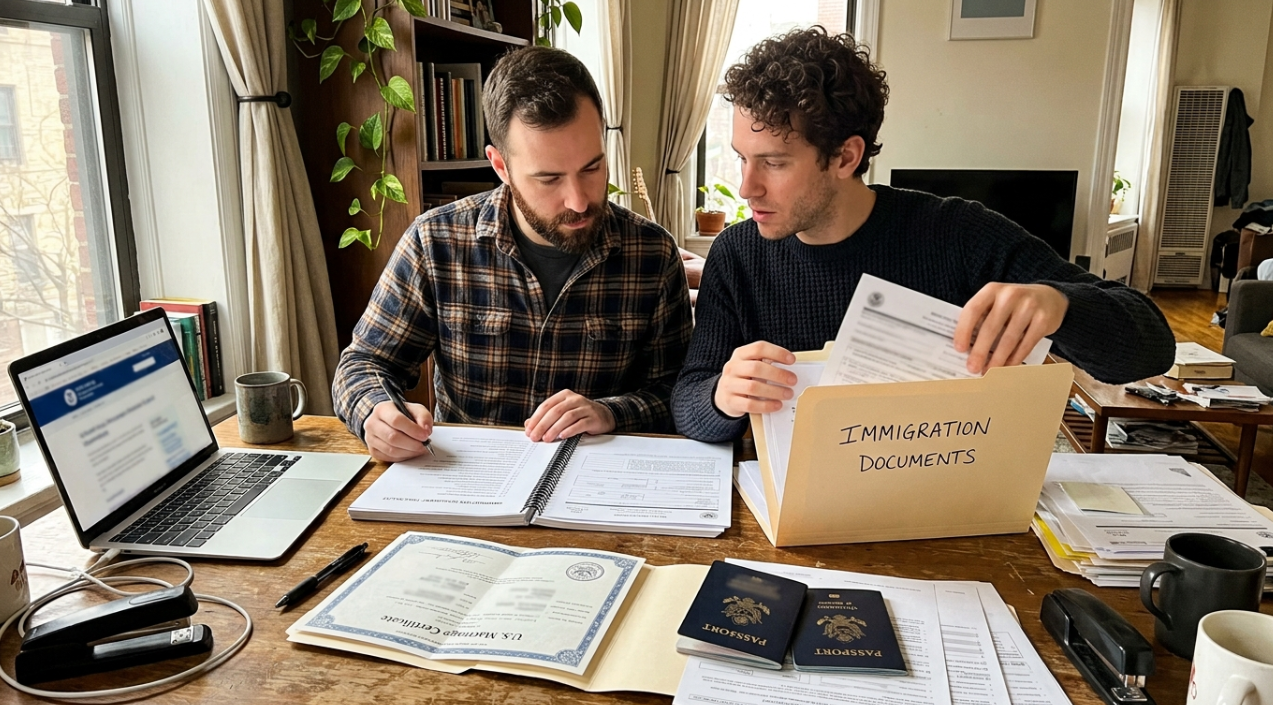
A legally valid same-sex marriage can be recognized for U.S. immigration purposes even when the country where the spouses live does not recognize same-sex marriage. USCIS generally applies the place-of-celebration rule when determining whether a marriage is valid for immigration purposes.
However, couples whose marriage ceremony occurred without the spouses being physically together must consider the separate immigration rule concerning consummation. U.S. immigration law provides that a marriage entered into when the contracting parties were not physically present together does not qualify as a marriage for certain immigration purposes unless the marriage has subsequently been consummated.
Therefore, couples should not assume that receiving a Utah marriage certificate automatically means every immigration requirement has been satisfied.
What couples should verify
Before filing an immigration petition, verify:
whether the marriage was legally valid under Utah law;
whether the marriage certificate meets USCIS documentation requirements;
whether the couple has subsequently met in person where required;
which immigration category applies;
whether additional evidence is needed to establish the bona fide nature of the relationship.
Immigration requirements can change, so applicants should check current USCIS guidance or obtain advice from a qualified U.S. immigration attorney before filing.
CR-1 / IR-1 Spouse Visa
The U.S. visa categories for spouses of U.S. citizens (IR-1 for marriages over two years old, CR-1 for newer marriages). These allow a foreign spouse to immigrate to the United States as a permanent resident.
Why it matters for online marriage in countries without marriage equality: A legally married same-sex couple can use the CR-1/IR-1 pathway even if the foreign spouse’s home country doesn’t recognize the marriage. USCIS applies the place-of-celebration rule, so a valid Utah marriage is sufficient. This makes online marriage a direct pathway to reunification for same-sex couples separated by borders and unequal laws.
K-1 Fiancé Visa
A U.S. visa for the fiancé(e) of a U.S. citizen, requiring the couple to marry within 90 days of the foreign partner’s arrival in the U.S. If you are already married (including via online marriage), you cannot use the K-1 and must use the spouse visa pathway instead.
Why it matters: Some couples wonder whether to marry online first or wait and use the K-1. The answer depends on timeline, separation circumstances, and immigration strategy. Practitioners on Reddit consistently report that the CR-1 route (marry first, then petition) often results in a faster overall timeline than the K-1, though individual cases vary. An immigration consultation can help clarify the best path.
Place-of-Celebration Rule (USCIS Context)
USCIS applies the same place-of-celebration rule to same-sex marriages as it does to opposite-sex marriages. If the marriage was valid in the jurisdiction where it was performed, USCIS recognizes it for immigration purposes, regardless of the laws in the couple’s home country.
Why it matters: This is arguably the most consequential legal principle for same-sex couples in countries without marriage equality who have a U.S. citizen or permanent resident partner. It means a Utah online marriage certificate can unlock the U.S. immigration system even when the foreign spouse comes from a country that criminalizes their relationship.
Documents You May Need for an International Online Marriage
The exact documents depend on the marriage jurisdiction and the country where the certificate will be used. Couples should generally organize the following:
Document | Why it may matter |
|---|---|
Government-issued ID | Identity verification and marriage application |
Marriage license | Authorization for the ceremony |
Certified marriage certificate | Proof that the marriage occurred |
Apostille | Authentication for use in participating foreign countries |
Embassy legalization | Alternative authentication route where applicable |
Certified translation | May be required when the destination authority does not accept English |
Immigration documents | Required for a U.S. immigration application |
Evidence of in-person meeting | May be relevant to immigration requirements for remote/proxy marriages |
Relationship evidence | May support immigration applications requiring proof of a bona fide relationship |
Do not assume that every country requires every document. The receiving government agency determines what it will accept.
The Two Legal Barriers to Online Marriage Recognition
Same-sex couples living in countries without marriage equality should separate two different legal questions.
Barrier 1: The country does not perform same-sex marriages
The couple cannot obtain a domestic marriage under the country's own marriage laws.
Barrier 2: The country may not recognize a foreign same-sex marriage
Obtaining a valid marriage elsewhere does not necessarily require the home country to recognize it. A country may apply domestic legal rules, public policy limitations or other recognition requirements when deciding whether to register or give effect to a foreign marriage.
A separate issue: recognition of remote marriages
There is also a distinct question about the ceremony itself. Some jurisdictions may recognize foreign same-sex marriages but apply different rules to marriages performed through remote appearance.
For this reason, couples should ask three separate questions:
Is our marriage valid where it was celebrated?
Does our destination country recognize foreign same-sex marriages?
Does our destination country recognize a marriage celebrated through remote appearance?
These questions should be answered separately rather than treating "online marriage" as a single legal category.
Some countries add a third complication: they reject online marriages entirely, regardless of the couple’s gender. Germany, France, Australia, Norway, Sweden, Hungary, Turkmenistan, Poland (varies by office), Taiwan, and Finland are known to not accept online marriages in general.
For a same-sex couple from one of these countries, both barriers apply simultaneously.
What a U.S. Marriage Certificate Still Provides
Even when the home country won’t recognize it, a U.S. marriage certificate from Utah still holds real value:
U.S. immigration eligibility. USCIS recognizes it for spouse visa petitions under the place-of-celebration rule.
Recognition in third countries. Any of the 38+ countries with marriage equality will generally recognize a valid U.S. marriage. This matters for travel, relocation, or emergency situations.
Future-proofing. When a country legalizes same-sex marriage, previously performed foreign marriages often gain retroactive recognition. Couples who married via Utah before Thailand legalized equality in 2025, for example, had their marriages recognized after the law changed.
Personal and symbolic weight. For many couples, having a legally binding document that affirms their marriage, even if their government doesn’t acknowledge it, carries deep significance.
Practitioners on Reddit frequently discuss this calculus. Threads in r/LGBTWeddings show couples weighing whether to proceed with a Utah online marriage knowing their home country (Australia, the Philippines, and others) may not immediately recognize it. The prevailing advice: get the certificate for what it does unlock, and consult a local attorney about what it doesn’t.
Regional Snapshot: Where Countries Stand
Africa
South Africa remains the only African country that performs and recognizes same-sex marriage. Namibia is the only other that legally recognizes same-sex marriages performed abroad. Meanwhile, Ghana’s Family Values bill could further tighten anti-LGBTQ laws in 2026. Most African nations lack any form of legal recognition for same-sex couples.
Asia
Taiwan was the first Asian country to legalize (2019), followed by Thailand (2025) and Nepal (2026). Japan is considered the next likely country, with roughly 90% of its population living in jurisdictions that have same-sex partnership registries and multiple court cases heading to the Supreme Court. Since January 2, 2023, Indonesia has effectively criminalized same-sex relations by banning sex outside of marriage without providing marriage equality.
Middle East
Israel recognizes foreign same-sex marriages (including those from Utah’s online system) but does not perform them domestically. Every other Middle Eastern country lacks marriage equality, and most criminalize homosexuality. The 2023 Israeli Supreme Court ruling on Utah online marriages stands as the region’s most significant legal precedent.
Europe
Twenty-two European countries have marriage equality. That still leaves 18 without any legal protection for same-sex couples, concentrated in Central and Eastern Europe. The Czech Republic is actively debating legalization but it remains politically contested.
Latin America and the Caribbean
Strong equality across much of South America (Argentina, Brazil, Chile, Colombia, Costa Rica, Cuba, Ecuador, Mexico, Uruguay). Most Central American and Caribbean nations still lack equality.
Frequently Asked Questions
Is an online marriage from Utah “real” and legally binding?
Yes. A marriage performed via Utah’s remote appearance process is a legal marriage under U.S. law, producing the same marriage certificate as any in-person ceremony. It is not symbolic or ceremonial. USCIS, U.S. courts, and countries that follow the place-of-celebration rule treat it as a valid marriage.
Will my home country recognize my Utah online marriage?
It depends on two things: whether your country recognizes foreign marriages generally, and whether it recognizes same-sex marriages specifically. Countries that invoke a public policy exception against same-sex unions will likely not recognize it, regardless of how it was performed. Countries that reject online marriages (such as Germany, France, or Australia) may also decline. Always consult local legal counsel or your country’s civil registration authority.
What’s the difference between a proxy marriage and an online marriage?
In a proxy marriage, a stand-in represents an absent spouse. In an online (remote appearance) marriage, both spouses are live participants via video. USCIS treats them differently, and online marriages generally carry stronger legal standing because both parties directly participated.
Do I need an apostille for my marriage certificate?
If you plan to use your U.S. marriage certificate outside the United States, almost certainly yes. For countries that are members of the Hague Apostille Convention (130 countries as of 2026), an apostille is sufficient. For non-member countries, you’ll need the longer embassy authentication process.
Can two people who are both outside the U.S. get married online through Utah?
Yes. Neither spouse needs to be a U.S. citizen or physically present in the United States. Both can participate from separate countries via video call.
What if my country criminalizes homosexuality? Is it safe to get an online marriage?
The U.S. marriage certificate is a U.S. legal document. Your home country’s government does not automatically receive notification of it. However, any attempt to use the certificate domestically (for legal name changes, property rights, etc.) could draw attention in countries where homosexuality is criminalized. Consult a lawyer familiar with your jurisdiction before taking any steps that could affect your safety.
Can I use a Utah online marriage for U.S. immigration even if my country doesn’t recognize same-sex marriage?
Yes. USCIS applies the place-of-celebration rule, meaning it evaluates the marriage based on Utah law, not the law of your home country. As long as the marriage is valid under Utah law and has been consummated (meaning you’ve met in person after the ceremony), it can support a spouse visa petition.
How quickly can I get married online?
Processing times vary depending on the plan and how quickly documents are prepared. Some services offer rush processing with scheduling guarantees. Check current pricing and plan options for specific timelines.
Online marriage won’t fix the global inequality in marriage rights. But for same-sex couples in countries without marriage equality, it provides something that didn’t exist a few years ago: a legal, accessible path to a valid marriage certificate. Whether that certificate is used for immigration, for recognition in a third country, or simply as proof that your commitment is real under at least one nation’s law, the option exists. Understand the terms, know the limits, and get the right legal advice for your specific situation.
Start your online marriage through Courtly’s step-by-step process.
Let us handle the paperwork.
Getting married is complicated. Courtly simplifies the process and provides everything necessary to get married online, including providing a licensed officiant who can perform a remote ceremony.
Get Married

Get married online.
Getting married is complicated. Courtly simplifies the process and provides everything necessary to get married online.

