

Green card holders can legally marry online through Utah’s virtual marriage process, and USCIS will recognize the marriage for immigration purposes under the place-of-celebration rule. However, LPR sponsors face a different path than U.S. citizens: they file under the F2A preference category, cannot use K-1 fiancé visas, and may encounter visa backlogs. Couples should plan to meet in person after the ceremony and gather strong evidence of a bona fide marriage, especially given increased scrutiny in 2025 and 2026.
Quick Answer: Can a Green Card Holder Marry Online?
Yes. A lawful permanent resident (green card holder) can marry online through a jurisdiction that legally permits virtual marriage, such as Utah, and then petition for the spouse through the F2A family-preference category. The marriage must be legally valid where celebrated, and the couple should carefully document their relationship and any required post-ceremony in-person meeting. Unlike U.S. citizens, LPRs cannot use the K-1 fiancé visa.
The Bottom Line
For a green card holder, the basic strategy is:
Marry legally → obtain the marriage certificate → file Form I-130 → classify the spouse under F2A → monitor the Visa Bulletin → pursue adjustment of status or consular processing when eligible.
The online wedding itself does not give the foreign spouse immigration status or permission to enter the United States. The immigration process begins with the qualifying marriage and Form I-130 petition.
Green Card Holder Online Marriage: The 2026 Process
The process generally follows these steps:
1. Confirm the online marriage is legally valid
↓
2. Complete the virtual ceremony and obtain the marriage certificate
↓
3. Document the bona fide relationship
↓
4. File Form I-130 with USCIS
↓
5. Receive the priority date and monitor the F2A Visa Bulletin
↓
6. If the spouse is in the U.S. and eligible, pursue adjustment of status
OR
6. If the spouse is abroad, complete consular processing
↓
7. Complete the required medical examination and financial sponsorship requirements
↓
8. Attend the interview or complete the adjustment process
↓
9. Receive permanent residence if approved
The exact process depends on whether the foreign spouse is inside or outside the United States and whether an immigrant visa number is available.
Can a Green Card Holder Legally Marry Online?
Yes, a green card holder can legally marry online if the jurisdiction conducting the marriage legally authorizes a virtual ceremony and the couple meets its requirements.
Utah is particularly relevant because it provides a process for couples to obtain a marriage license and conduct a virtual ceremony. The sponsor's immigration status does not itself prevent the couple from marrying.
However, being legally married and qualifying for immigration benefits are separate questions. After the wedding, the green card holder still needs to petition for the spouse, and the foreign spouse must independently qualify for an immigrant visa or adjustment of status.
For immigration purposes, the couple should preserve the official marriage certificate, ceremony records and evidence showing that the relationship is genuine.
Who Is This Guide For?
This guide is for couples where:
- One spouse is a U.S. lawful permanent resident (LPR) or green card holder.
- The couple is considering or has completed a legal online marriage.
- The foreign spouse needs a U.S. immigrant visa or green card.
- The couple wants to understand the F2A spouse sponsorship process.
- The couple is deciding between adjustment of status and consular processing.
It is especially relevant when the couple cannot easily travel to the same country for a traditional wedding or when the LPR sponsor wants to begin the immigration process after marrying online.
If the sponsor is already a U.S. citizen, the immigration category is different. U.S. citizen spouses generally fall into the immediate-relative category rather than F2A.
Core Terms: Online Marriage
Online Marriage / Virtual Marriage
An online marriage (also called a virtual marriage) is a legally binding wedding ceremony conducted remotely via videoconference. Both partners appear live on camera before a licensed officiant, but nobody needs to be in the same physical location.
As of 2025, Utah is the only U.S. state that allows fully virtual weddings where both parties appear remotely. You don’t need to be a Utah resident. The officiant must be physically located in Utah during the ceremony. Since Utah County began offering online marriage licenses and virtual ceremonies in January 2020, thousands of couples from around the world have used the service.
Immigration status does not affect your ability to get married. A green card holder can marry online through Utah just like a U.S. citizen can. The marriage produces a standard U.S. marriage certificate, which is the document you’ll need for any immigration filing.
This matters for green card holders specifically because they lack access to the K-1 fiancé visa. Marrying online first, then filing a spousal petition, is often the most practical path forward.
Proxy Marriage
A proxy marriage is a ceremony where one or both parties are absent and represented by a stand-in. This is fundamentally different from a virtual marriage, where both partners attend live via video.
The distinction matters enormously for immigration. USCIS applies stricter rules to proxy marriages, specifically requiring consummation before recognizing them. One immigration law analysis argues that Utah virtual weddings avoid this requirement because both partners are considered legally “present” under Utah law. However, practitioners report that USCIS officers frequently apply the consummation requirement to virtual marriages anyway.
For a deeper comparison, see our breakdown of proxy vs. virtual marriage differences.
The safest approach: treat your online marriage as if the consummation requirement applies, regardless of the legal debate.
Place-of-Celebration Rule
This is the core legal principle USCIS uses to evaluate whether a marriage is valid for immigration purposes. The rule is simple: if the marriage was legal in the place where it was performed, USCIS recognizes it.
For a green card holder who marries online through Utah, this means the marriage just needs to be valid under Utah law. It doesn’t matter if the foreign spouse’s home country wouldn’t recognize a virtual ceremony, and it doesn’t matter if other U.S. states don’t allow virtual marriages. Utah’s recognition is what counts for USCIS.
USCIS has clarified in its policy manual that virtual or online marriage ceremonies conducted via videoconference must meet the same legal standards as in-person marriages, and the place-of-celebration rule applies.
Does USCIS Require Consummation After an Online Marriage?
This is one of the most important distinctions in an online-marriage immigration case.
USCIS specifically addresses proxy marriages, where one or both parties are not physically present at the ceremony. Under immigration law, a proxy marriage generally is not recognized for immigration purposes unless the marriage was consummated afterward. USCIS materials also state that consummation must occur after the ceremony; a prior meeting or relationship does not satisfy that requirement.
A live virtual ceremony is not necessarily identical to a traditional proxy marriage. In a virtual ceremony, both spouses may participate live by videoconference rather than being represented by a proxy.
Because the treatment of remote marriages can involve fact-specific questions, couples should not assume that a marriage certificate alone resolves every immigration issue.
Conservative evidence strategy

If the spouses were not physically together during the online ceremony, a cautious evidence strategy is to:
- Meet in person after the ceremony.
- Keep airline tickets and boarding passes.
- Save hotel or lodging records.
- Take dated photographs together.
- Preserve evidence of the trip and time spent together.
- Keep communication records showing the ongoing relationship.
- Consider obtaining individualized immigration advice if the case involves a proxy-style ceremony or unusual circumstances.
The key distinction is that USCIS's specific consummation rule concerns proxy marriages, so the article should not state that every virtual wedding automatically requires consummation without qualification.
Our consummation and immigration guide walks through exactly what evidence to collect.
Don’t skip this step. It’s the single biggest mistake couples make when a green card holder marries online.
What USCIS Looks At in an Online Marriage Case
An online marriage does not eliminate the normal marriage-based immigration requirements. USCIS can examine whether:
- The marriage was legally valid where it was celebrated.
- The marriage is genuine and was entered into in good faith.
- The petitioner has a qualifying relationship with the beneficiary.
- The beneficiary is otherwise eligible for the requested immigration benefit.
- The required forms, fees and supporting documents were properly submitted.
- Any issues involving a proxy or remote ceremony have been adequately addressed.
The strongest application is not simply the one with the best marriage certificate. It is the one that clearly connects the legal marriage to a documented, ongoing relationship.
Core Terms: Green Card Holder Sponsorship
Green Card Holder (Lawful Permanent Resident / LPR)
A green card holder, formally called a Lawful Permanent Resident (LPR), is someone authorized to live and work permanently in the United States but who has not yet become a U.S. citizen. LPRs can sponsor certain family members for immigration, including a spouse, but the process is different from what U.S. citizens can do.
The most important differences: LPR sponsors cannot petition for a fiancé visa (K-1), their spouses fall into a preference category with annual visa caps, and the overall timeline tends to be longer. These constraints are exactly why the option for a green card holder to marry online has become popular. Instead of waiting for a fiancé visa that will never come, LPRs can marry first and file for a spousal green card immediately.
Same-sex LPR sponsors have identical rights under current U.S. law. A green card holder in a same-sex relationship can marry online and sponsor their spouse through the same F2A process described throughout this guide.
Form I-130 (Petition for Alien Relative)
Form I-130 is always the first step. It’s the petition filed by the sponsoring spouse (the green card holder) to establish a qualifying family relationship with USCIS. Filing this form is how you officially say: “I’m a permanent resident and I married this person. Please classify them for an immigrant visa.”
As of 2026, the filing fee is $625 online or $675 by mail. The I-130 can be filed immediately after your marriage, which is another reason online marriage is attractive for LPR sponsors who want to start the immigration clock as soon as possible.
Recent USCIS data shows approval rates for Form I-130 range from 84.5% to 90.4%. Those are strong numbers, but they assume solid documentation. A weak filing with minimal evidence of a bona fide marriage will face problems, especially when the marriage was conducted virtually.
If you’re weighing the immigration path after an online marriage, Courtly offers a spouse visa consultation with partner immigration attorneys.
What Does the Green Card Holder File After an Online Marriage?
The green card holder is the petitioner and generally begins the family-based immigration process by filing Form I-130, Petition for Alien Relative, for the spouse.
The I-130 establishes the qualifying family relationship. It does not, by itself, give the foreign spouse a green card, immigration status, or permission to enter the United States.
The next steps depend largely on where the spouse lives:
- Spouse outside the United States: The case generally proceeds through consular processing after the petition and visa-availability requirements are satisfied.
- Spouse inside the United States: The spouse may potentially pursue adjustment of status if eligible and if the applicable F2A visa-availability requirements are met.
The petitioner should include the marriage certificate and evidence supporting the legitimacy of the marital relationship.
F2A Visa Bulletin Status in 2026
F2A availability is not simply a matter of whether the category says “current.” The Department of State publishes separate Final Action Dates and Dates for Filing charts, and the two can produce different results.
For September 2026, the F2A Dates for Filing chart is current for all listed chargeability areas. However, the Final Action Date is not current: it is August 22, 2026 for most chargeability areas, China, India and the Philippines, and August 22, 2025 for Mexico.
This distinction matters because being able to file documents is not necessarily the same as having a visa number immediately available for final approval or issuance.
Because Visa Bulletin dates can move forward or backward, couples should check the current monthly bulletin rather than relying on a historical F2A status.
Visa Bulletin and Priority Date
The Visa Bulletin is a monthly report published by the U.S. Department of State that shows which family-based and employment-based visa categories have available visa numbers. For F2A specifically, it tells you whether there’s a line and how long it is.
What Is the F2A Priority Date?
For a family-preference petition such as F2A, the priority date generally corresponds to the date USCIS properly receives the Form I-130 petition.
The priority date functions as the beneficiary's place in the visa queue. The Department of State then compares that date with the applicable Visa Bulletin cutoff date to determine whether an immigrant visa number is available.
Because the Visa Bulletin contains separate Dates for Filing and Final Action Dates, a priority date can be eligible for one stage of the process without necessarily meaning that the immigrant visa or adjustment can be finally approved immediately.
For green card holder sponsors, checking the Visa Bulletin monthly is essential because F2A availability can shift.
F2A Dates for Filing vs. Final Action Dates
The Visa Bulletin contains two different dates that can affect a spouse of a green card holder.
Visa Bulletin term
What it means
Why it matters
Dates for Filing
Indicates when certain applicants may begin submitting required documentation
Can determine when an applicant can take the next filing step
Final Action Date
Indicates when a visa number is available for final action
Determines when an immigrant visa or adjustment can be finally approved, subject to the applicable rules
Current (C)
No cutoff date is listed for that category and chargeability area
Eligible applicants may proceed without a priority-date cutoff for that chart
For adjustment of status cases, applicants must follow the chart USCIS designates for that month. For consular processing, the Department of State uses the Visa Bulletin rules applicable to immigrant visa processing.
Because F2A dates can change, do not assume that a filing date or approval date from a previous month will remain available.
Adjustment of Status (I-485)
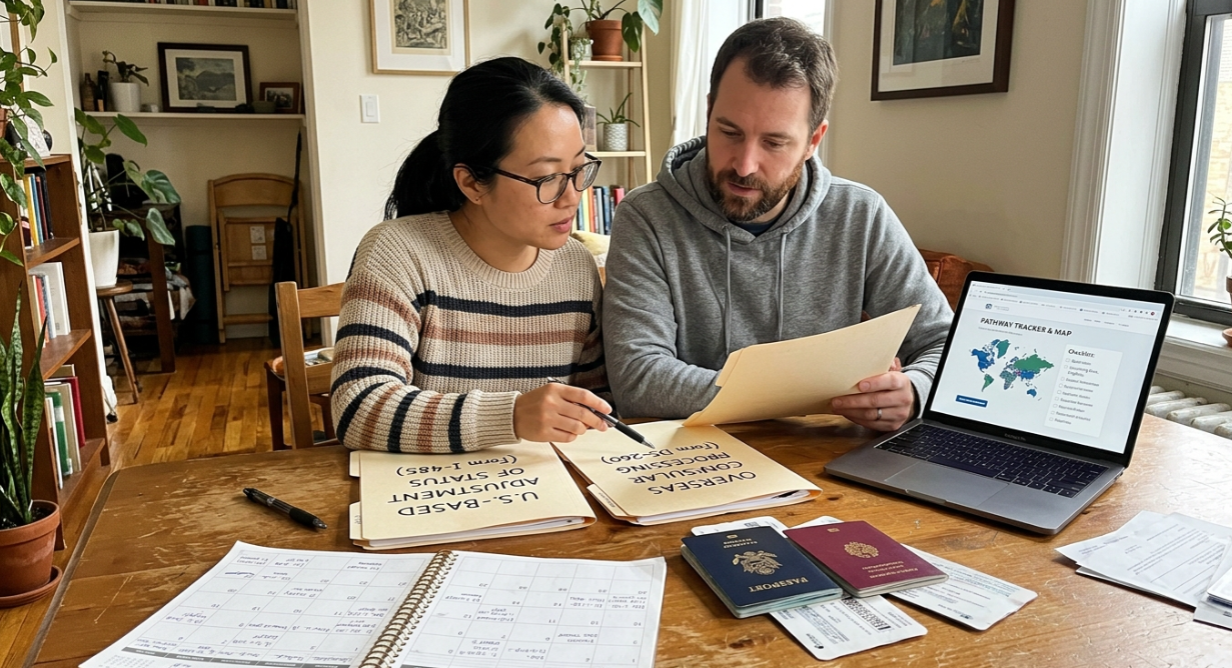
If the foreign spouse is already in the United States on a valid visa, they may be able to adjust status to permanent resident without leaving the country. This is done by filing Form I-485, Application to Register Permanent Residence.
For spouses of green card holders, concurrent filing (submitting I-485 alongside or shortly after I-130) is only possible when the F2A category is current. When it’s backlogged, you must wait.
Processing time for adjustment of status is typically 10 to 17 months from filing to interview. During this period, the applicant can request a work permit (EAD) and travel authorization (advance parole).
Can the Spouse Work While Waiting for the Green Card?
Not simply because the I-130 has been filed.
A pending Form I-130 does not itself provide employment authorization. If the foreign spouse is eligible to file Form I-485 for adjustment of status, they may also be eligible to apply for employment authorization through the applicable USCIS process.
The rules are different for a spouse processing an immigrant visa from outside the United States.
This distinction is important because couples sometimes assume that filing an I-130 automatically gives the beneficiary permission to live or work in the United States. It does not.
Consular Processing
If the foreign spouse is outside the United States, they’ll go through consular processing instead. After the I-130 is approved and a visa number is available, the case transfers to the National Visa Center (NVC) and eventually to a U.S. embassy or consulate abroad, where the spouse attends an interview.
Consular processing typically takes 18 to 24 months from the initial filing. Couples going this route usually need an apostilled marriage certificate or embassy authentication for use in the foreign country.
One practitioner on Team Blind, a tech worker forum, emphasized this reality for green card holder sponsors: “If she is located outside the US and you are a GC holder, then the only way to bring her to the US properly is through F2A and depends on the visa bulletin.”
Can the Foreign Spouse Visit the U.S. While an F2A Case Is Pending?
A pending I-130 does not automatically give the foreign spouse permission to enter the United States.
Whether the spouse can obtain a temporary visa or enter the United States depends on the requirements of the specific visa or admission category and the individual's circumstances.
A pending immigrant petition can also affect how a temporary-visa applicant's intent is evaluated. Couples should not assume that having an approved or pending I-130 guarantees admission as a visitor.
If the spouse is considering travel to the United States while an F2A case is pending, obtain case-specific advice before making travel plans.
Core Terms: Proving Your Marriage
Bona Fide Marriage
USCIS wants to see that your marriage is real, not just a means to obtain immigration benefits. A “bona fide marriage” is one entered into in good faith, with genuine intent to build a life together. This is relevant for every marriage-based green card application, but it carries extra weight when the couple married online without being in the same location.
Evidence USCIS looks for includes:
- Joint bank accounts or shared financial responsibilities
- Lease or mortgage documents with both names
- Photos of the couple together at various times
- Communication records (call logs, messages, video chat history)
- Travel records showing visits to each other
- Affidavits from friends and family attesting to the relationship
- Evidence of meeting in person after the online ceremony
As one immigration forum poster warned: “As soon as immigration officials see a proxy marriage on your application, they start questioning the validity of your relationship.” Virtual marriages get similar treatment. Build your evidence file early and keep adding to it.
Our proof of marriage evidence checklist covers exactly what to document and when.
Affidavit of Support (I-864)
The sponsoring green card holder must file Form I-864, Affidavit of Support, to prove they can financially support their spouse. This is a legally binding contract with the U.S. government.
For a two-person household in 2026, the minimum income requirement is $27,050 per year. If the sponsor doesn’t meet this threshold on their own, a joint sponsor (a U.S. citizen or permanent resident) can co-sign.
The I-864 obligation doesn’t expire when the spouse gets their green card. It continues until the sponsored spouse becomes a U.S. citizen, earns 40 qualifying quarters of work, dies, or permanently leaves the United States.
Conditional vs. Permanent Green Card (CR-1 vs. IR-1)
If you’ve been married for less than two years when the green card is issued, the spouse receives a conditional green card (CR-1), valid for two years. Before it expires, the couple must jointly file Form I-751, Petition to Remove Conditions on Residence, to convert it to a permanent green card.
If you’ve been married for more than two years when the green card is issued, the spouse receives a permanent green card (IR-1 equivalent) that’s valid for ten years.
For green card holder sponsors specifically, the processing timeline often means the marriage has passed the two-year mark by the time the green card arrives, particularly when F2A is backlogged. This can actually work in the couple’s favor by skipping the conditional period entirely.
Green Card Holder vs. U.S. Citizen Sponsor: Key Differences
This comparison is the heart of what makes the green card holder marry online scenario distinct.
Factor
U.S. Citizen Sponsor
Green Card Holder (LPR) Sponsor
Visa category
Immediate Relative (IR-1/CR-1)
Family Preference F2A
Annual visa cap
None
Subject to annual limits
Typical wait for visa number
None
0 to 7+ years depending on backlog
K-1 fiancé visa available?
Yes
No
Concurrent I-130/I-485 filing
Always
Only when F2A is current
Processing speed
Generally faster
Generally slower
The inability to file a K-1 fiancé visa is arguably the biggest practical difference. U.S. citizens can bring a fiancé to the U.S. first and marry them here. Green card holders cannot. This is precisely why marrying online makes strategic sense for LPR sponsors: it converts a fiancé into a spouse immediately, allowing the I-130 petition to be filed without waiting or traveling.
The Naturalization Upgrade
Here’s a strategy more green card holders should know about. If an LPR naturalizes (becomes a U.S. citizen) while an I-130 petition is pending for their spouse, the petition automatically upgrades from the F2A preference category to the immediate relative category.
This means:
- No more annual visa cap
- No more waiting for a current priority date
- Significantly faster processing
- The spouse can file I-485 concurrently regardless of bulletin dates
As one immigration law blog noted to a green card holder seeking advice: “As an LPR, once you are married, you can file a Form I-130 for your spouse. Later, if/when you naturalize, the petition can be automatically converted from the F2A category to immediate relative category.”
If you’re eligible for naturalization (generally after 5 years as an LPR, or 3 years if married to a U.S. citizen), pursuing it while your spouse’s petition is pending can cut years off the process.
Costs and Timeline Snapshot (2026)
Item
Cost
I-130 filing fee
$625 (online) / $675 (paper)
I-485 filing fee
~$1,440
Total USCIS government fees (full package)
$2,115 to $3,005
Medical exam (I-693)
$200 to $500
Document translation, postage
Varies
Attorney fees (optional)
Varies widely
Milestone
Typical Timeline
I-130 processing
6 to 12 months
Adjustment of status (I-485)
10 to 17 months from filing
Consular processing
18 to 24 months total
F2A backlog (when retrogressed)
3 to 7+ years historically
These timelines assume F2A is current. If F2A retrogresses, the wait between I-130 approval and being able to file I-485 or attend a consular interview could add years.
Increased Scrutiny in 2025 and 2026
The Trump administration reintroduced stricter requirements for marriage-based green cards in 2025. Marriage-based interviews have become more rigorous, with expanded in-person interview requirements, more detailed questioning, increased evidence demands, and enhanced vetting.
Online marriages draw additional attention. Officers want to determine whether the relationship is genuine. This doesn’t mean online marriages are rejected, as approval rates for I-130 petitions still range from 84.5% to 90.4%. But it does mean couples should prepare thoroughly.
Another practitioner on Team Blind offered blunt advice: “Do not take immigration advice from social media. Get a good lawyer. Trump admin changed a lot of the immigration process, for the worse.”
Practical steps to prepare:
- Gather extensive bona fide marriage evidence well before your interview
- Document your relationship timeline with photos, messages, and travel records
- Keep records of every in-person meeting, especially after the online ceremony
- Consider hiring an immigration attorney, particularly for complex cases
Common Mistakes to Avoid
1. Not meeting in person after the ceremony. This is the most dangerous mistake. Regardless of the legal debate about whether Utah virtual marriages technically require consummation for USCIS purposes, you should meet your spouse in person after the wedding and document it. Travel records, photos, hotel receipts, and affidavits are all valuable.
2. Confusing proxy and virtual marriage. These are legally distinct concepts. Make sure any attorney or officer you work with understands you had a virtual ceremony where both parties appeared live, not a proxy marriage with a stand-in.
3. Waiting when F2A is current. As of mid-2026, F2A is current for all countries. If you’re a green card holder who has married online, file your I-130 now. Dates can retrogress without warning, and a delay could cost years.
4. Weak bona fide evidence. An online marriage certificate alone is not enough. USCIS wants to see the relationship behind the paperwork. Start building your evidence file from day one.
5. Forgetting about the Affidavit of Support. The income requirement catches some sponsors off guard. Confirm you meet the $27,050 threshold (for a two-person household) before filing, or arrange a joint sponsor.
6. Not considering the naturalization upgrade. If you’re close to eligibility for U.S. citizenship, naturalizing while the I-130 is pending can dramatically accelerate your spouse’s case.
Ready to take the first step? Compare Courtly’s plans to see which package fits your situation, whether you need witnesses, rush processing, or ceremony recording for immigration evidence.
Frequently Asked Questions
Can a green card holder legally marry online?
Yes. A green card holder can marry online through Utah’s virtual marriage process just like any other person. Immigration status does not affect your ability to obtain a marriage license or hold a virtual ceremony. The resulting marriage certificate is a standard U.S. legal document valid for immigration filings.
Will USCIS accept an online marriage from a green card holder sponsor?
USCIS recognizes online marriages that are legal in the jurisdiction where they were performed, under the place-of-celebration rule. Since Utah legally authorizes virtual marriages, a Utah online marriage is valid for USCIS purposes. However, the couple should plan to meet in person after the ceremony and document that meeting, as USCIS may apply the consummation requirement.
What is the difference between F2A and immediate relative for immigration?
When a green card holder sponsors a spouse, the spouse falls under the F2A preference category, which has annual visa caps and potential backlogs. When a U.S. citizen sponsors a spouse, the spouse is classified as an immediate relative with no visa caps and no waiting period. This difference in processing speed and certainty is one of the most significant factors for LPR sponsors.
Can a green card holder use a K-1 fiancé visa?
No. The K-1 fiancé visa is only available to U.S. citizens. Green card holders cannot petition for a fiancé to enter the United States through this route. This is a key reason why marrying online first and then filing an I-130 spousal petition is a common strategy for LPR sponsors.
How long does the green card process take for a spouse of a green card holder?
When F2A is current (as it is in mid-2026), adjustment of status typically takes 10 to 17 months. Consular processing takes 18 to 24 months. When F2A is backlogged, wait times have historically ranged from 3 to 7 years before the spouse can even begin the adjustment or consular process.
Does meeting in person before the online marriage count as consummation?
No. USCIS requires that consummation occur after the marriage ceremony if the parties were not physically together during it. Prior meetings, and even having children together before the marriage, do not satisfy this requirement. You must meet after the wedding and provide evidence of that meeting.
What happens if a green card holder becomes a U.S. citizen while the I-130 is pending?
The pending I-130 petition automatically upgrades from the F2A category to the immediate relative category. This eliminates visa caps, removes any backlog wait, and generally speeds up the entire process. If you’re approaching naturalization eligibility, this upgrade can save significant time.
Is an online marriage more likely to be denied for immigration purposes?
Not inherently, but online marriages do face additional scrutiny. USCIS officers may ask more questions about the relationship to verify it’s genuine. Recent data shows I-130 approval rates between 84.5% and 90.4%, suggesting most petitions succeed. The key is strong documentation: a solid evidence file showing a real relationship, proof of meeting after the ceremony, and thorough interview preparation.
{
"@context": "https://schema.org",
"@type": "FAQPage",
"@id": "#faq",
"mainEntity": [
{
"@type": "Question",
"@id": "#faq-question-1",
"name": "Can a green card holder legally marry online?",
"acceptedAnswer": {
"@type": "Answer",
"text": "Yes. A green card holder can marry online through Utah's virtual marriage process just like any other person. Immigration status does not affect your ability to obtain a marriage license or hold a virtual ceremony. The resulting marriage certificate is a standard U.S. legal document valid for immigration filings."
}
},
{
"@type": "Question",
"@id": "#faq-question-2",
"name": "Will USCIS accept an online marriage from a green card holder sponsor?",
"acceptedAnswer": {
"@type": "Answer",
"text": "USCIS recognizes online marriages that are legal in the jurisdiction where they were performed, under the place-of-celebration rule. Since Utah legally authorizes virtual marriages, a Utah online marriage is valid for USCIS purposes. However, the couple should plan to meet in person after the ceremony and document that meeting, as USCIS may apply the consummation requirement."
}
},
{
"@type": "Question",
"@id": "#faq-question-3",
"name": "What is the difference between F2A and immediate relative for immigration?",
"acceptedAnswer": {
"@type": "Answer",
"text": "When a green card holder sponsors a spouse, the spouse falls under the F2A preference category, which has annual visa caps and potential backlogs. When a U.S. citizen sponsors a spouse, the spouse is classified as an immediate relative with no visa caps and no waiting period. This difference in processing speed and certainty is one of the most significant factors for LPR sponsors."
}
},
{
"@type": "Question",
"@id": "#faq-question-4",
"name": "Can a green card holder use a K-1 fiancé visa?",
"acceptedAnswer": {
"@type": "Answer",
"text": "No. The K-1 fiancé visa is only available to U.S. citizens. Green card holders cannot petition for a fiancé to enter the United States through this route. This is a key reason why marrying online first and then filing an I-130 spousal petition is a common strategy for LPR sponsors."
}
},
{
"@type": "Question",
"@id": "#faq-question-5",
"name": "How long does the green card process take for a spouse of a green card holder?",
"acceptedAnswer": {
"@type": "Answer",
"text": "When F2A is current (as it is in mid-2026), adjustment of status typically takes 10 to 17 months. Consular processing takes 18 to 24 months. When F2A is backlogged, wait times have historically ranged from 3 to 7 years before the spouse can even begin the adjustment or consular process."
}
},
{
"@type": "Question",
"@id": "#faq-question-6",
"name": "Does meeting in person before the online marriage count as consummation?",
"acceptedAnswer": {
"@type": "Answer",
"text": "No. USCIS requires that consummation occur after the marriage ceremony if the parties were not physically together during it. Prior meetings, and even having children together before the marriage, do not satisfy this requirement. You must meet after the wedding and provide evidence of that meeting."
}
},
{
"@type": "Question",
"@id": "#faq-question-7",
"name": "What happens if a green card holder becomes a U.S. citizen while the I-130 is pending?",
"acceptedAnswer": {
"@type": "Answer",
"text": "The pending I-130 petition automatically upgrades from the F2A category to the immediate relative category. This eliminates visa caps, removes any backlog wait, and generally speeds up the entire process. If you're approaching naturalization eligibility, this upgrade can save significant time."
}
},
{
"@type": "Question",
"@id": "#faq-question-8",
"name": "Is an online marriage more likely to be denied for immigration purposes?",
"acceptedAnswer": {
"@type": "Answer",
"text": "Not inherently, but online marriages do face additional scrutiny. USCIS officers may ask more questions about the relationship to verify it's genuine. Recent data shows I-130 approval rates between 84.5% and 90.4%, suggesting most petitions succeed. The key is strong documentation: a solid evidence file showing a real relationship, proof of meeting after the ceremony, and thorough interview preparation."
}
}
]
}
Let us handle the paperwork.
Getting married is complicated. Courtly simplifies the process and provides everything necessary to get married online, including providing a licensed officiant who can perform a remote ceremony.
Get Married

Get married online.
Getting married is complicated. Courtly simplifies the process and provides everything necessary to get married online.

