

K1 vs CR1 online marriage is the decision between staying engaged for a K-1 fiancé visa or getting legally married online first and filing for a CR-1/IR-1 spouse visa. K-1 brings your fiancé to the U.S. to marry within 90 days; CR-1 requires an existing legal marriage and lets your spouse enter as a permanent resident. An online marriage can open the CR-1 path, but only if it is legally valid and recognized for immigration, which typically means meeting in person after the ceremony and saving proof before filing.
This article is general information, not legal advice. Courtly is not a law firm and cannot guarantee immigration approval. Consult an immigration attorney before choosing a visa path.
Quick Answer: K-1 vs CR-1 Online Marriage
For most couples, K-1 can be faster for the foreign fiancé(e) to make an initial U.S. entry, while CR-1/IR-1 is usually more efficient for entering as a permanent resident. An online marriage can move a couple from the K-1 route to the spouse-visa route, but immigration recognition depends on the marriage's validity and applicable post-ceremony requirements.
K-1 vs CR-1
If your priority is... | Usually consider... | Why |
|---|---|---|
Getting the fiancé(e) to the U.S. before marriage | K-1 | The fiancé(e) enters the U.S. to marry the U.S. citizen within 90 days |
Entering the U.S. already married | CR-1/IR-1 | The spouse enters through an immigrant visa |
Entering as a permanent resident | CR-1/IR-1 | Permanent residence is granted through the immigrant-spouse process |
Avoiding adjustment of status after entry | CR-1/IR-1 | No post-entry I-485 process is required |
Marrying online before immigration processing | CR-1/IR-1 may be the relevant path | An online marriage can change the relationship from fiancé(e) to spouse |
Having a wedding in the United States after arrival | K-1 | Marriage occurs after the fiancé(e) enters |
Minimizing post-entry paperwork | CR-1/IR-1 | The spouse enters as a permanent resident |
Getting married online but not yet meeting afterward | Do not assume CR-1 is ready | Additional immigration requirements may apply to remote/proxy marriages |
K1 vs CR1 Online Marriage: What It Means and Which Path Fits
The phrase K1 vs CR1 online marriage captures a specific fork in the road that thousands of cross-border couples face every year. You are either staying engaged and filing a K-1 fiancé visa, or you are getting legally married first (potentially online) and filing a CR-1 or IR-1 spouse visa. The two paths answer fundamentally different questions, lead to different legal statuses at U.S. entry, and carry different costs, timelines, and paperwork burdens.
What makes this decision harder is the online marriage variable. A remote wedding, like those performed under Utah law, can shift your entire immigration strategy by changing your marital status. That shift can be powerful or problematic depending on how well you understand the rules.
If you are exploring whether an online marriage fits your immigration goals, Courtly’s immigration marriage page explains the logistics of the ceremony itself.
Quick Glossary of Key Terms
Before comparing visa paths, it helps to speak the same language as the forms, officers, and forums you will encounter.
K-1 visa. A nonimmigrant visa for the foreign-citizen fiancé(e) of a U.S. citizen. The fiancé enters the U.S. and must marry the sponsor within 90 days, then apply for adjustment of status to get a green card.
CR-1 visa. A conditional resident spouse visa, typically issued when the couple has been married for less than two years at the time the foreign spouse enters the U.S. The spouse enters as a permanent resident.
IR-1 visa. An immediate relative spouse visa, generally issued when the marriage is at least two years old at the time of U.S. entry. No conditional status, no need to later remove conditions.
Online marriage. A marriage ceremony conducted remotely by video. In Utah’s model, the officiant must be physically located in Utah, and the couple, officiant, and at least two witnesses must be able to see and hear each other in real time.
Proxy marriage. A marriage where one or both parties are not physically present together. For U.S. immigration purposes, a proxy marriage generally does not create “spouse” status unless consummated after the ceremony.
Consummation (immigration context). Proof that the couple was physically together after the marriage ceremony. USCIS historical guidance specifies there is no “pre-consummation,” meaning prior in-person meetings before the wedding do not satisfy this requirement.
I-129F. The petition form that starts the K-1 fiancé visa process.
I-130. The petition form that starts the CR-1/IR-1 spouse visa process.
Adjustment of status (AOS). The process a K-1 entrant uses after marrying in the U.S. to apply for permanent residence from inside the country.
Place-of-celebration rule. A marriage is generally valid for immigration if it was valid under the law of the jurisdiction where it was performed. USCIS’s 2025 policy alert on spousal petitions confirmed that virtual marriages are subject to this same rule.
For a deeper look at how these terms interact, see this guide to proxy vs virtual marriage differences in immigration.
K-1 vs CR-1 at a Glance
This comparison table is the fastest way to understand the K1 vs CR1 online marriage decision.
Factor | K-1 Fiancé Visa | CR-1/IR-1 Spouse Visa |
|---|---|---|
Relationship status at filing | Engaged, not yet married | Already legally married |
Who can petition | U.S. citizen only | U.S. citizen (CR-1/IR-1); LPR sponsors use different categories |
Main petition form | I-129F | I-130 |
Where marriage happens | In the U.S. after entry | Before filing, anywhere legally valid |
90-day marriage requirement | Yes, must marry within 90 days of U.S. entry | No, already married |
Status at U.S. entry | Nonimmigrant fiancé(e) | Permanent resident |
Work authorization after entry | Requires AOS filing and EAD application | Available as permanent resident |
Post-entry adjustment needed | Yes (I-485, EAD, advance parole) | No |
Online marriage fit | Usually conflicts with K-1 | Can fit if marriage is valid and recognized |
Sources: State Department K-1 page and State Department spouse visa page.
The table reveals something important. K-1 and CR-1 are not interchangeable options you pick based on speed alone. They depend on whether you are unmarried or already married. That is where online marriage changes the equation.
K-1 vs CR-1 Timeline: What Happens After You File?
The two visa routes have different timelines because they reach different milestones.
Stage | K-1 | CR-1/IR-1 |
|---|---|---|
Relationship at filing | Engaged | Married |
Petition | I-129F | I-130 |
USCIS petition processing | Required | Required |
National Visa Center processing | Required after petition approval | Required after petition approval |
Consular interview | Required | Required |
U.S. entry | Fiancé(e) enters | Spouse enters |
Marriage after entry | Required within 90 days | Already married |
Adjustment of status | Required | Not required |
Green-card process after entry | Additional step | Permanent resident status begins at entry |
The Key Timeline Difference
K-1 moves the marriage ceremony later in the immigration process. CR-1/IR-1 moves the marriage earlier and completes the immigrant-visa process before U.S. entry.
That means a K-1 can sometimes produce an earlier initial U.S. arrival without necessarily producing an earlier permanent-residence outcome.
What Does “Faster” Mean: U.S. Entry, Green Card, or Work?
There is no single K-1 vs CR-1 processing-time answer because the two visas reach different milestones.
A K-1 may get the foreign fiancé(e) to the United States sooner in some cases, but the person enters as a nonimmigrant and must marry within 90 days before applying for adjustment of status.
A CR-1/IR-1 generally takes the spouse through a longer immigrant-visa process before U.S. entry, but the spouse enters as a permanent resident rather than starting a separate adjustment-of-status process after arrival.
For that reason, compare the visas by the milestone that matters most:
Fastest initial U.S. entry: K-1 may have an advantage.
Fastest path to entering as a permanent resident: CR-1/IR-1 may be preferable.
Fastest access to permanent-resident status after entry: CR-1/IR-1 has a structural advantage because the spouse enters as a permanent resident.
Simplest process after U.S. entry: CR-1/IR-1 generally requires fewer post-entry immigration filings.
Ability to marry in the United States after arrival: K-1 is designed for this purpose.
Processing times vary by USCIS workload, National Visa Center processing, the assigned U.S. embassy or consulate, medical-exam availability, administrative processing, and individual case circumstances.
Can an Online Marriage Change Your K-1 Case to a CR-1 Case?

Yes, getting legally married can change the immigration strategy because K-1 is designed for a fiancé(e), while CR-1/IR-1 is for a spouse. The important question is whether the online ceremony created a marriage that is legally valid and recognized for U.S. immigration purposes.
The U.S. Department of State defines a spouse as a legally wedded husband or wife for the immigrant-spouse process.
Therefore, couples should not treat an online ceremony as a separate type of visa. The online ceremony is a marriage event; the immigration question is whether that marriage qualifies under the applicable rules.
If a K-1 Petition Is Already Pending
Do not assume that completing an online marriage simply leaves the existing K-1 petition unchanged.
K-1 is specifically for a foreign-citizen fiancé(e) of a U.S. citizen who will marry after entering the United States. If the couple becomes legally married before visa issuance, the facts of the case have changed and the appropriate immigration strategy should be reviewed before taking further action.
If this situation applies to you, get case-specific immigration advice before filing, withdrawing, or changing petitions.
The bottom line: Online marriage is a logistics solution for getting legally married when distance, local laws, or timing make an in-person wedding impractical. It is not an immigration shortcut.
Is an Online Marriage Legally Valid for CR-1 Immigration?
An online marriage should be evaluated at several different levels. A marriage can be legally valid under the law of the place where the ceremony occurs while still creating separate questions about immigration recognition or recognition in another country.
Question | What it means |
|---|---|
Is the ceremony valid under the law where it was performed? | Determines whether a legal marriage was created under the applicable marriage law |
Is the marriage recognized for U.S. immigration purposes? | Determines whether USCIS or the Department of State will treat the relationship as a qualifying marriage |
Is the marriage recognized in the foreign spouse's country? | Determines whether that country accepts the marriage for its own legal purposes |
Is additional documentation needed? | Some situations may require certified copies, translations, authentication, apostilles, or other documentation |
Is the marriage considered a proxy or remote marriage for immigration purposes? | This can affect the evidence and legal analysis required |
Utah Remote-Appearance Marriages
Utah County permits remote-appearance ceremonies in which the officiant is physically located in Utah while the couple and witnesses participate by live video. The couple and witnesses do not have to be in the same physical location.
However, Utah County specifically states that it cannot determine how foreign governments or immigration authorities will treat a remote-appearance marriage.
That distinction is critical for couples considering an online marriage specifically for immigration purposes.
The Big K-1 Warning: Do Not Marry If You Want a Fiancé Visa
This is the single most important rule in the K1 vs CR1 online marriage comparison.
If you are planning a K-1, an online wedding is not a harmless placeholder. It changes your immigration category. K-1 exists for fiancé(e)s traveling to the United States to marry the U.S. citizen sponsor within 90 days of arrival. If you are already married, you are not a fiancé.
Practitioners on Reddit warn about this exact scenario. Couples who filed K-1 and then impulsively completed an online wedding sometimes find themselves stuck between visa categories, needing to withdraw one petition and start another. Forum members consistently advise against getting married online while a K-1 petition (I-129F) is pending unless you are deliberately switching to the spouse visa path with attorney guidance.
If you marry online, assume you are moving toward CR-1/IR-1 unless an immigration attorney tells you otherwise.
Can You Use an Online Marriage for CR-1?
Yes, potentially. But “potentially” carries conditions.
A CR-1 or IR-1 visa requires a legally valid marriage. The State Department defines “spouse” as a legally wedded husband or wife and says that merely living together does not qualify. If your online marriage is legally valid under the place-of-celebration rule and recognized for immigration purposes, it can serve as the basis for an I-130 petition.
The complication involves remote and proxy marriage rules. Under Foreign Affairs Manual guidance, an unconsummated proxy marriage does not create “spouse” status for immigration. While Utah online marriages are sometimes distinguished from classic proxy marriages because both spouses appear by video, immigration officers may still scrutinize remote marriages closely.
The Post-Wedding Meeting Requirement
This is where couples get tripped up most often. The consummation issue is the practical heart of the K1 vs CR1 online marriage question.
USCIS historical field-manual language states that consummation can only occur after the ceremony. Meeting your partner before the online wedding, even multiple times, does not satisfy this requirement.
Practitioners on Reddit report this consistently. One r/USCIS discussion specifically warns couples not to file the I-130 until after they have met in person following the wedding and gathered evidence of that meeting. Another thread describes a couple’s anxiety after filing I-130 five months after a Utah online marriage without having met afterward.
An immigration attorney on LinkedIn echoed the same principle, explaining that USCIS acceptance of proxy/remote marriages depends on consummation and that couples should be able to prove they met in person after the marriage before filing.
For a detailed walkthrough of this requirement, see this CR-1 visa guide covering Utah marriages and consummation evidence.
Before Filing I-130 After an Online Marriage: Evidence Checklist
If you have completed an online marriage and plan to file for CR-1, gather this evidence before submitting the I-130:
Marriage certificate issued. Utah County provides a digital certificate after the officiant submits paperwork, with a physical copy mailed later.
Ceremony complied with jurisdiction rules. The officiant was in Utah, participants communicated by sight and sound in real time, and at least two witnesses were present.
Post-wedding in-person meeting evidence. This is the critical step. Save:
Passport entry/exit stamps
Boarding passes and flight itineraries
Hotel or Airbnb receipts
Photos together (location-tagged and timestamped if possible)
Receipts from shared meals, travel, or activities
Screenshots showing the ceremony date alongside later visit dates
Bona fide marriage evidence. Chat histories, call logs, photos with family and friends, joint financial records, and similar documentation showing the relationship is genuine.
Civil documents and translations. The State Department requires originals, copies, and translations for non-English documents at the consular stage.
Foreign recognition checked. Utah County warns remote marriages may be invalid in the country where parties reside. If you need your certificate legalized, see Courtly’s document legalization options.
Couples who want to start the marriage process can explore the online marriage license page for step-by-step guidance on how the Utah ceremony works.
Which Is Faster: K-1 or CR-1?
This is the most Googled part of the K1 vs CR1 online marriage comparison, and it is also the most misleading when answered with a single sentence. “Faster” means different things depending on what milestone matters most to you.
2026 Processing Times: K-1 vs CR-1
USCIS historical FY2026 data through May 31, 2026 shows a median processing time of 7.8 months for Form I-129F and 12.9 months for immediate-relative Form I-130 petitions. These figures measure USCIS petition processing and should not be treated as the total time from filing to U.S. entry.
Processing stage | K-1 | CR-1/IR-1 |
|---|---|---|
Initial USCIS petition | I-129F | I-130 |
FY2026 USCIS historical median* | 7.8 months | 12.9 months |
Visa processing after petition | Required | Required |
National Visa Center stage | Yes | Yes |
Consular interview | Yes | Yes |
Medical examination | Yes | Yes |
Status at U.S. entry | K-1 nonimmigrant | Permanent resident |
Adjustment of status after entry | Yes | No |
*USCIS historical median processing data through May 31, 2026. Actual cases can take substantially longer or shorter.
What These Numbers Do Not Tell You
The USCIS petition median is only one part of the immigration timeline. It does not by itself tell you how quickly the beneficiary will receive a visa or enter the United States.
The complete timeline can also depend on National Visa Center processing, document qualification, interview availability, medical-examination scheduling, administrative processing, requests for additional evidence, and the workload of the relevant U.S. embassy or consulate.
Faster to First U.S. Entry
K-1 may win here. USCIS historical median processing data through May 31 showed 7.8 months for I-129F at the petition stage, compared to 12.9 months for immediate-relative I-130 petitions. But these are petition-stage numbers only. They do not include NVC processing, consular interview scheduling, medical exams, or administrative processing.
Faster to Permanent Residence
CR-1/IR-1 is often cleaner. A spouse entering on a CR-1 arrives as a permanent resident. A K-1 entrant arrives as a nonimmigrant, must marry within 90 days, and then files adjustment of status (I-485), which adds months and paperwork. The K-1 route can stretch the total time to green card significantly beyond what the petition-stage numbers suggest.
Faster to Work Authorization
CR-1/IR-1 is usually stronger. The spouse enters with permanent resident status and can work. A K-1 entrant must wait for marriage, then file AOS, then receive an employment authorization document (EAD), which can take months.
Faster to a Simpler Life
CR-1/IR-1 avoids the entire post-entry adjustment process. No AOS filing, no advance parole application for travel, no separate EAD wait. For couples who value administrative simplicity, the spouse visa path has a clear advantage.
Processing times vary by USCIS workload, NVC backlogs, specific consular posts, medical exam scheduling, and individual case complexity. Do not rely on any single “X months total” estimate.
Cost and Paperwork Differences
Neither path is cheap, and both involve multiple government filings. Here is how the cost categories break down.
K-1 Cost Categories
I-129F petition filing fee
DS-160 nonimmigrant visa application fee: $265
Medical exam and vaccinations
Civil documents, police certificates, translations
Travel to the U.S. consulate
After entry: I-485 (AOS), I-765 (EAD), I-131 (advance parole), biometrics
CR-1/IR-1 Cost Categories
I-130 petition filing fee
DS-260 immigrant visa application fee: $325
Affidavit of Support review fee: $120 (when domestically reviewed)
Medical exam and vaccinations
Civil documents, translations
Travel to the U.S. consulate
USCIS Immigrant Fee (paid before green card is mailed)
K-1 often has a higher total cost because adjustment of status adds an entirely separate round of filing fees after U.S. entry. CR-1/IR-1 front-loads more of the process but avoids the post-entry adjustment expense.
USCIS filing fees change periodically. Always verify the current Form G-1055 fee schedule on USCIS.gov before budgeting.
Official Sources Used for This Guide
Because K-1, CR-1, and online-marriage immigration rules can change, this guide should be read alongside current government sources.
The primary authorities to check are:
USCIS: Petition and immigration rules, forms, policy guidance, and processing information
U.S. Department of State: K-1, CR-1/IR-1, National Visa Center, and consular-processing information
Utah County Clerk: Current requirements for Utah remote-appearance marriage ceremonies
U.S. Embassy or Consulate: Country-specific immigrant and fiancé(e) visa instructions
Government requirements should take priority over information from forums, blogs, or wedding-service providers.
Common Online Marriage Mistakes That Derail Visa Cases
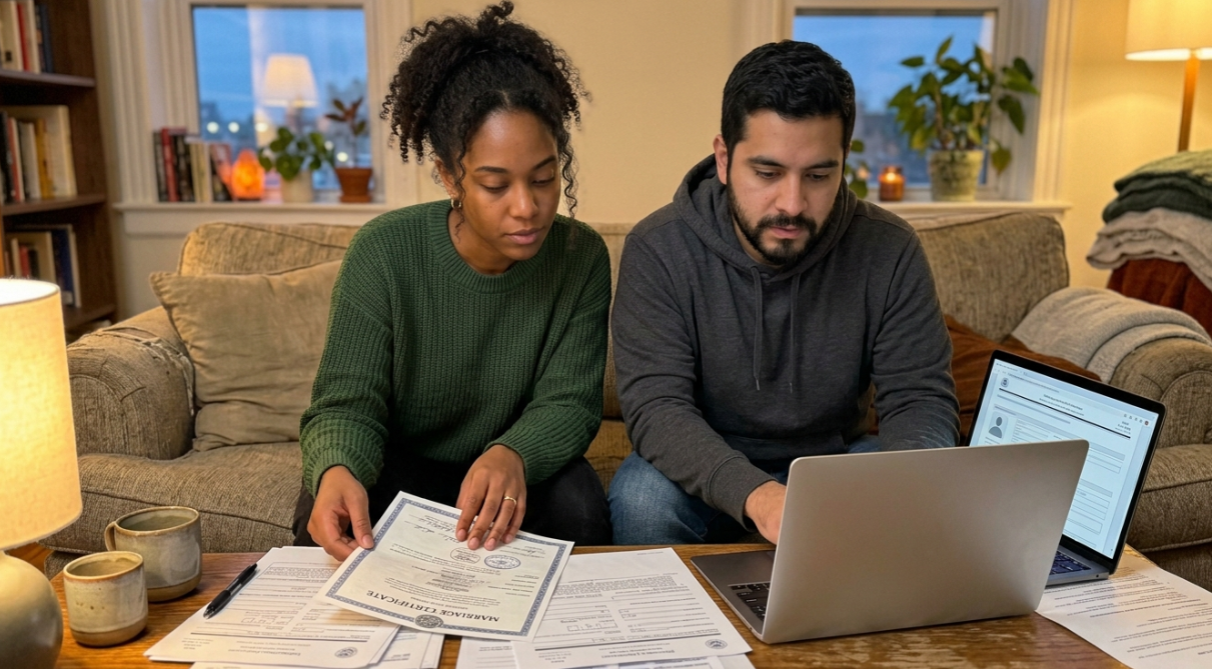
These are the pitfalls that forums, practitioners, and attorneys consistently flag. Avoiding them is essential when navigating K1 vs CR1 online marriage decisions.
Filing I-130 before meeting after the wedding. This is the most common error. Proxy marriage rules may require post-ceremony consummation for immigration recognition. Filing before that meeting creates unnecessary risk.
Assuming prior visits satisfy the consummation requirement. They do not. The meeting must happen after the ceremony date.
Assuming foreign recognition is automatic. Utah County explicitly disclaims responsibility for how foreign governments or immigration officials treat remote marriages. Your partner’s home country may not recognize the certificate at all.
Getting married online while a K-1 petition is pending. This can create a confusing gray area between visa categories. Get attorney advice before changing strategies mid-process.
Ignoring civil document requirements. Consular interviews require originals, translations, and sometimes legalized documents. Missing paperwork delays cases.
Using outdated fee or timeline information. Immigration costs and processing times change. Articles from 2022 may cite fees that are no longer current.
For a broader list of things that go wrong, see this guide to online marriage mistakes and legal pitfalls.
Which Path Should You Choose? Five Scenarios
Scenario A: You want to marry in the U.S. with family present
Likely path: K-1. This visa exists specifically for a fiancé to enter and marry the U.S. citizen sponsor within 90 days. If the wedding celebration in the U.S. matters to you, K-1 is designed for that.
Scenario B: You cannot marry locally but can marry online
Likely path: Online marriage, then CR-1/IR-1. Complete the remote wedding, meet in person afterward, gather evidence, and discuss filing the I-130 with an immigration attorney. This approach works well for couples blocked by local marriage restrictions, long distances, or bureaucratic barriers.
Scenario C: You married online but have not met since
Risk zone. Do not assume you are ready to file. The consummation requirement means your I-130 could face a request for evidence or, worse, a denial. Plan a post-wedding visit first. Save everything.
Scenario D: You filed K-1 but want an online wedding now
High risk. Getting married while K-1 is pending can disrupt your entire strategy. Talk to an immigration attorney before doing anything. This is not a DIY decision.
Scenario E: You are a same-sex couple
U.S. immigration recognizes same-sex spouses for the same benefits as opposite-sex spouses. But your partner’s home country may not recognize the marriage, which can complicate consular processing and local legal matters. An online U.S. marriage may solve the federal immigration side while leaving foreign recognition unresolved. For couples in this situation, Courtly’s LGBTQ+ marriage page covers how the remote ceremony works.
The Decision Tree
Start here and follow the path that matches your situation.
1. Are you already legally married?
Yes: K-1 is generally not the right path. Look at CR-1/IR-1.
No: Continue.
2. Do you want to marry in the U.S. after your partner arrives?
Yes: K-1 may fit.
No: Continue.
3. Can you legally marry online or in another jurisdiction now?
Yes: Online marriage may open the CR-1/IR-1 path.
No: K-1 may be more realistic.
4. If marrying online, can you meet in person after the ceremony before filing?
Yes: Gather evidence and consider CR-1/IR-1 with attorney guidance.
No: Do not assume CR-1 is ready. Get legal advice.
5. What matters more: first U.S. entry or arriving with permanent residence?
First entry: K-1 may be faster to that milestone.
Permanent residence and work stability: CR-1/IR-1 is often the stronger path.
For couples who have decided an online marriage is the right first step, see Courtly’s pricing for plans that include the officiant, ceremony, and certificate.
Frequently Asked Questions
Can I use an online marriage for a CR-1 visa?
Potentially, if the marriage is legally valid under the place-of-celebration rule and recognized for U.S. immigration purposes. If the marriage is treated as remote or proxy, you will likely need to prove a post-ceremony in-person meeting before filing. Consult an immigration attorney to evaluate your specific facts.
Can I get a K-1 visa after an online marriage?
Usually not. K-1 is for fiancé(e)s, not spouses. If you are legally married through an online ceremony, you should generally be looking at the CR-1/IR-1 spouse visa path instead. If there is any ambiguity about whether your online marriage is recognized, speak with an immigration attorney before filing anything.
Does meeting in person before the online wedding count as consummation?
No. USCIS historical guidance states that consummation must occur after the ceremony. Prior visits, no matter how extensive, do not satisfy this requirement for proxy or remote marriage recognition.
Do we need to be in the same country during the online ceremony?
Not for the ceremony itself. Utah County remote-appearance ceremonies require the officiant to be in Utah and all participants to see and hear each other in real time. The couple can be in different locations. However, immigration and foreign-country recognition should be checked separately.
Is CR-1 better than K-1?
It depends on what you prioritize. CR-1/IR-1 is often cleaner for permanent residence and work authorization because the spouse enters as a permanent resident. K-1 may be faster to initial U.S. entry and lets the couple marry in the United States. Neither is universally “better.”
Does a Utah online marriage guarantee USCIS approval?
No. Utah County says remote ceremonies hosted in Utah are legal under Utah law, but acceptance by immigration officials is beyond its control. USCIS evaluates the marriage’s validity and whether the relationship is bona fide through its own standards.
Does a same-sex online marriage work for U.S. immigration?
Same-sex spouses are eligible for the same U.S. immigration benefits as opposite-sex spouses. The marriage must still meet the same validity and recognition requirements. Foreign-country recognition can differ significantly, so check destination-country rules separately.
Should we get an immigration attorney before choosing K-1 vs CR-1?
Yes, especially if you are considering an online marriage. The K1 vs CR1 online marriage decision involves immigration law, marriage validity across jurisdictions, and evidence requirements that vary by case. An immigration attorney can review your specific facts and recommend the right path. Courtly offers a low-cost spouse visa consultation with partner attorneys for couples who need professional guidance.
Let us handle the paperwork.
Getting married is complicated. Courtly simplifies the process and provides everything necessary to get married online, including providing a licensed officiant who can perform a remote ceremony.
Get Married

Get married online.
Getting married is complicated. Courtly simplifies the process and provides everything necessary to get married online.

