

An online marriage checklist covers the legal terms, documents, and steps required to get married through a live video ceremony, most commonly through Utah’s remote appearance process. You’ll need a valid photo ID, a Utah marriage license (about $70, valid for 32 days), a certified officiant physically in Utah, and two witnesses who can see and hear everything over video. Your marriage certificate looks identical to one from an in-person wedding, and it’s recognized nationwide under the Full Faith and Credit Clause.
Getting married online sounds simple until you start Googling. Suddenly you’re sorting through terms like “remote appearance,” “affidavit of jurisdiction,” and “apostille,” wondering which ones actually apply to you. Most guides walk you through the process step by step, but they skip over the vocabulary that trips couples up.
This online marriage checklist takes a different approach. It defines every term you’ll encounter, organized by when you’ll encounter it, so you can follow along from your first planning session through the final name change. Think of it as a glossary that doubles as a to-do list.
If you want to understand how the full process works before diving into terms, Courtly’s guide on how online marriage works is a good starting point.
Explore Courtly’s online marriage plans
Quick Answer: What Do You Need for an Online Marriage?
If you're getting married through Utah's remote appearance process, you'll generally need:
Requirement | Required? | Notes |
|---|---|---|
Government-issued photo ID | ✔ Yes | Passport, driver's license, or national ID |
Utah marriage license | ✔ Yes | Approximately $71.75 and valid for 32 days |
Licensed officiant located in Utah | ✔ Yes | Officiant must be physically in Utah |
Two witnesses | ✔ Yes | Can attend remotely over live video |
Live video ceremony | ✔ Yes | Everyone must see and hear each other |
Stable internet connection | ✔ Yes | Test before the ceremony |
Marriage certificate | Issued afterward | Same legal certificate as an in-person wedding |
Apostille (international use) | Sometimes | Required by many foreign governments |
Takeaway: Most couples can legally complete a Utah online marriage in just a few days if they have valid identification, obtain a Utah marriage license, schedule a certified officiant, and complete the ceremony with two witnesses over live video.
Who This Online Marriage Checklist Is For
This guide is designed for:
International couples
Military families stationed overseas
Long-distance couples
Same-sex couples
Couples planning immigration
Couples unable to travel to Utah
Couples wanting a simple legal ceremony before a larger celebration
If you only need a traditional courthouse wedding, many of these remote appearance terms won't apply.
Online Marriage Timeline
Stage | Typical Time |
|---|---|
Prepare documents | 15–30 minutes |
Apply for Utah marriage license | 15–20 minutes |
License approval | Usually within 1–2 business days |
Schedule ceremony | Same day to several days |
Online wedding | About 15–20 minutes |
Digital certificate | Usually within days |
Physical certificate | Typically arrives by mail within weeks |
Apostille (if needed) | Additional processing time |
Legal Foundation Terms
These are the concepts that define what an online marriage actually is and what makes it legally binding. Getting clear on these first prevents confusion down the road.
Online Marriage / Virtual Marriage / Zoom Wedding
An online marriage is a legal wedding ceremony conducted through live video technology. Both spouses attend in real time while a licensed officiant performs the marriage remotely. The terms “virtual marriage” and “Zoom wedding” describe the same thing, though “Zoom wedding” is more colloquial.
The key word is “legal.” An online marriage performed in a jurisdiction that permits it produces the same marriage certificate as a courthouse wedding. There’s nothing on the document indicating it happened over video.
Since the Utah County Clerk’s Office began providing online marriage licenses and ceremonies in January 2020, thousands of couples from around the world have used their services. The internet wedding market is projected to grow at roughly 6.6% annually from 2025 onward.
For a deeper look at whether online weddings hold up legally, read about online marriage legality.
Remote Appearance Marriage
This is Utah’s official legal term for marriages where participants appear via video conference rather than standing in the same room. During a remote appearance ceremony, all participants connect through video conferencing software that allows everyone to see and hear one another in real time.
Why it matters for your checklist: when you see “remote appearance” on Utah County forms or court documents, it simply means the online ceremony format. You’re still personally present, just digitally.
Proxy Marriage (and Why It’s Different)
A proxy marriage is a ceremony where one or both partners are not physically present at all. A stand-in, or “proxy,” represents the absent party. This is fundamentally different from an online marriage, where both partners appear on screen and personally say their vows.
The distinction matters enormously for immigration and international recognition. Only a handful of U.S. states permit proxy marriages (Texas, Colorado, Kansas, and Montana, typically under strict conditions like active military duty). Practitioners on Reddit and immigration forums report that confusing these two terms is one of the most common mistakes couples make when planning. USCIS treats them very differently.
For a thorough breakdown, see the guide on remote marriage vs. proxy marriage.
Marriage License
A marriage license is the legal document that authorizes you to get married. You must obtain it before the ceremony. The couple, the officiant, and the witnesses all need to sign it during or after the ceremony. Once signed and filed, the marriage certificate is issued.
For Utah online marriages, you can apply for the license through Utah County’s online system. The license costs approximately $71.75 for most applicants and is valid for 32 days from issuance. There is no residency or citizenship requirement, meaning anyone in the world can apply.
Marriage Certificate
The marriage certificate is the official record proving your marriage took place. A certificate obtained through an online ceremony is identical to one from an in-person wedding. Nothing on the document indicates the ceremony happened over video. You’ll need this certificate for everything from name changes to immigration petitions to tax filings.
Officiant / Solemnizer
The officiant is the person who performs the marriage ceremony. The term covers Justices of the Peace, celebrants, marriage commissioners, ministers, notaries, and others empowered by law to conduct legally binding ceremonies.
For Utah online marriages, the officiant must be physically located in Utah during the ceremony. The couple and their witnesses can be anywhere in the world. This is a critical detail on your online marriage checklist: verify that your officiant is Utah-based and properly credentialed.
Witnesses
Utah requires two witnesses for a valid marriage ceremony. The witnesses must be able to clearly see and hear each party willingly enter into the marriage commitment over video. They don’t need to be in the same location as each other or the couple.
Finding two people who are available, willing, and able to join a video call during business hours can be harder than it sounds. Many couples on Reddit mention this as an unexpected logistical hurdle, especially for international or time-zone-spread ceremonies.
Utah Code 30-1-8
This is the specific statute governing marriage license applications in Utah. Under Utah Code 30-1-8, applicants must provide their names, addresses, social security numbers, dates of birth, and the names and places of birth of their parents. Applicants must also present a government-issued ID card containing their photo, legal name, and date of birth.
You don’t need to memorize the statute, but knowing it exists helps when you encounter references to it on official forms.
Can You Get Married Online? Quick Eligibility Checklist
You can usually use Utah's online marriage process if:
✔ You're both at least the legal marriage age.
✔ You each have valid government-issued identification.
✔ You're available to attend a live video ceremony.
✔ You can arrange two witnesses.
✔ Your officiant is physically located in Utah.
✔ Your country recognizes foreign marriages (if applicable).
If any of these are missing, resolve them before applying for a marriage license.
Pre-Ceremony Checklist Terms

Once you understand the legal framework, these are the practical terms and items you’ll work through before your ceremony date.
Government-Issued Photo ID
Both partners need a valid government-issued photo ID to apply for the marriage license. Acceptable forms include passports, driver’s licenses, and national ID cards. You’ll also need a smartphone to scan each ID and your face as part of the online application.
This is the single most important document on your online marriage checklist. Without a valid, unexpired photo ID, the application cannot proceed.
Affidavit of Jurisdiction
Both parties must sign an affidavit stating they agree to personal jurisdiction in Utah if they later divorce or annul the marriage. In plain terms, this means that if the couple ends the marriage, they agree to follow Utah’s divorce laws.
This catches some couples off guard. You’re not just choosing Utah for the wedding; you’re accepting Utah’s legal framework for any future dissolution. It’s a standard requirement, and it doesn’t prevent you from living wherever you want.
No Residency Requirement
Utah does not require that either spouse live in the state. You don’t even need to be a U.S. citizen. This is what makes Utah the go-to jurisdiction for online marriages. Couples from over 150 countries have used this process.
To understand how two foreigners can both be outside the U.S. and still marry through Utah, check out the guide on whether two foreigners can marry online.
Marriage Education Discount (MED)
Engaged Utah couples can get $20 off their marriage license fee by completing approved marriage education or counseling before applying. The discount is applied during the online application.
License Fee
The standard Utah County marriage license fee is approximately $71.75. This is a government fee paid directly to the county, separate from any ceremony service fees.
How Much Does an Online Marriage Usually Cost?
Expense | Typical Cost |
|---|---|
Utah marriage license | ~$71.75 |
Ceremony service | $199–$599+ |
Apostille (optional) | Additional fee |
Embassy legalization (optional) | Varies |
Name change kit (optional) | Varies |
Translation services (optional) | Varies |
License Validity Period
Your Utah marriage license is valid for 32 days after purchase. If you don’t complete the ceremony within that window, you’ll need to apply and pay again. Build this timeline into your planning, especially if you need to coordinate schedules across time zones.
For a detailed look at timelines, the article on how fast you can get married online breaks down typical wait times at each stage.
Video Conferencing Platform
The ceremony takes place over a video conferencing platform, most commonly Zoom. All participants (couple, officiant, witnesses) must be on video with working audio. The platform itself isn’t legally specified, but it must allow everyone to see and hear each other clearly.
Tech Rehearsal
A tech rehearsal is a brief test run of your video setup before the actual ceremony. No ranking page for “online marriage checklist” even mentions this, but it belongs on every couple’s list. Test your internet connection, camera angle, lighting, and microphone. If you’re in a location with unreliable Wi-Fi, have a mobile hotspot as backup.
Practitioners on Reddit frequently share that tech issues during the ceremony (frozen screens, audio drops, poor lighting) are the most common source of stress. A five-minute test the day before eliminates most of these problems.
During-Ceremony Terms
The ceremony itself is shorter than most couples expect. Here’s what happens and what you’ll hear.
Solemnization
Solemnization is the formal, legal act of performing the marriage. It’s when the officiant conducts the ceremony, the vows are exchanged, and the marriage becomes legally binding. In Utah, solemnization must happen while all parties are connected via video.
Legal Vows / Exchange of Consent
The exchange of consent is the moment both partners verbally agree to marry each other. This is the legal core of the ceremony. While couples can write personal vows, the officiant will also guide them through the legally required statements of consent.
Courtly offers a free vow builder tool if you want to personalize what you say beyond the legal minimum.
Ceremony Recording
A recording of the ceremony is a video capture of the entire proceeding. It is not legally required for the marriage to be valid. However, it serves multiple practical purposes: sharing with family members who couldn’t attend, preserving the memory, and (critically for some couples) providing evidence for immigration proceedings.
Users on Reddit regularly ask whether they need to record the ceremony for legal proof. The answer is no, but it’s strongly recommended for immigration cases and simply as a keepsake.
Live Translation
A live translation add-on provides real-time interpretation during the ceremony for non-English-speaking partners. This ensures both parties fully understand the vows and consent. Courtly offers live translation in Spanish, Italian, French, Chinese, Portuguese, Filipino, and additional languages.
Common Mistakes That Delay an Online Marriage
Avoid these common issues:
Applying too early and letting the 32-day license expire
Forgetting to schedule two witnesses
Using expired identification
Poor internet connection during the ceremony
Assuming every country recognizes online marriages
Forgetting to obtain an apostille before submitting documents overseas
Filing immigration paperwork before meeting in person when required
Immigration Documents Commonly Requested
Document | Common Purpose |
|---|---|
Marriage certificate | Proves legal marriage |
Passport copies | Identity verification |
Photos together | Relationship evidence |
Travel records | Proof of meeting |
Messages and call logs | Relationship history |
Joint financial documents | Shared life evidence |
I-130 petition | Starts spousal immigration process |
Post-Ceremony and International Terms
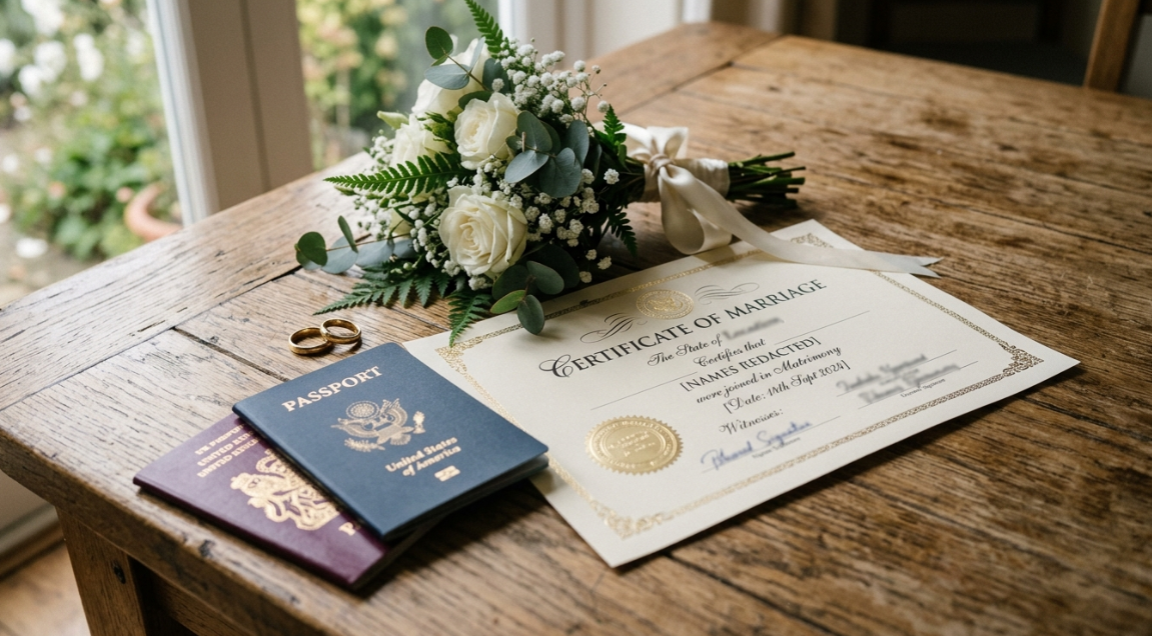
After the ceremony, you’ll deal with certificates, international recognition, and (possibly) document legalization. This section of your online marriage checklist is especially important for international couples.
Digital Certificate vs. Physical Certificate
After the ceremony, you typically receive a digital copy of your marriage certificate first, followed by a physical copy mailed to your address. The digital version works for many immediate needs (bank accounts, insurance), while the physical copy is necessary for government processes like passport applications and apostille requests.
Apostille
An apostille is an official certification that validates a public document for use in a foreign country that belongs to the Hague Apostille Convention. If you married online through Utah and need your marriage certificate recognized abroad, you’ll likely need an apostille stamp attached to it.
The apostille makes the document valid in every member country of the 1961 Hague Convention, which includes over 120 nations. For detailed guidance, the resource on everything about apostilles covers the process thoroughly.
Embassy Authentication / Legalization
If your destination country is not part of the Hague Convention, you’ll need embassy legalization instead of an apostille. This is a different, usually longer process where the embassy of the destination country certifies the document.
Understanding the difference between the two is critical. The guide on apostille vs. authentication explains when you need which.
Courtly offers both apostille and embassy authentication through its document legalization service.
Full Faith and Credit Clause
This U.S. constitutional provision (Article IV, Section 1) requires every state to recognize the legal proceedings of other states. An online marriage conducted in Utah, which permits it, is valid nationwide under this clause. You don’t need to “re-register” your marriage in your home state.
International Marriage Recognition
Most countries will recognize a marriage that was legally performed in the jurisdiction where it took place. For online marriages through Utah, this means your marriage certificate (especially with an apostille) will be accepted in the majority of countries.
However, there are known exceptions. Countries including Germany, France, Australia, Norway, Sweden, Finland, Poland, Hungary, and Turkmenistan have been reported as not recognizing online or remote appearance marriages. Spain, Italy, and Portugal are also flagged in various community discussions.
In 2023, the Israel Supreme Court ruled that thousands of Israeli marriages performed virtually in Utah would be recognized by the state. At least 200 same-sex couples from China have used Utah’s online marriage system to legally marry, since same-sex marriage is not available domestically in China.
For same-sex couples specifically, Courtly’s LGBT page outlines recognition guidance by country.
Immigration and Life-Admin Terms
For many couples, the entire reason for getting married online is immigration. This section of the online marriage checklist addresses the terms that matter most for visa petitions and post-wedding logistics.
Consummation (Immigration Definition)
This is the single most confusing term for couples pursuing immigration benefits after an online marriage. In everyday language, consummation refers to physical intimacy. For U.S. immigration purposes, it typically means the couple has met in person following the virtual ceremony.
Immigration attorneys on legal forums and Q&A platforms consistently clarify the distinction: for proxy marriages, USCIS requires consummation through sexual relations. For online/virtual marriages where both partners personally participated via video, the standard is generally meeting in person, a softer threshold that practitioners say is easier to satisfy.
One practitioner on Reddit noted that USCIS accepts online marriages as valid if the marriage is recognized where it was celebrated and the couple has met in person and consummated the marriage before filing the petition. Don’t skip this step if immigration is your goal.
For detailed guidance, read about online marriage recognition by immigration authorities.
CR-1 / IR-1 Spouse Visa
These are the two main visa categories for bringing a foreign spouse to the United States. CR-1 (Conditional Resident) applies if you’ve been married less than two years at the time of visa issuance. IR-1 (Immediate Relative) applies if you’ve been married two years or longer.
Both require a valid marriage. An online marriage through Utah satisfies this requirement, provided you’ve met and the marriage is consummated. Courtly offers a U.S. spouse visa consultation through partner attorneys for couples navigating this process.
I-130 Petition
Form I-130 (Petition for Alien Relative) is the first step in the spousal immigration process. The U.S. citizen or lawful permanent resident spouse files this form with USCIS. You’ll need your marriage certificate, proof of the petitioner’s citizenship, and evidence that the marriage is genuine.
Name Change After Marriage
Most people complete the name change process in 2 to 4 months, depending on processing times and how quickly they gather documents. The typical order is: obtain your marriage certificate, update your Social Security card, then update your passport, driver’s license, and financial accounts.
A critical detail that catches people: state DMVs use a digital system called SSOLV (Social Security Online Verification). If SSOLV returns a “no match” because you didn’t give the federal database 48 hours to refresh after updating Social Security, the DMV will turn you away. Wait at least two business days between updating Social Security and visiting the DMV.
Federal REAL ID enforcement took effect on May 7, 2025, which means you’ll need REAL ID-compliant documentation for domestic flights and federal building access. Factor this into your name change timeline.
Courtly’s name change kit provides prefilled forms, checklists, and prepaid envelopes to simplify updates across SSA, DMV, passport offices, and banks.
SSOLV (Social Security Online Verification)
SSOLV is the backend system that state DMVs use to verify your identity against Social Security Administration records. After you update your name with SSA, the change takes roughly 24 to 48 hours to propagate through SSOLV. Until it does, the DMV’s system won’t match your new name, and they’ll ask you to come back.
This is a small but frustrating detail that belongs on every post-wedding checklist.
Wedding Format Terms
These terms describe the types of wedding formats couples choose, especially when they decide to get married online. Knowing the differences helps you communicate your plans to family and vendors.
Elopement
The word “elopement” has evolved significantly. It no longer only means secretly running off to get married without parental permission. Today, it describes a beautifully scaled-down wedding with just the couple, maybe their witnesses, and an officiant. Many online marriages are essentially modern elopements.
Minimony
A minimony (short for “mini ceremony”) is a small event for the couple and their closest friends and family, typically not more than ten people. Couples who have a minimony often plan a larger anniversary reception or “sequel wedding” later. An online marriage can serve as the legal minimony, with a bigger celebration to follow.
Micro Wedding
A micro wedding falls between an elopement and a traditional wedding, usually involving up to 50 guests. Micro weddings tend to focus on personalized details over scale. Some couples use an online marriage for the legal component, then host a micro wedding celebration in person.
Legislative Developments Worth Watching
Utah’s online marriage framework continues to evolve. Utah Senator Todd Weiler introduced SB81, which would codify additional verification measures for remote appearance marriages. As Weiler put it: “I’m fine with Utah being the Las Vegas of virtual weddings; I don’t want Utah to be the Las Vegas of child or plural marriages virtually.”
These legislative developments signal that online marriage is becoming more regulated, not less, which generally strengthens its credibility and recognition over time.
Your Quick-Reference Online Marriage Checklist
Here’s the condensed version of everything above, organized as a scannable checklist:
Before the ceremony:
Gather valid government-issued photo IDs for both partners
Apply for a Utah marriage license online (about $71.75)
Confirm two witnesses who can join via video
Verify your officiant is licensed and physically in Utah
Sign the affidavit of jurisdiction
Complete marriage education for the $20 discount (optional)
Do a tech rehearsal (internet, camera, audio, lighting)
Schedule the ceremony within 32 days of license issuance
During the ceremony:
All participants join via video conferencing
Officiant performs solemnization
Both partners exchange consent / legal vows
Witnesses confirm they can see and hear everything
Ceremony is recorded (recommended, not required)
After the ceremony:
Receive digital marriage certificate
Receive physical marriage certificate by mail
Obtain an apostille or embassy authentication if needed internationally
If immigration is the goal, meet in person and document consummation
File I-130 petition (if applicable)
Update Social Security, then wait 48 hours
Update driver’s license, passport, bank accounts, and other records
Get started with Courtly’s online marriage service
Frequently Asked Questions
Is an online marriage legally valid in all 50 U.S. states?
Yes. A marriage legally performed in Utah through its remote appearance process is recognized in every U.S. state under the Full Faith and Credit Clause. Your marriage certificate is identical to one from an in-person ceremony.
What documents do I need for an online marriage?
At minimum, each partner needs a valid government-issued photo ID (passport, driver’s license, or national ID card), a valid email address, and a smartphone for identity scanning. You’ll also provide personal details required under Utah Code 30-1-8 and sign an affidavit of jurisdiction. For a complete list, see the documents needed checklist.
How much does an online marriage cost?
The Utah County marriage license fee is approximately $71.75. On top of that, you’ll pay for the ceremony service itself. Courtly offers plans starting at $199 for a Core package and going up to $599 for Fast-Track service with rush processing and provided witnesses. Add-ons like apostille, translation, and name-change kits are priced separately. See Courtly’s pricing page for full details.
Will my online marriage be recognized in my home country?
Most countries recognize a marriage that was valid where it was performed. However, several countries (including Germany, France, Australia, Norway, Sweden, and Finland) are known not to recognize online or remote-appearance marriages. If your country requires it, you may need an apostille or embassy authentication on your marriage certificate.
What’s the difference between an online marriage and a proxy marriage?
In an online marriage, both partners are personally present on video and verbally exchange consent. In a proxy marriage, a stand-in represents one or both absent partners. This distinction matters significantly for immigration: USCIS holds proxy marriages to a stricter consummation standard than online marriages where both spouses participated.
Can I use an online marriage for U.S. immigration?
Yes, USCIS recognizes online marriages performed in Utah as valid for immigration purposes, provided the marriage is legal where celebrated and the couple has met in person after the ceremony. The I-130 petition requires a valid marriage certificate and evidence the relationship is genuine.
How long does the entire online marriage process take?
From application to ceremony, many couples complete the process within days. The marriage license is typically issued quickly through Utah County’s online system, and the ceremony can be scheduled as soon as the license is approved. Rush processing can compress this timeline further. Post-ceremony, certificate delivery and any legalization steps add additional time.
Do I need to record my online wedding ceremony?
Recording is not legally required for the marriage to be valid. However, it’s strongly recommended. The recording serves as a keepsake, can be shared with family who couldn’t attend, and provides valuable evidence for immigration proceedings if needed.
Let us handle the paperwork.
Getting married is complicated. Courtly simplifies the process and provides everything necessary to get married online, including providing a licensed officiant who can perform a remote ceremony.
Get Married

Get married online.
Getting married is complicated. Courtly simplifies the process and provides everything necessary to get married online.

