

If you’re considering an online marriage (typically through Utah) to start the immigration process for your spouse, you need to understand specific legal terms and requirements that will determine whether your case succeeds or fails. This glossary covers every immigration term relevant to online marriages, from the consummation requirement and bona fide marriage evidence to the CR-1 vs. K-1 decision, processing times, and document legalization. Understanding these terms before you file can save you months of delays and thousands of dollars.
Couples who marry online and then file for a U.S. spouse visa face a unique problem: they’re navigating two complicated systems at once. One is the legal framework around online (virtual) marriage. The other is the U.S. immigration system, with its alphabet soup of forms, visa categories, and evidence requirements.
Most immigration guides assume you got married the traditional way. Most online marriage guides don’t address immigration at all. That leaves couples piecing together answers from government websites, Reddit threads, immigration forums, and attorney blogs, often getting conflicting information along the way.
This online marriage immigration FAQ fills that gap. It defines every term you’ll encounter, explains why each one matters for your specific situation, and flags the pitfalls that trip up real couples. This is educational content, not legal advice. For case-specific guidance, consult an immigration attorney.
See how online marriage works before reading through the immigration terms below.
Quick Answer: Can an Online Marriage Be Used for U.S. Immigration?
A legally valid online marriage can be used for U.S. immigration, but couples who marry remotely must satisfy additional requirements. For a Utah remote marriage, the ceremony must comply with Utah law, and for immigration purposes, a couple who was not physically together during the ceremony generally must consummate the marriage afterward. The couple must also prove the marriage is bona fide and submit the required marriage and immigration documents.
That distinction is extremely important: a marriage can be valid under Utah law while still creating recognition issues in the spouse's home country. Utah County itself warns that a remote marriage may be invalid in the country where the parties reside.
The 5 Things Online-Marriage Couples Need to Know
The marriage must be legally valid where it was performed.
The couple may need to consummate the marriage after the ceremony for U.S. immigration purposes.
The couple must establish that the marriage is bona fide, meaning it was entered into in good faith rather than primarily for immigration purposes.
Most couples living outside the United States will use the I-130 → NVC → consular-processing pathway.
Foreign-country recognition is a separate question from U.S. immigration recognition.
Question | Short Answer |
|---|---|
Does USCIS recognize online marriages? | A legally valid marriage may qualify, but additional rules can apply to marriages where the spouses were not physically together at the ceremony. |
Is Utah remote marriage legal? | Utah permits remote-appearance ceremonies when its statutory requirements are met. |
Does the couple need to meet after the ceremony? | For marriages falling under the federal proxy-marriage rule, post-ceremony consummation is required for immigration recognition. |
Can you use a K-1 after marrying online? | Generally no. A K-1 is for qualifying fiancé(e)s who are not yet married. |
What form starts the spouse visa process? | Form I-130. |
Is an apostille required for USCIS? | Not ordinarily just to establish the marriage for the I-130; foreign-country use may require an apostille or legalization. |
Does the spouse's country have to recognize the marriage? | Not necessarily for the U.S. immigration determination, but foreign-country recognition can matter for local legal purposes. |
What is the biggest online-marriage immigration issue? | The post-ceremony physical meeting/consummation requirement and documenting it properly. |
Marriage Types and Legal Validity
Online Marriage / Virtual Marriage
A legal marriage ceremony conducted by video conference, where both spouses appear live before an officiant but are not physically in the same location. Utah is currently the only U.S. state that allows fully remote marriage ceremonies for couples anywhere in the world, with no residency requirement.
Why it matters for immigration: USCIS does not have a blanket rule that every online marriage is automatically recognized for immigration purposes. The marriage must first be legally valid under the law governing the place of celebration, and additional federal immigration rules can apply when the spouses were not physically together during the ceremony.
For Utah remote marriages, Utah law provides for remote-appearance ceremonies when specific requirements are satisfied, including an officiant physically present in Utah and the required participation of the couple and witnesses.
Immigration attorney Gary Chodorow, one of the most cited practitioners on this topic, has confirmed that a valid Utah virtual wedding, once consummated, is recognized by U.S. immigration authorities. Practitioners on Reddit’s r/USCIS and r/immigration communities consistently report successful I-130 approvals using Utah online marriages, though they emphasize that consummation evidence and post-ceremony meeting documentation are the critical checkpoints.
Utah Remote Marriage Requirements
Utah County allows couples to complete the marriage-license process digitally and conduct a remote-appearance ceremony. For the ceremony to comply with Utah requirements, the officiant must be physically present in Utah, while the couple and required witnesses participate through real-time video. The participants must be able to see and hear one another during the ceremony.
Utah County also requires two witnesses who are at least 18 years old. For remote ceremonies, the officiant's physical location establishes the ceremony location for purposes of the Utah marriage license.
Utah Remote Marriage Checklist
Requirement | What to verify |
|---|---|
Marriage license | Valid Utah County marriage license |
Officiant | Authorized to solemnize marriages |
Officiant location | Physically present in Utah |
Couple | Participates through live video |
Witnesses | Two witnesses age 18+ |
Audio/video | Everyone can see and hear one another |
Ceremony | Legally solemnized according to Utah requirements |
Certificate | Official marriage certificate obtained after ceremony |
This gives you an excellent entity cluster:
Utah → Utah County → remote appearance → marriage license → officiant → witnesses → marriage certificate → USCIS
Proxy Marriage
A marriage where one or both parties are not physically present at the ceremony, with a stand-in (proxy) acting on their behalf. This is fundamentally different from an online/virtual marriage, where both spouses are present via live video.
Why it matters for immigration: USCIS only recognizes proxy marriages for immigration purposes if the couple consummates the marriage after the ceremony. The USCIS Policy Manual (Vol. 6, Part B, Ch. 6) codifies this rule. Here’s the complication: USCIS classifies Utah virtual marriages similarly to proxy marriages for consummation purposes, which means the consummation requirement applies to online marriages too.
As one immigration firm put it, Utah does not perform proxy marriages. Instead, it has “cut out the middleman” and allows spouses to marry virtually, with both parties signing their marriage certificate electronically. The certificate is issued by the State of Utah, making it accepted throughout the United States and for U.S. immigration purposes. For a deeper comparison, read about proxy vs. virtual marriage differences.
Place-of-Celebration Rule
The legal principle that USCIS uses to determine whether a marriage is valid: if the marriage is legally recognized in the jurisdiction where it took place, USCIS accepts it. Since Utah legally authorizes online marriage ceremonies, a Utah virtual marriage satisfies this rule.
Why it matters for immigration: This is the foundational reason online marriages work for immigration. You don’t need the marriage to be recognized in the foreign spouse’s home country for USCIS to accept it. You need it to be valid where it was performed, which is Utah.
That said, the foreign spouse’s country may need to recognize the marriage for other purposes (property rights, name changes, local legal status). That’s a separate issue from U.S. immigration recognition.
Marriage License
A government-issued document that authorizes a couple to marry. In Utah, the marriage license application can be completed entirely online through Utah County. No residency is required, and the process can be handled remotely.
Why it matters for immigration: The marriage license precedes the ceremony. You cannot get married without one, and your immigration case depends on having a legally performed marriage. The license itself is not what you submit to USCIS; the marriage certificate (issued after the ceremony) is your proof of marriage.
Marriage Certificate
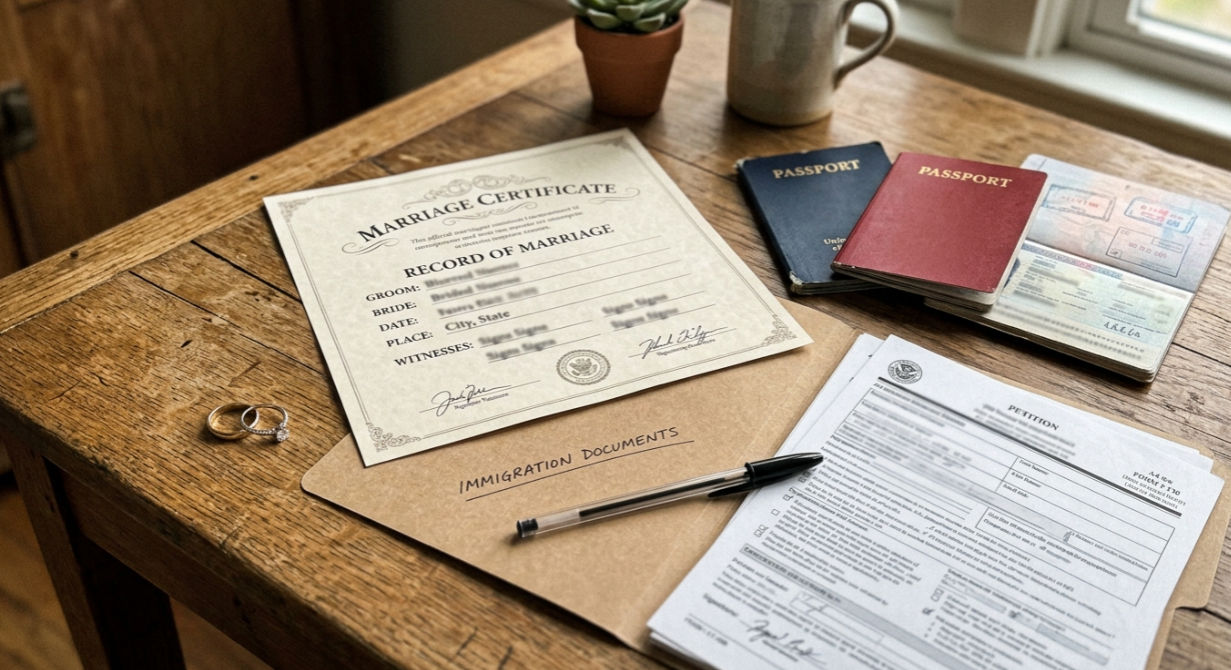
The official government document proving that a marriage took place. Issued after the ceremony by the jurisdiction where the marriage was performed. For online marriages through Utah, this is issued by Utah County.
Why it matters for immigration: The marriage certificate is the single most important document in your immigration case. You’ll submit it with your I-130 petition, and potentially need it apostilled or legalized for use in the foreign spouse’s country. A certified copy (not a photocopy) is required for immigration filings.
Consummation Requirement
The USCIS requirement that couples who married via proxy or virtual ceremony must physically meet and consummate the marriage after the ceremony for the marriage to qualify for immigration benefits.
This is the most important term in this entire online marriage immigration FAQ. It trips up more couples than any other requirement.
The rule is strict about timing: consummation before the marriage ceremony does not count. The couple must have been physically together after the online marriage. Many couples assume that prior visits satisfy the requirement. They do not.
Evidence USCIS accepts as proof of consummation includes:
Birth certificate of a child born to the couple after the ceremony
Passport stamps or airline tickets showing both spouses were in the same location after the marriage date
Joint lease, hotel receipts, or other evidence of shared residence after the ceremony
Signed witness affidavits from people who saw the couple together after the wedding
For the full breakdown of what counts and what doesn’t, the consummation guide goes into much more detail.
Bona Fide Marriage
A marriage entered into genuinely, with the intention of building a life together, not constructed solely to obtain immigration benefits. When you file Form I-130, a marriage certificate alone is not enough. USCIS requires evidence that the relationship is real.
Why it matters for immigration: Underestimating the bona fide marriage evidence requirement is one of the most common reasons I-130 petitions are delayed or denied. This is especially true under the current USCIS posture. The administration reintroduced stricter requirements for marriage-based green cards in 2025, with more rigorous in-person interviews, detailed questioning, and enhanced vetting measures.
Evidence categories include: joint tax returns, shared leases or mortgages, joint bank accounts, insurance beneficiary designations, photos together, travel records, communication logs (call records, chat histories), and affidavits from friends and family who can attest to the relationship.
For online marriage couples who may have spent significant time apart, communication evidence becomes particularly valuable. Save screenshots of video calls, messaging history, and records of visits. The immigration evidence checklist walks through each category in detail.
Visa Types and Immigration Forms
CR-1 Visa (Conditional Resident Spouse Visa)
A U.S. immigrant visa issued to the spouse of a U.S. citizen when the couple has been married for less than two years at the time of admission. The “C” stands for conditional, meaning the green card is valid for two years and comes with a requirement to file Form I-751 to remove conditions.
Why it matters for online marriage: The CR-1 is the primary visa pathway for couples who marry online and then petition for the foreign spouse. Because you’re already legally married, you skip the fiancé visa (K-1) entirely and go straight to the spouse visa. CR-1 holders receive a green card upon arrival in the U.S. and can work immediately.
IR-1 Visa (Immediate Relative Spouse Visa)
Same as the CR-1, but issued when the couple has been married for two or more years at the time of admission. The beneficiary enters as a full permanent resident with no conditions to remove, meaning no I-751 filing is required.
Why it matters for online marriage: Given that I-130 processing currently takes 10 to 15 months at most service centers, with consular processing cases taking around 17 to 18 months total, some couples who marry early in their relationship may actually cross the two-year mark by the time the visa is issued. That’s a meaningful advantage: you’d receive an IR-1 instead of a CR-1, avoiding the conditional residence process altogether.
K-1 Fiancé Visa
A nonimmigrant visa for engaged couples where one partner is a U.S. citizen. The foreign fiancé enters the U.S. and the couple must marry within 90 days. After marrying, the foreign spouse files for adjustment of status to get a green card.
Why it matters for online marriage: If you’ve already married online, the K-1 is no longer an option. You’re married, not engaged. This is actually good news for most couples. Here’s why:
Factor | K-1 Fiancé Visa | CR-1/IR-1 Spouse Visa |
|---|---|---|
Prerequisite | Engaged, must have met in person in last 2 years | Already legally married |
Green card on arrival | No, must file AOS after entry | Yes |
Work authorization | Must apply separately (EAD) | Immediate |
Denial rate | ~25% | ~8-9% |
Total government fees | Higher overall (petition + AOS) | Lower overall |
According to recent government data, K-1 visas have about a 25% denial rate, while CR-1s average around 8-9%. The CR-1 path also grants work authorization immediately upon arrival, while K-1 holders must wait months for a separate work permit. For a full comparison, see the K-1 vs. CR-1 guide.
Explore the spouse visa consultation if you want an attorney to review your specific situation.
Form I-130 (Petition for Alien Relative)
The first immigration form a U.S. citizen or permanent resident files to sponsor their spouse for a green card. It establishes the qualifying family relationship. Filed with USCIS.
Why it matters for online marriage: This is step one of the immigration process after your online wedding. The U.S. citizen spouse (the “petitioner”) files the I-130 for their foreign spouse (the “beneficiary”). You’ll need your marriage certificate, evidence of the petitioner’s U.S. citizenship, and evidence that any prior marriages were legally terminated.
Current processing reality: the 2026 I-130 processing time for spouse petitions filed by U.S. citizens runs between 10 and 15 months at most service centers. However, USCIS processing activity has been stalled since mid-March 2026, and the pending backlog sits at approximately 2.36 million petitions as of February 2026. Plan accordingly.
Form I-129F (Petition for Alien Fiancé)
The petition form used for K-1 fiancé visas, filed by the U.S. citizen for their foreign fiancé. Irrelevant if you’ve already married online, but worth knowing because many couples initially research the K-1 before discovering the CR-1 path.
Affidavit of Support (Form I-864)
A legally binding contract signed by the U.S. citizen petitioner, promising to financially support their spouse at 125% of the federal poverty level. This is not optional. It’s a requirement for every spouse visa petition, and it remains enforceable even if the couple later divorces.
Why it matters for online marriage: The financial threshold catches some petitioners off guard. For 2026, the 125% poverty guideline for a household of two is approximately $25,550/year (varies slightly based on state and household size). If the petitioner’s income falls short, a joint sponsor can co-sign.
Form I-751 (Petition to Remove Conditions on Residence)
Filed by CR-1 visa holders (conditional residents) within 90 days before their two-year green card expires. This petition asks USCIS to confirm the marriage is legitimate and convert the conditional green card to a permanent one.
Why it matters for online marriage: This is not a routine renewal. It’s a second round of scrutiny on your marriage. You’ll need to submit updated bona fide marriage evidence: joint bank statements, tax returns filed jointly, lease or mortgage documents, photos, and any other proof of a shared life. Couples who married online should continue building their evidence file from day one.
Immigration Process Steps
Adjustment of Status (AOS / Form I-485)
The process of applying for a green card while the beneficiary is already physically present in the U.S. on a valid visa. Filed concurrently with or after the I-130 approval.
Why it matters for online marriage: If your spouse is already in the U.S. on a valid nonimmigrant visa (student visa, work visa, tourist visa with lawful status), you may be able to adjust status without leaving the country. Many couples who concurrently file the I-130 and I-485 see their cases completed in under 12 months. However, eligibility for AOS depends on the spouse’s current immigration status and how they entered the U.S.
Consular Processing

The pathway used when the foreign spouse lives outside the United States. After the I-130 is approved, the case transfers to the National Visa Center and then to a U.S. embassy or consulate in the spouse’s country for an interview.
Why it matters for online marriage: Most online marriage immigration cases go through consular processing because the foreign spouse is overseas. This is the longer path (currently 17 to 18 months total for immediate relatives), but it results in a green card upon arrival. The consular interview is where the officer evaluates your marriage’s legitimacy, reviews your consummation evidence, and assesses the bona fide nature of the relationship. Under 2025 policy changes, these interviews have become significantly more rigorous.
National Visa Center (NVC)
The processing center that handles your case between I-130 approval and the consular interview. The NVC collects documents (Form DS-260, civil documents, Affidavit of Support) and schedules the embassy interview.
Why it matters for online marriage: NVC processing adds time to the overall timeline. Respond to document requests promptly and submit complete packets. Incomplete submissions create delays that compound over weeks or months.
Request for Evidence (RFE)
A notice from USCIS asking for additional documentation to support your petition. It’s not a denial, but it means USCIS needs more information before making a decision.
Why it matters for online marriage: RFEs are more common for online marriage cases because adjudicators may be less familiar with Utah virtual marriages. Common RFE triggers include insufficient consummation evidence, weak bona fide marriage documentation, and questions about the legitimacy of the online ceremony. Having thorough documentation from the start is the best way to avoid an RFE. The immigration red flags guide covers the most common triggers.
Priority Date
The date USCIS receives your I-130 petition. For immediate relatives of U.S. citizens (spouses, parents, unmarried children under 21), the priority date matters less because there’s no visa backlog for this category. Visas are always “current.”
Why it matters for online marriage: If the U.S. petitioner is a lawful permanent resident (green card holder) rather than a citizen, the priority date becomes critical because there is a visa backlog for that category. Processing takes significantly longer. The LPR F2A guide explains what to expect.
Document Legalization
Apostille
An internationally recognized certification that authenticates a public document for use in foreign countries that are members of the 1961 Hague Apostille Convention. Over 120 countries are parties to the convention.
Why it matters for online marriage: If your spouse’s home country is a Hague Convention member, you’ll likely need an apostille on your Utah marriage certificate to register the marriage there or use it for local legal purposes. The apostille does not change the document. It simply certifies that the signature and seal on it are genuine.
For more on the process and costs, the apostille overview covers what you need to know.
Embassy Legalization / Authentication
For countries that are not members of the Hague Convention (such as China, the UAE, or Vietnam), the marriage certificate must go through a longer multi-step process: state Secretary of State authentication, then U.S. Department of State authentication, then the destination country’s embassy or consulate legalization.
Why it matters for online marriage: This process takes longer and costs more than a simple apostille. If your spouse is from a non-Hague country, plan for additional time and budget. The distinction between apostille and authentication trips up many couples. See the apostille vs. authentication comparison for a clear breakdown.
Courtly offers document legalization services including both apostille and embassy authentication options.
Certified Copy
An official duplicate of a public record (like a marriage certificate) issued by the government office that holds the original. Only certified copies can be apostilled or submitted for immigration purposes. A photocopy or printout does not qualify.
Key Distinctions and Warnings
Countries That May Not Accept Online Marriage
Not every country recognizes marriages performed via video conference. Countries where government officials have previously indicated they do not accept U.S. marriage certificates from online ceremonies include: Germany, Hungary, Australia, Norway, France, Turkmenistan, Sweden, Poland (may depend on the office of registration), Taiwan, and Finland.
In Europe specifically, Spain, Italy, Portugal, and Germany are among the most consistent in rejecting online marriages for local registration purposes. A Zoom wedding may carry emotional meaning, but in these countries it does not create local legal marital status.
Important distinction: This refers to the foreign country’s recognition, not USCIS recognition. Your online marriage can still be valid for U.S. immigration even if your spouse’s home country doesn’t recognize it. The place-of-celebration rule means USCIS looks at Utah law, not foreign law. Check the country-specific guidance for your spouse’s country.
Same-Sex Marriage and U.S. Immigration
Since the Supreme Court’s Windsor decision in 2013 and Obergefell in 2015, same-sex spouses of U.S. citizens and lawful permanent residents are eligible for the same immigration benefits as opposite-sex spouses. There is no difference in the forms, process, or requirements.
Why it matters for online marriage: For same-sex couples, online marriage through Utah can be especially valuable when local laws in one partner’s country prohibit or don’t recognize same-sex unions. The U.S. immigration system treats the marriage equally. However, complications can arise with apostille and document legalization if the foreign country doesn’t recognize same-sex marriages at all.
Marriage Fraud
Entering into a marriage solely to obtain immigration benefits. This is a federal crime carrying penalties of up to five years in prison and a $250,000 fine, plus permanent immigration consequences for the foreign spouse.
Why it matters for online marriage: USCIS scrutinizes online marriage cases carefully because the format can, in theory, be used to create paper marriages between people who have no genuine relationship. This is exactly why the bona fide marriage evidence and consummation requirements exist. Couples with genuine relationships have nothing to worry about, but they do need to document their relationship thoroughly.
Conditional Permanent Residence
The immigration status given to spouses who have been married less than two years at the time the foreign spouse is admitted to the United States. The conditional green card is valid for two years. The couple must jointly file Form I-751 to remove conditions within the 90-day window before the card expires.
Failing to file I-751 on time can result in loss of permanent resident status. If the marriage has ended by the time I-751 is due, a waiver may be available, but the process becomes significantly more difficult.
Frequently Asked Questions
Does USCIS accept online marriages for immigration purposes?
Yes. USCIS applies the place-of-celebration rule: if the marriage is legal where it was performed, USCIS recognizes it. Utah legally authorizes online marriage ceremonies, so a Utah virtual marriage is valid for immigration. The key additional requirement is that the couple must consummate the marriage after the ceremony and provide evidence of that to USCIS.
What’s the difference between an online marriage and a proxy marriage for immigration?
In an online marriage, both spouses are present and participate live via video. In a proxy marriage, a stand-in acts on behalf of one or both parties. USCIS treats both similarly for consummation purposes, meaning both require post-ceremony consummation evidence. But an online marriage is generally viewed more favorably because both parties were actively present and participating.
Can I file a K-1 fiancé visa after getting married online?
No. The K-1 is only for engaged (unmarried) couples. Once you’re married online, you’re legally married, period. You would file for a CR-1 or IR-1 spouse visa instead. Given the CR-1’s lower denial rate (~8-9% vs. ~25% for K-1) and the fact that it grants a green card upon arrival, most immigration attorneys consider the spouse visa the stronger path.
Does my spouse’s country need to recognize the online marriage for U.S. immigration?
No. USCIS only cares whether the marriage is valid where it was performed (Utah). Your spouse’s country may not recognize the marriage for local purposes, but that does not affect the U.S. immigration case. You may still want the marriage recognized locally for other reasons, which is where apostille or embassy legalization comes in.
What happens if we met in person before the online marriage but not after?
Meeting before the ceremony does not satisfy the consummation requirement. USCIS requires that the couple physically meet after the marriage ceremony. This is the single most common misunderstanding in online marriage immigration cases. Plan a trip to be together after your wedding date, and document it with airline tickets, photos, hotel receipts, and affidavits.
How long does the CR-1 visa process take after an online marriage?
The I-130 petition currently takes 10 to 15 months at most service centers for U.S. citizen petitioners. For couples going through consular processing, total time from filing to visa issuance is approximately 17 to 18 months. These timelines can shift based on USCIS staffing and policy changes.
Do I need an apostille on my marriage certificate for immigration?
For the U.S. immigration filing itself, no. USCIS accepts a certified copy of the marriage certificate without an apostille. However, you may need an apostille (or embassy legalization for non-Hague countries) if you want to register the marriage in your spouse’s home country or use it for local legal purposes abroad.
Are 2025/2026 immigration interviews harder for online marriage couples?
The administration reintroduced stricter requirements for marriage-based green cards in 2025, including more rigorous in-person interviews and increased evidence requirements. This applies to all marriage-based cases, not just online marriages. The practical takeaway: documentation quality matters more than ever. Build your evidence file early, keep it organized, and consider consulting an immigration attorney before your interview.
Next Steps
Understanding these terms is the foundation, but every couple’s situation is different. The visa category that applies to you, the evidence you’ll need, and the timeline you’re looking at all depend on your specific circumstances.
If you’re ready to start the process, check Courtly’s pricing to understand the options for your online marriage ceremony, or browse the immigration page for a more detailed look at how online marriage fits into the spouse visa pathway.
For case-specific legal questions, consulting an immigration attorney is always the right call, especially given the heightened scrutiny in 2025 and 2026.
Let us handle the paperwork.
Getting married is complicated. Courtly simplifies the process and provides everything necessary to get married online, including providing a licensed officiant who can perform a remote ceremony.
Get Married

Get married online.
Getting married is complicated. Courtly simplifies the process and provides everything necessary to get married online.

