

TL;DR
USCIS now explicitly recognizes online marriages for immigration purposes, provided the marriage is valid in the jurisdiction where it was performed and the couple consummates the marriage afterward if they weren’t physically together during the ceremony. The October 2025 policy update (PA-2025-23) codified these rules. This glossary covers every term couples need to understand when using an online marriage for USCIS green card petitions, from the I-130 form to the place-of-celebration rule.
Thousands of international couples marry online each year, many of them specifically to begin the U.S. immigration process. But the terminology surrounding online marriage and USCIS can be overwhelming. Words like “consummation,” “place-of-celebration rule,” and “bona fide marriage” carry specific legal weight that determines whether a petition succeeds or fails.
This glossary exists to cut through that confusion. Every term below is defined in plain language and connected to the real scenario: you married (or plan to marry) online and need USCIS to recognize it.
Considering an online marriage for immigration? View Courtly’s pricing to understand the full process and costs before you begin.
Quick Answer: Does USCIS Accept Online Marriages in 2026?
Yes.
USCIS recognizes online marriages for immigration purposes if all three requirements are met:
USCIS Requirement | Required? | Evidence |
|---|---|---|
The marriage was legally performed where it occurred | Yes | Marriage certificate |
The jurisdiction allows online marriages | Yes | Utah marriage records |
The couple met in person after the ceremony | Yes | Travel records, photographs, hotel receipts |
An online marriage alone is not enough.
For USCIS to recognize the relationship, couples must also prove that the marriage is bona fide, meaning it was entered into in good faith rather than solely for immigration benefits.
Bottom line: A Utah online marriage followed by an in-person meeting can qualify for a CR-1 or IR-1 spouse visa.
Online Marriage USCIS Checklist
Before filing Form I-130, make sure you've completed every step below.
Step | Completed? |
|---|---|
Complete a legally recognized online marriage | □ |
Receive an official marriage certificate | □ |
Meet in person after the ceremony | □ |
Save travel records | □ |
Collect photographs together | □ |
Gather communication records | □ |
Assemble joint financial evidence | □ |
File Form I-130 | □ |
Missing even one of these steps can lead to delays, Requests for Evidence (RFEs), or denials.
Core Immigration Terms
USCIS (U.S. Citizenship and Immigration Services)
The federal agency responsible for processing all immigration benefit requests within the United States, including marriage-based green card petitions. When people search for “online marriage USCIS,” they’re really asking whether this agency will accept their virtual wedding as a basis for sponsoring a spouse. USCIS does not perform marriages or issue marriage certificates. It evaluates whether a marriage already performed is legally valid and genuine.
INA (Immigration and Nationality Act)
The foundational federal law governing all U.S. immigration, including who qualifies as a “spouse.” The INA defines the requirements USCIS officers must apply when reviewing marriage-based petitions. Critically, the INA is where the consummation requirement for proxy and virtual marriages originates. When USCIS denies an online marriage case, it typically cites specific INA provisions.
Form I-130 (Petition for Alien Relative)
The petition a U.S. citizen or lawful permanent resident files with USCIS to sponsor a spouse for a green card. This is the first formal step in marriage-based immigration and the form most directly relevant to online marriage USCIS questions. Processing currently averages more than 14 months for standalone petitions. About 12% of I-130 petitions are denied annually, most often because couples submitted insufficient evidence proving their marriage is genuine.
Why this matters for online marriages: If you married online, the I-130 is where USCIS will scrutinize whether your marriage meets all requirements. Filing with strong evidence from the start can prevent costly delays.
For a deeper look at how online marriages interact with spouse visas, Courtly offers a spouse visa consultation with partner immigration attorneys.
Form I-751 (Petition to Remove Conditions on Residence)
If your green card is approved less than two years after your marriage date, you receive a conditional green card valid for only two years. Form I-751 is the petition you file jointly with your spouse to remove those conditions and convert to a standard 10-year card. You must file during the 90-day window before your conditional card expires.
CR-1 Visa (Conditional Resident Visa)
The immigrant visa category for spouses whose marriage is under two years old at the time of green card approval. “CR” stands for Conditional Resident. If you marry online today and your spouse’s green card is approved 16 months from now, the marriage is still under two years old, so your spouse receives a CR-1. This means an additional I-751 filing down the road.
IR-1 Visa (Immediate Relative Visa)
The immigrant visa category for spouses whose marriage has passed the two-year mark by the time the green card is approved. No conditions are attached, so no I-751 is needed. Given current I-130 processing times exceeding 14 months, many couples who married online will cross the two-year threshold before approval, potentially landing in IR-1 territory.
K-1 Visa (Fiancé Visa)
A nonimmigrant visa for unmarried fiancés of U.S. citizens. This is a critical point of confusion: if you have already completed an online marriage, you cannot use the K-1 visa. The K-1 is only for couples who intend to marry after the foreign partner arrives in the United States. Couples sometimes discover this too late, after paying for both an online marriage service and beginning a K-1 application.
Understanding the differences between visa paths before you marry can save months of wasted time.
K-3 Visa (Nonimmigrant Spouse Visa)
A largely obsolete visa category originally created to let spouses enter the U.S. while waiting for I-130 processing. In practice, USCIS rarely issues K-3 visas today because I-130 petitions typically process faster than K-3 applications. You may still see it referenced in older guides, but it’s not a realistic path for most online marriage USCIS cases.
Adjustment of Status (AOS)
The process by which a foreign national already physically present in the United States applies for a green card without leaving the country. If your spouse is in the U.S. on a valid visa when you file the I-130, they may be eligible to adjust status domestically. This avoids consular processing abroad but requires the spouse to maintain lawful immigration status throughout.
Consular Processing
The path for a foreign-national spouse who is outside the United States. After USCIS approves the I-130, the case transfers to the National Visa Center and then to a U.S. embassy or consulate in the spouse’s home country. The spouse attends an interview, provides medical exams, and receives an immigrant visa to enter the U.S. This is the more common path for online marriage USCIS cases because the couple is typically in different countries.
Request for Evidence (RFE)
A formal USCIS letter requesting additional documentation before a decision is made on your petition. Getting an RFE is not a denial, but it is a warning sign. For online marriage cases, RFEs commonly ask for proof that the marriage has been consummated or for additional bona fide marriage evidence.
Practitioners on Reddit consistently report that couples who file with only a marriage certificate and no supporting evidence almost always receive RFEs. Travel receipts, photos together, chat logs, and proof of meeting in person after the ceremony are essential from day one.
Notice of Intent to Deny (NOID)
A more serious notification than an RFE. A NOID means USCIS has reviewed your case and intends to deny it unless you provide compelling rebuttal evidence within a set deadline (usually 30 days). In the online marriage USCIS context, NOIDs have been issued when officers questioned whether the marriage was valid or whether consummation occurred. A NOID requires an immediate, well-documented response, ideally prepared with an immigration attorney.
Bona Fide Marriage
A genuine marriage entered into for reasons beyond obtaining immigration benefits. USCIS requires evidence that your marriage is real and ongoing, not arranged solely to secure a green card. This standard applies to all marriage-based petitions but receives heightened scrutiny in online marriage cases because the couple may not have extensive shared history.
What USCIS looks for as evidence:
Joint financial accounts or shared expenses
Communication records (call logs, messaging history)
Photos together from visits or trips
Travel records showing in-person meetings
Affidavits from friends and family who know the couple
Joint lease, insurance, or other shared documents
Filing a strong evidence package upfront is the single best thing you can do to avoid RFEs and denials.
Marriage Law Terms
Online Marriage (Virtual Marriage)
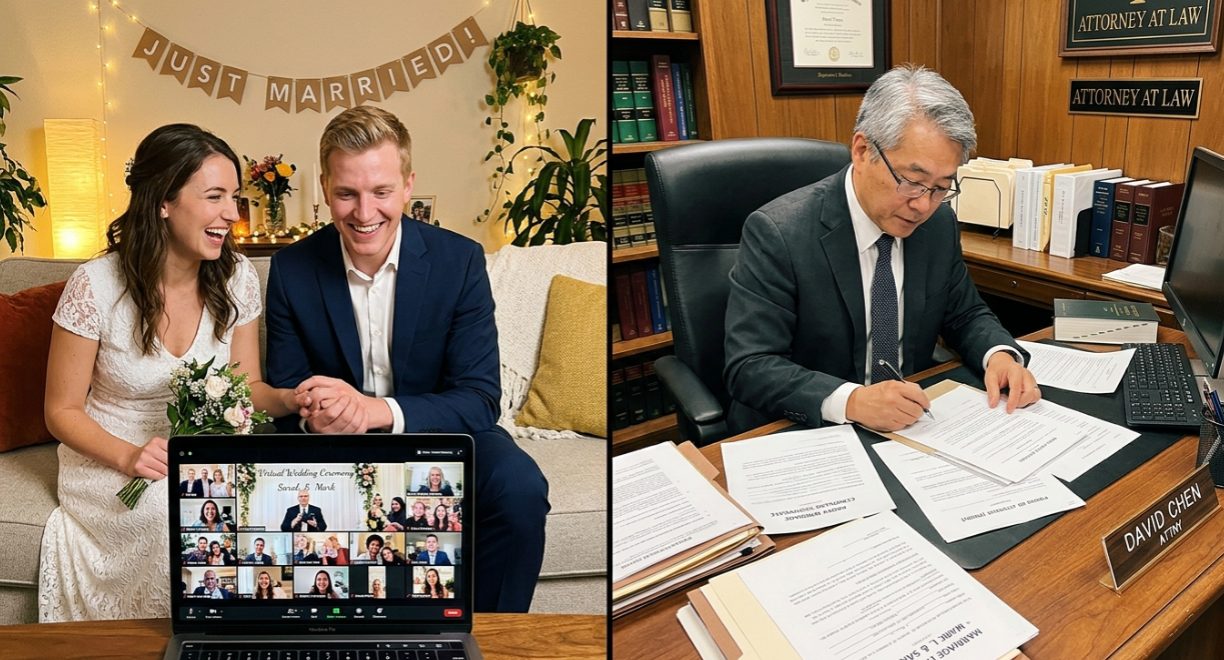
A marriage ceremony conducted via videoconference where both spouses participate live from different locations. Both parties give their own consent in real time, typically over platforms like Zoom. This is the type of marriage most people mean when they search “online marriage USCIS.”
Utah is the primary U.S. jurisdiction offering these ceremonies. Since the Utah County Clerk’s Office began providing online marriage licenses and ceremonies in January 2020, thousands of international couples have used the service. The marriage certificate issued is a standard Utah marriage certificate, identical in legal standing to one from an in-person ceremony.
For a full explanation of how the process works, see Courtly’s guide on what virtual marriage means legally and practically.
Proxy Marriage
A marriage where one or both spouses are physically absent from the ceremony and represented by a stand-in (a “proxy”). This is fundamentally different from a virtual marriage. In a proxy marriage, you do not participate directly. Someone else stands in your place.
Proxy marriages are legal in a handful of U.S. states, including Montana and Texas (by absence). USCIS recognizes them only if they were legally valid in the jurisdiction of celebration and subsequently consummated.
The distinction between proxy and virtual marriage matters enormously for immigration. USCIS views them differently, and many immigration attorneys report that proxy marriages attract more skepticism from officers than virtual marriages where both spouses were visibly present on video. For a thorough comparison, read about proxy vs. online wedding differences.
Online Marriage vs. Proxy Marriage for USCIS
Factor | Online Marriage | Proxy Marriage |
|---|---|---|
Both spouses participate | Yes | Not always |
Video participation | Yes | No |
Stand-in representative | No | Yes |
Requires consummation | Yes | Yes |
USCIS scrutiny | Moderate | Higher |
Most common jurisdiction | Utah | Montana |
Place-of-Celebration Rule
The USCIS doctrine stating that a marriage’s legal validity is determined by the laws of the jurisdiction where it was performed, not where the couple lives. This is the legal principle that makes online marriages work for immigration.
If Utah law recognizes your virtual marriage, USCIS recognizes it for immigration purposes, even if your home state or your spouse’s home country does not recognize online marriages. The USCIS Policy Manual explicitly confirms this: “a marriage is valid for immigration purposes in cases where the marriage is valid under the law of the jurisdiction in which it is performed.”
This principle also means that a state’s refusal to recognize virtual marriages does not affect validity if the marriage was lawfully celebrated in a jurisdiction that allows such ceremonies.
Consummation
The physical meeting and union of the married couple after the ceremony. This is the single biggest requirement couples overlook when planning an online marriage for USCIS purposes.
The INA states plainly: a person qualifies as a spouse only if both parties were present during the marriage ceremony, or the parties consummated the marriage following the ceremony if they were not present together. Since an online marriage by definition means the couple was not physically together during the ceremony, consummation is mandatory.
When must consummation happen? Before USCIS can recognize the marriage as valid. In practical terms, this means you should meet in person before filing your I-130 petition, or at minimum before your case is adjudicated. Filing without having met creates a vulnerability that can lead to an RFE or denial.
Immigration attorneys on LinkedIn emphasize that the consummation requirement is not about any narrow definition. It’s about proving the couple met physically after the ceremony. Travel records, boarding passes, hotel receipts, and photos from the visit are the standard evidence.
One particularly notable case from Reddit illustrates both the risk and the path forward: a user on r/USCIS reported their I-130 was denied because USCIS said their Utah marriage was not valid. The post was later updated to show the denial was overturned on appeal after the couple hired a lawyer and filed a 290B motion. The lesson: some USCIS officers still get the rules wrong, but proper evidence and legal counsel can win.
Evidence USCIS Wants for an Online Marriage
USCIS evaluates two separate questions:
Question 1: Is the marriage legally valid?
Evidence includes:
Marriage certificate
Marriage license
Utah County records
Question 2: Is the marriage genuine?
Evidence includes:
Evidence Type | Examples |
|---|---|
Travel evidence | Boarding passes, visas, passport stamps |
Photographs | Wedding screenshots and in-person photos |
Communication | Text messages, emails, call logs |
Financial records | Joint bank accounts and shared expenses |
Housing | Leases and utility bills |
Third-party evidence | Affidavits from family and friends |
Submitting evidence for only one category can trigger an RFE.
Marriage Certificate
The official government document proving a marriage took place. For online marriage USCIS cases, the certificate must be issued by the jurisdiction of celebration (typically Utah County, Utah). This certificate is what you submit with your I-130 petition. It is a standard marriage certificate, not marked as “virtual” or “online” in any special way.
If your spouse’s country requires the certificate for local registration, you’ll likely need an apostille or embassy authentication. Learn more about obtaining your online marriage license through Utah.
Solemnization
The formal ceremony that makes a marriage legally effective. In most U.S. states, solemnization requires the physical presence of the couple and an officiant. Utah is notable for permitting remote-appearance solemnization, meaning the officiant and the couple can all be in different locations during the ceremony. This legal provision is what makes Utah online marriages valid.
Document and Legalization Terms
Apostille
A form of international authentication for documents, governed by the Hague Apostille Convention. If your spouse’s country is a member of the Hague Convention, an apostille on your Utah marriage certificate makes it officially recognizable there. This is separate from USCIS requirements. You need an apostille for your spouse’s home country, not for USCIS itself.
Courtly offers document legalization services including apostille processing and expedited options for couples who need their certificate authenticated quickly. For a detailed explanation, see the guide on everything about apostilles.
Will My Country Recognize an Online Marriage?
USCIS recognition and foreign-country recognition are two different legal questions.
Organization | Recognition Standard |
|---|---|
USCIS | Place-of-celebration rule |
Foreign governments | Domestic family law |
Foreign embassies | Local registration requirements |
A marriage can be valid for U.S. immigration purposes while remaining unrecognized in a spouse's home country.
Always verify local marriage registration requirements before beginning the immigration process.
Embassy Authentication (Legalization)
For countries that are not members of the Hague Convention, a U.S. marriage certificate must go through embassy authentication (sometimes called “legalization”). This involves getting the document certified by the U.S. State Department and then authenticated by the foreign country’s embassy or consulate in the United States. The process takes longer and typically costs more than an apostille.
If you’re unsure whether your situation requires an apostille or embassy authentication, the comparison guide on apostille vs. authentication breaks down the differences.
Key Policy References
PA-2025-23 (USCIS Policy Alert, October 17, 2025)
The most important policy development for online marriage USCIS cases in recent years. Issued on October 17, 2025, this policy alert revised the USCIS Policy Manual to provide explicit guidance on virtual marriages in the context of I-130 spousal petitions.
Before this update, virtual marriages existed in a gray area. Individual officers made inconsistent decisions, as the Reddit denial case above illustrates. PA-2025-23 codified that virtual marriages are subject to the same requirements as all spousal cases, including the place-of-celebration rule and the consummation requirement.
The update also reaffirmed USCIS’s commitment to marriage equality, confirming that same-sex marriages are treated identically to opposite-sex marriages when legally valid in the place of celebration. Couples who married through an LGBTQ-inclusive online service can proceed with confidence that USCIS policy does not discriminate based on the gender of either spouse.
USCIS Policy Manual, Volume 6, Part B, Chapter 6
The specific chapter of the USCIS Policy Manual governing spousal petition standards. This is where adjudicators look when evaluating whether a marriage qualifies under the INA. It contains the consummation requirement language, the place-of-celebration rule application, and the evidentiary standards for bona fide marriages. Any immigration attorney representing an online marriage case should be citing this chapter.
Mandatory Interview Triggers
USCIS does not interview every spousal petitioner, but certain conditions trigger a mandatory interview. According to the October 2025 policy update, USCIS will conduct an interview when:
One or both spouses were under 15 at the time of marriage
One spouse was 16 or 17 and the other was at least 10 years older
The petitioner previously filed a spousal petition for a different person
An adverse decision or withdrawal was made on a prior spousal petition involving either party
Online marriages may face higher practical scrutiny beyond these formal triggers simply because the distance factor raises questions. Strong documentation from the outset is the best defense.
Same-Sex Marriage and USCIS
Same-sex online marriages receive identical treatment under USCIS policy. The place-of-celebration rule applies equally: if the marriage was valid where performed, USCIS recognizes it regardless of whether the couple’s home state or country recognizes same-sex unions. The PA-2025-23 update reinforced this explicitly.
This makes Utah online marriages particularly valuable for same-sex couples in countries where their marriage would be illegal locally. NPR reported that hundreds of Israeli couples used Utah’s online marriage system to obtain legal marriages that were later recognized by Israeli courts, because Israel has no civil marriage option domestically.
The Utah Factor
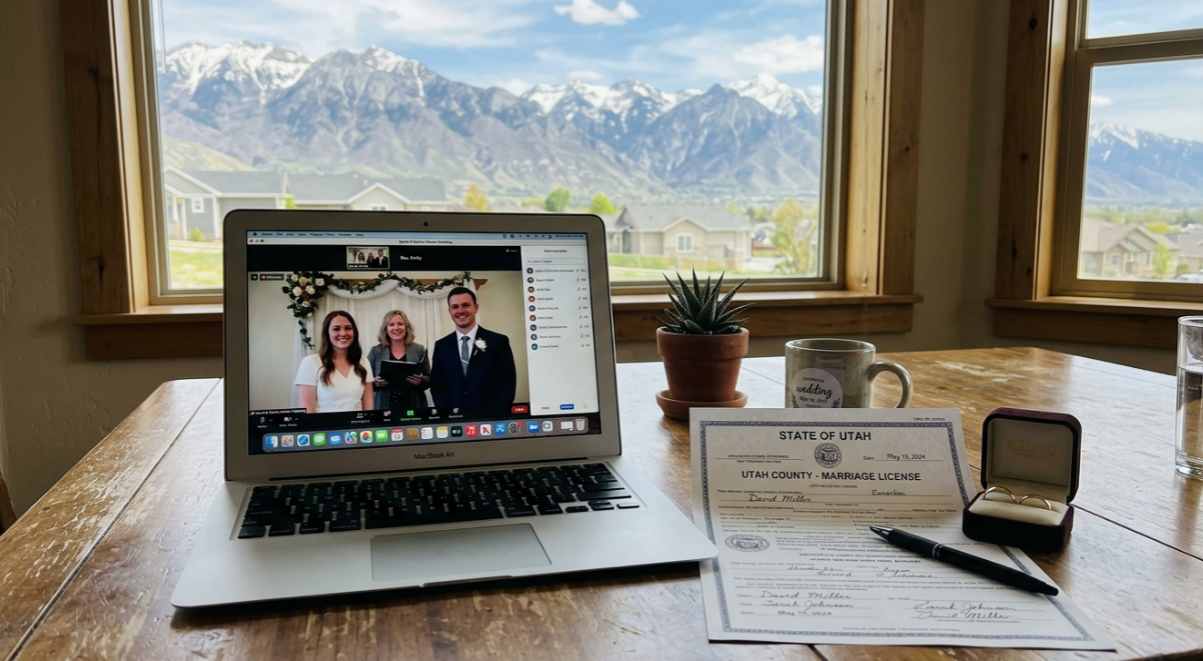
Utah is the primary venue for online marriages used in USCIS petitions. The Utah County Clerk’s Office began offering fully remote marriage licenses and ceremonies in January 2020, just before the pandemic accelerated demand. Utah law permits remote-appearance solemnization, meaning neither the couple nor the officiant needs to be physically present in the state.
The marriage certificate issued is a standard Utah County document. It carries the same legal weight as any in-person Utah marriage. For USCIS purposes under the place-of-celebration rule, the only question is whether the marriage was valid under Utah law, and it is.
For couples ready to start, review the Utah online marriage requirements to understand what documents and steps are involved.
Putting It All Together: The Online Marriage USCIS Pathway
Here’s how these terms connect in a typical case:
A U.S. citizen and their foreign-national partner complete an online marriage (virtual marriage) through Utah
They receive a marriage certificate from Utah County
They meet in person to fulfill the consummation requirement
The U.S. citizen files Form I-130 with USCIS, including bona fide marriage evidence
USCIS applies the place-of-celebration rule to confirm validity under Utah law
If the foreign spouse is abroad, the case moves to consular processing
The spouse receives either a CR-1 or IR-1 visa depending on the marriage’s age
If CR-1, the couple later files Form I-751 to remove conditions
At any point, USCIS may issue an RFE or NOID if evidence is insufficient. The 2025 policy update (PA-2025-23) means officers now have clear written guidance on virtual marriages, reducing (but not eliminating) inconsistent decisions.
Ready to get started? See Courtly’s plans and pricing for online marriage services that include certificate delivery, ceremony recording, and optional document legalization.
Online Marriage to Green Card Timeline (2026)
The timeline below illustrates a typical online marriage immigration case.
Stage | Typical Timeline |
|---|---|
Utah online marriage | 1–7 days |
Marriage certificate issuance | 1–3 weeks |
In-person meeting (consummation) | Varies |
Form I-130 filing | Immediately after evidence collection |
USCIS I-130 processing | 14+ months |
National Visa Center processing | 2–4 months |
Embassy interview | 1–6 months |
Green card approval | 18–24+ months |
Actual processing times vary by service center, country, embassy workload, and case complexity.
Frequently Asked Questions
Does USCIS accept online marriages for green card petitions?
Yes. As of the October 2025 policy update (PA-2025-23), USCIS explicitly addresses virtual marriages. An online marriage is valid for immigration purposes if it was legally performed in a jurisdiction that authorizes such ceremonies (like Utah) and the couple consummated the marriage afterward.
Do we need to meet in person after an online marriage for USCIS?
Yes. The INA requires consummation when the spouses were not physically present together during the ceremony. You should meet in person before filing your I-130 and keep evidence of the visit: travel records, photos, boarding passes, and hotel receipts.
Can I use a K-1 fiancé visa after an online marriage?
No. The K-1 visa is exclusively for unmarried fiancés. Once you are legally married (including through an online ceremony), the K-1 path is closed. You must pursue a CR-1 or IR-1 spouse visa instead.
What is the difference between an online marriage and a proxy marriage for USCIS?
In an online (virtual) marriage, both spouses participate live via video and give their own consent. In a proxy marriage, one or both spouses are represented by a stand-in. Both require consummation for USCIS recognition, but virtual marriages where both parties were visibly present tend to receive less scrutiny.
What happens if USCIS denies my I-130 based on an online marriage?
You can file a Motion to Reopen or Reconsider (Form I-290B). In a well-known case from Reddit’s r/USCIS community, a petitioner’s I-130 was denied because the officer incorrectly determined a Utah marriage was invalid. After hiring an attorney and filing a 290B appeal, the case was approved. Officer-level inconsistency still exists despite clear policy.
Do I need an apostille on my marriage certificate for USCIS?
Not for USCIS itself. USCIS accepts a standard marriage certificate from the issuing jurisdiction. However, you may need an apostille or embassy authentication if your spouse’s home country requires it for local registration or for the consular processing interview.
Are same-sex online marriages treated differently by USCIS?
No. USCIS treats same-sex marriages identically to opposite-sex marriages under the place-of-celebration rule. If the marriage was legal where performed, it is valid for immigration purposes regardless of either spouse’s country of residence.
How long does the I-130 take after an online marriage?
Standalone I-130 petitions currently average more than 14 months of processing time. The total timeline from online marriage to green card depends on additional steps like consular processing or adjustment of status, which can add several more months.
Let us handle the paperwork.
Getting married is complicated. Courtly simplifies the process and provides everything necessary to get married online, including providing a licensed officiant who can perform a remote ceremony.
Get Married

Get married online.
Getting married is complicated. Courtly simplifies the process and provides everything necessary to get married online.

