

Getting married online while waiting for a U.S. visa can change your immigration strategy. If you have a pending K-1 fiancé(e) case, do not assume the case will continue normally after marriage. For couples who marry remotely while physically apart, U.S. immigration generally requires the marriage to be consummated afterward before it can qualify as a spousal relationship. Online marriage does not speed up USCIS, NVC, or consular processing.
Can You Get Married Online While Waiting for a U.S. Visa?
Yes, but getting married online can affect your immigration strategy, especially if you have a pending K-1 fiancé(e) visa. A remote marriage may be legally valid where performed, but U.S. immigration generally does not treat a proxy marriage as a qualifying spousal relationship unless the marriage is consummated after the ceremony. If you have a pending K-1, get immigration advice before marrying online because marriage can change which visa category applies to your case.
Should You Get Married Online While Waiting for a Visa?
Your safest next step depends on which immigration process you currently have.
Your situation | What online marriage can mean | Recommended next step |
|---|---|---|
No visa petition filed yet | You may be able to marry and pursue a spouse visa | Confirm the marriage will qualify for U.S. immigration purposes, then consider Form I-130 |
K-1 not filed yet | Marriage generally changes the strategy from fiancé(e) to spouse | Compare the K-1 and CR-1/IR-1 routes before marrying |
K-1 petition pending | Marriage can create a serious case-management issue | Speak with an immigration attorney before marrying online |
K-1 approved but visa not issued | Do not assume the K-1 can continue normally after marriage | Get case-specific legal advice before marrying |
Married online while physically apart | The marriage may be treated as a proxy marriage for immigration purposes | Meet in person after the ceremony and document the meeting before relying on the marriage for a spouse petition |
Married online and already met afterward | The marriage may be usable for U.S. immigration purposes if all other requirements are satisfied | Preserve evidence of the post-ceremony meeting and bona fide relationship |
Already pursuing an I-130 spouse case | Online marriage does not speed USCIS, NVC, or consular processing | Continue the existing process and monitor official processing updates |
What Does “Online Marriage While Waiting for a Visa” Mean?
“Online marriage while waiting for a visa” describes a situation where a couple legally marries through a remote or virtual ceremony while one partner is outside the country and an immigration case is pending or has not yet been filed.
The phrase is not an official U.S. immigration category. The important questions are:
Was the marriage legally valid where it was performed?
Were both spouses physically present during the ceremony?
If not, was the marriage consummated afterward?
Which visa or immigration petition is pending?
Which country will evaluate the marriage?
Can the couple document a bona fide marital relationship?
Those questions determine whether the online marriage is simply a legal marriage, a qualifying marriage for U.S. immigration purposes, or a potential complication for an existing visa case.
Get married online through Courtly if you’ve already confirmed an online marriage fits your immigration plan.
The 3 Timelines You Must Keep Separate
Most confusion about getting married online while waiting for a visa comes from mixing up three timelines that run independently of each other.
Timeline | What it controls | What online marriage changes |
|---|---|---|
Marriage validity | Whether you are legally married | May establish a legal marriage under the law where performed |
Immigration recognition | Whether U.S. immigration treats the marriage as qualifying | Proxy-marriage rules may apply |
Visa processing | How quickly the government processes the case | Does not automatically speed processing |
Clock 1: The Marriage Clock
This is when a jurisdiction says you are legally married. For a Utah remote appearance ceremony, that happens when the couple has a valid marriage license, each party declares intent to marry, a certified officiant pronounces them married, and at least two adult witnesses observe the declarations. Utah County confirms that remote appearance ceremonies hosted by someone in Utah are legal under Utah law, while noting that acceptance by foreign governments or immigration officials is outside the county’s control.
A Utah marriage license must be used within 32 days. For details on how the license step works, see Courtly’s online marriage license page.
Clock 2: The Immigration Recognition Clock
This is when USCIS or the Department of State treats the couple as spouses for immigration purposes. A marriage certificate starts this clock, but it may not be enough on its own.
If the spouses were not physically together during the ceremony, U.S. immigration treats the marriage under proxy marriage rules. The State Department’s Foreign Affairs Manual states that a proxy marriage is not valid for visa purposes unless consummated after the ceremony. A proxy marriage consummated after the ceremony is treated as valid from the date of the proxy ceremony. One consummated only before the ceremony does not count.
In practical terms: couples who marry online while in different locations need to meet in person after the ceremony before the marriage can support a spouse visa petition. For a detailed explanation of how this requirement works, see our consummation and immigration guide.
Clock 3: The Visa Processing Clock
This is government processing time, and no ceremony controls it. After filing an I-130 petition, the case moves from USCIS to the National Visa Center, then to a consular interview. Each stage has its own backlog.
Getting married online may let a couple start the spouse visa process sooner. It does not make the government process the case faster.
Does USCIS Recognize Online Marriage?
Sometimes. There is no blanket yes or no.
U.S. immigration follows a “place of celebration” rule. If the marriage is legally valid where it was performed, it can generally be recognized for immigration purposes. Utah remote appearance ceremonies are legal under Utah law. That satisfies the first requirement.
The second requirement is where things get complicated. When both spouses were not physically present at the ceremony, USCIS and the State Department apply proxy marriage analysis. The immigration question becomes: was the marriage consummated after the ceremony? If yes, spouse status is created. If no, the marriage does not yet support a spouse visa petition (though the person may still be processable as a fiancé(e) in some circumstances).
For same-sex couples: The State Department confirms that same-sex spouses of U.S. citizens are eligible for the same benefits as opposite-sex spouses. A same-sex marriage valid in its place of celebration is recognized even if the applicant lives in a country where same-sex marriage is illegal. The same proxy and bona fide evidence rules still apply. Courtly’s LGBTQ+ marriage page covers additional considerations for these couples.
Think of the marriage certificate as the starting document, not the finish line.
See Courtly’s pricing to understand what each ceremony package includes.
Is Every Online Marriage a Proxy Marriage?
No. The key issue is not simply whether the ceremony happened online. The important question is whether the spouses were physically present together during the marriage ceremony.
For U.S. immigration purposes, a marriage ceremony in which the parties were not physically present together can fall under the rules for proxy marriages. Under those rules, the marriage generally must be consummated after the ceremony before it qualifies as a spousal relationship for immigration purposes.
Therefore, “online marriage” and “proxy marriage” should not automatically be treated as identical terms. The specific ceremony format, location of each spouse, and applicable law matter.
The K-1 Trap: Do Not Marry Online During a Fiancé Visa Process
This is the most dangerous mistake couples make when considering online marriage while waiting for a visa.
The K-1 fiancé visa exists for one purpose: bringing a foreign fiancé(e) to the United States to marry within 90 days of arrival. USCIS materials state that both parties must be legally free to marry and intend to marry within 90 days of the foreign national’s admission. The K-1 admission period cannot be extended.
If a couple marries online during a pending K-1 case, the legal status shifts. They are no longer fiancé(e)s. But if the online marriage is unconsummated because they have not met in person after the ceremony, they may not qualify as spouses for immigration purposes either.
Users on VisaJourney describe this exact confusion. One thread debates whether an unconsummated online marriage voids K-1 eligibility or creates a usable spouse relationship. The practical answer is neither, cleanly. Practitioners on immigration forums consistently warn that mixing an online marriage with a pending K-1 creates a “too married for fiancé, not married enough for spouse” trap that can stall a case for months.
For a side-by-side comparison of the two visa paths, read our breakdown of K-1 vs. CR-1 timing.
Bottom line: If you already filed a K-1, talk to an immigration attorney before getting married online. You may need to withdraw the petition, wait, and file a spouse petition instead.
What Happens If You Marry Online During a Pending K-1?
If you already have a K-1 case, do not treat an online wedding as a harmless administrative change. The K-1 is designed for a U.S. citizen to bring a fiancé(e) to the United States to marry after admission, generally within 90 days. USCIS requires the parties to be free to marry and intend to marry within that period.
The practical decision tree is:
K-1 pending → considering online marriage
Have you already married?
No: Do not marry online until you understand how it could affect the pending K-1.
Yes: Determine whether the marriage is legally valid and whether it qualifies as a marriage for U.S. immigration purposes.
Married online while physically apart: Determine whether the proxy-marriage rules apply and whether the marriage has been consummated afterward.
Marriage qualifies as a spousal relationship: The immigration strategy may need to shift from the K-1 route to a spouse-based process.
Marriage does not yet qualify as a spousal relationship: Do not assume the K-1 automatically continues. Obtain case-specific legal advice before taking further action.
The important point is that there is no universal “online marriage fixes the K-1” or “online marriage automatically cancels the K-1” rule that can safely be applied to every case.
K-1 vs. CR-1/IR-1 After an Online Marriage
Factor | K-1 Fiancé(e) Visa | CR-1/IR-1 Spouse Visa |
|---|---|---|
Relationship | Unmarried fiancé(e) | Legally married spouse |
Main petition | Form I-129F | Form I-130 |
Marriage timing | Marriage generally occurs after K-1 admission | Marriage occurs before the immigrant visa process |
Can an online marriage affect eligibility? | Yes, potentially | Yes, especially if proxy-marriage rules apply |
Main immigration purpose | Bring fiancé(e) to the U.S. to marry | Bring an eligible spouse to the U.S. as an immigrant |
Permanent residence | Adjustment of status after marriage | Immigrant visa leads to permanent residence upon admission |
Best question to ask | “Are we still eligible to marry after admission?” | “Does our existing marriage qualify for immigration purposes?” |
The right choice depends on the facts of the case, not simply which route appears faster.
Can Online Marriage Help You File a CR-1 or IR-1 Spouse Visa?
Yes, but only if it creates a qualifying marriage relationship under immigration law.
U.S. citizens bring foreign spouses to the United States through the IR-1 or CR-1 immigrant visa route using Form I-130. The difference between them is timing. If the marriage is less than two years old when the foreign spouse enters on the immigrant visa, the spouse generally receives conditional permanent residence (CR-1). If married two years or more at entry, the green card is typically valid for ten years (IR-1).
For couples who married online while in different locations, there is an extra step before filing: meeting in person after the ceremony and documenting it thoroughly.
Before Filing an I-130 After an Online Marriage
Before filing Form I-130, confirm these five points:
The marriage is legally valid. Confirm that the ceremony complied with the law of the place where the marriage was performed.
The physical-presence issue is resolved. If the spouses were not physically together during the ceremony, determine whether the marriage is subject to U.S. proxy-marriage rules.
The post-ceremony meeting is documented. Keep travel records, passport stamps, hotel records, photographs, and other evidence showing when and where the spouses met after the ceremony.
The relationship is bona fide. Gather evidence showing that the marriage is genuine rather than entered into primarily for immigration benefits.
The filing strategy matches the current relationship status. If a K-1 petition is pending, do not assume an I-130 can simply be added without addressing the existing case.
Evidence You Should Gather Before Filing
USCIS I-130 instructions list what counts as bona fide marriage evidence: joint property, shared lease agreements, combined financial accounts, children’s birth certificates, affidavits from people with personal knowledge of the relationship, and other proof of an ongoing marital union.
For couples who married online while waiting for a visa, the post-ceremony meeting proof is equally critical. Collect:
Passport stamps showing travel to the same location after the wedding
Flight itineraries and boarding passes
Hotel or rental receipts placing both spouses in the same city
Dated photos together after the ceremony
A written timeline of the relationship
Communication logs (call records, chat histories)
Our immigration evidence checklist covers what to collect and how to organize it before filing.
How Long After an Online Marriage Can You File I-130?
There is no general waiting period simply because a marriage was performed online. The important issue is whether the marriage qualifies as a marriage for U.S. immigration purposes at the time of filing.
If the spouses were physically together during the ceremony and the marriage is otherwise valid, the analysis is different from a ceremony where the spouses were in separate locations. When the spouses were not physically present together, U.S. immigration's proxy-marriage rules can require consummation after the ceremony before the relationship qualifies as a spousal relationship.
For that reason, couples should not use the wedding date alone as their filing trigger. Confirm the marriage's immigration eligibility, document any required post-ceremony meeting, and then prepare the I-130 evidence.
The RFE Risk Is Real
Practitioners on Reddit report receiving Requests for Evidence (RFEs) specifically asking for proof that the couple met in person between the online marriage date and the I-130 filing date. One user described marrying online in December 2021 and receiving an RFE years later, in March 2025, asking for exactly this documentation.
Other community members on r/immigration repeat the same practical rule: meet in person after the ceremony, save every receipt and photo, then file. The couples who skip this step are the ones who face delays. This is the strongest operational insight that mainstream immigration guides tend to miss. The failure point is not the certificate itself. It is the gap between the ceremony and the post-wedding meeting.
Can Your Spouse Visit While Waiting for the Visa?
This is one of the most common side questions when couples are dealing with online marriage and visa waiting periods. The short answer: sometimes, but never guaranteed.
A foreign spouse may qualify for B-2 visitor classification for a temporary visit. The State Department’s Foreign Affairs Manual confirms that a spouse of a U.S. citizen may receive B-2 classification if the purpose of the visit is genuinely temporary.
The challenge is immigrant intent. Under INA 214(b), a visitor must demonstrate strong ties abroad that will compel them to leave after a short stay. A pending I-130 signals the opposite. Boundless, a popular immigration resource, notes that visiting during a pending case is possible but invites extra scrutiny at the port of entry.
If your spouse has a job, lease, school enrollment, or family responsibilities abroad, those documents can help demonstrate temporary intent. If they sold everything and packed to move, a temporary visitor claim becomes much harder to support. Never misrepresent marital status or the purpose of travel.
How Long Will the Visa Wait Be After Online Marriage?
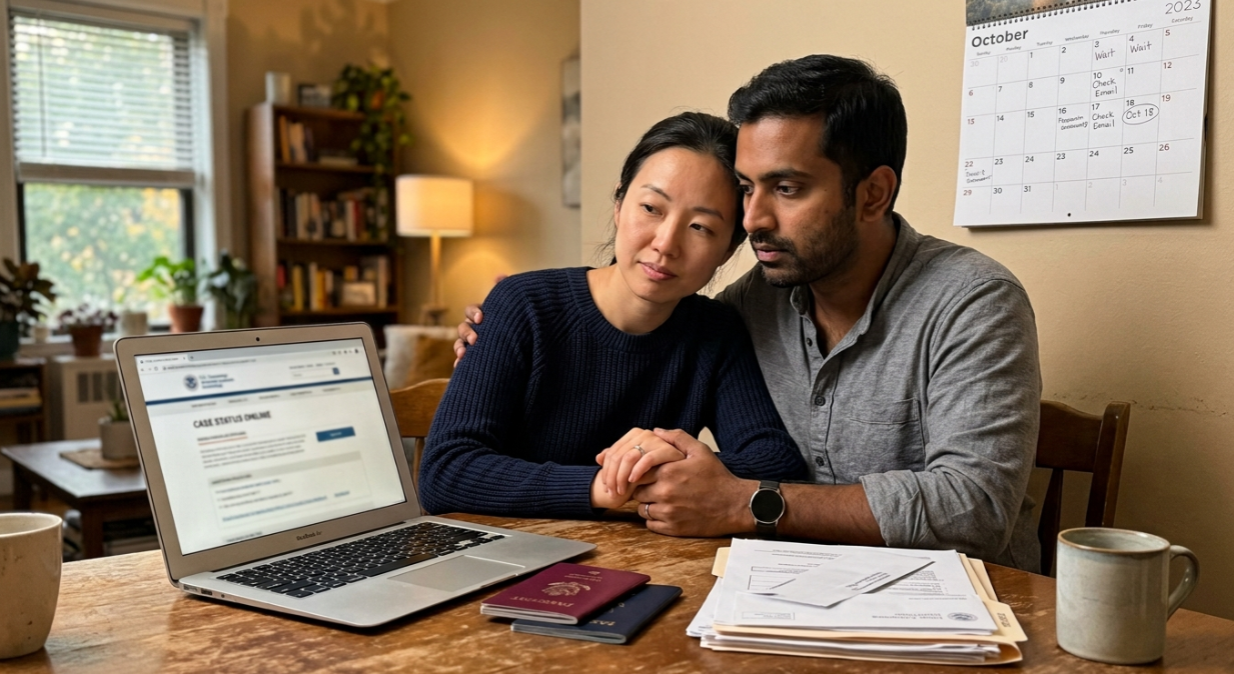
Marrying online while waiting for a visa does not come with a timeline shortcut. This is worth repeating because it is the most common misconception.
After filing I-130, the case enters a pipeline:
USCIS petition review (varies by service center and category)
NVC case creation and document review (NVC publishes weekly processing timeframes)
Consular interview (varies by embassy, often weeks to months)
Visa issuance and travel
For spouses of lawful permanent residents in the F2A category, the monthly Visa Bulletin adds another variable. Unlike immediate relatives of U.S. citizens, F2A cases are subject to numerical limits that can shift from month to month.
The honest answer: an online marriage waiting for a visa process may let a couple become legally married sooner and start the spouse visa path once immigration requirements are met. It does not accelerate USCIS approval, NVC review, embassy scheduling, or visa issuance. Check current processing times directly, because static estimates in any article (including this one) go stale quickly.
Does Every Country Accept Online Marriage for Visas?
No. This matters more than most guides acknowledge.
Canada is the most important exception. Immigration, Refugees and Citizenship Canada (IRCC) states that it does not recognize proxy marriages conducted by telephone, internet, or fax if one or both parties were not physically present at the ceremony. Narrow exceptions exist for applications received before June 10, 2015, and certain Canadian Armed Forces cases, but the general rule is firm.
Practitioners on Reddit’s r/ImmigrationCanada regularly discuss this gap. Couples who follow U.S.-focused advice about online marriage and then try to sponsor through Canadian immigration discover the rules are fundamentally different. This catches people off guard.
Other countries have their own frameworks. Courtly publishes country-specific recognition guidance to help couples check before committing to a path.
The rule of thumb: U.S. rules are not global rules. A marriage useful for one country’s immigration pathway may not be accepted by another.
Apostille and Document Legalization: What They Do and Don’t Do
Many couples pursuing online marriage while waiting for a visa assume an apostille makes everything work internationally. Not quite.
An apostille or certificate of authentication verifies a document’s origin for foreign use. For Hague Convention countries, it functions as an apostille. For non-Hague countries, a separate embassy authentication may be needed.
What an apostille does: confirms the document was officially issued by the stated authority. What it does not do: validate the contents of the document or guarantee that any foreign government will accept the underlying marriage for its own purposes.
If you need a U.S. marriage certificate prepared for use abroad, Courtly offers apostille and authentication services as add-ons. Always check destination-country requirements first.
Common Mistakes to Avoid
1. Filing I-130 before the post-ceremony meeting. If the online marriage is treated as a proxy marriage because the spouses were in different locations, official guidance requires post-ceremony consummation before the marriage creates spouse status. Community reports consistently show RFEs when the timing is unclear.
2. Assuming a K-1 continues normally after marrying online. K-1 eligibility depends on being fiancé(e)s who are free to marry and intend to marry after admission. An online marriage changes that legal posture entirely.
3. Thinking apostille equals visa acceptance. An apostille verifies document origin. It does not force recognition by any immigration agency.
4. Applying U.S. online marriage advice to Canadian immigration. Canada generally does not recognize internet or proxy marriages for immigration sponsorship.
5. Under-documenting a real long-distance marriage. USCIS expects evidence beyond the certificate: joint finances, communication logs, travel records, photos, affidavits. Couples who treat the certificate as the only proof leave themselves exposed to RFEs and delays.
For a broader look at what trips couples up, see our guide on common online marriage pitfalls.
When to Talk to an Immigration Attorney
Some situations are straightforward. Others are not. Get legal advice when:
A K-1 is pending or already approved
You married online while in different countries and have not met in person since
A prior I-130 was denied or an RFE was issued
The case involves Canada or another country that may reject online marriages
One partner lives in a country where same-sex marriage is illegal
The case involves prior marriages, divorces, removal proceedings, or suspected misrepresentation
Immigration practitioners on LinkedIn have noted that USCIS’s 2025 spousal petition guidance has changed how attorneys analyze virtual and proxy marriages. The discussion around place-of-celebration rules, consummation evidence, and online religious ceremonies (such as Nikah) has become more detailed, not less. Getting professional guidance early can prevent costly mistakes.
Book a spouse visa consultation through Courtly’s partner attorneys if your online marriage is connected to an immigration case.
Frequently Asked Questions
Is online marriage the same as a spouse visa?
No. Online marriage is a way to get legally married. A spouse visa is an immigration process requiring proof of a qualifying relationship, a genuine marriage, and specific forms and evidence. The two are related but legally separate steps.
Can we file I-130 right after an online wedding?
Only if the marriage already qualifies for U.S. immigration purposes. If the ceremony happened while the spouses were in different locations, consummation after the ceremony is required before it creates spouse status. Meet in person first, document everything, then file.
What proof shows we met after an online marriage?
Passport stamps, flight records, hotel bookings, photos together after the wedding, receipts placing both spouses in the same city, affidavits, and records showing shared travel or cohabitation. USCIS separately expects bona fide evidence like joint finances, lease agreements, and communication records.
Can we marry online while a K-1 fiancé visa is pending?
This requires attorney review. The K-1 is for fiancé(e)s who will marry within 90 days of arrival, and both parties must remain legally free to marry. An online marriage can put the entire case in limbo between fiancé and spouse classification.
Can my spouse visit the U.S. while waiting for a CR-1 or IR-1?
Possibly, but admission is never guaranteed. A B-2 visitor must show temporary intent and overcome concerns about immigrant intent. A pending I-130 invites extra scrutiny. Carry evidence of ties abroad and keep the visit short.
Does an apostille make an online marriage accepted everywhere?
No. An apostille verifies that a document is officially issued. It does not guarantee acceptance by a foreign government or immigration agency for its own legal purposes.
Does Canada accept online marriages for immigration?
Generally, no. IRCC does not recognize proxy, telephone, internet, or fax marriages when one or both parties were not physically present, with narrow exceptions for pre-2015 applications and Canadian Armed Forces cases.
Are same-sex online marriages recognized for U.S. immigration?
Yes, under the same rules as opposite-sex marriages. Same-sex marriages valid in their place of celebration are recognized by U.S. immigration, but the couple must still satisfy proxy and consummation requirements and provide bona fide evidence of a genuine relationship.
Let us handle the paperwork.
Getting married is complicated. Courtly simplifies the process and provides everything necessary to get married online, including providing a licensed officiant who can perform a remote ceremony.
Get Married

Get married online.
Getting married is complicated. Courtly simplifies the process and provides everything necessary to get married online.

